What's inside
- Key Takeaways
- Quick Picks
- How Were These Large Desks Chosen?
- What Does a Large Desk Actually Change?
- Straight, L-Shaped or Two-Person: Reading the Geometries
- How Do the Six Compare Side by Side?
- How Should You Choose a Large Desk Without Wasting the Wall?
- Lighting and Power Across a Very Long Surface
- One Large Desk or a Desk Plus a Table?
- The Second Life of a Large Desk
- Chairs, Floors and the Space Behind a Large Desk
- Common Mistakes When Buying a Large Desk
- Frequently Asked Questions
- Final Recommendation
- Related Guides
As an Amazon Associate I earn from qualifying purchases. This post may contain affiliate links at no extra cost to you.
widgetverdict.com is reader-supported. When you buy through links on our site, we may earn an affiliate commission.
Where to buy: Amazon carries all six of these large desks, and the list opens naturally with the PRAISUN 71 Inch Large Office Desk, whose listing packs power outlets, a thicker desktop and USB-C ports into its 71 inches. The best large desks are bought when a setup outgrows ordinary furniture — multiple monitors, a tower, reference materials, a second person’s elbows — and the defining fact of this category is that size stops being a luxury and becomes the working condition. Every pick here is at least 63 inches long, and the largest runs to 109 inches of L-shaped estate.
Large desks divide by how they spend their size. The straight desks — PRAISUN, Huuger 70 and the VIVO standing desk — lay their length along one wall in a single working line. The two-person Tribesigns spends its 78.74 inches on two workstations sharing one frame. The L-shaped pair — the SEDETA at 109 inches and the Huuger 63 — turn corners into command centres, wrapping the worker in surface on two sides. Each geometry suits a different room and a different working life, and the reviews are blunt about which rooms each one will overwhelm.
The honest warning for this category is logistical. Large desks arrive in large packages, sometimes several; they claim whole walls; they reorganise the rooms they enter. The tape measure is not a formality here — wall length, door swing, stair turn and the chair’s retreat all need numbers before the courier is booked. Readers whose rooms cannot take these dimensions will find the same makers working smaller in our Best College Desks guide, where the tape measure is kinder.
Key Takeaways
- Lengths run from 63 inches to the SEDETA’s 109-inch L-shaped total — measure the wall and the route in.
- Power is built into three picks: the PRAISUN with USB-C ports, the SEDETA and the Huuger L, both with outlets.
- The VIVO is the only standing desk here — 71 x 30 inches, 220 lbs capacity, 4 memory presets, single motor.
- Desktop thickness is a stated feature twice: the PRAISUN’s 25mm top and the Huuger L’s 0.95-inch top.
- The Tribesigns seats two people along 78.74 inches with a monitor stand and storage shelves.
Quick Picks
| Pick | Badge | Why it earns its place |
|---|---|---|
| PRAISUN 71 Inch Large Office Desk | The powered executive | 71 inches, 25mm thicker desktop, power outlets with USB-C ports, sturdy metal frame. |
| Huuger 70 Inch Office Desk | The long simple line | 70 inches with storage, large legroom and a metal frame, in black. |
| Tribesigns Two Person Desk with Monitor Stand | The double workstation | 78.74 inches for two people, with a monitor stand and storage shelves, in rustic brown. |
| VIVO 71 x 30 Inch Electric Standing Desk | The rising expanse | 71 x 30 inches, electric, 220 lbs capacity, 3-piece top and 4 memory presets. |
| SEDETA 109 Inch L Shaped Gaming Desk | The corner estate | 109 inches of L-shape with 4 drawers, a display cabinet, 2 monitor stands, LED and power. |
| Huuger 63 Inch L Shaped Desk with Power Outlets | The thick-topped corner | 63-inch reversible L with power outlets and a 0.95-inch thicker desktop, in rustic brown. |
How Were These Large Desks Chosen?
Length was the entry ticket — nothing under 63 inches was considered — but length alone did not make the six. Each pick had to spend its size on something the buyer can name: power at the surface, a second workstation, height adjustment, a corner’s zoning, or a thicker top that turns length into substance. Large desks that are merely long, with the same features as their smaller siblings stretched thinner, were passed over; at this scale, a desk must justify the wall it consumes.
Published figures did the sorting wherever they exist. The VIVO states its capacity and presets; the PRAISUN states its desktop thickness and its 31.5-inch width; the Tribesigns and SEDETA state their lengths to the decimal. Where a title is silent — on the Huuger 70’s storage specifics, on capacities for most of the list — the review flags the silence and leaves the checking to the product page, because a buyer committing a whole wall deserves to know which numbers are promises and which are homework.
We also weighed the delivery as part of the product. A 71-inch top that ships in three pieces, as the VIVO’s does, is a different ownership experience from a single slab, and a 109-inch L is a project with a date attached. Assembly, package counts and reversibility are treated in the reviews as first-order facts. Buyers whose priority is depth rather than length should read our Best Deep Desks guide alongside this one — the two categories overlap at the VIVO’s 30 inches of depth, and the right axis depends on the room.
Guests notice it too, which is a social fact worth one sentence: a large desk makes a home office read as a workplace rather than a hobby, and for the freelancer whose clients visit, the consultant whose calls are video, and the small business run from a spare room, that reading has a cash value no specification captures. The PRAISUN’s executive framing and the LITTLE TREE class of furniture elsewhere in this series of desk guides both trade on it knowingly.
What Does a Large Desk Actually Change?
It changes the number of things that can be true at once. On an ordinary desk, the second monitor evicts the notebook, the printer evicts the reference books, and the setup is a zero-sum negotiation renewed daily. On a 70-inch surface, the screens, the paper, the printer and the project coexist in zones, and the worker moves between them instead of rearranging them. That coexistence is the entire luxury: not space for its own sake, but the end of the daily clear-up before work can start.
It changes the room, too, and not always gently. A large desk is a room’s second-largest object after the bed or the sofa, and it sets the room’s terms — where the chair lives, where the light falls, what the door may swing into. Rooms with a large desk become studies that contain other furniture; rooms without one remain flexible. Buyers should choose that transformation deliberately, because reversing it means selling a 71-inch desk, which is its own project.
And it changes the setup’s future. Large desks absorb growth — the third screen, the second machine, the hobby that becomes a job — without replacement, which is why this category is where serious home offices eventually land. The desk bought one size too large in the first year is the desk still serving in the fifth; the desk bought exactly to size is a classified advertisement waiting for its photograph.
There is a hybrid worth mentioning for rooms that cannot decide: a straight desk with a return improvised by a side table or a filing pedestal at its end. It lacks the L’s single-plane elegance, and the height match is never perfect, but it lets a room grow into the corner format across two purchases. Buyers unsure whether the corner life suits them can stage it this way for a season; the Huuger L will still be there when the experiment concludes, and it concludes, in most rooms, in the L’s favour.
Straight, L-Shaped or Two-Person: Reading the Geometries
The straight desks suit the long wall and the single worker whose setup spreads in a line: screens centred, peripherals flanking, storage at the ends. They are the simplest to place, the simplest to light, and the easiest to share a room with, because their depth is uniform and their footprint predictable. The PRAISUN and Huuger 70 are the fixed versions; the VIVO adds the standing dimension to the same honest line.
The L-shapes suit corners and zoned lives. One arm faces forward for the screen work; the return holds the second activity — paperwork, a second machine, the making and mending of things. The SEDETA’s 109 inches is the maximal version, a desk that wraps its owner; the Huuger 63 is the same idea at a scale ordinary corners accept, and its reversibility lets the return follow the room rather than the catalogue.
The two-person desk suits the household whose work is genuinely doubled. The Tribesigns’ 78.74 inches is two real stations, not one desk with two chairs squeezed at it, and the monitor stand and shelves divide the territory visibly. Couples, siblings and partners in a small business are its constituency; solo workers should note that a two-person desk is also, simply, a very large one-person desk with a spare half for projects — a legitimate purchase, made knowingly.

PRAISUN 71 Inch Large Office Desk — The powered executive
The PRAISUN leads this guide because its listing answers the large-desk questions in the right order: 71 inches of length, a 25mm thicker desktop, power outlets with USB-C ports, a sturdy metal frame, and a stated width of 31.5 inches — which makes this not just a long desk but a deep one, a member of two categories at once. The thicker top is the specification that matters most at this length: a 71-inch span lives or dies by its resistance to sag and drum, and a maker who publishes the top’s thickness is thinking about the right problem.
USB-C at the desk is the modern detail. The laptop that charges by it, the phone that fast-charges by it, the tablet — all plug into the surface instead of hunting the wall, and at 71 inches the wall may be a genuine journey from the chair. The executive framing is earned: this is a desk for a home office that hosts a business, with the rustic brown finish warming a surface that could otherwise read as industrial.
The listing publishes no load capacity and no storage, so the spec discipline is familiar: confirm the figure on the product page if monitor arms will concentrate weight, and plan separate storage for paper. What is published — size in both dimensions, thickness, power — is more than most of this list offers, and it is the information a buyer committing a wall actually needs first.
For the single worker with a long wall, a multi-screen setup and devices that charge all day, the PRAISUN is the complete fixed answer: length, depth, substance and power in one rectangle.
- Surface: 71 inches long, 31.5 inches wide
- Desktop: 25mm thicker top per the listing
- Power: outlets with USB-C ports built in
- Frame: sturdy metal frame; finish rustic brown
- Load capacity: no figure appears in the listing title — the manufacturer’s own documentation is where to confirm it
The PRAISUN also understands the executive desk’s second job: it is the room’s backdrop. On calls and in client visits, 71 inches of rustic brown with a tidy powered surface reads as an established business, and the depth lets the camera sit at a flattering distance with the working mess zoned behind the screens, out of frame. Large desks are furniture in the theatrical sense, and this one plays the part without costume.
One more PRAISUN consideration: at 31.5 inches wide, the desk gives a camera-and-microphone setup its geography — the camera at the back row’s distance, the microphone clear of the keyboard’s parish, the notes in the middle band. Creators and consultants whose office is also a studio will find the depth quietly doing production work that narrower executive desks make into a daily negotiation.
Strengths
- Length and genuine depth in one desk — 71 by 31.5 inches.
- A published thicker desktop answers the long span’s sag question.
- USB-C power at the surface serves the modern device pile.
Trade-offs
- No storage is built into the design.
- Capacity is unpublished in the title; arm users must check.
- Seventy-one inches claims the whole wall, permanently.
Best for: a home-office executive setup with several screens and hungry devices.
Not suited for: a room whose longest wall is already spoken for by a sofa or a bed.
See the PRAISUN 71-inch desk on Amazon if the wall is long and the devices are many.

Huuger 70 Inch Office Desk — The long simple line
The Huuger 70 is the PRAISUN’s plainer sibling in spirit: 70 inches of office desk with storage, large legroom and a metal frame, in black, described in the listing’s own words as a long simple desk. Simple is the selling point. At 70 inches, a desk’s complications multiply — and this design declines most of them, offering length, legroom and some storage in a black rectangle that disappears behind the setup it hosts.
Large legroom at this length is a two-person feature in waiting: a 70-inch desk with an open frame beneath can seat a second chair for the pairing session, the homework supervision, the occasional shared project, without either sitter negotiating with a drawer bank. The black finish serves the same invisibility — the desk as stage, not performer. The listing names gaming, writing, study and work among its uses, and a plain 70-inch surface genuinely serves all four identically, which is the virtue of having no theme.
The title’s vagueness is the cost: the storage is named but not specified, and neither capacity nor depth is published, so the product page carries real homework for once — what the storage consists of, how deep the top runs, what the frame is rated to hold. Buyers should do that reading before the wall is promised. What the title does establish — length, frame, legroom, finish — is the skeleton of a sound purchase, and Huuger’s repeated presence across these desk guides suggests a maker whose desks are bought in volume and answered for.
For the worker who wants the length without the lit, themed or motorised complications — a home office that must also be a spare room by night — the Huuger 70 is the list’s quiet answer.
- Length: 70 inches
- Frame: metal
- Legroom: described as large in the listing
- Storage: included, form not specified in the title
- Depth and capacity: not published in the listing title — check the manufacturer’s documentation for both
There is a tenancy argument for the Huuger 70’s plainness: a black 70-inch rectangle is the easiest large desk to sell on, hand on or re-purpose when the room’s life changes — it becomes the craft table, the studio bench, the second household’s first desk without a negotiation about themes. Large furniture that can leave gracefully is large furniture that can be bought without fear.
The Huuger 70’s open legroom has a storage corollary: the space beneath a long desk with no drawer bank accepts the rolling pedestal, the tower on its stand, the archive boxes — furniture the owner chooses rather than furniture the desk imposed. At 70 inches, that under-desk parish is a room within the room, and an open frame is what keeps it usable.
Strengths
- Seventy inches of un-themed, multi-purpose surface.
- Open legroom seats a second chair when life requires it.
- Black simplicity disappears behind the setup.
Trade-offs
- The storage’s form must be discovered on the product page.
- No power outlets are claimed.
- Depth is unpublished; deep-desk seekers should verify.
Best for: a long wall needing one plain, generous, unthemed work surface.
Not suited for: a specification-first purchase, since the homework sits on the product page.
Look at the Huuger 70-inch desk on Amazon when length matters and themes do not.

Tribesigns Two Person Desk with Monitor Stand — The double workstation
The Tribesigns spends its 78.74 inches on the honest version of sharing: two workstations along one frame, with a monitor stand raising the screen line and storage shelves taking the overflow, in rustic brown. The monitor stand is the design’s diplomat — a shared raised shelf lets both stations’ screens sit at one considered height, and the surface beneath becomes the border territory where keyboards retreat and notebooks advance, negotiated daily without conflict.
Seventy-eight inches divides into two 39-inch stations, each the size of a respectable solo desk, and that arithmetic is the whole case for the design over two separate desks: one frame, one delivery, one wall, and a shared shelf-and-stand infrastructure that two solo desks would duplicate. The rustic brown keeps the large object warm in a living space, because a two-person desk almost always lives in a shared room rather than a private study.
The listing does not publish a capacity or the top’s depth in its title, and for a desk carrying two people’s full setups those figures matter — the product page is required reading, particularly for monitor-arm plans at either end. The shelves’ open format also means the shared desk displays both occupants’ discipline publicly; households with one tidy and one tidal worker should negotiate the shelf treaty before the desk arrives, not after.
For couples working from home in one room, siblings sharing a study, or a small business’s first office, the Tribesigns is the purpose-built answer — and, as our durability guide noted of its sibling frame, a desk built for two carries one person’s estate with headroom to spare.
- Length: 78.74 inches, two-person
- Screens: monitor stand included
- Storage: shelves
- Finish: rustic brown
- Capacity and depth: the listing title states neither — the manufacturer’s documentation holds the figures
The shared monitor stand has an ergonomic dividend the listing does not mention: one raised line for both stations’ screens means both workers’ displays sit at a considered height without either buying arms, and the shelf beneath the stand becomes the household’s charging row — phones, tablets and e-readers in one visible, negotiated place. Shared infrastructure, honestly shared, is what makes a two-person desk a household appliance rather than a compromise.
The Tribesigns also handles the asymmetric household — one full-time worker, one occasional — better than two solo desks would, because the occasional station costs no extra furniture and the full-time station loses nothing by the arrangement. The spare half becomes the household’s project surface in the evenings, which in a small home is a room’s worth of function recovered from a single frame.
Strengths
- Two genuine stations with shared stand and shelf infrastructure.
- One frame and one wall instead of two desks’ worth.
- Rustic brown keeps a big shared object warm in a living room.
Trade-offs
- Open shelves make both workers’ clutter a public exhibit.
- Two setups’ combined load needs the capacity confirmed.
- The wall commitment is total and shared.
Best for: two people working side by side in one room, daily.
Not suited for: two workers on constant simultaneous calls in a small echoing room.
Check the Tribesigns two-person desk on Amazon if the office has two chairs and one wall.
VIVO 71 x 30 Inch Electric Standing Desk — The rising expanse
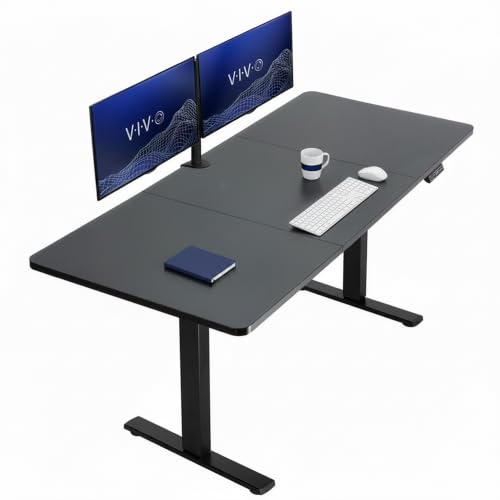
The VIVO brings the standing dimension to full size: a 71 x 30 inch electric desk with a published 220 lbs capacity, a single motor, a smooth 3-piece black top, 4 memory presets and a black frame. It is the only riser in this guide, and its figures are the most completely published of the six — capacity, presets, dimensions in both axes — which suits a desk whose purchase involves trusting a motor with a whole estate of equipment.
Four presets at this size suggest the household the desk imagines: two users with a sit and a stand each, or one user with a stool height and a perching height besides. Thirty inches of depth puts it in the deep category as well as the large, so the monitors stand at honest distance through the desk’s whole travel. The 3-piece top is the shipping compromise that lets a 71-inch surface arrive through ordinary doors, and the listing’s word for it — smooth — is the claim to verify on assembly day, running a palm across the seams before the equipment lands.
A single motor lifting 71 inches deserves the capacity figure’s respect: keep the estate’s real weight — screens, arms, tower if it rides the top — comfortably inside 220 lbs, and dress the cables for the full height of travel. The listing names the model, DESK-KIT-1B7B, a kit designation from an established frame maker, which matters for documentation and parts across the desk’s long life.
For the worker whose setup is large and whose back is vocal, the VIVO is the only pick that answers both, and it answers them with published numbers.
- Surface: 71 x 30 inches, black, 3-piece top
- Mechanism: electric, single motor
- Capacity: 220 lbs as published
- Presets: 4 memory presets
- Height range in figures: not given in the listing title — confirm it in the manufacturer’s documentation
VIVO’s kit format carries a long-life argument: a desk sold as a frame-and-top system from an established maker is a desk whose parts, documentation and settings remain findable years later, when an anonymous one-piece listing has vanished from the internet. At 71 inches, a desk is a decade-scale purchase, and the maker’s persistence is part of the specification whether or not it appears in the title.
Standing at 71 inches changes the room’s sightlines more than buyers expect — the worker rises above the furniture’s horizon, visible from the doorway, present in the household’s eye. In a shared living space that presence is a consideration, and the VIVO’s black, unlit plainness helps it sit quietly at sitting height, saving its statement for the hours it is actually raised.
Strengths
- Full large-desk size with genuine sit-stand travel.
- The most completely published figures in this guide.
- Four presets serve two users’ full posture range.
Trade-offs
- A 3-piece top has seams a single slab does not.
- A single motor asks the load to stay honest.
- No storage or power features are included.
Best for: a large multi-screen setup whose owner works standing part of every day.
Not suited for: an estate heavier than the published 220 lbs capacity allows.
View the VIVO 71 x 30 standing desk on Amazon when the big setup also needs to rise.

SEDETA 109 Inch L Shaped Gaming Desk — The corner estate
The SEDETA is the largest object in this guide by a wide margin: 109 inches of L-shaped gaming desk with 4 drawers, a display cabinet, 2 monitor stands, a CPU stand, LED lights and a power outlet, in black. Read that inventory again slowly, because it describes not a desk but a room system — the corner of a gaming or working room comprehensively furnished in one purchase, with a cabinet for display, drawers for concealment, stands for screens and tower, and light over all of it.
The display cabinet is the feature that reveals the intended owner: someone whose setup includes objects worth showing — the console collection, the built models, the lit tower’s companions. Combined with the CPU stand, the desk treats the whole gaming estate as an exhibit that also happens to be a workstation. The 2 monitor stands stage the screens without arms, and the power outlet gathers the estate’s many plugs to the surface where they can be managed.
The cautions scale with the ambition. A 109-inch L needs a corner measured in both directions and a room that can spare it; the delivery and assembly are a half-day project with a helper, not an evening’s unboxing. The listing title does not publish the return’s exact dimensions or a capacity, and both matter — the product page must be read with the room’s measurements in hand, because an L this size forgives no assumptions about which arm is longer.
For the gaming room, the streaming den, the home office that is also a hobby’s headquarters — the SEDETA is not the biggest desk here so much as the biggest idea: the corner, completely solved.
- Total length: 109 inches, L-shaped
- Storage: 4 drawers plus a display cabinet
- Screens and tower: 2 monitor stands, CPU stand
- Power and light: outlet built in, LED lights included
- Return dimensions: not published in the listing title — the manufacturer’s documentation carries the full plan
The SEDETA’s completeness has a budgeting virtue buyers overlook: bought as one system, the corner needs nothing else — no separate cabinet, no stand purchases, no drawer unit wheeled in later at a mismatched height. One delivery, one assembly project, one finish. The piecemeal corner, assembled over a year of separate purchases, usually costs more and matches less, which reframes the big desk as the economical version of itself.
Assembly order matters acutely on the SEDETA: build the frame in the corner, fit the cabinet and drawer units before the tops land, and dress the power while the underside is still reachable. A system this complete rewards a plan drawn on paper first — which wall gets the long arm, where the tower’s stand faces, where the cabinet’s display will be seen from the door. The desk is a room design; treat its Saturday accordingly.
Strengths
- A complete corner system: desk, storage, display and stands in one.
- Four drawers hide what the cabinet displays — both needs served.
- Power and LED complete the gaming estate without additions.
Trade-offs
- The largest footprint here; the corner must be measured twice.
- Assembly is a project, with a helper, not a task.
- Gaming styling commits the room’s character.
Best for: a gaming or streaming room whose corner should become the whole setup.
Not suited for: a multipurpose room that must return to neutral by morning.
Open the SEDETA 109-inch L desk on Amazon if the corner deserves an estate, not a desk.

Huuger 63 Inch L Shaped Desk with Power Outlets — The thick-topped corner
The Huuger L closes the guide at the most accessible scale of corner: 63 inches, reversible, with power outlets and a 0.95-inch thicker desktop, on a metal frame, in rustic brown. The thicker top is the headline for the same reason as the PRAISUN’s — an L-shape’s long arm is a span, and a maker who publishes the desktop’s thickness is answering the sag question before it is asked. At 63 inches the corner format fits the rooms that the SEDETA’s 109 would evict.
Reversibility plus power is the practical pairing. The return builds left or right to suit the corner, and the outlets sit on the desk where the laptop, screens and chargers gather — corners being, as these desk guides keep noting, the places walls forget to put sockets. The rustic brown finish keeps the corner warm and forgiving, and the metal frame keeps the structure’s promise simple.
The listing does not enumerate storage, and buyers whose corner must also be the room’s filing system should check the product page for what, if anything, is included — or plan the pedestal beside the desk from the start. Capacity likewise waits on the product page. What the title does publish — size, shape, thickness, power, frame, finish — covers the decisions that cannot be changed later, which is the right order of information.
For the home worker with a corner, two screens and a moderate estate, the Huuger L is the corner format at its most reasonable: zoned, powered, substantial, and sized for the rooms people actually have.
- Shape: 63-inch L, reversible
- Desktop: 0.95-inch thicker top per the listing
- Power: outlets built in
- Frame: metal; finish rustic brown
- Storage provision: not enumerated in the listing title — verify it through the manufacturer’s documentation
The Huuger L also suits the renter’s corner better than its size suggests: reversible, panel-built and metal-framed, it disassembles into a car-friendly stack for the next address, and its rustic finish shrugs off the scuffs that moves distribute. Corner desks have a reputation as permanent installations; this one is a corner desk that can move house, which in rented life is the difference between an asset and an anchor.
For the worker whose corner faces a window, the Huuger L offers a small daily pleasure the straight desks cannot: one arm for the screens in the room’s shade, the return for paperwork in the window’s light. Paper in daylight and screens out of glare is the arrangement every office ergonomist sketches and few rooms allow; a reversible L in the right corner allows it exactly.
Strengths
- Corner zoning at a scale ordinary rooms accept.
- A published thicker desktop over the long arm’s span.
- Power on the desk solves the corner’s socket drought.
Trade-offs
- Storage is not enumerated; paper-heavy work must plan its own.
- Capacity is unpublished in the title.
- The corner, once built, is committed.
Best for: a two-screen home worker with a corner and a moderate estate.
Not suited for: a paper-heavy workflow needing drawers the listing does not promise.
Find the Huuger 63-inch L desk on Amazon when the corner is modest but the work is not.
One absence in the table is worth a sentence: no pick here folds, rolls or shrinks, because at these dimensions portability is not a feature but a contradiction. A large desk is a commitment the room makes, and the guides for movable furniture live elsewhere in this series — the honesty of this category is that it asks for the commitment openly, in inches, before a single panel is unpacked.
How Do the Six Compare Side by Side?
| Desk | Size and shape | Power | Storage | Distinguishing figure |
|---|---|---|---|---|
| PRAISUN 71 Inch | 71 x 31.5 in, straight | Outlets with USB-C | None | 25mm thicker desktop |
| Huuger 70 Inch | 70 in, straight | Not stated in title | Included, form unspecified | Large legroom |
| Tribesigns Two Person | 78.74 in, straight, double | Not stated in title | Shelves, monitor stand | Two workstations |
| VIVO 71 x 30 | 71 x 30 in, straight, electric | Not stated in title | None | 220 lbs, 4 presets |
| SEDETA 109 Inch L | 109 in, L-shaped | Outlet built in | 4 drawers, display cabinet | 2 monitor stands, CPU stand |
| Huuger 63 Inch L | 63 in, L-shaped, reversible | Outlets built in | Not enumerated | 0.95-inch thicker desktop |
The table sorts the six by the question each answers. Need power and depth on one wall: the PRAISUN. Need plain length: the Huuger 70. Need two stations: the Tribesigns. Need the surface to move: the VIVO. Need the corner furnished completely: the SEDETA. Need the corner furnished reasonably: the Huuger L. A buyer who can state their question in one of those forms has already chosen; the rest is measuring.
And photograph the wall before ordering — a habit borrowed from every installer. The photograph catches the socket behind the bookcase, the radiator valve at skirting height, the picture rail that limits a hutch or a tall monitor, the door’s true swing. Large desks fail on details the eye edited out during the measuring visit; the camera does not edit, and five minutes with its evidence has saved more deliveries than any tape measure.
How Should You Choose a Large Desk Without Wasting the Wall?
Measure the wall, then measure the room’s life. The wall gives the maximum length; the life gives the right one. A desk that fills the wall exactly leaves no room for the shelf, the plant, the door’s swing or the future’s rearrangement, and a hand’s breadth of slack at each end is the cheapest flexibility in this guide. Then measure the route — door, hallway, stair turn — because at these sizes the delivery is a design constraint, and the VIVO’s 3-piece top and the L-shapes’ panel construction exist precisely to survive it.
Then audit the setup’s real estate honestly: screens and their stands or arms, the tower’s home, the printer, the paper, the second person’s elbows if there are any. Match the audit to the geometries — line, corner or double — and let the smaller axis decide between the finalists: depth for the PRAISUN and VIVO class, corner dimensions for the L pair. Buyers whose households work at one desk in shifts rather than side by side should compare the two-person options in our Best Office Desks for Large People guide’s neighbouring picks before committing to a double.
Keep the assembly documentation and a photograph of the finished desk’s underside — the cable routes, the frame’s fixings, the power strip’s position. A large desk will be serviced, moved and re-cabled across its life, and the household that can see how it was built, without crawling under it with a torch, maintains it in minutes instead of afternoons. At this scale, documentation is a feature the buyer creates.
Last, plan the desk’s electricity before its position is final. Three of the six bring power to the surface; the others need a wall socket within a cable’s honest reach and a plan for the bundle. A large desk placed beautifully and powered badly is a daily annoyance at architectural scale.
Lighting and Power Across a Very Long Surface
Length multiplies the lighting problem. A lamp that served a 40-inch desk lights the middle of a 71-inch one and leaves the ends in gloom, and work migrates to the lit parish while the expensive ends become storage by default. Plan light in zones from the start: a lamp at the main station, the room’s light considered for the second, and — on the L-shapes — the return given its own small light if paperwork will live there. The SEDETA’s LED handles ambience across its estate; task light remains the buyer’s contribution, at every size in this guide.
Power scales the same way. A long desk’s far end is a long way from the socket, and setups drift toward the powered end unless the desk itself distributes power — which is the quiet genius of the PRAISUN’s outlets and USB-C, the SEDETA’s outlet and the Huuger L’s outlets. On the desks without built-in power, a mounted strip at the desk’s centre, fed by one lead, is the difference between a surface used along its whole length and a surface used at one end.
Cable runs at this scale deserve a route, not a hope: along the back edge, in a tray or clipped beneath, with the tower’s position deciding the geography. A 100-inch-class setup can carry twenty cables; dressed once along a planned route, they vanish; left to gravity, they become the room’s most visible feature, underneath its largest one.
One Large Desk or a Desk Plus a Table?
Households reaching for square footage often face a fork: one large desk, or a standard desk plus a side table. The single large surface wins for screen work, because the setup’s zones share one plane at one height — the monitor stand, the keyboard and the reference all agree. The desk-plus-table wins for mixed lives, where the second surface is a making table, a printer stand or a guest’s temporary station that can leave the room entirely.
The picks here mostly argue for the single surface, with one exception worth naming: the two-person Tribesigns is effectively both objects fused, and the SEDETA’s return plays the side table’s role inside the L. Buyers whose second surface would host messy work — paint, solder, plants — should keep it separate and sacrificial; buyers whose second surface would host a second screen should buy the length, and let one honest plane do the whole job.
The Second Life of a Large Desk
Large desks outlast their first purpose more often than any other furniture, because their size makes them useful in every subsequent role: the studio bench, the craft and homework table for a whole family, the workbench of a garage conversion, the counter of a small business’s first premises. Buyers should let that afterlife into the purchase — a finish that suits more than one room, a frame that disassembles for the move between lives, a top thick enough to survive being worked on rather than merely at.
By that test the list divides kindly. The plain Huuger 70 and PRAISUN change jobs without changing character. The Tribesigns becomes the family table of a homework era. The VIVO’s frame can carry new tops and new rooms across a decade. The L-shapes are the most committed — a corner desk’s second life usually needs another corner — and the SEDETA’s system is the most specific of all, a gaming estate that will serve a hobby’s whole career and then demand a like-minded heir.
None of this argues against buying the specific desk for the specific life. It argues for noticing, at purchase, which futures each design keeps open — because at 70-plus inches, a desk is not consumed; it is inherited, by your future self if by nobody else.
Chairs, Floors and the Space Behind a Large Desk
A large desk’s footprint is only the beginning of its claim; the chair’s territory behind it is the larger half. A working chair needs its full retreat — pushed back, turned, vacated in a hurry — and on a two-person desk that territory doubles. Measure the room’s short dimension as desk depth plus chair retreat plus a walkway, and let that sum, not the wall’s length, veto the largest sizes. The SEDETA in a room that fails this arithmetic becomes a beautiful obstacle; the Huuger L in the same room becomes the right answer.
Floors take the consequences quietly. A loaded 71-inch desk concentrates its weight at four or six feet, and on softwood floors those feet deserve pads from day one; on carpet, a large desk settles into its pile and should be levelled after a week, when the settling has declared itself. The standing VIVO adds a rhythm of load through its travel that makes the level worth re-checking seasonally. None of this is difficult; all of it is cheaper than the floor’s repair or the frame’s complaint.
Delivery day deserves its own plan at this scale: clear the route, protect the floor at the build site, keep the packaging until the desk has been loaded and levelled, and photograph the underside fixings before the equipment hides them. The households that treat delivery as part of the purchase end the day with a desk; the others end it with a project that follows them into the week.
Common Mistakes When Buying a Large Desk
The first is measuring the wall and not the route — the 71-inch top that cannot turn the landing is a return shipment with a story. The second is filling the wall exactly, leaving no slack for the door, the shelf or the rearrangement that year two always demands. The third is buying length for a setup that needed depth: screens at arm’s length on a long shallow desk still crowd the worker, and no amount of sideways room fixes a front-to-back problem.
The fourth mistake is ignoring the chair’s estate — a large desk plus a large chair plus a second chair for the pairing session is a floor plan, and rooms fail it quietly for years. The fifth is under-planning storage at scale: a 100-inch setup generates more cables, drives and paper than a small one, and the desks without drawers need a pedestal planned, not improvised. The sixth is assembling an L-shape in the room’s centre and discovering that a built L does not rotate through doorways; build it in its corner, panel by panel.
A closing thought on proportion: a large desk should be the room’s largest working object, not its largest object of any kind. Where a bed, a sofa or a table already claims that title, the desk that serves best is usually the size below the maximum the wall allows — which is why this guide holds its 63 and 70-inch options in as much respect as its flagships. Size is a means; the end is a room that still works as a room around the work.
Frequently Asked Questions
How large is too large for a home office desk?
When the desk abolishes the room’s other functions — the door’s swing, the walkway, the second chair, the guest bed. As a working rule, a large desk should leave the room able to be a room: if the floor plan only works on paper with everything else removed, step down one size, from the SEDETA’s estate to the Huuger L’s corner, or from 71 inches to the low 60s.
Is a two-person desk better than two separate desks?
For one wall and one room, usually yes: the Tribesigns gives two genuine stations, a shared monitor stand and shelves on a single frame, with one delivery and one cable geography. Two separate desks win when the workers need different rooms, different heights or doors that close between them. The shared frame is an economy; the separate desks are a boundary.
Do large desks sag in the middle?
A long span can, which is why desktop thickness is a headline figure on two of these picks — the PRAISUN’s 25mm top and the Huuger L’s 0.95-inch top — and why the frame’s design matters more at 70 inches than at 40. Keep the heaviest loads, towers especially, over the legs rather than mid-span, whatever the desk.
Can a large desk be a standing desk too?
Yes — the VIVO in this guide is exactly that, at 71 x 30 inches with a 220 lbs published capacity and 4 memory presets. The cautions are the standing category’s own: dress every cable for the full height of travel, keep the estate’s weight honestly inside the capacity, and expect the delivery in pieces — its top is a 3-piece design.
What should I check on the product page for the L-shaped desks?
The return’s dimensions in both directions, which arm is longer in each configuration, the capacity, and what storage is actually included. The SEDETA enumerates its drawers, cabinet and stands in its title; the Huuger L leaves storage unenumerated. An L-shape is the least forgiving geometry to buy on assumptions, so the five minutes with the dimension diagram is the best-spent time in the whole purchase.
How much assembly should I expect at this size?
An unhurried project rather than a task: the long tops arrive in pieces or panels, the frames in sections, and the sensible plan is a helper, a cleared room and the desk built in its final position. The VIVO’s top is explicitly 3-piece; the L-shapes build panel by panel into their corners. Nothing here is beyond a careful first-timer, but everything here punishes haste — a large desk assembled slightly out of square announces it at every seam, for years.
Should a large desk go against the wall or face the room?
Against the wall is the default for good reasons — cables hide, the wall takes the light’s bounce, the room keeps its middle. Facing the room suits the executive arrangement, where the worker sits behind the desk like a counter and the screens’ backs face the door; the PRAISUN and the Huuger 70 both carry that posture handsomely, provided the cable route to the wall is planned as a floor channel rather than a tripwire. The L-shapes belong to corners in either philosophy.
Final Recommendation
For most large setups on a straight wall, the PRAISUN 71 Inch is the recommendation: length, real depth, a thicker top and USB-C power in one published, measurable package. For plain length without theme, take the Huuger 70; for two workers, the Tribesigns; for the standing estate, the VIVO; for the corner completely furnished, the SEDETA; and for the corner furnished wisely, the Huuger L. Measure the wall, the route and the chair’s retreat before any of them is ordered, and leave a hand’s breadth of slack at each end of the wall. A large desk chosen with slack in it is the one that still fits the room — and the life — five years and three setups from now.


