What's inside
- Key Takeaways
- Quick Picks
- How Were These Six Chosen for Student Rooms?
- What Should a Student Measure Before Ordering?
- Drawers, Shelves or Nothing: Which Storage Suits a Dorm?
- How Do the Six Compare Side by Side?
- How Should a Student Choose Between Folding and Fixed?
- How Do You Make a Small Desk Work Like a Bigger One?
- What About Ergonomics at a Desk This Small?
- Sharing the Desk: Roommates, Partners and the Second Chair
- Keeping a Small Desk Alive Through the Whole Degree
- Common Mistakes When Buying a College Desk
- Frequently Asked Questions
- Final Recommendation
- Related Guides
As an Amazon Associate I earn from qualifying purchases. This post may contain affiliate links at no extra cost to you.
widgetverdict.com is reader-supported. When you buy through links on our site, we may earn an affiliate commission.
Where to buy: Amazon stocks all six desks in this guide, and the quickest route into the list is the Pamray 32 Inch Small Computer Desk with 2 Drawers, the only pick here that pairs a genuinely small footprint with real drawers. The best college desks share one trait before any other: they respect the tape measure. A dorm room or a first apartment does not forgive a desk that arrives two inches too wide for the only wall it can stand against, so every pick in this guide was chosen first for the space it occupies and only then for what it offers on top.
College furniture lives a harder life than ordinary furniture. It is assembled in August, disassembled in May, carried down stairwells, lent to roommates, and asked to serve as study surface, dining table, vanity and charging station in the same week. A desk that survives that cycle is not necessarily the sturdiest object in the world; it is the one whose size, storage and setup match the way students actually live. The six below split into three temperaments: fixed desks with drawers for students who stay put, folding desks for students who move or share space, and open shelf designs for students whose storage needs run to textbooks and consoles rather than paperwork.
One honest warning before the picks. None of these desks is a full-size workstation, and none pretends to be. A 32-inch or 40-inch top holds a laptop, a notebook and a lamp with discipline; it will not hold a laptop, two monitors, a printer and a pizza. Students running multi-screen setups in a rented room should look at the roomier surfaces in our Best Deep Desks guide alongside this one, and treat this list as what it is: the shortlist for rooms where the floor plan, not the budget, makes the decisions.
Key Takeaways
- Widths run from 28.6 inches to 40 inches — measure the wall, the doorway and the lift before choosing.
- Two picks fold flat (the Huuger and the HMFOR), which suits shared rooms and frequent movers.
- Drawer storage divides the list: the Pamray offers 2 drawers, the Lufeiya 4 fabric drawers, the Furinno 3 open shelves instead.
- The SHW Mission is the plainest design here — a 40-inch black top with no stated extras — and that plainness is its appeal.
- Reversible layouts on the Lufeiya let the drawers sit on whichever side the room allows.
Quick Picks
| Pick | Badge | Why it earns its place |
|---|---|---|
| Pamray 32 Inch Small Computer Desk with 2 Drawers | The drawer-equipped compact | A 32-inch top with 2 drawers, sized for bedroom study corners in small spaces. |
| Huuger Folding Desk for Small Spaces | The fold-away space saver | A 31.5-inch foldable table that assembles easily and disappears when the room needs its floor back. |
| Furinno Efficient Desk 28.6 Inch | The shelf-sided mini | The narrowest pick at 28.6 inches wide, with 3 open side shelves for books and gear. |
| Lufeiya 40 Inch Computer Desk with Drawers | The fabric-drawer organiser | A 40-inch reversible desk with 4 fabric drawers for students with more to store. |
| SHW Mission 40-Inch Home Office Desk | The no-frills worktop | A plain 40-inch black desk that spends nothing on extras and keeps the surface clear. |
| HMFOR Folding Table Computer Desk | The zero-assembly traveller | A 35.8-inch folding desk needing no assembly, built for dorms, RVs and compact storage. |
How Were These Six Chosen for Student Rooms?
By measuring first and admiring second. Each candidate was checked against the realities of student housing: a single wall run in a dorm room, the corner of a studio flat, the gap between a bed and a wardrobe in a shared house. Widths between roughly 28 and 40 inches cover that territory; anything wider stops being a college desk and starts being a negotiation with the landlord. Within that band we looked for variety of storage, because students differ more in what they stash than in what they type on.
Assembly mattered almost as much as size. A desk that takes an afternoon and a second pair of hands to build will be resented twice a year, at move-in and move-out, and folding designs that skip assembly altogether earned their places on effort saved alone. We also weighed how each desk behaves at semester’s end: drawers that hold their contents, frames that fold or break down flat, finishes dark enough to hide the evidence of shared housing. Rustic brown and black dominate the list for that reason; pale finishes in a dorm are a promise nobody keeps.
Finally, every specification quoted in the reviews below comes from the product’s own listing title — widths, drawer counts, shelf counts and folding claims. Where a title is silent about a detail, the review says so plainly rather than filling the gap with a guess. Students order these desks from a phone screen in a busy week; the least a guide owes them is numbers that were actually published. Readers furnishing a younger student’s room rather than a dorm will find the age-graded sets in our Best Kids Desks roundup a better starting point than anything here.
We also read each listing the way a tired student reads it at midnight — quickly, on a phone, looking for the numbers that matter. Listings that publish their width, storage and folding claims in the title itself, as most of these six do, earned trust that vaguer listings did not. The SHW Mission is the exception that proves the rule: its title says almost nothing, and its review below treats that silence as homework for the buyer rather than a gap for us to fill with invention.
What Should a Student Measure Before Ordering?
Three numbers decide whether a college desk works, and only one of them is the desk’s width. The first is the wall run itself, measured at skirting-board height rather than at the open floor above it, because radiators, pipes and bed frames all steal inches at exactly desk level. The second is the route in: the width of the bedroom door, the turn at the top of the stairs, the lift if there is one. A 40-inch desk that cannot make the turn into the room is a hallway ornament. The third is the chair space — the depth behind the desk where a chair and a seated student need to fit without the chair’s back meeting the bed.
Depth deserves a sentence of its own. These listings publish widths prominently and depths less so, which is why the reviews below flag depth as a figure to confirm on the product page before ordering. A shallow top pushes a laptop toward the edge and leaves forearms unsupported; a deeper one eats the chair space. For a single laptop and a notebook, the compact depths typical of this class are workable, but a student who writes longhand beside the keyboard should confirm the figure rather than assume it.
Power is the measurement nobody takes. Dorm rooms ration sockets, and the socket is rarely where the desk wants to stand. None of the six titles here advertises built-in outlets, so plan the cable run as part of the purchase: an extension lead with surge protection, routed along the wall rather than across the walkway, is part of the real cost of every desk in this guide. It is unglamorous arithmetic, and it prevents the most common first-week complaint in student housing — a perfect desk standing two metres from the nearest plug.
Drawers, Shelves or Nothing: Which Storage Suits a Dorm?
Drawers suit students whose clutter is small and private: cables, chargers, stationery, medication, the documents a student accumulates and must not lose. The Pamray’s two drawers and the Lufeiya’s four fabric drawers serve that student. Fabric drawers trade rigidity for lightness and silence — they will not slam in a shared room at midnight — but they ask to be treated as organisers rather than vaults, and heavy textbooks belong elsewhere.
Open shelves suit students whose clutter is large and visible: textbooks, binders, a console, a printer if the room allows one. The Furinno’s three side shelves keep those things off the work surface without hiding them, which matters in a small room where out of sight usually means under the bed. The cost is dust and visual noise; an open shelf displays whatever discipline its owner has, in public.
No storage at all suits the student who stores elsewhere — wardrobe, boxes, a shelf above the bed — and wants the desk to be a pure surface. The SHW Mission and the two folding desks take that line. It is a legitimate one: in the smallest rooms, a desk with nothing underneath leaves legroom and floor visible, and visible floor is what makes a nine-square-metre room feel survivable. Choose storage for the clutter you actually have, not the organised life you intend to start in September.
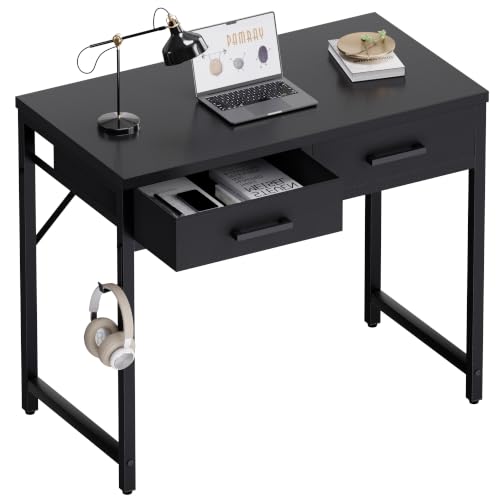
Pamray 32 Inch Small Computer Desk with 2 Drawers — The drawer-equipped compact
The Pamray makes the strongest storage argument in this guide at the second-smallest width. Thirty-two inches of top is a laptop, a notebook opened beside it, and a mug — no more — but the two drawers underneath change what that top has to carry. Chargers, pens, a calculator, the passport and paperwork a student keeps in one known place: all of it leaves the surface, and a small desk with a clear surface feels a size larger than it is. For bedroom study corners in small spaces, which is exactly the use the listing names, that trade is the right one.
The black finish suits the brief too. Dorm furniture absorbs marks, and a dark top under a desk lamp hides the ring stains and pen scores of a semester far better than a pale one. The design is a fixed desk rather than a folder, so it suits the student who moves once a year rather than once a month, and who would rather have drawers than portability. Assembly is part of the deal with any fixed desk; the listing title does not publish a time or a tool list, so expect a standard flat-pack session and keep the instructions for the reverse journey in May.
Where the Pamray asks for honesty is width discipline. Thirty-two inches will not host a second monitor beside the laptop, and a student whose course involves large sketchbooks or dual-screen coding will outgrow it. It is a desk for the laptop-and-notebook workflow that most coursework actually is, organised by drawers rather than spread across a bigger top.
Daily life on the Pamray has a rhythm the bigger desks cannot offer: everything returns to a drawer at night, so the morning surface is empty and the room reads as a bedroom again rather than a study that happens to contain a bed. That reset matters in a small room more than any single feature, because visual clutter is the tax small spaces charge. The drawers also give a student one genuinely private volume in housing where privacy is otherwise negotiated — a lock is not claimed in the listing and none should be assumed, but a closed drawer is still a boundary roommates respect.
- Top width: 32 inches
- Storage: 2 drawers
- Finish: black
- Stated setting: bedroom study, writing, home office, small spaces
- Depth and legroom figures: the listing title leaves these unpublished — cross-check the manufacturer’s own documentation before ordering
One more consideration belongs to shared houses: noise. Drawers that close on a runner rather than a slam, in a desk used at midnight before a roommate’s early lecture, are a social feature. The Pamray’s conventional drawer format also accepts the small organisers and trays students already own, so the sorting system from home survives the move. A desk that absorbs an existing life, rather than demanding a new one, settles into a room faster.
Strengths
- Real drawers at a 32-inch width — a rare combination in this class.
- A clear surface makes a small top feel bigger than its measurement.
- Black finish forgives the marks of shared housing.
Trade-offs
- No room for a second screen beside the laptop.
- Fixed build — it does not fold away when floor space is needed.
- Two drawers organise small clutter but swallow no textbooks.
Best for: a student in a small bedroom who wants paperwork and chargers hidden in drawers.
Not suited for: a dual-monitor setup needing width this 32-inch top cannot give.
Look at the Pamray 32-inch desk on Amazon if drawers matter more to you than folding tricks.

Huuger Folding Desk for Small Spaces — The fold-away space saver
The Huuger’s argument is disappearance. At 31.5 inches it is a proper small work surface — laptop, notebook, lamp — and when the room needs to be a living room, a guest room or simply a room with a floor, it folds away. In shared housing that trick is worth more than storage, because the scarcest resource in a student flat is not drawer space but unoccupied floor. The listing promises easy assembly, which for a folding desk mostly means the frame arrives ready to unfold rather than ready to build.
Rustic brown is the finish, a warm mid-tone that sits comfortably in the mismatched furniture landscape of a rented room. The listing names home office, study, bedroom and dorm as its settings, and the honest summary is that it serves all four the same way: as a surface that exists when work does and stops existing when it does not. Students who host, students in studio flats where the bed and the desk share a wall, students whose lease forbids nothing but whose roommate forbids clutter — this is their design.
The compromises are the folding family’s own. There are no drawers and no shelves, so storage must live elsewhere in the room. A folding frame also asks to be set on a reasonably level floor; the listing title does not publish a weight capacity or a frame specification, so heavy multi-device loads are a question for the product page rather than an assumption to make here. For laptop-based coursework, the design’s lightness is the point, not a flaw.
Think of the Huuger as furniture with office hours. Set up in the morning it is a desk in every way that matters for coursework — a stable top at sitting height for a laptop and notes — and folded in the evening it hands the room back to the people who live in it. That rhythm suits the rhythm of student life better than a permanent desk does, because student rooms are social rooms: friends sit on the floor, a partner visits, a society meets. A desk that can leave the room without tools or a second pair of hands will be forgiven its lack of drawers many times over.
- Top width: 31.5 inches
- Design: foldable computer table
- Assembly: described as easy in the listing
- Finish: rustic brown
- Load capacity: the listing title gives no figure — the manufacturer’s documentation is the place to confirm it
The Huuger also deserves credit as a guest-room and revision-week instrument. Folded, it stores where spare furniture hides; unfolded in a family home during the holidays, it recreates a study corner in a bedroom that stopped having one years ago. Students whose term-time and holiday lives happen in different houses will feel that second life of the desk every vacation, and it is a large part of why folding designs outsell their specifications.
Strengths
- Folds away to return the floor to the room.
- Easy assembly suits move-in day and its limited patience.
- Rustic brown blends with rented-room furniture of every origin.
Trade-offs
- No drawers or shelves — storage must live elsewhere.
- Folding frames prefer level floors and moderate loads.
- A surface that folds away also gets folded away mid-project.
Best for: a studio flat or shared room where the desk must vanish between study sessions.
Not suited for: a permanent workstation that stays set up and loaded all semester.
See the Huuger folding desk on Amazon when the floor plan, not the feature list, is making your decisions.

Furinno Efficient Desk 28.6 Inch — The shelf-sided mini
At 28.6 inches wide, the Furinno is the narrowest desk in this guide, and it earns its place by spending its small footprint cleverly: three open side shelves stand where drawers would go, turning the desk’s flank into a bookcase. A laptop sits on top; textbooks, binders and a console stack beside the student’s knees rather than across the work surface. For the very small room — the box room in a shared house, the dorm single with a bed, a wardrobe and no third wall — that vertical storage is the difference between a desk that fits and a desk that merely squeezes.
The listing describes it as a gaming desk as well as a study desk, and the shelf logic supports both lives: course books during term, game cases and a headset in the holidays. Dark espresso is the finish, near-black brown, forgiving of marks and easy to match with the black furniture student rooms accumulate. The open shelves keep everything visible, which suits students who lose things they cannot see.
Honesty about width again: 28.6 inches is a laptop’s width plus a notebook held at an angle, and writers who spread paper across a desk will feel the limit daily. The shelves also fix the desk’s orientation — they occupy one side, so the room must offer the right wall for that side. Measure with the shelves in mind, not just the top. The listing title does not publish the shelf dimensions or the desk’s depth, so a student planning to shelve large binders should confirm those figures on the product page first.
The Furinno rewards a particular kind of student: the one whose books are the furniture. Three shelves of course texts beside the knee turn the desk into a small library station, and reaching sideways for a reference instead of standing up keeps a study session unbroken. It also disciplines the top by subtraction — whatever does not fit the 28.6 inches must justify itself, and most clutter cannot. Students who work digitally and read physically will find the proportions exactly reversed from a normal desk, and exactly right.
- Top width: 28.6 inches
- Storage: 3 open side shelves
- Finish: dark espresso
- Stated setting: home office, study room, dorm, bedroom
- Shelf dimensions: not published in the listing title — check the manufacturer’s documentation for binder fit
There is also a honesty to the Furinno’s proportions that suits first-year life in particular. A new student does not yet know their workflow — how much paper, how many books, whether the laptop ever leaves the desk — and a small desk with visible shelves teaches that workflow quickly, because everything owned is on display. By the second year the shelves have edited the possessions. Few larger desks can claim to have improved their owner’s habits.
Strengths
- The narrowest footprint here, with storage that climbs instead of spreading.
- Side shelves keep books visible and off the work surface.
- Dark espresso hides wear and matches black room furniture.
Trade-offs
- The top is a one-laptop surface; paper-spreaders will feel it.
- Open shelves show dust and disorder alike.
- The shelved side dictates which wall the desk can use.
Best for: the smallest rooms, where storage has to go vertical or go without.
Not suited for: coursework that spreads books and paper across the whole top at once.
Check the Furinno Efficient desk on Amazon if your wall run is measured in centimetres of slack, not metres.

Lufeiya 40 Inch Computer Desk with Drawers — The fabric-drawer organiser
The Lufeiya is the roomiest fixed desk in this guide and the most storage-heavy: a 40-inch top over four fabric drawers, in a reversible layout that lets the drawer bank sit on the left or the right. Reversibility sounds like a footnote until you have furnished a real room, where the radiator is on one side, the socket on the other, and the desk must fit the room rather than the catalogue photograph. Building the drawers on whichever side the wall allows is a genuine, practical freedom.
Four fabric drawers sort a student’s small possessions properly — one for cables and chargers, one for stationery, one for documents, one for the miscellaneous that every student life generates. Fabric keeps the weight down, keeps the noise down in a shared room, and keeps the price of the whole desk in student territory. The rustic brown finish warms a room that white flat-pack would chill. The listing aims it at kids, students and home office use in small spaces, and the student reading is the natural one: this is the desk for the organised first apartment.
The cautions are fabric’s own. Drawers of cloth and board organise; they do not protect, and they sag if asked to carry a shelf’s worth of textbooks. Treat them as sorting, not storage of record. The 40-inch width is also the joint-largest here, so the tape-measure discipline of this guide applies in full — wall run, door turn and chair space all confirmed before ordering. The listing title does not publish the desk’s depth or the drawers’ internal dimensions; both are worth a look on the product page.
There is a first-apartment pleasure to the Lufeiya that goes beyond storage counts: it looks like furniture chosen on purpose. Rustic brown, a full 40 inches, drawers that close — in a room of borrowed chairs and a landlord’s curtains, the desk becomes the one object that feels owned. That feeling is not frivolous; students study longer at desks they like sitting at. The reversible build also future-proofs the purchase against the next room, whose free wall will inevitably be the other one.
- Top width: 40 inches
- Storage: 4 fabric drawers
- Layout: reversible — drawer bank builds on either side
- Finish: rustic brown
- Drawer internal dimensions: absent from the listing title — the manufacturer’s documentation carries them
Coursework with a practical element — design, engineering, art — spreads materials in a way pure reading never does, and the Lufeiya’s 40 inches plus drawer sorting is the closest this guide comes to a studio bench for a small room. Materials live in drawers between sessions instead of migrating to the bed. Students on such courses should still confirm the depth figure on the product page, since sketchbooks and cutting mats are depth purchases as much as width ones.
Strengths
- Four drawers give a student’s small clutter a real sorting system.
- Reversible build fits rooms where the free wall is the awkward one.
- The widest fixed top here still counts as small-space furniture.
Trade-offs
- Fabric drawers organise light items; textbooks will sag them.
- Forty inches needs the full measurement routine before ordering.
- Cloth drawer fronts show scuffs sooner than solid ones.
Best for: an organised student in a first apartment who wants everything sorted and hidden.
Not suited for: storing heavy books inside drawers built from fabric and board.
View the Lufeiya 40-inch desk on Amazon if four drawers sound like the semester, finally filed.

SHW Mission 40-Inch Home Office Desk — The no-frills worktop
The SHW Mission’s listing title is the shortest in this guide — a 40-inch home office computer desk, black — and the brevity is the product’s character. No drawers are promised, no shelves, no folding trick, no finish poetry. What is offered is a plain, full-width-for-its-class work surface that spends its entire budget on being a desk. There is a real student case for that: the renter whose storage already exists in wardrobes and boxes, whose room needs a surface and legroom and nothing else competing for the floor.
Forty inches of uncluttered top is genuinely useful. It takes a laptop and an open textbook side by side, or a laptop on a stand with a separate keyboard — the setup long essay seasons reward. Black goes with everything a student room contains and hides what a semester does to furniture. A plain desk is also the easiest kind to resell or pass on at graduation, because it promises nothing specific to the next owner’s life.
The discipline this pick demands is informational. Because the title publishes so little, the product page carries the whole burden: depth, frame construction, assembly and load figures all need confirming there before purchase, and the review below reflects that honestly in its spec list. Buyers comfortable doing that homework get a straightforward desk; buyers who want their questions answered by the title itself should look at the Pamray or the Lufeiya, whose listings say more.
The Mission’s plainness has a second virtue beyond price discipline: it imposes nothing on the room’s future. A desk with no drawers, no shelves and no colour opinion can become a dressing table, a hobby bench or a partner’s desk in the next home without fighting its own design. Students buying for a single course should weigh that adaptability; the cheapest desk is the one that does not need replacing when life changes shape, and an unadorned black rectangle changes shape more gracefully than any themed alternative in this guide.
- Top width: 40 inches
- Finish: black
- Storage: none named in the listing
- Stated setting: home office
- Frame and depth details: the listing title is silent on both — the manufacturer’s documentation is where to verify them
The Mission also makes a quiet case as the hand-me-down champion of the list. Plain black desks pass between siblings, housemates and incoming first-years without anyone needing to like a finish or forgive a theme, and a surface with no mechanisms has almost nothing to break in transit. In housing where furniture circulates informally from leaver to arriver every June, that neutrality is a durable, practical virtue.
Strengths
- A clear 40-inch surface fits laptop plus open textbook properly.
- Nothing underneath means full legroom and visible floor.
- Plain black design resells or hands down without argument.
Trade-offs
- No storage of any kind is offered.
- The short title leaves homework for the product page.
- No folding or breakdown feature is claimed for moving day.
Best for: a renter with storage elsewhere who wants a plain, honest worktop.
Not suited for: a room with no other storage, where the desk must hide the clutter too.
Open the SHW Mission desk on Amazon when plain and wide beats clever and small.
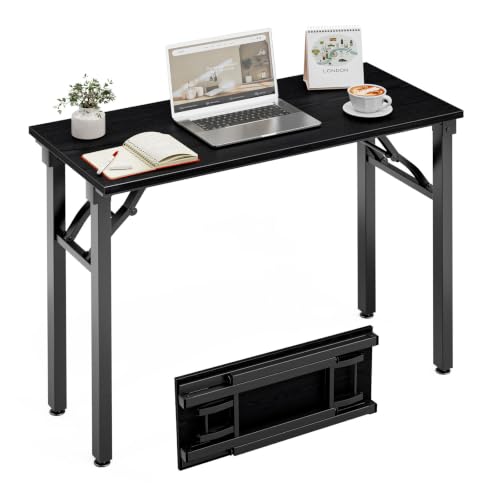
HMFOR Folding Table Computer Desk — The zero-assembly traveller
The HMFOR removes the worst hour of student furniture: it needs no assembly at all. The listing’s claim is a folding desk that arrives ready — unfold it and work. At 35.8 inches it is also the widest of the movable picks here, wide enough for a laptop and a notebook in genuine comfort, and its stated territory runs beyond the dorm to RVs and other small spaces, which tells you how the design thinks about itself: a desk for people whose rooms change.
Dark oak is the finish, a deeper tone than the Huuger’s rustic brown, and compact storage is the second promise — folded, it slides into the gaps student housing offers: behind a wardrobe, under a bed, flat against a wall. For the student who moves between a term-time room and a family home, or whose course includes a placement semester in another city, a desk that travels flat and sets up in moments is not a compromise purchase. It is the only category of desk that fits the life.
The trade-offs mirror the Huuger’s with one addition. No storage is offered, as with any folder. And a no-assembly folding frame concentrates all its engineering in the hinge and locking points, so those deserve a look on the product page; the listing title publishes no load capacity and no frame material, and a buyer planning to park a heavy monitor on it should confirm both figures first. For laptop coursework and writing, the design brief is sound.
The HMFOR also solves a problem students rarely anticipate: the desk needed somewhere that is not the room. A library strike, a noisy flatmate, a sunny kitchen in a shared house, a week at a partner’s place before exams — a desk that folds in seconds and carries under one arm turns any table-less corner into a study. That portability compounds across a degree. The student who can manufacture a workstation anywhere is never hostage to the one room the timetable and the landlord happened to assign.
- Top width: 35.8 inches
- Assembly: none — folding design, ready to unfold
- Storage: folds compact for storage
- Finish: dark oak
- Frame material and load rating: not given in the listing title — confirm through the manufacturer’s documentation
Students on placement years and sandwich courses live the HMFOR’s brief most literally: two addresses a year, furnished rooms of unknown shape, a need to work from the first evening. A desk that travels in the car with the boxes and stands ready before the kettle boils removes one whole category of settling-in friction. Even for static students, the same quality serves during redecoration, guests and the annual deep clean, when a fixed desk is an obstacle and a folder is a rumour.
Strengths
- Zero assembly — the desk works the minute it is unfolded.
- The widest top among the folding picks here.
- Folds flat for the gaps where student furniture actually lives.
Trade-offs
- No drawers or shelves in the design.
- Hinges carry the whole engineering brief; inspect them on arrival.
- Suits laptop loads; heavy monitor rigs need the capacity confirmed first.
Best for: a student who moves often and refuses to build furniture twice a year.
Not suited for: a fixed heavy rig that never moves and never folds.
Find the HMFOR folding desk on Amazon if your next three addresses are already known and all of them are small.
One pattern in the table deserves drawing out: storage and mobility trade against each other almost perfectly. Every pick that folds offers no storage; every pick with drawers or shelves stays where it was built. There is no design here that does both, because the mechanisms conflict — a drawer bank cannot fold, and a folding frame cannot carry one. Students should therefore decide which scarcity governs their room, floor space or storage space, and let that single decision shortlist the six to two or three before any other comparison begins.
How Do the Six Compare Side by Side?
| Desk | Width | Storage | Moves how | Finish |
|---|---|---|---|---|
| Pamray 32 Inch | 32 inches | 2 drawers | Fixed build | Black |
| Huuger Folding | 31.5 inches | None | Folds flat | Rustic brown |
| Furinno Efficient | 28.6 inches | 3 open side shelves | Fixed build | Dark espresso |
| Lufeiya 40 Inch | 40 inches | 4 fabric drawers, reversible | Fixed build | Rustic brown |
| SHW Mission | 40 inches | None | Fixed build | Black |
| HMFOR Folding | 35.8 inches | None | Folds flat, no assembly | Dark oak |
Read the table by lifestyle rather than by width. The two 40-inch desks sit at opposite poles of the same size: the Lufeiya spends its footprint on storage, the SHW spends its on emptiness, and both choices are right for different rooms. The folders form their own pair — the Huuger smaller and simpler, the HMFOR wider and assembly-free. The Pamray and the Furinno are the storage specialists at the compact end, one hiding clutter in drawers, the other displaying it on shelves.
How Should a Student Choose Between Folding and Fixed?
Count your moves and count your clutter; the two numbers decide. A student in one room for a full degree, with paperwork and devices accumulating, is served by a fixed desk with storage — the Pamray for a small room, the Lufeiya for a larger one. A student changing rooms every term, living in furnished housing, or sharing a studio where the desk competes with daily life, is served by a folder — the HMFOR if assembly is the enemy, the Huuger if the fold must fit the tightest gap.
Then interrogate the workflow honestly. Laptop-only study tolerates every desk here. Laptop plus open textbook points at the 40-inch pair or the HMFOR. Laptop plus second monitor points away from this entire guide toward wider furniture — and students tempted to perch a monitor on a 28.6-inch top should let the Best Solid Wood Desks guide’s sturdier, wider options make the counter-argument before the first wobble does.
Finally, buy for the room you have measured, in the finish that forgives your habits, with the storage that matches your actual clutter. College desks fail by inches and by optimism, rarely by quality. The student who measures the wall, the door and the chair space, and who knows whether their clutter is drawer-shaped or shelf-shaped, will pick correctly from this list almost regardless of which of the six they land on.
Budget for the whole workstation, not the desk alone. The lamp, the extension lead, the chair cushion and the screen stand are part of what makes a small desk function, and students who spend everything on the desk itself end up working in gloom at a surface they cannot plug anything into. The modest prices of this category — a claim about positioning, not a figure — exist precisely so the accessories can be afforded alongside.
How Do You Make a Small Desk Work Like a Bigger One?
By treating the surface as a stage that changes scenes rather than a landscape that holds everything at once. The small-desk workflow that succeeds is serial: laptop and current notebook out, everything else stored; when the task changes, the surface changes. Drawers and shelves earn their keep precisely here — the Pamray’s drawers and the Furinno’s shelves are not storage so much as scene-change machinery, holding the off-stage props within arm’s reach.
Vertical space is the second expansion. The wall above a small desk is unclaimed territory in most student rooms, and a shelf or a pinboard there takes the lamp, the speakers and the reference books off the top without touching the floor plan. Landlords vary in their feelings about fixings, so favour adhesive and over-desk solutions in rented rooms, but use the wall in some form: a 32-inch desk under a used wall behaves like a 48-inch desk under a bare one.
Light is the third. A small desk under a good lamp feels deliberate; the same desk in a room’s general gloom feels like a concession. A clamp lamp on the desk’s rear edge costs no surface at all and returns focus that width cannot buy. Students often spend their budget widening a desk when lighting the one they have would have changed more.
What About Ergonomics at a Desk This Small?
Small desks punish posture in predictable ways, and the punishments are avoidable with habits rather than purchases. The screen is the first problem: a laptop on a low top pulls the head down for hours. A stand or even a stable stack of books raising the screen, paired with a separate keyboard, is the standard remedy, and the wider picks here — the Lufeiya, the SHW and the HMFOR — have the depth of top to make that arrangement comfortable.
The chair is the second problem, and it is usually the room’s own chair rather than anything bought for study. Whatever its origin, the test is simple: feet supported, lower back met by something, elbows near a right angle at the keyboard. A cushion behind the back and a box under the feet have rescued more student spines than any chair upgrade bought in a panic during essay week.
The third problem is time itself. Small workstations concentrate the body in one position, and the honest ergonomic advice for any desk in this guide is movement: stand between tasks, take the reading to the bed, let the folding desks’ portability vary the posture of the day. No 40-inch desk makes eight still hours healthy; every desk here makes four varied hours perfectly comfortable.
Sharing the Desk: Roommates, Partners and the Second Chair
Many college desks are bought by one person and used by two. A roommate’s essay crisis, a partner who works from the same flat, a friend whose own desk is buried — the borrowed desk is a feature of student life, and it argues for the wider, simpler picks. The SHW Mission’s empty 40 inches absorbs a second user’s habits without a drawer turf war; the Lufeiya’s drawers, by contrast, are personal territory and should be understood as such before the desk becomes shared infrastructure.
Where two students genuinely work side by side in one room, two small desks usually beat one large one in this guide’s territory: two Pamrays or a Pamray and a folder give each person a surface, a boundary and a schedule of their own. The folding picks shine again here, because the second desk can leave the room when the room must be a bedroom again.
Keeping a Small Desk Alive Through the Whole Degree
Student desks rarely die dramatically; they fade — a wobble at one corner, a drawer that sticks, a surface ringed and scored. The fading is mostly preventable with ten minutes a term. Fittings on assembled desks work loose under the vibration of typing and the dragging of moves, and a termly pass with the original Allen key restores the new-desk feel for free. Keep the key taped under the top, where future you will actually find it.
Surfaces ask for one habit: nothing wet stands on them unprotected. Mugs are the enemy of every finish in this guide, dark or rustic, and a single coaster outperforms any amount of later regret. Folding desks ask for a different habit — fold them unloaded, every time, because a hinge asked to close around a laptop’s weight learns bad geometry. Drawers ask only to be loaded by weight honestly: heavy things low and few, light things many.
At the end of the degree the desk’s second life begins, and the picks divide by how gracefully they enter it. The folders store until needed again; the plain SHW hands down to the next student without explanation; the drawer desks become hallway or hobby furniture in a first real home. A desk bought with that afterlife in mind is rarely the wrong purchase, whichever of the six it is.
Common Mistakes When Buying a College Desk
The first is measuring the room and not the route. Desks are abandoned in hallways and stairwells every September because the turn into the room was never paced out. The second is buying width for a workflow you do not have: a 40-inch desk bought for a second monitor that never arrives is floor space taxed for three years. The third is the reverse — a charming 28.6-inch desk bought by a student whose course spreads A3 paper across every surface.
A fourth error is ignoring the socket. A desk placed beautifully and two metres from power becomes a desk with a cable across the floor, which in shared housing becomes a cable someone trips over weekly. The fifth is treating assembly as a one-time event; student furniture is built and unbuilt annually, so keep the fittings, keep the instructions, and favour designs whose moving-day story you can picture without wincing. The sixth is forgetting the chair. A desk without chair space is a shelf at sitting height, and the chair is half the workstation even though it appears in no listing.
Frequently Asked Questions
Is 32 inches wide enough for a laptop and notes?
Yes, for the standard student workflow: a laptop centred, a notebook open beside it, a mug at the corner. It is not enough for a laptop plus a separate monitor, or for spreading several books at once. Students whose courses are paper-heavy should step up to a 40-inch pick such as the Lufeiya or the SHW Mission.
Are fabric drawers strong enough for textbooks?
No, and they are not meant to be. The Lufeiya’s four fabric drawers are organisers for cables, stationery, documents and small devices. Textbooks belong on a shelf — the Furinno’s open side shelves are the in-guide answer — or in a box under the bed.
Which of these desks is easiest on moving day?
The HMFOR, because it asks for no assembly in either direction and folds flat for transport. The Huuger folds as well and is smaller. Fixed desks travel as flat-pack only if you kept the fittings and the patience, which is why folders dominate among students who change rooms every term.
Do any of these desks have built-in power outlets?
None of the six listing titles advertises built-in outlets, so plan on an extension lead with surge protection routed along the wall. Measure the distance from the desk’s likely position to the nearest socket before ordering, not after the desk is standing in the wrong corner.
What depth should a college desk be?
These listings publish widths rather than depths, so depth is a figure to confirm on each product page. As a working rule, a laptop plus forearm support needs a top deep enough that the keyboard is not at the edge; students who write longhand beside the laptop should favour the deeper end of whatever range the product pages confirm.
Can a folding desk really survive a whole degree?
A folding desk survives by being treated as a mechanism rather than a table: unfold it on level floors, do not drag it loaded, and keep its loads to the laptop-and-books work it was designed for. The HMFOR and the Huuger ask no assembly, which removes the loosening-fittings failure that ends most flat-pack student furniture. Treated that way, a folder commonly outlasts the tenancy it was bought for.
Should I buy the desk before I have seen the room?
Only a folding one. Room photographs in listings flatter dimensions, and a fixed desk bought blind is a gamble on the wall run, the door turn and the socket position all at once. A folder such as the HMFOR or the Huuger forgives a wrong guess because it can live folded until the room reveals itself; every other pick here should wait until the tape measure has visited the actual room, even if that means a week of working from the bed.
Final Recommendation
For most students in most small rooms, the Pamray 32 Inch is the recommendation: real drawers, a forgiving black finish, and a width that fits the wall a dorm actually offers. Students who move every term should take the HMFOR and its zero-assembly fold; students with the wall space and the clutter should take the Lufeiya and file their semester away in its four drawers. The Furinno owns the smallest rooms, the SHW owns the simplest brief, and the Huuger owns the studio flat. Measure the wall, the door and the chair space, and the right one of the six will be obvious. A desk chosen by tape measure in August is the one still earning its floor space in May.


