What's inside
- Key Takeaways
- Quick Picks
- How Were These Minimal Cases Selected?
- The Six Minimal ATX Cases, Reviewed in Full
- How Do the Minimal Six Compare at a Glance?
- A Second Look: Minimal Cases in Daily Service
- Matching Each Minimal Case to a Room and a Routine
- Minimalism in Practice: Light, Dust and Desk Discipline
- How Should You Choose a Minimal Case Without Losing Performance?
- What Does Minimalism Ask of the Builder?
- Second Builds, Hand-Me-Downs and Resale
- Why Does Minimalism Age Better Than Gaming Styling?
- How Do Minimal Cases Handle Heat in Real Rooms?
- The Economics of Buying Calm Once
- Common Mistakes When Buying a Minimal ATX Case
- What Should You Verify in the Full Listing Before Ordering?
- Frequently Asked Questions
- At the Desk: Sound, Sight and Touch, Case by Case
- Final Recommendation
- Related Guides
As an Amazon Associate I earn from qualifying purchases. This post may contain affiliate links at no extra cost to you.
widgetverdict.com is reader-supported. When you buy through links on our site, we may earn an affiliate commission.
Where to buy: The NZXT H5 Flow opens this guide and its Amazon listing is the quickest starting point; every other pick below carries its own link inside its review, so the case you settle on is never more than one click from its current listing.
The best minimal pc cases for ATX builds exist because a powerful computer does not have to look like one. Minimalism in a chassis is not the absence of design — it is design that has finished arguing. Flat planes, a single material story, no sculpted plastic shouting across the front, nothing glowing that was not asked to glow. A minimal case sits in a room the way a good bookshelf does: present, useful, and silent about itself. For builders whose desk is also their office, their studio backdrop and their evening retreat, that restraint is not a luxury. It is the feature everything else hangs from.
Minimal should never mean compromised, and the six designs here prove the point with their own listing titles. Between them they offer front radiator support up to 360mm, graphics-card clearance as long as 410mm, a 20Gbps USB Type-C port, five pre-installed PWM fans in one model, genuine walnut in two, and vertical graphics-card mounting in another. The aesthetic is calm; the engineering underneath is entirely current. What none of them does is waste the front panel on decoration that will look dated before the second graphics card arrives.
There is also a practical dividend to restraint. A minimal exterior has fewer seams, fins and novelty shapes to trap dust, fewer lighting systems to fail or to argue with sleep, and a silhouette that survives a house move, a job change or a redecoration without becoming the room’s loudest object. Readers whose minimalism extends to the side panel itself will find kindred thinking in our guide to solid-panel designs, and those whose desks are shrinking should keep Best Compact ATX PC Cases in mind as the neighbouring territory — several picks below live near that border.
Key Takeaways
- Minimal design here means disciplined surfaces and one material story, not missing features.
- The NZXT H5 Flow pairs a compact ATX mid-tower shell with two included 120mm fans and 360mm front radiator support.
- The ASUS Prime AP303 brings the strongest front connectivity in the guide: a 20Gbps USB Type-C port.
- The Cooler Master Elite 502 Lite clears graphics cards up to 410mm, the longest figure stated in any title here.
- The Lian Li LANCOOL 217 ships with five PWM fans and genuine wood panels, and is ready for back-connect motherboards.
- Walnut appears twice — on the LANCOOL 217 and the Fractal Design North — for builders who want minimal to also mean warm.
Quick Picks
- Best Minimal All-Rounder — NZXT H5 Flow: a compact ATX mid-tower in black with two included 120mm fans, 360mm front radiator support and tempered glass, pitched by its own title as a great first airflow build.
- Best Front Connectivity — ASUS Prime AP303 ATX Case: mesh panel design, a pre-installed fan, graphics-card support up to 360mm, 360mm radiator support, room for a 180mm ATX power supply and 20Gbps USB Type-C.
- Best for Very Long Graphics Cards — Cooler Master Elite 502 Lite ATX Case: a high-airflow minimalist shell clearing 410mm of graphics card, with 360mm AIO support, Type C and an intakes grill.
- Best Fan Package Included — Lian Li LANCOOL 217: five PWM fans factory-fitted — two 170mm, two 120mm and one 140mm — with genuine wood panels and back-connect readiness.
- Best Quiet Minimalist — be quiet! Pure Base 501 Black: two preinstalled 140mm PWM fans, optimised air pressure, a compact shell, vertical GPU installation and USB 3.2 Gen.2 Type C.
- Best Minimalism With Warmth — Fractal Design North (Charcoal, TG): a genuine walnut front, dark tempered glass side panel, two 140mm Aspect PWM fans and Type C USB in an ATX airflow mid tower.
How Were These Minimal Cases Selected?
The first test was visual discipline, judged from each maker’s own presentation: could this case sit in a photographed living room without becoming the subject? Sculpted gaming fronts, aggressive vents styled like armour and built-in light shows all failed that test regardless of their other merits. The second test was that minimalism had to be engineered, not just styled — each pick needed a cooling or layout idea worth having, whether that is the H5 Flow’s airflow-first shell, the AP303’s mesh and fast front port, or the LANCOOL 217’s five-fan factory package.
The third test was currency. A minimal case bought today should not strand its owner with yesterday’s connections or clearances, so stated figures were compared across titles: radiator ceilings, graphics-card lengths, power-supply room, Type-C presence. Where a title leaves a figure unstated, the spec boxes below say so in plain words rather than borrowing a number from a sibling model. Minimalism, after all, is partly an honesty aesthetic — the guide should practise it too.
Finally, the set was balanced across temperaments. Two picks wear glass, because a tidy build behind dark glass can be the most minimal look of all. Two wear wood. One is a silence specialist’s compact tower, one a mesh-panelled all-rounder. A reader moving equipment between rooms and vehicles may also appreciate Best Car PC Cases, since a calm exterior travels better than a theatrical one.
The Six Minimal ATX Cases, Reviewed in Full

NZXT H5 Flow
NZXT built its reputation on exactly this design language — unbroken surfaces, a single colour, nothing on the exterior that does not earn its place — and the H5 Flow is that language in a compact ATX mid-tower. The listing title describes a black case with two included 120mm fans, 360mm front radiator support and tempered glass, and calls it a great first airflow build. That last phrase is worth taking seriously: the Flow line exists to move air through a perforated path rather than seal the build behind a decorative front, so the minimalism here is functional. The front is plain because the front is busy breathing.
First-time builders are the obvious audience, and the title says so, but the H5 Flow also suits experienced hands who are tired of theatre. A tidy interior behind the glass, a compact footprint that leaves desk surface for work, and radiator room at the front for a serious all-in-one cooler make it a case that disappears into a routine. It asks little of its owner beyond the ordinary: keep the intake path clear, enjoy the fact that the machine looks like it was designed by an adult.
Strengths
- Compact ATX mid-tower footprint preserves desk space while keeping full-size board support.
- Front radiator support to 360mm gives all-in-one cooling real headroom.
- Two 120mm fans included, so the airflow story starts complete rather than theoretical.
Trade-offs
- The title names no front USB-C port, so connector plans should be checked on the full listing.
- Tempered glass, however tidy the build, remains a fragile panel to move house with.
- Compact shells reward planned cable routing; a sprawling parts list will feel the walls.
Spec mini box
- Format: compact ATX mid-tower
- Included fans: two 120mm
- Radiator support: 360mm at the front
- Side panel: tempered glass
- Colour: black
- Front ports beyond the basics: the title does not enumerate them, so the manufacturer’s documentation is the place to confirm before relying on a specific connector
Best for: a first airflow build, or a tidy desk machine that must look calm in a work video call.
Not suited for: a parts list that needs front Type-C confirmed on paper before purchase.
Begin at the H5 Flow listing on Amazon and check the port panel photograph against your desk peripherals — that small detail decides daily convenience more than any headline figure.

ASUS Prime AP303 ATX Case
The Prime line is ASUS speaking in its quietest voice, and the AP303’s title is a model of useful plainness: mesh panel design, a pre-installed fan, graphics-card support up to 360mm, 360mm radiator support, room for a 180mm ATX power supply, 20Gbps USB Type-C, and a two-year warranty. Read that list again and notice what is missing — adjectives. The case is a mesh-fronted ATX box engineered around clearances and one genuinely fast front port, and its minimalism comes from that refusal to perform.
The 20Gbps Type-C deserves its own sentence, because front ports are where minimal cases sometimes cut the wrong corner. A port at that speed serves external SSD work, fast media ingest and future peripherals without reaching behind the machine, and pairing it with 360mm of graphics-card room and a full-size 180mm power-supply allowance makes the AP303 the pragmatist’s pick: nothing decorative, everything sized generously. The stated warranty adds a plain-spoken confidence that suits the Prime badge.
Strengths
- 20Gbps USB Type-C is the fastest front connection stated anywhere in this guide.
- Graphics cards up to 360mm and radiators up to 360mm cover most current build plans.
- A 180mm ATX power-supply allowance avoids the shortlist of cramped-PSU compromises.
Trade-offs
- Only a single pre-installed fan is named, so a cooling build-out should budget for more.
- Mesh panels show the interior’s shadowing; builders wanting a sealed look should look elsewhere here.
- The title does not state a fan size for the included unit, a detail to confirm on the full page.
Spec mini box
- Format: ATX case with mesh panel design
- Included: pre-installed fan (count of one stated)
- Graphics-card support: up to 360mm
- Radiator support: 360mm
- Power supply: up to 180mm ATX
- Front connectivity: 20Gbps USB Type-C
- Warranty: two years, per the title
Best for: a working machine whose front port gets used daily for fast external storage.
Not suited for: a build expecting a full fan set in the box on day one.
Study the AP303 on Amazon if your workflow involves shuttling large files — the port specification in its title is the detail rival minimal cases most often quietly omit.
Cooler Master Elite 502 Lite ATX Case
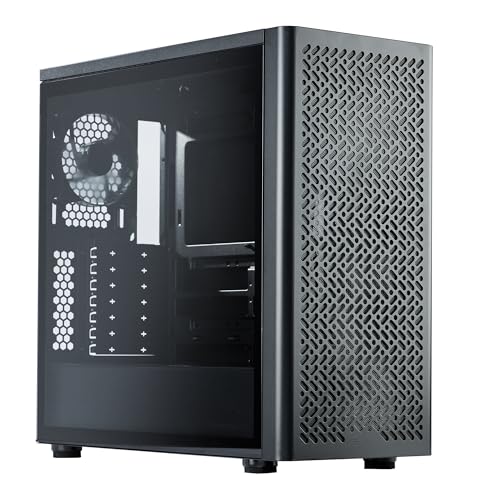
Cooler Master’s Elite 502 Lite calls itself minimalist in its own title and then immediately talks about airflow and clearance, which is the correct order of priorities. The stated figures: graphics-card room up to 410mm — the longest in this guide — compatibility with the largest current flagship cards named in the title, 360mm AIO support at the maximum, Type C connectivity, tempered glass, a 120mm fan and an intakes grill. This is minimalism as subtraction of ornament rather than subtraction of capability, aimed at builders whose next graphics card is the dimension that matters.
That 410mm figure changes the buying conversation. Graphics cards have grown relentlessly, and a case that clears 410mm removes the tape-measure anxiety from the next two upgrade cycles. The intakes grill tells the cooling story plainly: air comes in through a working surface, not through slits hidden under styling. For a high-draw gaming build in a room that rejects gaming aesthetics, the Elite 502 Lite is the reconciliation — flagship hardware inside, office furniture outside.
Strengths
- 410mm graphics-card clearance is the most future-proofing figure in any title here.
- High-airflow design with an intakes grill suits power-hungry flagship builds.
- 360mm AIO maximum and Type C keep the rest of the specification equally current.
Trade-offs
- A single 120mm fan is named in the title; serious builds will add intake and exhaust.
- Tempered glass needs the usual care in transit and during desk rearrangements.
- The title gives no power-supply length figure, so that measurement belongs on the pre-order checklist.
Spec mini box
- Format: ATX, high-airflow minimalist design
- Graphics-card clearance: 410mm maximum
- AIO support: 360mm maximum
- Front connectivity: Type C named
- Side panel: tempered glass
- Included fan: 120mm (one named)
- Intake: grill design
Best for: a flagship graphics-card build that must pass as ordinary furniture in the room it occupies.
Not suited for: a silent-first build brief, since airflow hardware and hush pull in opposite directions here.
Measure your current card, then look at the Elite 502 Lite on Amazon — the clearance figure in the title is the reason this case exists, and it either solves your problem or it does not.
Lian Li LANCOOL 217
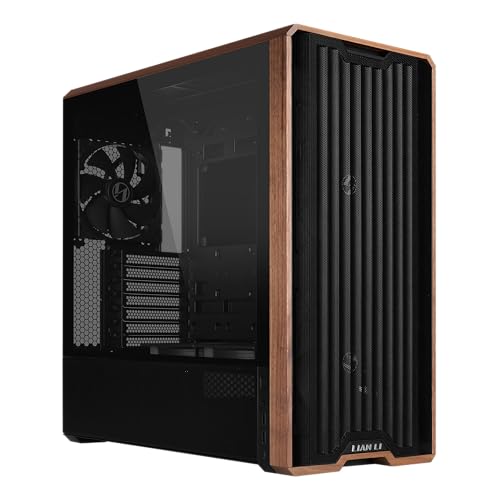
The LANCOOL 217 is where minimalism meets generosity. Its title lists five pre-installed PWM fans — two of 170mm, two of 120mm and one of 140mm — genuine wood panels in black walnut, readiness for back-connect motherboards, and flexible power-supply mounting. Most cases in this guide ask the owner to complete the cooling story; the 217 arrives with the story written. Those two enormous 170mm front fans are the heart of it, moving serious air at speeds low enough to stay discreet, behind a wood-trimmed front that keeps the whole apparatus looking like cabinetry.
Back-connect readiness is the other forward-looking detail: motherboards that move their connectors to the rear are the current direction of tidy building, and a case prepared for them will not strand its owner mid-fashion. Flexible PSU mounting adds a quieter kind of freedom, letting the builder balance cable runs and drive space. Altogether the 217 suits the enthusiast whose minimalism is about visual calm rather than component austerity — a full, powerful, carefully cooled machine that happens to wear walnut.
Strengths
- Five PWM fans pre-installed, including two 170mm units, is the richest factory fan package here.
- Genuine wood panels give the minimal silhouette a warm, furniture-grade finish.
- Back-connect motherboard readiness protects the case against the next layout fashion.
Trade-offs
- The title states no radiator ceiling, so liquid-cooling plans need the manufacturer’s documentation first.
- Five fans mean five cables to route well; the tidy result requires a tidy builder.
- Real walnut varies in tone, which is character to most eyes and inconsistency to a few.
Spec mini box
- Format: ATX mid-tower
- Pre-installed fans: two 170mm, two 120mm, one 140mm — all PWM
- Panels: genuine wood, black walnut finish
- Motherboard support: back-connect ready
- Power supply: flexible mounting
- Model: LAN217X
Best for: an air-cooled performance build that should read as furniture and arrive fully fanned.
Not suited for: a liquid-cooling plan that needs a stated radiator figure before money moves.
Count the fans in the LANCOOL 217 listing on Amazon and price what five equivalent fans would cost separately — the arithmetic is a large part of this case’s argument.

be quiet! Pure Base 501 Black
The Pure Base 501 is minimalism from the silence specialists: a compact ATX midi tower in black with two preinstalled 140mm PWM fans, airflow tuned around optimised air pressure, support for vertical graphics-card installation, and USB 3.2 Gen.2 Type C at the front. Where other minimal cases pursue calm by looking calm, be quiet! pursues it by sounding calm, and the 501’s restraint is acoustic before it is visual. The exterior is a plain black compact tower; the engineering is about moving air under pressure discipline so the fans never need to hurry.
Vertical GPU installation is the one flourish, and it is a considered one: in a compact case it can tidy the interior’s air path and present the card’s face rather than its edge. Combined with the pair of 140mm PWM fans — a size that suits quiet work — the 501 fits the creator or professional whose machine renders, compiles or games in a room where other people are trying to think. It is the smallest commitment in footprint here that still behaves like a full ATX build.
Strengths
- Two 140mm PWM fans preinstalled, sized and controlled for quiet operation.
- Compact midi-tower shell keeps the desk footprint modest for an ATX build.
- USB 3.2 Gen.2 Type C and vertical GPU support keep the feature list modern.
Trade-offs
- The title names no radiator figure, so AIO plans belong in the manufacturer’s documentation first.
- Vertical mounting may need an accessory riser arrangement; confirm what the box includes.
- Compact interiors ask for patience with cable routing around a long card.
Spec mini box
- Format: ATX midi tower, compact
- Preinstalled fans: two 140mm PWM
- Cooling design: optimised air pressure
- Graphics card: vertical installation supported
- Front connectivity: USB 3.2 Gen.2 Type C
- Colour: black
Best for: a compact, quiet ATX workstation on or under a desk in a shared room.
Not suited for: a build whose cooling plan starts with a large radiator and works backwards.
Look at the Pure Base 501 on Amazon if the machine will share air with conversation — its title’s emphasis on pressure and PWM control is the sound of a case designed to be ignored.

Fractal Design North (Charcoal, TG)
This North wears the other face of the design: where its mesh-sided sibling appears in our solid-panel guide, this configuration pairs the genuine walnut front with a dark tempered glass side panel, two 140mm Aspect PWM fans and Type C USB in an ATX airflow mid tower, finished in charcoal black. The dark tint on the glass is the minimal masterstroke — the interior is present but subdued, a shadow of components rather than a lit exhibition, and the walnut keeps the front in the world of furniture.
Choose this North when the build itself is tidy enough to deserve a subdued display and the room deserves better than a black box. Cable discipline becomes part of the aesthetic contract, since the glass shows silhouettes; builders who enjoy that discipline get the most design-led case in this guide. Readers weighing it against the mesh version should decide by room: mesh for maximum discretion and breathing, dark glass for a build that earns a quiet showing. Either way, the walnut front does the same diplomatic work with the rest of the furniture.
Strengths
- Genuine walnut front remains the most distinctive minimal material in the category.
- Dark tempered glass subdues the interior instead of exhibiting it.
- Two 140mm Aspect PWM fans and Type C USB are confirmed in the title.
Trade-offs
- The glass, dark or not, still asks for tidy cabling and careful handling.
- Mid-tower airflow designs reward sensible fan curves over brute speed.
- Wood grain and tone vary naturally between units.
Spec mini box
- Format: ATX airflow mid tower
- Front: genuine walnut wood
- Side panel: tempered glass, dark tint
- Included fans: two 140mm Aspect PWM
- Front connectivity: Type C USB
- Colour: charcoal black
Best for: a tidy, design-led build on a visible desk in a furnished room.
Not suited for: a rough-and-tumble transport routine, where glass of any tint is the wrong material.
For a machine that must survive regular travel, the carrying solutions in Best Military PC Cases territory are worth a look after you view the North in charcoal on Amazon and decide the glass earns its place.
How Do the Minimal Six Compare at a Glance?
| Case | Defining figure in the title | Fans named | Front Type-C | Panel story |
|---|---|---|---|---|
| NZXT H5 Flow | 360mm front radiator support | Two 120mm included | Not stated in the title | Tempered glass |
| ASUS Prime AP303 | GPU to 360mm, PSU to 180mm | One pre-installed | 20Gbps USB Type-C | Mesh panel design |
| Cooler Master Elite 502 Lite | GPU clearance 410mm | One 120mm named | Type C named | Tempered glass |
| Lian Li LANCOOL 217 | Five PWM fans, back-connect ready | Two 170mm, two 120mm, one 140mm | Not stated in the title | Genuine wood panels |
| be quiet! Pure Base 501 | Vertical GPU, optimised air pressure | Two 140mm PWM | USB 3.2 Gen.2 Type C | Compact closed tower |
| Fractal Design North (TG) | Walnut front, airflow mid tower | Two 140mm Aspect PWM | Type C USB | Dark tempered glass |
The table separates the guide into three temperaments. The H5 Flow, AP303 and Elite 502 Lite are airflow pragmatists with escalating clearance figures. The LANCOOL 217 and the North are material-led, betting on walnut to carry the minimal brief. The Pure Base 501 stands for the acoustic school, where minimal describes the sound signature as much as the silhouette. None of the six is the others’ rival in every respect; each is the answer to a differently worded version of the same request for calm.
A Second Look: Minimal Cases in Daily Service
Daily service tests minimalism differently from a product photograph. The H5 Flow’s test is the weekly desk reset: its compact shell and plain faces wipe down in seconds, the glass shows dust early enough to prompt a quick clean rather than a deep one, and the machine never becomes the visual excuse for a cluttered desk. Owners of airflow-first cases also learn the small discipline of keeping the front’s breathing path unobstructed by books and boxes — the case is honest about needing air, and repays the honesty with cool, quiet running.
The AP303’s daily story is told at the front panel. A fast Type-C port used every day changes habits: external drives live on the desk instead of in a drawer, footage gets ingested where the editor sits, and the reach-around-the-back ritual disappears. Cases earn their keep through such repetitions, and a port specification that looks like a line in a table becomes, in service, the most touched feature of the machine. The mesh front asks only for a vacuum’s brush attachment now and then.
The Elite 502 Lite proves itself on upgrade day. When a longer card arrives — and the direction of graphics hardware says it will — the 410mm clearance turns a potential case replacement into a simple swap. That is minimalism’s hidden economy: buy the unadorned box with the generous interior once, and stop buying boxes. Between upgrades, the intakes grill keeps a flagship build fed without the front ever needing to look like a jet intake.
The LANCOOL 217’s service story is about never opening the fan box in the cupboard. Five factory fans, including those two huge front units, mean the cooling conversation is finished at purchase; the owner’s remaining job is curves and dust. The walnut, meanwhile, does what walnut does in any room — it warms up the corner it occupies, and it makes the computer’s presence feel chosen rather than tolerated by the rest of the household.
The Pure Base 501 disappears in service, which is its design goal stated as an outcome. Compact, black, quiet under pressure-disciplined airflow, it becomes the case owners forget to mention when describing their setups — until a visitor asks why the room is so calm during a render. The North in glass form takes the opposite daily path: it stays present, a composed object on the desk, reminding its owner pleasantly that the machine was chosen, not merely assembled.
Matching Each Minimal Case to a Room and a Routine
Give the H5 Flow the student’s or the young professional’s desk: one monitor, a laptop beside it, a room that doubles as everything. Its compact shell leaves space for the rest of life, its glass side gives the build a finished feeling at the end of a first assembly, and its airflow-first front keeps a mid-range card cool through long evenings. The routine it suits is the ordinary heroic one — work by day, play by night, no ceremony either way.
The AP303 belongs to the desk that processes things: the photographer’s ingest station, the small-business workstation, the family machine that backs up every drive in the house. Its routine is transfer and throughput, and the fast front port plus generous power-supply room make it the case that never becomes the bottleneck in a working day. Mesh keeps it breathing through long exports, and the plain Prime styling keeps it credible in a client-facing office.
The Elite 502 Lite is the gamer’s concession to a grown-up room. Its routine is high-refresh play in a space shared with people who did not sign up for a light show — a partner, flatmates, a child asleep nearby. The flagship card inside gets its 410mm and its airflow; the room gets a plain black box with a glass side and nothing to apologise for. When the next card generation lands, the routine survives unchanged, which is the deepest compliment a case can earn.
The LANCOOL 217 suits the enthusiast who hosts: the desk friends gather around, the build people ask to see. Its walnut and its five fans make it both the furniture and the conversation, and back-connect readiness means the interior can be kept presentable enough to justify the attention. Its routine is the considered build, assembled slowly, photographed once, then used hard for years.
The Pure Base 501 takes the room where concentration is the currency — the writer’s study, the developer’s corner, the audio editor’s nook. Its routine is long, quiet sessions where the machine’s contribution should be results, not ambience. Compact enough to tuck beside a desk leg, calm enough to record voice in the same room, it is minimal in the sense a library is minimal: everything present, nothing performing.
The North in charcoal and glass claims the design-conscious living space: the desk that faces the sofa, the setup in the background of video calls with clients who notice rooms. Its routine is being seen, daily, and never once looking like an appliance that escaped from a server cupboard. Walnut does the diplomacy; the dark glass keeps the technology in a minor key; the owner simply gets on with work in a room that feels finished.
Minimalism in Practice: Light, Dust and Desk Discipline
A minimal case changes the owner’s habits in small, compounding ways. Lighting discipline comes first: with no built-in light show to manage, the desk’s illumination becomes a choice — a monitor light bar, a warm lamp — rather than a software settings page, and sleep in the same room improves in a way owners consistently underestimate before they experience it. Dust discipline follows: plain surfaces show a film honestly and wipe clean in one pass, glass shows it sooner and mesh hides it longest, and each owner settles into the rhythm their panel dictates. The Elite 502 Lite’s grill and the AP303’s mesh ask for a brush attachment monthly; the North asks for a cloth and a moment of care, like any wood in the house.
Desk discipline is the subtlest effect. A case that looks finished makes the surface around it look unfinished by contrast, and owners find cables getting channelled, peripherals getting chosen, the whole station rising to meet the case’s standard. That ratchet effect is a real, if unglamorous, benefit of buying design discipline: the minimal PC becomes the room’s quiet argument for order. It is also why these cases photograph well in ordinary rooms rather than only in studios — they were designed for the rooms most people actually have.
How Should You Choose a Minimal Case Without Losing Performance?
Start from the largest component you will plausibly own in the case’s lifetime, not the one in today’s basket. If a flagship card is even a maybe, the Elite 502 Lite’s 410mm or the AP303’s 360mm figures frame the decision. Then settle the cooling route: front-radiator builders have stated support in the H5 Flow and AP303 titles, air-cooling traditionalists are best served by the LANCOOL 217’s five-fan package, and quiet-first builders by the Pure Base 501’s pressure tuning. Minimalism narrows the exterior choices; it should never narrow these engineering ones.
Then interrogate the front panel of your daily life. List the devices plugged in weekly. A fast external drive habit points at the AP303’s 20Gbps port; a mixed modern desk is well served by the Type-C ports on the 501 and North. Finally, decide the material story — glass, mesh or walnut — by the room the case will actually sit in, at the hour it will mostly be seen. Minimal cases are bought with the eyes, and there is no shame in that, provided the figures were checked first.
What Does Minimalism Ask of the Builder?
It asks for honesty about the build’s interior, because several of these designs show it. Behind the H5 Flow’s glass or the North’s dark panel, a power supply with rainbow sleeving and a rats’ nest of spare cables will read as visual noise through the tint — the case supplies the calm, but the builder must not smuggle the chaos back in. The discipline is not onerous: route the cables once, properly; choose components in finishes that do not fight; resist the one glowing accessory that turns the whole composition into a before-and-after photograph. Builders who enjoy that discipline find minimal cases deeply satisfying to assemble, because the result looks intentional from every angle, including the one through the glass.
It also asks for restraint in expansion. A minimal desk setup stays minimal by deciding what belongs: one machine, its peripherals chosen rather than accumulated, storage moved to a network drive or a single fast external SSD on that AP303 port. The case becomes the anchor of a simpler desk ecology. Owners who treat it that way report the curious effect that the whole workstation gets upgraded less often and enjoyed more — the opposite of the styled build’s appetite for novelty.
Second Builds, Hand-Me-Downs and Resale
A minimal case has a second life that styled cases struggle to match. Handed down to a family member, it arrives as furniture rather than as a teenager’s cast-off gaming rig; offered for resale, its plain surfaces photograph honestly and its lack of lighting systems removes the commonest failure points a buyer worries about. The walnut-fronted designs hold a particular advantage here, since wood-fronted cases remain distinctive in a secondhand market full of black glass boxes. Even within one household, the minimal case migrates gracefully — from main desk to spare room to media corner — because nothing about its appearance ties it to a single era of its owner’s life.
That longevity loops back to the selection criteria used for this guide. Clearances with headroom, current ports, complete fan packages and honest materials are not just first-owner virtues; they are what make a case worth keeping, gifting or selling years later. Buy the minimal case as a decade-long object and the six titles above stop looking like a style shortlist and start looking like what they are: six different answers to the question of what a computer should look like while it grows old gracefully.
Why Does Minimalism Age Better Than Gaming Styling?
Styling dates because it references a moment: a film franchise, a racing aesthetic, a lighting fashion. Minimal design references proportions and materials instead, and those do not expire on the same schedule. A walnut front relates to furniture that predates computing; a flat black tower relates to hi-fi equipment that has looked similar for forty years. The practical consequence is that a minimal case can move from a student desk to a professional office to a living room across a decade without ever looking like it wandered in from a different life. For a component with the longest service life in the build, that portability across life stages is a genuine specification, even if no table prints it.
How Do Minimal Cases Handle Heat in Real Rooms?
Real rooms are warmer and dustier than review benches, and they impose the two conditions minimal cases must survive: a radiator against the wall in winter, a closed window in summer. The airflow-led picks here — H5 Flow, AP303, Elite 502 Lite — answer with working surfaces: perforated or mesh fronts and grills that keep intake area generous even when the room is warm. The fan-led answer is the LANCOOL 217’s: sheer installed volume, five PWM fans whose curves can be set to wake early on hot days. The pressure-led answer is the Pure Base 501’s, keeping internal airflow organised so components are washed by a deliberate stream rather than a general turbulence. All three strategies work; the owner’s part is placement and curves, not worry.
One habit matters more in a minimal case than in a glass showcase: listening. A showcase owner watches temperatures through the panel almost unconsciously; a minimal owner should schedule the same awareness deliberately — a monitoring widget during the first heatwave, a hand near the exhaust during a long render, a fan curve adjusted once and then trusted. The cases here give the tools for that relationship, from PWM control to generous radiator ceilings, and the relationship itself is what keeps a calm-looking machine calm-running for years.
The Economics of Buying Calm Once
There is a financial shape to minimalism that rarely gets stated. A styled gaming case tends to be replaced when its styling dates, often at the second or third build, and each replacement costs not only the new case but an afternoon of rebuilding. A minimal case, chosen with generous clearances and current ports, tends to be kept — through card swaps, platform changes and house moves — because nothing about it argues for replacement. Spread across three builds, the plainer box is frequently the cheaper box, and the money not spent on its successors migrates to components that actually change performance. The picks here were chosen with that arithmetic in mind: stated clearances with headroom, Type-C ports where the title offers them, fan packages that do not need immediate supplementing, and materials — walnut, mesh, plain black steel — that will still look intentional when the current styling cycle is a memory.
Common Mistakes When Buying a Minimal ATX Case
The first mistake is confusing minimal with small. Several picks here are compact, but minimalism describes surfaces, not dimensions — a full-size minimal case exists in spirit in this list’s larger shells, and squeezing a hot build into a tiny box for the look of it punishes the hardware daily. The second mistake is ignoring the fan inventory. Two of these titles name a single included fan; a builder who assumes a full set arrives will meet thermal reality on the first warm day. The third is treating the front port list as trivia, when it is the part of the case touched most often.
The fourth mistake is buying glass for a build that will not be kept tidy, or mesh for a room where the interior’s shadow-play will irritate. The fifth is forgetting the next graphics card: clearance figures are stated plainly in these titles precisely so the mistake is avoidable. Read them, measure the desk, count the fans, and the minimal case will reward the discipline with years of not being thought about.
What Should You Verify in the Full Listing Before Ordering?
Minimal cases reward a particular kind of pre-order care, because their titles — like the designs — omit some things deliberately. Where a radiator figure is absent, as with the LANCOOL 217 and Pure Base 501, treat the manufacturer’s documentation as the deciding document before an AIO is ordered. Where a fan count is singular, as with the AP303 and Elite 502 Lite, price the additional fans the build will want and add them to the same order, so the build is not paused mid-assembly. Confirm the front port list against the devices on the desk today, confirm the graphics-card measurement against the specific card model rather than its family name, and confirm what a vertical-mounting claim requires in the box. None of this is suspicion; it is the ordinary diligence of buying the least-upgraded component in the machine, and five minutes of it protects a decade of service.
It is also worth deciding, before the box arrives, where the case will breathe. Minimal designs often hide their intakes elegantly — under a front edge, behind a grill, through a mesh — and a case pushed flush against a wall or a bookshelf side can quietly strangle the very airflow its title promises. Leave the clearances the documentation asks for. A minimal case in a well-chosen spot, fed with air and kept on a simple cleaning rhythm, will look and run in year five much as it did in week one, which is the entire promise of the style.
Frequently Asked Questions
Does a minimal case have to be small?
No. Minimalism is about surface discipline. The LANCOOL 217 is a full ATX mid-tower with five fans and wood panels; nothing about it is small except its visual noise.
Can a minimal case cool a flagship graphics card?
Yes, when the airflow design and clearance are chosen for it. The Elite 502 Lite pairs a high-airflow intake design with 410mm of card room, and the LANCOOL 217 ships five PWM fans for exactly this class of build.
Is tempered glass compatible with a minimal look?
It can be the minimal look, particularly in the North’s dark-tinted form, where the interior reads as a subdued shadow. The contract is tidy cabling; a chaotic interior behind glass is neither display nor minimal.
What does back-connect ready mean on the LANCOOL 217?
Newer motherboards are moving their connectors to the board’s rear face for cleaner interiors. A case described as back-connect ready has the openings and clearances to accommodate those boards.
Which pick is quietest by design intent?
The Pure Base 501, from a manufacturer specialising in quiet hardware, with pressure-optimised airflow and 140mm PWM fans. Individual results still depend on the components and fan curves chosen.
At the Desk: Sound, Sight and Touch, Case by Case
Sit with the H5 Flow for an evening and the first thing noticed is how little there is to notice. The front is a calm, dark plane; the glass reveals a tidy interior without tinting the room’s light; the fans, working through an airflow-led front, produce the low, even wash that the ear learns to delete within minutes. Under a game load the note rises but stays featureless, which is the acoustic signature of a case that was designed around air first and styling second. To the touch, during a drive swap or a cable adjustment, it feels like the compact it is — everything within a short reach, nothing requiring the case to be dragged out from the desk and turned around twice.
The AP303 at the desk is a more businesslike presence. The mesh front gives it a faintly technical texture, closer to studio equipment than to furniture, and its sound under load is the honest sound of air through mesh — present, uncoloured, and easy to place. What the senses remember most, though, is the front port: the small daily click of a fast drive connecting without a journey around the back of the machine. Over months, that single convenience outweighs several specification lines, and it is why working desks, rather than showcase desks, are this case’s natural habitat.
The Elite 502 Lite feels like the heavyweight it serves. With a flagship card installed, the grill-fed front keeps a deep, unhurried airflow moving, and the case’s presence is felt mostly as capability — the knowledge that nothing inside is short of breath or room. Visually it stays in the black-box register, glass side and all, and in a shared room that anonymity is a social feature: the most powerful machine in the house is also the least commented upon, which is precisely the arrangement its owner bought.
The LANCOOL 217 changes the desk’s temperature in both senses. The walnut warms the sightline, and the two great front fans, turning slowly behind it, produce the softest full-size airflow note in this guide — more weather than machinery. Opening it for a drive or a card reveals the other half of its character: a spacious, fan-rich interior that feels provisioned rather than merely empty. It is the case most likely to be touched appreciatively in passing, the way people touch good wood without thinking about it.
The Pure Base 501 is the introvert of the six. Compact, matte, nearly silent at working loads, it asks the senses for nothing and gives back a room that sounds like a room. Recording a voice memo beside it, joining a call, reading while a render runs — the case never enters the account of the day. Owners who value that absence describe it in almost affectionate terms, the way people praise a good chair: it disappears, and everything else gets easier.
The North in charcoal and glass is the one that gets looked at, deliberately and with pleasure. Morning light through the walnut, the dark glass holding the interior in silhouette, the whole object sitting on the desk like a piece of audio equipment from a more elegant decade — it earns its visibility rather than demanding it. Its sound is a gentle airflow murmur when the 140mm fans are curved kindly, and its daily sense-impression is of a machine that has been civilised. For the right room, that civilisation is the entire point of the purchase.
Do minimal cases hold their value?
Better than styled ones, as a rule. Plain finishes photograph honestly, there are no lighting systems to fail, and a walnut or matte black exterior suits the next owner’s room as easily as the first one’s. Combined with the generous clearances in several of these titles, that makes the minimal case the rare component that can be resold or handed down without an apologetic paragraph in the listing, and it is one more reason the style keeps gaining ground among builders planning a second decade of upgrades rather than a second season of novelty.
Final Recommendation
Let the deciding figure find you. If it is front-port speed, the ASUS Prime AP303 stands alone here. If it is graphics-card future-proofing, the Cooler Master Elite 502 Lite’s 410mm settles the argument. If the build should arrive fully fanned and warmly finished, the Lian Li LANCOOL 217 is the complete package, and if the room is the real client, the Fractal Design North in charcoal and walnut is the case guests will ask about. The NZXT H5 Flow remains the balanced first step into airflow minimalism, and the be quiet! Pure Base 501 the connoisseur’s compact quiet tower. Minimalism, done this well, is not a compromise made for appearances — it is what a PC looks like when nothing is left to take away.
Two parting checks protect the choice. First, lay the intended graphics card’s true length beside the figure in the title of the case you favour — not the card family’s typical length, the specific model’s, cooler shroud included — and leave a margin for cables and sanity. Second, stand where the case will stand and look at the spot for ten seconds: imagine a black slab there, a mesh front there, a walnut front there. The imagination test sounds unscientific and is in fact the most reliable predictor of five-year satisfaction with a minimal case, because the figures merely permit the purchase while the room ratifies it.
Whichever of the six earns the desk, the deeper satisfaction is the same: a machine that stops asking for attention it has not earned. Buy the calm, keep the change for components, and let the loudest thing in the room be the work itself. Months later, when the setup has settled into the background of a well-run room and the only reminder of the decision is how rarely the case crosses your mind, the minimal brief will have proved itself in the only court that matters — daily life, uninterrupted.


