What's inside
- Key Takeaways
- Quick Picks
- How Were These Rugged Cases Chosen?
- The Six Entries, Reviewed in Full
- How Do the Six Entries Compare at a Glance?
- Military-Grade Marketing Versus MIL-STD Reality: What Is the Difference?
- How Should You Choose Between a Rugged Chassis and a Hard Transport Case?
- Rugged at Home: Workshops, Garages, Dorms and Site Cabins
- Steel, Thickness and the Fingertip Test
- The Logistics Mindset: Treating a PC as Equipment
- A Second Look: The Four Chassis in Daily Service
- Six Entries, Six Postings
- What About Dust, Moisture and Field Maintenance?
- Common Mistakes When Buying a Military-Styled Case
- How Should You Vet a Toughness Claim in Any Listing?
- Olive, Black and the Semiotics of the Rugged Desk
- Frequently Asked Questions
- Building the Rugged Machine: Component Choices That Match the Case
- Final Recommendation
- Related Guides
As an Amazon Associate I earn from qualifying purchases. This post may contain affiliate links at no extra cost to you.
widgetverdict.com is reader-supported. When you buy through links on our site, we may earn an affiliate commission.
Where to buy: The CORSAIR WARTHOG in Olive Drab opens the linked picks and its Amazon listing is the first stop; the other three chassis are linked inside their reviews. The final two entries are transport hard cases discussed in prose only, deliberately without purchase links, because they are a different kind of product and deserve a different kind of reading.
The best military pc cases require an honest paragraph before any product names, because the word military does two different jobs in this market. In its strict sense, military specification means tested standards — the MIL-STD family of procedures that subject equipment to defined drops, vibrations, humidity and dust, with pass marks recorded by laboratories. In its common retail sense, military usually means a look and a construction attitude: olive drab paint, steel instead of plastic, angular reinforcement, a brand line built around toughness. No consumer gaming case in this guide claims laboratory certification in its listing title, and this guide will not pretend otherwise. What the four linked chassis offer is the second sense done well — durable materials, serious frames, designs that shrug off the knocks of real rooms — and the final two entries offer the first sense’s civilian cousin: hard transport cases, the kind of protection that actually travels with equipment into rough places.
That split is the guide’s structure, and it is deliberate. Slots one to four are computer cases you build a PC inside: a steel-framed Corsair in olive drab, a dual-chamber ASUS from the TUF line, a compact heavy-steel Zalman, and an SPCC steel Thermaltake. Slots five and six are not computer cases at all. The Pelican 1495 and the Durabox are hard transport cases — protective shells you carry a computer or equipment inside, not chassis you mount a motherboard into. They are included, in prose and without links, because a reader searching this phrase often wants protection for a machine that must survive a journey, and honesty about which product does which job serves that reader better than six lookalikes would.
Judge the four chassis, then, on construction evidence in their titles: frame material, steel thickness where stated, cooling capacity that implies structural ambition, and the design lineage of the line. Judge the two hard cases on their category’s terms — shell, dimensions, weather intent. And if the machine’s real enemy is the journey rather than the room, start from our transport thinking in Best Easily Portable PC Cases and treat this guide’s last two entries as the heavy-duty end of that conversation.
Key Takeaways
- Military, on consumer cases, describes styling and construction attitude — no listing title here claims certified MIL-STD testing.
- The CORSAIR WARTHOG pairs an olive drab finish with a steel frame, modular fan mounting and dual 360mm radiator support.
- The ASUS TUF Gaming GT502 Horizon brings a dual-chamber layout with independent cooling zones for processor and graphics card.
- The Zalman CUBIX states heavy-duty 0.8T steel in a compact micro-ATX and mini-ITX shell.
- The Thermaltake Versa H21 is the plain SPCC steel workhorse of the set.
- Slots five and six are transport hard cases, not chassis — included in prose, without links, for readers whose real problem is the journey.
Quick Picks
- Best Military Look With Real Structure — CORSAIR WARTHOG Airflow Mid-Tower Case (Olive Drab): a durable mid-tower with a steel frame, high airflow and fan capacity, modular fan mounting and dual 360mm radiator support.
- Best Engineered Toughness — ASUS TUF Gaming GT502 Horizon ATX Case: a panoramic dual-chamber mid-tower supporting 360mm radiators and 400mm graphics cards, with independent cooling zones.
- Best Compact Steel — Zalman CUBIX Compact Micro-ATX MATX Mini ITX PC Case: heavy-duty 0.8T steel, an 80mm fan fitted, room for an ATX power supply, USB 3.0, across micro-ATX, mini-ITX and related small formats.
- Best Plain Steel Value — Thermaltake Versa H21 ATX Mid Tower: an SPCC steel ATX mid tower in black, model CA-1B2-00M1NN-00, with no decorative ambitions.
- Prose-Only: Hard Transport, Laptop Class — PELICAN 1495 Deluxe Computer Case: a rigid protective transport case from the best-known name in equipment shells; not a chassis, and presented without a purchase link by design.
- Prose-Only: Hard Transport, Compact — Durabox All Weather Hard Case 16 x 14 x 4: an all-weather hard case in a 16 by 14 by 4 inch format for equipment protection on the move; again, a transport shell, not a PC case.
How Were These Rugged Cases Chosen?
The first filter was material honesty. A pick had to ground its toughness in something checkable from its title — a steel frame, a stated steel type or thickness, a line whose engineering brief is durability. Paint alone did not qualify a case; paint plus structure did, which is why the WARTHOG’s olive drab rides on a steel frame and the CUBIX’s compact shell is specified as heavy-duty 0.8T steel. The second filter was capability under the armour: a rugged case that cannot cool a modern build is a costume, so radiator support, fan capacity and graphics-card room were weighed wherever titles state them.
The third decision was the guide’s honest architecture: reserving two slots for transport hard cases, in prose, because the search intent behind this phrase divides between people wanting a tough-looking build and people wanting a machine to survive being moved through the world. Serving the second group with two more gaming chassis would have been a failure of candour. The hard cases are described from their category facts — maker, format, stated purpose — without invented specifications and without links, so the comparison stays clean. Readers whose priority is a quiet home machine rather than a rugged one will find the opposite design philosophy in Best Quiet Pc Mid Tower Cases.
The Six Entries, Reviewed in Full

CORSAIR WARTHOG Airflow Mid-Tower Case (Olive Drab)
The WARTHOG is the pick that wears the theme openly: a durable mid-tower in olive drab, built on a steel frame, with high airflow and fan capacity, modular fan mounting and dual 360mm radiator support. Read the title in order and the priorities declare themselves — colour first for the eye, then frame, then cooling. That order is actually reassuring. A case trading purely on military paint would stop at the colour; this one continues into structure and a cooling specification that would satisfy a purely civilian performance brief, with room for two 360mm radiators and a fan layout the owner can rearrange.
Modular fan mounting is the sleeper feature. It lets the builder reconfigure the airflow as the build evolves — more intake for a hotter card, a different arrangement for a radiator — rather than accepting a fixed pattern for the case’s whole life. In a workshop, a garage studio, a room where the PC shares space with tools and projects, the steel frame and the drab, scuff-forgiving finish make daily sense. This is the case for a powerful machine that works in a place where things get knocked, carried and used hard.
Strengths
- Steel frame gives the military styling a structural foundation.
- Dual 360mm radiator support is serious cooling headroom for a mid-tower.
- Modular fan mounting lets the airflow layout evolve with the build.
Trade-offs
- Olive drab is a commitment; it will not disappear into a pale, minimal room scheme.
- The title states no front-port list, so connectivity should be confirmed on the full listing.
- High fan capacity invites a fan purchase to fill it; budget for the full layout.
Spec mini box
- Format: mid-tower
- Frame: steel
- Finish: olive drab
- Cooling: high airflow design, modular fan mounting
- Radiator support: dual 360mm
- Front ports: the title does not enumerate them, so check the manufacturer’s documentation before planning peripherals around the panel
Best for: a high-performance build in a workshop, studio or gaming room that suits an olive, utilitarian finish.
Not suited for: a pale Scandinavian desk scheme, where olive drab becomes the loudest object present.
Inspect the WARTHOG listing on Amazon for the fan-mounting diagrams — the modular layout is the feature to picture against your own cooling plan.

ASUS TUF Gaming GT502 Horizon ATX Case
The TUF line is ASUS’s durability-branded family, and the GT502 Horizon expresses toughness through engineering rather than colour: an ATX mid-tower with a panoramic design, support for 360mm radiators and 400mm graphics cards, a dual-chamber layout, and independent cooling zones for the processor and the graphics card. The dual-chamber idea is the substantive one. By giving the two hottest components their own thermal territories, the case stops them from pre-heating each other’s air — a layout decision with measurable consequences under sustained load, and the sort of toughness that matters at hour three of a render rather than in a photograph.
The 400mm graphics-card figure places it at the generous end of mid-tower clearance, and the panoramic design means this is the showpiece of the four chassis: a build displayed, but displayed inside a structure from a line whose brief is endurance. Choose it when the machine must be both presentable and hard-working — a streamer’s rig, a studio workstation, a gaming PC in a room where it will be seen by people who notice build quality. TUF’s military echo is in the name and the brief; the case itself argues in chambers and millimetres.
Strengths
- Dual-chamber layout with independent CPU and GPU cooling zones is genuine thermal engineering.
- 400mm graphics-card support covers the largest current cards.
- 360mm radiator support keeps liquid-cooling options open.
Trade-offs
- Panoramic glass is a display feature, and glass remains the fragile material in any rough environment.
- Dual-chamber cases are wider than conventional mid-towers; measure the desk space.
- The title does not state included fans, so the cooling budget should assume additions.
Spec mini box
- Format: ATX mid-tower
- Layout: dual-chamber, panoramic design
- Cooling zones: independent for CPU and graphics card
- Radiator support: 360mm
- Graphics-card support: up to 400mm
- Line: TUF Gaming
Best for: a powerful, visible build that must sustain heavy loads without its two hottest parts cooking each other.
Not suited for: genuinely rough transport duty, where a panoramic glass design is the wrong tool entirely.
Study the chamber diagrams on the GT502 Horizon listing on Amazon — the cooling-zone split is the reason to choose this case over a conventional tower.

Zalman CUBIX Compact Micro-ATX MATX Mini ITX PC Case
The CUBIX makes its toughness claim in the most literal way on this list: heavy-duty 0.8T steel, a stated material thickness, in a compact case spanning micro-ATX, MATX and mini-ITX boards, with an 80mm fan fitted, room for an ATX power supply, and USB 3.0 at the front. In a category of adjectives, a number is a relief. Steel thickness is what fingers feel when they flex a panel and what a case relies on when it is carried, stacked against or knocked — and a compact steel box is inherently harder to damage than a large one, because its panels span shorter distances.
The format list tells the rest of the story: this is a small-form-factor and home-theatre-adjacent case, the kind that serves in a media corner, a small office, a dorm, a workshop bench PC. Accepting an ATX power supply is a practical kindness, sparing the owner the hunt for a compact PSU, and the single 80mm fan sets honest expectations — this is a case for modest, efficient builds, not for flagship heat. Within that brief, the CUBIX is the most materially serious small case here, a little steel strongbox for a little computer.
Strengths
- Heavy-duty 0.8T steel is a stated, checkable toughness figure.
- Compact shell suits micro-ATX, MATX, mini-ITX and related small formats.
- Fits an ATX power supply, easing parts selection and reuse.
Trade-offs
- A single 80mm fan signals modest cooling; hot components are out of scope.
- Compact interiors demand low-profile planning for coolers and cards.
- USB 3.0 is the stated front standard — no faster port is claimed.
Spec mini box
- Format: compact, micro-ATX / MATX / mini-ITX (also ITX, DTX, SFF, HTPC positioning in the title)
- Material: heavy-duty 0.8T steel
- Fan: one 80mm fitted
- Power supply: ATX size accepted
- Front connectivity: USB 3.0
- Colour: black
Best for: a compact, efficient build for a bench, media corner or small office where steel matters more than size.
Not suited for: a flagship graphics card and a tall cooler, which belong in the full towers above.
Small-build planners should read the CUBIX on Amazon with their cooler’s height in hand — in a steel box this compact, that single measurement decides the build.
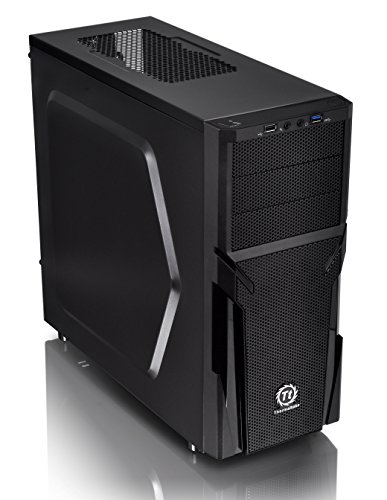
Thermaltake Versa H21 ATX Mid Tower
The Versa H21 is the list’s plain soldier: an ATX mid tower in SPCC steel, black, carrying the model code CA-1B2-00M1NN-00 and no decorative claims whatsoever. SPCC is the standard cold-rolled steel of the case industry — unglamorous, well understood, and the material of countless office and workshop machines that have run for a decade without a thought. In a guide about military character, the H21 represents the procurement end of the idea: a serviceable steel enclosure, bought for fleets and benches, that does its job without asking to be admired.
That plainness has real virtues. A standard steel mid-tower is easy to build in, easy to replace, and anonymous in any room — the case for a second machine, a test bench, a family PC in a utility space, a build whose budget belongs in the components. Its title’s silence on cooling figures and ports should be read as the listing’s brevity rather than the case’s incapacity, and the full product page is where a buyer confirms the details. But the proposition is clear enough: steel, space, black, done.
Strengths
- SPCC steel construction in a standard ATX mid-tower format.
- Anonymous black styling suits offices, benches and utility rooms.
- A long-serving model line means a well-understood, conventional build experience.
Trade-offs
- The title states no radiator, fan or port figures, so the full listing must be read before planning.
- No military styling to speak of — the toughness here is material, not theatre.
- Builders wanting modern front connectivity should verify the panel on the product page.
Spec mini box
- Format: ATX mid tower
- Material: SPCC steel
- Model: CA-1B2-00M1NN-00
- Colour: black
- Cooling and port figures: the title is silent on these, so the manufacturer’s documentation should be consulted before a parts list depends on them
Best for: a bench, office or second-machine build in a standard steel enclosure at the practical end of the market.
Not suited for: a showcase build, or a parts list that needs stated radiator support before purchase.
Confirm the panel and fan details on the Versa H21 listing on Amazon — with a workhorse like this, the small print is the specification.
PELICAN 1495 Deluxe Computer Case (Transport Hard Case)
Now the category changes, and the change must be stated without blur: the Pelican 1495 is not a computer case in the chassis sense. Nothing mounts inside it permanently; no motherboard has ever been screwed into one as a build. It is a hard transport case from Pelican, the maker whose rigid shells carry cameras, instruments and field equipment for professionals whose gear must arrive working. The 1495 belongs to the company’s computer-case line — a protective shell sized around carrying a laptop-class machine and its kit — and its presence in this guide is as the honest answer to a real version of the military question: not how a PC looks, but how equipment survives being moved through the world by people and vehicles that do not love it.
Pelican’s reputation rests on the properties a gaming case never claims: rigid shells that take impacts on their structure, closures that keep weather and dust on the outside, interiors configured to cradle contents against shock. A field technician, a photographer with a laptop workstation, a surveyor with delicate electronics — these are the 1495’s people. For a desktop builder, its lesson is about the journey rather than the build: if a machine must travel through freight, weather or other people’s handling, this class of product, sized correctly for the cargo, is the proportionate protection. It is presented here in prose, without a purchase link, because it answers the transport half of the military question and should be considered on that basis, from the maker’s own documentation, rather than impulse-bought beside chassis.
Strengths
- Pelican’s hard-shell transport pedigree is the genuine article in equipment protection.
- Rigid case format suits freight, weather and third-party handling.
- Computer-case line sizing is aimed at carrying a machine and its kit.
Trade-offs
- It is not a chassis: no PC can be built or run inside it.
- Sized around laptop-class cargo, not a desktop tower.
- Protection of this class is bought deliberately, from documentation, not on impulse.
Spec mini box
- Type: hard transport case (protective shell)
- Maker: Pelican
- Line: 1495 Deluxe Computer Case
- Role: carrying and protecting equipment in transit
- Not a: PC chassis — no components mount inside for a running build
Best for: protecting laptop-class equipment through freight, weather and rough handling.
Not suited for: housing a desktop build, which it cannot do in any configuration.
No purchase link is provided for this entry by design. Readers whose journeys demand this class of protection should work from Pelican’s own sizing documentation and choose the shell against the cargo’s measured dimensions.
Durabox All Weather Hard Case 16 x 14 x 4 (Transport Hard Case)
The Durabox makes the same honest category statement in a smaller format: an all-weather hard case, 16 by 14 by 4 inches, for protecting equipment in transit and storage. Like the Pelican, it is a shell, not a chassis. Its stated dimensions describe its world precisely — this is a case for compact, valuable, damage-averse cargo: a small device, an instrument, a drive enclosure, a kit of delicate parts that must cross a wet car park, a site, a season in storage, and arrive unchanged. The all-weather claim is the point of the product type: a rigid, closing shell between the cargo and the climate.
Its inclusion completes the guide’s argument. The military idea, pursued honestly, ends at logistics — at the unglamorous truth that equipment survives through shells, foam, seals and handles far more than through styling. A builder whose desktop lives at home needs none of this; a technician whose tools and small systems travel weekly may need exactly this, in this size, and the 16 by 14 by 4 format is stated plainly enough to judge against a tape measure. As with the Pelican, the entry is prose-only and link-free: it is guidance about a category, offered so the reader buys the right kind of thing from the right documentation, not a chassis recommendation wearing a disguise.
Strengths
- All-weather hard-shell format aimed at protection in transit and storage.
- Stated dimensions — 16 x 14 x 4 inches — make fit a measurement, not a guess.
- Suits compact, delicate cargo that a soft bag would under-protect.
Trade-offs
- Not a PC chassis in any sense; nothing builds or runs inside it.
- The compact format excludes towers and most full-size equipment.
- Interior arrangement details belong to the maker’s documentation, not this guide.
Spec mini box
- Type: all-weather hard transport case
- Stated size: 16 x 14 x 4 inches
- Role: equipment protection in transit and storage
- Not a: PC chassis — a protective shell for cargo
Best for: compact, delicate equipment that travels or stores in uncontrolled weather.
Not suited for: any desktop build, or cargo larger than its stated inches.
No purchase link accompanies this entry either. Treat it as a pointer to a product class: measure the cargo, then consult the maker’s documentation for the shell that matches it. Readers speccing a retro drive-bay build in a steel tower, meanwhile, will find the chassis-side conversation in Best PC Cases With 5.25 Drive Bays.
How Do the Six Entries Compare at a Glance?
| Entry | Kind | Toughness evidence in the title | Headline capability |
|---|---|---|---|
| CORSAIR WARTHOG | PC chassis, mid-tower | Steel frame, olive drab | Dual 360mm radiators, modular fans |
| ASUS TUF GT502 Horizon | PC chassis, ATX mid-tower | TUF durability line, dual-chamber structure | 400mm GPU, independent cooling zones |
| Zalman CUBIX | PC chassis, compact | Heavy-duty 0.8T steel | ATX PSU in a small steel shell |
| Thermaltake Versa H21 | PC chassis, ATX mid-tower | SPCC steel | Plain standard-format workhorse |
| PELICAN 1495 | Transport hard case | Pelican hard-shell pedigree | Prose-only; not a chassis |
| Durabox All Weather | Transport hard case | All-weather rigid shell | Prose-only; 16 x 14 x 4 in |
The table is really two tables wearing one heading, and keeping them distinct is the guide’s service to the reader. The first four rows compete as homes for a computer; the last two do not compete with them at all, because they protect computers and equipment from the outside during journeys. Confusing the two kinds is the category’s founding error, and every honest guide to this phrase should refuse to make it.
Military-Grade Marketing Versus MIL-STD Reality: What Is the Difference?
The phrase military-grade has no regulated meaning in consumer marketing. It can describe a product tested against a named standard, a product built from materials also used in military equipment, or a product whose designer liked the aesthetic — and the packaging rarely says which. MIL-STD, by contrast, is a family of published test regimes with defined procedures: drops from specified heights onto specified surfaces, vibration profiles, thermal and humidity cycles, dust and immersion exposures, each with recorded outcomes. Equipment genuinely procured against those standards carries documentation saying so, in those terms.
No title in this guide makes such a claim, and the correct reader response is not disappointment but calibration. A steel-framed case is genuinely tougher than a plastic one for the hazards of a room — knocks, flex, thread wear, years of panel removals — and that toughness is worth buying for those hazards. It simply is not a promise about drops onto concrete or monsoon exposure, and a buyer whose machine faces those hazards should be shopping the transport-shell category, with test documentation in hand, rather than trusting a colour. Honest guides owe readers that boundary line, drawn brightly.
How Should You Choose Between a Rugged Chassis and a Hard Transport Case?
Ask where the danger lives. If the danger lives in the room — a workshop’s knocks, a shared house’s traffic, a decade of upgrades flexing panels — the answer is a rugged chassis: steel where it counts, structure behind the styling, cooling that does not apologise. The WARTHOG and the CUBIX answer that danger at two sizes; the GT502 answers it with thermal engineering; the H21 answers it with plain procurement sense. If the danger lives on the road — freight, weather, strangers’ handling — the answer is a hard transport shell sized to the cargo, and the chassis question becomes secondary, because the best-protected tower is the one whose journey was engineered, not merely whose panels are thick.
Many real setups need both, in sequence: a steel case for the years at the desk, a proper shell for the one journey that matters. Buying them in that order, each for its own hazard, is the genuinely military approach — logistics first, aesthetics where they belong.
Rugged at Home: Workshops, Garages, Dorms and Site Cabins
The environments that actually test a case are rarely dramatic. A workshop PC lives with vibration from benches, dust that finds every seam, temperature swings between a cold morning and a warm afternoon, and the occasional contact with a carried plank or a toolbox. Steel panels and a real frame are the difference between a case that treats that life as normal and one that slowly loosens, rattles and scars. The WARTHOG was styled for this postcode, and the CUBIX — compact, thick-skinned, cheap to place out of harm’s way on a shelf — is its bench-sized counterpart. Neither needs to be believed in as battlefield equipment; both need only be believed in as workshop equipment, which is the claim their materials actually support.
The dorm and the shared house run a different audit: traffic. Doors, guests, vacuum cleaners, the friend who uses the case as a footrest or a coaster. A rugged chassis in that setting is social armour — the machine survives the semester’s accidents without its owner becoming the person who polices the room. The GT502’s glass complicates that story and suits the tidier end of shared living, while the H21’s anonymity is itself a defence: nobody leans a drink on a case they barely notice, and nobody’s younger sibling targets it for stickers.
The site cabin and the field office complete the picture: machines that work in portacabins, site offices, festival production compounds and farm buildings, where the floor is not level, the air is not filtered and the PC is a tool among tools. Those settings are the honest civilian frontier of the military idea, and they explain why this category persists. The correct equipment response is layered — a steel chassis for the room’s hazards, a hard shell for the journey between sites, and no illusions about which layer answers which threat.
Steel, Thickness and the Fingertip Test
There is a simple physical literacy to case steel that marketing rarely teaches. Press a side panel with a fingertip: a thin panel drums and flexes, announcing its gauge before any specification is read; a heavy panel answers with a dull solidity. Thickness governs more than impact resistance. It governs how a panel sounds when a fan vibrates against it, how threads hold after the fiftieth removal, how a case feels when carried by one edge. The CUBIX’s stated 0.8T figure is valuable because it converts that fingertip knowledge into a number a buyer can compare before purchase, and the WARTHOG’s steel frame moves the same virtue into the structure itself, where it matters most when a loaded case is lifted.
Steel type tells a complementary story. SPCC, the H21’s material, is the industry’s standard cold-rolled sheet — consistent, formable, proven across millions of enclosures. Nobody should apologise for it, and nobody should crown it either; it is the correct material for a workhorse, and its presence in a title signals a maker describing a product honestly. Between the fingertip test, a stated gauge and a named steel, a buyer has nearly everything knowable about a case’s toughness without a laboratory — which is fortunate, because the laboratory reports belong to a different market and a different price conversation entirely.
The Logistics Mindset: Treating a PC as Equipment
Military organisations are, at their competent core, logistics organisations, and the transferable lesson for PC owners is procedural rather than material. Equipment that must work after movement is inventoried, packed to a standard, and checked on arrival. A home or studio that adopts even a light version of that discipline — a known-good photograph of the build, a packing routine for journeys, a hard shell for the moves that justify one, a steel case for the room it lives in — gets nearly all the real-world benefit that the military aesthetic gestures at. The products in this guide are the purchasable half of that discipline; the other half is habit, and habit is free.
That mindset also reframes value. A case bought as equipment is judged on service life and failure modes, not on launch-day glamour. Steel that shrugs off a decade, a layout that accepts three generations of components, a shell that outlives the machine it first carried — these compound quietly, the way good logistics always does, invisibly, until the day everything arrives working and nobody can remember why they ever worried.
A Second Look: The Four Chassis in Daily Service
Daily service is where rugged claims are audited. The WARTHOG’s audit is conducted by its environment: a garage studio’s temperature swings, a workbench’s vibration, the occasional carried-by-one-hand move between rooms. A steel frame does not notice these things, and the drab finish hides the evidence of the ones it does notice. The modular fan mounting, meanwhile, turns out to be a service feature as much as a cooling one — a failed or dusty fan can be rethought rather than merely replaced in kind.
The GT502’s audit is thermal and temporal: long sessions, back to back, in a warm room. Dual chambers age well because their advantage compounds — components that run cooler live calmer lives, and a layout that separates heat sources keeps its composure in year three as in week one. The CUBIX’s audit is conducted by small spaces and frequent handling; compact steel boxes get picked up, slid, stacked beside, and the 0.8T panels are the difference between a case that accumulates dents and one that accumulates only dust. The H21’s audit is the simplest: it is still there, still black, still holding a machine, asking nothing — the workhorse’s entire eulogy and recommendation in one sentence.
Six Entries, Six Postings
Post the WARTHOG to the garage studio: a room with a bench, a bike in the corner, music work and gaming sharing one powerful machine. The olive finish belongs among tools, the steel frame ignores the environment’s small violence, and the dual radiator ceiling means the build inside never has to be the modest one. Its posting is permanent — this is a case that stays where it is put and anchors the room’s working end.
Post the GT502 Horizon to the production desk: streaming, editing, long sessions under lights, a machine whose thermals are a professional concern. The dual chambers keep the two furnaces apart through marathon workloads, the panoramic side shows a build kept tidy enough to deserve showing, and the TUF brief — endurance as identity — matches an owner whose income rides on the machine finishing the job.
Post the CUBIX to the bench itself: the little steel box that runs the workshop’s media, the test rig, the small office’s quiet servant. It will be picked up, slid aside, stacked upon and wiped down for years, and its thick panels will keep the ledger of those years as patina rather than damage. Small steel is an underrated category; this is its argument in one product.
Post the Versa H21 to the fleet: the classroom corner, the family utility room, the second machine that exists to work. Nobody writes poems about it, and that is its posting orders fulfilled. When it is replaced in a decade, it will be because the components aged out, not because the enclosure failed, and its successor will very likely be whatever then occupies this same plain, correct niche.
Post the Pelican 1495 to the road crew: the technician’s car, the photographer’s freight, the field kit that crosses weather and handling chains. It does not care about desks. Its posting is the journey itself, repeated until the shell’s latches and structure have repaid their deliberateness many times over — and it accepts that posting in a category this guide deliberately keeps separate from chassis, because logistics is a profession, not an accessory.
Post the Durabox to the damp corner of the operation: the site store, the boat shed, the van that lives outside. Sixteen by fourteen by four inches of all-weather stubbornness for the small cargo that must not get wet, dusty or crushed between seasons. Its posting is storage as much as travel — the long, quiet guard duty that decides whether equipment works when it is finally called for.
What About Dust, Moisture and Field Maintenance?
Rugged settings generate rugged dirt. Workshop dust is abrasive and conductive in ways living-room dust is not; site air carries moisture and grit; garages swing through dew points. A steel chassis answers with cleanability — panels that can be removed, wiped and even washed, interiors that tolerate a brush and an air blower without cosmetic anxiety — and with the structural indifference to be opened often. Maintenance in such rooms should be scheduled like tool maintenance: filters and fans on a calendar, interiors inspected when the seasons change, cables checked where vibration lives. The cases here suit that regime because none of them treats opening the machine as a ceremony.
Moisture deserves its own sentence of caution. No chassis in this guide claims sealing, and a machine stored in a damp space needs the room addressed — ventilation, a cover, elevation off a cold floor — rather than faith in a panel. Where equipment must sit in genuinely wet custody, the answer again belongs to the hard-shell category, used as storage. Knowing which layer of the system answers moisture is the same honesty, applied to weather, that this guide applies to marketing.
Common Mistakes When Buying a Military-Styled Case
The first mistake is believing the adjective. Military styling is a look until a material or a test makes it more, and the titles here were read for materials precisely so the mistake stays theoretical. The second is buying toughness against the wrong hazard — a thick-panelled case for a machine whose real risk is the annual car journey, which a transport solution would have addressed directly. The third is neglecting cooling for character: a rugged case still has to breathe, and the WARTHOG’s and GT502’s stated radiator figures are there to be used in the decision, not admired.
The fourth mistake is category confusion at the checkout — ordering a transport hard case expecting to build inside it, or a chassis expecting it to survive freight. The fifth is forgetting the room: olive drab and panoramic glass are both commitments, one to a colour and one to a display, and the wrong commitment is regretted daily. Match the product kind to the hazard, the material to the claim, and the look to the room, in that order.
How Should You Vet a Toughness Claim in Any Listing?
The skill this category demands is transferable, so it is worth stating as a method. First, separate the claim into colour, material and test. Colour claims are free and worth exactly what they cost. Material claims — a named steel, a stated gauge, a frame described in structural terms — can be weighed, compared and sometimes verified against the maker’s documentation, and they are where honest toughness lives in consumer products. Test claims are the rarest: a named standard, a named procedure, a result. When a test is claimed, the documentation should be findable in one search; when it is not findable, the claim was decoration.
Second, ask what failure the toughness prevents. Flexing panels, stripped threads, scuffed finishes and heat-soaked components are the failures of rooms; cracked shells and drowned boards are the failures of journeys. A product honest about the first set is a good product, and a buyer who needs the second set should change category, not brand. Third, let the price of the claim guide the scepticism: genuine testing costs money and is advertised with paperwork, while adjectives cost nothing and are advertised with fonts. The six entries in this guide were sorted by exactly that method, and it will serve on every future listing in the category.
Olive, Black and the Semiotics of the Rugged Desk
Colour in this category is communication, and it is fair to enjoy it once the materials have been audited. Olive drab says the machine belongs to the world of tools and field kit; it pairs with benches, boots and canvas, and it hides the evidence of that world gracefully. Matte black says procurement: the machine is infrastructure, present to work. The GT502’s panoramic presentation says something else again — that durability and display are not enemies, that a machine can be built like equipment and shown like craft. None of these messages is dishonest in itself. The dishonesty this guide guards against is only the substitution of message for substance, and a buyer who checks the steel first is free to choose the message with a clear conscience.
Frequently Asked Questions
Are any of these cases actually MIL-STD certified?
No listing title here claims certification, and this guide does not claim it for them. The four chassis offer durable materials and construction; the two hard cases offer transport protection. Certified test documentation is a different class of claim, found in specialist procurement channels.
Why are two entries not computer cases at all?
Because the honest answer to part of this search is transport protection. The Pelican 1495 and the Durabox are hard cases for moving equipment safely; they are labelled as such, reviewed as such, and given without purchase links so the distinction stays unmistakable.
Which chassis is toughest by stated evidence?
By material evidence, the CUBIX’s stated heavy-duty 0.8T steel and the WARTHOG’s steel frame are the most concrete claims. By engineering, the GT502’s dual-chamber structure is the most considered. Toughest depends on whether the threat is impact, flex or heat.
Can a hard transport case replace a padded carrying bag?
For freight, weather and third-party handling, it exceeds one. For a weekly car trip to a friend’s house, it is usually more protection than the journey needs and less convenient to live with. Match the shell to the custody chain.
Does olive drab paint add any protection?
None worth claiming. Its virtues are real but cosmetic and practical — it hides scuffs and suits utilitarian rooms. The WARTHOG’s protection story is its steel frame; the colour is the uniform, not the armour.
Should a workshop PC prioritise a rugged case or a quiet one?
The room decides. A workshop’s hazards are physical first — knocks, dust, vibration, traffic — so structure and cleanability lead, and the steel picks here are the answer. A studio’s hazard is acoustic, and the quiet-first designs in the neighbouring guide serve it better. Many owners solve both in sequence: a rugged steel case for the machine, positioned and maintained well, is quieter in practice than a delicate case being nursed in the wrong room.
How long should a rugged case realistically serve?
Longer than any component inside it. Steel enclosures do not obsolesce on the industry’s schedule; a case with current board support, honest cooling room and panels that survive repeated removal can carry three component generations. That service life is the economic core of the category, and it is why the material audit matters more at purchase than any styling decision.
Building the Rugged Machine: Component Choices That Match the Case
A rugged case deserves a build philosophy to match, and the principles are unglamorous. Prefer components with a service story: coolers that mount with through-bolts rather than push-pins where the format allows, drives secured with screws rather than resting in tool-less trays when the machine will be moved, cables routed with slack at connectors so vibration works on the slack instead of the socket. In the workshop and site settings these cases serve, a solid-state drive’s indifference to shock is worth more than a spinning drive’s capacity, and a modest overprovision of cooling — the WARTHOG’s fan capacity used, the GT502’s chambers fed — buys the thermal headroom that dusty rooms slowly steal.
Keep the build documented like equipment: a note of what is installed, a photograph of the cable runs, the case’s own screws bagged and kept with it. When the machine is serviced in year four by hands that did not build it — perhaps the owner’s own, memory being what it is — that documentation is the difference between maintenance and archaeology. It is also, not coincidentally, exactly how organisations that depend on equipment treat equipment, which returns the guide to its thesis: the military virtue worth importing is not a colour or a claim, but a standard of care.
Finally, site the machine like equipment. Off the floor where floors flood or get mopped, out of the direct path of carried loads, with its intake side given air that is as clean as the room offers. The toughest case in this guide still breathes the room it sits in, and placement is the cheapest protective measure in the entire system — cheaper than steel, cheaper than shells, and entirely within the owner’s control from the first day.
There is a temptation, once the rugged case is chosen, to treat the build as finished business and load it with every component ambition at once. Resist the stacking of risks. A hard-working room rewards a build with margins: cooling headroom unused, drive bays unfilled, a power supply loafing below its ceiling. Margins are the engineer’s version of the logistics mindset — capacity held in reserve against the day the room, the workload or the weather stops cooperating. The chassis in this guide provide the shell for that philosophy; the margins themselves are chosen at the parts list, and they are what separate a machine that survives its environment from one that merely starts in it.
Final Recommendation
Buy the hazard, not the adjective. For a powerful build in a hard-working room, the CORSAIR WARTHOG is the complete rugged statement — steel frame, serious cooling, honest drab. For thermal endurance in a visible build, the ASUS TUF Gaming GT502 Horizon earns its place on engineering. For a compact steel strongbox, the Zalman CUBIX stands alone here, and for a plain fleet workhorse, the Thermaltake Versa H21 remains the sensible order. And when the mission is movement itself, respect the guide’s last two entries enough to shop their category properly, from the makers’ documentation, in the right size. That discipline — the right shell for the right threat — is the most genuinely military thinking in this entire guide.
A closing word about expectations, since this category attracts more of them than most. None of the six entries will make a computer indestructible, and the two hard cases will not make a desktop portable in the laptop sense. What they offer, honestly divided, is a tougher class of home for a build and a tougher class of shell for a journey — and for the great majority of readers, one or the other is precisely the protection the situation calls for. Choose the layer that matches the threat, keep the paperwork habit, and the machine will repay the discipline in the only currency that matters here: still working, years later, in a room that has not been gentle with it. That outcome, unglamorous and complete, is the real military standard — not a shade of paint, not a font on a box, but a machine, a shell and a set of habits arranged so that the work survives the world it has to work in, journey after journey and year after year, through every posting the machine is ever given, without drama or complaint.


