What's inside
- Where to Buy
- Key Takeaways
- Quick Picks
- How the picks were chosen
- Comparison table
- How to choose the best precise 3d printers for functional parts?
- Where dimensional accuracy actually comes from
- Validation: how to prove a printer’s accuracy instead of believing it
- Common mistakes
- Frequently Asked Questions
- Final recommendation
As an Amazon Associate I earn from qualifying purchases. This post may contain affiliate links at no extra cost to you.
[SITE_DOMAIN] is reader-supported. When you buy through links on our site, we may earn an affiliate commission at no extra cost to you. Prices and availability change; check the Amazon listing for the current details.
Where to Buy
Creality K2 Combo (listing B0FC2CZ11V) — Check price on Amazon
Creality K2 Pro Combo (listing B0FDGBWZ58) — Check price on Amazon
Bambu Lab P2S Combo (listing B0FT818HCH) — Check price on Amazon
ELEGOO Centauri 2 Combo (listing B0GZZ7C12J) — Check price on Amazon
Flashforge Adventurer 5M (listing B0CH4NYL6J) — Check price on Amazon
Original Prusa XL 2-Toolhead (listing B0D4ZBC8S6) — Check price on Amazon
The best precise 3d printers earn the adjective the slow way, and this guide will define its terms before it spends them. Precision in filament printing is not a number a marketing department can award; it is the outcome of a motion system that goes where it is told, a calibration routine that establishes where the bed and nozzle truly are, an extrusion path that delivers consistent material, and a frame that holds those virtues steady at working speed. No listing in this set states a dimensional tolerance — not one title offers a plus-or-minus figure — and this guide will not invent any. Instead, the reviews assess the machinery of accuracy as the titles describe it: CoreXY frames and direct drive extruders, auto leveling and dual AI cameras, active chamber heating and toolhead systems, each examined for what it contributes to parts that fit, mate, and measure the way their drawings intended.
The six picks approach that goal from different altitudes. Creality’s K2 Combo and K2 Pro Combo bring the CFS multicolour system, high stated speeds, smart cameras, and — on the Pro — active chamber heating and a larger volume to the accuracy question. Bambu Lab’s P2S Combo contributes the managed ecosystem’s discipline, with AI error detection standing watch over long, exacting prints. ELEGOO’s Centauri 2 Combo is the set’s stated-temperature outlier, naming a 350-degree nozzle alongside its CoreXY frame and four-colour printing. Flashforge’s Adventurer 5M returns as the compact all-metal CoreXY with a three-second nozzle swap — a maintenance feature whose accuracy implications are underrated. And the Original Prusa XL in its 2-toolhead form scales the question up: a large-format CoreXY where a dual tool system must keep two materials in register across a big stage.
A reader’s definition of precision should be set by their parts, not by this guide’s enthusiasm. A gear that must mesh, a housing that must close on a gasket line, a jig that must locate a workpiece the same way on the fiftieth use as on the first — these are the tribunals before which a printer’s accuracy is actually tried. Decorative printing forgives nearly everything; functional printing forgives almost nothing, and the gap between the two is where the machines below separate themselves. Read each review, then, for its accuracy machinery: how the machine knows where it is, how it keeps that knowledge at speed, and how its owner maintains the knowledge across months of work.
One promise can be made safely at the outset, because it depends on the reader rather than on any listing: an owner who approaches these machines as instruments — calibrating them, measuring their output, recording what the measurements teach — will extract more genuine precision from the humblest pick in this set than a careless owner will extract from the flagship. The machines differ, and the reviews grade those differences honestly. But the variance contributed by the operator’s discipline is larger than the variance among the six, which is why so much of this guide is about habits wearing the clothes of hardware advice.
Key Takeaways
- No title in this set states a dimensional tolerance, so accuracy here is judged qualitatively — by motion system, calibration, and process control — with no invented figures.
- CoreXY frames dominate the set because a still bed and a light toolhead remove whole categories of motion error at speed.
- Auto leveling appears on both Creality picks, the Centauri 2, and the Adventurer 5M; first-layer consistency is the foundation every accurate part stands on.
- The K2 Pro Combo adds active chamber heating and dual AI cameras at a 300-millimetre volume — thermal stability and supervision both serve dimensional consistency.
- The Centauri 2 Combo states the set’s highest nozzle figure, 350 degrees, alongside its CoreXY frame.
- The Prusa XL 2-Toolhead poses the hardest accuracy problem in the set — two tools in register across a large format — on a professional platform.
Quick Picks
| Pick | Badge | Why it earns its place |
|---|---|---|
| Creality K2 Combo | The Calibrated Multicolour | CFS colour, a smart AI camera, auto leveling, and a next-generation direct drive extruder at 260 millimetres cubed. |
| Creality K2 Pro Combo | The Chambered Precision Flagship | Dual AI cameras, active chamber heating, and a 300-millimetre volume for larger functional parts. |
| Bambu Lab P2S Combo | The Supervised Ecosystem Pick | AMS 2 Pro colour with AI error detection guarding long, exacting prints. |
| ELEGOO Centauri 2 Combo | The Hot-Nozzled Value CoreXY | A stated 350-degree nozzle, 500mm/s CoreXY motion, and four-colour printing with auto leveling. |
| Flashforge Adventurer 5M | The Compact Rigid Frame | All-metal CoreXY rigidity and a three-second nozzle swap that keeps the extrusion path honest. |
| Original Prusa XL 2-Toolhead | The Large-Format Register Keeper | A dual tool system on a large-format CoreXY frame for professional prototyping. |
How the picks were chosen
Selection began by discarding the usual evidence. In most categories a buyer’s guide can lean on stated figures; in this one, the figure that matters — a guaranteed dimensional tolerance — appears in none of the six titles, and importing one from a datasheet the listing does not cite, or inventing one from the machine’s reputation, would corrupt the entire exercise. So the guide graded the machinery of accuracy instead: the motion architecture that determines whether commanded positions become real ones, the calibration systems that establish the machine’s knowledge of itself, the extrusion hardware that decides whether material arrives evenly, and the thermal systems that keep a part’s dimensions from drifting as it grows. Every pick states several of those systems in its title, in the maker’s own words, and the reviews confine their accuracy claims to what those systems plausibly deliver — described in words, not in borrowed decimals.
Speed was read through the accuracy lens rather than celebrated on its own. A 600mm/s ceiling means little to a gear blank; what matters is whether the frame and motion system stay composed at the speeds functional profiles actually use, and whether the machine’s calibration survives its own pace. That is why the set leans so heavily on CoreXY designs, whose still beds and light toolheads are structurally kind to accuracy, and why features like the K2 Pro’s active chamber heating earn their place here: a part that warps microscopically as it prints is a part whose final dimensions were decided by the weather in the box, not by the drawing. Thermal steadiness is dimensional steadiness, stated in another vocabulary.
Supervision was the third criterion, because precision work is long work. A functional part with fine features may occupy a machine for many hours, and the most precise printer in the world produces scrap when a failure at hour three goes unnoticed until hour nine. Cameras, detection systems, and managed ecosystems — the K2’s smart AI camera, the K2 Pro’s dual cameras, the P2S Combo’s AI error detection — are therefore accuracy features in the only sense production cares about: they protect the dimensions of parts that would otherwise never be measured at all.
Finally, maintainability was weighed as an accuracy property. A nozzle is a wear item whose condition writes itself into every extrusion; the Adventurer 5M’s three-second swap makes restoring that condition trivially cheap, and a machine whose wear items are easy to renew is a machine whose tenth month resembles its first. The XL’s dual tool system poses the opposite maintenance shape — more hardware to keep in register — on a platform whose professional positioning accepts that burden as the price of scale. Both shapes are represented because precision is not one problem; it is a family of problems wearing a single adjective, and the six reviews treat it that way.
There is a temptation this guide had to refuse explicitly, and naming it may help readers refuse it elsewhere: the temptation to treat a machine’s most photographable feature as its accuracy feature. Colour systems, cameras, and applications all photograph beautifully, and each appears in this set — but the reviews keep returning to the unphotogenic foundations, the frame’s stiffness, the bed’s level, the extruder’s path, the chamber’s steadiness, because that is where dimensions are decided. A buyer who learns to read a precision listing from the foundations upward, treating the photogenic layer as supervision and convenience rather than as accuracy itself, will read every future listing in this category more shrewdly than the listing’s author perhaps intended. That reading skill, more than any single pick, is what a guide like this one is ultimately for.
The set’s composition makes one more quiet point. Five of the six machines bundle colour or multiple materials in some form, and the sixth is a dual-tool professional platform — a decade ago, a precision guide would have been a row of austere single-extruder instruments. The convergence is not a corruption of the category; it reflects that functional buyers now expect one machine to prototype in colour, produce in a structural material, and hold its dimensions through both. The reviews grade each machine on whether its accuracy machinery survives its own versatility — whether calibration, supervision, and thermal control keep pace with the palette — because that, increasingly, is the actual precision question a modern buyer is asking.

Creality K2 Combo — The Calibrated Multicolour
Badge: The Calibrated Multicolour — CFS colour over a self-levelling foundation
- Colour system: multicolor printing with CFS
- Speed: 600mm/s printing speed
- Assembly: 95% pre-assembled
- Supervision: smart AI camera
- Calibration: auto leveling
- Extruder: next-gen direct drive extruder
- Build volume: 260x260x260mm
The K2 Combo’s accuracy case is built from three stated systems that each guard a different stage of a print. Auto leveling guards the foundation: a first layer laid at a consistent height across the whole plate is the precondition of every dimension above it, because errors at the base do not stay at the base — they tilt, offset, and haunt the part all the way to its top face. The next-generation direct drive extruder guards the material: with the drive at the toolhead, extrusion responds promptly and evenly, and even delivery is what consistent wall thickness is made of. The smart AI camera guards the duration, watching for the failures that turn an exacting long print into an unmeasured loss. Around those three, the CFS brings multicolour printing into the functional world — colour-coded prototypes, labelled housings, parts whose second colour carries assembly information — at a 260-millimetre build volume that covers the serious middle of functional work.
The 95 percent pre-assembled figure deserves its own reading in an accuracy guide, because assembly quality is accuracy quality. A machine whose frame arrives essentially built arrives with its geometry established under factory conditions rather than on a kitchen table, and the remaining setup is small enough to be done carefully. Owners of kit machines can match that geometry with patience; the K2’s proposition is that most buyers would rather spend the patience on their parts. The 600mm/s printing speed, read with the usual discipline, is headroom — the practical accuracy question is whether the machine stays composed at the moderate speeds functional profiles use, and a platform engineered for pace generally holds its manners well below its ceiling.
The honest limits are the category’s own. No tolerance is stated, so a buyer whose parts must mate with machined components should validate with test geometries and measurement, as this guide’s closing sections advise, rather than trusting any adjective — including this review’s. Multicolour printing through the CFS adds its change cycles to long jobs, and colour-rich functional parts should be designed with the change count in mind. And Creality’s ecosystem, while increasingly polished, asks the owner to live within its profile world for the best-supported results. Within those borders, the K2 Combo is a coherent precision proposition: foundation, material, and duration each watched by a stated system, in a machine that arrives nearly built and ready to be measured against real work.
Strengths
- Auto leveling secures the first layer every accurate part depends on.
- The direct drive extruder delivers material evenly for consistent walls.
- Near-total pre-assembly establishes frame geometry under factory conditions.
Trade-offs
- No dimensional tolerance is stated; validation with test parts is the buyer’s task.
- CFS colour changes add cycles to long functional prints.
- The headline speed is headroom, not an accuracy guarantee at pace.
Best for: seeking multicolour functional printing on a self-levelling, direct-drive foundation at a mid-size volume.
Not suited for: seeking a guaranteed tolerance figure stated inside the listing title.
The calibration and camera specification is set out on the listing, where measurement-minded readers can Check price on Amazon.
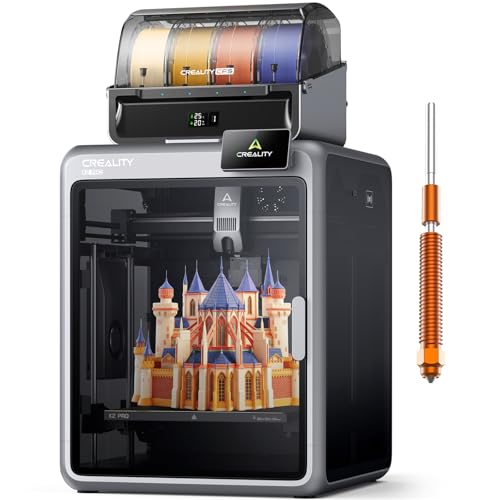
Creality K2 Pro Combo — The Chambered Precision Flagship
Badge: The Chambered Precision Flagship — thermal steadiness at a larger scale
- Colour system: multicolor printing with CFS
- Speed: 600mm/s high-speed
- Supervision: dual AI camera
- Chamber: active chamber heating
- Calibration: auto leveling
- Build volume: 300x300x300mm large build volume
The K2 Pro Combo extends its sibling’s formula in the two directions precision cares about most: thermal control and scale. Active chamber heating is the headline for accuracy’s sake. A part’s dimensions are not finished when the nozzle leaves them; they settle as the material cools, and cooling that happens unevenly — a draughty side, a cold corner — writes itself into the part as warp and internal stress. A chamber held at temperature by active heating narrows that lottery, which is why engineering materials and large functional parts both ask for one. At a 300-millimetre build volume, the effect compounds in the buyer’s favour twice over: larger parts present more surface for uneven cooling to attack, so the Pro’s chamber earns its keep precisely where its size invites trouble. Dual AI cameras extend the supervision story — two viewpoints watching long, valuable prints — and auto leveling again underwrites the first layer on the bigger plate, where levelling errors have more room to grow.
Read as a flagship, the Pro also clarifies the K2 family’s internal logic for a buyer choosing between the siblings. The standard K2 Combo concentrates on foundation and material — leveling, direct drive, a camera — at the middle volume. The Pro spends its premium on environment and oversight: the held chamber, the second camera, the larger stage. A precision buyer whose parts are small and whose materials are gentle may honestly never cash the Pro’s advantages; a buyer whose parts are large, whose materials are warp-prone, or whose prints run unattended through working days is buying exactly the systems that decide whether those prints arrive at their drawn dimensions. That is a clean, workload-shaped choice, and this guide’s comparison table exists to make it at a glance.
The cautions are proportional to the ambition. A heated chamber is a process responsibility as well as an asset — placement, ventilation, and material discipline all join the workflow — and the larger machine asks more of the bench it stands on. No tolerance figure is stated here either, and the Pro’s greater capability makes the validation discipline more important, not less: the bigger and more valuable the part, the more a test-coupon habit pays. The 600mm/s figure remains a ceiling. None of this dims the Pro’s standing as the set’s most completely specified precision platform on stated evidence — foundation, environment, and supervision all addressed in the title, at the largest single-extruder-class volume in the guide.
Strengths
- Active chamber heating steadies cooling, the hidden half of dimensional accuracy.
- Dual AI cameras supervise long prints from two viewpoints.
- The 300-millimetre volume serves larger functional parts without splitting.
Trade-offs
- Chamber heat adds placement and ventilation responsibilities.
- No tolerance is stated; larger parts raise the value of test validation.
- The flagship’s systems exceed what small, gentle workloads will ever use.
Best for: seeking larger functional parts whose dimensions are protected by a held chamber temperature and dual supervision.
Not suited for: seeking compact, small-part printing where chamber systems would stand idle.
The chamber and camera specification rewards a close read on the product page: Check price on Amazon.

Bambu Lab P2S Combo — The Supervised Ecosystem Pick
Badge: The Supervised Ecosystem Pick — managed consistency, watched prints
- Bundle: P2S printer with AMS 2 Pro
- Printing type: multi-color 3D printing
- Architecture: high-speed CoreXY
- Supervision: AI error detection
- Model source: MakerWorld model library
- Calibration details: Not stated in the listing title – verify with the manufacturer documentation
The P2S Combo approaches precision from the direction of repeatability, which is precision’s production form. A single accurate part is an achievement; the same part accurate forty times is a process, and processes are built from managed variables. Bambu Lab’s managed ecosystem is exactly a variable-management system: curated profiles that encode material behaviour, a model library whose files arrive with settings attached, a material system — the AMS 2 Pro bundled here — that handles filament as a controlled input, and AI error detection standing watch so that the long prints precision work requires are intercepted when they stray rather than discovered as scrap. The high-speed CoreXY frame underneath supplies the motion foundation, its toolhead travelling light above a bed that stays put, in the architecture this category consistently favours.
There is a subtle accuracy dividend in the library model that deserves articulation. A large share of dimensional disappointment in filament printing is not mechanical at all; it is profile error — shrinkage unaccounted for, wall counts mismatched to the design, materials printed at temperatures that flatter or punish them. A library and profile ecosystem refined across an enormous installed base quietly corrects those errors before the machine ever moves, because the profile that reaches the owner has already survived thousands of other owners’ parts. That is not a specification and cannot be printed in a title, but a precision buyer weighing ecosystems should count it: the P2S’s accuracy case rests as much on the accumulated correctness of its software world as on the stiffness of its frame.
The standing caveats apply with their usual force. The title does not state calibration specifics or dimensions, so a buyer with exact requirements verifies them in the manufacturer’s documentation rather than inferring them from the platform’s polish. The managed ecosystem is a boundary as well as a benefit — behaviour outside the maker’s design is behaviour the machine resists — and multicolour printing through a single nozzle still spends purge filament at every change, a tax the AMS 2 Pro manages but cannot repeal. No tolerance is promised, here or anywhere in this guide. What the P2S Combo promises, on stated evidence, is the most supervised and repeatable route to consistent parts in the set — and for functional work produced in quantity, repeatability is the form of precision that pays.
Strengths
- AI error detection protects the long prints precision work depends on.
- The managed profile ecosystem quietly corrects common dimensional errors.
- The AMS 2 Pro bundle makes the material input a controlled variable.
Trade-offs
- Calibration specifics and dimensions are unstated in the title.
- The managed ecosystem resists operation outside its intended envelope.
- Single-nozzle colour changes still consume purge filament.
Best for: seeking repeatable, supervised production of functional parts inside a managed ecosystem.
Not suited for: seeking calibration and dimension figures confirmed within the listing title itself.
Repeatability-focused readers will find the detection and bundle claims stated on the listing — Check price on Amazon — beside the library description.

ELEGOO Centauri 2 Combo — The Hot-Nozzled Value CoreXY
Badge: The Hot-Nozzled Value CoreXY — a stated 350 degrees on a CoreXY frame
- Nozzle: 350°C nozzle
- Architecture: high-speed CoreXY
- Speed: 500mm/s high-speed
- Colour: 4-color printing, multicolor combo
- Calibration: auto leveling
- Model source: Nexprint model hub
- Control: remote control with app
- Positioning: beginner-friendly multicolor printing
The Centauri 2 Combo states the figure the rest of this set mostly withholds: a 350-degree nozzle. Temperature belongs in a precision guide for a reason that is easy to miss — materials print most dimensionally honestly inside their proper thermal window, and a hotend with headroom lets the operator run engineering-leaning filaments at the temperatures where their shrinkage behaviour is stable and documented, rather than at the ragged edge of a cooler hotend’s ability. Paired with a CoreXY frame at a stated 500mm/s and auto leveling under the first layer, the Centauri’s stated systems cover the same foundation-material-environment triangle as its pricier company, and its four-colour combo format brings multicolour functional work — labelled parts, colour-coded assemblies — into the same machine without a separate material system purchase.
The beginner-friendly framing deserves a precision reading rather than a dismissive one. ELEGOO positions this machine for newcomers, with a model hub and app-based remote control, and there is a real sense in which approachable machines produce more accurate parts in practice: an owner who understands their printer’s routines maintains its calibration, while an intimidating machine’s routines get skipped until quality visibly collapses. Remote control contributes quietly to the same economy — a print checked from the next room is a print whose early failure gets caught, and catching failures early is a dimensional strategy for the parts that follow, since a machine diagnosed promptly returns to tolerance promptly. The hub, like the libraries elsewhere in this guide, supplies starting profiles whose correctness has been crowd-tested.
The limits are stated plainly. Beginner-friendly positioning usually means the machine’s deeper controls are curated rather than exposed, and an advanced user chasing the last increments of dimensional performance may find the curation in the way. No build volume appears in the title, so part-size planning requires the manufacturer’s documentation, and — the refrain of this entire guide — no tolerance is stated or implied by anything in the listing. The 500mm/s figure is a ceiling in the usual way. Judged on its stated systems, the Centauri 2 Combo is the set’s value-shaped precision proposition: the hottest stated nozzle, a CoreXY foundation, self-levelling, and colour in the box, offered to owners who would rather spend their attention on parts than on the machine’s personality.
Strengths
- The stated 350-degree nozzle gives materials their proper thermal window.
- CoreXY motion and auto leveling cover the motion and foundation bases.
- Four-colour printing arrives in the combo without a separate system purchase.
Trade-offs
- Build volume is unstated in the title and needs documentation.
- Beginner-oriented curation may bound advanced dimensional tuning.
- No tolerance figure is stated, as throughout this guide.
Best for: seeking a hot-nozzled CoreXY machine whose colour and calibration systems arrive ready in one combo.
Not suited for: seeking build dimensions confirmed inside the listing title before purchase.
The 350-degree specification is printed on the listing itself, where value-conscious readers can Check price on Amazon.

Flashforge Adventurer 5M — The Compact Rigid Frame
Badge: The Compact Rigid Frame — accuracy through stiffness and serviceability
- Frame: all-metal CoreXY
- Travel speed: 600mm/s maximum travel
- Extruder: 280°C direct drive extruder
- Nozzle change: 3-second nozzle swap
- Calibration: one-click auto leveling
- Build volume: 220x220x220mm
The Adventurer 5M’s precision argument begins with the word all-metal. Rigidity is the unglamorous root of accuracy in a moving machine: every direction change asks the frame to hold its geometry against the toolhead’s momentum, and a frame that flexes prints that flex into the part as surface artefacts and dimensional drift. An all-metal CoreXY structure, moving a light toolhead over a still bed, is the compact category’s most direct answer to that physics, and the stated 600mm/s maximum travel — a motion ceiling, as always — indicates the headroom the structure was engineered around. One-click auto leveling handles the foundation, and the 280-degree direct drive extruder covers the material side with a short, controlled filament path and a temperature ceiling that reaches the engineering-leaning shelf.
The feature that elevates this machine in a precision guide, though, is the three-second nozzle swap, and it deserves the prominence this review gives it. A nozzle is the final author of every dimension a printer produces; its orifice erodes, its tip accumulates damage, and its condition degrades gradually enough that owners adapt to worsening output instead of correcting it. When swapping that component takes seconds and no tools worth mentioning, the correction becomes a habit rather than a project — and a machine whose most accuracy-critical wear part is renewed on a whim is a machine whose tenth month prints like its first. Precision, in the long view, is less a property a machine has than a condition its owner maintains, and the 5M is engineered to make that maintenance nearly free.
The borders are size and scope. The 220-millimetre build volume confines the precision to compact parts — which describes a great deal of functional work, from brackets and gears to enclosures and fixtures, but excludes the large-format ambitions served elsewhere in this guide. No multicolour system is named in the title, so colour-coded functional work is not this machine’s native tongue. And no tolerance is stated, in keeping with every listing here. Within its compact borders, the 5M is the guide’s clearest statement that accuracy is a maintained condition: a rigid frame to hold geometry, a hot direct drive to deliver material, self-levelling to found each part, and a nozzle that renews in three seconds when the work demands it.
Strengths
- The all-metal CoreXY frame resists the flex that prints as dimensional error.
- The three-second nozzle swap keeps the most accuracy-critical wear part fresh.
- A 280-degree direct drive extruder feeds material along a short, controlled path.
Trade-offs
- The 220-millimetre volume limits precision work to compact parts.
- No multicolour system is named in the title.
- Maximum travel speed describes motion headroom, not measured accuracy.
Best for: seeking compact functional parts from a rigid frame whose nozzle renews in seconds.
Not suited for: seeking large-format precision work or bundled multicolour printing.
Compact-bench owners can study the quick-swap specification where it is listed: Check price on Amazon.
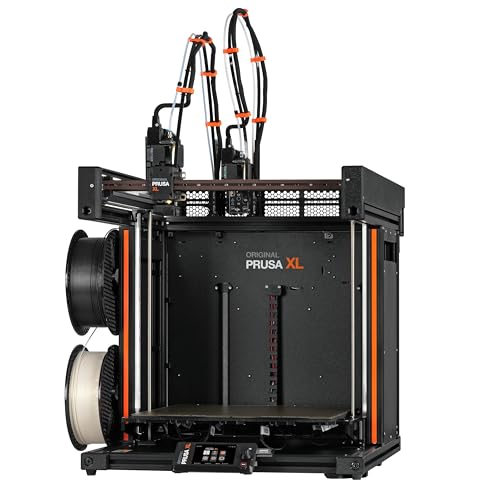
Original Prusa XL 2-Toolhead — The Large-Format Register Keeper
Badge: The Large-Format Register Keeper — two tools, one big stage
- Tool system: 2-toolhead multi-material, dual tool system
- Format: large-format CoreXY
- Positioning: professional printer for advanced prototyping
- Performance positioning: high-speed industrial performance
- Design family: Original Prusa
- Build dimensions: Not stated in the listing title – verify with the manufacturer documentation
The XL in its 2-toolhead form poses the most interesting accuracy problem in this guide and brings a professional platform to it. The problem is registration at scale: two toolheads must agree about position across a large-format stage, so that a second material lands exactly where the first material’s geometry expects it — in support interfaces, in two-material functional parts, in assemblies printed as one job. Misregistration that a small machine hides becomes visible and structural on a large one, because every offset error is drawn across a bigger canvas. Prusa’s answer, per the title, is a dual tool system on a large-format CoreXY frame, positioned for advanced prototyping and high-speed industrial performance — a platform framing that suits the problem, since keeping tools in register across years of work is a platform discipline of calibration design and documented maintenance rather than a single feature.
The two-head configuration is itself a considered choice worth explaining to precision buyers. The XL family scales upward in toolheads, and the 2-toolhead variant is the configuration where multi-material capability arrives with the least calibration surface: two tools to keep in register, two materials ready — typically a structural material and its support, or two functional materials whose interface is the part’s whole point. For prototyping work, that pairing covers the overwhelming majority of real jobs, and the large format means prototypes print at working scale rather than as reduced models whose fit tells comforting lies. A gear printed at full size meshes or does not; a housing printed at full size closes or does not. Scale is an accuracy instrument in its own right, because it removes the extrapolation between the prototype and the thing it prototypes.
The burdens are the professional ones. A large-format, dual-tool machine occupies serious space, carries a serious commitment, and asks its owner to maintain a calibration relationship with two toolheads across a big stage — a discipline Prusa’s documentation culture supports but does not perform on the owner’s behalf. The title withholds the stage’s dimensions, so exact part planning belongs to the manufacturer’s documentation. And no tolerance is stated, completing the guide’s clean sweep: six listings, zero invented figures. For the prototyping studio whose work is large, two-material, and fit-critical, the XL 2-Toolhead is the set’s summit — the machine where precision stops being a desktop virtue and becomes an industrial practice.
Strengths
- A dual tool system keeps two materials ready and registered for functional interfaces.
- Large-format printing validates fit at working scale rather than by extrapolation.
- Prusa’s platform documentation supports the calibration discipline the format demands.
Trade-offs
- Two toolheads across a large stage multiply the calibration relationship to maintain.
- Stage dimensions are unstated in the title and require documentation.
- The footprint and commitment exceed desktop-bench scale.
Best for: seeking large-format, two-material prototyping where registration and working-scale fit decide success.
Not suited for: seeking compact desktop printing with a single material and minimal upkeep.
Studios can examine the dual tool specification on the listing — Check price on Amazon — before consulting the documentation for stage dimensions.
Comparison table
| Machine | Motion system as listed | Calibration as listed | Accuracy-relevant extra |
|---|---|---|---|
| Creality K2 Combo | Direct drive, architecture unstated in title | Auto leveling | Smart AI camera, CFS colour |
| Creality K2 Pro Combo | Architecture unstated in title | Auto leveling | Active chamber heating, dual AI camera |
| Bambu Lab P2S Combo | High-speed CoreXY | Not stated in title | AI error detection, AMS 2 Pro |
| ELEGOO Centauri 2 Combo | CoreXY | Auto leveling | 350°C nozzle, 4-colour printing |
| Flashforge Adventurer 5M | All-metal CoreXY | One-click auto leveling | 3-second nozzle swap, 280°C direct drive |
| Original Prusa XL 2-Toolhead | Large-format CoreXY | Not stated in title | Dual tool system for two-material register |
How to choose the best precise 3d printers for functional parts?
Choose by the part that will judge the machine. A buyer printing enclosures that must close, brackets that must bolt to existing holes, and gears that must mesh should weight the foundation systems first — auto leveling, frame rigidity, direct drive consistency — because those decide whether drawn dimensions survive contact with the process. That weighting favours the K2 Combo’s stated trio, the Adventurer 5M’s rigid compact frame, and the Centauri 2’s levelled CoreXY. A buyer whose parts are large or warp-prone should promote thermal control to the first rank, which is the K2 Pro Combo’s chamber argument. A buyer printing the same functional part in quantity should promote repeatability and supervision — the P2S Combo’s ecosystem and detection — because their accuracy problem is not one part but the fortieth.
It also helps to separate two virtues that buying guides habitually blur: precision and resolution. Resolution is the fineness a machine can render — thin layers, small features, smooth curves. Precision is the faithfulness of the result to the drawing’s intent. A machine can render beautifully and measure wrongly, and for functional work the second failure is the expensive one, because a gorgeous part that does not fit is scrap with good lighting. Every system graded in this guide was graded on the faithfulness side of that divide: foundations, motion, extrusion consistency, thermal steadiness, registration. Buyers whose work is primarily visual may weight the set differently and fairly; buyers whose work must mate with the physical world should keep the divide in view and let it govern the shortlist, because the physical world grades exclusively on fit.
Then interrogate the two-material question, because it hides inside many precision briefs. Parts with support interfaces, captive mechanisms, or two-material functional zones need their materials in register, and that is the XL 2-Toolhead’s entire proposition at large format, with the colour systems of the K2 and P2S picks serving the lighter end of the same need. Buyers arriving from the multi-head world of independent extruders and toolchangers will recognise the registration problem in its several mechanical forms, and should choose the form whose calibration burden their workflow can carry daily.
Finally, budget for measurement itself. A precision purchase that ends at the printer is half a purchase; the other half is the means to verify — measuring tools appropriate to the parts, test geometries, and the habit of printing a calibration object whenever a variable changes. The general filament landscape in our guide to fFF 3D Printers covers the machines these picks evolved from, and the ownership disciplines that keep any of them accurate for years are the subject of our guide to long-Term 3D Printers. Precision is a system that happens to include a printer; buy the system. Buyers whose accuracy problem is specifically the registration of several materials should then study the mechanism family in our guide to iDEX 3D Printers, where that problem is the entire subject.
One last matching exercise sharpens the choice for buyers still torn between two picks: write down the last five functional parts actually printed or planned, with their sizes and materials, and mark which stated system in each candidate’s title would have governed each part’s success. The exercise takes ten minutes and routinely dissolves weeks of abstract comparison, because most buyers discover their parts cluster tightly — small and single-material, or large and two-material, or mid-size and colour-coded — and the cluster points at one machine’s stated systems with embarrassing clarity. Buyers whose parts genuinely scatter across every cluster are the rare case the flagship logic exists for, and they can choose the K2 Pro Combo’s breadth with a clear conscience. Everyone else is buying a cluster with accessories, and should pay for the cluster first.
Where dimensional accuracy actually comes from
It is worth assembling the whole causal chain in one place, because marketing fragments it. A part’s dimensions begin in the slicer, where shrinkage compensation, wall strategy, and seam placement are decided in software. They pass to the motion system, which must convert commanded positions into real ones — the CoreXY frames in this set exist because a stationary bed beneath a light, fast toolhead converts commands into positions more faithfully than a slinging bed does. They depend on the first layer, whose height uniformity is the part’s foundation, which is why auto leveling appears in title after title here. They are fed by the extrusion path, where a direct drive’s prompt, even delivery keeps wall thickness honest, and they are finished by cooling, where chamber control decides whether the drawn shape is the shape that survives to room temperature. A weakness anywhere in that chain is the part’s weakness, regardless of strengths elsewhere — which is why this guide graded systems rather than adjectives, and why the most accurate purchase is the one whose chain has no neglected link for the buyer’s particular materials and geometries.
Two links in that chain deserve a final emphasis because buyers habitually skip them. The first is the humble build surface: its flatness, its coating’s condition, and its cleanliness set the ceiling for the first layer’s uniformity, and a worn or contaminated plate quietly taxes every machine in this guide equally, whatever its frame cost. The second is the room itself. A printer beside a draughty door or a cycling heater lives in a changing thermal environment that no leveling routine can see, and functional parts printed across a cold night and a warm afternoon can differ measurably while the machine insists nothing changed — because, from the machine’s sensors, nothing did. Placing a precision machine is part of calibrating it, and the owners who grasp that early stop chasing ghosts in their motion systems that were only ever weather.
Validation: how to prove a printer’s accuracy instead of believing it
Since no listing here states a tolerance, the buyer’s own validation is not a paranoid extra; it is the only tolerance evidence that will ever exist for a given machine, material, and profile combination. The method is neither exotic nor expensive. Print a standard test geometry with known features — holes, posts, spans, a cube whose faces can be measured — in the actual material of the work, then measure the result with the best instruments the parts justify, and record the deviations. Repeat after any change of material, nozzle, or profile. The record that accumulates is the machine’s true specification sheet, written in the only units that matter: this printer, this filament, these settings, these outcomes. Owners who keep that record stop arguing about accuracy in the abstract, because they possess it in the particular — and when a part fails to fit, the record says whether the machine drifted, the material changed, or the drawing was optimistic, which is the difference between a workshop that improves and one that merely troubleshoots.
Validation has a second, quieter use: it disciplines the drawing hand. Designers who measure their printed output learn, within a few iterations, which features filament printing renders faithfully and which it negotiates — where a hole will close slightly, where a thin wall will swell, where an overhang’s underside will never match its drawing no matter the machine. That knowledge migrates into the designs themselves, and parts begin arriving from the printer already fitting, not because the machine improved but because the design and the process finally understand each other. The most precise workshops are not the ones with the most expensive printers; they are the ones where this feedback loop has been running longest, with records to prove it. Any machine in this guide can anchor such a loop. None can substitute for it.
Common mistakes
The category’s founding mistake is believing that precision can be bought as an adjective — trusting a listing’s confidence instead of validating a machine’s output against measured test parts. The second is chasing speed ceilings with functional parts, then measuring the ringing and drift that aggressive profiles print into parts whose drawings never asked for haste. Third is neglecting the first layer: skipping the leveling routine, printing on a contaminated plate, and then diagnosing the resulting dimensional chaos as a motion-system fault. Fourth is letting the nozzle age in place — the wear part whose condition writes every extrusion — when several machines in this guide make its renewal a matter of seconds or a routine combo service. Fifth is changing several variables at once during troubleshooting, which guarantees the actual cause is never isolated and the same fault returns wearing a new costume. The last mistake is measuring nothing and recording less: an owner without a validation record owns an opinion about their printer’s accuracy, and opinions do not make parts fit.
A subtler mistake threads through several of those: treating accuracy as a property of the machine alone, when every section of this guide has argued it is a property of a system — machine, material, profile, room, and operator in combination. Buyers who internalise that systems view stop asking which printer is most precise in the abstract, a question with no honest answer, and start asking the answerable version: which printer’s stated systems cover the weak links in my particular chain? For one buyer that is a chamber, for another a fresher nozzle, for a third a second toolhead in register. The six picks were chosen so that each of those answers exists somewhere in the set, stated in a title, waiting to be matched to the chain that needs it.
Frequently Asked Questions
Why does this guide contain no tolerance figures?
Because none of the six listing titles states one, and this site does not invent specifications. Dimensional tolerance in filament printing depends on the machine, the material, the profile, and the geometry in combination, so a single borrowed figure would misrepresent every pick. The guide instead grades the systems that produce accuracy — motion, calibration, extrusion, thermal control — and its validation section describes how a buyer establishes real figures for their own combination.
Does a CoreXY frame guarantee better accuracy than other layouts?
No guarantee exists, but the structural argument is real: a CoreXY machine moves a light toolhead over a still bed, removing the errors a moving bed introduces at speed, which is why CoreXY designs dominate this set. Execution still decides outcomes — a well-made machine of another layout, well calibrated, will out-print a neglected CoreXY — so the frame should be read as a favourable starting condition, not a certificate.
How much does the chamber on the K2 Pro Combo matter for accuracy?
For small parts in gentle materials, modestly. For large parts and warp-prone engineering materials, substantially — because dimensions finish settling as a part cools, and a chamber held at temperature makes that cooling even rather than weather-dependent. The Pro’s chamber is best understood as insurance for exactly the work its larger volume invites, where uneven cooling has the most surface and the most time to distort a part.
Can multicolour printing hurt precision?
It can complicate it. Every colour change is an interruption in extrusion and a small opportunity for offset or flow inconsistency, and colour-rich parts should be designed with the change count in mind. The combo systems in this guide manage those changes as controlled processes, and for colour that carries function — labels, assembly cues, coded parts — the trade is usually worth making knowingly rather than discovering afterwards.
What is the first thing to check when a previously accurate machine drifts?
The wear chain, in order of likelihood and cheapness: the nozzle’s condition, the build surface and first-layer quality, filament dryness and consistency, and only then the motion hardware. Most drift is a consumable announcing itself, which is why this guide treats features like the Adventurer 5M’s three-second nozzle swap as accuracy features — they lower the cost of the most common correction to nearly nothing.
Is the two-toolhead Prusa XL more accurate than single-extruder machines?
It answers a different accuracy question. Single-extruder machines must keep one tool honest; the XL must keep two tools honest and in register with each other, across a large format. For two-material parts, that registration is the accuracy that matters, and the XL’s professional platform exists to sustain it. For single-material parts, the comparison dissolves — the XL’s advantages are scale and material pairing, not a finer grade of the same virtue.
How do materials affect the accuracy of the same machine?
Profoundly, and through shrinkage above all. Every filament contracts as it cools by its own characteristic amount, and engineering materials add warping tempers that everyday filaments do not have — which is why this guide treats chamber control and hotend headroom as accuracy features, and why validation must be performed in the actual material of the work. A machine validated in one filament and trusted blindly in another is a machine whose accuracy is known for a job it is not doing.
Final recommendation
For most functional buyers, the K2 Pro Combo is this guide’s most complete precision proposition on stated evidence: auto leveling for the foundation, active chamber heating for the cooling half of accuracy, dual cameras for the long hours, and a 300-millimetre stage for parts at working size. The K2 Combo serves the same logic at the middle volume with its direct drive emphasis. The P2S Combo is the repeatability pick, where an ecosystem’s accumulated correctness matters more than any single mechanism. The Centauri 2 Combo carries the value argument on the set’s hottest stated nozzle, the Adventurer 5M keeps compact accuracy maintainable almost for free, and the XL 2-Toolhead owns the large, two-material summit. Whichever machine is chosen, let the relationship begin with measurement: print the test geometry, record what the calipers say, and let that record — not any adjective in any guide, including this one — be the authority the parts are finally judged by.
There is a satisfaction waiting at the end of that discipline which no specification can confer in advance: the first assembly whose printed parts simply close, mesh, and bolt together as drawn, without persuasion. Owners remember that moment the way they remember a first successful print, because it marks the point where the machine stopped being a hobby’s appliance and became an instrument. Every system graded in this guide — every levelled bed, held chamber, fresh nozzle, and registered toolhead — exists to make that moment routine rather than remarkable, and a buyer who chooses by systems and verifies by measurement will not wait long to feel it, measure it, and begin trusting the machine, on measured evidence, with parts whose failure would actually matter in service.


