Our Top Picks


What's inside
- The brand and the Shark line
- What a surf watch does that a normal sports watch does not
- How tide databases work, and where they stop
- Water resistance: what 100 m and 200 m really mean
- Straps: Leash, Clip and standard silicone
- Case size, thickness and legibility in glare
- Backlight for dawn sessions
- Alarms, heat timers and interval timers
- Battery type and realistic service intervals
- Choosing between tide and non-tide models in the line
- How to read a Freestyle listing and tell current from discontinued lines
- Care after salt water
- Common buying mistakes
- A short checklist you can use yourself
- Check prices on Amazon
- How this guide was researched and a note on links
As an Amazon Associate I earn from qualifying purchases. This post may contain affiliate links at no extra cost to you.
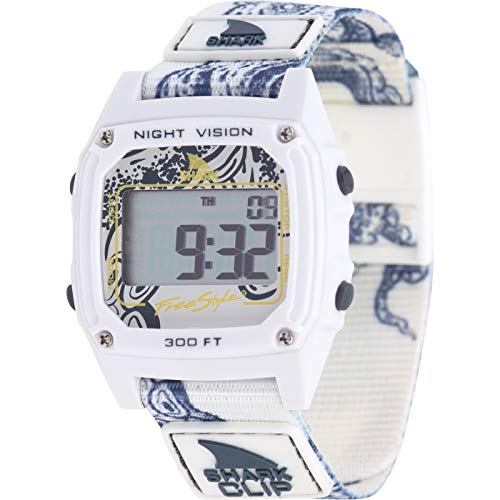
A surf watch earns its place on a wrist in a way that a general sports watch does not. It is not there mainly to count steps, log a run, or buzz when a phone call arrives. It is there to answer a small set of questions that shape a session before it starts and while it unfolds: when is high tide, when is low tide, how fast is the water moving between the two, what will the tide be doing tomorrow at first light, and how long is left in a heat. Freestyle, the brand behind the long running Shark line, has built its name almost entirely around those questions. If you are weighing a Freestyle surf watch against a broader sports watch, the useful comparison is not screen brightness against screen brightness or app against app. The useful comparison is whether the tide information, the water rating, the strap, and the timer set match the beaches you surf and the way you actually spend time in the water.
This guide works through the Freestyle line in that order. It covers the background of the brand and the Shark family, the difference between tide and non-tide models, the way stored tide databases work and where they stop being reliable, and the practical details that decide whether a watch is easy to live with: strap behaviour under a wetsuit sleeve, legibility in hard glare, backlight strength at dawn, button feel with cold hands, and battery service. It also covers the unglamorous side of ownership, from rinsing salt off a strap to spotting a discontinued model in a listing that has been written to look current. None of that requires a laboratory. Most of it comes down to reading published specifications carefully and matching them, honestly, to your own routine.
The brand and the Shark line
Freestyle is a specialist watch brand that dates to the early 1980s, and published brand material has long presented it as a company founded around surf and beach culture rather than around general timekeeping. That distinction matters because it explains the shape of the catalogue. Where a large watch group spreads its effort across dress watches, field watches, dive watches, and connected models, Freestyle concentrated on digital watches for surfers and other water users, and the Shark became its defining line. The Shark name has been used across several generations and case shapes, from compact models aimed at smaller wrists and younger surfers to larger, louder designs with oversized digits and bold colour combinations that were easy to spot on a beach towel from twenty paces.
The Shark line built its reputation on a few traits that kept recurring in the brand material: strong water resistance for a digital watch at an accessible end of the market, a tough resin case, simple controls that could be worked without a manual in hand, and, on the tide models, stored tide information for named beaches. Over time the line widened. Some Shark models are pure time and timer watches with no tide function at all. Some add tide data, moon phase, and sunrise and sunset times. Some lean into retro styling, with colourways and case shapes that refer back to earlier decades of the brand. Others are stripped back and plain, aimed at a buyer who wants a durable watch for lifeguard work, swimming, paddling, or a job that involves getting wet every day.
That breadth is both the strength and the trap of the line. Two watches can both carry the Shark name and have very different abilities. One may hold tide data for hundreds of beaches and show a tide graph; another may offer only time, date, an alarm, and a stopwatch. The name alone tells you about the family, the styling, and the intended environment. It does not tell you whether tide prediction is present, how deep the water rating goes, or which strap system the watch uses. For that you have to read the individual model specification, which is why a later section of this guide deals at length with how to decode a Freestyle listing.
What a surf watch does that a normal sports watch does not
A normal sports watch is built around activity. It measures what your body did: distance, pace, heart rate, laps, elevation. A surf watch is built around the environment. It describes what the ocean is about to do, and it times your interaction with it. That is a different job, and it leads to a different feature set. The core surf functions on Freestyle tide models are pre-programmed tide data for named beaches, a visual indication of tide height and direction, sunrise and sunset times, moon phase, and the ability to look forward to a future date and see the predicted tide pattern for that day.
Start with the named beach. Instead of asking you to enter latitude and longitude or to accept a generic port prediction, a tide watch stores a library of locations. You select the beach or the nearest listed point, and the watch works from the stored harmonic data for that place. For a surfer who rotates between three or four regular breaks, that is a genuinely useful shortcut. Set your home break once, check it at the kitchen table, and you know whether the morning tide suits the bank you intend to surf. Set a second location for a weekend trip and you can plan the drive around the tide rather than arriving to find the reef exposed or the beach break drowned by too much water.
Tide height graphs add shape to a pair of times. Knowing that high tide falls at a given hour tells you a single fact. Seeing the curve tells you how quickly the water rises through the middle of the tide, how long the slack period near high water is likely to feel, and whether a session starting two hours before high tide will be a session on a filling beach or one that spends most of its length near the top. Freestyle tide models present this in simplified digital form, sometimes as a graph and sometimes as a height figure alongside the time of the next high or low. Simplified is the right word. The display is small, the resolution is coarse, and the value lies in the trend, not in a precise height to the centimetre.
Sunrise and sunset times and moon phase complete the planning picture. Dawn sessions depend on first light, and a watch that shows sunrise for your selected location helps you set an alarm that matches the season rather than a fixed clock time you chose in summer and forgot to move. Moon phase is a rough proxy for the spring and neap cycle: near a new or full moon, tidal range tends to be larger, currents stronger, and the difference between a good and a poor window sharper. None of this replaces a proper tide table for an unfamiliar coast, but together the functions let you form a sensible first judgement in seconds, on the wrist, without a phone signal.
Future tide prediction is the function buyers most often overlook when comparing models, and it is one of the most valuable. A watch that only shows today forces you to plan a trip on other tools. A watch that lets you step forward day by day lets you answer questions while you are still at home: does Saturday suit the outer bank better than Sunday, will the evening tide next week leave enough light for a session after work, and is a planned holiday week built around neap tides that will leave a particular reef underworked. Check the listing for how far forward the prediction runs and how you move through dates, because button sequences for stepping through days vary and a clumsy sequence is one you will stop using.
How tide databases work, and where they stop
A stored tide database is a set of pre-calculated predictions, built from the tidal constituents for each listed location. In plain terms, the movement of the tide at a port can be described as a sum of repeating cycles driven by the moon and the sun. If you know the size and timing of those cycles for a place, you can reconstruct its tide pattern far into the future with reasonable accuracy. That is what sits inside a non-connected tide watch. The watch is not receiving the tide. It is calculating, from stored data and its own clock and calendar, what the pattern for your chosen beach should be on the date you ask about.
Three practical consequences follow. First, accuracy depends on the watch clock being right. A watch that is twenty minutes fast will present a tide curve shifted by twenty minutes, and a watch with the wrong date, wrong location, or wrong daylight saving setting will give you confident looking information for the wrong day or place. When you set up a Freestyle tide model, treat the setup as part of the product: choose the location carefully, confirm the date and time against a trusted source, and recheck the location after any battery change or full reset, because a reset can return the watch to a default beach far from your own.
Second, the number of stored locations matters, but not in the simple way marketing suggests. A large library is valuable if it includes the specific beaches and ports nearest to where you surf, with sensible spacing along your coast. A large library padded with distant locations you will never visit adds nothing. Before choosing a model, look for a published location list or manual that names the regions covered, and check your home breaks and the places you travel to most. Pay attention to how the watch handles a beach that sits between two listed points. Predictions for the nearer port may be close in timing but differ in height, and some breaks respond more to an offshore bar or estuary than to the nearest harbour, so local observation still has the final word.
Third, a non-connected watch receives no live updates. It cannot know about a storm surge, a strong onshore wind holding water in a bay, low pressure lifting the actual sea level above the predicted level, or a river in flood pushing against an estuary mouth. Weather can move real water levels and timings noticeably, and on shallow, complex coasts the gap between prediction and reality can be the difference between a working bank and a wash of white water. Use the watch to plan, then use your eyes on arrival. If the water is clearly ahead of or behind the prediction, trust the water.
Water resistance: what 100 m and 200 m really mean
Water resistance is the most misunderstood specification on any surf watch, largely because the number on the case is expressed in metres and reads like a depth you are allowed to reach. It is not. The metre figure comes from a static pressure test under controlled conditions, described in standards such as ISO 22810 for general water resistant watches, where a sample watch is subjected to a set pressure in still water. Real surfing is not still water. A wipeout, a duck dive, a wave breaking on your wrist, and the simple act of paddling hard all create brief dynamic pressures that can exceed what the depth beneath you would suggest. The rating is best read as a grade of construction and sealing, not as a permission slip for a depth.
Within the Freestyle line, 100 m and 200 m are the figures you will meet most often on surf oriented models. A watch rated to 100 m is, in manufacturer guidance for this class of watch, generally considered suitable for swimming, snorkelling, and surfing in ordinary conditions, provided the crown and buttons are used as the manual directs and the seals are in good condition. A 200 m rating indicates a more robust build, with greater margin against pressure spikes and, usually, a case and gasket arrangement designed to tolerate more demanding use. For most surfers the honest difference is margin, not access. You are not surfing at either depth. The 200 m model gives you more headroom against impact pressure, ageing seals, and the accumulated knocks of beach life, and that headroom is worth having if the price gap is modest and the larger case still suits your wrist.
What the rating does not survive is neglect. Heat, sunscreen, solvents, sand under a bezel, a cracked crystal, a perished gasket, and a battery change done without renewing or checking seals can all reduce real resistance far below the figure printed at the factory. Hot showers and saunas deserve a specific mention, because warm water, steam, soap, and rapid temperature change are hard on seals and are a common cause of fogging in watches that never leaked in the sea. If a manual warns against hot water, follow it. The watch was built for the ocean, not for the bath.
Buttons, crowns and pressing controls in the water
Button behaviour is where surf watches separate themselves from watches that merely carry a good rating. Many water resistant watches carry a warning not to operate buttons or pull a crown while the watch is wet or submerged, because moving a stem or button can momentarily disturb a seal and let water past it. Some surf and dive designs are built and rated so that buttons may be pressed in the water. Those are different claims, and the manual for your exact model is the only source that settles which one applies. Do not infer it from the metre figure, from a photograph of a surfer, or from the behaviour of a different Shark model.
In practice, set what you can on land. Start a heat timer before you paddle out if the manual discourages wet button use. Choose your tide location at home. If a model does allow button operation in the water, still press buttons with a deliberate, single action rather than leaning on them, and avoid working a button that feels gritty with sand until you have rinsed it. Sand around a button or under a rotating bezel is an abrasive paste once salt water dries, and forcing a control through it wears the very surfaces that keep water out. A rinse first, a press second, is a small habit that protects an expensive seal.
Also check how the buttons feel with cold, wet hands. Large, well spaced pushers with a clear click are usable in February. Small, flush buttons that need a fingernail are not, whatever the specification sheet says about functions. If you surf in gloves, this matters even more. A timer you cannot start reliably is not a timer you own in any useful sense, so when you handle a watch in a shop, or examine product photographs and manual diagrams before ordering, pay as much attention to button size and spacing as to the list of modes behind them.
Straps: Leash, Clip and standard silicone
Freestyle is unusual in giving its straps names and treating them as part of the design rather than as an afterthought. The best known is the Shark Leash strap, which closes with a hook-and-loop fastener in the manner of a surfboard leash cuff. Instead of a buckle and a row of holes, the strap wraps and fastens along a length of material, giving a wide range of adjustment with no fixed steps. That matters for surfers because wrist size in the water is not constant. A strap that fits a bare wrist in summer must also close over a wetsuit cuff in winter, and a hook-and-loop system handles that change without running out of holes or leaving a long loose tail.
The Leash system has real advantages beyond adjustment. There is no buckle tongue to work loose, no hole to tear, and the closure spreads pressure over a broad area, which many wearers find comfortable during long paddling sessions. It is also quick: pull, wrap, press, go. The trade-offs are equally real. Hook-and-loop material collects sand, wax, lint, and salt, and its grip weakens as the hooks clog or wear. It needs rinsing and occasional cleaning with a soft brush to stay strong. It can also catch on wetsuit material and on the inside of a sleeve, and a worn Leash strap that has begun to lift at the edge is a loss waiting for a heavy set. Inspect it the way you inspect a board leash, because the failure mode is the same: gradual wear, then a sudden parting under load.
The Shark Clip strap takes a different route. It uses a clip style closure that fastens positively and gives a cleaner, more conventional profile than the wrap of the Leash. For wearers who dislike the bulk and texture of hook-and-loop, or who wear the watch all day and not only in the sea, the Clip can be the better everyday answer. It tends to sit flatter, slide under a shirt cuff more easily, and avoid the gradual fraying that soft fasteners suffer. The questions to ask are about security and adjustment. Confirm how the clip locks, whether it can be knocked open against a board or a reef, and how fine the adjustment steps are. A closure that is secure but only fits well at one step either side of your size will annoy you every session.
Standard silicone and resin straps with a conventional buckle remain common across the line, and they should not be dismissed. Silicone is soft, tolerant of salt, easy to rinse, and comfortable against skin that is already irritated by neoprene and sun. A buckle gives a repeatable fit you can find by hole number, which is a small but genuine convenience when you are fitting the watch over gloves in dim light. The weaknesses are familiar: holes can stretch and tear at the point of greatest flex, keepers can split, and a long tail can flap and catch. Whichever system you choose, check whether the strap is replaceable, whether it attaches with standard spring bars or a proprietary fitting, and whether spare straps for that model are still sold. A watch with a sound module and a perished proprietary strap is a watch with a short remaining life.
Straps under a wetsuit sleeve
How a strap behaves under a wetsuit sleeve decides whether you will read the watch in the water or only on the beach. A thick hook-and-loop wrap adds bulk at exactly the point where a tight neoprene cuff already grips, and it can push the sleeve up or be pushed down by it, leaving the watch hidden when you want a quick tide or time check between sets. A slimmer silicone strap slides more predictably, and many surfers wear the watch over the sleeve rather than under it, which favours a strap with enough length and a closure that stays secure on neoprene rather than skin. Try to picture, or better still reproduce, the full stack: glove, sleeve, strap, case. If the total bulk stops you flexing your wrist freely while paddling, the watch will migrate, rotate, or be left in the car, and none of its tide data will help you from there.
Case size, thickness and legibility in glare
Surf watches are read in the worst conditions a display can face: direct sun, a wet crystal, salt drying on the surface, and a glance that lasts a second while you watch for the next set. Legibility therefore matters more than almost any feature on the list, and it is governed by plain physical choices. Digit size, contrast, the angle at which the display remains readable, and the amount of reflective material around the dial all count. Freestyle models vary widely here. Some use large digits on a clear ground and can be read at arm length. Others pack tide graphs, moon phase, day, date, and seconds into a compact display, and the result is informative on a table and crowded in the sea.
Case width and thickness shape both comfort and risk. A wide case gives room for larger digits and larger buttons, and it can look right on a larger wrist. It also presents a bigger target to a board, a reef, and the edge of a car door, and it stands proud of the wrist where a sleeve or glove will catch it. Thickness is the dimension buyers ignore and wearers feel. A thick case under a tight wetsuit cuff creates a pressure point, and a thick case worn over a sleeve slides more readily. Published dimensions in a listing sometimes give case width without the crown or buttons and sometimes with them, so compare like with like, and treat a single headline figure with caution. Lug to lug length, where it is given, tells you more about how a watch will sit on a smaller wrist than width alone.
Glare deserves its own test, and you can do it yourself in seconds. Hold the watch, or a phone showing a clear product photograph if you are shopping at a distance and judging by manual diagrams, under a bright light and tilt it slowly. Note the angle at which the digits wash out. Negative displays, where light digits sit on a dark ground, look striking and modern and are chosen by many buyers for style, but they are often harder to read in bright, angled light and at dawn than a conventional positive display. That is not a rule that settles every model, because display quality varies, but it is a consistent enough pattern that a surfer who mainly needs fast glances in hard sun should think twice before choosing a negative display for its looks alone.
Backlight for dawn sessions
The dawn patrol is where a backlight stops being a convenience and becomes the feature that decides whether the watch is usable at all. You set an alarm in the dark, drive in the dark, suit up in half light, and want to check the tide and the time without lighting up the whole car park or blinding yourself. Freestyle models use electroluminescent or LED style illumination depending on generation and model, and the qualities to look for are evenness, duration, and whether the light can be operated by a button you can find by touch. A light that flares in one corner and leaves the tide graph in shadow is of limited use. A light that stays on only for a very brief moment may not give you time to read a graph and a next tide time in one press.
Some models offer an afterglow setting that holds the light for a few seconds, and some offer an automatic light that responds to wrist movement. Automatic light is attractive and frequently a drain. It triggers when you do not need it, in a cinema, in bed, while driving, and each trigger spends battery that a surf watch, which may use a cell expected to last years, can ill afford to waste on gestures. If a model offers it, learn how to turn it off, and consider leaving it off except for a specific trip. Also note the colour and brightness in relation to your eyes at dawn. A very bright white light destroys night adaptation for a short while. A softer, even glow that lets you read the digits and then look straight at a dark sea is the better tool, even if it photographs less dramatically in a product listing.
Alarms, heat timers and interval timers
Surf timing is specific. A competitive heat runs for a set length, often with a need to know elapsed time, time remaining, and sometimes the approach of a final few minutes in which a score must be posted. Freestyle surf oriented models address this with a mix of countdown timers, heat timers, stopwatches, and multiple alarms, but the names are not used consistently across the market, so read what a given model actually does. A countdown timer that can be set once and repeats is useful for heats and for interval work on the beach. A dedicated heat timer may add preset durations and signals at set points, which saves setting a general timer from scratch each time.
Check four things in the manual before you rely on any timer. First, the maximum duration and the resolution: can it be set in seconds, or only in whole minutes, and does that suit the heat format you surf. Second, the signal: is the alert audible in wind and through a hood, does it vibrate on models that offer vibration, and can you feel or hear it while a set is breaking outside. Third, repeat and memory behaviour: does the timer restart automatically, stop at zero, or count up beyond zero so that a missed signal does not erase the information. Fourth, whether the timer can run alongside the tide display or forces you to leave the time mode and lose sight of the next tide time. Small operational details like these decide whether a timer is a working tool or a specification line.
Interval timers belong to training rather than competition, and they earn their place for surfers who do paddle intervals, beach sprints, or pool work to build the fitness that surfing demands. A model that lets you set work and rest periods and repeat them lets you run a session without watching a clock. If that is part of your routine, confirm how many intervals can be chained and whether the settings survive a mode change. If it is not part of your routine, do not pay for it in case size or complexity. Every added mode lengthens the button sequence you must learn, and modes you never use still stand between you and the tide screen when you press one button too many in cold water.
Alarms sound simple and are used daily, so their details matter. Multiple daily alarms help if you keep different start times for work, training, and dawn sessions across a week. A snooze function helps some people and ruins the mornings of others. The practical test is volume and duration in real conditions: an alarm that is clear in a quiet bedroom may be lost in a windy car park with the watch under a sleeve. If you depend on a watch alarm to catch a tide window, set a backup on your phone until you know, from your own mornings, how reliably the watch wakes and reaches you.
Battery type and realistic service intervals
Most Freestyle digital models use a replaceable coin style lithium cell rather than a rechargeable pack, and that choice suits the product. A surf watch may sit in a drawer between trips, be used hard for a season, and need to work without a charging cable or an app. A coin cell gives long life, predictable behaviour, and no charging port to corrode or admit water. The cost is that replacement is a service event, not a nightly habit. Opening the case back disturbs the gasket seal, and a battery change done carelessly, with a nicked gasket, a trapped grain of sand, or screws tightened unevenly, can end the water resistance that made the watch worth owning.
Published battery life figures should be read as estimates under a defined pattern of use, as noted above, and real life varies with light use, alarms, timers, temperature, and the age of the cell fitted. Cold water and cold air reduce the effective capacity of small cells, so a watch that seems healthy in summer may show a fading display or a dim light during a winter dawn session as the cell nears its end. Treat those signs as a prompt to arrange a change before a trip, not as a curiosity. A flat watch on the first morning of a surf holiday is an avoidable failure, because the warning signs are usually gradual.
For replacement, the safest route for a watch you intend to keep surfing in is a service that replaces or inspects the gasket, cleans the sealing surfaces, and pressure tests the watch afterwards, and that can state what test was performed. A simple cell swap on a market stall may restore the time and quietly remove the surf suitability. If you change a cell yourself, work in a clean, dry, well lit place, note the exact cell type from the manual or the marking on the old cell, avoid touching the new cell faces with bare fingers, keep the gasket in its groove without stretching it, and accept that without a pressure test you cannot honestly claim the original rating still holds. Many owners make that trade knowingly for an old watch used in shallow water. The mistake is making it unknowingly for a watch you then trust in heavy surf.
Choosing between tide and non-tide models in the line
The central choice in the Freestyle range is not colour or case shape. It is whether you need tide data on your wrist at all. Tide models cost more, are often larger, carry more modes to learn, and depend on correct location setup. Non-tide models are simpler, frequently tougher in the sense that there is less to set wrong, and often cheaper to replace if lost. Neither is the better watch in the abstract. Each is better for a defined pattern of use, and naming your pattern honestly is the whole of the decision.
Choose a tide model if you surf several breaks with different tide windows, if you travel along a coast and plan sessions days ahead, if your home break is strongly tide dependent, or if you regularly arrive without phone signal and want the prediction on your wrist. Choose a tide model, too, if you are building local knowledge: comparing the predicted curve with what you observe, session after session, teaches you how your break departs from the nearest listed port, and that personal correction is worth more than any generic forecast. The watch becomes a notebook prompt even when you use other tools for a final check.
Choose a non-tide model if you surf one forgiving beach break that works through most of the tide, if you already plan with a detailed local source you trust and would only duplicate it on your wrist, if you want a watch mainly for timing heats, training intervals, lifeguarding, swimming, or general water work, or if you prefer the smallest and simplest watch that will survive the sea. There is no virtue in carrying a tide database for a beach that does not need one, and a simpler watch that you wear every session beats a capable watch left at home because its display feels busy.
Between those poles sits the buyer who surfs occasionally at unfamiliar places. For that pattern, the deciding question is coverage. A tide watch helps on a trip only if its database lists beaches near your destination with useful spacing. Check the location list for the trip you actually have in mind before ordering, not a general claim about worldwide coverage. Also consider how you will set the location on arrival, whether the manual is available to you in a form you can read on a phone or in print, and whether the watch holds more than one location or must be reset each time you move. A model that stores a small set of favourite locations suits a travelling surfer better than one that holds a single place, however large its total library may be.
How to read a Freestyle listing and tell current from discontinued lines
Freestyle listings, especially from third party sellers and clearance outlets, require a particular kind of reading. Model names repeat, colourways return, specifications are copied between related models, and a listing may pair photographs of one variant with the description of another. Your defence is to anchor every claim to a model number and to the manufacturer manual or specification for that number, rather than to the marketing paragraph at the top of a page. If a listing cannot give you a precise model reference, treat every detailed claim in it as provisional.
Work through a listing in a fixed order. First, identify the exact model and variant, including strap type, because a Shark on a Leash strap and the same core watch on a Clip or silicone strap may be listed under near identical titles. Second, confirm the tide function from the specification, not from the word surf in the title: a surf styled watch may have no tide data at all. Third, confirm the water rating figure and any statement about button use in water. Fourth, note case dimensions, display type, battery type, and alarm and timer functions, each from the specification block or manual. Fifth, check what is in the box, whether a manual is included or only available as a download, and what warranty, if any, the seller is actually offering, as opposed to a general brand statement copied into the listing.
Telling a current model from a discontinued one takes a little detective work. Current models appear in the manufacturer catalogue or official store with matching photographs, colours, and specifications, and their manuals are readily available. Discontinued models linger for years in marketplace listings, old reviews, and unsold stock, often at attractive prices. Neither state is a verdict on quality. A discontinued model may be excellent value and perfectly supported for straps and batteries, or it may use a strap fitting that is no longer sold and a manual that is hard to find. The checks that matter are practical: can you obtain the manual, can you buy a replacement strap that fits, is the battery a common cell type, and does the tide database, where fitted, still cover your beaches. Answer those four and the word discontinued loses most of its sting.
Beware a few recurring listing habits. Stock photographs may show a colour that is not the variant on offer, so read the colour field in the specification rather than trusting the main image. Dimensions may be given for a different case in the same family. Tide location counts may be quoted from a newer model. Water resistance may be described with loose phrases such as water proof, which no careful manufacturer uses as a rating, in place of a stated figure. And a listing may describe functions in the present tense for a model whose production ended years ago, which matters for warranty expectations rather than for the watch itself. None of this requires suspicion of every seller. It requires the ordinary discipline of matching claims to a model number before money moves.
Care after salt water
Salt water care is simple, repetitive, and decisive. More surf watches are ruined slowly by dried salt, sand, and sunscreen than are destroyed in a single dramatic incident. The routine takes minutes, and it protects the seals, the strap, the buttons, and the crystal all at once. After each session, rinse the watch in clean fresh water. If the manual permits, a gentle soak in lukewarm fresh water loosens salt from around buttons, spring bars, and the textured parts of a strap. Work the buttons lightly while rinsing only if the manual allows wet operation; otherwise rinse with the watch held so that water flows over the surfaces without pressing controls. Let fresh water reach the underside of the strap and the case back, where salt collects against skin and dries into an abrasive crust.
Rinsing, drying and strap care
Dry the watch with a soft cloth and then let it air dry fully before storing it in a closed box or bag. Each strap type needs its own attention. A hook-and-loop Leash strap should be opened fully, rinsed until the water runs clear, brushed gently if sand is lodged in the hooks, and dried flat and open, because a Leash strap stored damp and closed will smell, weaken, and lose grip. A silicone or resin strap should be washed with mild soap from time to time to remove sunscreen and salt film, rinsed thoroughly, and checked at the holes and keepers for small splits that grow under flex. A Clip strap should be rinsed around its mechanism, opened and closed a few times under clean water only if the guidance for the model allows it, and dried so that no gritty residue remains in the joint.
Never use high pressure water, harsh solvents, or ultrasonic cleaning on a surf watch unless the manufacturer guidance for that model expressly permits it. A pressure washer or a strong tap jet aimed at a seal is a small scale version of the dynamic pressure problem discussed earlier, and solvents can attack resin, printed markings, and gasket material. Keep sunscreen and insect repellent off the watch where you can, and rinse promptly when they do reach it, because some formulations stain or soften plastics over time. If the display fogs and stays fogged, or you see droplets inside the crystal, stop using the watch in water and seek service. Fog that appears briefly in cold air and clears may be a temperature effect on air already inside the case, but persistent internal moisture is a seal problem, and further immersion will make it worse.
Gasket checks and storage
Gaskets are the invisible part of the specification. You cannot assess them fully by eye, but you can adopt habits that preserve them and a schedule that respects their age. Store the watch out of direct sun and away from heat, both of which age rubber and resin. Do not leave it on a dashboard or a sunny windowsill between sessions. At battery change, insist on gasket inspection or renewal as part of the job, as covered earlier. Between services, look for obvious warning signs: a case back that does not sit evenly, a crown or button that feels loose or gritty, a strap that has pulled a spring bar out of line, or a crystal with a chip at its edge. Any of those earns a check before the next heavy session.
Common buying mistakes
The most common mistake is buying the name instead of the specification: choosing any Shark and assuming tide data, a 200 m rating, and a Leash strap come with it. They may, on a particular model. They do not come with the family name. The second mistake is the mirror image: rejecting a sound non-tide model because a listing used the word surf loosely and the buyer expected a tide graph that model never claimed to have. Both errors vanish if you read the specification for the exact model number.
The third mistake is treating the metre rating as a depth and ignoring button guidance, then operating controls underwater on a model whose manual forbids it. The fourth is choosing case size by photograph. Product images rarely show a watch on a wrist like yours, under a sleeve like yours, and a case that looks bold online can be unwearable over your wetsuit. The fifth is buying a negative display for style without considering glare and dawn light, and then discovering that the watch you check most often in bright sun is the version hardest to read in bright sun.
The sixth mistake is neglecting the strap as a consumable. Buyers compare modules and forget to ask whether a replacement strap exists, what it costs in time and effort to find, and how the fitted strap will behave after a season of salt and sun. The seventh is trusting a copied listing over a manual, especially for tide location counts, timer behaviour, and water guidance copied from a sibling model. The eighth is leaving setup until the beach: a tide watch whose location, date, daylight saving, and alarm have not been set and checked at home will be set in a hurry, in wind, with wet hands, and that is how a good watch produces a wrong prediction that the owner then blames on the database.
A short checklist you can use yourself
Before you order, or before you commit to a secondhand watch, work through a short set of checks in person or against the manual. Confirm the exact model number. Confirm whether tide data is fitted, which locations are listed for your coast, and whether future dates can be viewed. Confirm the water rating figure and the rule for buttons in water. Measure your wrist over the thickest sleeve you surf in, and compare that with case dimensions and strap length. Decide which strap system suits your routine and confirm a replacement is obtainable. Check display style in bright light if you can, and find the backlight button by touch with your eyes closed. Read the battery type and think about who will change it and whether the seals will be tested afterwards. Finally, set a return or walk away condition in advance: if any of the load bearing claims, tide function, rating, strap type, cannot be tied to the exact model, pause rather than hope.
Once the watch is yours, spend twenty quiet minutes with the manual before the first session. Set time, date, location, and alarms. Run the timer once on land. Find the tide graph and step it forward to the weekend. Rinse and dry the watch after a practice wear in the shower only if the manual permits shower use; if it warns against hot water and soap, respect that and practise the rinse routine at a sink instead. Small rehearsals like these are how a specification sheet becomes a tool you can operate half asleep in a dark car park, which is the real standard a dawn surf watch has to meet.
Check prices on Amazon
Live listings for the shortlist in this guide are pulled from Amazon below, so prices and availability are always current at the moment you look.


How this guide was researched and a note on links
This guide rests on published sources rather than direct handling of the products. The sources used were manufacturer specification pages and manuals for the Freestyle and Shark lines, published brand background material, and reference material on water resistance standards and on how tide predictions are constructed from stored location data. Specifications, function names, and care guidance can change between model generations, and individual listings may differ from the manufacturer record for the same model number, so confirm the details of any specific watch against the manual for that exact model before you rely on them. As an Amazon Associate we earn from qualifying purchases. Where a link in this guide leads to a retailer, that relationship does not change the checks recommended above, and it is not a reason to accept a listing claim that the manual for the model does not support.
Freestyle occupies a clear and honourable niche: a specialist brand that kept making watches for the particular rhythm of tides, dawn light, wet sleeves, and timed heats while much of the watch world chased other prizes, and the right Shark, chosen by specification rather than by name, still fits that rhythm better than a general watch that merely survives the sea – so pick the model that matches your beach, set it up at the kitchen table, and let it earn its keep one well timed session at a time.