Our Top Picks

What's inside
- Why the antenna dominates a mobile CB system
- Magnet mounts: convenience with honest limits
- Fibreglass whips: construction and character
- Steel whips and the case for length
- The ground plane, explained for real vehicles
- No-ground-plane systems for fibreglass and composite bodies
- SWR: what it measures and how makers say to tune
- Coaxial cable: the supplied length and how to route it
- Mounting positions and what each one costs
- Height, clearance, and life on the road
- Choosing by vehicle and by work
- A selection and fitting checklist
- Care, spares, and living with the installation
- How CB antennas sit alongside a vehicle’s other radios
- Check prices on Amazon
- Regional practice, channels, and courteous operation
As an Amazon Associate I earn from qualifying purchases. This post may contain affiliate links at no extra cost to you.
How this page supports itself deserves one clear sentence before anything technical: outbound links here can be affiliate links, meaning a completed purchase after following one may return a small commission to this site, paid by the seller rather than added to the buyer’s total. Comparisons below rest on manufacturer specifications, documentation published by antenna makers, and recurring themes in feedback from drivers and hobbyists who run these antennas daily, with no claim that this site has fitted every model to every vehicle.
Citizens band radio occupies a modest slice of spectrum and an outsized place in mobile communication. Forty channels around twenty-seven megahertz carry truck drivers exchanging road information, off-road groups keeping a convoy together, rural households reaching neighbours beyond mobile coverage, and hobbyists who simply enjoy the unlicensed, infrastructure-free character of the band. The radio in the cab gets most of the attention during a purchase, yet experienced operators repeat a consistent truth: the antenna decides how far that radio actually reaches. A modest transceiver behind an efficient, well-matched antenna outperforms an expensive transceiver strangling through a poor one.
Mobile installation is where CB becomes unforgiving. A base station can raise a tall antenna above a house with a proper earth and generous space, while a vehicle offers a curved metal roof, a fibreglass cab, a mirror bracket, or a pickup bed, each presenting different mounting and electrical conditions. The antenna must radiate efficiently from whatever surface the vehicle provides, survive vibration, weather, car washes, low garages, and highway airflow, and connect through a cable run threaded past door seals and trim. This guide works through those constraints in the order a buyer meets them: mount type first, then antenna construction, then the ground-plane question, then matching, cable, and placement.
The families under comparison are the ones drivers actually choose between. Magnet-mount antennas, complete with cable attached, suit temporary and multi-vehicle use. Fibreglass whips on stud or bracket mounts serve trucks, off-road vehicles, and anyone wanting a durable, tunable installation. Steel whips offer maximum length and flexibility for dedicated setups. No-ground-plane kits solve the special problem of vehicles whose bodies provide little or no metal counterpoise. Each family publishes specifications that allow honest comparison: overall length, coil position, power handling as stated by the maker, cable type and length included, connector fitted, and the tuning method the documentation describes.
Why the antenna dominates a mobile CB system
A CB transceiver delivers a limited, regulated amount of power to the antenna connector, broadly similar across legal radios. What differs dramatically between installations is how much of that power the antenna system radiates as a useful signal and how much returns toward the radio as reflected energy or dissipates as heat in a loading coil. Antenna efficiency at twenty-seven megahertz is challenged by physics: a full quarter-wave radiator for the band stands roughly nine feet tall, far beyond what most vehicles can carry, so mobile antennas shorten the radiator electrically with coils, trading efficiency and bandwidth for a manageable physical length. Understanding that trade explains nearly every specification that follows.
Loading coils are the heart of the compromise. A coil adds inductance that makes a short whip behave electrically like a longer one, allowing it to resonate on the band. Where the coil sits changes performance and durability. Base-loaded designs keep the coil low, protecting it and simplifying the whip, while concentrating current in a short section. Centre-loaded designs place the coil midway, generally improving efficiency for a given length. Top-loaded and continuously loaded fibreglass designs distribute the inductance along the whip, a construction many fibreglass antennas use, wrapping wire helically under the outer sheath so the whole structure shares the work. Manufacturer literature identifies the loading style for each model, and that line deserves reading before length alone seduces a buyer.
Bandwidth matters because the forty channels span a slice of spectrum wide enough that a sharply resonant short antenna may match beautifully at the middle channels and poorly at the edges. Published usable bandwidth, or a maker’s statement of the channel range over which the match stays within a stated standing-wave figure, tells a buyer whether a short antenna suits a driver who lives on one working channel or a hobbyist who roams the whole band. Longer whips generally hold an acceptable match across more channels, one of several reasons length keeps reappearing as the simplest performance feature a specification sheet can offer.
Reception follows the same physics in reverse. A resonant, well-placed antenna collects incoming signals efficiently and delivers them to a receiver whose sensitivity is otherwise similar across radios. Drivers upgrading only an antenna commonly report hearing stations that were previously buried, a result that surprises people who assumed range was purely a transmitting matter. Convoy and worksite users, who depend on hearing weaker replies from the edge of their group, benefit from antenna quality at least as much as highway users calling outward, so the comparison criteria in this guide treat receiving performance as a first-class concern rather than a footnote.
Magnet mounts: convenience with honest limits
The magnet mount is the entry point for most mobile CB users and the permanent choice for many. A strong magnet in a wide base grips a steel roof or boot lid, the antenna stands on the base, and the attached coaxial cable routes through a door or window seal to the radio. Nothing is drilled, nothing is permanent, and the whole system can move between vehicles in minutes or come indoors when the car is sold. For drivers with leased vehicles, company cars, or a shared family vehicle, that reversibility is not a compromise at all; it is the feature that makes CB possible in the first place.
Magnet size and base design determine whether convenience survives the highway. A larger magnet with a broad footprint resists the overturning force that airflow applies to a tall whip, and makers publish magnet diameter and sometimes a speed or height guidance that should be respected rather than treated as pessimism. A thin protective pad under the magnet guards paintwork and prevents the slow grinding of trapped grit against the finish, a detail included with better kits and worth adding if absent. Owners who remove the base periodically, clean both surfaces, and reseat it firmly report far fewer surprises than owners who fit a magnet once and forget it for years.
Electrically, a magnet mount couples to the vehicle body through capacitance between the base and the metal beneath the paint, which serves as its counterpoise connection. That coupling works well on a broad steel roof and less well on a narrow rail or an aluminium panel, so placement guidance in the manual, usually the centre of the roof, reflects electrical reality rather than aesthetics. Cable attached at the factory is normally a specific type and length that the maker has chosen for the design; shortening it casually or coiling the excess tightly behind a panel can alter the match, and the documentation usually warns against both habits in plain language.
The limits of the format are equally clear. Height is capped by magnet strength and common sense, so the longest, most efficient whips belong on fixed mounts. Cable routed through a door seal is exposed to chafing and water tracking if the path is chosen carelessly, and the seal itself can be deformed by a thick cable left in one spot for months. Security is minimal, since a magnet-mounted antenna can be lifted away in seconds, which matters for vehicles parked overnight in public places. None of these points disqualifies the format; they define the jobs it does brilliantly and the jobs where a fixed mount earns its holes.
Fibreglass whips: construction and character
Fibreglass antennas build their radiating element as wire wound around or along a tapered fibreglass rod, sealed under a protective outer layer. The construction produces a whip that is stiff compared with steel, resistant to corrosion, and available in lengths from short roof-friendly sizes to tall whips for trucks and off-road vehicles. Because the wire is wound helically in many designs, the loading is distributed along the rod, which makers credit for the family’s combination of reasonable bandwidth and durability. Published specifications list the winding style, the frequency range, and the tuning arrangement, commonly a removable cap covering a stinger or an adjustable tip described in the fitting instructions.
Stiffness cuts both ways in daily use. A fibreglass whip holds its shape at highway speed instead of bending back dramatically, keeping its radiation pattern consistent, and it shrugs off the light branch contact that occurs on rural lanes. The same stiffness transmits impacts to the mount rather than absorbing them by flexing, so the stud, bracket, and the panel behind them must be strong enough for the leverage a tall, rigid whip applies. It can also strike garage entrances, car park ceilings, and trail obstacles with less warning than a springy steel whip gives, which is why many fibreglass installations pair the whip with a spring base or a quick-disconnect fitting chosen from the same maker’s accessory range.
Weather sealing is integral to the design rather than applied to it, since the radiating wire lives inside the rod. Damage usually arrives as cracks from a hard strike or as deterioration of the top cap and the tuning access point. Owner feedback repeatedly mentions checking the cap after winters and after any visible impact, because water entering at the top travels down the winding and degrades performance gradually. A whip that suddenly matches poorly after seasons of good behaviour often carries such hidden damage, and the manufacturer’s troubleshooting guidance typically suggests inspection of the cap and tip before condemning the mount or cable.
Fibreglass whips are the default answer for mirror-bracket installations on trucks, where a pair may be fitted in a dual configuration. Dual installations look purposeful and can shape the radiation pattern along the road when spaced and matched exactly as the maker directs, using the specified harness. Fitted casually, with incorrect spacing or a harness improvised from ordinary cable, a dual setup can perform worse than a single well-placed whip. The documentation for dual kits states spacing and cable requirements precisely, and this guide’s position is simple: follow a published dual specification completely, or run one good antenna on the best mount the vehicle offers.
Steel whips and the case for length
Steel whips represent the traditional mobile CB form: a long, flexible stainless or chrome-moly rod, often used with a base loading coil or as a full-length quarter-wave on vehicles that can accommodate its height. Flexibility is their signature virtue. A steel whip bends away from branches, parking structures, and drive-through canopies, then springs back, and a heavy spring at the base absorbs the larger encounters. Drivers in wooded regions and low-clearance work environments have relied on that forgiving character for decades, and the accessory ecosystem of springs, studs, and disconnects around steel whips remains the deepest in the category.
Length is their performance argument. Approaching a true quarter wavelength reduces the loading required, raising efficiency and widening usable bandwidth, which is why the longest practical whip so often satisfies its owner. The qualification is vehicle reality: overall height with a tall whip excludes many garages and car parks, and route planning acquires a new vertical dimension. Published overall height for a whip and its mount should be added to the vehicle’s own height and kept in the driver’s notes, the same discipline recommended for any tall vehicle accessory. Where a full-length whip cannot live, a shorter steel whip with a well-designed coil still offers the family’s durability, accepting the usual efficiency trade in exchange for clearance.
Mounting a steel whip concentrates force differently from fibreglass. The whip itself flexes, but its base experiences repeated side loads as the rod sways, so ball mounts and heavy studs exist to spread that work across a panel or bracket. Thin body panels can oil-can or crack around an undersized mount over time, a failure pattern owner reports attribute to enthusiasm for a tall whip on a light panel without reinforcement. Manufacturer mount ratings, stated in terms of whip length or weight supported, exist precisely to prevent that mismatch, and matching mount to whip on paper before drilling anything is the cheapest insurance in the whole installation.
Tuning a steel whip usually means adjusting its effective length, sliding a stinger section or trimming according to the maker’s instructions, in small steps with a standing-wave check between them. The instructions emphasise small steps for a reason: metal removed cannot be replaced, and a whip trimmed past its best point on the low channels may still suit the middle of the band while disappointing at the edges. Patient installers keep notes of each adjustment and the readings at several channels, building a record that makes later changes, a different mount or a replacement whip, far easier to evaluate honestly.
The ground plane, explained for real vehicles
Every mobile vertical antenna works against a counterpoise, the conductive surface that forms the other half of the antenna system. On most vehicles that surface is the metal body itself, which is why antenna position on the body changes performance so noticeably. The centre of a broad steel roof offers counterpoise in every direction, letting the antenna radiate evenly. A position at the edge of a panel, on a narrow rail, or on a small bracket reduces the counterpoise in some directions and skews both the radiation pattern and the match. Manufacturer placement diagrams, with their preference for open central metal, describe this physics in picture form.
Ground in this context means radio-frequency bonding, not a wire trailing to the earth. The mount must connect electrically to the body metal, which sometimes requires cleaning paint or coating at the contact point as installation instructions direct, and keeping that interface free of corrosion afterwards. A mount can be mechanically tight yet electrically poor if paint, rust, or a rubber gasket isolates it, and the symptom is an antenna that refuses to match within the range its documentation promises. Checking the bond, with the paint removal and protective finishing the maker specifies, resolves a large share of installations that otherwise chase their tails through repeated whip adjustments.
Vehicles with fibreglass, composite, or aluminium bodies complicate the picture in different ways. Fibreglass provides essentially no counterpoise, so a conventional antenna mounted on a fibreglass cab, boat-style body, or camper shell lacks its other half and matches unpredictably. Aluminium conducts but joins and panels may be isolated from each other by sealants and coatings, producing a patchwork counterpoise. Published vehicle-specific guidance from antenna makers addresses these cases directly, and a buyer whose vehicle falls into them should start from that guidance rather than from general advice written for steel cars, because the correct product category changes entirely.
No-ground-plane systems for fibreglass and composite bodies
No-ground-plane antennas, usually shortened to NGP in catalogues and manuals, are engineered systems rather than ordinary whips with optimistic labelling. An NGP kit typically supplies a specially designed antenna and a specific length of coaxial cable that together form a complete radiating system, using the cable arrangement and the antenna’s own construction to compensate for the missing metal counterpoise. The documentation for such kits is emphatic on two points: use the supplied cable at its supplied length, and mount the antenna exactly as directed, because the cable is part of the design rather than a neutral accessory that can be swapped for whatever is on hand.
The applications justify the special engineering. Motorhomes with fibreglass bodies, trucks with composite cabs, agricultural and construction machinery with plastic panels, boats, and off-road vehicles with fibreglass tubs all present the same missing-counterpoise problem. On such vehicles an NGP system converts an installation that would otherwise perform erratically into one that matches predictably and radiates usefully. Owners of steel vehicles gain nothing from an NGP kit and may complicate a straightforward installation by choosing one, which is why makers describe the intended vehicle types so specifically in their literature; matching the kit to the body material is the entire decision.
Installation discipline matters more with NGP than with conventional systems because there is less margin for improvisation. The cable route, the separation from metal structures, and the mounting height relative to the cab all appear in kit instructions, since each influences how the engineered counterpoise behaves. Shortening the supplied cable is the classic error, usually done to tidy the installation, and it can shift the match beyond the antenna’s adjustment range. The correct approach to excess cable, as manuals describe, is loose routing that avoids tight coils and sharp bends, preserving the electrical length the designer intended while keeping the cab tidy enough for daily use.
Performance expectations for NGP should be calibrated honestly. A well-installed NGP system on a fibreglass motorhome delivers dependable local and convoy communication and a match the radio can work with safely, which is a genuine achievement on a body offering no metal. It will not magically out-range a long conventional whip centred on a large steel roof, because physics still governs both. Buyers comparing published figures should compare NGP kits against each other on their documented terms, length, cable supplied, and mounting requirements, rather than against conventional antennas whose figures assume a counterpoise the NGP buyer simply does not have available.
SWR: what it measures and how makers say to tune
Standing wave ratio, almost always shortened to SWR, describes how well the antenna system accepts power from the radio across the coax. A perfect match would show a ratio of one to one, meaning no reflected power; real mobile installations show higher figures, and manufacturer documentation states the range a given antenna should achieve when installed and tuned as directed. Readings rise when the antenna is electrically too long or too short for the channel in use, when the counterpoise is inadequate, when the cable or connectors are damaged, or when the antenna sits too close to metal structures that distort its field.
Tuning follows the method the maker publishes for the specific design. Fibreglass whips may adjust at a tip under a cap, steel whips by sliding or trimming a stinger, and some compact antennas by moving a tuning ring or adjusting a set screw at the base. The shared discipline across all methods is measurement at several channels, typically the lowest, a middle channel, and the highest, because the pattern of readings reveals the direction of adjustment: higher readings at the top of the band than at the bottom indicate one correction, the reverse pattern indicates the opposite, and equal elevation at both edges with a good middle suggests a problem that length adjustment alone will not cure, such as a poor bond or nearby obstruction.
Measurements must be taken under conditions the manuals specify, and those conditions matter more than beginners expect. Doors and bonnet closed, the vehicle away from buildings, fences, and other vehicles, the engine state as directed, and the meter connected with a short patch lead of the correct impedance all influence the numbers. A reading taken beside a steel warehouse describes the warehouse as much as the antenna. Careful installers move the vehicle to open ground for final tuning, record the three channel readings in a notebook, and keep that record with the vehicle documents, creating a baseline against which later changes in performance can be judged rather than guessed.
Pursuing a perfect figure at one channel can harm the wider picture, and manufacturer guidance generally aims for a balanced result across the channels the operator actually uses. A driver who spends nearly all airtime on a single working channel may reasonably tune for that channel’s neighbourhood. A hobbyist roaming the band needs the flattest result obtainable, accepting slightly higher readings at the extremes. What no guidance endorses is transmitting for long periods into a severely mismatched antenna while hoping for the best; high reflected power stresses the radio’s output stage and wastes the limited power available, so a bad match is a problem to fix on the ground, not to endure on the road.
Meters, patch leads, and honest readings
An external SWR meter remains the standard instrument for this work because it can stay in line during adjustment and show forward and reflected behaviour directly. Built-in radio meters, where fitted, give a rough indication but vary in calibration, and documentation from radio makers usually frames them as guides rather than instruments. Whichever meter is used, its patch lead and connectors become part of the measured system, so a damaged or incorrect lead manufactures problems that do not exist. Keeping one known-good patch lead reserved for tuning, rather than borrowing whatever cable is nearest, is a small discipline that experienced installers recommend in consistent terms.
Readings that change when the coax is touched or the door is closed point away from the whip and toward connections, cable damage, or bonding. Readings that change dramatically between two nearby parking spots point toward surroundings. Readings that are poor on every channel in open ground, with a verified bond and intact cable, finally point toward the antenna itself or its suitability for the mounting position. Working through that logic in order, rather than adjusting the whip in response to every symptom, is the difference between a tuned installation and a superstitious one, and manufacturer troubleshooting charts are organised around exactly this sequence.
Coaxial cable: the supplied length and how to route it
Mobile CB antennas are commonly supplied with coaxial cable already attached or specified, frequently RG-58 family cable for conventional mounts and a proprietary arrangement for NGP kits. The cable carries the signal between radio and antenna, and its impedance, condition, and connectors matter as much as its presence. Loss in a typical vehicle-length run is modest at twenty-seven megahertz, which is why makers can supply practical lengths generously; the greater enemies are crushing, chafing, sharp bends, corroded connectors, and water entering at a damaged jacket, each of which degrades the system in ways that masquerade as antenna faults.
Routing deserves a plan before trim panels start coming off. The path should avoid hinge pinch points, seat rails, pedal mechanisms, and the sharpest heater and steering hardware, while staying clear of high-current wiring where practical. Where the cable passes through a door seal on a magnet-mount installation, a spot where the seal is thickest and the door closes least often reduces wear on both seal and jacket. Grommets belong wherever metal edges are crossed. Slack should allow seat movement and radio removal for service without tugging the antenna connector, and excess length should be dressed in broad, loose loops rather than tight coils, following the guidance supplied with the antenna.
Connectors, most often the familiar PL-259 family at the radio end, need inspection as part of installation rather than faith. A correctly soldered or properly crimped plug with a clean centre pin and an intact shield connection behaves invisibly for years, while a plug with stray shield strands or a cold joint produces intermittent behaviour that defies tuning. Owner feedback on otherwise respected antennas frequently traces disappointment to a single poor connector, sometimes factory-fitted and replaced under guidance from the maker’s support documentation. Checking continuity and shield integrity with a basic meter before routing the cable through the vehicle saves dismantling the interior twice.
Drivers planning the wider electrical layout of a cab will find antenna cable routing interacts with power leads for other accessories, and keeping the coax separated from charging cables and inverter wiring reduces the chance of interference being carried into the receiver; the accessory power context in best car chargers is relevant background when several devices share one dashboard supply. Separation does not require perfection, only awareness: crossing at right angles where crossing is unavoidable, and avoiding long parallel runs bundled tightly against noisy leads, reflects the routing advice repeated across installation manuals from multiple makers.
Mounting positions and what each one costs
The centre of the roof remains the reference position against which all others are judged, because it combines the broadest counterpoise, the greatest height available on the vehicle, and clearance from the distorting influence of panel edges. Its costs are practical rather than electrical: drilling a premium vehicle, reaching the position for cleaning and inspection, and accepting the tallest overall profile. Magnet and through-roof mounts both serve this position, and for a dedicated CB vehicle used on open roads, the roof centre is where a serious installation usually ends up after experiments elsewhere have demonstrated their compromises.
Mirror brackets dominate heavy truck practice for reasons of access and fleet practicality. The mount clamps to the mirror arm without body drilling, the antenna sits where a driver can reach it, and replacement after a strike is quick. Electrically the position is offset to one side with limited counterpoise, and the pattern favours some directions over others, which highway work tolerates because the road ahead and behind matter most. Bracket quality varies widely, and the documentation’s material and clamping specifications matter, since a bracket that flexes or corrodes at its joint becomes the weak point in both the mechanical support and the electrical bond.
Boot-lid, bumper, and bed-rail positions serve vehicles whose roofs are unavailable, occupied, or made of the wrong material. Each lowers the antenna relative to the roofline, placing part of the vehicle body in the path of signals in some directions and reducing the counterpoise beneath the mount. A pickup bed rail mount behind the cab, for example, is convenient and sturdy yet shadowed by the cab toward the front, a pattern users accept for convoy work behind them and notice when calling ahead. Manufacturer diagrams showing expected pattern distortion for offset mounts help buyers choose these positions knowingly rather than discovering the shadow during a trip.
Fender and bonnet-edge mounts, often using brackets that share existing bolt points, appeal to owners avoiding visible drilling. Their counterpoise is the wing panel itself, their height is modest, and their great virtue is a clean, reversible installation on a vehicle that must look standard. For local communication, event marshalling, and farm use, that compromise is frequently the correct one, and the antenna fitted there should be chosen from models whose published expectations match the position, rather than a tall whip whose documentation assumes a roof. Matching ambition to position is a recurring theme in maker guidance because disappointment usually begins with a mismatch between the two.
Height, clearance, and life on the road
A mobile antenna changes the vehicle’s effective height, and the change must be recorded wherever the driver keeps critical dimensions. Parking structures, drive-through lanes, car washes, ferry decks, and low rural bridges all impose limits, and a whip that clears a home garage may strike a commercial car park entrance with expensive confidence. Flexible steel whips forgive many encounters, fibreglass demands more respect, and quick-disconnect fittings exist for both families so a tall whip can be lowered or removed in seconds before a known restriction. Published whip length plus mount height, added to roof height, is the arithmetic that prevents the loudest lesson in this category.
Automatic car washes deserve an explicit rule: remove the antenna or stay out, unless the maker states otherwise in writing. Rotating brushes catch whips, bend mounts, and occasionally tear a magnet base across a roof panel, and the resulting damage blames the antenna for what was a procedural error. Quick disconnects earn their place here, turning removal into a ten-second habit rather than a spanner job that drivers postpone until it is too late. Owner reports of wash damage are so consistent that several manufacturers print the warning on the packaging itself, which tells a buyer how frequently the lesson is learned the expensive way.
Highway airflow imposes a continuous load that grows with whip height and flexibility characteristics. A tall, thin whip may lean back substantially at speed, altering its effective height and pattern while fatiguing its base, whereas a tapered fibreglass rod holds its line and transfers the load to the mount. Neither behaviour is automatically superior; they suit different vehicles and duties. What matters is that the mount, spring, and stud combination carries a rating from its maker that covers the whip chosen, at the speeds the vehicle actually travels, rather than an assumption that metal is metal and any stud will do.
Vibration completes the mechanical picture. Diesel engines, corrugated tracks, and off-road surfaces shake an antenna assembly continuously, loosening threaded joints that were merely snug and fretting electrical contacts that were merely touching. Thread-locking practices recommended in installation manuals, periodic checks of the stud and mount fasteners, and connectors tightened to the maker’s guidance rather than by guesswork all appear in the documentation because the failure mode is so familiar. A monthly walk-around that includes a firm hand-check of the antenna base catches the looseness that vibration creates long before it announces itself as intermittent radio behaviour on a journey.
Choosing by vehicle and by work
The daily-driven car that joins occasional convoys or supports a hobby commute is served best by reversibility: a quality magnet mount with a mid-length whip, routed neatly, removed when unwanted. Its owner values the absence of holes and the ability to share the antenna between vehicles, and accepts that a fringe-distance contact will sometimes fade where a roof-drilled installation might have held. Choosing the magnet model with the largest base the roof accepts gracefully, and the longest whip the magnet is rated to hold, extracts the most from the format without pretending it is something else.
The working pickup presents a different balance. Bed, bumper, and mirror positions compete with roof mounting, loads in the bed argue against antennas mounted where cargo shifts, and dust and vibration argue for fibreglass or heavy steel with a spring. Contractors, farmers, and rural drivers who depend on CB for coordination across a property should weight documented durability, replaceable whips, and a dealer or maker who stocks the wear parts, because an antenna on a working truck is a consumable component of the vehicle in a way a hobby antenna never becomes. The comparison criteria in the specification sheets, particularly mount ratings and whip replacement availability, reflect that working reality.
Off-road and overland vehicles add trail clearance and body material to the decision. Fibreglass tubs and composite canopies push toward NGP systems or toward mounts on steel bumpers, racks, or tyre carriers that provide a bonded metal position, each with pattern consequences to accept knowingly. Trail users also strike vegetation constantly, so spring bases and flexible whips move from accessories to necessities, and a spare whip or a disconnect that allows a damaged section to be swapped at a campsite can save a group’s communications for an entire expedition. Groups planning vehicles together benefit from standardising on one antenna family, simplifying spares and shared knowledge.
Motorhomes and camper conversions combine the fibreglass problem with generous interior space for cable routing and a genuine need for communication beyond mobile coverage. An NGP kit fitted exactly to its instructions, or a conventional antenna on a bonded metal ladder or rack verified as electrically continuous, both appear in manufacturer guidance for this class. Because these vehicles also carry navigation and camera electronics, antenna placement should consider separation from those systems; drivers comparing cab electronics may consult best affordable dash cameras for the other half of a crowded dashboard layout, while keeping radio-frequency separation in mind as manuals advise.
Single antenna or dual: settling a durable argument
Dual antennas attract buyers through symmetry and truck styling, and the physics supports them only under the conditions makers specify: correct spacing on a wide vehicle, a matched dual harness of the specified type and length, and identical antennas tuned as a system. On a vehicle wide enough to meet the spacing, a proper dual installation shapes radiation toward the road ahead and behind, which suits highway work. On a narrow vehicle, or with an improvised harness, the same visual idea produces a compromised pattern and a difficult match. The honest summary from manufacturer literature is that one antenna installed excellently beats two installed approximately, in almost every vehicle a private buyer owns.
Where a single antenna is chosen for a truck, the driver’s side mirror or roof position usually wins on practical grounds: the driver can see and reach it, the cable run into the cab is short, and roadside obstructions on the passenger side, signs, branches, and loading equipment, strike the far antenna more often in many operating environments. Fleet guidance varies by country and driving side, so local manufacturer and installer literature should override any imported habit. The principle underneath is stable even when the side changes: place the antenna where it can be inspected, protected, and kept bonded, because an installation maintained beats an installation merely specified.
A selection and fitting checklist
Paperwork before purchase prevents most returns and nearly all drilling regrets. The checklist below follows the order in which specifications eliminate candidates, beginning with the vehicle rather than the catalogue, because body material and mounting position decide which product families are even eligible before length, loading style, or brand preference enter the discussion.
- Identify the body material at every candidate mounting point, steel, aluminium, fibreglass, or composite.
- Decide whether the installation must be reversible, and choose magnet, clamp, or fixed mounting accordingly.
- Record vehicle height and the maximum added height garages and regular routes permit.
- Confirm whether a no-ground-plane kit is required, and commit to using its supplied cable unshortened.
- Compare published length, loading style, bandwidth, and tuning method for each shortlisted antenna.
- Check that the mount, spring, and stud ratings cover the chosen whip’s length and weight.
- Plan the full cable route, including seals, grommets, pinch points, and where excess length will rest.
- Arrange a meter, a known-good patch lead, and open ground for the tuning session after fitting.
Fitting day should end with records, not just reception. Note the final readings on the lowest, middle, and highest channels used, the exact mounting position, any paint removed for bonding and how it was protected, and the routing path chosen for the cable. Photographs of the mount before trim is replaced help future fault-finding enormously. Those records turn the inevitable later question, why did performance change, from guesswork into comparison, because a new reading can be set against the baseline taken when everything was known to be correct.
Troubleshooting after fitting follows a sequence that manufacturer charts repeat with good reason. Verify the radio on a known system if possible. Inspect connectors and the full cable length for damage or water. Confirm the mount bond electrically, not just visually. Recheck readings in open ground away from structures before adjusting anything. Only then adjust the antenna, in the small steps its manual prescribes, recording each change. Most installations that seem cursed resolve at one of the early steps, most often a connector or a bond, which is why experienced fitters resist touching the whip until the plumbing has been proven innocent.
Care, spares, and living with the installation
A mobile CB antenna asks for modest, regular attention. The base and mount should be checked for tightness and corrosion, the whip inspected for cracks, cap damage, or a bent stinger, and the cable examined where it flexes at doors and boots. After winter salt or coastal exposure, a rinse and inspection of the bonding point preserve both the electrical contact and the bodywork around it. None of this requires specialist equipment, and the inspection intervals in maker literature align with ordinary vehicle servicing, so the antenna check can ride along with tyre and light checks rather than demanding its own ceremony.
Spares strategy separates working users from hobbyists in a useful way. A vehicle that depends on its radio should carry the small parts whose failure silences the system: a spare fuse for the radio supply, a replacement connector, a short patch lead, and ideally a spare whip section or a complete standby antenna for long expeditions. Manufacturers support this approach by selling whips, caps, studs, and cables separately, and the availability of those parts for a given model is a legitimate comparison criterion at purchase time, printed in catalogues for anyone who looks beyond the headline product photograph.
Interference management is the final living-with-it skill. Vehicle electronics, chargers, lighting conversions, and camera systems can all add noise to a receiver, and the diagnostic method is patient isolation: note when the noise appears, which accessory or engine state accompanies it, and whether it arrives through the antenna at all by briefly disconnecting the coax as manuals describe for diagnosis. Keeping the antenna cable separated from noisy wiring, as discussed earlier, prevents much of this, and the long-range reception context in best long range routers is a reminder that every radio system in a building or vehicle lives or dies by the same placement and interference fundamentals.
Expectations, set honestly, complete the picture. Mobile CB is a local and regional tool of genuine usefulness: convoy coordination, worksite organisation, road information, and neighbourly contact beyond the reach of other services, delivered without infrastructure or subscription. A carefully chosen antenna, matched to its vehicle, bonded properly, tuned patiently, and maintained lightly, extracts everything the band can give a moving vehicle. Pursuing results beyond that physics with ever stranger accessories wastes money that a better mount, a longer permitted whip, or an hour of careful tuning would have spent to real effect.
How CB antennas sit alongside a vehicle’s other radios
A modern cab rarely carries only one radio service. Broadcast receivers, satellite units, mobile data equipment, and the CB set all compete for roof space, cable routes, and the driver’s attention, and their antennas interact when placed carelessly. Separation is the governing principle in manufacturer guidance across all these services: antennas crowded together distort each other’s patterns and can couple unwanted energy into neighbouring receivers. A CB whip given the roof centre should push lesser antennas toward the edges, not the reverse, because the CB system, working at the longest wavelength in the vehicle, is the most sensitive to counterpoise and obstruction of anything fitted.
Listening habits cross between services more than buyers expect. Drivers who monitor a working channel for hours often use an external speaker positioned near the head, because cab noise at highway speed defeats small internal speakers regardless of antenna quality. The reception chain is only as intelligible as its final link, and owner reports praising an antenna upgrade sometimes credit, on closer reading, the speaker fitted in the same weekend. Readers building a complete listening setup may find the headphone and headset discussion in best am fm radios headsets a useful companion for the broadcast side of the cab, while remembering that CB clarity begins with the antenna match described throughout this guide.
Power wiring for the radio deserves the same care as its antenna, since the two systems meet inside the transceiver. A supply taken from a noisy accessory circuit can carry alternator whine and accessory interference straight into the receiver, undoing the clean routing of the coax. Installation manuals direct power to a stable point, often the battery through a fused lead on permanent installations, with the negative return made as the radio maker specifies. Voltage drop on an undersized or corroded supply lead also reduces transmitted output, a fault easily mistaken for antenna inefficiency until a meter at the radio terminals tells the truth during transmission.
Check prices on Amazon
Live listings for the shortlist in this guide are pulled from Amazon below, so prices and availability are always current at the moment you look.

Wilson 305-492 T2000 Series CB Radio Antenna Black Mobile CB Trucker Antenna with 5" Shaft
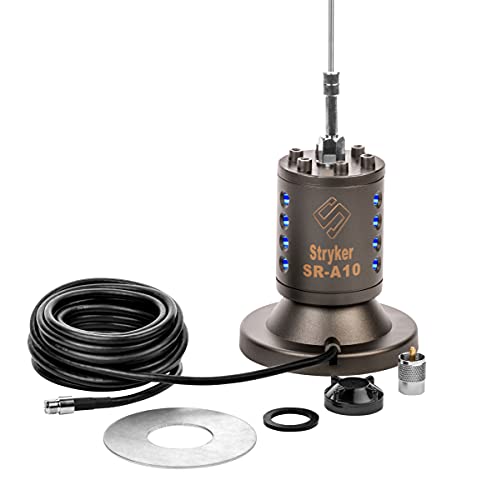
Stryker SR-A10MM Magnetic Mount CB & 10-Meter Radio Antenna

Tram® Nighthawk 400-Watt 26 MHz to 29 MHz 43-Inch-Whip CB Antenna

Combo: 2X Sirio Bull Trucker 3000 3/8 CB & 10M Mobile Antenna with Shaft – Green LED!


Nagoya CB-72 Magnetic Mount CB Antenna, 28 in, 18 ft RG-58A/U, PL-259

Regional practice, channels, and courteous operation
Working habits on the band vary by region and trade, and a new antenna serves its owner best when paired with listening before transmitting. Spending the first journeys monitoring reveals which channels local drivers, depots, marinas, or off-road groups actually use, what signal reports sound like from the routes the vehicle travels, and where the dead spots lie behind hills or inside industrial estates. That knowledge converts the antenna from a specification into a working tool, because the owner learns the real coverage of their own installation rather than the coverage a catalogue photograph implies, and can judge any later change in performance against lived experience.
Courtesy is also an engineering matter on a shared band. A clean, matched antenna radiates the intended signal efficiently, so the operator needs less time on air and causes less splatter into adjacent channels than a distorted, mismatched installation struggling to be heard. Keeping transmissions concise, confirming the channel is clear, and using the lowest practical microphone gain all appear in operating guidance published alongside antenna documentation, and they compound the hardware’s advantages. Groups that adopt shared operating habits, a home channel, scheduled check-ins, and a fallback channel when the first is occupied, consistently report better results from identical equipment than groups relying on hardware alone.
Emergency value follows from the same discipline. A vehicle whose CB installation is maintained, matched, and familiar to its driver becomes a communication resource when other networks fail or lie out of reach, in floods, remote breakdowns, and rural incidents where a passing driver may be the only other station listening. That reliability is not an accident of purchase; it is the accumulated result of the bond checked each season, the readings recorded at fitting, the cable routed away from harm, and the whip inspected before journeys. Owners who treat the antenna as part of the vehicle’s safety equipment, alongside lights and tyres, describe exactly that maintenance rhythm in their feedback.
Before the first long journey on a new installation, a short local drive with a cooperative contact at a known location provides the most honest verdict available. Signal reports exchanged at a few familiar points, a hill, a valley floor, a distant edge of town, map the installation’s real character far better than any single reading in a driveway. Noting those reports beside the tuning figures completes the vehicle’s radio record, and repeating the same small circuit after any later change, a new whip, a moved mount, a replacement cable, shows immediately whether the change helped, harmed, or merely rearranged the compromise every mobile installation embodies.
That small circuit of familiar checkpoints also teaches a driver the rhythm of the band itself: which hours bring local activity, which bring distant voices carried by atmospheric conditions, and how the vehicle sounds to others at each point. Knowledge of that kind cannot be bought as an accessory, yet it multiplies the value of every component already fitted, because an operator who understands their own coverage stops blaming hardware for geography and starts using both deliberately.
Fit the antenna your vehicle can support properly, tune it in open ground with the readings written down, and drive with the quiet confidence that when a voice matters out beyond the last bar of coverage on a handset screen, the whip above your roof, chosen for its mount and its match rather than its packaging, will carry your call down the dark road and bring the answer back through the static like a neighbour leaning across a fence at dusk.