Our Top Picks


What's inside
- Why receive-only design changes the antenna equation
- Frequency coverage from longwave to 30 megahertz
- Active loop antennas and the MLA-30+ pattern
- Mini-Whip active antennas and very small E-field probes
- Long-wire antennas with a balun or matching unit
- Passive loops and the YouLoop approach
- Noise floor, RFI, and the urban listening problem
- Gain, overload, and receiver dynamic range
- Indoor versus outdoor placement in real homes
- Grounding and common-mode noise control in principle
- Check prices on Amazon
- Pairing antennas with portable and desktop receivers
As an Amazon Associate I earn from qualifying purchases. This post may contain affiliate links at no extra cost to you.
Shortwave listening rewards patience, and this guide exists to help you spend wisely before you string wire across a roof. This article contains affiliate links, and the site may earn a commission when readers buy through those links, at no added cost to the reader. Every comparison below rests on manufacturer specifications, published technical data, and owner reports rather than any claim of direct product trials. Receive-only antennas for dedicated shortwave receivers occupy a distinct niche because they never need to handle transmitter power. That single freedom changes design priorities toward low noise, controlled gain, and predictable behavior across a very wide span of frequencies.
A dedicated shortwave receiver, whether a desktop set with a proper antenna socket or a portable with a telescopic rod, hears a world that ordinary broadcast radios barely suggest. Between roughly 100 kilohertz and 30 megahertz sit maritime weather broadcasts, amateur conversations, international services that still survive, time signals, aviation weather, and utility traffic that follows no fixed schedule. The antenna decides how much of that world reaches the receiver in usable form. A poor antenna leaves strong stations audible while weaker signals drown under household interference. A well matched antenna lifts the wanted signal without lifting every switching supply and dimmer in the building by the same amount.
Readers coming from other listening hobbies will find useful parallels elsewhere on the site, including our roundup of options gathered under best am fm radio headphones for private listening during late night sessions. Headphones matter because shortwave audio often carries fading, static crashes, and narrow bandwidth speech that loudspeakers smear. Still, no headphone can recover a signal that the antenna never delivered cleanly. Antenna work therefore comes first in any serious listening setup. The sections that follow treat each major antenna family on its own merits, then turn to placement, noise control, and receiver pairing.
Why receive-only design changes the antenna equation
Transmitting antennas must survive power, present a safe match to a transmitter, and meet efficiency demands within narrow amateur allocations. A receive antenna faces none of those burdens, so designers can use thin wire, small loops, active electronics, and broadband matching that would fail instantly under transmission. Freedom from power handling also permits very compact active designs whose tiny elements would be absurd for sending a signal. The trade is that receive antennas must coexist with receivers of widely varying sensitivity and dynamic range. What flatters a robust desktop receiver can overwhelm a small portable whose front end was built down to a price.
Frequency coverage on receive can stretch across three decades of spectrum in a single installation. Longwave beacons near 200 kilohertz, medium wave broadcasters, the tropical bands, and the higher shortwave allocations near 28 megahertz all behave differently in wavelength terms. An antenna that spans that range evenly is rare, and most designs favor part of the span. Active loops often publish coverage beginning near 100 or 500 kilohertz and extending to 30 megahertz or beyond. Long wires favor lower frequencies where their physical length becomes a meaningful fraction of a wavelength. Understanding which segment you actually listen to prevents buying coverage you never use.
Another difference involves impedance behavior across the band. A transmitting antenna is usually tuned or matched for a narrow slice, while a receive antenna feeds a high impedance or 50 ohm input across everything. Mismatch losses that would alarm a transmitter operator matter less on receive because external noise usually dominates at these frequencies. Below about 20 megahertz, atmospheric and man-made noise typically sit well above a decent receiver noise floor. Losing a few decibels in a matching network therefore costs little audibility. That principle explains why simple antennas can perform far better than their laboratory figures suggest.
Owner reports consistently emphasize that location outweighs exotic construction at shortwave frequencies. A modest wire raised above a quiet garden routinely outperforms an expensive active device mounted beside a noisy computer desk. Reports from apartment listeners describe the opposite frustration, where every antenna choice becomes a negotiation with building wiring and limited outdoor access. The receive-only equation is therefore partly electrical and partly domestic. Balcony rules, landlord restrictions, lightning exposure, and cable routes shape the shortlist as firmly as any specification sheet.
Cost structure also differs from transmitting gear. Receive antennas span simple wire kits costing very little through engineered active loops with machined enclosures and filtered power supplies. Spending more mainly buys lower self-noise, better strong-signal handling, weather resistance, and build consistency. It does not buy a guaranteed path around local interference. Experienced listeners often advise starting with the antenna type your space supports best, then refining with placement experiments. That advice appears repeatedly in owner discussions across several antenna families.
Frequency coverage from longwave to 30 megahertz
The span from 100 kilohertz to 30 megahertz covers wavelengths from about 3,000 metres down to 10 metres, an enormous mechanical range. No passive structure of domestic size resonates usefully across all of it, so designers rely on non-resonant elements, active buffering, or tuned loops that the listener adjusts. Published coverage figures need careful reading because a stated range only promises response, not equal quality throughout. An active loop specified from 500 kilohertz to 30 megahertz may deliver its cleanest results between 2 and 18 megahertz. A long wire may be superb at 6 megahertz and mediocre at 24 megahertz where its pattern breaks into lobes.
Longwave and medium wave reception rewards large capture area or ferrite and loop structures that respond to the magnetic component. Listeners pursuing non-directional beacons or distant medium wave stations often prefer loops because loops can null interfering stations by rotation. Shortwave broadcast and amateur listening between 3 and 18 megahertz forms the heartland for most of the antennas discussed here. Above 18 megahertz, signals depend heavily on solar conditions, and antenna height plus low-loss feed become more influential. Published gain figures quoted at a single frequency should never be extrapolated across the whole span.
Receiver coverage also matters, since many portables tune from longwave through shortwave continuously while some desktop sets add coverage gaps or conversion quirks. Checking the receiver manual for its antenna input arrangements prevents mismatched expectations. Some portables disconnect or attenuate the telescopic path when an external antenna is plugged into a 3.5 millimetre socket. Others keep both paths partly active, which can confuse comparisons. Manufacturer documentation for both receiver and antenna should be read together before judging weak performance.
Season and time of day reshape which frequencies deserve antenna priority. Lower bands open at night and during winter, while higher bands favor daylight and periods of stronger solar activity. An antenna chosen during a summer afternoon trial may disappoint on winter evenings if its strength lies above 15 megahertz. Owner reports that span several seasons are therefore more valuable than first impressions gathered in one week. Listeners who keep simple logs of band conditions build a clearer picture of antenna behavior than those who rely on memory.
For readers who split listening between broadcast radio and other home audio topics, our coverage filed under best am fm radios headsets offers a useful contrast in how domestic receivers handle much narrower frequency ranges. Shortwave sets must remain agile across a far wider field, which is why their antenna terminals and gain controls differ so much. Treating a shortwave antenna purchase like an accessory for a kitchen radio understates the engineering involved. The antenna is effectively half the receiving system. Its published bandwidth deserves the same scrutiny as the receiver tuning range printed on the box.
Active loop antennas and the MLA-30+ pattern
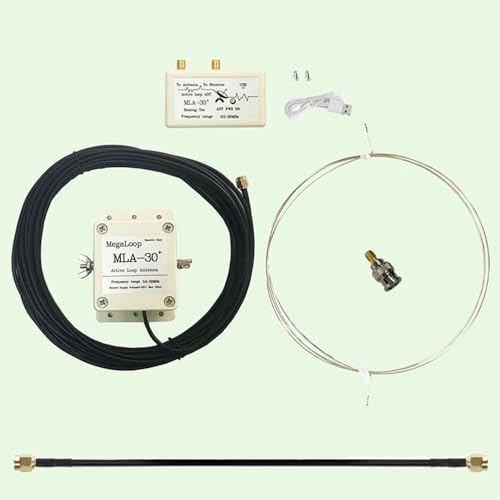
Active loops pair a small conductive loop, often around a metre across or formed from a length of coaxial cable, with a low-noise amplifier mounted at the loop itself. The amplifier compensates for the tiny capture area of an electrically small element, delivering a usable signal down the feed line. Designs in the MLA-30+ pattern made this approach widely accessible, with a loop of thin stainless wire, a weather-sealed amplifier box, and a bias tee that sends power up the coaxial cable. Manufacturer specifications for this class commonly list coverage from about 500 kilohertz to 30 megahertz. Published gain figures vary by frequency and should be read as indicative rather than absolute.
The magnetic response of a loop explains much of its appeal in noisy homes. Many household interference sources radiate predominantly electric-field energy at close range, while distant shortwave signals arrive as balanced electromagnetic waves. A loop that responds chiefly to the magnetic component can therefore favor distant signals over nearby hash. Loops also exhibit deep nulls off their sides, so rotating the loop can reduce a specific interfering station or noise source. Owner reports from urban flats frequently describe a loop on a camera tripod outperforming a wire strung around a window frame. That pattern repeats often enough to treat loop placement as a genuine feature, not a novelty.
Amplifier quality separates strong active loops from disappointing ones. Key published indicators include noise figure, intercept performance, power consumption, and the frequency range over which gain stays reasonably flat. Cheap amplifiers can generate intermodulation products when several powerful broadcasters arrive together, creating phantom signals that no receiver control can remove. Better designs use devices and bias choices selected for strong-signal composure. Because the amplifier sits before any receiver filtering, its overload behavior sets a ceiling for the whole system. Readers should value honest dynamic range data over headline gain numbers.
Power arrangements deserve attention before purchase. Most active loops draw direct current through the feed line from a bias tee powered by a small supply or USB source. Noisy USB chargers can inject interference straight into the antenna system, defeating the loop advantage. Owner reports describe cleaner results from linear supplies, battery packs, or well filtered USB sources. Cable routing matters as well because the feed line can collect noise on its outer surface. A choke at the receiver end and sensible routing away from mains wiring help preserve the loop benefit.
Mounting flexibility is a practical strength of the active loop family. A loop can hang in a loft, stand on a balcony, clamp to a mast, or rest on a bookshelf near a window for portable use. Weatherproofing varies, and indoor-rated amplifier boxes may suffer when left through a wet winter. Stainless loop wire resists corrosion better than plain copper in coastal air. Listeners in rented homes appreciate that a loop can be removed without leaving drilled holes or long wire runs. That reversibility makes experimentation cheap in effort even when the hardware itself costs more than wire.
Limitations should be stated plainly. An active loop will not match a large outdoor wire on the lowest frequencies in a quiet rural location, where capture area still rules. Its amplifier also adds a failure point that passive antennas lack, and a flat battery or failed supply silences the antenna entirely. Strong local medium wave transmitters can still overwhelm modest loop amplifiers. For city listeners, though, the balance of size, null steering, and broadband coverage explains the popularity of this class. The MLA-30+ pattern proved that a small loop could serve as a primary antenna rather than a compromise of last resort.
Mini-Whip active antennas and very small E-field probes
The Mini-Whip takes miniaturisation further than any loop, using a small metal plate or short rod as an electric-field probe feeding a high-impedance amplifier. The original design emerged from amateur experimentation and has been copied in many commercial and kit forms. Published coverage for typical versions spans roughly 10 kilohertz or 100 kilohertz up to 30 megahertz. The element itself may be only a few centimetres long, which makes the design attractive for discreet mounting on a mast, fence post, or balcony rail. Its inventor intended it to sit high and clear, using the feed line and a ground reference as part of the receiving structure.
That dependence on installation details explains sharply divided owner opinion. Reports from listeners who mounted a Mini-Whip above roof height with a clean ground reference describe lively reception across longwave and shortwave. Reports from indoor or low mounting describe noise domination and disappointing sensitivity. The probe responds to electric fields, including the electric clutter that fills modern homes, so height and separation from wiring are not optional refinements. They are core requirements of the design. Treating a Mini-Whip as a desk accessory misunderstands its operating principle.
Grounding arrangements for this family follow a particular logic. The amplifier needs a reference against which the tiny probe voltage is measured, usually provided through the coaxial shield and an earth connection at the base. Poor or noisy earth paths degrade results quickly. Some owners use a dedicated ground rod and short bonding lead, while others experiment with counterpoise wires. Manufacturer instructions for specific versions should be followed because grounding advice differs between implementations. General principles appear later in this guide, but product documentation always takes precedence for a given unit.
Strong-signal behavior is the other recurring theme in Mini-Whip discussions. A broadband probe delivers every strong local signal to its amplifier at once, and modest amplifiers can produce intermodulation under urban broadcast loads. Attenuation or filtering ahead of the receiver sometimes becomes necessary in cities with powerful medium wave transmitters. Rural listeners face fewer such problems and often praise the design value. Published specifications rarely include full intercept data for the cheapest versions, so buyer caution is warranted. A Mini-Whip bought for its size should still be judged by amplifier quality.
Weather exposure is a genuine design consideration because these antennas almost always live outdoors. Sealed enclosures, corrosion resistant hardware, and strain relief for the feed line determine service life. Ultraviolet exposure cracks cheap plastic housings within a few seasons. Owner reports mention water ingress as the most common failure mode for budget versions. Mounting the unit where it can be retrieved without roof work softens that risk. A small antenna that needs a ladder for every inspection is less convenient than its dimensions suggest.
For the right site, the Mini-Whip offers something no other family matches: near invisibility. Homeowner association rules, listed building restrictions, and shared roofs often forbid visible wire or loops. A probe the size of a thumb on a short mast can pass unnoticed while still feeding a serious receiver. That social advantage explains continued interest despite installation sensitivity. Listeners considering this route should budget time for placement trials rather than expecting instant results. Patience during setup is part of the purchase price.
Long-wire antennas with a balun or matching unit
The long wire, sometimes called a random wire when its length avoids exact resonance complications, remains the reference against which other receive antennas are judged. A span of wire between roughly 10 and 40 metres, raised as high and clear as the property allows, collects generous signal across the lower shortwave bands. At the feed point, a 9:1 matching transformer, commonly described as a balun or unun in product literature, tames the wild impedance swings of a non-resonant wire. Manufacturer data for such matching units usually quotes coverage across medium wave and shortwave with modest loss. The wire itself costs little, which keeps this family central to budget planning.
Pattern behavior changes with frequency in ways listeners should understand. At lower frequencies the wire behaves almost omnidirectionally for practical purposes, gathering signals from all directions at low radiation angles. As frequency rises and the wire spans several wavelengths, its pattern splits into lobes and nulls that favor some directions over others. A wire running east to west may favor different regions on 15 megahertz than on 7 megahertz. Owner reports of one band thriving while another sulks often trace back to pattern rather than equipment faults. Rotating a wire is rarely practical, so orientation is a one-time strategic choice.
Feed line arrangements influence noise performance more than many beginners expect. Bringing the wire straight into the listening room imports outdoor signal efficiently but also gives household noise a path backward along the cable. A matching unit at the wire end, followed by coaxial feed with a common-mode choke, keeps the noisy indoor segment shielded. Grounding the matching unit to a rod at the entry point gives static charges and interference currents a local exit. Published guidance from matching unit makers generally recommends exactly this layout. Skipping the choke is the most common reason a promising wire sounds harsh indoors.
Height and clearance matter as much as raw length. A wire sagging between low fences near metal sheds and power lines will underperform a shorter wire raised cleanly above roof level. End supports should keep the wire away from gutters and foil insulation that distort its behavior. Insulators at both ends protect against voltage gradients and keep the wire electrically separate from supports. Tree supports demand strain relief because trunks move in wind and can snap a taut wire. Experienced installers leave a gentle catenary rather than a guitar-string span.
Safety obligations accompany any long outdoor conductor. A wire must never cross or approach overhead power lines, and installation near them belongs to professionals or should not happen at all. Lightning protection deserves real planning rather than a paragraph of reassurance, because a long wire collects charge efficiently during storms. Disconnecting the feed during thunderstorms and providing a proper discharge path are standard practices described in antenna handbooks. Local electrical codes govern what may be bonded to a home earth system. Readers should consult those codes or a qualified electrician rather than improvising protective arrangements.
Where space and safety allow, the long wire still delivers the most signal per unit of money spent. Its weaknesses are visual impact, planning effort, and the noise that a large structure can gather in dense housing. Suburban listeners with gardens continue to choose it as a primary antenna for desktop receivers. Portable receiver owners can also use a shorter version through a suitable matching arrangement, though overload becomes likely on sensitive portables. The wire rewards methodical installation more than any other family in this guide.
Passive loops and the YouLoop approach
Passive loops remove the amplifier from the antenna and rely on the receiver for gain, which changes both strengths and weaknesses. A tuned passive loop uses a variable capacitor to resonate the loop at the listening frequency, delivering useful selectivity before the receiver front end. An untuned passive loop of the YouLoop type uses a small transmission-line loop with a matching transformer, presenting a quiet broadband element roughly 60 centimetres across in its common form. Manufacturer descriptions of the YouLoop concept stress low noise pickup and suitability for receivers with adequate sensitivity. Because there is no active device, there is nothing at the antenna to overload.
The noise advantage of a passive loop is structural. Without an amplifier raising the floor, the loop delivers only what the element gathers, and its magnetic response plus null steering still apply. Modern receivers, especially desktop sets and better portables, usually have sensitivity to spare below 20 megahertz. Trading surplus sensitivity for a lower noise environment is often a winning exchange in flats and terraced houses. Owner reports describe readable signals emerging from what sounded like a wall of hash on a telescopic rod. The improvement is usually described as clarity rather than louder audio.
Portability defines the YouLoop style of listening. The loop folds or coils for travel, hangs from a curtain rail or picture hook, and pairs naturally with portable receivers on trips. Hotel room listening, campsite sessions, and balcony use all suit a passive loop that needs no power feed. Its balanced construction reduces feed line noise pickup when used with the supplied or recommended connection arrangement. Listeners who move between rooms value an antenna that can be repositioned in minutes to hunt for a quiet corner. That mobility turns placement into a repeatable experiment rather than a fixed installation decision.
Tuned passive loops serve a different temperament. A larger tuned loop with a quality capacitor can deliver striking selectivity on medium wave and lower shortwave, pulling one station out of a crowded channel. The listener must retune whenever frequency changes substantially, which suits deliberate band exploration rather than casual scanning. Published Q values and tuning ranges help buyers judge whether a given loop covers their favorite bands. These loops are often handcrafted products with prices reflecting mechanical quality. Their following among medium wave enthusiasts remains loyal for good reason.
Passive loops do have clear limits. On the highest shortwave bands, where atmospheric noise falls and receiver sensitivity matters more, a small passive loop may deliver too little signal for a mediocre portable. Desktop receivers with low noise floors handle the same loop far better. Cable losses and connector quality also become visible when no amplifier masks them. Buyers should match loop expectations to the receiver they actually own. A passive loop paired with a deaf receiver disappoints for reasons that have nothing to do with loop construction.
Durability is a quiet virtue here. With no electronics outdoors, a passive loop tolerates weather, storage, and neglect that would kill active devices. The main vulnerabilities are mechanical: cracked loop tubing, worn connectors, and capacitor faults on tuned models. For listeners who want an antenna that simply works whenever it is unpacked, that simplicity carries real value. Passive designs also sidestep every question about power supply noise. In a hobby full of variables, removing two failure modes at once is a meaningful achievement.
Noise floor, RFI, and the urban listening problem
Radio frequency interference defines modern shortwave listening more than receiver quality does. Switch-mode power supplies, LED lighting, solar inverters, power-line networking adapters, and cheap chargers all spray energy across the bands. The result is a raised noise floor that masks weak signals no matter how sensitive the receiver claims to be. Antenna choice fights this problem in two ways: by responding less to local fields, and by being placed farther from the sources. Loops address the first mechanism while outdoor placement addresses the second. Any buying decision that ignores interference will misread published sensitivity figures completely.
Identifying your own noise sources is the cheapest performance upgrade available. Switching off circuits one at a time while listening to a battery powered receiver reveals which appliances pollute the spectrum. Owner reports routinely trace a band-wide roar to a single phone charger, aquarium heater, or networking adapter. Replacing one offender with a better filtered unit can transform reception more than a new antenna would. Ferrite chokes on offending cables help in some cases, though results vary by frequency and cable layout. Methodical hunting beats guesswork because interference sources rarely match expectations.
Distance remains the most reliable noise medicine. Noise from a household device falls quickly with separation, while distant shortwave signals arrive essentially undiminished across a garden. Moving an antenna even ten metres from the house can lower the local floor by a clearly audible margin. That is why outdoor loops and wires fed by coaxial cable so often beat indoor antennas of cleverer design. Balcony listeners gain less distance but can still exploit height and the shielding of the building itself. Placement experiments with a portable receiver and headphones map the quiet zones of a property quickly.
Readers who battle interference across several home technologies may also appreciate our material collected under best long range outdoor wifi extenders, where separation and placement discipline solve a different wireless problem with familiar logic. The frequencies differ enormously, yet the habit of surveying the environment before buying hardware transfers directly. Shortwave listeners face interference that is older, broader, and less regulated in practice. A site survey with a portable set costs an evening and informs every later purchase. Skipping that survey is how good antennas earn unfair reviews.
Noise figures quoted for active antennas deserve translation into real expectations. A low-noise amplifier preserves weak signals that the element captures, but it cannot subtract interference that arrives through the same element. When external noise dominates, amplifier noise figure becomes almost irrelevant, and strong-signal handling matters far more. Urban buyers should therefore rank overload data above sensitivity data. Rural buyers under genuinely quiet skies face the opposite ranking. Published specifications rarely state which environment the designer assumed, so owner reports from similar housing carry extra weight.
Time patterns help separate local interference from band conditions. Household noise often follows domestic routines, peaking during evenings when lighting, cooking equipment, and chargers run together. Solar inverters pollute mainly during daylight generation hours. Keeping a simple log of noise by hour and band reveals these signatures within a week. Such a log also prevents misjudging an antenna bought during a quiet holiday period. Experienced listeners treat noise management as an ongoing practice rather than a one-time purchase decision.
Gain, overload, and receiver dynamic range
Gain is the most advertised and least understood figure in receive antenna marketing. An active antenna with high gain delivers more signal and more noise to the receiver, which helps only when the receiver itself is the limiting factor. Below 20 megahertz that condition is uncommon with modern sets. Excess gain instead pushes strong signals closer to the overload threshold of both the antenna amplifier and the receiver front end. The audible symptoms include phantom stations, distorted audio on strong broadcasts, and a noise floor that rises with the attenuator disengaged. More gain can therefore make a crowded band sound worse.
Overload behavior deserves a vocabulary of its own. Intermodulation occurs when two or more strong signals mix in a non-linear stage and create false products on unrelated frequencies. Blocking occurs when one powerful signal desensitises the receiver to everything else nearby. Desktop receivers generally publish intercept and dynamic range figures that let buyers estimate resilience. Portable specifications are usually thinner, which is why owner reports about a portable misbehaving on a large antenna are so valuable. A receiver that sings on its telescopic rod may collapse when fed by a 30 metre wire.
Attenuators and gain controls are the practical tools for managing this balance. Many desktop sets include a switchable attenuator and an RF gain control that together tame strong evening broadcast bands. Some active antennas provide gain adjustment or a bypass option for exactly this reason. Using attenuation on shortwave often improves readability even though the S-meter reads lower, because the receiver stages return to linear operation. New listeners sometimes resist attenuation on principle, assuming maximum signal must be best. Published receiver design literature has argued the opposite for decades.
Filtering offers another line of defence. A high-pass filter can strip powerful medium wave energy before it reaches an amplifier intended for shortwave. Band-pass filters for a favorite allocation can transform a difficult location during contest weekends or broadcast peaks. Filters cost insertion loss, which matters little when external noise dominates. Their benefit appears as cleaner audio and fewer phantom signals rather than stronger meter readings. Antenna selection and filter selection should be planned together for listeners near powerful transmitters.
Comparing published gain curves across brands requires care because measurement setups differ. Some makers quote gain relative to a reference dipole at one frequency, while others quote amplifier gain alone with no element attached. Neither figure predicts what a given receiver will display on its meter. The honest use of published data is comparative within a single product line or against a clearly stated reference. Buyers who treat marketing gain as a league table will misrank antennas whose virtues lie elsewhere. Noise behavior and overload composure rarely fit into a single decibel headline.
A balanced shortlist therefore pairs each antenna with the receiver it will feed. High gain active antennas suit deaf receivers and very small spaces. Modest gain or passive designs suit sensitive receivers and strong-signal districts. Adjustable systems cost more but forgive mismatches between antenna ambition and receiver ability. The goal is a chain where no stage is driven into distortion during the strongest conditions you regularly meet. That goal is achievable at several price levels once the principle is understood.
Indoor versus outdoor placement in real homes
Indoor antennas live with the listener, which makes them convenient and perpetually compromised. Building materials attenuate signals unevenly: foil-backed insulation and metal roofing can screen a loft almost completely, while ordinary brick and timber pass shortwave with modest loss. Reinforced concrete frames in apartment blocks create partial shielding that varies by floor and orientation. Windows usually form the most transparent path, which is why indoor loops gravitate toward them. A top-floor flat under a timber roof may enjoy indoor results that a ground-floor flat behind steel framing cannot approach.
Outdoor placement buys signal clarity at the price of installation effort and exposure. Even a small loop on a balcony rail escapes much of the indoor noise field and gains a clearer view of the sky. Height helps most on the higher bands, where line-of-sight character grows, while lower bands care more about distance from noise than altitude. Feed line quality and weatherproof connections decide whether outdoor gains survive the journey indoors. A superb antenna feeding a waterlogged connector performs like a poor antenna. Installation budgets should include connectors, sealant, and cable, not just the antenna itself.
Lofts occupy an interesting middle ground that many listeners underrate. A loop or wire in a dry loft sits above most household noise sources while remaining accessible in any weather. The compromises are roof material screening and proximity to solar panels or wiring runs in modern homes. Owner reports from loft installations are frequently positive for active and passive loops alike. Wires in lofts must respect joist spacing and should avoid contact with foil insulation. A loft also simplifies lightning disconnection routines compared with a roof mast.
Seasonal and domestic realities shape placement as much as physics. A garden wire that delights in summer may cross a neighbour sightline or a washing line route in ways that cause friction. Balcony antennas must respect building rules that can change with management. Portable indoor antennas sidestep most disputes because they vanish into a cupboard after each session. Listeners who share space often value an antenna that deploys in minutes over one that performs slightly better but stays permanently visible. Household diplomacy is a legitimate selection criterion.
Our related coverage under best wifi boosters and extenders deals with a parallel placement puzzle indoors, where moving a device a short distance can change results dramatically. Shortwave placement behaves similarly, except the distances are larger and the interference sources are more varied. A methodical listener moves a loop around a room while noting noise on several bands, then repeats the survey at a different hour. Those notes usually identify one or two favored spots. Marking the spot and the loop orientation turns future sessions into quick setups rather than fresh experiments.
Hybrid strategies deserve mention because few homes force a single choice. Many listeners keep an outdoor wire or loop for serious evening sessions and a small indoor loop for casual daytime listening. Others run one feed line to a switch and alternate between an active loop and a wire by band. Antenna switches rated for receive use are inexpensive and add flexibility without new cable runs. Planning for two modest antennas can beat stretching a budget on one prestigious model. The bands themselves reward variety because no single structure excels everywhere.
Grounding and common-mode noise control in principle
Grounding language confuses newcomers because one word covers several distinct jobs. A safety earth protects people and property during faults and lightning events, and it follows electrical codes rather than hobby preference. An RF reference gives certain antennas, notably the Mini-Whip family and end-fed wires, a defined return path that affects performance. A noise drain gives common-mode currents on a feed line somewhere better to go than through the receiver. These jobs sometimes share hardware, but they are not interchangeable concepts. Antenna manuals that blur them together do readers a disservice.
Common-mode current is the quiet villain of many installations. It flows on the outside of coaxial cable, turning the feed line into an unintended antenna that collects household noise on its way to the receiver. A choke balun or line isolator at the right point impedes that current while leaving the wanted differential signal untouched. Placement matters: a choke near the antenna, near the building entry, or at the receiver each solve slightly different problems. Owner reports of noise dropping after a choke was fitted are extremely common. Published choke specifications should state impedance across the shortwave range, not just a single frequency figure.
For end-fed wires and matching units, a short connection to a ground rod at the feed point usually improves both consistency and noise behavior. Long wandering earth leads can act as antennas themselves and import the noise they were meant to drain. Keeping leads short, straight, and outside the living space follows principles repeated across antenna handbooks. Where a dedicated rod is impossible, a counterpoise wire offers an alternative reference for some designs. Product instructions should guide the choice because matching units differ in what they expect. Experimentation within those instructions is normal and safe at receive-only levels.
Lightning and static protection belong in every outdoor plan, stated at the level of principle rather than recipe. A disconnected antenna during a storm cannot deliver a surge to the receiver, which is why many listeners use a switch or a removable link at the entry point. Gas discharge protectors and proper bonding exist for permanent installations and follow local codes. Static build-up on long wires during dry wind or snow can produce crackling and, in extremes, damaging discharges. Bleed resistors in matching units address part of that risk. Readers uncertain about protective bonding should hire qualified help instead of copying forum diagrams.
Indoor loops simplify the grounding story considerably. A balanced loop with a proper feed arrangement needs no earth connection for performance, and adding random earth wires can worsen noise by importing it. That independence is one reason loops dominate apartment recommendations. Active loops powered through bias tees still benefit from feed line chokes in noisy buildings. The principle is selective: connect earth where the design calls for a reference, and choke where currents should be blocked. Applying both ideas blindly to every antenna creates muddled systems that are hard to troubleshoot.
Documentation habits pay off in this area. Sketching the antenna, feed line, chokes, and earth connections on paper exposes loops and unintended paths that memory misses. Labeling which connection serves safety and which serves RF reference prevents later modifications from defeating protection. When noise changes after building work or a new appliance arrives, the sketch speeds diagnosis. Grounding done thoughtfully is invisible in daily use, which is precisely the point. The listener hears stations instead of the house.
Check prices on Amazon
Live listings for the shortlist in this guide are pulled from Amazon below, so prices and availability are always current at the moment you look.
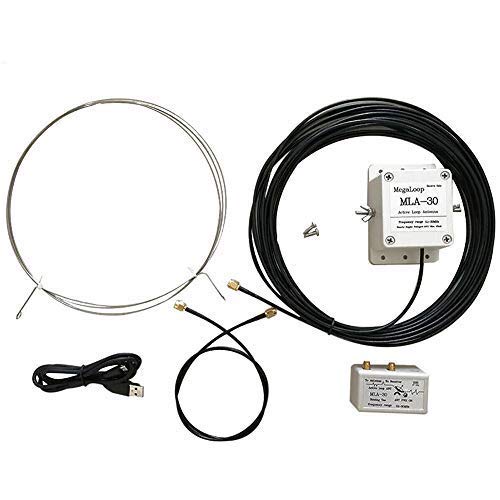
MLA-30 Loop Antenna Active Receiving Antenna 100kHz – 30MHz for Short Wave Radio

Shortwave, SWL, AM, OC, Basic Longwire antenna Kit. 100 FEET


Pairing antennas with portable and desktop receivers
Portable shortwave receivers impose the tightest constraints in this guide. Their telescopic rods and simple external antenna sockets were designed around modest signal levels, and many portables overload gracefully or not at all. A passive loop or a short wire through an attenuator usually partners better than a high gain active antenna. Some portables accept external antennas through a 3.5 millimetre jack that also serves other functions, so adapter quality matters. Published receiver manuals often warn against very long wires, and that warning reflects real front-end limits. Ignoring it produces distorted audio that owners sometimes blame on the antenna brand.
Desktop receivers sit at the opposite pole, with 50 ohm inputs, switchable attenuation, preselection on better models, and dynamic range built for serious antennas. They exploit long wires and active loops fully, and they tolerate the strong evening bands that swamp portables. A desktop set also justifies investment in feed line chokes, switches, and filters because its performance ceiling is higher. Buyers planning a desktop purchase can choose antennas more ambitiously. Buyers committed to a portable should let its limits shape the shortlist from the start.
Intermediate receivers blur the boundary in useful ways. Larger portables and transportable sets often include proper coaxial inputs, attenuators, and sync detection that reward better antennas. Their manuals and owner communities usually document which antenna classes pair well. Checking community reports for your exact receiver model is more predictive than general advice. Model-specific quirks, such as an external socket that mutes the internal ferrite on medium wave, change antenna value significantly. Research at model level is a recurring theme in experienced listener guidance.
Connector and adapter discipline prevents small frustrations from becoming performance losses. Shortwave gear uses a mix of SO-239, BNC, SMA on some modern sets, and simple wire terminals on matching units. Every adapter adds a possible intermittent contact, especially outdoors. Keeping the adapter count low and weather-sealed preserves the signal that the antenna worked to gather. A small spares box with the right adapters saves a listening weekend. Published antenna specifications should be checked for the connector actually fitted, not assumed from photographs.
Gain staging across the whole chain is the final pairing skill. Antenna amplifier gain, filter loss, attenuator setting, and receiver RF gain should be adjusted as one system rather than independent dials. A useful routine starts with attenuation engaged on strong bands, then relaxes it as conditions weaken late at night. Listeners who learn that routine extract good results from modest hardware. Those who leave every control at maximum often conclude wrongly that their location is hopeless. Technique multiplies the value of whatever antenna you choose.
Building a shortlist that fits your home and receiver
A sensible shortlist begins with the building rather than the catalogue. Flat dwellers with a balcony should rank active loops and passive loops first, with a Mini-Whip considered only where a high, clear mounting point exists. House owners with a garden of reasonable size should compare a matched long wire against an outdoor loop, letting noise surveys decide between them. Rural listeners under quiet skies can exploit larger passive structures that would overwhelm a city receiver chain. Writing those constraints down before browsing products prevents the common drift toward whichever antenna has the loudest marketing.
Budget allocation deserves the same discipline as antenna selection itself. Money reserved for cable, chokes, connectors, sealant, and a safe mounting system usually improves results more than the same amount added to the antenna purchase. A mid-priced loop on a proper stand with a choked feed line will outperform a premium loop dangling from a noisy indoor hook. Installation accessories are unglamorous, and catalogues rarely bundle them honestly. Owner reports that include full installation details are therefore more useful than reports quoting the antenna model alone. Copy the system, not just the headline product.
Reading published specifications with a checklist keeps comparisons fair. Note the stated frequency range, whether gain is quoted for the element or the amplifier, the power requirement and how it is delivered, connector type, weather rating, and any overload or intercept data the maker is willing to publish. Absence of overload data on a broadband active antenna is itself information worth weighing. For passive products, note dimensions, tuning range where relevant, and what feed arrangement the maker recommends. A maker who documents grounding and choke advice clearly is signaling engineering care that usually shows elsewhere.
Second-hand markets serve this hobby well because receive antennas suffer little wear when used indoors. Loops, matching units, and passive designs change hands frequently as listeners upgrade or move home. Outdoor active units deserve closer inspection for water damage and corroded connectors before purchase. Asking a seller about the environment a unit lived in is reasonable and often revealing. Warranty support matters more for active electronics than for wire and transformers. Factor that support difference into any price comparison between new active gear and used passive gear.
Expect a period of adjustment with whichever family you choose. Antenna placement, receiver gain settings, and local noise patterns interact, and finding the best combination takes several sessions across different bands and hours. Listeners who change one variable at a time learn what each adjustment actually does. Those who rebuild the whole system after every disappointing evening learn nothing except frustration. A simple notebook beside the receiver, recording antenna position, band, time, and noise character, becomes a personal reference more valuable than generic advice. Your home has its own radio climate, and the notebook maps it.
Future expansion should influence connector and switch choices even on a first purchase. A listener who expects to add a second antenna later benefits from a feed entry panel and a receive antenna switch planned from the start. Desktop receivers with two antenna inputs reward that planning immediately. Portable listeners may instead invest in adapters that let one loop serve at home and on trips. Thinking one step ahead avoids the tangle of improvised junctions that grows around many listening posts. Modest planning keeps the hobby focused on listening rather than perpetual rewiring.
Community knowledge remains the richest resource for this niche. Shortwave listeners publish reception logs, antenna comparisons, and noise investigations with a level of detail that product pages never match. Reading those accounts with attention to housing type and receiver model filters the useful from the merely enthusiastic. A report from a similar flat, suburb, or rural setting predicts your results better than a report from a different continent and housing stock. Contributing your own findings after a purchase returns value to that commons. The hobby has always run on shared logbooks.
Value judgments differ by listening ambition, and no single antenna wins every category in this guide. The active loop offers the broadest urban usefulness in the smallest footprint, while the passive loop offers quiet simplicity and travel readiness. A matched long wire remains the signal-gathering benchmark where land, safety, and planning allow it. The Mini-Whip serves a narrow but real need for near-invisible installation done carefully. Matching one of those profiles to your rooms, roof, and receiver is the actual decision. Specifications merely help you execute that match with fewer regrets.
Maintenance habits protect the investment after the excitement of installation fades. Outdoor connectors benefit from periodic inspection for green corrosion, cracked seals, and cable jackets split by sunlight or frost. Indoor loops need little beyond dusting and an occasional check that the feed cable has not been pinched by furniture or doors. Matching units and chokes should be kept dry, and any enclosure that has admitted water once will usually do so again until the entry point is resealed properly. A brief inspection each spring and autumn prevents the slow decline that listeners sometimes misread as worsening band conditions or a failing receiver. Photographing the installation when it works well gives a reference for restoring it after storms, roof work, or a house move disrupts the original arrangement.
Documentation from the maker should be kept with the receiver manuals rather than discarded with the packaging. Pinouts for bias tees, polarity notes for power supplies, and grounding diagrams become important months later when memory has faded and a fault needs methodical tracing. Recording which power supply belongs to which active antenna prevents the classic error of feeding a unit the wrong voltage during a hurried reassembly. Spare fuses, adapters, and a short length of the correct coaxial cable complete a modest support kit for the listening post. None of this equipment improves a specification sheet, yet all of it protects listening time, which is the resource the hobby actually consumes.
Choose the antenna your home can host honestly, place it with care, and let the bands themselves teach you what it does best.