Our Top Picks



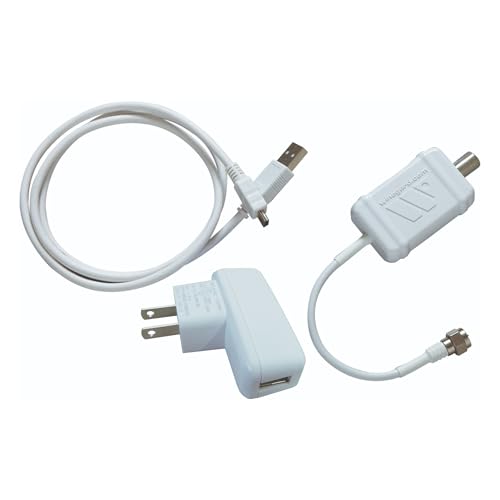
What's inside
- What a mast-mounted preamp actually does
- When a preamp genuinely helps reception
- When a preamp makes pictures worse
- Reading gain figures like an installer
- Noise figure, the quiet specification that matters
- LTE and 5G filtering near the television band
- Power through the coax, and where installs go wrong
- Weather, housings, and the outdoor half of the job
- Preamp or distribution amplifier: different tools
- Matching the familiar model families to real homes
- A calm installation sequence that avoids rework
- Check prices on Amazon
- Troubleshooting patterns owners report most
As an Amazon Associate I earn from qualifying purchases. This post may contain affiliate links at no extra cost to you.
This guide contains affiliate links, and the site may earn a commission when readers buy through those links, at no extra cost to the reader. Recommendations rest on published manufacturer specifications, documented installation guidance, and patterns in owner reports, never on invented bench figures. Prices and model lineups shift over time, so the buying advice below focuses on specifications and installation logic that stay useful across product generations.
What a mast-mounted preamp actually does
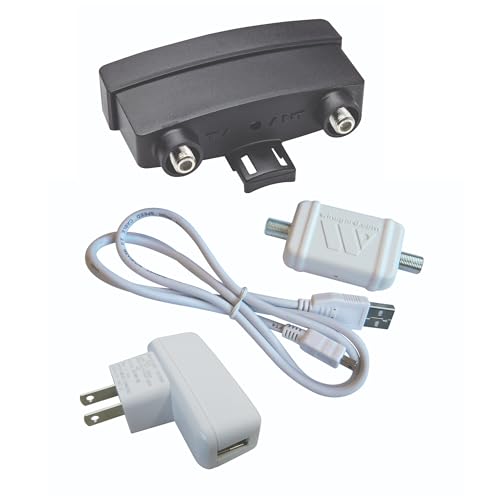
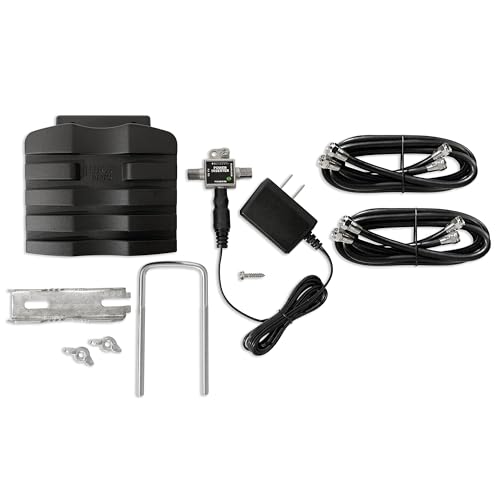
A mast-mounted preamplifier is a small weather-sealed amplifier that sits outdoors, close to a television antenna, and strengthens the signal before that signal travels down a long run of coaxial cable. Products in this family include the Channel Master Amplify and Titan lines, the Winegard Boost series, several RCA outdoor models, and the Antennas Direct Juice. Although the housings and brand names differ, the electrical job is identical everywhere. The unit takes a weak over-the-air signal at the antenna terminals, adds a controlled amount of gain measured in decibels, and sends a stronger copy toward the televisions inside the home.
Placement explains most of the value. Every metre of cable between an antenna and a tuner absorbs a small share of the arriving energy, and every splitter divides what remains among its output ports. When amplification happens at the mast, the signal starts that journey from a higher level, so the losses along the way consume a smaller fraction of the total. When amplification happens beside the television instead, the cable has already weakened the signal and added its own share of electrical noise, and the late amplifier raises both together. That ordering, gain first and loss second, is the entire technical case for putting the electronics outdoors.
The indoor half of the system is a power inserter, a compact device that feeds direct current up the same coaxial cable that carries television signals down. The preamp itself has no battery and no separate power cord. It draws a modest supply, commonly in the range of five to twelve volts depending on the design, through the centre conductor and shield of the feed line. The inserter sits near a television or behind a distribution point, plugged into a wall outlet that stays live around the clock.
Nothing about a preamp creates signal that the antenna failed to capture. A rooftop antenna pointed at a distant transmitter collects a fixed amount of energy, and the amplifier can only preserve more of that energy through the delivery path. Viewers who grasp this point shop differently. They stop hunting for the largest gain number on the box and start matching gain, noise performance, and filtering to the real losses and real interference in their own installation.
Three numbers dominate every specification sheet in this category. Gain states how much the device lifts signal level, stated in decibels. Noise figure states how much unwanted hiss the device adds while doing that work, also stated in decibels, with lower values preferred. Dynamic range, described less often in consumer literature, states how strong a signal the device can handle before its output distorts. A sensible purchase weighs all three rather than celebrating the first alone.
When a preamp genuinely helps reception
Long cable runs form the clearest case. RG6 coaxial cable, the standard feed line for home television work, loses roughly five to six decibels per hundred feet at the upper UHF frequencies where many digital channels now live. A farmhouse with an antenna on a detached barn, a home with the antenna at one gable and the televisions at the far end, or a tall house with cable routed through an attic and down interior walls can easily accumulate eighty to one hundred fifty feet of total path. At those lengths, cable loss alone can erase a marginal channel before any tuner sees it.
Multiple televisions form the second clear case. A two-way splitter sends a little more than half the incoming power to each output once internal losses are counted, a penalty near three and a half decibels per port in published splitter data. A four-way splitter costs roughly seven decibels per port. Homes feeding three or four sets from one antenna therefore start every viewing session with a built-in deficit, and a mast preamp sized to that deficit restores comfortable margin without touching anything indoors.
Fringe locations form the third case. Viewers forty to seventy miles from the broadcast towers often receive signals that hover near the digital reception threshold, strong enough on a calm evening and gone during rain, summer foliage growth, or temperature swings. Digital television fails abruptly at that threshold, a behaviour often called the cliff effect, so a modest reserve of extra level converts an unreliable channel into a dependable one. Owners in deep fringe areas consistently describe this margin, rather than any dramatic channel haul, as the real benefit they bought.
Attic installations deserve a mention of their own. An antenna under a roof starts with a penalty from roofing material, radiant barrier foil, and nearby ductwork, then usually feeds a long drop to the living spaces below. A preamp cannot undo the roof penalty, yet it can protect whatever signal the attic antenna does collect from further erosion on the way down. Many attic owners pair the amplifier with a later antenna relocation, and the amplifier remains useful after the move because the cable path rarely gets shorter.
Certain symptoms point toward a preamp as the right remedy. Channels that arrive cleanly at a television temporarily connected near the antenna, then vanish at the end of the full house run, indict the distribution path rather than the sky. Channels that fade as more televisions join the system point the same way. A channel scan that improves when a splitter is removed for a trial evening tells the same story in miniature. Each pattern shows loss inside the home, and loss inside the home is precisely the problem a mast preamp was built to solve.
Detached structures deserve their own sentence in this survey because they combine every favourable factor at once. A workshop, studio, or guest house fed from the main antenna can sit two hundred feet from the mast, beyond the reach of passive cable at UHF no matter how carefully the run is built. A preamp at the source antenna is often the only component that makes such a feed viable, and owners of outbuildings report the clearest before-and-after stories in the entire category.
New housing developments create a quieter version of the same need. Streets built quickly often share long in-wall cable paths installed to a price, with splitters hidden in ceilings and plates daisy-chained in ways no diagram records. Residents inherit losses they cannot see and did not choose. A mast preamp compensates for that hidden arithmetic without opening a single wall, which explains its popularity in subdivisions where the towers sit at a middling distance and every home on the street reports the same two fragile channels.
When a preamp makes pictures worse
Strong-signal neighbourhoods reverse the logic completely. A home within ten or fifteen miles of the main transmitter cluster already receives abundant energy at the antenna. Adding twenty decibels of gain on top of abundance pushes the combined level past the point where the preamp, the tuner, or both begin to distort. Distortion in a digital system does not produce the ghosting and snow that analogue viewers remember. It produces breakup, frozen frames, audio dropouts, and channels that disappear from the scan despite a signal meter reading very high.
Overload confuses many owners because the meter looks encouraging while the picture falls apart. The meter reports total energy, not clean energy. An overloaded amplifier generates spurious products that land inside wanted channels, and the tuner then faces a mixture where the desired broadcast competes with interference manufactured inside the home system itself. Removing the preamp in this situation feels counterintuitive, yet owner reports repeat the pattern often: the amplifier came out, the breakups stopped, and the channel count stayed the same or grew.
Nearby transmitters of other kinds add to the risk. A strong FM radio station, a close mobile phone tower, or a neighbour operating powerful radio equipment can each present the preamp with energy far stronger than the television signals it was meant to lift. Wideband consumer preamps amplify a broad swath of spectrum, so a single powerful out-of-band emitter can consume most of the available headroom. The television channels then suffer even though nothing about the television towers changed.
Short, simple systems rarely need help either. One television, twenty feet of cable, line of sight to the towers, and a modern tuner already form a chain with margin to spare. Adding electronics to that chain introduces a power dependency, two extra connectors exposed to weather, and an overload risk, all in exchange for gain the system cannot use. Experienced installers advise proving a need first: run the antenna straight to one set, note the stable channels, then decide whether distribution losses justify amplification.
Homes near an airport or beneath a flight path meet a different nuisance, multipath reflections that shift as aircraft pass, and gain does not repair reflections. Antenna height, antenna aim, and a more directional antenna address that problem. Spending on a preamp before addressing aim and placement ranks among the most common wasted purchases in this hobby, a point antenna forums repeat with remarkable consistency across many years of owner threads.
Reading gain figures like an installer
Published gain for mast preamps spans a wide band, from roughly ten decibels in low-gain and adjustable designs up to thirty decibels or more in high-gain fringe models. Channel Master has long sold both ends of that spectrum, with Titan and Amplify variants aimed at different distances, while Winegard Boost models cluster in the middle and Antennas Direct positions the Juice as a moderate-gain, low-noise option. RCA outdoor units often quote a single mid-range figure near twenty decibels. None of these numbers is inherently superior. Each suits a different loss budget.
A loss budget is simple arithmetic that any buyer can do on paper. Start with cable loss for the full run at the highest channel frequency of interest. Add splitter loss for the largest split in the system. Add a decibel or two for connectors, wall plates, and the inevitable extra jumper behind the television stand. The total is the deficit the preamp must cover, plus a small reserve of three to six decibels for weather and seasonal change. A home with nine decibels of calculated loss gains nothing from a thirty-decibel amplifier beyond a shorter path to overload.
Adjustable gain, offered on several current models, earns its keep in real homes because loss budgets change. A family adds a bedroom television, swaps a two-way splitter for a four-way unit, or moves the antenna to a taller mast with a longer drop. A dial or switch that trims gain in steps lets the same amplifier follow those changes. Owners who document their installs often describe starting at the lowest setting and stepping upward only until marginal channels stabilise, a habit that keeps headroom in reserve.
Separate VHF and UHF gain figures deserve a close look. Many specification sheets publish one number for the high-VHF band and another, usually higher, for UHF. A market where the must-have network affiliates still broadcast on VHF channels seven through thirteen needs healthy VHF gain, while a market fully migrated to UHF does not. Repack changes over the past decade moved many stations, so checking the actual radio-frequency channels in the local market matters more than the virtual channel numbers shown on screen.
Beware of headline gain quoted at a single favourable frequency. Cable loss also varies with frequency, climbing steadily toward the top of the UHF band, so a preamp whose gain peaks low and sags high may leave the hardest channels short. Reputable makers publish a gain curve or at least band-specific figures. When only one number appears, treat it as an approximation and leave extra reserve in the budget rather than planning to the last decibel.
Noise figure, the quiet specification that matters
Noise figure measures how much a preamp degrades the purity of what passes through it. Every amplifier adds some noise of its own, and the figure, stated in decibels, tells how much. Values around one to two decibels mark strong designs in this category. Values near three decibels remain serviceable for suburban systems. Higher figures start to matter exactly where help is needed most, at the fringe, because a weak desired signal competes directly with the noise floor the electronics establish.
The first amplifier in a chain sets the noise character for everything after it. That rule of receiver design explains why a low-noise mast unit outperforms a louder amplifier placed indoors even when both quote identical gain. By the time a signal has crossed a hundred feet of cable, its level has fallen toward the noise contributions of later stages, and no later stage can restore the original ratio. Owners comparing two preamps with equal gain should therefore choose the lower noise figure almost every time.
Manufacturers sometimes quote noise figure for UHF alone, sometimes as a single blended value, and the VHF figure can differ by a decibel or more. Shoppers in mixed markets should look for both numbers. A unit that shines on UHF but runs noisy on high-VHF can leave a key affiliate puzzlingly fragile while every other channel looks robust. That asymmetry shows up in owner reports as one stubborn channel, and it often traces back to this overlooked line of the specification table.
Noise figure also interacts with antenna choice. A small indoor antenna with poor efficiency delivers a weak, noisy starting point that no preamp can polish into fringe performance. A properly sized outdoor antenna with clean aim delivers more raw signal, and a low-noise preamp then preserves that advantage through the house wiring. The sensible sequence is antenna first, preamp second, distribution hardware third. Reversing the sequence spends money in the order least likely to help.
Temperature and age nudge noise performance slowly, which is one reason a preamp that performed beautifully for six seasons can seem tired in the seventh. Semiconductor junctions age, connector corrosion creeps inward, and water vapour finds seams. When a once-solid fringe channel degrades gradually rather than suddenly, swapping in a known-good amplifier for comparison is a legitimate diagnostic step, provided the connectors and feed line pass inspection first.
LTE and 5G filtering near the television band
The television spectrum shrank when the 600 megahertz band moved to mobile service, and the top of the current UHF television band now ends at channel thirty-six, near 608 megahertz. Mobile downlink signals begin not far above that edge. A phone tower a few streets away can therefore pour strong energy into a wideband preamp tuned for an older, wider television band. The preamp spends its headroom on signals nobody wants to watch, and television reception suffers in ways that look random until the tower is noticed.
Modern preamps answer with built-in LTE filtering, a low-pass characteristic that passes television frequencies and rejects the mobile bands above them. Product literature for recent Channel Master, Winegard, and Antennas Direct models highlights this filtering because tower proximity has become a mainstream suburban condition rather than a rare one. The filter works best when it sits before the active gain stage, stopping the unwanted energy from consuming dynamic range in the first place.
Older preamps that still work well can gain the same protection from a separate inline LTE filter fitted at the antenna, ahead of the amplifier input. Owner reports describe a familiar rescue story: reception degraded over one summer as a new tower entered service nearby, advice from a forum suggested the filter, and the lost channels returned within an evening. The filter adds a small insertion loss, usually well under a decibel or two across the television band, which the loss budget can absorb easily compared with the overload it prevents.
Filtering has limits worth stating plainly. A filter cannot remove interference that already falls inside a television channel, and it cannot fix a preamp that overloads on strong television signals themselves. It addresses one specific, steadily more common mechanism. Buyers far from any mobile tower gain little from premium filtering, while buyers who can see a tower from the roof should treat the feature as close to mandatory in a new purchase.
FM radio deserves a footnote in this discussion. The FM band sits just below the high-VHF television channels, and a very strong local FM station can trouble VHF reception through some wideband designs. Certain preamps include an FM trap or a switchable attenuation for that band. Viewers whose problem channels cluster on high-VHF and who live near an FM transmitter should look for that line in the feature list before blaming the antenna.
Power through the coax, and where installs go wrong
The power inserter is the component owners forget, misplace, and miswire more than any other part of a preamp system. Its job sounds trivial: put direct current onto the cable going up to the mast, and pass the returning television signal through to the set. Yet a remarkable share of dead-preamp stories end at this small box. The inserter was plugged into a switched outlet that goes dark with the room lights. The inserter was left in a drawer after a move. The inserter was connected backwards, feeding the television port toward the antenna.
Splitters complicate the power path. Standard splitters block direct current on some or all ports, so an inserter placed after a blocking splitter starves the preamp while television signals still dribble through at reduced level. The symptom is maddening: some channels work, fringe channels vanish, and the amplifier gets blamed. The fixes are equally specific. Place the inserter before the first split, or choose a splitter whose ports pass power on the leg that leads to the mast, clearly marked on better hardware.
Voltage matters at the margins. Long cable runs drop a little of the inserter voltage before it reaches the mast, and corroded connectors drop more. Most designs tolerate that range gracefully, but a system built from a marginal power supply, a very long run, and tired outdoor connectors can sag below the threshold where gain falls away. When a preamp behaves intermittently on hot afternoons, power delivery deserves a check alongside the more glamorous suspects.
Some households prefer a distribution point in a closet or basement where the inserter can live on an unswitched outlet with the cable runs radiating outward. That layout shortens troubleshooting for years: one place holds the inserter, the splitter, and often a grounding block, and every television problem starts its investigation there. Labelling each cable at that hub with the room it feeds sounds fussy on install day and feels brilliant two years later.
Readers planning a wider living-room setup sometimes pair an antenna feed with a screen that has its own tuner, and our notes on best projectors with tv tuner cover that neighbouring question. The preamp logic stays the same regardless of the display at the end of the cable. Clean gain at the mast, honest power delivery, and a splitter plan that respects the direct-current path will serve a projector, a flat panel, or a small kitchen set equally well.
Weather, housings, and the outdoor half of the job
A mast preamp lives outside through heat waves, ice storms, ultraviolet exposure, and the occasional woodpecker, so housing quality decides service life as much as circuit quality does. Better units seal the electronics in a housing with gasketed seams, downward-facing cable entries, and a mounting strap or clamp that holds the body firmly against the mast without crushing it. Published operating temperature ranges for reputable models comfortably span the extremes most rooftops see, from deep winter nights to summer attic-adjacent heat radiating off shingles.
Water management follows a few durable rules. Form a drip loop in the cable below each outdoor connector so rain running down the jacket falls off the loop instead of creeping into the joint. Seal outdoor connections with quality weatherproofing tape or purpose-made boots, applied on a dry day to dry fittings. Keep the jumper between antenna and preamp short, because every extra foot of that first jumper subtracts from the signal before amplification, the costliest place in the whole system to lose a decibel.
Connector discipline outdoors separates lasting installs from seasonal ones. Finger-tight fittings loosen under thermal cycling and wind vibration. A gentle snug with a small wrench, without crushing the cable, plus a dab of protection against corrosion, keeps the shield contact solid. The shield carries both the return signal path and the preamp power, so a green, fuzzy connector is not a cosmetic issue. It is a failing power supply and a failing signal path sharing one corroded ring.
Grounding and lightning protection belong in every outdoor antenna conversation, at the level of principle rather than improvisation. The mast and the incoming cable should bond to the home electrical ground through a listed grounding block, following local electrical code and the antenna maker guidance. A preamp does not change those obligations, and no consumer amplifier offers meaningful protection against a direct strike. The realistic goal is draining static and giving induced surges a proper path that does not run through the televisions.
Inspection rhythm keeps small faults small. Owners who glance at the outdoor hardware each spring, checking tape, boots, loop shape, and clamp tension, report far fewer mid-season failures than owners who wait for channels to vanish. Birds nest, squirrels chew, and winter ice pries at every seam. Ten minutes on a ladder in mild weather protects the whole viewing year, and it costs nothing beyond attention.
Some preamps offer separate inputs for a VHF antenna and a UHF antenna, combining the two bands internally before amplification or amplifying each path on its own terms. Two-antenna fringe installs, where a large VHF yagi and a compact UHF array share one mast, benefit most from that arrangement. A single-input unit fed through an external combiner can work nearly as well when the combiner is a proper band combiner rather than a reversed splitter. The distinction matters because a reversed splitter treats both antennas as one electrical load across all frequencies, inviting each antenna to receive on bands where it performs badly and to spoil the other antenna pattern in the process.
Gain staging across the whole house deserves one careful pass before any purchase is finalised. Add the preamp gain, subtract cable and splitter losses, then subtract any distribution amplifier gain still to come, and ask what level finally reaches the farthest tuner. Modern tuners are happiest inside a fairly wide window, unhappy below it and equally unhappy above it. The window framing explains why a system can fail at both extremes with identical symptoms, and why the middle settings on adjustable gear so often win. Installers who sketch that single line of arithmetic on paper rarely need a second service visit.
Attenuators, the humble opposite of amplifiers, belong in the same toolkit. A small inline attenuator costing very little can tame a system that overshoots by a few decibels on strong locals while fringe channels sit comfortably. Owners sometimes discover that the winning combination is a healthy preamp for the weak stations plus a modest pad that the strong stations can afford to lose. That pairing sounds paradoxical until the window idea sinks in: the goal was never maximum level, but level inside the window on every wanted channel at once.
Smart televisions add a modern footnote to an old subject. Their tuners are generally competent, but their channel scans and diagnostic screens vary wildly in honesty, and some sets rescan destructively, wiping a carefully built channel list when signal conditions change. A household that relies on one marginal channel should learn how its set adds channels manually, if it allows that at all, before judging any amplifier by scan results alone. The amplifier may be performing while the television software hides the evidence.
Weather at the transmitter end also belongs in a complete mental model. Tropospheric ducting on warm evenings can carry distant stations over the horizon for a few delightful hours, and no honest guide should credit a preamp for those gifts. The same ducting can import a co-channel station from another city that tramples a local favourite until midnight. Owners who keep brief reception notes learn their market seasonal rhythms within a year, and they stop blaming hardware for the sky behaving like the sky.
Budget planning follows naturally from the loss budget. The amplifier itself is rarely the largest cost in a proper install once cable, connectors, a grounding block, weatherproofing supplies, and perhaps a taller mast enter the ledger. Buying the amplifier last, after the antenna and feed line are known quantities, prevents the classic error of pairing a premium low-noise unit with bargain cable that hands its advantage back. Sequenced spending, antenna then cable then amplification then distribution, consistently produces the systems owners describe as finally boring in the best possible way.
Preamp or distribution amplifier: different tools
Confusion between a mast preamp and a distribution amplifier generates endless forum friction, because both boxes promise gain and both connect to coaxial cable. The difference is position and purpose. A preamp works at the antenna on the weakest version of the signal, and its defining virtue is a low noise figure. A distribution amplifier works indoors after the long run, where signals are already established, and its job is brute delivery: feeding many outlets, long in-home runs, or both, without each split starving the next television.
Some homes legitimately use both. A fringe property with a hundred-foot drop and six outlets might place a low-noise preamp at the mast to secure the signal, then a distribution amplifier at the basement hub to serve the outlet count. The gain in such a system must be planned as a whole, since the two stages add together. Installers trim the distribution stage to the lowest setting that holds every outlet steady, keeping total level below the overload threshold of the farthest tuner.
Other homes need only the indoor box. A strong-signal suburb with eight outlets faces a splitting problem, not a sensitivity problem, and a distribution amplifier solves it without adding outdoor electronics. Conversely, a rural two-television home with a long drop needs the mast unit and gains nothing from indoor amplification. Naming the actual problem, sensitivity or splitting, points straight at the correct box.
Adjustable distribution amplifiers and amplified splitters blur the catalogue further, so buyers should read connection diagrams rather than product nicknames. Where does the maker intend the box to sit? What noise figure is published, if any? Does the power supply arrangement match the home layout? Those three answers classify any product more reliably than the marketing label on its carton.
Sound follows picture in many of these rooms, and readers refining a compact television corner may also browse best compact soundbars for tv after the reception side is settled. Reception comes first in priority because no speaker can rescue a channel that breaks up. Once the signal chain is stable, though, audio upgrades are the natural next step for the same space.
Matching the familiar model families to real homes
Channel Master built its reputation on fringe reception, and its catalogue reflects that heritage with distinct low-gain and high-gain branches. The Amplify line appeals to buyers who want adjustment, since switchable gain suits homes whose distance sits between the classic categories. The Titan family covers stronger fixed gain for deep fringe runs, plus wideband designs that handle the full current television spectrum. Shoppers should read which band plan and filter set a given variant carries, because the family name alone spans several quite different electrical personalities.
Winegard Boost models occupy the friendly middle of the market, moderate gain paired with respectable noise performance and, in recent versions, attention to LTE rejection. For the large group of suburban homes twenty to forty miles out with two or three televisions, that middle profile often matches the loss budget better than either extreme. Winegard also documents its power arrangements clearly, which helps owners keep inserter and splitter order straight during a first install.
The Antennas Direct Juice built a following on a compact housing and a low published noise figure, aimed at viewers who need preservation more than brute force. Its moderate gain suits attic and mid-distance rooftop systems where overload lurks nearby. RCA outdoor amplifiers serve the budget end and the replacement market, often chosen when an older bundled amplifier fails and the owner wants a like-for-like swap without redesigning the system. With any of these, the honest comparison is specification against loss budget, never logo against logo.
Bundled amplifiers shipped inside antenna boxes deserve scepticism rather than contempt. Some are competent moderate-gain units with unpublished noise figures. Others are loud, wide-open designs that overload near suburbs. When a bundled unit misbehaves, replacing it with a documented mast preamp is a rational upgrade. When it behaves, published specifications for a replacement should promise a specific improvement, such as lower noise or LTE filtering, rather than a vague hope.
Buyers should also confirm band coverage against the post-repack spectrum. A legacy preamp designed when UHF ran to channel sixty-nine still functions on current channels, but its unfiltered top end invites mobile-band energy straight into the gain stage. A current model built for the modern band edge, with filtering to match, fits the present spectrum by design. That distinction alone justifies many upgrades that owners describe as night-and-day, especially within sight of a tower.
A calm installation sequence that avoids rework
Begin with a baseline scan. Connect the antenna to one television through the shortest practical cable, with no splitter and no amplifier, and record which channels hold steady at different times of day. That baseline separates antenna problems from distribution problems before any money moves. If the baseline is poor, work on antenna aim, height, or model first, because amplification downstream of a poor baseline preserves disappointment faithfully.
Next, mount the preamp at the mast with the shortest jumper available, following the maker orientation for cable entries and drainage. Connect the downlead, form drip loops, and weatherproof every outdoor joint while the weather and the fittings are dry. Run the cable to the indoor hub, fit the grounding block where the cable enters the building, and only then bring the inserter and splitter into the chain in the correct power order.
Power up and rescan at the nearest television before connecting the whole house. Compare against the baseline channel list. A healthy install holds every baseline channel and usually stabilises the marginal ones. Then connect the remaining outlets one at a time, rescanning or spot-checking the weakest channel after each addition. A fault introduced by one leg, such as a damaged in-wall run or a miswired plate, reveals itself at the step where it joins rather than hiding inside a whole-house mystery.
Finish by documenting the system on paper kept near the hub: antenna model and aim, preamp model and gain setting, inserter location, splitter layout, and the date of the outdoor weatherproofing. Future troubleshooting, whether by the owner or a hired installer, starts from that sheet. Households that keep it solve later problems in minutes. Households that skip it repeat the baseline scan from memory, usually on a ladder, usually in worse weather.
Listeners who split time between television and radio sometimes ask whether antenna work helps their other sets, and best am fm radios headsets covers the listening side of that household. The shared lesson is respect for the feed line. Whether the destination is a tuner, a television, or a receiver across the room, loss and noise obey the same arithmetic everywhere along the cable.
Distance categories help buyers translate all of this into a first shortlist. Inside fifteen miles, with a clear view of the towers, the default answer is no preamp at all, and any breakup should be investigated as overload, multipath, or a damaged cable before gain enters the conversation. Between fifteen and thirty-five miles, a low-gain unit in the ten to seventeen decibel range covers most two-television homes, especially where one split and a medium cable run stack their losses together. Between thirty-five and fifty-five miles, moderate gain near seventeen to twenty-four decibels, paired with a noise figure at or below two decibels, fits the majority of rooftop installs. Beyond fifty-five miles, high-gain models in the twenty-five to thirty decibel class earn consideration, but only alongside a serious outdoor antenna, careful aim, and honest acceptance that weather will still win some evenings.
Those bands are guides rather than laws because terrain bends every rule. A home at twenty miles behind a forested ridge can behave like a fringe install, while a home at forty-five miles across flat farmland with a tall mast can behave like a suburb. Tower power differs by station as well. Full-power network affiliates may arrive strongly at distances where a low-power local channel barely registers, so the weakest wanted station, not the average station, should set the gain target for the whole system.
High-VHF stations add one more wrinkle to the distance maths. VHF signals travel farther and bend over terrain more forgivingly than UHF, yet many indoor and compact antennas receive them poorly because their elements are sized for shorter UHF wavelengths. A preamp cannot correct an antenna that barely responds to VHF, and owners hunting one stubborn VHF affiliate often need a larger antenna with proper VHF elements first. Once the antenna delivers a fair VHF signal to the mast, the preamp can preserve it like any other channel.
Apartments, townhouses, and rental homes impose practical limits on all of the above. A renter may lack roof access, may be forbidden to drill a cable entry, and may inherit a wall plate wired by an unknown hand years earlier. In those homes the realistic preamp question narrows: does a modest indoor-adjacent amplifier, placed as close to a balcony or attic antenna as the lease allows, hold the marginal channels steady? Sometimes it does, because even a short preservation of level before a lossy in-wall run helps. The same loss-budget arithmetic applies, merely at a smaller scale and with less freedom to optimise each step.
Households running a recorder or a network tuner should count those devices as full outlets in the budget. A dual-tuner recorder splits the feed internally, and a four-tuner network device divides it further, so the outlet count on paper understates the real splitting. Owners who add a recorder and watch live channels wobble have usually discovered this hidden split. Feeding the recorder from its own splitter port, planned from the start, avoids the surprise.
Support and documentation quality round out the purchase in ways that spec sheets hide. Makers who publish full gain curves, per-band noise figures, filter response, and clear power-path diagrams make correct installation far more likely. Makers who publish a single heroic gain number and nothing else leave owners guessing at every step. Warranty length matters outdoors, where one wet winter can end a marginal unit, and a responsive support desk that understands inserter placement saves more installs than any single decibel of extra gain.
Check prices on Amazon
Live listings for the shortlist in this guide are pulled from Amazon below, so prices and availability are always current at the moment you look.


Troubleshooting patterns owners report most
All channels gone at once, after months of good service, points first at power. Check the inserter outlet, the inserter light if one is fitted, and any splitter change made during unrelated work. A cleaner once unplugged an inserter to run a vacuum and the mystery lasted a week in one widely retold owner story. Sudden total loss is rarely the antenna and almost never the sky.
Only the weakest channels gone, with strong locals untouched, suggests rising loss or falling gain. Suspects include a waterlogged connector at the mast, a kinked cable crushed by a new staple, a splitter swapped for a larger one during a remodel, or a preamp aging out. Work from the baseline method: one television, shortest path, components reintroduced one by one. The step that breaks the weak channels owns the fault.
Breakup that arrives with a neighbour activity pattern, such as evening interference or weekend interference, hints at an external emitter or an overloaded front end reacting to one. Note the clock times, compare across channels, and consider whether a new tower, a new LED lighting installation, or a failing power supply nearby entered service on the same schedule. Interference hunting rewards diaries more than hunches, and a week of brief notes often names the culprit.
Seasonal fading that tracks leaf growth and rain points back to margin. The system was living within a decibel or two of the cliff, and summer took the reserve away. Remedies include a modest gain step on an adjustable preamp, a better aim documented against a compass bearing, or removing one unneeded split. Each remedy buys margin honestly. Stacking a second amplifier almost never does, because the added noise and overload risk consume the apparent gain.
Readers whose antenna feed shares a room with the home network sometimes extend the same troubleshooting calm to connectivity gear, and best wifi boosters and extenders treats that separate chain. Keeping the two systems conceptually apart helps: broadcast reception is a one-way path from tower to tuner, while the network is a two-way conversation. The preamp decisions in this guide belong wholly to the broadcast path.
Neighbourhood knowledge is an underrated shopping tool in this category. Streets share tower geometry, so a neighbour two doors down with a stable fringe install has already solved a version of the same problem. Asking which antenna height worked, which direction the ridge blocks, and whether a preamp helped or hurt on that street yields information no specification sheet can offer. Local installer shops accumulate the same knowledge professionally, and their counter advice, given freely to customers buying connectors, often steers buyers away from gain they do not need.
Second-hand preamps circulate widely and can serve well when bought with open eyes. The risks are invisible: a unit that survived a nearby lightning event may work yet carry a wounded input stage with a ruined noise figure, and a unit sold without its matching inserter invites a hunt for a compatible supply. A fair trial arrangement, where the unit can be returned after a weekend scan comparison, separates honest surplus from other people problems. New buyers without a baseline system for comparison are usually better served by a documented current model.
One last distinction matters for households near borders between two television markets. A preamp lifts everything the antenna hears, including the weaker market leaking in from the back or side of a directional antenna. During ducting evenings that leakage can become interference, and a rotor that re-aims the antenna between markets solves what gain cannot. Owners in two-market territory should budget for aim flexibility before raw amplification, because direction is a filter that never overloads and never adds noise.
A second opinion from the tuner itself often settles arguments. Most modern televisions and converter boxes bury a signal diagnostic screen inside their menus, showing level and, on better sets, a quality or error measure per channel. Level alone misleads, for the overload reasons covered earlier. Quality, error counts, and stability over a full minute tell the truer story. Owners comparing a system with and without a preamp should judge by those quality readings across several channels, not by the tallest bar on the strongest local station.
Two-antenna households, often built to pull stations from two cities in different directions, need extra care with amplification. Combining two antennas already costs level and invites phase problems when both receive the same station. Amplifying one leg and not the other unbalances the pair further. The cleaner designs amplify each antenna at its own mast with matched units before combining, or use a purpose-built combiner with documented behaviour. Casual tees and reversed splitters, common in inherited installs, quietly undo much of what the preamps were bought to do.
Cable quality quietly underwrites every claim in this guide. Modern RG6 with a solid copper centre conductor carries both signal and preamp power predictably over long runs. Older RG59, still hiding in many walls, loses more at UHF and its thinner shield invites interference. Copper-clad steel centre conductors, common in bargain cable, resist direct current more than solid copper and can starve a distant preamp on a very long run. None of this demands rewiring a house on suspicion. It does mean a chronic, unexplained shortfall should eventually prompt a look at what the walls contain.
Finally, patience separates good reception work from expensive churn. Change one component, rescan, watch the weakest channels across a full evening, and write down the result before changing anything else. Two changes at once make every outcome ambiguous. The owners who end up with stable, boring, dependable reception almost always worked that way, one documented step at a time, and their systems stay stable for years because every part of the chain earned its place.
One related habit protects every other decision in this guide: keep the removed parts. The old splitter, the spare inserter, the short jumper that came off the mast, and the attenuator that lost this round all belong in a labelled box near the hub. Reception systems evolve as households add rooms and services, and yesterday surplus part is frequently tomorrow missing piece. A labelled parts box turns a future change from a shopping trip into a ten-minute experiment, and experiments, run one at a time with notes, are how these systems stay understood.
Buy a mast preamp when the loss budget says so: long cable, several outlets, fringe distance, or a proven gap between reception at the antenna and reception at the far television. Choose gain that covers the calculated loss plus a modest reserve, favour the lowest published noise figure within that gain class, and insist on LTE filtering when any mobile tower stands within easy sight of the roof. In strong-signal districts, skip the amplifier entirely and spend the money on antenna placement instead.
Among the familiar families, Channel Master suits buyers who want clearly separated gain classes and fringe pedigree, Winegard suits the suburban middle with tidy documentation, Antennas Direct suits compact low-noise installs, and RCA suits straightforward replacements on a budget. Those are starting points for a specification comparison, not rankings carved in stone, because the correct unit is the one whose numbers meet the individual home halfway.
Treat installation quality as part of the purchase. Short jumpers, sealed connectors, correct inserter order, sane splitter choices, and a written record will let a mid-priced preamp outperform a premium unit installed carelessly. The amplifier is one component in a chain that begins at a distant tower and ends at a tuner, and chains reward the owner who respects every link in order.