Our Top Picks
 Swpeet 240 Pcs Organic Chemistry Molecular Model Student23.5.5cm2 x 3 x 3 inches1.3 poundsCheck on Amazon


What's inside
- Why a physical model still earns its place beside the textbook
- Counting atoms and bonds: how much set is enough
- CPK colours: the shared language printed on plastic
- Flexible and rigid bonds, and what each one teaches
- Two design families: Prentice-Hall style and Molymod style
- Hybridisation made visible: sp3, sp2 and sp
- Geometric isomerism: cis, trans and the E/Z system
- Cyclohexane chairs and the most useful flip in the course
- Classroom sets and personal sets are different purchases
- Cases, trays and the discipline of keeping a set complete
- Ball-and-stick and space-filling: two honest views, neither complete
- Common mistakes when choosing and using a set
- Chirality and stereocentres: where the model outperforms the drawing
- A functional-group tour the set should support without strain
- Using the set as a study routine, not an occasional prop
- Selection criteria in the order a buyer should apply them
- Care, spares and keeping the set accurate
- Resonance, lone pairs and the shapes between the structures
- Following a reaction mechanism with models
- Atom sizes, bond lengths and reading a model quantitatively
- What changes in a second course, and how a set keeps up
- Check prices on Amazon
- Conclusion: buy for the builds the course will demand
As an Amazon Associate I earn from qualifying purchases. This post may contain affiliate links at no extra cost to you.
One quick transparency note. Some purchase links in this guide may earn a commission that supports the work behind it, and that commission never adds to the price you pay. The recommendations below rest on piece counts, materials and documented specifications rather than on any single offer.
Why a physical model still earns its place beside the textbook
Organic chemistry is a subject drawn flat and lived in three dimensions. A skeletal formula on a page shows which atoms connect to which, but it hides the angles between bonds, the way groups crowd one another in space, and the reason two molecules with the same formula can behave like different substances. A molecular model set closes that gap with the hands. Turning a carbon chain over, pushing two bulky groups toward each other until the bonds resist, and flipping a cyclohexane ring from one chair form to the other teaches in seconds what a paragraph of description struggles to convey. Based on manufacturer specifications, published documentation and owner reports, the sets that serve students best are not always the largest; they are the ones whose atoms, bonds and colours match the way the course itself is taught.
The core idea behind every student set is a drilled atom piece, usually a plastic sphere or a shaped hub with holes arranged at the angles of a particular bonding pattern, joined by connectors that represent bonds. A carbon piece intended for single bonds has four holes arranged tetrahedrally, pointing toward the corners of a tetrahedron at about 109.5 degrees. A carbon piece for double-bond work carries holes in a trigonal arrangement near 120 degrees, and a piece for a triple bond is linear at 180 degrees. Those fixed geometries are the whole pedagogical point: the model makes the student build the shape the theory predicts, instead of merely reading that the shape exists.
A buyer choosing for a first organic course, a buyer returning for a second semester with spectroscopy and synthesis, and a teacher equipping a whole laboratory bench all need different quantities of the same basic pieces. This guide works through those differences in order: how many atoms and bonds a set should contain, what the standard colours mean, which bonds should bend and which should stay rigid, how the two dominant design families compare, and how the model represents hybridisation, geometric isomerism and ring conformations. It closes with the honest limits of the format, because knowing what a ball-and-stick model cannot show is part of using one well.
Counting atoms and bonds: how much set is enough
The atoms a student set must include
Carbon and hydrogen do most of the work in an organic course, so they dominate every sensible inventory. A personal set for one student should carry enough carbon pieces to build chains and rings of at least eight to ten carbons, because exercises quickly move past propane and butane into substituted hexanes, cyclohexane derivatives and simple aromatic systems. Hydrogen pieces are consumed faster than beginners expect: a single fully saturated eight-carbon chain needs eighteen hydrogens, and a set that runs out of small white pieces halfway through an alkane exercise teaches frustration rather than structure. Generous hydrogen counts are therefore a mark of a thoughtfully composed student set, not padding.
Heteroatoms come next in teaching order. Oxygen pieces appear in alcohols, ethers, aldehydes, ketones, carboxylic acids and esters, and a useful set provides oxygen in both its two-bond form, with holes near the bent angle of about 109 degrees, and its double-bond form arranged for trigonal work near 120 degrees. Nitrogen appears as amines, amides and nitriles, needing both three-bond pyramidal pieces and forms suited to double and triple bonding. Halogens are single-bond terminal pieces, large and clearly coloured, and a set with at least two each of chlorine, bromine and iodine lets a student build dihalogenated compounds and compare leaving groups without dismantling the previous molecule. Sulphur and phosphorus appear less often in a first course but matter for thiols, sulfides and phosphate-linked examples in biochemistry-leaning syllabuses.
Bonds: the quiet limiting factor
Students run out of bonds before they run out of atoms, because every connection consumes one and branched, cyclic structures consume them quickly. Short rigid connectors represent single bonds in compact models, longer connectors give chains room to adopt realistic spacing, and curved or spring-like connectors represent double and triple bonds in the classic sets, where two or three arcs join the same pair of atoms. A personal set should include a clear surplus of single-bond connectors over the minimum implied by its atom count, plus enough multiple-bond pieces to build several double bonds and at least a couple of triple bonds at the same time, since an exercise comparing an alkane, an alkene and an alkyne side by side is a standard early assignment.
Bond fit is a quality signal that specifications rarely state directly. A connector should push into an atom hole with firm resistance and stay there while the model is picked up and rotated, yet release without pliers when the molecule is dismantled. Loose bonds make large structures sag and collapse during discussion, while excessively tight bonds slow every rebuild and discourage experimentation. Owner reports consistently treat this balance as the difference between a set that gets used weekly and one that stays in its box, and it is the main reason established educational designs persist across decades of students.
CPK colours: the shared language printed on plastic
Standard atom colours in student models follow the CPK convention, named for the Corey, Pauling and Koltun colouring used in early space-filling models, and consistency with that convention is what makes a model readable across a classroom. Carbon is black or dark grey. Hydrogen is white. Oxygen is red. Nitrogen is blue. Chlorine is green, bromine is a dark red-brown, iodine is dark violet, sulphur is yellow and phosphorus is often purple or orange depending on the maker. Fluorine is commonly a pale green or light shade distinct from chlorine. When every set on the bench follows the same scheme, a tutor can say the red atom beside the black chain and be understood instantly, and a photograph of a model in a textbook matches the object in the student’s hand.
Deviations from CPK colours are not a cosmetic quibble. A set that colours carbon in a bright shade and hydrogen in black reverses the most frequent visual relationship in organic structures and forces the student to translate on every build. Some compact travel sets use nonstandard colours to reduce production cost, and they can still serve private revision, but for a course taught with CPK figures in lectures and texts, matching the standard removes a needless layer of friction. Check the product listing’s colour table against the convention before purchase, because sellers’ photographs under warm light can make dark grey carbon look brown and red-brown bromine look like oxygen red.
Colour also interacts with size. In ball-and-stick designs the atom pieces are usually uniform or only loosely scaled, so colour carries most of the identification work. In space-filling designs the spheres are scaled to van der Waals radii and colour still identifies the element at a glance. A student who learns to read both conventions gains a transferable skill, because molecular graphics software uses the same CPK palette on screen, and the model on the desk and the rendering in a lecture slide become two views of one language.
Flexible and rigid bonds, and what each one teaches
Single bonds in real molecules rotate, and a good model lets them. Flexible long connectors, or rigid connectors that turn freely inside the atom holes, allow a butane chain to rotate from the staggered anti arrangement, where the two end methyl groups sit opposite each other, through eclipsed arrangements where they align. That rotation, felt as changing crowding when bulky groups pass one another, is the physical basis of conformational analysis. A set whose single bonds lock every chain into one frozen pose cannot teach the topic it will most often be used for, so freedom of rotation around single bonds is a primary selection criterion, not a refinement.
Double bonds must do the opposite. The pi component of a carbon-carbon double bond prevents rotation under ordinary conditions, which is why geometric isomers exist as separate, stable substances. Curved multiple-bond connectors in classic sets hold the two carbons and their substituents in one plane and resist twisting, correctly making a cis arrangement stay cis when the model is handled. If a model’s double bonds are made from two loose straight connectors that pivot freely, the student can accidentally rotate an alkene into its isomer and absorb exactly the wrong lesson. Rigidity where the chemistry is rigid, and freedom where the chemistry is free, is the design rule that separates a teaching instrument from a construction toy.
Triple bonds use three connectors or a dedicated straight assembly that holds the four atoms around the bond in a line, matching the 180 degree geometry of an alkyne or a nitrile. Aromatic systems present a subtler case: a benzene ring built with alternating double and single connectors shows one Kekulé form, and better student sets include either curved bonds that make the ring’s symmetry easy to discuss or enough pieces to build both alternating arrangements and compare them. The instructor’s point, that the real ring has equal bond lengths between single and double, can then be made with the model in hand rather than against it.
Students who also build physical objects for other courses will recognise the value of parts that move exactly where movement belongs, a quality shared with the articulated kits discussed in best 3d printers kits, where a joint that flexes in the wrong place undermines the whole design.
Two design families: Prentice-Hall style and Molymod style
Student sets cluster into two broad families whose names come from long-established educational suppliers. Prentice-Hall style sets use larger atom pieces with clearly visible holes and pronged or curved connectors, giving models that are easy to assemble, easy to photograph and robust in the hands of a whole class passing one structure around a bench. The atoms are often shaped so that unused holes remain visible, which tutors use to discuss lone pairs and incomplete valences. These sets suit lecture demonstration and group work, where legibility at arm’s length matters more than compactness.
Molymod style sets use smaller, denser plastic atoms with a neater finish and short links for single bonds plus curved links for multiple bonds, producing compact models that pack tightly into a small box. The scale suits individual study: a student can keep the set in a bag, build at a library desk and store a semester’s worth of structures in little space. The pieces are precise, the colours follow CPK closely, and spare parts and expansion packs are widely documented, which matters when a particular atom runs short during a course on carbonyl compounds and every exercise suddenly needs more oxygen.
Neither family is universally better, and mixing families inside one working set is the outcome to avoid, because hole diameters and connector fittings differ between systems and pieces that almost fit teach only wobbling. Choose the family that matches the institution’s existing stock if the set will be used in a taught laboratory, so that borrowed atoms and bonds actually connect. Choose freely when the set is purely personal, weighing model size against portability: larger pieces for a home desk and discussion with study partners, smaller pieces for commuting, shared accommodation and a crowded bench.
Materials, finish and longevity
Atom pieces are moulded in durable plastics that tolerate thousands of insertions, but the holes do wear, and a set used by several cohorts gradually develops a few loose sockets that owners manage by reserving those atoms for terminal positions. Bonds are the consumable: curved multiple-bond connectors fatigue where they flex, and thin single links can snap when a model is forced apart at an angle. A maker that sells replacement bond packs and individual atom groups extends the working life of the whole purchase, and published spare-part availability is a legitimate specification to compare before choosing, in the same way that documentation quality is compared for the display equipment covered in best 10 bit monitors.
Hybridisation made visible: sp3, sp2 and sp
Hybridisation is the topic where a model set most plainly justifies its existence. A tetrahedral carbon piece with four equivalent holes at 109.5 degrees is sp3 geometry made solid: methane, the carbons of an alkane chain and the saturated ring carbons of cyclohexane all use it, and the student who builds with that piece cannot accidentally produce a flat alkane. When a course introduces alkenes and carbonyl compounds, the trigonal piece at 120 degrees takes over for sp2 carbon, and the flat shape of ethene, the planar carbonyl group and the ring atoms of benzene follow from the piece itself rather than from a rule recited for an examination.
Linear sp geometry completes the sequence at 180 degrees, used by alkyne carbons and the carbon of a nitrile group. Building ethyne with a tetrahedral piece is impossible in a well-designed set, and that impossibility is instructive: the holes are simply not there, so the student reaches for the linear piece and absorbs the connection between electron arrangement and shape. Oxygen and nitrogen follow the same logic in their common forms. Two-bond oxygen in an alcohol is bent, with the modelled angle reflecting its tetrahedral electron geometry including lone pairs, while carbonyl oxygen belongs to the trigonal world of the carbon it is joined to. Amine nitrogen is pyramidal, amide nitrogen is far flatter because of resonance with the carbonyl, and a set with distinct nitrogen pieces lets that contrast be built and discussed rather than asserted.
Orbitals themselves are not part of a ball-and-stick set, and a tutor will still draw the overlapping lobes of a pi bond on a board. What the model contributes is the framework those orbitals decorate: bond angles that can be measured with a protractor against the piece, planes that can be sighted along, and a physical check on whether a proposed structure can exist in the shape the student has drawn. A structure that cannot be built because the angles collide is often a structure that has been drawn wrongly, and catching that at the desk is far cheaper than catching it in a marked script.
Geometric isomerism: cis, trans and the E/Z system
Restricted rotation around a double bond creates geometric isomers, and a model set with properly rigid multiple bonds lets a student build both forms of a molecule such as but-2-ene and confirm that no rotation converts one into the other without breaking the bond assembly. In the cis form the two methyl groups sit on the same side of the double bond and crowd each other slightly; in the trans form they sit opposite and the molecule straightens. Handling both models makes the difference in shape, and the resulting difference in physical behaviour, feel inevitable rather than arbitrary.
The E/Z naming system extends the same idea to double bonds whose substituents are all different, assigning priority by atomic number under the Cahn–Ingold–Prelog rules and then asking whether the two higher-priority groups lie on the same side or opposite sides. Priority arguments are a notorious source of errors on paper, because a student must hold the three-dimensional arrangement and the priority ranking in mind at once. Building the molecule, marking the priority groups with a finger on each, and sighting across the double bond separates the two tasks: the model holds the shape, leaving the mind free for the ranking. Ring systems add a second family of geometric questions, since substituents on a cyclohexane or a smaller ring can lie on the same face or opposite faces, and those cis and trans relationships persist through ring flips, a distinction the next section develops.
Alkenes in rings show why size matters to isomerism. A trans double bond can be accommodated in a large ring but not in a small one, because the ring chain cannot reach around the rigid planar unit without impossible strain, and a student who tries to force a small trans-cycloalkene together with model pieces feels that strain as connectors that will not meet. The model thereby introduces angle strain and torsional strain as physical experiences before they arrive as vocabulary, which is the correct order for durable understanding.
Cyclohexane chairs and the most useful flip in the course
The chair conformation of cyclohexane is the set piece of conformational analysis, and it needs a model with freely rotating single bonds and enough tetrahedral carbons to close a six-membered ring without strain. Built correctly, the ring settles into the familiar chair with alternating carbons above and below the mean plane, three axial positions pointing up and three down, and six equatorial positions splaying outward around the ring’s equator. A student can then attach a methyl group axially and count its uncomfortable 1,3-diaxial interactions with the axial hydrogens on the same face, move it equatorially and feel the crowding vanish, and understand in the hands why the equatorial conformer predominates.
The ring flip is the second act. Pushing the chair through its higher-energy forms into the flipped chair exchanges every axial position for an equatorial one and every equatorial position for an axial one, while leaving up groups up and down groups down. That last point, that a ring flip changes axial and equatorial character but never changes whether a substituent points to the upper or lower face, is the single most confused idea in early conformational work, and a physical model settles it in one motion. With two substituents attached, the student can enumerate the combinations, identify which isomer can place both groups equatorially, and connect that geometry to relative stability without any appeal to memorised slogans.
Boat and twist-boat forms can also be coaxed from the same pieces, letting a tutor show flagpole interactions in the boat and explain why the chair dominates at room temperature while the twist-boat appears as a minor, flexible intermediate. Larger coursework follows naturally: decalin ring junctions, where cis and trans fusion decide whether the system can flip at all, and substituted rings in natural products, where a bulky tert-butyl group effectively locks a ring by demanding the equatorial position. A set that cannot close a comfortable chair, because its bonds are too short or its carbon angles are wrong, fails the most important single build in the syllabus, so chair-building belongs on the buyer’s personal checklist ahead of exotic atom counts.
Students preparing visual coursework on a computer as well as at the bench often pair the physical set with a machine capable of molecular graphics, and the considerations in best 3d modeling laptops under 700 dollars apply to that software side of the same study habit.
Classroom sets and personal sets are different purchases
A classroom or laboratory set is bought for throughput. It must survive many hands, rebuild quickly between groups and contain enough multiples of common atoms for several benches to build the same structure at once. Large inventories, duplicate atom groups, demonstration-size pieces for the front of the room and a storage system that lets a technician count completeness at a glance all matter more than elegance. Loss is a certainty in teaching stock, so a classroom buyer should favour a maker with documented spare parts and a design stable enough that replacements bought years later still fit the original atoms.
A personal set is bought for depth of study by one person. It needs breadth across the functional groups of the syllabus, a comfortable chair build, rigid double bonds and a box small enough to live in a study bag. Total piece count is a weaker guide than distribution: a personal set with moderate totals but the right balance of carbon geometries, oxygen forms and halogen variety will outperform a larger set padded with surplus hydrogen and little else. Students heading into a second course with heterocycles, organometallic introductions or carbohydrate chemistry should check whether expansion packs exist for their chosen family before committing, because a compatible expansion preserves the original investment.
- For a first personal course: strong carbon and hydrogen counts, both oxygen forms, basic nitrogen, at least two of each common halogen, surplus single bonds and enough curved bonds for several double bonds at once.
- For a classroom: multiples of everything, demonstration-scale pieces, replaceable bonds, and trays that make end-of-session counting fast.
- For advanced study: expansion paths for sulphur, phosphorus and additional ring systems, plus space-filling supplements for steric work.
- For revision only: a compact set in either family, provided its colours follow CPK and its double bonds stay rigid.
Cases, trays and the discipline of keeping a set complete
The storage system decides whether a set stays complete. A rigid box with a moulded or compartmented tray, where each atom colour and each bond type has its own section, turns tidying into sorting and makes a missing group visible before it matters. Loose bags and single open compartments guarantee the opposite: bonds migrate, small hydrogen pieces settle at the bottom and the student discovers a shortage in the middle of a timed exercise. Better sets include a compartmented box whose lid closes firmly enough for bag transport, and some provide a printed inventory card that doubles as a checklist for counting pieces back in.
Personal discipline completes what the tray begins. Count pieces back after a study session in the same way every time, keep bonds separated by type because curved multiple-bond pieces hide among straight ones, and store the set away from heat that can warp thin connectors. A small resealable pouch for the two or three atoms currently attached to a work-in-progress model prevents the classic loss of a halogen piece to the floor. These habits sound minor until a cohort reaches the stereochemistry week of term, when every set in the room is in simultaneous use and the student with a complete, sorted kit simply works faster.
Photographing finished models is part of the same organisational habit, since a phone photograph of a correctly built chair or an E/Z pair becomes revision material later, and students who render structures on screen for coursework will find the display guidance in best monitors for 3d modeling rendering relevant to that digital half of the workflow.
Ball-and-stick and space-filling: two honest views, neither complete
A ball-and-stick model shows connectivity and angles beautifully and sizes badly. Its atoms are shrunk and its bonds are sticks, so groups appear to have room that a real molecule does not offer, and a student can build a structure whose atoms, at true van der Waals radii, would overlap severely. Rotating bonds also appear free of consequence in ball-and-stick form, because the sticks sweep past each other without the spheres colliding, which hides the steric interactions that conformational analysis exists to explain. The format is the right default for learning structure, provided its spacing is understood as diagrammatic.
A space-filling, or calotte, model corrects the sizes and sacrifices the skeleton. Spheres scaled to van der Waals radii nest into one another, bonds disappear inside the fused surface, and the student sees the molecule’s outer shape and crowding faithfully: the bulk of a tert-butyl group, the shielded face of a carbonyl and the tightness of a cis alkene all become obvious. What vanishes is the internal geometry, since bond angles cannot be measured on a surface with no visible bonds, and atoms buried inside a large structure cannot be inspected at all. Neither representation lies, but each answers a different question, and a mature student chooses per problem: ball-and-stick to establish connectivity and angle, space-filling to judge bulk and access.
Other limits apply to both formats. Neither shows electron distribution, polarity as a graded property, or the partial charges that decide where a reagent attacks, although colour and convention can hint at them. Neither shows bond order subtleties such as the equalised bonds of a carboxylate anion or an aromatic ring without the builder deliberately discussing them. Models are also static in the hand while molecules vibrate, rotate and interconvert continuously, and a flipped chair in plastic takes a push that the real ring performs rapidly at room temperature. Naming these limits in coursework is not pedantry; markers and tutors reward students who state what a representation omits as clearly as what it shows.
Common mistakes when choosing and using a set
- Counting total pieces instead of distribution: a large headline number can hide a shortage of oxygen forms, halogens or multiple-bond connectors.
- Accepting nonstandard colours: a set that departs from CPK forces translation against every textbook figure and lecture slide.
- Choosing loose double bonds: an alkene that twists freely teaches the opposite of geometric isomerism.
- Ignoring the chair build: if six tetrahedral carbons cannot close into a relaxed chair, the set fails the central conformation exercise.
- Mixing incompatible families: atoms and bonds from different systems rarely fit, and near-fits produce sagging, unreliable models.
- Storing pieces loose: an unsorted set loses small atoms steadily and hides bond shortages until an exercise exposes them.
- Treating the model as the molecule: ball-and-stick spacing flatters crowded structures, so steric conclusions need a space-filling check.
A subtler mistake is building only finished, correct structures. The educational value of a set rises sharply when it is also used to build the wrong structure deliberately: the eclipsed butane that costs energy, the axial methylcyclohexane that suffers diaxial crowding, the impossible small trans ring that will not close. Comparing a strained build with its relaxed alternative gives the abstract language of stability a physical referent, and dismantling a wrong answer with the hands is a better revision method than rereading a right one. Students should also rebuild key structures from memory during revision, because the pieces expose gaps instantly; a student who cannot assemble tartaric acid or a substituted chair without the book open has located exactly what to study next.
Chirality and stereocentres: where the model outperforms the drawing
A carbon bearing four different groups is a stereocentre, and its two mirror-image arrangements cannot be superimposed. On paper that claim requires careful wedge and dash drawing and a confident imagination; with a model it requires ten seconds. Build one arrangement, build its mirror image with a second set of pieces or by rebuilding, and try to rotate one into the other. The failure to superimpose is immediate and physical, and the student who has felt it stops treating enantiomers as a drafting convention. This is why sets with enough duplicate atoms to hold two versions of a molecule at once have a teaching advantage out of proportion to their extra pieces.
The R and S assignment that follows becomes a manipulation rather than a riddle. Orient the model with the lowest-priority group pointing away, a move that is awkward to imagine from a flat drawing and trivial with an object in the hand, then read the order of the remaining three groups. Swapping any two groups on the model inverts the configuration, which demonstrates physically why a single exchange in a mechanism step matters and why two exchanges return the original arrangement. Fischer projections, which flatten a stereocentre into a cross with strict conventions about which bonds project forward, can then be checked against a built model until the translation between the two representations becomes automatic.
Diastereomers extend the lesson to molecules with two or more stereocentres. Building both forms of a two-centre molecule such as a tartaric acid pattern shows one pair that are mirror images and another form, the meso compound, whose mirror image can be rotated into itself because an internal plane of symmetry cancels its optical activity. That discovery, made by turning a model rather than by accepting a sentence, is repeatedly cited by students as the moment stereochemistry stopped being notation. A set intended for a course with serious stereochemistry should therefore include duplicate heteroatom pieces and enough identical carbons to construct and compare complete isomers side by side, not merely enough to build one molecule at a time.
A functional-group tour the set should support without strain
Walk the syllabus and count the demands it places on the box. Alkanes and cycloalkanes need tetrahedral carbon, hydrogen in quantity and flexible single bonds. Alkenes and alkynes add trigonal and linear carbon and rigid multiple bonds. Alcohols and ethers need bent two-bond oxygen. Aldehydes and ketones need trigonal carbon with a double-bond oxygen and, for aldehydes, the discipline of a terminal hydrogen that students forget until the model leaves a hole visibly unfilled. Carboxylic acids and their derivatives combine both oxygen forms on one carbon, and esters, amides and acid chlorides each rearrange that partnership in ways a model displays clearly, including the flat amide group whose shape follows from resonance.
Amines, nitriles and nitro compounds exercise the nitrogen pieces in their several geometries, while halogen compounds support the substitution and elimination chapters, where the size of a halogen piece relative to hydrogen makes backside attack and steric hindrance visible during an SN2 discussion and shows why a tertiary centre blocks the approach. Aromatic chemistry needs a ring that can be built repeatedly without consuming the whole bond supply, because benzene becomes a platform for substitution patterns, and ortho, meta and para relationships are spatial facts that a model states at a glance. A set that survives this entire tour without running dry in any single category is correctly composed for a full-year course, whatever its headline piece count claims.
Using the set as a study routine, not an occasional prop
The students who gain most from a model set use it in short, frequent bursts tied to specific tasks. Before a lecture on a new reaction family, build the starting material and the product and identify what changed in connectivity and shape. During problem work, build any structure whose stereochemistry the question asks about, rather than reserving the set for structures that already feel difficult, because the questions that feel easy on paper are where unexamined spatial assumptions hide. After a marked assignment is returned, rebuild the structures that lost marks and locate the exact group whose position was misjudged; the correction attaches to a physical memory instead of to a red annotation alone.
Group study multiplies the benefit when it is organised. One student builds a structure from a name, another checks it against the name independently, and a third rotates it to a different viewpoint and asks whether the configuration assignments survive the change of perspective. That last check catches a common examination error, since a correct R or S assignment does not change when the molecule is turned, while a student’s first attempt often quietly depends on the original orientation. A shared personal set between two study partners is workable when both follow the same sorting discipline, although a set per student remains the smoother arrangement during the crowded stereochemistry weeks.
Selection criteria in the order a buyer should apply them
Begin with the syllabus, not with a product page. List the functional groups, ring systems and stereochemistry topics the course will examine, and turn that list into minimum counts for each atom geometry and bond type. Next check colour fidelity against the CPK convention and confirm that the set distinguishes bromine from oxygen and chlorine from any pale fluorine shade without ambiguity. Then examine bond behaviour on the evidence available: published documentation describing flexible single bonds and rigid curved multiple bonds, and owner reports about fit, sag and breakage across a semester of use. A set that fails any of those three checks should be set aside however generous its inventory looks.
Only then compare family, size and storage. Decide between the larger Prentice-Hall style pieces for visibility and group work and the compact Molymod style for portability, confirm the box has compartments rather than a single open well, and verify that spare bonds and atoms are obtainable for that exact system. Finally, look ahead one course: if advanced topics will need sulphur, phosphorus, additional ring pieces or a space-filling supplement, an existing expansion path protects the first purchase. This ordering matters because the early criteria are about whether the set teaches correctly, while the later ones are about convenience, and convenience should never outrank correctness in a study tool.
Care, spares and keeping the set accurate
Model pieces ask for little maintenance beyond cleanliness and honest storage. Wash atoms and bonds occasionally in warm water with a mild detergent if bench grime builds up, dry them fully before boxing, and keep the set out of prolonged direct sunlight, which can fade the very colours the CPK system depends on. Retire bonds that have gone slack or developed a visible crack at the flex point, because a tired connector that lets a double bond twist undermines the set’s central lesson, and replacement bonds are among the least expensive spares in either major family.
Keep a written inventory inside the lid, updated whenever an expansion pack is added or a broken piece is discarded, and mark any atom whose socket has worn loose by reserving it for terminal positions where the joint carries no structural load. If pieces are shared within a household or a study group, agree one sorting layout and keep to it, since most losses happen during well-meant tidying by someone who did not know the system. Treated this way, a student set routinely outlasts the degree it was bought for and remains useful for tutoring, revision and the occasional argument about a structure at a kitchen table years later.
Resonance, lone pairs and the shapes between the structures
Resonance is the point where a single static model first becomes insufficient, and a good set handles that moment honestly. A carboxylate anion built with one double bond and one single bond looks unsymmetrical, yet the real ion has two equal carbon-oxygen bonds and the charge shared between both oxygens. Building both contributing forms and placing them side by side shows exactly what the double-headed arrow in the textbook means: not a molecule flickering between two states, but one structure whose truth lies between the drawings. The same exercise with an amide explains its flat nitrogen and its restricted rotation, and with benzene it explains why all six ring bonds measure alike. A set with enough oxygen and carbon pieces to hold two resonance forms at once therefore supports a more truthful discussion than a set that forces each form to be dismantled before the next can be inspected.
Lone pairs deserve explicit attention because most student atoms hide them. The bent shape of water, the pyramidal shape of ammonia and the trigonal pyramidal geometry around the oxygen of an alcohol all follow from electron pairs that occupy space without ending in an atom. Some teaching sets include small paddles or dummy pieces that occupy a lone-pair position, and where those are absent a tutor can mark the position with a bond stub or a contrasting terminal piece. What matters is that the student accounts for the invisible pair when predicting shape, because a model that shows only atoms will tempt its builder to call an alcohol oxygen linear or an amine nitrogen flat. Ask, for every heteroatom built, where its lone pairs sit and what they push away; the question costs seconds and prevents a whole family of geometry errors.
Following a reaction mechanism with models
Mechanisms are choreography, and models let a student rehearse the steps. For a nucleophilic substitution, build the substrate with its leaving group attached, position a hydroxide oxygen near the back side of the carbon, and observe the crowding that a methyl, primary, secondary and tertiary substrate each present to that approach. The trend that examinations ask about stops being a memorised ranking and becomes a visible obstruction. For an elimination, rotate a secondary halide until a beta hydrogen sits anti-periplanar to the leaving group, and the geometric requirement of the E2 pathway becomes a condition the hands can find rather than a phrase to recite.
Addition reactions benefit in the same way. Approach a planar carbonyl carbon from either face with a nucleophile piece and note that both faces are open in an achiral aldehyde, then add a neighbouring stereocentre and see how one face becomes shielded by a bulky group. Build the tetrahedral intermediate, collapse it back by expelling a leaving group, and the acyl substitution sequence acquires a physical middle step that flat arrow-pushing tends to skip. None of this requires special reaction-model equipment; it requires enough duplicate pieces to hold the starting material, the intermediate and the product in view together, which is another reason duplicate heteroatoms matter in a serious personal set.
Models also discipline the drawing that follows. After building, sketch the same molecule as a skeletal formula, then as a wedge-and-dash drawing, then rebuild it from the drawing alone and compare the two objects. Any mismatch is a located error in translation between representations, and repairing that translation is precisely the skill that examinations reward. Students preparing coursework that mixes bench models with on-screen structures will find this loop familiar, since molecular graphics software demands the same constant checking between a rotated view and a flat projection.
Atom sizes, bond lengths and reading a model quantitatively
Student sets simplify dimensions in two different ways, and knowing which simplification a set uses prevents misreading. In a ball-and-stick design, bond lengths are usually represented proportionally enough that a carbon-carbon single bond is visibly longer than a carbon-carbon double bond built from curved connectors pulled tighter, and both are longer in effect than a compact triple-bond assembly, matching the real trend in which bond length falls as bond order rises. Carbon-hydrogen links are the shortest connectors in the box, and carbon-halogen links among the longest, so a built molecule already hints at the relative reach of its parts.
Atom size in the same design is deliberately understated, because true van der Waals spheres joined at true bond distances would swallow the bonds entirely, which is exactly what a space-filling model shows. A useful classroom exercise builds one molecule, such as a branched alkane or a substituted cyclohexane, in both formats and measures each with a ruler: overall length, width across the bulkiest group and the gap, if any, between two groups that appear to clash. The numbers make the earlier qualitative discussion concrete and give students a defensible way to write about steric bulk in an assignment, citing the representation used and its known simplification rather than treating either model as a photograph of the molecule.
Bond angles can be checked the same way. A protractor held against a trigonal carbon confirms the near-120 degree arrangement, and sighting along a linear alkyne confirms the straight axis that the sp pieces enforce. Cyclopropane exposes the opposite case, since its three-membered ring forces angles near 60 degrees that no tetrahedral piece wants to adopt, and the bent, strained bonds that result in the real molecule become a discussion the strained model in the hand motivates naturally. Quantitative habits like these lift a model set from a visual aid into a measuring instrument, which is the role its inventors intended for it.
What changes in a second course, and how a set keeps up
A second organic course shifts the centre of gravity from structure toward synthesis and spectroscopy, and the demands on the box shift with it. Retrosynthetic problems ask the student to hold a target molecule and several candidate precursors in view at once, which consumes duplicate rings, duplicate carbonyl carbons and more oxygen pieces than a first course ever required simultaneously. Heterocyclic chemistry adds rings in which one or two atoms are nitrogen or oxygen rather than carbon, so the ring-building stock must include heteroatom pieces with the correct two-bond geometry for a ring environment. Carbohydrate and amino-acid topics, where they appear, multiply stereocentres and reward the duplicate pieces discussed in the chirality section, because a sugar drawn flat conceals a chair and a set of axial and equatorial hydroxyl groups that only a built model displays convincingly.
Spectroscopy changes the questions rather than the pieces. A student assigning an infrared carbonyl band or reasoning about chemically equivalent protons in a proton magnetic resonance spectrum benefits from building the candidate structure and inspecting its symmetry directly: equivalent groups in the model, related by a symmetry operation the student can perform by rotating the object, correspond to the single signals that simplify a spectrum. Enantiotopic and diastereotopic hydrogens, a distinction that defeats many careful readers, become approachable when the two hydrogens on a carbon beside a stereocentre are marked on a model and the student checks whether exchanging each in turn for a different marker produces enantiomers or diastereomers. The set bought for a first course supports all of this without modification, provided its original composition was balanced; the sets that struggle in a second year are the ones that were padded with a single atom type and never had the heteroatom depth to begin with. That is the practical meaning of buying for distribution rather than for a headline count, and it is why the inventory inside the lid, honestly kept, predicts a set’s useful life better than the number printed on its box.
One final practical test ties the criteria together before any purchase is settled. From the maker’s published inventory alone, plan three builds on paper: a substituted cyclohexane with one axial and one equatorial group, an E/Z alkene pair sharing the same carbon skeleton, and an ester with its parent acid beside it. If the listed pieces complete all three without dismantling one to finish another, the distribution is sound for a full course; if any build fails, the missing category names the expansion pack to order alongside the set, or the rival set whose inventory already covers it.
Check prices on Amazon
Live listings for the shortlist in this guide are pulled from Amazon below, so prices and availability are always current at the moment you look.


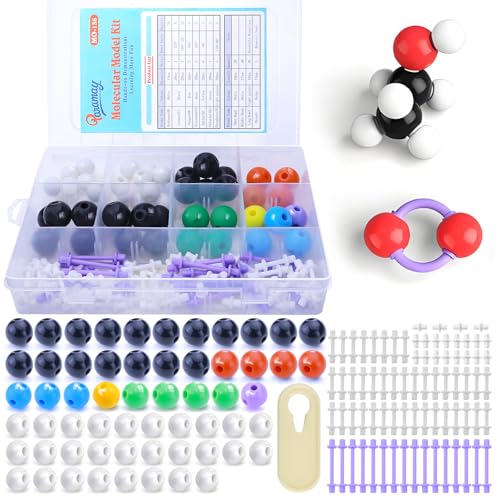

Conclusion: buy for the builds the course will demand
The right organic chemistry model set is the one whose atoms, colours and bonds agree with the course being studied: CPK colours that match the textbook, carbon pieces in tetrahedral, trigonal and linear geometries, single bonds that rotate, multiple bonds that refuse to, enough heteroatoms and surplus connectors for the functional-group tour, and a compartmented box that keeps the inventory complete. Prentice-Hall style sets favour visibility and shared bench work, Molymod style sets favour compact personal study, and either choice succeeds when it is made on distribution and bond behaviour rather than on a headline piece count. Add a space-filling supplement when steric questions begin to matter, and treat both representations as partial views whose limits are part of the lesson.
Pick the set that builds a relaxed cyclohexane chair without a struggle, and it will carry you honestly from the first alkane chain to the last stereochemistry problem of the course.