Our Top Picks


What's inside
- Why the 9 volt block became the pedalboard standard
- Current draw: the number that governs everything
- Alkaline: the default, examined properly
- Carbon-zinc: the cheap block with a tonal cult
- Lithium primary: the long-haul premium block
- Rechargeable blocks: NiMH and regulated lithium-ion
- Voltage sag: defect, feature, or both
- Noise, grounding and the daisy-chain question
- Runtime planning for rehearsals, sets and tours
- Choosing by scenario instead of by slogan
- Storage, leakage and the life of a block outside a pedal
- Troubleshooting: reading a dying battery’s symptoms
- Myths, half-truths and buying mistakes
- Check prices on Amazon
- Questions players ask repeatedly
As an Amazon Associate I earn from qualifying purchases. This post may contain affiliate links at no extra cost to you.
Disclosure first, plainly stated: several outbound links on this page are affiliate links, so a purchase made after following one can pay this site a commission, and that commission plays no part in how any battery here is ranked or described. The comparisons that follow lean on manufacturer specification sheets, published discharge curves and discharge tables, pedal makers’ stated current draws, and patterns that recur across owner reports, not on invented bench sessions.
A 9 volt block is the oldest power convention in the effects world, and it refuses to retire because it solves three problems at once. It delivers enough voltage for healthy headroom in a gain stage, it fits inside enclosures too small for a row of AA cells, and its snap connector doubles as a tidy internal switch point. Yet two blocks that both say nine volts on the wrapper can behave like different supplies once a pedal starts drawing current, and that difference is the whole subject of this guide.
Chemistry decides the shape of the discharge curve, internal resistance decides how far voltage dips when the load changes, and the pedal decides how much any of that matters. A germanium fuzz cares deeply about a falling supply rail. A modern digital reverb cares mostly about total milliamp-hours and about never dropping below its regulator threshold mid-song. Sorting batteries without sorting pedals first produces advice that is tidy, quotable and wrong for half the boards it lands on.
So the order here is deliberate. Current draw by pedal family comes first, because milliamp figures turn vague runtime claims into arithmetic anyone can redo. Chemistry comes second, with alkaline, carbon-zinc, lithium primary, nickel-metal hydride and regulated lithium-ion blocks treated as distinct tools rather than price tiers. Voltage sag, ground noise, daisy-chain behaviour, gig habits and storage follow, because those are the places where a technically fine battery still disappoints a player. Readers short on time can jump to the scenario section, although the draw tables in prose form repay a full read. best sound cards for recording guitar
Why the 9 volt block became the pedalboard standard
The rectangular 6LR61 format stacks six small cells in series inside one case, which is why a fresh alkaline example measures roughly 9.5 to 9.6 volts open circuit even though the label promises nine. Pedal designers in the late 1960s built around that readily available block, and the convention hardened: centre-negative 2.1 mm barrel jacks arrived later as the external alternative, wired so plugging in a supply disconnects the internal battery on most designs. Decades of enclosures, battery clips and switching jacks now assume this geometry, so the format persists by infrastructure as much as by merit.
Nine volts also suits analog audio circuits gracefully. A single supply of that size lets a simple transistor or op-amp stage swing several volts of signal before clipping, which translates into clean headroom for picking dynamics. Designers who want more headroom sometimes run 18 volts internally with a charge pump, yet the input still expects the familiar block or its jack equivalent. Understanding that heritage explains why battery behaviour shows up in tone discussions at all: the supply rail is part of the circuit, not an accessory bolted onto it.
The snap connector deserves a mention because it causes a share of field failures. Its two terminals grip with spring tension that weakens after years of swaps, and a loose snap can interrupt power when a pedal is stomped or a cable tugs the enclosure. Owner reports about crackling that vanishes when the battery is reseated usually trace back to that contact, or to a battery compartment door pressing a slightly swollen block against the clip. Chemistry cannot fix a tired connector, and replacing a clip costs less than cycling through battery brands hunting a cure.
Current draw: the number that governs everything
Manufacturers publish current draw in milliamps, usually measured at a full nine volt supply with the effect engaged. That figure converts directly into runtime once capacity enters the picture: a typical alkaline block offers roughly 500 to 600 milliamp-hours at light drains, so a pedal drawing 10 milliamps can, in simple division, run for about fifty hours before the curve collapses. Real life trims that estimate because capacity shrinks as draw rises and because pedals misbehave before the block is truly empty, but the division remains the most honest starting point available.
Fuzz pedals sit at the frugal extreme. A two-transistor germanium fuzz commonly draws between 1 and 5 milliamps, partly because the circuit contains so little silicon doing so much work. Silicon fuzz variants land in a similar band, often near 3 to 6 milliamps. At those drains a single alkaline block can power a fuzz through months of rehearsals, which is one reason fuzz players develop strong battery opinions: they change cells rarely, notice gradual voltage drift, and hear that drift as a slow evolution of the pedal’s character.
Overdrive and distortion pedals occupy the next step up. A classic three-knob overdrive built around a dual op-amp typically draws 4 to 12 milliamps, while distortion circuits with extra clipping stages, active tone stacks or LED clipping indicators may reach 15 to 25 milliamps. These are still gentle loads. A block that would wilt in a digital unit will cruise here, and the tonal argument for batteries over supplies in this category usually concerns noise floor and convenience rather than survival through a show.
Boost and buffer pedals draw so little that owners forget they contain batteries at all. Clean boosts frequently specify 2 to 8 milliamps, and a simple buffer may sip under 5 milliamps. The risk profile flips accordingly: the danger is not mid-gig death but a block installed two years ago, forgotten, and slowly leaking inside a pedal that lives on a shelf. Calendar checks matter more than capacity charts for this family, and writing the install date on painter’s tape stuck to the block is a habit experienced players recommend in forum threads with monotonous regularity.
Compressors vary more than their simple controls suggest. Optical designs with an internal lamp or LED-and-photocell arrangement can draw 10 to 20 milliamps, while VCA-based studio-style units with gain-reduction metering climb toward 25 milliamps or beyond when every meter LED lights. A compressor also tends to stay engaged for entire sets, unlike a fuzz that visits for two songs, so its modest draw multiplies across hours. Runtime planning should treat always-on pedals as the baseline load and intermittent effects as rounding errors.
A wah pedal is a study in modest appetite: most specify roughly 1 to 6 milliamps, since the circuit is essentially an inductor, a transistor stage and a potentiometer swept by the treadle. Inductor-based wahs add no digital overhead, so a block lasts for many months of regular use. The wah-specific battery trap is mechanical rather than electrical. The pedal sits at the front of many boards, gets stomped hard, and its battery door often faces downward, so a tired clip or a cracked door shows up here first as intermittent silence at the worst angle of the sweep.
Tuner pedals split into two camps. Simple needle-style or small LED tuners draw perhaps 10 to 30 milliamps while active, and they mute the signal path, which encourages players to leave them engaged between songs with the display lit. Bright, high-visibility displays on stage tuners push consumption upward, and a tuner left on through a three-hour function-band engagement can eat a surprising share of a block. The saving grace is duty cycle: thirty seconds of tuning between songs is trivial, while a forgotten lit display during a long break is not.
Analog chorus, vibrato and phaser pedals cluster around 10 to 35 milliamps. Their bucket-brigade delay chips need clock drivers and companding circuitry, and the low-frequency oscillator runs continuously, so consumption stays steady rather than spiking with playing. Analog flangers with shorter delay lines and more clock circuitry can reach 30 to 45 milliamps. These pedals also reveal a tired battery audibly before they fail: the sweep narrows, the effect thins, and clock noise can creep into the audio as supply voltage slides toward the bucket-brigade chip’s comfortable minimum.
Tremolo spans a wide range because the category hides two architectures. A bias tremolo or simple optical design may draw 5 to 15 milliamps, while feature-rich units with tap tempo, multiple waveforms and stereo outputs behave like small digital pedals and draw 40 milliamps or more. Optical tremolo adds a subtlety worth knowing: the lamp or LED element pulses with the rate control, so current draw pulses too, and a high-internal-resistance battery near exhaustion can let that pulse modulate the supply rail and imprint a faint ticking on unrelated gain stages sharing the same power source.
Analog delay pedals, built on bucket-brigade chips with hundreds or thousands of stages, typically draw 25 to 60 milliamps depending on delay time and filtering. They are the hungriest purely analog category most boards carry. Their failure mode on a sagging block is distinctive: repeats darken further, then the delayed signal loses level and clarity while the dry path stays healthy, which can mislead a player into blaming cables or the amplifier. Checking the battery before reordering a pedalboard around a phantom fault saves money and embarrassment.
Digital delay crosses into a different league entirely. DSP chips, converters and memory push typical draws to 100 to 300 milliamps, and some large multi-mode delays specify more. At 200 milliamps, an alkaline block’s effective capacity collapses far below its light-drain rating, sometimes delivering under two hours of service, and the pedal may reboot or fall silent without the graceful degradation analog circuits offer. This arithmetic, repeated across owner reports for two decades, is why digital delay is the category where battery power survives mainly as emergency backup rather than a plan.
Digital reverb is thirstier still. Algorithmic plates, halls and shimmer effects demand sustained DSP throughput, and flagship units commonly specify 300 to 500 milliamps at nine volts, sometimes with a higher voltage or a dedicated supply requirement altogether. A 9 volt block inside such a pedal is best understood as a short bridge: enough to finish a song or save settings, not enough for an evening. Players who insist on battery-only boards for aesthetic reasons usually exclude this category or feed it from a rechargeable power bank through a voltage converter cable.
Loopers combine DSP, memory writes and bright status lighting, landing commonly between 90 and 300 milliamps. Their particular hazard is not tone but data: a supply collapse during a save can cost a stored loop, and repeated hard cut-offs are unkind to any device that writes files. Phrase samplers therefore belong on mains-derived power for anyone who treats stored loops as part of the act. As a battery proposition they resemble digital delay, with the added argument that the cost of failure is a lost performance asset rather than a merely quiet pedal.
Multi-effects units and amp modellers complete the spectrum. Floor processors frequently require 300 milliamps to well over 1 amp, often at a specified polarity and sometimes at 9 volts only in name, with strict minimum current ratings printed on the supply. Many such units have no battery compartment at all, which is the manufacturer’s verdict on the question. Where a block is accepted, treat the published draw as a hard planning figure and expect runtimes measured in minutes-to-a-few-hours, then decide whether that trade serves any real purpose beyond surviving a power cut mid-set.
Noise gates, graphic equalizers and octave pedals fill the middle ground in instructive ways. A straightforward gate may draw 10 to 20 milliamps; a seven-band EQ with slider LEDs can reach 20 to 30 milliamps; analog octave-down circuits sit near 10 to 15 milliamps while digital pitch units jump past 100 milliamps. The pattern generalises beautifully: once a pedal contains a processor, consumption leaves the battery-friendly zone, and once it is purely analog, a block remains a rational supply. Classifying a board by that single question predicts battery success better than any brand preference. best 10 inch guitar speakers
Alkaline: the default, examined properly
Alkaline manganese dioxide chemistry is the reference against which every other 9 volt option is judged, and its published discharge curves explain its popularity. Under a light 10 milliamp drain, a quality alkaline block holds above 8 volts for the majority of its roughly 550 milliamp-hour capacity, then falls away steeply near the end. That plateau-then-cliff shape suits pedals well: performance stays consistent for most of the block’s life, and the end announces itself over one rehearsal rather than across a month of mysterious drift.
Internal resistance is alkaline’s quiet weakness. A fresh block might measure around 1 to 2 ohms, rising substantially as the cell depletes and as temperature drops. In a pedal drawing a steady few milliamps that resistance is irrelevant, but in a circuit whose draw pulses, or in cold outdoor conditions, the resulting voltage dips become audible as compression or gating artefacts. This is also why a block retired from a digital pedal often works happily for months in a fuzz: the load shrank, so the resistance stopped mattering.
Shelf life is a genuine alkaline strength. Manufacturers commonly rate quality alkaline blocks for five to ten years of storage with modest capacity loss, thanks to low self-discharge. For the spare-in-the-gig-bag role, that stability beats every rechargeable option in this guide, none of which holds a full charge across a season in a drawer. The counterweight is leakage risk in neglected installations: an exhausted alkaline left inside a pedal for years can vent electrolyte that corrodes clips and boards, a failure mode documented endlessly in repair forums with photographs nobody enjoys.
Temperature behaviour rounds out the alkaline picture. Cold slows the chemistry and raises internal resistance, so a winter load-in followed by an outdoor set can make a half-used block behave like a nearly dead one until it warms. Heat accelerates self-discharge and shortens storage life. None of this is exotic; it simply means the block in a hot car boot ages faster than the identical block in a cool drawer, and tour planning in extreme climates should budget accordingly rather than blaming a brand for physics.
Carbon-zinc: the cheap block with a tonal cult
Carbon-zinc, sold as general purpose or heavy duty, is the oldest chemistry in the rectangular format and the weakest by capacity, often delivering roughly half the milliamp-hours of an alkaline equivalent at moderate drains, with a discharge curve that slopes downward from the first hour instead of plateauing. On paper it loses everywhere. In a fuzz pedal, that sloping curve and higher internal resistance become the point: the supply sags under load, headroom shrinks, and the circuit’s response turns spongy, gated and compressed in ways a devoted minority of players actively chase.
The sag effect deserves precision because folklore inflates it. What changes the sound is supply voltage at the transistor and the dynamic dip under signal peaks, not the label on the wrapper. A carbon-zinc block at mid-life might rest near 8 volts and dip further when the fuzz is driven hard, starving the circuit in a rhythm that follows playing intensity. The same territory can be reached with a dying alkaline or with a variable-voltage supply, which is why experienced fuzz owners describe carbon-zinc as a convenient, disposable way to live permanently in that half-starved zone rather than as magic dust.
Economics and risk set the limits. Carbon-zinc blocks cost little, leak more readily than alkaline when exhausted, and give shorter service in anything hungrier than a fuzz or a low-draw overdrive. Using them across a whole board is false economy: the digital and modulation pedals will chew through them, and the replacement churn invites exactly the forgotten-leaking-block scenario that damages pedals. The defensible pattern, echoed across owner communities, is surgical: carbon-zinc for the one vintage-style fuzz that rewards it, alkaline or better for everything else.
Availability is quietly shrinking as manufacturers favour alkaline lines, so players who build their sound around a particular carbon-zinc behaviour should stock modest quantities and store them cool and dry, rotating stock rather than hoarding for years. Shelf life is shorter than alkaline, commonly a few years, and capacity testing a stored block under load tells more than its printed date. A block that reads nine volts on a multimeter with no load can still collapse in the pedal, a measurement trap this guide returns to in the troubleshooting section.
Lithium primary: the long-haul premium block
Lithium iron disulfide 9 volt blocks are non-rechargeable, cost several times an alkaline price, and justify it with capacity figures around 750 to 1,200 milliamp-hours depending on drain and brand, an exceptionally flat discharge curve, and a shelf life manufacturers rate at ten years or more. Weight is noticeably lower, which matters in a guitar’s control cavity more than in a pedal. For a wireless transmitter pack or a rarely opened active instrument, the arithmetic of fewer changes and dependable storage is compelling even at the premium.
In pedals, lithium primary shines where access is annoying and draw is moderate: the pedal buried under a riser, the acoustic preamp in a gig bag that must work after months idle, the backup block that cannot be allowed to self-discharge into uselessness. Its flat curve holds voltage high until late in life, which fuzz players should note cuts both ways: the gradual sag some players cultivate never arrives, and the pedal sounds like itself at full voltage for almost the entire block, then declines quickly.
Two cautions temper the enthusiasm. First, fresh lithium blocks can measure slightly higher open-circuit voltages than alkaline equivalents, and a handful of vintage circuits with no regulation and fragile germanium transistors deserve a conservative owner who checks the maker’s guidance before feeding them the liveliest block chemistry available. Second, the end of a lithium discharge is abrupt, so the rehearsal-warning that alkaline gives over an evening may compress into a single set. Players who choose lithium for reliability should pair it with scheduled replacement rather than waiting for symptoms.
Cold-weather performance is lithium’s other documented advantage, retaining useful capacity at temperatures where alkaline output sags badly. Outdoor winter gigs, festival stages in cold climates and unheated rehearsal spaces are the scenarios owner reports praise most. The premium therefore buys three separable things, capacity, storage stability and cold tolerance, and a buyer who needs none of the three is simply overpaying for a label. Matching the chemistry to the actual hardship is the recurring discipline of this entire guide. best li ion battery chargers
Rechargeable blocks: NiMH and regulated lithium-ion
Nickel-metal hydride 9 volt format rechargeables carry a naming quirk every buyer must understand: most are built from seven 1.2 volt cells and are nominally 8.4 volts, not nine. Fresh off the charger they may read near 9.5 volts, then settle quickly toward the mid-eights for most of their discharge. Many pedals run perfectly on that rail, especially op-amp designs with generous supply tolerance, but circuits voiced around a full nine volts can sound slightly softer, and a pedal with a minimum operating voltage near eight can reach its cutoff sooner than the capacity figure suggests.
NiMH capacity in this format typically falls between 200 and 350 milliamp-hours, markedly less than a good alkaline block, so runtime per charge is shorter even before self-discharge enters the ledger. Low-self-discharge variants hold charge far better in storage and suit gigging players who charge before a show weekend. The honest use case is a high-turnover board: a player performing or rehearsing weekly, burning through disposables, who accepts shorter per-charge life in exchange for not buying alkaline blocks by the dozen across a year.
Regulated lithium-ion 9 volt blocks take a different approach: an internal lithium cell of 3.7 volts nominal feeds a boost converter that outputs a steady nine volts until the cell is spent, then stops. The flat output pleases pedals that hate drift, and capacities are often quoted in milliwatt-hours that translate to roughly 500 to 650 milliamp-hours at the output for common models. USB charging on many versions removes the need for a dedicated block charger, which simplifies a touring kit considerably.
The regulated design has two signatures owners should recognise before buying. The converter can introduce a faint high-frequency whine into high-gain or poorly filtered pedals, a complaint that surfaces in owner reports for some block-and-pedal pairings and not others, because susceptibility lives in the pedal’s power filtering as much as in the block. And the flat-then-stop discharge removes every early-warning symptom: the pedal sounds perfect, then it is off. For a headline set that trade may be unacceptable; for rehearsals, lessons and home recording it is often ideal. A spare charged block in the case converts the weakness into a thirty-second swap.
Charge discipline separates satisfied rechargeable owners from disappointed ones. NiMH blocks want a charger designed for the 9 volt format with proper termination, not an overnight bake on a timer-only unit that cooks cells slowly across hundreds of cycles. Lithium-ion blocks should be charged with their supplied cable or specified USB source and retired when the case swells, the output flickers, or runtime craters. Both chemistries dislike being stored fully depleted. None of this is burdensome, but it is a routine, and players who know they will not keep a routine should buy disposables without guilt. best battery nimh chargers
Cost modelling favours rechargeables only when turnover is real. A weekly rehearsal board running three always-on analog pedals at a combined 40 milliamps drains an alkaline block in roughly a dozen hours of plugged-in time, which across a year becomes dozens of blocks; rechargeables pay for themselves inside that year even with their shorter per-charge life. A bedroom board used twice a month inverts the maths completely, because shelf losses and charger cost dominate. The deciding variable is plugged-in hours per month, a number every player can estimate honestly in ten seconds.
Voltage sag: defect, feature, or both
Sag is the momentary or sustained drop of supply voltage under load, governed by the battery’s internal resistance and state of charge. In amplifier design the term describes rectifier behaviour in tube amps; pedal players borrowed it for the same felt experience of a supply that breathes with the playing. A fuzz or a simple booster fed by a sagging rail clips earlier, compresses more, and can gate sputteringly on decaying notes, producing textures that some genres treat as essential vocabulary rather than malfunction.
The circuits most sensitive to sag share traits: few components, no voltage regulation, transistor stages whose operating point is set directly by the supply. Germanium fuzz designs lead the list, followed by simple silicon boosters and some treble boosters. Op-amp pedals with regulated internal rails or generous design margins shrug off a volt of droop with little audible change, and digital pedals do not sag gracefully at all; they work, then they reboot or mute. Knowing which family a pedal belongs to predicts its battery personality more reliably than its price or its boutique status.
Players who want sag on demand have three honest routes. The first is chemistry: carbon-zinc or a deliberately tired alkaline, accepting unpredictability as part of the charm. The second is a variable-voltage output on a quality power supply, sometimes labelled a sag control, which starves the pedal repeatably at a chosen voltage night after night. The third is a small inline voltage-drop device between supply and pedal. Repeatability is the dividing line professionals cite: a dying battery drifts through the sweet spot and keeps going, while a dialled supply parks there.
Sag also has a failure dialect that should not be romanticised. When a block fades in a pedal that does not flatter it, symptoms include lost low end, fizzy decay on clean passages, volume that pumps oddly with hard strums, and in extreme cases motorboating oscillation in high-gain circuits. Guitarists sometimes chase these ghosts through pickup height, cable swaps and amplifier valves before checking a two-minute battery swap. The diagnostic order in the troubleshooting section exists precisely because battery decline impersonates expensive faults so convincingly.
Recording engineers add a practical footnote: a fuzz tracked with a battery at its charismatic mid-life voltage will not sound identical next week, which complicates punch-ins and overdubs. Studios that care keep notes on supply voltage for signature tones, or use a regulated variable supply so the exact starved voltage can be recalled. The battery that makes a live gig feel alive can make a recording session quietly inconsistent, and neither judgement contradicts the other; they are different crafts placing different values on the same physics.
Noise, grounding and the daisy-chain question
A battery is the quietest power source a pedal can have because it floats entirely: no connection to mains earth, no switching converter spraying radio-frequency hash, no shared ground path with other pedals. That is the technical core of the battery-versus-supply argument, and it is real. High-gain rigs in electrically dirty rooms often fall silent, hum-wise, when run from blocks. The price of that silence is everything discussed elsewhere in this guide: finite capacity, drift, waste and the risk of mid-set death.
Daisy-chaining, where one supply feeds several pedals through a splitter cable, creates the classic noise scenarios batteries avoid. Digital pedals shed clock noise onto a shared rail that analog pedals then amplify. Ground paths multiply through patch cables and supply leads, inviting hum loops whose pitch and volume shift with venue wiring. None of this condemns chaining universally; a chain of low-draw analog pedals on a clean, adequately rated supply can be perfectly quiet, and millions of boards prove it nightly. Problems scale with mixed digital loads, total draw near the supply’s limit, and poor cable hygiene.
Isolated supplies answer chaining’s flaws by giving each output its own galvanically separated feed, at higher cost and weight. Batteries answer it by removing the network entirely, one pedal at a time. The hybrid pattern many working players settle on is pragmatic: isolated supply for the board’s core, batteries for the one or two pedals that hum, buzz or sing with any shared source, very often a vintage-style fuzz that also prefers its power unregulated and slightly unruly. Insisting on a single doctrine for every pedal is where rigs become religions instead of tools.
Whine deserves its own paragraph because it is the noise most often misattributed. A high-pitched tone that changes with a pedal’s tempo or mode usually originates in a digital pedal or a charge pump, then travels along shared power or ground. Running the suspect pedal from a battery for one rehearsal is the cleanest isolation experiment available: if the whine vanishes, the coupling was through power; if it persists, the path is audio or radio interference and the search moves elsewhere. Batteries thus earn their keep as diagnostic instruments even on boards that never gig with them.
Polarity and voltage mistakes cause the expensive noises, the ones followed by silence and a smell. Most pedals expect centre-negative nine volts; a centre-positive supply or an 18 volt feed into a pedal rated only for nine can destroy components instantly. Battery snaps enforce correct polarity mechanically, one underappreciated safety virtue of the old format. Players mixing batteries and supplies across a board should still label every wall wart and lead, because the accident rate in owner reports clusters around borrowed supplies, dark stages and hurry, not around ignorance of the theory.
Runtime planning for rehearsals, sets and tours
Honest runtime planning starts from plugged-in time, not playing time. On most pedals, inserting a jack plug into the input socket completes the battery circuit; the pedal then draws current whether or not anyone is playing, and whether or not the effect is engaged, unless the design sleeps intelligently, which most analog designs do not. A board left plugged in across a four-hour rehearsal with sandwiches and discussion consumes four hours of battery. That single fact explains most mysterious premature deaths reported by puzzled owners.
The unplugging habit follows directly. Pulling the input lead at breaks, or the output on the minority of pedals switched at that socket, disconnects the block and can multiply effective battery life several times over for intermittent effects. Stereo pedals may switch power from either input jack, so the manual’s diagram is worth one look. Guitarists who find unplugging fussy sometimes fit a battery disconnect switch or simply accept disposables as a consumable like strings; the sin is not choosing convenience, it is choosing it accidentally and being surprised monthly.
For a gig, plan backwards from total draw. Add the engaged draws of every battery-powered pedal, multiply by the hours from soundcheck to encore including the plugged-in gaps, then demand a block with at least twice that milliamp-hour figure at that drain rate, because published capacities assume gentler conditions and a pedal’s idea of empty arrives before the chemistry’s. A fresh alkaline per important show remains the working professional’s unglamorous answer for low-draw analog boards, with the removed half-used blocks demoted to rehearsal and home duty rather than binned.
Soundcheck is the hidden battery killer on show days. A board powered at four in the afternoon for line checks, left connected through dinner and support acts, may deliver half its life before the first song of the headline set. Crew-minded players unplug after soundcheck or fit a master power switch for the battery pedals. Function bands playing three sets with long breaks face the same arithmetic stretched thinner, and for them rechargeable blocks charged during breaks, rotated in pairs, can outperform disposables operationally even at lower capacity per unit.
Touring multiplies small habits into logistics. Spare blocks ride in the gig bag, not the checked case; a multimeter or a cheap battery tester rides along too, used under load where possible; and one person owns the battery list the way one person owns the string inventory. Owner reports from touring players converge on boring consistency: same brand bought fresh from high-turnover shops, dates marked, no heroics. Batteries fail on stage far less often than systems for managing batteries fail in diaries, vans and good intentions.
Choosing by scenario instead of by slogan
Scenario one: a vintage-style fuzz and a tuner are the whole board, both analog, combined draw under 35 milliamps even with the tuner lit. Almost anything works here, so choose by taste: carbon-zinc if the sagging response is the sound, alkaline for neutral reliability, lithium for a board that lives in a bag for weeks between uses. This is the scenario where battery-only purism costs nothing and the noise benefits arrive free, which is why its owners are the loudest battery advocates; their experience is genuine and entirely unrepresentative of larger rigs.
Scenario two: a five-pedal analog board of overdrive, compressor, chorus, analog delay and boost, all engaged at various times, total draw near 90 milliamps when everything runs. Alkaline blocks remain viable with per-pedal rather than shared thinking, since each pedal carries its own block and the hungriest, the delay, still returns roughly eight to ten hours per block. A recharge rotation suits a weekly rehearsal cycle. Lithium earns its premium only on the hardest pedal to reach physically.
Scenario three: the hybrid modern board, analog drives in front, digital delay and reverb behind, perhaps a looper for solo work. Batteries should power the analog front end where they flatter and last, while the digital units belong on a proper isolated supply sized with headroom above their printed draws. Attempting an all-battery version of this board produces the classic two-hour digital deaths that fill forum threads, and the failure gets blamed on battery quality rather than on a category error in planning.
Scenario four: acoustic and roots players running a preamp or DI box, a tuner and maybe a reverb, often far from convenient mains power at weddings, churches and festival side stages. Here lithium primary blocks are the connoisseur’s choice for the preamp that must not die during a ceremony, alkaline for the tuner, and a rehearsed spare protocol matters more than any chemistry debate. Silence between songs at a wedding is noticed by everyone; a slightly softer top end from an 8.4 volt rechargeable would be noticed by nobody, which recalibrates priorities usefully.
Scenario five: the home recording player who values quiet above all and plays in short sessions. Batteries remove mains-borne hum from high-gain recording chains and cost little at this duty cycle; a handful of alkaline blocks lasts months, and rechargeables are optional rather than necessary. The main discipline is removal during long gaps between sessions, because a home pedal can sit plugged into an interface for a fortnight, draining silently. An unplugged cable on the desk is the cheapest battery technology ever devised.
Scenario six: the teacher, busker or workshop player whose gear works daily in short bursts across many rooms. Predictability beats peak performance, so a labelled rotation of regulated lithium-ion blocks, charged nightly like a phone, often beats a drawer of half-used disposables of unknown age. The abrupt cutoff of regulated blocks is managed by swapping at fixed times rather than by symptoms. This scenario rewards systems thinkers and punishes romantics, a sentence that could honestly summarise the entire battery question in miniature.
Storage, leakage and the life of a block outside a pedal
Store blocks cool, dry and at room temperature, in original packaging or a case that keeps terminals from touching metal objects or each other. A loose 9 volt block in a gig-bag pocket with keys and coins is a genuine short-circuit hazard because both terminals sit exposed on the same face; a strip of electrical tape over the snap, or the plastic cap some brands ship, neutralises it. Fire services publish this warning regularly, and it applies to the spares every guitarist carries, not just to exotic chemistries.
Leakage is primarily a crime of neglect. Alkaline and carbon-zinc cells vent corrosive electrolyte when left fully discharged, especially in warm conditions, and the damage appears on battery clips, springs and occasionally circuit boards. The prevention is embarrassingly simple: remove blocks from pedals entering storage, from seasonal gear, and from any pedal that will sit unused for months. Repair technicians’ advice on this point is unanimous across decades of interviews, and the cost of ignoring it is routinely a pedal worth fifty times the battery’s price.
Rechargeables prefer the opposite storage treatment from the one folklore suggests. NiMH blocks hold up best stored partly charged and topped up every few months, while lithium-ion blocks age fastest when stored brim-full in heat and slowest at moderate charge in the cool. Neither should be left in a charger for weeks as a storage strategy. A small label with the charge month turns guesswork into rotation, and rotation, once again, is the unglamorous technology that separates reliable rigs from lucky ones.
Disposal rules vary by jurisdiction, but the direction of travel is uniform: batteries of every chemistry in this guide belong in recycling streams, not household rubbish, and lithium primary and lithium-ion blocks especially should never be punctured, incinerated or binned where collection schemes exist. Many music shops and supermarkets host collection points. Players who burn through disposables professionally have an extra reason to model rechargeables honestly, because the waste arithmetic of a year of weekly alkaline changes is visible, countable and ever harder to shrug at.
Troubleshooting: reading a dying battery’s symptoms
Symptom one: the pedal works but sounds smaller, with low end thinned and transients blunted. In an analog gain pedal this is the classic early sag signature as voltage slides down the discharge slope. The confirming experiment takes one minute: substitute a known-fresh block and listen for the missing weight. If nothing changes, the battery was innocent and the hunt moves to cables, valves or ears at the end of a long day, all of which also produce this exact complaint with impressive regularity.
Symptom two: crackles, dropouts or silence when the pedal is moved or stomped. Suspect the mechanical chain before the chemistry: snap connector tension, a cracked battery door, a block slightly undersized for its compartment rattling against the clip, or a switching jack whose contact no longer grips. A fresh block that happens to be a fraction larger can mask the fault temporarily, which is how connectors earn batteries a bad reputation. Flexing the snap leads gently while listening tells the truth faster than buying three brands in hope.
Symptom three: a digital pedal that reboots, freezes or drops audio mid-song, then behaves perfectly at home. Under load, a tired block’s voltage collapses across the pedal’s regulator threshold during current peaks, often when a bright display, a tempo LED and a DSP spike coincide. At home, shorter sessions and a warmer room let the same block stay just above the line. This is the scenario where a multimeter reading misleads most cruelly, because open-circuit voltage recovers when the load disconnects, smiling at nine volts while hiding the collapse that matters.
Symptom four: whine, ticking or pulsing noises that arrive late in a battery’s life on a previously quiet board. As internal resistance climbs, current pulses from an oscillator, a tempo LED or an optical element modulate the shared rail inside a single pedal or across a chained supply, imprinting rhythm on the audio. The battery-swap experiment separates this from component failure instantly. If a fresh block silences it, log the runtime achieved; a pedal that eats blocks while singing this song is telling its owner its true draw, whatever the manual’s optimistic typical figure claims.
Symptom five: a pedal found dead after storage, with white or green crust at the snap. That is electrolyte residue or corrosion, and the chemistry inside is finished regardless of any voltage reading. Clean contacts carefully with a dry brush and isopropyl alcohol on a swab, inspect the clip for pitting, and replace rather than rehabilitate the block. If corrosion reached the board, a technician’s inspection beats optimism. Then change the storage habit that caused it, because the pedal has now taught the same lesson it teaches every owner exactly once.
Myths, half-truths and buying mistakes
Myth: expensive blocks sound better in every pedal. Reality: chemistry changes voltage level, curve shape and internal resistance, and only circuits sensitive to those variables respond audibly. In a regulated digital pedal, a premium block buys runtime, not tone, and in many op-amp designs the audible difference between fresh alkaline brands is nil. Spending more is rational when it purchases capacity, storage life or cold performance. Spending more for unspecified sonic magic in a pedal that regulates its own supply is donation, not engineering.
Myth: a block reading nine volts on a meter is healthy. Reality: open-circuit voltage is the least informative measurement available, because depleted cells recover surface charge when rested. A battery tester that applies a load, or simply trying the block in the hungriest pedal available, reveals the truth. This single misunderstanding sustains more forum confusion than any other in the battery world, and it is why the troubleshooting experiments in this guide always involve substitution under real working conditions rather than readings taken on a bench.
Myth: rechargeable blocks are always the economical choice. Reality: the maths depends on turnover, as the earlier cost section showed, and on honest accounting for shorter per-charge capacity, charger cost and eventual cell replacement. For a low-draw fuzz changed twice a year, a rechargeable block may never repay its purchase before its own calendar ageing ends it. For a weekly working board, disposables become the extravagant option. Both conclusions come from the same arithmetic applied to different lives, which is why universal recommendations in this category deserve automatic suspicion.
Mistake: buying blocks in bulk far beyond rotation speed. Alkaline deals tempt players into drawers of fifty, but even good shelf life is finite, and a bargain block that dies in storage or leaks in a pedal was not a bargain. Buy at the pace of consumption, from shops whose stock turns over, and mark purchase dates. Mistake two is mixing chemistries casually across a board and then forgetting which pedal holds the regulated lithium block that will cut off without warning during the longest set of the month. A tiny label inside the battery door ends that risk.
Check prices on Amazon
Live listings for the shortlist in this guide are pulled from Amazon below, so prices and availability are always current at the moment you look.
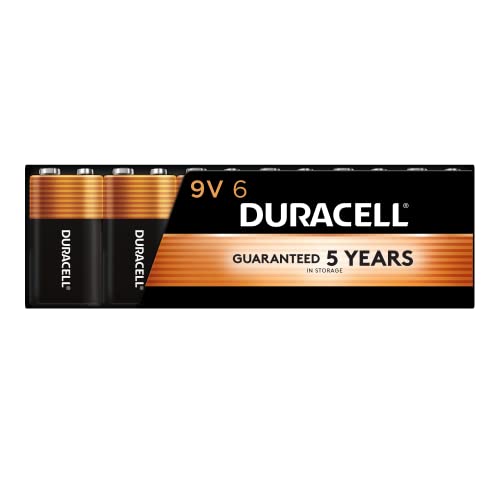
DURACELL Coppertop 9V Battery, 6 Count, Smoke Detector Battery

Duracell Coppertop 9V Battery, 2 Count, Smoke Detector, Long-lasting


Questions players ask repeatedly
Can a battery and a power supply be connected together? On most pedals the switching jack disconnects the internal block when a supply plug is inserted, so the two do not fight, but the block still drains if the input jack remains plugged in on designs where the switch lives at the input socket. The safe habit is unchanged: unplug the instrument lead during long breaks regardless of which source is active, and never improvise splitters that parallel a battery with a mains supply outside a manufacturer’s documented design.
Why does a fuzz sound glorious one week and thin the next on the same block? Because the block is not the same: its voltage has slid, its internal resistance has climbed, and the circuit’s operating point has wandered with both. Temperature swings between a cold van and a hot stage accelerate the apparent change. Players who fall for a particular week’s sound should measure the block under load and write the figure down; that number, not the brand, is the recipe, and a variable supply can recreate it on demand with any healthy block chemistry removed from the equation entirely.
Do wireless systems change the battery question? Guitar wireless transmitters often use AA cells rather than blocks, but pedal-format receivers and some bodypacks do use 9 volt power, and their digital draws place them firmly in the short-runtime camp. Lithium primary blocks earn their premium here through capacity and predictable behaviour, and professional practice is a fresh or verified block per show with the removed ones demoted to rehearsal. A transmitter dying mid-song is uniquely unforgiving because there is no cable to grab as a rescue.
Is it safe to leave a block in a pedal on a powered board indefinitely? Electrically the pedal may be running from the supply with the block disconnected, yet the block still ages, self-discharges and eventually enters the leakage-risk zone while everyone forgets it exists. A twice-yearly board audit, blocks out, contacts inspected, dates checked, prevents the classic discovery of a corroded compartment during a pre-tour service. Several touring technicians quoted in trade features describe exactly that audit as standard practice, as routine as checking jack sockets and tightening potentiometer nuts.
What about pedals that accept 18 volts for extra headroom? Some designs allow a higher supply to widen clean swing, and running them from a single block simply forgoes that option; two blocks in series inside a pedal is rare enough to be a curiosity. The battery-relevant point is that headroom-hungry players dissatisfied with a pedal’s openness at nine volts sometimes blame the block when the design merely wants the voltage its maker documented. Reading the manual’s supply range before shopping for exotic chemistries saves a familiar, pointless expense.
Choose the block the way a sound engineer chooses anything: by the load it must feed, the hours it must survive, and the failure you can afford, and a 9 volt battery stops being a guess and becomes the quietest, simplest line in the rig rider.