What's inside
- Key Takeaways
- Quick Picks
- How Did We Choose These Picks?
- Alnico or Ceramic — Which Magnet Suits Your Playing?
- How Do Wattage and Sensitivity Decide Breakup and Loudness?
- What Should You Verify Before Ordering a Replacement 10?
- Open-Back or Closed-Back — How Does the Cabinet Change the Driver?
- Single 10, 2×10 or 4×10 — What Does Adding Drivers Buy You?
- How Do You Read a Guitar Speaker’s Spec Sheet Without Being Fooled?
- Should You Hunt a Vintage Original Instead of a Reissue?
- How Does the Speaker Change What Your Pedals and Recordings Do?
- Which 10-Inch Guitar Speakers Deserve Your Amplifier?
- How Do You Decide When You Cannot Hear the Speaker First?
- Which Speaker Suits a 5-Watt, 15-Watt or 40-Watt Amp?
- Why Stay With a 10 When 12-Inch Speakers Exist?
- How Do the Six Guitar Drivers Compare Side by Side?
- How Do You Swap a Combo Speaker Without Damaging Anything?
- What Mistakes Do Speaker Swappers Keep Making?
- Final Recommendation
- Frequently Asked Questions
- Related Guides
As an Amazon Associate I earn from qualifying purchases. This post may contain affiliate links at no extra cost to you.
widgetverdict.com is reader-supported. When you buy through links on our site, we may earn an affiliate commission.
Where to buy: Every pick in this guide carries a checked Amazon listing, so the names below are links all the way down — three Jensens covering the vintage American voices, one Celestion for the British side of the street, and two Eminence drivers for players who need volume and composure. Match the impedance and wattage to your amp before anything else; the sections after the table explain exactly how.
A speaker swap is the cheapest identity change an amplifier can undergo, and nowhere is that truer than in the world of the best 10 inch guitar speakers. The 10-inch format lives inside some of the most loved small amps ever built — tweed and blackface Fenders, countless practice combos, studio favourites — and the driver inside accounts for an outsized share of what those amps actually sound like at the volumes people really use. Change the speaker and you change when the amp breaks up, how its top end behaves against a bright single-coil, how much clean headroom survives a loud drummer, and whether the low end stays composed or turns to fog. It is a thirty-minute job with a screwdriver that can feel like buying a different amplifier.
This guide covers six current 10-inch drivers that between them span the format’s real territory: the vintage American Jensen voices in both ceramic and alnico form, Celestion’s British-flavoured Ten 30, and two Eminence designs — one built for loud, clean American punch, one built around a hemp cone that smooths everything it touches. What the list will not do is pretend these are interchangeable. A 25-watt alnico Jensen and a 75-watt Eminence Copperhead share a mounting pattern and almost nothing else, and choosing between them is really choosing what your amplifier is for. The guide sections therefore spend as much time on matching — wattage against amp power, sensitivity against your volume needs, magnet type against your taste in breakup — as on the drivers themselves.
Key Takeaways
- All six picks are linked and current: Jensen C10R, C10Q and P10R, Celestion Ten 30, Eminence Copperhead and Eminence Cannabis Rex 10.
- Match wattage to the amp: a speaker rated near or modestly above the amp’s output breaks up musically; a hugely overrated speaker stays clean and can sound stiff at low volume.
- Sensitivity is your volume dial — the Copperhead’s high efficiency makes a small amp dramatically louder, while the vintage Jensens trade loudness for earlier, sweeter breakup.
- Alnico (the P10R) compresses gently at volume for a singing vintage feel; ceramic drivers stay firmer and punchier for the same money.
- Impedance is non-negotiable: fit the ohm rating your amp’s output stage expects, and check whether your combo’s speaker is the only load.
- The Cannabis Rex 10’s hemp cone is the specialist fix for amps and guitars that are too bright — it smooths the top end without touching the amp.
Quick Picks
| Pick | Badge | Why it earns its place |
|---|---|---|
| Jensen C10R | Best vintage American voice | The 25-watt ceramic voice of small blackface-style combos — bright, present and quick to sing. |
| Jensen C10Q | Best step-up Jensen ceramic | More muscle and low-end composure than the C10R while keeping the same family accent. |
| Jensen P10R | Best alnico tweed voice | The alnico original-style driver for tweed warmth, gentle compression and early breakup. |
| Celestion Ten 30 | Best British-flavoured value | A 30-watt Celestion voice that gives small amps a midrange-forward British accent for modest money. |
| Eminence Copperhead 10 | Best for clean headroom and volume | A loud, efficient 75-watt driver that keeps a small amp clean and present in a band. |
| Eminence Cannabis Rex 10 | Best for taming brightness | A hemp-cone 50-watt driver that rounds off harsh top end and fattens single-coils. |
How Did We Choose These Picks?
Three filters shaped the list. The first was format honesty: every driver here is a genuine guitar-voiced 10, designed to colour the sound — because in guitar amplifiers the speaker is not a neutral reproducer but the final stage of the instrument. Bass drivers and full-range drivers were excluded even when they share the diameter; our bass-cabinet guide covers the other discipline. The second filter was coverage of the real decision space. Players shopping this size are almost always doing one of four jobs — restoring a vintage-voiced combo, making a small amp louder and cleaner, warming up a bright amp, or giving a neutral practice amp a personality — and the six picks map onto those jobs with deliberate overlap so you can choose by taste within each.
One more consideration ran quietly through the selection: serviceability of the decision itself. Each of these drivers is common enough that a future owner, tech or buyer of your amplifier will recognise it, find its specifications in seconds, and understand what it is doing in your amp. Obscure drivers can sound wonderful and still complicate every later conversation about the instrument. In a component that becomes part of an amplifier’s identity, being well documented is a genuine feature, and it is one more reason this list reads like a roll of familiar names rather than a treasure map.
The third filter was that each driver had to be a current, listed product with a verifiable identity, because the vintage-speaker market is full of recones, relabels and optimistic descriptions. All six passed with clean listings, which is why this guide, unlike its bass counterpart, is fully linked. We also weighted the accumulated owner record heavily: these are drivers with years of fitments in named amplifiers, so their behaviour in a Princeton-style combo or a tweed-style box is documented rather than theorised. A speaker is a marriage with an amp, and we preferred candidates whose marriages have public track records.
Alnico or Ceramic — Which Magnet Suits Your Playing?
The oldest argument in this category is still the most useful one to understand. Alnico drivers, like the Jensen P10R, use a magnet alloy that was standard in the 1950s and early 1960s, and they behave in a way players describe as sweet, vocal and forgiving. The mechanism is partly magnetic: at high power an alnico magnet’s field softens slightly, producing a gentle natural compression that rounds off peaks and lets notes bloom rather than spike. In a tweed-style amp pushed to its singing zone, that compression is a large part of the sound people chase, and no pedal fully imitates it because it happens after the amplifier, in the air-moving itself.
Ceramic (ferrite) magnets arrived as the cheaper, stronger alternative and never left. A ceramic driver holds its field firmly at power, so the response stays tighter, the low end stays disciplined, and the top end keeps its edge — the sound of the blackface era and of most modern production amps. Ceramics also deliver more speaker per unit of money, which is why the C10R and C10Q can offer authentic vintage-American voices at working-musician prices. Neither magnet is better; they are two different agreements about what happens when you turn up. If your favourite sound is an amp on the edge, compressing and vocal, alnico flatters it. If your favourite sound is a firm clean platform that takes pedals literally, ceramic is the honest tool.
How Do Wattage and Sensitivity Decide Breakup and Loudness?
A guitar speaker’s wattage rating is a ceiling, not a target, and the relationship between that ceiling and your amplifier’s output writes the amp’s dynamic story. Put a 15-watt amp through a 25-watt speaker and the speaker itself joins the overdrive party early, adding cone breakup — a papery, harmonically busy edge — to the amplifier’s own distortion. Put the same amp through a 75-watt speaker and the cone stays composed at any volume the amp can produce; all the grit comes from the amp, the cleans stay truly clean, and the overall feel is firmer and more modern. Vintage-voiced low-wattage drivers like the P10R and C10R are chosen precisely for that early participation. The Copperhead is chosen precisely to refuse it.
Sensitivity, measured in decibels for a standard input, is the other half of the equation and the one most often ignored. The spread across this list is several decibels, which in practice is the difference between a practice amp that hangs with a drummer and one that gets buried by him. If your complaint about your combo is volume, a high-sensitivity swap is a more effective fix than any boost pedal, because it converts the watts you already own into more sound. If your complaint is that the amp only sounds good too loud for home use, walk the other way: a lower-sensitivity vintage driver lets you reach the amp’s sweet spot at a friendlier room volume. Wattage tells you when the speaker joins in; sensitivity tells you how loud the conversation gets.
What Should You Verify Before Ordering a Replacement 10?
Impedance first, always. Most of the drivers in this guide are sold in 8-ohm form, with some also offered at 4 or 16 ohms, and the variant in the listing title is the one that matters. Your amplifier’s output transformer was wound for a specific load; a mismatch in the dangerous direction can stress the amp, and in the safe direction costs you power and changes the feel. Check the label on the driver you are removing — combo manufacturers occasionally fit a 4-ohm driver where you would expect 8 — and order the same number.
Then measure the unglamorous things. Mounting depth matters in shallow combos where a deep alnico bell cover or a large ceramic magnet can foul the chassis or tubes; the P10R’s alnico assembly and the Copperhead’s substantial magnet both deserve a tape measure before they deserve your money. Cutout and bolt patterns are near-universal in this size but not universal, and a four-bolt pattern meeting an eight-bolt baffle is a solvable problem only if you know about it before the old speaker is out. Finally, weigh the amp’s future: if you are restoring a collectible combo, keep the original driver even if it is tired — a reconed original preserves the amp’s value and voice in a way no modern driver, however good, can.
Open-Back or Closed-Back — How Does the Cabinet Change the Driver?
Most 10-inch guitar drivers live in open-back combos, where the cabinet’s rear is partly open and sound radiates from both sides of the cone. That arrangement gives the format its airy, room-filling quality and its forgiving low end: bass escapes out the back instead of building pressure, so even a driver with modest low-frequency discipline sounds tidy. It also means the room becomes part of the amplifier — an open-back combo against a wall sounds fatter than the same combo in the middle of a stage — and that a driver’s job in an open cab is mostly about midrange character and top-end behaviour, which is exactly where the six picks here differ most.
Closed-back 10-inch cabinets are rarer and more demanding. Sealing the box tightens the low end, adds punch and projection, and exposes any driver whose bass response is loose, because there is nowhere for sloppiness to hide. The firmer ceramics — the C10Q and the Copperhead — take to closed cabinets naturally; the softer vintage drivers can sound boxy if the enclosure is small. If you are building or buying a closed 1×10 or 2×10, weight low-end control more heavily than this guide’s general ordering does, and treat sparkling top end as a bonus the box may partly keep for itself.
Single 10, 2×10 or 4×10 — What Does Adding Drivers Buy You?
One driver is the sound of intimacy: a single 10 in a small combo speaks quickly, breaks up as a unit, and suits recording and small rooms where its whole personality fits inside the music. Adding a second driver does more than add volume. Two cones move more air with less individual excursion, so cleans gain effortless headroom, the sound spreads wider, and the cabinet starts to feel like an instrument with a bigger body. The classic 2×10 combo is many players’ lifetime amp for exactly this reason — loud enough for a stage, alive enough for a studio.
Four 10s, the format of the great tweed and blackface stage amps, change the physics again: immense clean spread, a low end that arrives as a wave rather than a point, and a top end that shimmers because four slightly different cones average out each other’s peaks. The costs are weight, price and the simple fact that four drivers breaking up together is a volume event few rooms welcome. For the purposes of this guide, remember that every pick is also a citizen of these larger formats — P10Rs in a quad, Copperheads in a pair — and that sensitivity matching matters more, not less, as the cabinet grows.
How Do You Read a Guitar Speaker’s Spec Sheet Without Being Fooled?
Start with the frequency response graph if the maker publishes one, and read it for shape rather than numbers. A rising top end promises brightness and detail; a midrange hump promises vocal push; a rolled-off treble promises the Rex’s kind of smoothness. Then check sensitivity, because it is the spec with the most honest relationship to your life: it predicts how loud the amp will be, full stop. Wattage, as covered earlier, predicts behaviour at the limit, not quality. Magnet weight and type predict feel and price more than tone in any simple way.
Be suspicious of what the sheet omits. A driver with no published sensitivity is asking you not to compare loudness. A rating quoted only as “peak” or “music power” is asking you not to compare strength. The six makers’ drivers in this guide publish the real figures, which is one quiet reason they are here: in a component you cannot audition before fitting, the honesty of the paperwork is part of the product. Finally, remember the sheet describes the driver alone in a test baffle. Your cabinet, your amp’s output stage and your guitar will all vote on the final sound, and their votes count for more than the last decibel of any graph.
Should You Hunt a Vintage Original Instead of a Reissue?
Every driver in this guide is a modern production unit, several of them built to vintage recipes, and the obvious question is why not simply buy a 1960s original. Sometimes you should: a healthy original Jensen in a collectible amp is both a sound and an asset, and reconing a tired original with correct materials can return it to service with its character intact. But the vintage market demands expertise most buyers should not have to rent. Cones are replaced and described loosely, magnets weaken, voice coils rub after decades of sagging suspensions, and a driver that tests fine at parlour volume may protest at stage level. The price of a mistake is not just the purchase — it is shipping a fragile antique back and starting again.
The reissues in this guide exist because the makers hold the original designs and materials specifications. A new C10R or P10R arrives with a warranty, known parameters and a suspension at the start of its life rather than the end. What it cannot have is sixty years of ageing, and players disagree — honestly and forever — about how much that ageing contributes. Our practical position: if the amp is a collectible and the original driver survives, recone the original and keep the amp whole. If the amp is a working tool, fit the modern driver that matches its voice and spend the difference on playing. Working musicians need reliability on Friday night more than they need provenance.
How Does the Speaker Change What Your Pedals and Recordings Do?
Because the speaker is the last voice in the chain, swapping it re-voices every pedal you own without touching a knob. A bright driver makes a mild overdrive sound more aggressive by passing its fizz intact; the Cannabis Rex makes the same pedal sound thicker by declining to reproduce that fizz. Fuzz, which lives in the upper harmonics, is the most speaker-sensitive effect of all — the difference between a velcro snarl and a smooth sustain is often the cone, not the circuit. Players who change speakers and immediately re-audition their whole pedalboard are not being obsessive; they are doing the necessary recalibration, and many discover a pedal they disliked was simply speaking through the wrong translator.
Recording makes the effect permanent. A microphone in front of a 10-inch cone captures the driver’s character with forensic honesty, and engineers choose small combos for tracking partly because a 10’s focused midrange leaves room in a mix for everything else. The C10R’s mix-ready balance, the P10R’s compressed sustain and the Ten 30’s midrange density each print a different production decision onto the tape before any EQ is touched. If you record more than you gig, choose your driver as a producer would: by the records you want your tracks to resemble, at the volumes your room allows.
Which 10-Inch Guitar Speakers Deserve Your Amplifier?

Jensen C10R — Best vintage American voice
The C10R is the sound of the small American combo as most players carry it in their heads: bright without being brittle, present in the midrange, and ready to add its own soft breakup just as the amplifier reaches the top of its clean range. Jensen’s reissue programme rebuilt these drivers to the original recipes, and the C10R’s 25-watt ceramic design is the voice associated with Princeton-style amplifiers — the recording-studio staple whose clean tone has underscored decades of records. At home volumes it is chimey and articulate, fingerpicking detail intact; push the amp and the top end takes on a musical sizzle rather than a harsh crackle.
Those limits are simply the limits of its era. Twenty-five watts of rating means it belongs in small amps and stays there — it is not a candidate for a high-powered combo, and its low end, while tidy, will not deliver the thump a bigger driver gives palm-muted rock. What it delivers instead is proportion: everything in its frequency range arrives in the balance the original designers intended. For owners of small Fender-voiced combos whose stock speaker sounds flat or tired, the C10R is the restoration and the upgrade in a single part, and its modest price makes the experiment easy to justify.
Recording engineers quietly love this driver for a reason worth stealing: at moderate volume its balance sits almost exactly where a mix wants a small-amp guitar to sit, so tracks need less corrective EQ and the amp’s own tone control stays near the middle of its travel. If your combo spends its life in front of a microphone rather than a crowd, that mix-readiness is worth more than extra headroom you will never use.
- Build: ceramic-magnet 10-inch guitar driver
- Impedance: 8 ohms
- Rated power: 25 watts
- Voice: bright, present, vintage American
- Best habitat: small blackface-style combos, studio amps
Strengths
- Authentic small-Fender voice with musical top-end breakup.
- Articulate cleans that record beautifully at modest volume.
- Friendly price for a genuine tonal restoration.
Trade-offs
- Strictly small-amp duty at 25 watts.
- Low end is tidy rather than weighty.
- Brightness can expose a harsh guitar or pickup choice.
Best for: owners of Princeton-style and other small American combos wanting the period voice. Not suited for: high-powered amps or players needing heavy low-end thump.
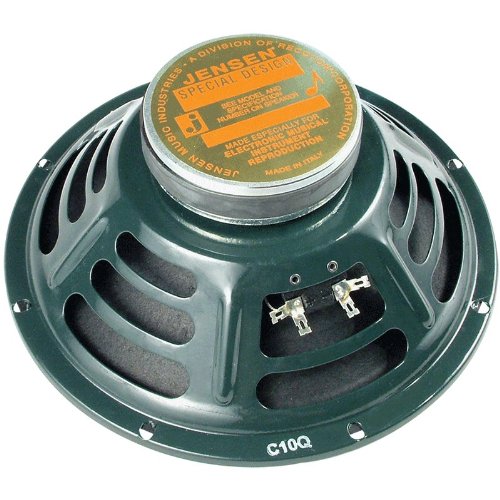
Jensen C10Q — Best step-up Jensen ceramic
Think of the C10Q as the C10R’s bigger brother who kept the family accent and added muscle. Its 35-watt rating and stronger motor give it more low-end composure and a little more clean headroom before the cone joins the distortion, which makes it the Jensen ceramic to choose when the C10R’s brief is right but your amp is a touch more powerful, or your band a touch louder. The top end keeps the Jensen sparkle, the midrange stays open rather than honky, and the whole presentation feels like the same amp with its shoulders back.
That makes the C10Q the natural pick for the middleweight vintage-style combos — the Vibrolux-style and larger Princeton-adjacent boxes — and for players who love the Jensen voice but play with a drummer who has never once been asked to play quieter. It also behaves well with overdrive pedals, holding its low end together where the lighter C10R can start to flap. Between the two ceramics, the decision is mostly about headroom: choose the R for maximum vintage give, the Q for the same voice with a firmer handshake.
There is a maintenance argument for the Q as well. Because it runs further from its limits in a mid-power combo, it tends to live an easier life than a lighter driver doing the same job at the edge of its rating — voice coils age by heat and excursion, and headroom is longevity bought in advance. Players who gig a vintage-style combo weekly are not only buying tone when they step up to the Q; they are buying margin.
- Build: 10-inch driver with a ceramic motor
- Impedance: 8 ohms
- Power handling: 35 watts
- Voice: Jensen sparkle with firmer lows
- Best habitat: mid-size vintage-style combos, louder small bands
Strengths
- More headroom and low-end control than the C10R.
- Keeps the family voice while handling pedals better.
- Suits a wider range of combo sizes.
Trade-offs
- Breaks up later — less vintage give at the same volume.
- Still a modest ceiling for genuinely powerful amps.
- Slightly heavier than the R it outmuscles.
Best for: players who want the Jensen voice with more composure and headroom. Not suited for: purists chasing the earliest, softest breakup.

Jensen P10R — Best alnico tweed voice
If the C10R is the blackface voice, the P10R is the tweed one — the alnico driver in the style of the units fitted to the late-1950s amplifiers that defined rock and roll’s first vocabulary. Its defining trait is the gentle compression described earlier: as you push the amp, the P10R does not merely get louder, it leans in, rounding transients and letting sustained notes swell with a vocal quality that players describe as the amp breathing. Clean, it is warm and slightly soft at the very top, flattering to bright guitars; driven, it produces the harmonically dense, midrange-rich bark that tweed circuits are loved for.
This is also the driver most associated with multi-speaker vintage rigs — the 4×10 format of the classic Bassman-style amp uses its larger sibling logic, and pairs or quads of P10Rs in an open-back cabinet create a spread and shimmer no single driver imitates. Respect its 25-watt rating and its alnico price premium, and check mounting depth, since the alnico assembly’s bell is not the slimmest here. In the right tweed-style or vintage-voiced amp, though, the P10R is not one option among six; it is the reference the others are measured against.
Handle the P10R’s reputation with one caution: its magic is volume-dependent. At whisper levels an alnico driver is simply a warm, pleasant speaker, and the compression that justifies its price only arrives when the amp works hard enough to soften the magnet’s field. Players who mostly record quietly at home may find the ceramics give them more of their character per decibel, while stage and studio players who can turn up get the full alnico effect they paid for.
- Build: alnico-magnet 10-inch guitar driver
- Load: 8 ohms
- Rating: 25 watts
- Voice: warm, compressing, tweed-era
- Best habitat: tweed-style amps, vintage-voiced combos, multi-10 cabinets
Strengths
- Genuine alnico compression and bloom at volume.
- The reference tweed voice, solo or in pairs and quads.
- Forgiving top end suits bright vintage-style guitars.
Trade-offs
- Alnico pricing is the highest per watt in this list.
- 25-watt ceiling demands a small-amp context.
- Bell depth needs checking in shallow cabinets.
Best for: tweed-style amp owners and vintage-voice restorations. Not suited for: tight budgets or high-powered modern combos.
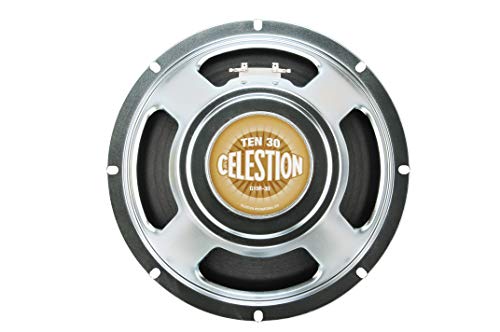
Celestion Ten 30 — Best British-flavoured value
The Ten 30 is Celestion’s way of putting a recognisably British voice into the amplifiers that ship with forgettable speakers. Where the Jensens are open and sparkly, the Ten 30 is midrange-forward and purposeful: chords gain a woody density, single notes carry a vocal push, and overdrive settles into the thick, singing character associated with British amplifiers rather than the sizzle of the American school. It is a 30-watt ceramic driver fitted as original equipment in a long list of practice and small gigging amps, which means its behaviour in real cabinets is thoroughly documented by owners.
Its finest use is resurrection. Thousands of perfectly good small combos are let down by a stock speaker chosen to a price; the Ten 30 is the inexpensive swap that gives such an amp an actual point of view. It will not turn a practice amp into a vintage treasure, and its top end is more polite than sparkling, so players chasing Fender-style chime should look at the Jensens instead. But for rock-leaning players with a modest amp and a modest budget, it is the highest-value personality transplant in this guide.
The Ten 30 also earns its keep as a diagnostic tool. If a budget combo sounds dramatically better with one fitted — and it usually does — you have learned that the amplifier’s electronics were never the problem, which redirects any further upgrade money toward the guitar, the pedals or lessons rather than a new amp. Few components at this price return that much information along with the improvement.
- Build: ceramic 10-inch driver, British voicing
- Impedance: 8 ohms (check listing variant)
- Power handling: 30 watts
- Voice: mid-forward, woody, British-leaning
- Best habitat: practice-amp upgrades, small British-voiced combos
Strengths
- Distinctive British midrange character at a low price.
- Proven as original equipment in many production amps.
- Thickens thin-sounding small combos convincingly.
Trade-offs
- Top end is polite rather than sparkling.
- 30-watt rating keeps it in small-amp territory.
- Its midrange push can crowd an already mid-heavy amp.
Best for: rock players upgrading a bland practice or starter combo. Not suited for: chime-first players or powerful amplifiers.

Eminence Copperhead 10 — Best for clean headroom and volume
The Copperhead answers the most practical complaint in the small-amp world: “I love my combo, but it disappears next to the drums.” With a 75-watt rating and sensitivity at the loud end of this list, it converts a modest amplifier’s output into startling volume while refusing to break up itself — cleans stay clean at band level, pedal overdrive arrives exactly as the pedal voiced it, and the low end stays firm under country picking, funk rhythm and jazz comping alike. Its voice is American in accent, balanced rather than scooped, with enough top-end clarity for detail to survive a loud stage.
That composure is also its trade. Players who buy a small tube amp for the way amp and speaker distort together will find the Copperhead almost too well-behaved: the grit must come from the amp alone, and at home volumes the combination can feel stiff compared with a low-wattage Jensen’s give. It is also a substantial magnet assembly, so weigh the combo and measure the depth. Judged on its own brief — make a small amp gig — nothing else in this guide does the job as completely, which is why working players who cannot mic up everywhere keep choosing it.
Clean-country and funk players should note one more Copperhead trait: its firm cone keeps fast, percussive playing intelligible. Chicken-picked runs and muted rhythm chops live or die on transient clarity at volume, and drivers that soften under power smear exactly those details. The Copperhead’s refusal to soften, a limitation for the breakup chaser, is the entire point for the rhythm player whose job is to be a percussion instrument with pitch.
- Build: high-power ceramic 10-inch driver
- Impedance: 8 ohms
- Power handling: 75 watts
- Voice: loud, clean, balanced American
- Best habitat: gigging small combos, pedal-platform amps
Strengths
- Highest headroom and among the loudest here per watt.
- Firm low end under fast, clean playing styles.
- Lets pedals and amp voicing speak without cone colouration.
Trade-offs
- Adds little breakup of its own — vintage-give seekers look elsewhere.
- Heavy magnet assembly for a 10-inch driver.
- Can feel stiff at bedroom volumes.
Best for: gigging players who need a small amp to stay clean and present. Not suited for: players whose sound is speaker breakup itself.
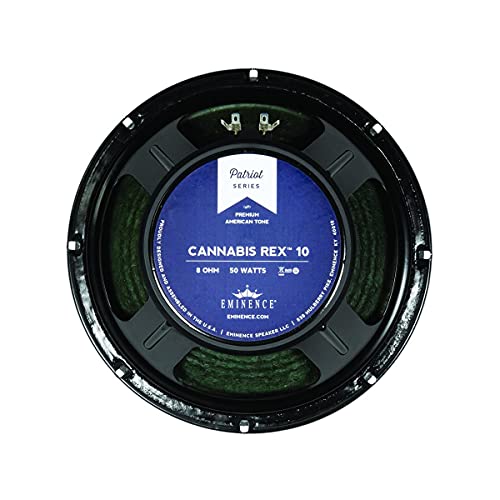
Eminence Cannabis Rex 10 — Best for taming brightness
Some rigs have a splinter in them: a bright guitar through a bright amp in a hard room, producing a top end that makes listeners flinch at volume. The Cannabis Rex 10 is the surgical answer. Its hemp cone — the material is the design, not a gimmick — has a natural damping that smooths the highest frequencies and thickens the midrange, so single-coil guitars gain body, harsh overdrive loses its fizz, and the whole amp seems to relax. Its larger sibling is a famous fix in the 12-inch world; this 10-inch version brings the same therapy to small combos at a useful 50-watt rating.
The smoothing is a genuine tonal commitment, so choose it deliberately. Players whose sound depends on glassy top-end detail — country chicken-picking, funk scratch, jangly indie rhythm — will feel the Rex rounding off exactly the edges they love. For blues, jazz, roots rock and any player who has ever rolled the amp’s treble down and still winced, it is transformative, and its efficiency keeps volume healthy while it smooths. Think of it as the only pick here bought to subtract something — and for the right rig, subtraction is the whole art.
Jazz players discovered this family of hemp-coned drivers early, and their reasoning transfers: a warm, even speaker lets the amplifier run its tone controls near flat, which keeps the guitar’s own voice — pickup selection, picking position, touch — in charge of the sound. When the speaker stops editorialising at the top end, small changes in technique become audible again, and that responsiveness is a pleasure that spec sheets cannot describe.
- Build: hemp-cone 10-inch guitar driver
- Nominal load: 8 ohms
- Rated power: 50 watts
- Voice: smooth, warm, thickened midrange
- Best habitat: bright amps and guitars, blues and jazz combos
Strengths
- Hemp cone genuinely tames harsh top end.
- Fattens single-coils without pedals or EQ surgery.
- 50-watt rating suits mid-power combos.
Trade-offs
- Smoothing is permanent — detail-first styles lose their edge.
- Warmth can turn muddy in an already dark amp.
- Hemp cone divides opinion; it is a taste decision.
Best for: players fighting a bright, harsh rig, especially with single-coils. Not suited for: sparkle-dependent styles or already-dark amplifiers.
How Do You Decide When You Cannot Hear the Speaker First?
Almost nobody gets to audition a replacement driver in their own amplifier before buying, so the decision has to be made from evidence — and the evidence is better than it first appears. Begin with recordings of the amplifier family you own fitted with the driver you are considering; owner communities for the classic small combos are meticulous about documenting swaps, and a phone recording of the right amp with the right speaker tells you more about character than any specification. Listen specifically for the three moments that define a guitar speaker: the clean attack, the edge-of-breakup transition as chords are dug into, and the fully driven sustain. A driver that flatters all three in your amp’s family will very likely flatter yours.
Then interrogate your own complaint, because a speaker swap fixes speaker problems and merely rearranges others. If the amp is too quiet, the answer lives in sensitivity — the Copperhead’s end of the list. If it is loud enough but harsh, the answer lives in top-end behaviour — the Rex, or the alnico’s rounding. If it is characterless, the answer is a driver with a stronger point of view — the Ten 30’s midrange or the Jensens’ sparkle. If it falls apart when pushed, the answer is headroom and low-end discipline — the C10Q or the Copperhead again. Notice that each complaint maps to a different pick; that mapping, not brand loyalty, is the whole decision method of this guide.
Finally, buy from a seller whose returns policy respects the reality that a speaker is an audition you conduct at home. Fit it carefully, keep the packaging, play it across several days and styles rather than one excited hour, and let the break-in begin before you judge. The drivers in this list are established enough that a mismatch is a matter of taste, not quality — and taste is precisely what a fair returns window exists to arbitrate.
Which Speaker Suits a 5-Watt, 15-Watt or 40-Watt Amp?
Amplifier power sorts this list faster than taste does. A 5-watt amp lives entirely in the zone where the speaker is a co-conspirator: it cannot bully any driver here, so the low-wattage vintage voices — C10R and P10R — give it a full dynamic range from clean to singing within a single volume knob’s travel, and their modest sensitivity keeps the whole event at household scale. Fitting a Copperhead to a 5-watt amp is legal and even interesting — enormous clean headroom from a tiny box — but the amp’s own breakup arrives before the speaker contributes anything, and some of the small-amp charm goes missing.
The 15-to-22-watt class is the format’s heartland and the range where all six picks are legitimate answers differentiated purely by intent. Vintage voice at full song: the Jensens. British density: the Ten 30. Stage volume with pedals: the Copperhead. Smoothness: the Rex. At 40 watts and above, arithmetic starts eliminating candidates — the 25- and 30-watt drivers are below a safe margin for an amp that will actually be turned up — and the list narrows to the C10Q at the cautious edge, the Rex, and emphatically the Copperhead, whose 75-watt rating exists for exactly these amplifiers. When in doubt, the maker’s guidance for a single driver is a rating comfortably above the amp’s maximum output; pairs and quads share the load and reopen the vintage options.
Why Stay With a 10 When 12-Inch Speakers Exist?
Because the 10 does things the 12 does not, and the difference is character rather than quality. A smaller, lighter cone responds faster, so pick attack is crisper and fast passages stay separated; the low end is naturally tighter, which in a small combo is usually a virtue rather than a lack, since the cabinet and room supply warmth the driver does not have to. The 10’s midrange focus is also why these little amps record so well — the sound arrives pre-shaped for a mix, occupying the guitar’s territory without trespassing on the bass player’s.
The 12 counters with body: more low-end weight, a broader spread, and the thump that heavier styles expect. Players who find every 10 thin are not wrong about their taste; they are simply shopping in the wrong aisle, and no driver in this guide will convert them. But players who love their small amp’s immediacy and merely want it better — sweeter, louder, smoother, more British — should resist the assumption that bigger is the upgrade. The upgrade is a better 10, chosen against the complaint, and it preserves the portability and response that made the amp worth owning in the first place. Format loyalty, in this corner of the catalogue, is a feature.
How Do the Six Guitar Drivers Compare Side by Side?
| Driver | Magnet / cone | Power | Character |
|---|---|---|---|
| Jensen C10R | Ceramic | 25W | Bright vintage American, early breakup |
| Jensen C10Q | Ceramic | 35W | Same voice, firmer and louder |
| Jensen P10R | Alnico | 25W | Tweed warmth, gentle compression |
| Celestion Ten 30 | Ceramic | 30W | British midrange push, great value |
| Eminence Copperhead 10 | Ceramic | 75W | Loud, clean, pedal-friendly |
| Eminence Cannabis Rex 10 | Hemp cone | 50W | Smooth top, thick mids |
The table sorts itself by intent. The three Jensens sell history in three temperatures; the Celestion sells a British accent cheaply; the two Eminence drivers sell solutions — volume and smoothness — to modern problems. Pick the job first and the driver usually picks itself.
How Do You Swap a Combo Speaker Without Damaging Anything?
Unplug the amp and let it sit; tube amplifiers hold charge in their capacitors, and while a speaker swap touches only the speaker leads, working inside any open amp deserves that basic respect. Photograph the wiring before removal, noting which lead lands on which terminal — most combos use push-on connectors that slide off with a gentle wiggle, never a yank. Support the old speaker as you remove its last screws so it cannot drop onto a tube or the cabinet floor, and note any gasket that should transfer or be replaced.
Two habits separate clean swaps from horror stories. First, lay the screws out in the order and pattern you removed them; baffles are often drilled by hand at the factory, and each screw has a hole it already fits. Second, route the speaker leads exactly as the originals ran, clear of tubes and away from the cone’s travel — a lead resting against a chassis edge or a hot valve will announce itself as a buzz that masquerades as a faulty driver. Cable-tie or clip the leads if the originals were dressed that way; the factory’s tidiness was functional, not decorative.
Fit the new driver with even, progressive bolt pressure, connect the leads to the same terminals, and test at low volume before reassembling the back panel. Play clean first, listening for rattles, buzzes from a fouling lead, and the general balance; then bring the volume up gradually over the first session rather than debuting the new speaker at full tilt. Keep the old driver boxed and labelled. Tastes change, amps get sold, and a combo reunited with its original speaker is worth more to its next owner than the same amp with a mystery unit inside.
What Mistakes Do Speaker Swappers Keep Making?
Add one more that wastes more money than all the others combined: swapping speakers in a chase for a recorded sound without asking what made the record. The famous small-amp tones were printed by specific guitars, rooms, microphones and engineers; a driver can move your amp toward that family, but expecting any single component to deliver the whole photograph leads to a shelf of perfectly good speakers and a persistent feeling of failure. Buy for the complaint you actually have, in the room you actually play in.
The expensive classic is the impedance mismatch — fitting an 8-ohm driver where the amp expects 4, or the reverse, because the listing’s headline buried the variant. Next comes buying wattage by fear: fitting a hugely overrated speaker to a small vintage amp “to be safe”, then wondering where the amp’s liveliness went. A third error is judging a new speaker in its first hour; cones loosen and ears adjust, and several of the drivers here — the hemp-coned Rex especially — settle noticeably over the first weeks. Fourth is ignoring depth and discovering the magnet against the chassis with the old speaker already sold. And the quiet mistake is swapping speakers to fix a problem that lives elsewhere: tired tubes, a drifting bias and worn strings have all been blamed on innocent drivers.
Final Recommendation
Whichever you choose, fit it carefully, keep the driver it replaces, and give the pairing a fortnight of real playing before you deliver a verdict — speakers settle, ears calibrate, and more than one player has re-fitted a driver they nearly returned and found the sound they were chasing all along.
Restore a small American combo with the Jensen C10R, or the C10Q if your band plays louder than your amp’s designer expected. Chase the tweed bloom with the P10R and accept its premium as the price of that compression. Give a bland practice amp a British accent with the Ten 30, make a gigging combo heard with the Copperhead, and reach for the Cannabis Rex 10 when the rig’s top end has teeth you are tired of dodging. The right 10-inch speaker does not make a small amp bigger — it makes it more honestly itself — and few purchases in a guitarist’s life return so much change in sound for so little money, risk and regret, or undo themselves so cleanly if taste moves on next year, which makes the experiment easy to begin and easier still to recommend to a bandmate.
Frequently Asked Questions
Will a speaker swap void my amplifier’s warranty or hurt its value?
A reversible swap with the original driver kept safely rarely harms value; collectors pay for originality, so store the stock speaker and its screws. Warranty terms vary by maker, and opening a new amp is worth a quick read of its manual — but the swap itself, done without soldering or cabinet modification, is among the least invasive upgrades in guitar gear.
Can I mix two different 10-inch speakers in a 2×10 cabinet?
Yes, and it is a respected trick: pairing a bright driver with a warm one — a C10R beside a Cannabis Rex 10, say — blends characters and broadens the cabinet’s sweet spot. Match impedance exactly, keep sensitivities within a couple of decibels so one does not bury the other, and expect the blend to sound like a third speaker rather than either parent.
How long does a new guitar speaker take to break in?
Most drivers here settle over roughly ten to twenty hours of real playing at moderate volume, growing a little fuller in the lows and smoother at the top. The change is refinement, not transformation — if a speaker sounds wrong for your amp on day one in character rather than stiffness, it will probably still be wrong on day thirty.
Is an 8-ohm speaker louder than a 16-ohm speaker?
Not inherently. Loudness follows sensitivity and the power the amplifier actually delivers into that load. Many amps produce their rated output into a specified impedance and less into a higher one, so the practical answer depends on your amp’s specification — another reason to fit the impedance the amp was designed for.
My combo has one 8-ohm speaker — can I add an extension cabinet?
Only if the amplifier provides for it. Many small combos offer an extension output wired in parallel or series with the internal driver, and the manual states the resulting minimum load. Adding a cabinet changes the total impedance the output stage sees; guesswork here is how output transformers get hurt. If the amp has no extension provision, enjoy the combo as designed — a louder internal driver, like the Copperhead, is the safer route to more volume.
Do I need to solder the connections?
Most combos use push-on terminals that need no solder, and the drivers here accept them. If your amp’s leads are soldered, a neat solder joint is fine, but keep the iron’s heat brief and away from the cone, and never let solder drip inside an open-back cabinet near the tubes.
Related Guides
Speaker choices ripple through the whole rig. Players weighing the other discipline should read best 10 inch bass cabinet speakers, those building a live rig may need best 10 inch powered pa speakers, and anyone comparing ready-made boxes with a driver swap can start at best 10 passive dj speakers. Modeler players, meanwhile, belong over at best 12 frfr speakers.


