What's inside
- Key Takeaways
- Quick Picks
- How Did We Select Projectors for Bright Rooms?
- What Does a Lumen Actually Buy You in a Lit Room?
- How Do the Six Compare at a Glance?
- How Should You Pair a Bright Projector With a Screen?
- How Do You Measure a Bright Room Before Choosing?
- Why Do Bright Rooms Prefer Solid-State Light?
- What Should Institutional Buyers Check That Home Buyers Can Skip?
- What Mistakes Waste a Bright Projector’s Output?
- Which Rooms Should Step Down to a Dimmer, Deeper Projector Instead?
- What Happens to a Bright Projector When the Room Finally Darkens?
- How Do You Keep a High-Output Projector Honest Over Years?
- How Should You Budget the Whole Bright-Room System?
- Final Recommendation
- What Else Should a Bright-Room Buyer Ask Before Ordering?
- Frequently Asked Questions
- Related Guides
As an Amazon Associate I earn from qualifying purchases. This post may contain affiliate links at no extra cost to you.
widgetverdict.com is reader-supported. When you buy through links on our site, we may earn an affiliate commission.
Where to buy: All six projectors below are listed on Amazon. Brightness claims in this class deserve scrutiny, so open the manufacturer’s own specification sheet from the listing and confirm whether the figure quoted is an ANSI, ISO or LED lumen number before comparing across brands.
Brightness is the most abused number in projection, and the class gathered here is where the abuse matters most. The best 4000 lumen projectors exist for rooms that will not go dark: classrooms with windows along one wall, training spaces lit for note-taking, open-plan homes where a film shares the evening with cooking and conversation, houses of worship, pubs showing sport at noon. At roughly four thousand lumens and above, a projector stops asking the room to change and starts negotiating with the light that is already there.
Negotiation is the honest word. No projector defeats direct sunlight on a screen, and any guide that promises otherwise is selling lumens as magic. What this output class genuinely buys is legibility and colour survival under ordinary indoor light: text that stays readable from the back row, a football pitch that stays green at lunchtime, a presentation chart whose weakest pastel survives the ceiling panels. The six machines below reach that territory by different roads — laser, LED and lamp; 1080p and 4K; standard throw and one ultra-short-throw design that sits beneath its own picture — and the differences decide which room each one truly serves.
Key Takeaways
- Around 4,000 lumens is the threshold where projected images stay legible and colourful under normal indoor lighting rather than merely visible.
- Confirm the measurement standard behind any brightness claim; ANSI and ISO figures are conservative, while some LED lumen claims run generously higher.
- Laser and LED models dominate this class because high output plus long life suits rooms that run projectors all day.
- Resolution still matters: text-heavy rooms should favour the 4K picks or keep screen sizes and seating distances honest with 1080p.
- An ambient-light-rejecting screen multiplies this brightness class more effectively than another thousand lumens would.
Quick Picks
| Pick | Badge | Why it is here |
|---|---|---|
| ViewSonic LS740HD | Brightest Here | Laser output in the mid-5,000 lumen class with 1080p clarity for halls and classrooms. |
| ViewSonic PX749-4K | Best 4K Value | Four thousand lumens wrapped around a 4K home-entertainment picture. |
| BenQ LH750 | Best for Meetings | LED output in the 5,000-lumen class with presentation manners and wireless thinking. |
| Epson Pro EX11000 | Best Colour in Light | 3LCD laser brightness where saturated colour must survive a lit room. |
| Epson Pro EX9270 | Best Installed All-Rounder | WUXGA laser projection in the low-4,000 lumen class for fixed professional rooms. |
| Epson EpiqVision LS800 | Best Ultra-Short Throw | Four thousand lumens from a cabinet beneath the screen, with television manners. |
How Did We Select Projectors for Bright Rooms?
The entry ticket was an honest four-figure output claim from a manufacturer with a measurement reputation to protect, which excluded the anonymous end of the market where five-figure lumen claims dissolve on contact with a light meter. Survivors were then sorted by the work bright rooms actually do: text legibility for teaching and meetings, colour survival for sport and media, and duty cycle for spaces that run a projector from morning registration to evening events.
Light source carried unusual weight in this class. High-output lamp machines exist, but a room bright enough to need 4,000 lumens is usually a room that runs its projector hard, and laser or LED engines — with long rated lives and stable output — match that life better than a lamp on a replacement treadmill. Five of the six picks are solid-state for exactly that reason.
Finally, we kept one ultra-short-throw design and one 3LCD pair in the frame, because bright-room buyers are not a single tribe: the pub, the classroom, the glass-walled home and the training suite each punish a different weakness, and a guide that only served one of them would be a catalogue, not a guide.
What Does a Lumen Actually Buy You in a Lit Room?
A lumen is a unit of light output, and a projector’s rating describes what leaves the lens, not what reaches your eye. Between lens and eye stand the throw distance, the screen’s size and surface, and the room’s own light competing for the same square metres. Double the screen’s width and the same lumens spread across four times the area; add ceiling light and the projector must outshout it on every pixel. This is why brightness advice that ignores screen size is worthless, and why this class begins where it does: four thousand lumens feeds a two-to-three-metre screen in a lit room with enough left over for colour and contrast to remain recognisable.
Contrast, not raw visibility, is what ambient light actually steals. A lit room sets a floor under your blacks — the screen can never be darker than the light falling on it — so shadow detail and text contrast compress from below while brightness defends them from above. High output buys back the top of that range. An ambient-light-rejecting screen defends the bottom, reflecting the projector’s image toward the audience while refusing light from ceiling angles, and in a genuinely bright room that screen is a better purchase than the next projector tier.
Measurement standards decide whether comparisons mean anything. ANSI and ISO lumens are measured conservatively and track each other; LED lumens, quoted by some makers for LED models, describe perceived brightness and run higher than the ANSI figure for the same machine. Neither is fraudulent, but mixing them in one comparison is. This guide flags the class each pick belongs to and lets the room, not the arithmetic trick, decide.

ViewSonic LS740HD — Brightest Here
The LS740HD tops this page on the only ranking a bright-room buyer cannot ignore: it is the most powerful light engine here, a laser design rated in the mid-5,000 lumen class, built for the halls, classrooms and houses of worship where the picture must survive windows that nobody is allowed to cover. If your room is the brightest on your street, start here and work down only if the budget insists.
Laser drive suits the duty. Output arrives instantly, holds steady across a school day of lessons, and asks for no lamp ceremony between terms. The 1080p image is the honest match for the work: text at presentation sizes stays crisp from the back of a hall, video content looks clean, and the machine’s installation flexibility — generous zoom and correction tools — forgives the mounting positions real ceilings impose.
Home buyers should read its brief accurately. This is a brightness instrument before it is a cinema instrument; its contrast tuning serves lit rooms, and in a darkened home theatre its muscle is surplus while its blacks remain professional rather than filmic. Households whose viewing happens in genuine light, however — the open-plan sports wall, the games room that never darkens — may find its priorities are secretly theirs.
Running costs complete the case for institutions: a laser rated for tens of thousands of hours, filters as the main consumable, and no lamp budget line for a caretaker to defend. In rooms that measure projectors in decades of assemblies, that ledger matters as much as the picture.
Consider a winter morning in a school hall to understand this machine’s design centre: blinds half-drawn against a low sun, two hundred students, a video that must land and a worksheet whose smallest line must read from the back bench. The LS740HD was specified for exactly that hour. Its output does not merely make the picture visible; it keeps the picture’s hierarchy — headings louder than body text, the diagram’s red line distinct from its blue one — intact under duress.
There is a confidence trick high-output laser performs on a whole institution: because the projector never looks tired, nobody rations it. Assemblies, parents’ evenings, the drama club’s backdrop, the sports club’s analysis night all end up on the big screen, and the machine’s cost quietly divides by a usage figure its lamp ancestors never reached. Brightness, in that accounting, is not a specification but an invitation.
Home buyers borrowing it for a media barn or a bright annexe should simply confirm the throw against their wall and accept its professional menus as the dialect of its homeland. In exchange they receive the closest thing this page offers to daylight indifference, short of closing the curtains like everyone else.
Noise, the usual tax on output, is handled with more grace than the class historically managed: at teaching distances the LS740HD’s fan registers as room tone rather than interruption, and its eco trims let a small seminar trade surplus lumens for near-silence. Institutions should still mount it away from the front row’s ears where the ceiling allows, because the cheapest acoustic treatment is distance.
Second-hand and redeployment prospects are strong, too: a laser hall projector retired from a main space remains overqualified for a classroom, a rehearsal room or a community hall, which is how institutions cascade value through a fleet. Buying output headroom, in that world, is buying a second career for the machine.
- Format: 1080p Full HD
- Output: mid-5,000 lumen class, laser
- Installation: flexible zoom, hall-friendly throw
- Duty: long-life solid-state engine
- Home ground: classrooms, halls, worship spaces
Strengths
- Highest output in this guide
- Laser steadiness across long days
- Installation forgiveness for real ceilings
Trade-offs
- 1080p ceiling for fine text at huge sizes
- Contrast tuned for light, not cinema darkness
- Professional feature emphasis throughout
Best for: the brightest rooms — halls, classrooms and venues.
Not suited for: dedicated dark home cinemas.

ViewSonic PX749-4K — Best 4K Value
The PX749-4K is the crossover artist of the class: a home-entertainment projector that happens to carry a 4,000-lumen lamp, so the living room that cannot darken for a Saturday match still gets a 4K picture with genuine authority. It serves the household whose projector life is mostly films and sport, in a room whose curtains are more decorative than functional.
Four thousand lumens behind a 4K DLP image produces the class’s most television-like bright-room picture: detailed, punchy, with colour that holds its saturation while the ceiling lights stay on. Gaming credentials ride along — high-refresh 1080p modes for the console crowd — making this the one pick here that a mixed household can buy without a single member feeling like a compromise.
The lamp is the honest counterweight. It delivers the output at a purchase price laser rivals envy, then asks for replacements across the years, each one a modest, predictable cost. Households that run the projector nightly for a decade should do that arithmetic against the laser picks before deciding; households that run it for films and fixtures will find the lamp entirely reasonable.
Setup is home-friendly: a throw that suits ordinary rooms, enough zoom to fit existing screens, and menus that assume entertainment rather than facilities management. For the bright living room that wants one machine for everything, the PX749-4K is the page’s most natural resident.
Sport is the PX749-4K’s finest bright-room hour. A midday match on a three-metre screen, curtains open, friends drifting between kitchen and sofa — the picture holds its green, its detail and its dignity in conditions that reduce cinema projectors to apologetic shadows. The 4K resolution earns its place here precisely because the audience sits close and casual, near enough to read a score bug and a shirt number without leaning forward.
Its gaming modes give the same room a second life after the match: high-refresh 1080p for the console, the big screen for split-screen sessions that a television would cramp. A household choosing one display for a bright, social room could reasonably stop reading this page at this pick and spend the saved research time on the screen pairing instead.
Lamp economics, handled honestly, barely dent the case at domestic duty cycles. A film-and-fixtures household will measure lamp life in years, and each renewal returns the machine to full brilliance for the price of a modest dinner out. The treadmill that frightens institutions is, at home, a staircase taken slowly.
Its remote and menus deserve a domestic compliment: picture modes are labelled for the content a family actually watches, and the bright-room trim can be stored rather than reconstructed each Saturday. Small courtesies of that kind decide whether a powerful projector gets used at full competence or at whatever setting it happened to be left in.
For buyers comparing it against the laser Epsons, the deciding question is content shape. Films, sport and games in a bright room crown the ViewSonic’s 4K punch; saturated gatherings and presentation colour crown the 3LCD pair. Both answers are respectable, and confusing them is the only real mistake available at this level.
- Format: 4K UHD
- Output: 4,000-lumen class, lamp
- Entertainment: gaming refresh modes included
- Installation: standard home throw
- Home ground: bright living rooms
Strengths
- 4K detail that survives room light
- Gaming and film competence in one box
- Purchase price undercuts laser rivals
Trade-offs
- Lamp replacements belong in the budget
- Blacks remain bright-room class in darkness
- Fan presence grows at full output
Best for: bright living rooms wanting 4K for everything.
Not suited for: all-day institutional duty cycles.

BenQ LH750 — Best for Meetings
BenQ’s LH750 was designed in the meeting-room world and carries that world’s virtues proudly: LED output rated in the 5,000-lumen class by the maker’s LED measure, 4K resolution for fine text, and the wireless, quick-start manners of a machine that expects to be used by whoever walks into the room rather than by a technician.
Text is its home fixture. Spreadsheets, code, design drawings and dense slides all benefit from the combination of genuine resolution and colour that stays saturated under office lighting, and BenQ’s presentation tuning understands that a chart’s weakest pastel is information, not decoration. In a training room, that legibility is the difference between a projector and a wall ornament.
The LED engine suits the meeting rhythm: instant on for the unscheduled call, no lamp anxiety during the quarterly review, colour that remains consistent across years of short, frequent sessions rather than long ones. Wireless casting support reduces the cable negotiation that opens every meeting in rooms without it.
Homes should borrow it knowingly. Its talents translate beautifully to a bright media room or a home office that doubles as a cinema, but its soul is professional — in a dedicated dark theatre, the cinema-tuned picks elsewhere on this site will flatter films more. As a working display for rooms that earn their living, the LH750 is the class benchmark.
The LH750’s colour work deserves emphasis because meeting rooms are where colour goes to be lied about. Corporate palettes, brand reds, the amber warning buried in a dashboard — a projector that shifts hues under office light teaches an audience to distrust the screen. BenQ’s LED engine holds those colours with a steadiness that makes the machine disappear, which is the highest compliment a presentation tool can earn.
Its 4K panel also future-proofs the room against the rising resolution of ordinary work: design reviews, architectural walkthroughs and data visualisations all arrive denser each year, and a display bought for a decade of meetings should resolve the last of them as cleanly as the first. The LH750’s specification reads like it was written by someone who has sat through those meetings and taken notes.
For the home-office hybrid — the professional who presents by day and streams by night in the same bright room — it may be the most rational machine on this page, its working virtues translating directly into domestic ones whenever the laptop closes.
Facilities teams will appreciate a detail home buyers can borrow: the LH750’s consistency across a fleet. Rooms equipped identically behave identically, so a presenter moving between suites carries settings in their head rather than in a notebook. Homes rarely run fleets, but the underlying virtue — predictability — is the same one that makes a family projector trustworthy.
Its audio provisions and collaboration features also shorten the distance between the projector arriving and the projector being useful, a distance in which many professional purchases quietly die. BenQ clearly intends the machine to be working within the hour, and that intention is felt in every menu.
- Format: 4K UHD
- Output: 5,000-lumen class by LED measure
- Engine: LED, instant-on behaviour
- Collaboration: wireless casting support
- Home ground: meeting and training rooms
Strengths
- Fine text stays legible under office light
- LED consistency across stop-start days
- Meeting-friendly wireless and startup manners
Trade-offs
- LED lumen figures are not ANSI-comparable
- Presentation tuning over cinema tuning
- Professional pricing for home buyers
Best for: offices, training suites and bright media rooms.
Not suited for: dark-room film purists.
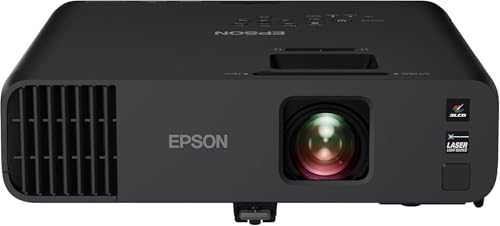
Epson Pro EX11000 — Best Colour in Light
The EX11000 brings the argument of the previous guide into the brightness wars: 3LCD’s equal colour and white brightness, here in the mid-4,000 lumen class from a laser source. In lit rooms, where content is saturated — kits, charts, animation, signage — that equality stops being a specification nicety and becomes the visible difference between a picture that glows and one that merely shows.
Its Full HD resolution is the deliberate trade. At the screen sizes and viewing distances of lit, social spaces, the audience reads content rather than counting pixels, and Epson spent the budget on light and colour instead of a 4K badge. Buyers projecting fine text to a back row should weigh the 4K picks; buyers projecting life-size sport and gatherings will not miss what they never needed.
Laser ownership in a social room has a particular rhythm: the projector is always ready, never rationed, as happy for a ten-minute photo slideshow as for a cup final. Wireless flexibility and installation manners follow the professional brief, and the machine’s presence in homes keeps growing precisely because open-plan architecture keeps defeating cinema assumptions.
In darkness it remains competent rather than magical, its contrast tuned for the lit world it serves. Judge it where it works — lights up, room full, picture winning — and the EX11000 is the most sociable projector in this guide.
A lit room reveals a subtle truth about the EX11000’s 3LCD engine: pastel colours, the first casualties of ambient light on lesser machines, survive here with their identities intact. A child’s animated film at teatime, a cooking programme’s pale sauces, a slide deck of watercolour charts — all keep the delicate end of the palette that bright-room viewing usually sacrifices, because the colour light never queued behind the white.
Its scale manners are equally social. This is a projector comfortable filling a genuinely large wall for a genuinely large gathering, the kind of evening where the back row is a kitchen doorway and the picture must still arrive. Laser readiness means the machine never makes such evenings feel like an imposition on a lamp’s lifespan.
Buyers torn between this and the 4K ViewSonic should interrogate their content honestly: gatherings, sport and presentations crown the Epson; solitary film nights and fine text crown its rival. The room has already decided; the buyer’s task is to hear it.
There is a generosity to the EX11000’s brightness that changes hosting: nobody dims a room for a projector’s feelings, nobody draws curtains at a party, and the picture simply participates in the evening like a very large, very confident guest. Hosts who have lived with cinema projectors will recognise how radical that social relaxation feels.
Its professional wireless and split-screen talents, surplus in a cinema, become party pieces in a social home — two matches at once, a slideshow beside a scoreboard — and remind the buyer that a professional brief, honestly bought, often out-features a domestic one.
- Format: 1080p Full HD, 3LCD
- Output: mid-4,000 lumen class, laser
- Colour: colour brightness equals white
- Connectivity: wireless-friendly professional set
- Home ground: lit, social, open-plan spaces
Strengths
- Saturated colour survives room light
- Laser readiness for spontaneous use
- Large-screen authority in bright rooms
Trade-offs
- No 4K for fine-detail work
- Cinema blacks are not its pursuit
- Professional styling and menus
Best for: bright open-plan homes and event spaces.
Not suited for: text-dense back rows or dark cinemas.

Epson Pro EX9270 — Best Installed All-Rounder
The EX9270 is the quiet professional of the six: a WUXGA laser projector in the low-4,000 lumen class, built for installed rooms — boardrooms, lecture spaces, houses of worship with ambitions — where the projector disappears into the ceiling and the picture simply has to be right, every day, for years.
WUXGA resolution, slightly beyond Full HD in the vertical, suits the mixed diet of installed rooms: documents and dashboards in the morning, video in the afternoon, an evening event after both. The 3LCD engine keeps colour honest under the mixed lighting such rooms accumulate, and the laser source removes the maintenance calendar that facilities teams quietly dread.
Installation is its native language: flexible optics, network-minded management and the build of a machine intended to be fitted once by professionals and then forgotten. Homes with a permanent media room and professional habits — a rack, a fixed screen, a control system — will recognise the temperament immediately.
It lacks the entertainment flourishes of the PX749-4K and the sheer output of the LS740HD, positioning itself instead as the balanced institutional answer. For a room that must serve every master competently, balance is not a compromise; it is the specification.
Installed rooms develop a particular relationship with a machine like the EX9270: it becomes building infrastructure, judged the way lighting and acoustics are judged — by its absence of incident. Term after term, the picture is simply correct, and that reliability is a compound of the laser’s steadiness, the 3LCD colour stability and optics that were aligned once by someone who cared.
Its WUXGA canvas quietly suits the documentation age, where the projected artefact is as likely to be a spreadsheet at midnight before a deadline as a film on Friday. The extra vertical room over Full HD is a small mercy that document workers feel daily and film viewers never notice, which is precisely the profile an all-rounder should have.
Homes adopting it should budget for the professional installation it assumes — a proper mount, aligned once, cabled once — because the machine’s whole value proposition is permanence, and a temporary setup spends that proposition without collecting it.
Lecture capture and hybrid attendance have quietly raised the value of machines like the EX9270: a room whose projected content must read clearly to a camera as well as to the back row benefits from exactly its combination of output, colour stability and flicker-disciplined light. The specification was written before that need peaked, and reads now like foresight.
For the worship and community spaces in its audience, its manners matter as much as its metrics: it starts reliably, behaves identically every week, and asks its volunteer operators for almost nothing. Reliability, in rooms run by rota, is a form of kindness.
- Format: WUXGA, beyond Full HD
- Output: low-4,000 lumen class, laser
- Engine: 3LCD colour integrity
- Installation: professional, network-aware
- Home ground: boardrooms and lecture rooms
Strengths
- Balanced resolution, output and colour
- Laser permanence for installed duty
- Professional installation flexibility
Trade-offs
- No gaming or streaming showmanship
- Output trails the ViewSonic flagship
- Home buyers pay for pro features unused
Best for: permanently installed professional rooms.
Not suited for: portable or entertainment-first use.
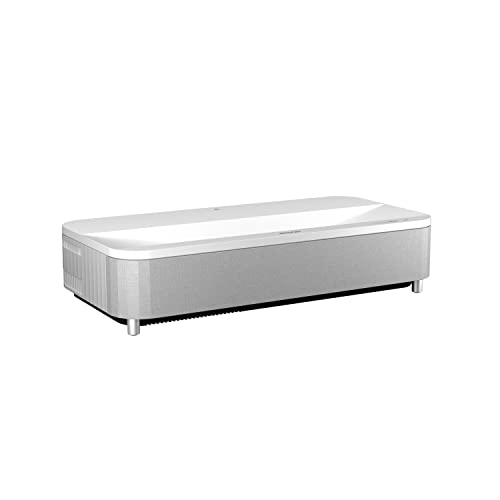
Epson EpiqVision LS800 — Best Ultra-Short Throw
The LS800 performs the class’s neatest trick: four thousand lumens of laser light, delivered from a cabinet centimetres beneath the screen, in a 3LCD design with television ambitions. For the bright living room that wants a wall-sized picture without a ceiling installation, this is the machine that rewrote the floor plan.
Ultra-short throw has a brightness advantage hiding in plain sight — the light travels almost no distance, so less of it is lost before it reaches the screen — and paired with a UST ambient-light screen, the LS800 holds a genuinely watchable picture in rooms where long-throw rivals fade. Its built-in sound, developed with a respected audio partner, is the only audio on this page that a household might honestly live with.
The smart platform completes the television impersonation: streaming built in, a familiar interface, and a picture that appears where a very large television would stand, at sizes televisions do not reach. Film evenings in darkness are enjoyable rather than reference-grade, the honest tax of a design optimised for living rooms rather than caves.
Placement discipline is the price: a level, stable surface at an exact distance, and a screen flat enough for the grazing angle. Households willing to furnish for it gain the brightest casual viewing in this guide; households wanting to move the picture between rooms should look at the conventional throws above.
The LS800’s social genius is that it removes the projector from the conversation. Guests see a large, bright picture and a handsome soundbar-like unit beneath it; nobody discusses throw ratios over dinner. For households whose enthusiasm is for films rather than for equipment, that disappearance is the feature, and the 4,000-lumen laser ensures the trick works at Sunday lunchtime as well as at midnight.
Its 3LCD heart keeps the colour story consistent with the Epson argument running through this guide: saturated content stays luminous, skin tones stay plausible, and the picture never feels like a compromise made for brightness. Add the platform’s streaming fluency and the LS800 becomes the bright room’s most complete single purchase.
The discipline it asks — furniture placed exactly, a screen chosen specifically — should be read as the terms of a television replacement rather than as projector fussiness. Televisions, after all, also dictate their wall and their viewing distance; the LS800 merely does so at a scale televisions cannot reach.
Parents should note the LS800’s daylight personality in family terms: cartoons at breakfast, a nature programme at noon, homework help on a wall-sized canvas — the machine treats all of it as its main job rather than as a warm-up for film night. A projector that serves the whole day earns its cabinet in a way a darkness-only machine must argue for.
Its sound, finally, closes more evenings than expected. Not every viewing justifies waking a receiver and five speakers, and the LS800’s built-in audio carries dialogue-led content with a fullness that keeps the big picture from feeling underdressed at ordinary volumes.
- Format: 4K enhanced, 3LCD
- Output: 4,000-lumen class, laser
- Placement: ultra-short throw, cabinet-top
- Audio: built-in, unusually capable
- Home ground: bright living rooms
Strengths
- Huge picture with no ceiling work
- Short light path flatters bright rooms
- Television-like platform and sound
Trade-offs
- Demands a proper flat UST screen
- Fixed furniture geometry
- Dark-room contrast is living-room class
Best for: bright living rooms wanting television convenience at cinema size.
Not suited for: portable use or uneven walls.
How Do the Six Compare at a Glance?
| Pick | Format | Output class | Source | Signature room |
|---|---|---|---|---|
| ViewSonic LS740HD | 1080p | Mid-5,000s | Laser | Hall, classroom |
| ViewSonic PX749-4K | 4K | 4,000 | Lamp | Bright living room |
| BenQ LH750 | 4K | 5,000 LED measure | LED | Meeting room |
| Epson EX11000 | 1080p | Mid-4,000s | Laser | Open-plan home |
| Epson EX9270 | WUXGA | Low-4,000s | Laser | Boardroom, lecture |
| Epson LS800 | 4K enhanced | 4,000 | Laser | Cabinet-top living room |
How Should You Pair a Bright Projector With a Screen?
In lit rooms the screen stops being a passive surface and becomes an optical ally. Ambient-light-rejecting materials use micro-structure to accept the projector’s steep or direct angle while refusing the ceiling’s, recovering contrast that lumens alone cannot. The pairing rules matter: lenticular and fresnel designs are throw-specific, with UST variants that must never be substituted for long-throw versions, so buy the screen for the projector’s geometry, not its size alone.
Size discipline is the second pairing rule. Every metre of width spends brightness, and in a lit room the budget is already negotiated. A slightly smaller image with authority beats a wall-filling wash that sends viewers to their phones; measure the seating distance, choose the width that distance flatters, and let the lumens concentrate where eyes actually sit.
Finally, position the screen against the room’s light, not within it: a wall that receives no direct window strike, with the audience between the windows and the picture rather than beside them. Such courtesies cost nothing at planning time and are worth a thousand lumens forever.
How Do You Measure a Bright Room Before Choosing?
Walk the room at the hour you will actually use it, and be forensic. Note which windows strike the screen wall and which merely light the room, whether the ceiling lights dim or merely switch, and where the audience sits relative to both. A phone’s light-meter application will not give laboratory figures, but it will rank your rooms honestly — and the ranking, not the number, is what chooses between the 4,000-lumen picks and the 5,000-class flagships here.
Then measure the picture you intend: the wall’s usable width, the seating’s nearest and furthest distances, the ceiling’s mountability. Brightness, size and distance form a triangle that no specification can cheat; a buyer who arrives at the shortlist with all three measured will find the correct projector almost chooses itself, while a buyer shopping lumens in the abstract will keep shopping after the purchase, which is the expensive way.
Why Do Bright Rooms Prefer Solid-State Light?
The correlation is economic before it is technical. Bright rooms are usually busy rooms — schools, offices, social homes — and busy rooms accumulate projector hours at a rate that turns lamp replacement from an event into a schedule. A laser or LED engine rated in tens of thousands of hours converts that schedule back into an event so distant it can be ignored, while holding its output steady instead of declining toward the next lamp.
There is also a colour argument: solid-state sources hold their calibration, so a room tuned in September still looks tuned in June. For institutions presenting a public face and homes presenting to guests, that consistency is a quiet form of professionalism. The lamp survivor in this guide earns its place on purchase price and domestic duty cycles, but the class’s centre of gravity has moved to solid-state for reasons any caretaker can explain.
What Should Institutional Buyers Check That Home Buyers Can Skip?
Duty cycle and serviceability lead the list. A projector running thirty hours a week in a school needs filter access a caretaker can perform without a ladder expedition, a warranty whose terms understand institutional hours, and a light source whose life is quoted in the same units as the timetable. Network management — monitoring, scheduling, remote diagnosis — moves from luxury to necessity the moment a second room joins the first.
Security and consistency follow: Kensington provisions and control lockouts in public spaces, and colour consistency across multiple units when a suite of rooms must match. Home buyers may skim all of this; facilities buyers should treat the absence of any item as a cost deferred, not a cost avoided.
What Mistakes Waste a Bright Projector’s Output?
The first is stretching the image past the brightness budget, then blaming the machine for the room’s arithmetic. The second is pairing a high-output projector with a bargain screen whose gain pattern hotspots under real light, advertising every flaw at the exact sizes this class is bought for. The third is ignoring the windows: a single uncovered pane striking the screen at noon defeats equipment that cost real money, while a blind costing very little would have settled the argument.
Owners also neglect the picture mode. Bright-room projectors ship with modes tuned for showrooms and modes tuned for accuracy, and the difference under office light is a full lesson in colour compression. Spend ten minutes with a familiar chart or match recording, store the honest mode, and the machine you bought is the machine you see.
Which Rooms Should Step Down to a Dimmer, Deeper Projector Instead?
Honesty about this class requires naming its boundary. A room that can be truly darkened, used mainly after sunset, for films whose cinematography lives in shadow, is a room mis-served by brightness artillery: the same money buys contrast, colour refinement and quiet there, and the audience will feel the difference in every night scene. Basements, converted garages and dedicated media rooms with doors that close belong to that other guide, and their owners should follow their room’s logic rather than this page’s headline.
The boundary runs through mixed households, too. If the projector’s week is ninety percent evening film and ten percent Sunday sport, buy for the ninety and let the ten tolerate drawn curtains. If the ratio inverts — daytime sport, lit gatherings, teaching, events — this class is not the compromise; it is the correct tool, and the cinema machines are the ones that would have disappointed by Friday.
What no buyer should do is purchase brightness as insurance against a room they have not measured. Lumens bought in fear sit unused while their costs — contrast, noise, price — are paid nightly. Measure the light, name the content, and let those two facts choose the class before the class chooses the model.
What Happens to a Bright Projector When the Room Finally Darkens?
Evening exposes the class’s honest compromise. With the room dark, the bright machines’ black floors — set by optics tuned for output — sit visibly above a cinema projector’s, and film lovers will see grey where they hoped for ink. The correct response is calibration, not regret: engage the eco or cinema trim, close the iris-equivalent settings where offered, and let the machine present its most contrast-honest face. Most households discover the result entirely enjoyable for the mixed viewing that fills their week.
Buyers for whom darkness is the main event should simply shop the cinema guides on this site instead, where the lumens are fewer and the blacks are deeper. This class exists for the other eighteen hours of the day, and judged in those hours it has no rival. A projector, like a car, should be bought for the journeys it will actually make.
How Do You Keep a High-Output Projector Honest Over Years?
Heat is the biography of every bright projector, written slowly. Keep the airflow the manual specifies, clean filters on the rhythm your environment dictates — a termly habit in schools, a seasonal one in homes — and never let a ceiling void’s summer temperature turn the mount into an oven. Solid-state engines forgive much, but their electronics still age faster in heat, and the cheapest longevity in this guide is ventilation.
Keep a settings record and a lamp or hour log where relevant, photograph the installation, and check firmware when a source device changes. Bright rooms are working rooms, and working rooms reward the same dull diligence as any other workplace: the projector that is maintained disappears, and the one that is not becomes a meeting agenda item.
How Should You Budget the Whole Bright-Room System?
Let the projector take roughly half the budget and defend the rest fiercely. The screen — ambient-rejecting where the room demands it — is the second purchase, not an accessory; the mount, cabling and a blind for the offending window follow; and a modest audio solution outranks every projector upgrade for audience satisfaction. Bright-room projects fail by starving exactly those supporting items to afford a brighter box, then discovering that light is a system and the system was never bought.
Institutions should add the unglamorous lines: a spare remote, a filter stock, an installation photograph and settings record, and a service contact agreed before the first fault rather than during it. Homes should add a surge protector and a labelled cable or two. None of this is exciting, and all of it is the difference between a bright room that works for a decade and one that works until the first small thing goes wrong.
Final Recommendation
Match the machine to the room’s light, not to its owner’s optimism. The LS740HD owns the genuinely bright institutional spaces; the LH750 and EX9270 divide the professional world between meetings and installations; the EX11000 serves the social, saturated, open-plan home; the PX749-4K gives the bright living room its 4K all-rounder; and the LS800 performs the furniture-friendly miracle for rooms that want a television’s manners at twice a television’s size.
Whichever you choose, spend the screen money and the blind money before considering a brighter projector. Light is a system — source, surface and room in negotiation — and the households and institutions that understand that are the ones whose four thousand lumens look like eight.
One closing thought for the home buyers in this class’s audience, because institutions already know it: a bright projector changes a household’s geography. The room with the big, light-tolerant picture becomes the room where people gather by default — homework migrates to it, grandparents’ slideshows happen in it, the match and the meeting and the film all gravitate to the wall that never asks anyone to sit in the dark. That gravitational pull, more than any lumen figure, is what the money buys, and it is why choosing the machine that fits your brightest, busiest room so often proves to be the choice the whole family would have made.
What Else Should a Bright-Room Buyer Ask Before Ordering?
How many lumens does a pub or café sports screen need?
Commercial rooms with mixed daylight usually start their thinking at this class’s upper end and pair it with an ambient-rejecting screen, because the audience is distant, the content is fast and the lights stay on for service. Measure the worst hour — a bright lunchtime in summer — and specify for that, not for the evening average.
Can I use a bright projector for outdoor cinema?
After full dark, comfortably; at dusk, the high-output picks here are among the few that hold a picture together. Outdoor air, dust and dew argue for bringing the machine in afterwards and cleaning its filter before the next indoor duty.
Does high brightness shorten a laser projector’s life?
Running any light source at full output generates the most heat, and heat is what ages electronics. Sensible ventilation and an eco trim for smaller screens return that longevity with interest, which is why this guide keeps recommending headroom bought and then used gently.
Should a church or community hall choose laser or lamp?
Laser, in almost every realistic rota: the hours accumulate unpredictably, the operators rotate, and a light source that simply remains bright for years removes the one maintenance failure — a lamp dying before a service — that such rooms most fear. The higher purchase price is the premium on that peace.
What is the largest sensible screen for this class?
In a lit room, most of these machines are happiest feeding screens in the two-to-three-metre width range, with the highest-output picks stretching further where the light is controlled. Beyond that, the honest options are a bigger class of projector or a darker room.
Why does my bright projector look washed out at noon?
Because noon is the examination every claim must sit: check first whether light is striking the screen directly, then whether the picture mode is the honest one you stored, and only then question the lumens. In most rooms the first two answers explain the third, and a blind plus a stored mode recover more picture than a model upgrade would.
Are these projectors loud?
High output makes heat, and heat makes fan work, so this class is rarely silent at full power. Eco trims, sensible mounting distance and the solid-state models’ steadier thermal behaviour keep the noise at room-tone level for most uses, but a buyer planning hushed cinema should shop the cinema class instead.
Can one of these replace a television entirely?
The LS800 is designed to try, and in a room furnished for it the answer can be yes. The conventional-throw models replace a television’s picture only when the installation — screen, sound, light control at the worst hour — is treated as part of the purchase rather than as an afterthought.
Do bright projectors use much electricity?
High-output models draw meaningfully more than cinema-class machines, particularly lamp designs at full power, but the duty that matters is hours: a laser running gently in eco trim for a school day can cost less than a lamp run hard for an evening. Check the wattage on the listing if running costs are a deciding factor in your building.
What throw distance do these models need?
Most standard-throw picks here fill a two-metre screen from roughly three metres, give or take the model’s zoom, while the LS800 sits centimetres from its wall. Always confirm with the manufacturer’s throw chart for your exact screen width before mounting anything.
Is a warranty extension worth it for institutional use?
For a machine on a public rota, usually yes: the cost is small against a mid-term failure in a room that depends on the display daily, and the paperwork is far easier to arrange at purchase than after a fault.
Frequently Asked Questions
Can a 4,000-lumen projector work in direct sunlight?
No projector wins against sun striking the screen. This class handles ordinary indoor light — ceiling panels, lamps, shaded windows — with authority, but a sunlit pane needs a blind before it needs more lumens.
Are LED lumens the same as ANSI lumens?
They are not. LED lumen figures describe perceived brightness of LED models and typically read higher than an ANSI measurement of the same machine. Compare ANSI with ANSI, and treat cross-standard comparisons as approximations.
Is 1080p enough for a classroom?
For presentation-sized text and video, yes, provided seating distances are sensible. Rooms projecting fine spreadsheets or code to a distant back row should favour the 4K or WUXGA picks and keep type sizes honest.
Why do bright projectors have modest contrast?
Their optics and tuning prioritise output, and in lit rooms the ambient light sets the black floor anyway. In darkness, cinema-tuned models will show deeper blacks; in light, the bright machines show more of everything else.
How long do the laser models last?
Laser light sources in this class are typically rated in the tens of thousands of hours, far beyond a lamp’s span, with gradual rather than sudden decline. Filters and fans become the main maintenance items across that life.
Do I need a special screen for the LS800?
Effectively, yes. Ultra-short-throw geometry needs a flat, UST-specific ambient-light screen to perform as designed; a standard screen or bare wall wastes the engineering you paid for.
Should I use the lower-power mode once the room goes dark in the evening?
Yes, and the change is worth making a habit rather than an experiment. Full output exists to fight daylight, so after sunset it mostly buys glare, washed shadows and extra fan work the room no longer needs. Dropping to the quieter, lower-power picture mode restores some depth to blacks, softens the noise floor during dialogue, and treats the light source more gently across years of daily use. Save both settings as separate presets if your model allows it, labelled by time of day, so switching takes one button press instead of a menu expedition.
Related Guides
Continue with our ambient light screen pairing guide, the classroom and boardroom projector handbook, and our laser versus lamp ownership explainer.



[…] next our DLP versus 3LCD technology explainer, the lens shift and placement handbook, and our home cinema screen pairing […]