What's inside
- Key Takeaways
- Quick Picks
- How We Chose These Picks
- What Should a Thousand-Dollar Pair of Towers Actually Do?
- Which Amplifiers Pair Best With Towers at This Tier?
- How Should You Audition Towers Before Committing?
- How Do the Six Towers Compare Side by Side?
- How Does Room Size Rearrange This Ranking?
- How Should You Place Towers in This Tier?
- Should You Grow These Towers Into a Home Theatre?
- What Mistakes Do Buyers Make at This Price Point?
- What Sources and Cables Deserve Your Remaining Budget?
- What About Finishes, Grilles and Living With Big Towers?
- Why Does This Tier Hold Its Value Better Than Cheaper Speakers?
- Final Recommendation
- Frequently Asked Questions
- Related Guides
As an Amazon Associate I earn from qualifying purchases. This post may contain affiliate links at no extra cost to you.
widgetverdict.com is reader-supported. When you buy through links on our site, we may earn an affiliate commission.
Where to buy: five of the six towers below are linked to the Amazon listings we verified for this guide, and the sixth — a slim British-designed floorstander sold mainly through hi-fi dealers — is named in full so you can audition it locally. Prices in this tier move with finishes and seasons, so treat the tier itself, not any single day’s tag, as the budget you are planning around.
The best 1000 floor standing speakers live at the most contested price point in home audio: the tier where a pair of towers stops being an accessory for the television and becomes the centre of a real listening room. Spend much less and you accept obvious compromises in cabinet, drivers and bass. Spend much more and the returns diminish into finish quality and brand prestige. At roughly four figures for a pair, the engineering gets serious — real crossovers, braced cabinets, drivers designed rather than merely sourced — and the differences between the best models become matters of taste rather than competence.
That is what makes this tier both rewarding and confusing. Every tower in this guide is good; they are good in different directions. One plays with the dynamic swagger that makes films and rock music feel physical. Another disappears into a recording with the neutrality mastering engineers aim for. A third wraps everything in the warm, forgiving glow that keeps listeners in their chairs for whole albums. Choosing between them is not about finding the best speaker — it is about finding the speaker whose virtues match your room, your amplifier and your records.
We have ranked six towers that define this tier, five with verified listings and one dealer-channel model that earns its place on sound alone. All are passive designs needing an amplifier or AV receiver, all are sold singly unless stated otherwise, and all will expose the quality of what feeds them — which at this level is a compliment, not a warning. Feed them a competent amplifier and a decent source, place them with a little care, and this is the tier where visitors start asking what changed in your room.
Key Takeaways
- At this tier the choice is about voicing character — dynamic, neutral or warm — because basic competence is guaranteed by every pick here.
- The Klipsch RP-8000F II is the most exciting listen of the six, with horn-loaded efficiency that makes modest amplifiers sound muscular.
- The SVS Prime Tower is the value anchor: sold as a pair, honestly specified, and the easiest recommendation for mixed film and music use.
- The ELAC F6.2 is the neutral reference of the group, rewarding good recordings and exposing poor ones without mercy or malice.
- The Polk ES60 brings the most home-theatre-friendly feature set, including high-resolution certification and bass that behaves near walls.
- The Wharfedale Diamond 12.4 is the music lover’s pick — warm, spacious and kind to older recordings and long listening sessions.
Quick Picks
| Pick | Badge | Why it earns its place |
|---|---|---|
| Klipsch RP-8000F II | Best for dynamics and films | Dual 8-inch woofers and a Tractrix horn deliver scale and excitement no rival here quite matches. |
| SVS Prime Tower (Pair) | Best value pair | Sold as a matched pair with deep, disciplined bass and a customer-first support model behind it. |
| ELAC Debut 2.0 F6.2 | Best neutral all-rounder | Triple aramid woofers and a balanced, unhyped voicing that serves every genre even-handedly. |
| Polk ES60 | Best home-theatre feature set | Power Port bass, high-resolution certification and a matching centre channel in the same range. |
| Wharfedale Diamond 12.4 | Best warm sound for music | The largest Diamond floorstander pairs Kevlar-coned drive units with a relaxed, spacious presentation. |
| KEF Q550 | Best slim design (prose-only) | A Uni-Q point-source array in a narrow cabinet for rooms where width is the constraint. |
How We Chose These Picks
The first filter was the tier itself, applied honestly: a pair of these towers, in a standard finish, should land in the neighbourhood this keyword describes — not a single speaker at that figure, and not a pair that only reaches it during a clearance event. Within the tier we required a genuine three-way or well-executed two-and-a-half-way design, a cabinet with credible bracing, and a manufacturer whose published specifications survive scrutiny: sensitivity figures measured in room rather than anechoic fantasy, impedance curves that do not ambush modest amplifiers, and frequency claims with tolerances attached.
Listening priorities came next, and they are the priorities of the tier’s real buyers. Bass quality outranked bass quantity — a tower that plays low and stays articulate beats one that plays lower and blurs the bass guitar into the kick drum. Midrange honesty mattered because voices are the reference every listener owns. Treble character decided the final order more than any other factor, since at this level the difference between exciting and exhausting lives in the top two octaves, and a speaker you cannot listen to for an evening has failed regardless of its measurements.
Ownership factors closed the selection. We favoured ranges with matching centre channels and surrounds for buyers who may grow into home theatre, finishes that survive domestic life, grilles that protect drivers from small fingers without muffling them, and feet or plinths that keep a tall cabinet stable on real floors. The KEF Q550 passes every product test but is sold through KEF’s dealer network with marketplace listings too inconsistent to link responsibly, so it appears as a prose-only pick rather than being quietly dropped from a guide it belongs in.
What Should a Thousand-Dollar Pair of Towers Actually Do?
It should make the room disappear more often than it makes itself noticed. Concretely, that means bass that reaches into the region where kick drums and orchestral weight live without needing a subwoofer for music, a midrange that keeps dialogue and vocals intelligible at low evening volumes as well as at full tilt, and stereo imaging stable enough that a singer stays centred when you shift on the sofa. It also means dynamics: the jump from a whispered lyric to a full chorus should startle slightly, the way it does in a studio control room, rather than arriving pre-compressed by a speaker protecting itself.
Build quality at this tier is not vanity. A braced cabinet is a quiet cabinet, and a quiet cabinet lets low-level detail — the room reverb on a recording, the decay of a piano note — survive instead of being masked by panel resonance. Terminals should accept real cable without wobbling, plinths should not flex, and finishes should be the kind you can dust weekly for a decade. These are ten-year purchases; the correct standard is whether the speaker still feels well made when the warranty is a memory.
Finally, this tier should reward better electronics without demanding them. Every tower here will play happily from a competent mid-range AV receiver, and every one will reveal more when later fed by a proper stereo amplifier. That scalability is part of what the money buys: a speaker that is the strongest link in your system today and still not the weakest link after two upgrades elsewhere. Judge the six below against that standard and the ranking will make sense even where your taste reorders it.
Which Amplifiers Pair Best With Towers at This Tier?
Amplifier matching at this level is about current and character, not wattage arithmetic. The Klipsch RP-8000F II is the forgiving case: its efficiency means even a modest stereo amplifier or receiver reaches cinema levels, and the pairing question becomes one of taste — a slightly warm amplifier rounds the horn’s forwardness beautifully, while a lean one keeps the excitement on a knife edge that some listeners love and others tire of. The Wharfedale is nearly as easygoing, asking only for clean power and repaying a smooth amplifier with an even smoother evening.
The ELAC F6.2 and SVS Prime Tower sit at the other end of the appetite scale. Both are honest loads rather than difficult ones, but their neutrality reveals amplifier quality, and their bass control tightens noticeably when the amplifier can deliver current into the woofers’ impedance dips. This is where the classic advice applies: a smaller amplifier from a maker who specifies real power honestly will outperform a giant headline figure from one who does not. Buyers planning to keep these towers through an electronics upgrade can buy confidently — the speakers will grow with the system.
AV receivers deserve a fair word. A modern mid-range receiver drives every pick in this guide respectably for films, with room correction that can tame placement compromises the Polk ES60 was designed around. Stereo purists will still prefer a dedicated integrated amplifier for music, and several receivers offer pre-outs that let that amplifier arrive later without replacing anything. The towers are the decade-long constant in these systems; electronics rotate around them, which is precisely why this tier repays choosing on voicing rather than on this year’s feature list.

Klipsch RP-8000F II — Best for dynamics and films
The RP-8000F II is the extrovert of this tier and proud of it. Two 8-inch cerametallic woofers give it the cone area to move air like a much larger speaker, and the Tractrix horn loading its titanium tweeter delivers the efficiency Klipsch is famous for — this tower plays loud from amplifiers that would leave its rivals sounding polite. For film soundtracks that efficiency translates into effortlessness: dialogue stays locked and intelligible at reference levels, effects arrive with genuine physical snap, and the speaker never sounds as if it is counting its own watts.
The second-generation Reference Premiere revisions matter more than the badge suggests. The larger horn and revised throat tame the brightness that older Klipsch designs could tip into, and the result is a speaker that keeps the brand’s live-event energy while asking less forgiveness from the listener over a long evening. Rock and electronic music are its home ground — guitars have bite, drums have chest — but a well-recorded acoustic set benefits too, because the dynamics that flatter explosions also flatter the attack of a piano.
Practical notes: the cabinet is big and rear-ported, so it wants breathing room behind it and will overwhelm a tiny room at the volumes it tempts you toward. Its impedance and sensitivity make it an easy electrical load despite the size. Bi-wiring terminals are fitted for those who enjoy such things. In the ebony and walnut finishes it looks like the serious furniture it is, and its matching centre channel is among the best in class for buyers expanding toward surround.
Second-generation details reward a closer look. The cabinet bracing and the revised port geometry are aimed at the low-level cabinet talk that blurred earlier generations at volume, and the binding-post panel now sits in a cleaner arrangement for chunky cable. Owners upgrading from the first-generation model report the same excitement with less edge — evolution rather than revolution, executed where it counts.
The Prime Tower’s three-way layout deserves emphasis because it is rarer at this tier than it should be. Giving the midrange its own driver, rather than asking a woofer to cover voices between bass duties, is why dialogue and vocals stay composed when the low end is working hard — a benefit film viewers notice in busy scenes and music listeners notice in dense choruses alike. It is engineering money spent invisibly, which is the SVS way.
There is a quiet confidence in how the F6.2 handles low volume, a test domestic speakers face every evening and hi-fi demonstrations rarely apply. At conversation level the balance holds — bass present, treble unforced, voices natural — where lesser designs need loudness compensation to wake up. Households that listen late, in flats with neighbours, will find this trait worth more than any peak specification.
Polk’s attention to the television experience extends to the small hours: the ES60’s clarity at low volume suits late-night viewing where effects must stay intelligible without waking the house. That is a voicing decision made in the crossover, not a night mode in the receiver, and it shows the range was designed by people who watch films in living rooms rather than only measure them in labs.
The 12.4 also makes a fine case for vinyl listeners. Its forgiving top end treats surface noise and the brighter pressings of the digital era kindly, while the warm midrange gives voices and acoustic guitars the body that makes record listening feel different from streaming. Paired with a modest turntable setup, it anchors the kind of system that gets used nightly rather than admired occasionally.
- Configuration: two 8-inch cerametallic woofers, horn-loaded titanium tweeter
- Character: high efficiency, wide dynamics, forward and physical presentation
- Placement: rear-ported, happiest with space behind and around it
- Range: matching centre and surrounds available for theatre expansion
Strengths
- Plays big and loud from modest amplification without strain
- Film dialogue and effects carry genuine physical impact
- Second-generation horn tuning keeps long sessions listenable
Trade-offs
- Large cabinet dominates small rooms visually and sonically
- Rear port needs distance from the wall to behave
- Forward character can expose bright recordings honestly
Best for: film lovers and rock listeners with medium-to-large rooms and amplifiers of ordinary power. Not suited for: small rooms, near-wall placement, or listeners who prefer a laid-back presentation.
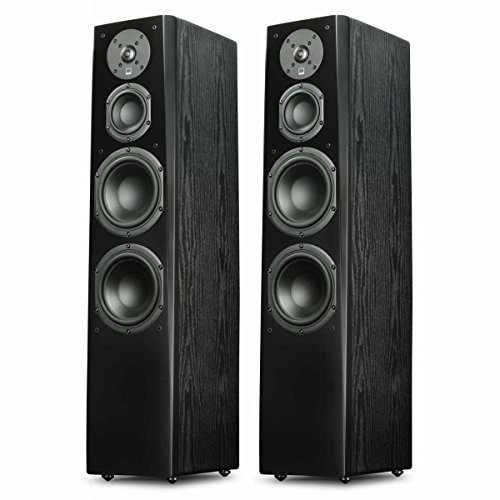
SVS Prime Tower (Pair) — Best value pair
SVS built its name on subwoofers and applied the same engineering-led, specification-honest approach to the Prime Tower. It is the only pick here sold as a pair in a single listing, which removes the classic tower-buying trap of budgeting for one and discovering the price was per speaker. What the money buys is a three-way design with twin woofers, a dedicated midrange driver and an aluminium dome tweeter, voiced for accuracy with a low end that reflects the company’s heritage: deep for the cabinet size, and unusually disciplined about stopping when the note stops.
That discipline defines the listening experience. Bass guitar lines stay legible inside dense mixes, film scores have weight without bloat, and the midrange presents voices plainly, without the warmth some rivals add or the edge others subtract. The Prime Tower is the speaker in this guide most likely to be described as correct — which some listeners will hear as praise and others as a mild warning. It does not flatter poor recordings, and it does not editorialize good ones; it hands you the mix as the engineer signed it off.
Ownership is where SVS pulls further ahead. The company’s support model — long trial periods through its own channels, responsive technical advice, upgrade paths within the range — treats a speaker as a relationship rather than a transaction. The cabinetry is plainer than the Klipsch or Wharfedale, finished in a black ash that prioritises understatement, and the tower is not the most efficient here, so very low-powered amplifiers will find its limits sooner. For a buyer building a serious system one careful step at a time, it remains the easiest recommendation in this guide to defend.
- Configuration: three-way, twin woofers, dedicated midrange, aluminium dome tweeter
- Sold as: a matched pair in one listing — no per-speaker surprises
- Character: accurate, disciplined bass, uneditorialised midrange
- Support: trial-friendly, advice-led ownership model
Strengths
- Pair pricing makes the true cost obvious from the start
- Bass depth with control that reflects the maker’s subwoofer pedigree
- Support and trial culture reduce the risk of a tier-sized purchase
Trade-offs
- Plain finish beside the furniture-grade rivals here
- Accuracy exposes weak recordings and weak sources
- Asks more of the amplifier than the Klipsch does
Best for: buyers who want one honest pair for films and music, bought once and kept. Not suited for: listeners who want their speakers to add warmth or drama of their own.

ELAC Debut 2.0 F6.2 — Best neutral all-rounder
The F6.2 is the largest of ELAC’s Debut 2.0 floorstanders, a range designed under Andrew Jones with a philosophy that reads like a rebuke to hi-fi theatre: spend on drivers, crossover and cabinet, save on ornament. Three 6.5-inch aramid-fibre woofers handle the low and midrange duties beneath a cloth dome tweeter in a purpose-designed waveguide, and the measured behaviour is as tidy as the brief suggests — this is a speaker engineered to be even-handed, and even-handed is exactly how it sounds.
In the room, that neutrality becomes versatility. Jazz trios keep their proportions, orchestral recordings lay out in depth rather than width alone, film dialogue sits at a natural level against effects rather than shouting over them, and electronic music gets bass that is firm rather than flattering. The F6.2 does not have the Klipsch’s physical drama or the Wharfedale’s glow; what it has is the trustworthiness to be the only pair of speakers in a house with eclectic taste. Households arguing between film nights and record collections settle those arguments with this kind of speaker.
The compromises are the honest kind. Sensitivity is moderate, so the F6.2 appreciates an amplifier with genuine current behind its rating, and its black finish is functional rather than furniture-grade. It is also revealing enough that a poor streaming source sounds poor — a backhanded compliment at this tier. As the anchor of a system that will grow — matching Debut centre and surrounds are plentiful — it is the pick we would hand to a friend who said the words “just tell me what to buy” and meant them.
- Configuration: three 6.5-inch aramid woofers, cloth dome tweeter in waveguide
- Character: neutral, even-handed, genre-proof
- Amplifier note: moderate sensitivity rewards real current delivery
- Range: extensive matching centres and surrounds in the Debut line
Strengths
- Balanced voicing serves films, classical, jazz and rock equally
- Engineering budget spent on sound rather than ornament
- Deep, firm bass without subwoofer assistance for music
Trade-offs
- Functional finish beside prettier rivals
- Wants an amplifier with honest current delivery
- Neutrality can read as restraint beside the Klipsch’s drama
Best for: eclectic households wanting one pair that does everything well. Not suited for: buyers chasing maximum excitement or furniture-grade looks first.

Polk ES60 — Best home-theatre feature set
Polk’s Signature Elite flagship tower is engineered with the television as a first-class citizen rather than an afterthought. The ES60 carries high-resolution audio certification, is voiced to partner modern AV receivers — including the immersive formats whose logos cover receiver boxes — and uses Polk’s Power Port bass design, which vents the cabinet downward in a way that produces clean low end with less of the chuffing and wall-interference drama that rear ports cause. For the many buyers whose towers will flank a screen in a real living room, those are not footnotes; they are the product.
The sound is big-hearted and cinematic. Three 6.5-inch woofers give the ES60 genuine scale, dialogue through a matching ES centre is seamless, and the tweeter is tuned for clarity at the listening levels films actually use, which are lower than demonstration levels. Music listening is enjoyable rather than revelatory — the presentation favours warmth and size over the ELAC’s forensic balance — but as the front end of a system that must do Friday film night and Sunday records, it covers both without making either feel like a compromise purchase.
Placement friendliness is the ES60’s quiet superpower. The downward-firing port tolerates closer wall placement than the Klipsch allows, the cabinet is slimmer than its output suggests, and the range’s centre channels are voiced to match so precisely that panning effects cross the screen without changing character. If your room dictates placement — and most living rooms do — the ES60 asks the fewest apologies of any pick here.
- Configuration: three 6.5-inch woofers, 1-inch tweeter, downward Power Port
- Certification: high-resolution audio certified, immersive-format friendly
- Character: warm scale, cinema-first clarity, placement-tolerant bass
- Range: Signature Elite centres and surrounds voiced to match
Strengths
- Power Port bass behaves near walls where rear ports boom
- Feature set aimed squarely at modern AV receivers
- Matching centre channel makes theatre expansion painless
Trade-offs
- Music presentation favours warmth over forensic detail
- Tall cabinet still needs sensible distance from side walls
- Less efficient than the Klipsch for very large rooms
Best for: living-room cinema systems that also play records, in rooms that dictate placement. Not suited for: purist two-channel listeners who never watch films.

Wharfedale Diamond 12.4 — Best warm sound for music
The Diamond range has been British hi-fi’s sensible recommendation for four decades, and the 12.4 — the largest floorstander of the current series — shows why the line endures. Kevlar-woven cones, a cabinet built with the multi-layer construction Wharfedale calls its own, and a voicing that prizes tonal warmth and spatial ease over specification combat. Play a record you love on the 12.4 and the first impression is not of a speaker at all, but of musicians arranged in a space that feels larger than your room.
That warmth is a deliberate, defensible choice. The top end is smooth rather than spotlighted, so older recordings, live albums and anything mastered brightly in the early digital era remain listenable — a library-friendly trait that forensic speakers cannot claim. Vocals carry body, acoustic instruments keep their wood, and long sessions accumulate no fatigue. The trade is a degree of leading-edge definition: the Klipsch will show you the pick attack the Wharfedale rounds, and action-film transients land with weight here rather than snap.
As an ownership proposition the 12.4 is gentle: finishes that suit real furniture, a front-firing slot port arrangement that forgives placement, and an amplifier appetite that modest receivers satisfy. It is the pick for the listener whose system exists to serve a record collection rather than a demonstration disc, and in this tier that listener is more common than the industry admits.
- Configuration: twin Kevlar-coned woofers, soft dome tweeter, slot-ported cabinet
- Character: warm, spacious, fatigue-free over long sessions
- Placement: port arrangement tolerates living-room positioning
- Heritage: flagship floorstander of a long-running British range
Strengths
- Warm tonal balance flatters real record collections
- Spacious imaging makes rooms feel larger than they are
- Easy amplifier load and forgiving placement
Trade-offs
- Rounded transients beside the Klipsch’s snap
- Smooth treble hides some fine detail on pristine recordings
- Less theatrical for action films than the Polk or Klipsch
Best for: music-first listeners with broad, imperfect record collections and long evenings. Not suited for: buyers who want maximum impact and forensic treble.
KEF Q550 — Best slim design (prose-only)
KEF’s Q550 approaches this tier from a different geometry. Its Uni-Q driver places the tweeter at the acoustic centre of the midrange cone, so the speaker radiates like a point source — the stereo image stays coherent even for listeners well off axis, which is how people actually sit in living rooms. The cabinet is notably slimmer than the others here, trading the twin-big-woofer formula for a single active driver with passive radiators, and the result is a tower that fits the rooms the Klipsch cannot.
The sound is clean, focused and modern, with imaging precision that embarrasses wider cabinets and a low end that is articulate rather than abundant. We list the Q550 without a link because KEF sells primarily through its dealer network and marketplace listings for the Q range were inconsistent when we checked; through a dealer, with an audition, it is a first-rank choice for design-conscious rooms. Its limits are physics: it will not move air like the RP-8000F II, and large rooms at film levels will find its ceiling. Within its intended habitat — the stylish medium-sized room — it is arguably the cleverest speaker in this guide.
Audition tip for the Q550: listen from the room’s worst seat, not its best. The Uni-Q array’s party trick is how little the sound changes as you move, so the chair in the corner — where a partner actually sits — is the honest test. Few speakers at any price pass that test as gracefully.
- Configuration: Uni-Q point-source array with passive bass radiators
- Character: precise imaging, clean modern balance, articulate bass
- Form: the slimmest cabinet in this guide by a clear margin
- Buying note: dealer-network product; audition locally where possible
Strengths
- Point-source imaging stays coherent across the whole sofa
- Slim cabinet suits rooms where width is the constraint
- Clean voicing pairs beautifully with modern streaming sources
Trade-offs
- No stable verified Amazon listing at the time of writing
- Bass weight cannot match the twin-woofer rivals
- Large rooms at high levels reach its limits sooner
Best for: medium rooms where design and imaging precision lead the brief. Not suited for: big-room film systems chasing maximum scale.
How Should You Audition Towers Before Committing?
An audition at this tier should be boringly methodical, because the speakers are not. Bring three recordings you know intimately — one vocal, one dynamic, one that has always sounded slightly wrong — and play the same thirty seconds of each on every candidate at the same volume. The speaker that makes the familiar vocal sound most like a person in the room, rather than most impressive, is usually the right long-term answer. Excitement is easy to manufacture in a demonstration; honesty is what remains after the hundredth evening.
Insist on hearing the speakers with an amplifier comparable to your own, at the distance you will sit, and — if the dealer allows — in a room of similar size to yours. A tower voiced in a cavernous showroom will not repeat the performance in a flat, and a good dealer knows this and will say so. Ask about the return policy with the same directness you ask about the sound: at this tier, the makers and sellers in this guide generally stand behind home trials because they know the room is half the system.
Finally, audition the quiet end. Turn the volume down to the level of a late evening and listen for whether the balance survives — bass still present, voices still clear, treble still airy rather than vanished. Most listening happens at these levels, and the towers that hold together quietly are the ones that get used daily. The demonstration that matters is not the loudest thirty seconds in the shop; it is the quietest thirty minutes in your life.
How Do the Six Towers Compare Side by Side?
| Pick | Voicing | Amplifier appetite | Strongest use |
|---|---|---|---|
| Klipsch RP-8000F II | Dynamic, forward, physical | Very easy — high efficiency | Films and rock at scale |
| SVS Prime Tower (Pair) | Accurate, disciplined | Moderate | Mixed film and music, bought once |
| ELAC Debut 2.0 F6.2 | Neutral, even-handed | Moderate, wants current | Eclectic all-round listening |
| Polk ES60 | Warm scale, cinema-first | Easy to moderate | Living-room theatre systems |
| Wharfedale Diamond 12.4 | Warm, spacious, smooth | Easy | Long music sessions |
| KEF Q550 | Precise, clean, focused | Moderate | Slim rooms, imaging lovers |
How Does Room Size Rearrange This Ranking?
In a large room — the kind with a sofa well away from walls and a ceiling that does not press down — the ranking at the top of this guide holds and arguably stretches: the Klipsch’s scale becomes a clear first, the SVS and Polk fill space with disciplined ease, and the ELAC’s neutrality projects across distance without hardening. Large rooms forgive big cabinets and reward cone area, and they are where this tier was born to play.
Medium rooms, the majority case, are where the guide’s balance was struck. Every pick works, and the choice collapses to voicing and placement: rear ports get their space, the downward-firing Polk relaxes the wall question, the slim KEF solves the width question. Listeners in medium rooms should spend their decision energy on the warm-versus-neutral question, because that — not size — is what they will hear every day for ten years.
Small rooms punish excess honestly. The Klipsch can overwhelm at the levels it invites, the ELAC’s bass can thicken if the towers are trapped in corners, and even the Wharfedale needs its ports unblocked. In genuinely small spaces the KEF Q550’s point-source coherence at close range is a real advantage, and buyers should audition at the distance they will actually sit. A tower that images correctly at two metres is worth more in a small room than a specification sheet full of bass extension nobody can use.
How Should You Place Towers in This Tier?
Placement is the cheapest upgrade in audio, and at this tier it is worth real money in sound. Start with the speakers forming a triangle with the main seat, roughly as far apart as they are from the listener, pulled at least a hand’s breadth — and for the rear-ported Klipsch, considerably more — away from the wall behind them. Toe-in is a tuning control, not a rule: speakers pointed straight at the listener sound brightest and most focused; angled outward they trade a little focus for width and calm. Change one thing at a time, live with it for an evening, and trust the setting that makes you forget to adjust anything.
Room boundaries shape bass more than any specification. Corners multiply low end unevenly, bare parallel walls smear imaging with reflections, and a rug, soft furniture and bookshelves are acoustic treatment that happens to be furniture. If one tower must sit near a side wall and the other cannot, expect asymmetry and fix it with balance and patience rather than equalisation heroics. Finally, spike or firmly couple tall towers to the floor — a rocking cabinet blurs bass and endangers itself — and re-check levels after a week, when the new-speaker excitement has stopped inflating the volume control.
Should You Grow These Towers Into a Home Theatre?
Every range in this guide offers the centre channel and surrounds that turn a stereo pair into a cinema, but the paths differ in character. The Polk route is the most turnkey: Signature Elite centres are voiced to disappear behind the ES60s, and the range’s pricing keeps a full system within the logic of the tier. The Klipsch route is the most theatrical, with a centre channel whose dialogue projection is a product in its own right and surrounds that keep the horn character consistent around the room. Buyers who know theatre is coming should weigh those centres now, because the centre carries more of a film than the towers do.
The SVS and ELAC routes suit listeners who split their time evenly. Both ranges offer capable centres, and both makers voice them with the same neutrality as their towers, so music-first owners are not buying into a cinema-flavoured ecosystem to get a matching badge. The Wharfedale Diamond range includes centres and standmounts that share the warm house sound, letting a music lover add film capability without the system’s character changing at the front. The KEF Q range, through dealers, offers the most design-coherent path of all, with Uni-Q centres that image like the towers.
Timing matters less than matching. A stereo pair bought this year and a centre bought in two years, from the same range and generation, will integrate better than a discounted bundle of mismatched badges bought at once. If a range is mid-generation — as several here are — the centre is unlikely to vanish before your upgrade arrives. Buy the towers on voicing, keep the range’s centre on your list, and let the theatre grow at the pace your room and budget prefer.
What Mistakes Do Buyers Make at This Price Point?
The first is buying the speaker of someone else’s room: a glowing recommendation from a friend with a large treated space may describe a tower that overwhelms your smaller one. The second is starving the purchase — spending the whole budget on towers and feeding them from an ageing receiver with tired capacitors, then blaming the speakers. The third is judging by a single demonstration track, usually a bass showcase, when the speaker must live with dialogue, acoustic music and the news. The fourth is ignoring the centre channel question until the theatre upgrade, then discovering the chosen range’s centre is discontinued or mismatched. And the quietest mistake is skipping the audition of the warm-versus-neutral question entirely: at this tier, taste is the specification, and only your ears can measure it.
What Sources and Cables Deserve Your Remaining Budget?
Once towers at this level are in the room, the weakest link is rarely the cable and often the source. A streaming subscription’s highest-quality tier, a properly ripped local library, or a decent turntable with a fresh stylus will each improve what these speakers reveal more than any accessory purchase. The towers are revealing enough that compression artefacts become audible as a greyness in the treble and a flatness in the stage; feeding them well is not audiophile ritual, it is simply removing the ceiling they were bought to raise.
Cable advice can stay mercifully short. Use speaker cable of adequate thickness for the run — long runs to the far tower deserve heavier gauge — terminate it cleanly, and spend what remains on music. Interconnects between source and amplifier should be sound and screened; beyond that, differences shrink below what placement changes deliver for free. The honest hierarchy at this tier is speakers first, room second, amplifier third, source quality fourth, and everything else a distant fifth.
One accessory does earn its mention: a simple sound-level app or meter for setting channel levels if the towers join a theatre system, and a notebook for the placement positions that sounded best. Systems drift — furniture moves, towers get nudged by vacuums and children — and the owner who can restore a known-good setup in five minutes owns a consistently good system, which beats a occasionally perfect one.
What About Finishes, Grilles and Living With Big Towers?
A tower at this tier is furniture whether you planned it or not, and the domestic details decide whether it is welcome furniture. The Klipsch in walnut reads as a deliberate statement and earns its floor space visually; the Wharfedale’s finishes blend into traditional rooms with similar ease. The SVS and ELAC wear plainer clothes — a virtue in media rooms where the screen should hold the eye, a compromise in rooms where the speakers are the largest objects present. None of this is trivial: a speaker resented by the household gets played less, and a played-less speaker is a poor purchase at any specification.
Grilles deserve a decision rather than a default. With children or pets in the house, grilles on is cheap insurance for drivers that cost real money to replace, and every maker here voices its speakers to sound right with them fitted. Without those risks, grilles off reveals the driver craftsmanship this tier buys — the Klipsch’s copper cones and the KEF’s Uni-Q array are genuinely handsome engineering. Dust with a soft brush, keep cabinets out of direct sunlight that fades one side faster than the other, and a decade later the pair will still look like the purchase you remember making.
Stability is the last domestic note. Tall towers on hard floors should be spiked or coupled as the maker intends, both for the bass tightening it brings and for the safety of a cabinet that a climbing toddler or a large dog can test. Check the plinth screws after the first month — they settle — and after any move. These are the habits of owners whose speakers survive to be upgraded around, which is the natural life of a good tower at this tier.
Why Does This Tier Hold Its Value Better Than Cheaper Speakers?
Owners who upgrade tend to sell rather than discard, and the second-hand market treats this tier kindly for structural reasons. The cabinets are heavy enough that shipping filters out careless sellers, the brands here support their ranges for years with spare drivers and matching models, and the voicing of a known tower is a known quantity to the next buyer. A pair bought carefully, kept with its boxes and grilles, and sold when the next tier calls will return a meaningful share of its cost — which quietly lowers the true price of ownership below what the receipt suggests.
That resale logic also disciplines the original purchase. Finishes in the middle of a range sell faster than the eccentric option, complete accessories matter, and the original packaging is worth its cupboard space. None of this should override choosing the voicing you love — a speaker kept for fifteen years needs no resale value at all — but for buyers who know they climb ladders, this tier is the first rung where the ladder holds its worth. Buy the pair you would happily keep, keep it like you mean it, and the economics look after themselves.
Final Recommendation
If your room and taste allow one default, make it the SVS Prime Tower: honestly priced as a pair, honestly voiced, and supported like a long-term purchase should be. Take the Klipsch RP-8000F II when films and dynamics lead your listening and your room can give it space, the ELAC F6.2 when one pair must serve every genre without fear or favour, and the Polk ES60 when the system is a living-room cinema first. Choose the Wharfedale Diamond 12.4 for the evenings this hobby is really about — records, time, and a chair you do not want to leave — and hunt down the KEF Q550 at a dealer when the room itself vetoes wide cabinets. At this tier there are no bad speakers in this guide, only mismatches; match the voicing to your life and the money is well spent for a decade.
A closing practical note on delivery and setup day: towers at this tier arrive as heavy single boxes, and the hour of unboxing deserves the same care as the audition. Photograph the packaging before opening if a corner looks crushed, keep the cartons until the return window closes, and set the speakers up first in their approximate positions rather than their final ones — a week of small adjustments teaches you the room, and only then should spikes be driven home and positions marked. The buyers who enjoy this tier most are the ones who treat the first fortnight as part of the purchase: placement experiments, amplifier settings revisited, favourite records replayed to hear what changed. That slow beginning is not delay; it is the system being tuned to the only room it will ever need to please.
One more question settles many showroom arguments: does the speaker make your own records sound like themselves, or like the speaker? Bring the recording you have played most in your life — the one whose every flaw you know — and listen to whether those flaws remain honestly present while the music gains scale and calm. The towers in this guide all pass that test in their different accents, which is why the final choice can safely be made on character. A speaker that respects a familiar record will respect the unfamiliar ones you have not bought yet, and that trust is the real product this tier sells.
Budget the delivery day as part of the system, too: a friend to help carry, a clear path from door to listening room, and the old speakers moved before the new ones are unboxed rather than after. Towers this size reward patience at every stage, and the first hour sets the tone for the decade that follows.
And when the system is finally settled, do the least audiophile thing imaginable: stop adjusting it. Every tower in this guide was chosen to disappear into a life of films and records, and the owners who get the decade of value this tier promises are the ones who spend the second month listening rather than tweaking. Positions marked, levels set, grilles decided — then the speakers become part of the room’s furniture in the best sense, present every evening and thought about rarely, which is the highest compliment domestic audio can earn.
Keep the cartons if you possibly can. They protect the towers in any future move, they reassure a future buyer, and they take up less loft space than regret does.
Register the warranty while the boxes are still in the room. It takes minutes, it anchors the purchase date for any future claim, and it is the last small act of care in a purchase built from larger ones.
Frequently Asked Questions
Do I need a subwoofer with towers at this level?
For music, no — every tower here reaches low enough to cover a record collection convincingly. For films, a subwoofer still adds the infrasonic weight of effects tracks and relieves the towers at high levels, so theatre-first buyers should plan one as a second step rather than a first necessity.
How much amplifier do these speakers need?
Less than marketing suggests and more than the cheapest receivers honestly give. The Klipsch and Wharfedale thrive on modest power; the ELAC and SVS reward amplifiers with real current delivery. Judge amplifiers by their behaviour into real speakers, not by their headline wattage.
Are these speakers sold singly or as pairs?
Most floorstanders in this tier are priced per speaker, and the listings here follow that convention except the SVS Prime Tower, which is sold as a pair. Always confirm the listing quantity before comparing totals — it is the oldest confusion in this category.
Can towers this size work in a small room?
The slimmer picks — the KEF, the Polk and the Wharfedale — can, with careful placement and moderate expectations of volume. The Klipsch genuinely needs space to breathe. In a truly small room, a smaller tower or standmount plus subwoofer may serve better than any of these.
What is the difference between neutral and warm voicing?
A neutral speaker adds as little character as possible, presenting recordings as they were made; a warm speaker gently emphasises the midrange and softens the treble, which flatters many recordings and long sessions. Neither is more correct — they are different contracts with your record collection.
How long should speakers at this tier last?
Decades, with care. Drivers and cabinets at this level are built for long service; the realistic maintenance is re-foaming nothing, replacing nothing, and keeping cabinets out of direct sun and damp. Many owners keep tier-level towers through three changes of electronics, which is the correct economic shape of a system.
Is bi-wiring or bi-amping worth it with these towers?
Bi-wiring offers, at most, marginal differences that placement changes dwarf. Bi-amping with a capable second amplifier can add control on the hungrier picks here, but it is a refinement to explore after the room and the source are sorted — not a first purchase.
Related Guides
Complete the system with our best 300 floor speakers, our best 2 0 home theater speakers, and our best 2 channel speakers.


