What's inside
- Key Takeaways
- Quick Picks
- How We Chose These Picks
- Comparison
- Why Does Brightness Matter More for Sport Than for Film?
- How Do You Set Up a Room for a Big Match?
- What About Motion — Does Sport Need Special Handling?
- How Do You Host a Whole Tournament, Not Just One Match?
- How Loud Does the Sound Need to Be for a Crowd?
- How Big Should a Sports Picture Be?
- What Maintenance Does a Season of Sport Ask For?
- Projector or a Very Large Television for Sport?
- How Do Different Sports Change the Brief?
- How Should Families Handle Kickoff Times and Young Viewers?
- How Much Does the Broadcast Feed Itself Matter?
- How Do You Run a Garden Screening of an Evening Match?
- What About Replays, Highlights and the Second Screen?
- Common Mistakes
- Final Recommendation
- Frequently Asked Questions
- Related Guides
As an Amazon Associate I earn from qualifying purchases. This post may contain affiliate links at no extra cost to you.
widgetverdict.com is reader-supported. When you buy through links on our site, we may earn an affiliate commission.
Choosing the best projectors for sports games starts with a confession about how sport is actually watched: in daylight or lamplight, with people moving around, talking over the commentary, opening the fridge and the curtains in roughly equal measure. That social, bright, distracted reality inverts the home-cinema hierarchy. Brightness becomes the first filter — a projector that cannot hold its picture against a lit room cannot show a match, whatever its colour pedigree — and everything else queues behind it: motion clarity for a ball crossing grass at speed, screen size for a room full of viewers, and connections that welcome the broadcast box, the streamer and the console without a ceremony. The six machines below were chosen through that filter: three Epsons spanning 4K PRO-UHD flagships to a bright 1080p all-rounder, two BenQs split between a 4K gaming-sport hybrid and a short-throw room-saver, and one Optoma short-throw 4K built for tight spaces. Linked names lead to Amazon, where you can check price on Amazon before match day commits you.
A note on the numbers quoted here, because sports buyers are marketed at aggressively. Input-lag figures appear in this guide only where a listing title states them — the BenQ TK700 prints its latency claims, and they are quoted as printed; the other models are described without invented stopwatch numbers, because a lag figure a manufacturer did not publish is a figure a guide should not fabricate. Brightness claims are quoted as stated, with the standing reminder that a lumen figure is a claim about a machine’s best mode, and the mode you watch a match in may be a more honest, slightly dimmer one. Read the figures as the titles give them and the room as your eyes find it, and the six reviews below will sort themselves by your Sundays.
Resolution deserves its usual translation in this company. Two of the Epsons wear 4K PRO-UHD badges, which means pixel-shifting — a rendering beyond 1080p, short of native 4K — and on a fast-moving match, that distinction matters less than almost anywhere else in projection, because motion, brightness and screen size dominate what the eye actually receives. The guide notes the badge honestly wherever it appears and then gets on with judging the picture a crowd will see.
Key Takeaways
- Brightness is the first filter for sport: the Epson Home Cinema 1100 states 3400 lumens, the Home Cinema 3200 states 2900, and the BenQ TK700 states 3200.
- Epson’s Home Cinema 3800 is the flagship here — 4K PRO-UHD pixel-shifting, three-chip colour and HDR for the dedicated sports room.
- BenQ’s TK700 is the sport-and-gaming hybrid, printing its latency figures in its title and naming PS5 and Xbox readiness.
- BenQ’s TH671ST and Optoma’s UHD35STX solve the small-room problem with short-throw lenses that fill a wall from close range.
- Epson’s Home Cinema 1100 adds wireless streaming with AirPlay and Miracast, so the match can arrive without a cable run.
- Every pick assumes a social room: plan the seating, the snacks and the light together, because match day tests all three.
Quick Picks
| Pick | Badge | Why it made the cut |
|---|---|---|
| Epson Home Cinema 3800 4K PRO-UHD Projector | The flagship sports room | 4K PRO-UHD three-chip projection with HDR for the serious setup. |
| Epson Home Cinema 3200 4K PRO-UHD Projector | The balanced Epson | 2900 stated lumens of colour and white brightness with 10-bit HDR support. |
| BenQ TK700 4K HDR Gaming Projector | The sport-and-gaming hybrid | Stated latency figures, 3200 lumens and console-ready positioning. |
| BenQ TH671ST 1080p Short Throw Projector | The small-room saver | Short throw, 3000 stated lumens and low input lag positioning. |
| Optoma UHD35STX 4K Short Throw Gaming Projector | 4K from close range | Short-throw 4K UHD for rooms where the projector cannot sit back. |
| Epson Home Cinema 1100 1080p Projector | The bright wireless all-rounder | 3400 stated lumens with AirPlay and Miracast streaming built in. |
How We Chose These Picks
Selection ran brightness first, as the introduction promised. Listings that state a lumen figure earned scrutiny before those that do not, and the stated figures below — 3400, 3200, 3000, 2900 — describe machines that can hold a picture in the semi-darkness of a real match day. Three-chip models were credited with their architectural honesty: where Epson states colour and white brightness together, the colourful chaos of sport — kits, grass, crowd — is being shown at the quoted output rather than at a discount from it. Single-chip models were judged on their own virtues of crispness and response, with the standing note that a minority of viewers see colour-wheel rainbows, a sensitivity worth checking before a household commits.
Throw distance formed the second filter, because sports rooms are social rooms and social rooms are full. Two short-throw picks — the TH671ST and the UHD35STX — exist here for the flats, dens and bedrooms where a conventional projector’s long throw would put the machine behind the sofa and its shadows across every raised arm. Gaming credentials formed the third filter, since the sports projector in most homes doubles as the console projector: the TK700’s stated latency figures and console positioning, the TH671ST’s low-input-lag billing and the UHD35STX’s gaming brief all answer that double duty, while the Epsons answer it with brightness and size. No figure appears below that its listing title did not print first.
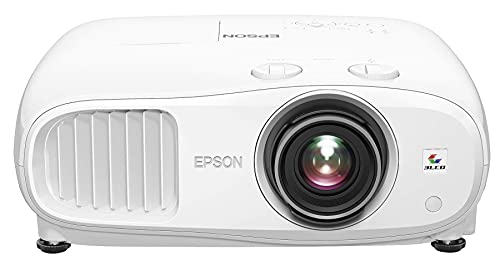
Epson Home Cinema 3800 4K PRO-UHD Projector — The flagship sports room
The Home Cinema 3800 is the machine for the household that has decided the big matches deserve a big room and a serious picture. Its 4K PRO-UHD badge carries the translation this guide applies everywhere: pixel-shifting that renders beyond 1080p without claiming native 4K, delivered through Epson’s 3-chip 3LCD architecture with HDR technology named in the title. For sport, the three-chip design’s gift is colour at full output — a night match under floodlights, with saturated kits against deep green, is precisely the image that separates colour brightness from white brightness, and the 3800 shows it whole.
A flagship’s virtues compound across a long tournament. The picture stays rich in the dark scenes between play — the studio analysis, the evening kickoffs — where lesser brightness-first machines flatten into grey. HDR support gives floodlit highlights their glare and tunnel shadows their depth, the visual drama that makes a final feel like a final. As the senior model in Epson’s line here, the 3800 also suits the room that doubles as a cinema after the season ends: the same colour honesty that flatters a cup final flatters a film, and the household that buys one projector for both duties will find this the least compromised of the six for that double life.
Its demands are the flagship’s usual ones. The 3800 belongs in a room that can be darkened with intent — not a cave, but a space whose curtains close — and its talents are wasted on a wall that fights it with sunlight. The listing title here is concise, leaving detailed figures to the listing page, and the spec box records that honestly. Buyers building the dedicated room, with the screen and the seating to match, are buying the picture the rest of this guide measures itself against.
- Resolution: 4K PRO-UHD pixel-shifting — not native 4K — per the listing title
- Architecture: 3-chip 3LCD, per the listing title
- HDR: HDR technology, per the listing title
- Brightness: Not stated in the listing title — verify with the manufacturer documentation
- Latency figure: Not stated in the listing title — verify with the manufacturer documentation
- Throw type: Not stated in the listing title — verify with the manufacturer documentation
Strengths
- Three-chip colour at full richness for kits, grass and crowd.
- Pixel-shifted detail beyond 1080p for big screens.
- Equally at home with films after the season.
Trade-offs
- Key figures live on the listing page, not the title.
- Deserves a room that darkens with intent.
- Pixel-shifting is not native 4K rendering.
Best for: a dedicated sports room that doubles as a cinema. Not suited for: a sunlit open-plan space used at midday.

Epson Home Cinema 3200 4K PRO-UHD Projector — The balanced Epson
The Home Cinema 3200 states its numbers where the 3800 leaves them implied, and the numbers suit match day precisely: 2900 lumens of colour brightness and 2900 of white brightness — the three-chip promise, printed in full — with 10-bit HDR support and 18 Gbps HDMI 2.0 to carry the full signal from a modern broadcast box or console. That HDMI figure matters more than it looks: a full-bandwidth port means the projector accepts the best feed the household’s equipment can send, with no quiet downscaling at the door.
On the wall, the balance the model name implies is what a long season needs. Brightness enough for the afternoon kickoff with the curtains drawn, colour depth enough for the evening match to look rich rather than merely visible, and pixel-shifted rendering — the same PRO-UHD translation applies — to keep a large picture composed when the camera pans across a stadium. Ten-bit HDR support speaks to gradient quality: skies, floodlight glare and the slow dusk of a day-night match are where lesser pipelines band and posterise, and a 10-bit path keeps those transitions smooth.
Against its flagship sibling, the 3200 is the considered household choice — the model for the room that hosts everything, sport first among equals, without the dedicated-cinema ceremony. Against the brighter 1100 below, it trades raw lumens for resolution and HDR depth, which is the right trade in any room that can darken to dusk. A season is long and varied; the 3200 is built for its whole length.
- Resolution: 4K PRO-UHD pixel-shifting — not native 4K — per the listing title
- Architecture: 3-chip 3LCD, per the listing title
- Brightness: 2900 lumens colour and white brightness, as stated in the listing title
- HDR: 10-bit HDR support, per the listing title
- Connections: 18 Gbps HDMI 2.0, as stated in the listing title
- Latency figure: Not stated in the listing title — verify with the manufacturer documentation
Strengths
- Colour and white brightness quoted equal, and both strong.
- Full-bandwidth HDMI accepts the best available feed.
- 10-bit HDR keeps dusk matches and skies smooth.
Trade-offs
- Outgunned on raw lumens by the brighter picks here.
- Pixel-shifting rather than native 4K, as with its sibling.
- No latency figure is published in the title for gamers.
Best for: households wanting one Epson for the whole season in a dimmable room. Not suited for: the brightest rooms, where the 1100’s output rules.

BenQ TK700 4K HDR Gaming Projector — The sport-and-gaming hybrid
The TK700 is the pick that treats the sports room and the gaming room as the same room, because in most houses they are. Its title is the most forthcoming in this guide: 4K HDR, 3200 lumens, latency figures printed outright — a 4.2ms figure in its headline claims and 16ms input lag stated alongside — plus Enhanced Black Detail, a Dolby Atmos speaker note, PS5 and Xbox readiness and a three-year warranty. A guide that refuses to invent stopwatch numbers can quote these with pleasure, because BenQ published them. For the player who watches the match and then becomes the match, those figures are the product.
Sport benefits from the gaming brief in ways beyond latency. A machine tuned for games is tuned for motion and for the dark detail of night scenes — Enhanced Black Detail speaks to shadow legibility, the tunnel, the evening crowd, the kit colours in a floodlit box. The 3200 stated lumens hold that picture in a social room’s semi-darkness, and the 4K HDR rendering keeps a big screen composed when the broadcast camera sweeps. When the final whistle blows and the console takes over, nothing about the setup has to change: same screen, same seats, same machine, and the stated lag figures mean the projector stops being the excuse for a missed tackle.
The warranty line deserves its sentence: three years stated in the title is a meaningful promise on a machine that will log heavy hours across seasons of sport and gaming alike. The TK700’s compromises are the hybrid’s usual ones — a cinema purist in a blacked-out room will find more colour depth elsewhere in this site’s guides — but for the room where the match and the console share a wall, this is the most honestly specified tool in the six.
- Resolution: 4K HDR, per the listing title
- Brightness: 3200 lumens, as stated in the listing title
- Latency: 4.2ms latency and 16ms input lag figures, as stated in the listing title
- Connections: HDMI 2.0, per the listing title
- Console readiness: PS5 and Xbox ready, per the listing title
- Warranty: 3 year warranty stated in the listing title
Strengths
- Published latency figures a gamer can plan around.
- Brightness and 4K HDR in one sport-ready package.
- A stated three-year warranty for a hard-working machine.
Trade-offs
- Single-chip design: a minority of viewers see rainbows.
- Cinema colour depth yields to its gaming priorities.
- Still wants dusk, not daylight, for its best picture.
Best for: rooms where match day ends with the console coming out. Not suited for: a rainbow-sensitive household that has not tested DLP first.

BenQ TH671ST 1080p Short Throw Projector — The small-room saver
Short throw is a geometry promise: a big picture from a short distance, the projector sitting a metre or so from the wall instead of across the room. The TH671ST builds its whole case on that promise, and for sports it solves the small room’s two curses at once. Nobody walks between the projector and the picture, because the machine sits in front of the audience, close to the wall — no shadows of raised arms across a penalty kick. And a flat, a den or a bedroom that could never host a long-throw setup gets a wall-sized match anyway.
The supporting figures are stated plainly: 3000 lumens, which is real match-day brightness for a dimmed small room; low input lag positioning that suits the console after the match; auto vertical keystone for the shelf-and-go placement small rooms impose; dual HDMI for the broadcast box and the streamer; and a built-in speaker for rooms where the projector is also the sound. A three-year warranty is stated in the title, as on its TK700 sibling. The 1080p resolution, at the screen sizes a small room allows and the distances its seats impose, is not the limitation it would be on a cinema wall — the eye is close, the picture is modest, and the pixels stay politely invisible.
The short-throw bargain has one clause to respect: a lens that close to the wall magnifies the wall’s imperfections and demands the machine sit low and centred, because keystone correction at short range spends sharpness quickly. Give it a flat wall and a coffee table at the right distance, and the TH671ST turns the smallest room in the house into the room everyone chooses on match day — which is, for many households, the entire point of buying a projector for sport.
- Resolution: 1080p, per the listing title
- Throw: short throw, per the listing title
- Brightness: 3000 lumens, as stated in the listing title
- Latency: low input lag positioning, per the listing title
- Connections and sound: dual HDMI, built-in speaker, per the listing title
- Warranty: 3 year warranty stated in the listing title
Strengths
- A wall-sized match in rooms a long throw cannot serve.
- No audience shadows crossing the picture.
- Brightness and gaming manners in a compact brief.
Trade-offs
- 1080p is the ceiling, where siblings offer more.
- Short throw punishes bumpy walls and steep angles.
- Placement must be low, centred and undisturbed.
Best for: flats, dens and bedrooms hosting match day at close range. Not suited for: a large room built around a very big screen.

Optoma UHD35STX 4K Short Throw Gaming Projector — 4K from close range
The UHD35STX answers the question the TH671ST leaves open: what if the small room wants 4K as well as a short throw? Optoma’s listing states the combination directly — 4K UHD, short throw, gaming and home entertainment — and the pairing is rarer than it should be, because short-throw optics and high resolution are each other’s natural allies: the closer the seats, the more the extra rendering shows, and small rooms seat everyone close. For the gamer-sports household in a flat, this is the specification that ends the compromise conversation.
Optoma’s DLP heritage brings the crisp, high-contrast character the brand’s theatre machines are known for, applied here to a brief where motion and proximity dominate. A short-throw gaming projector also inherits a placement gift for sport: the machine lives beside the screen wall, under or in front of the picture, so a room full of standing, gesturing supporters never intersects the beam. Cables stay short, the console sits beside its projector, and the whole installation can live on a low cabinet that a long-throw room would use for seating.
The title here is a headline rather than a datasheet, so brightness and latency figures are recorded below as the title leaves them — to be confirmed on the listing — and buyers comparing stopwatch numbers should hold the TK700’s published figures as the guide’s only quoted ones. What the title does guarantee is the combination itself, and combinations are what small rooms buy. If your wall is near, your seats are nearer, and your standards are 4K, the UHD35STX is the pick shaped like your room.
- Resolution: 4K UHD, per the listing title
- Throw: short throw, per the listing title
- Intended use: gaming and home entertainment, per the listing title
- Brightness: Not stated in the listing title — verify with the manufacturer documentation
- Latency figure: Not stated in the listing title — verify with the manufacturer documentation
- Zoom range: Not stated in the listing title — verify with the manufacturer documentation
Strengths
- 4K rendering where the audience sits close enough to see it.
- Short throw keeps the beam clear of a standing crowd.
- A compact installation with short cable runs.
Trade-offs
- Brightness and lag figures need confirming on the listing.
- Short-throw placement discipline applies in full.
- Single-chip design carries the usual rainbow caveat.
Best for: small rooms wanting 4K sport and gaming from a low cabinet. Not suited for: a buyer who shortlists by published latency figures alone.

Epson Home Cinema 1100 1080p Projector — The bright wireless all-rounder
The Home Cinema 1100 is the pragmatist’s champion: 3400 lumens of colour and white brightness — the highest figure stated in this guide, quoted for colour as well as white in Epson’s three-chip manner — at native 1080p, with wireless streaming through Apple AirPlay and Miracast, a built-in speaker and two HDMI ports. Read that specification as a match-day plan: brightness for the room as it is, wireless for the phone or laptop that carries the stream, wired ports for the broadcast box, and sound aboard for the garden or the spare room where the main system does not live.
Wireless streaming changes where a sports projector can work. A permanent installation with cable runs is a commitment; a bright projector that receives a cast from the phone becomes a pop-up venue — the garage for the derby, the patio wall after dusk, the office for the lunchtime semi-final. AirPlay and Miracast together cover both phone ecosystems, so the household’s mixed devices all get a route to the big picture. The two HDMI ports then handle the serious sources when the venue becomes permanent, and the 1080p picture at sports distances and sports sizes is, as the TH671ST also proves, a resolution the eye forgives instantly once the match begins.
What the 1100 surrenders is the PRO-UHD rendering of its Epson siblings and any claim to cinema-first colour depth; what it gains is the highest stated brightness here and the fewest obstacles between a decision and a kickoff. For the household whose sports viewing is frequent, social and mobile, those gains are the season. It is the pick most likely to be used in the most places — the projector as household utility, in the best sense.
- Resolution: 1080p, per the listing title
- Architecture: 3-chip 3LCD, per the listing title
- Brightness: 3400 lumens colour and white brightness, as stated in the listing title
- Streaming: wireless with Apple AirPlay and Miracast, per the listing title
- Connections and sound: 2x HDMI ports, built-in speaker, per the listing title
- Latency figure: Not stated in the listing title — verify with the manufacturer documentation
Strengths
- The highest stated brightness in this guide, colour included.
- AirPlay and Miracast make pop-up venues effortless.
- Two HDMI ports cover the permanent sources as well.
Trade-offs
- Native 1080p where Epson siblings render beyond it.
- Wireless quality rides on the home network’s strength.
- Built-in sound serves a room, not a crowd outdoors.
Best for: frequent, social sports viewing in bright and improvised venues. Not suited for: a dedicated cinema room chasing pixel-shifted detail.
Comparison
| Pick | Resolution | Stated brightness | Signature feature |
|---|---|---|---|
| Epson Home Cinema 3800 | 4K PRO-UHD pixel-shift | Not stated in title | Flagship three-chip HDR picture |
| Epson Home Cinema 3200 | 4K PRO-UHD pixel-shift | 2900 lumens | 10-bit HDR, 18 Gbps HDMI |
| BenQ TK700 | 4K HDR | 3200 lumens | Published latency figures |
| BenQ TH671ST | 1080p | 3000 lumens | Short throw for small rooms |
| Optoma UHD35STX | 4K UHD | Not stated in title | Short-throw 4K gaming |
| Epson Home Cinema 1100 | 1080p | 3400 lumens | AirPlay and Miracast wireless |
Why Does Brightness Matter More for Sport Than for Film?
A film asks for darkness and gets it: the audience sits still, the curtains close, the room becomes a cave by agreement. A match asks for company and gets that instead — doors opening, lights rising at half time, a window’s worth of evening sun across the first half. Every lumen of ambient light lifts the picture’s blacks toward grey and drains the grass of its depth, and the projector’s only defence is output: enough light of its own that the image’s contrast survives the room’s. That is why this guide filters by stated brightness first, and why the 1100’s 3400 and the TK700’s 3200 are match-day figures rather than vanity numbers.
Colour brightness is the refinement inside the rule. A white-only figure flatters a spreadsheet and a test pattern; a match is almost entirely colour — kits, skin, grass, crowd — so a machine whose colour output matches its white output, as the three-chip Epsons state, shows the game at the number on the box. Single-chip machines answer with their own strengths in motion and contrast, and plenty of households prefer their snap; the honest summary is that sport rewards whichever projector keeps saturated colour standing up in a lit room, and the titles that quote colour brightness are quoting the figure that matters.
There is a practical test any household can run before spending anything: at the hour of your typical kickoff, hold a white sheet where the picture will live and look at how bright the room makes it unaided. That sheet is showing you the projector’s black level — every lumen of light already on it will be inside the picture’s shadows. If the sheet glows, buy brightness and keep the screen modest; if the sheet sits dim and patient, the colour-rich machines come into their own. Five seconds with a bedsheet settles arguments that specification sheets prolong for weeks.
How Do You Set Up a Room for a Big Match?
Work backwards from the final whistle’s photograph: a room of people, all seeing the picture, nobody’s head in the beam. Place the screen or choose the wall first, at the end of the room with the fewest windows, then set the seating in a shallow arc rather than a long queue, because a projected picture’s brightness falls off for viewers at steep side angles. Short-throw owners place the machine low in front; long-throw owners mount it behind and above the back row, high enough that standing supporters — and there will be standing supporters — stay under the beam.
Light management is the second job: curtains on the windows the sun uses at kickoff time, a lamp with a shade for the half-time migration rather than the ceiling light’s full glare, and the kitchen’s brightness kept behind a door where possible. Sound third: sport is commentary and crowd, and a soundbar at the screen wall keeps voices attached to faces; the built-in speakers on several picks serve a small room honestly and a garden bravely, but a crowd of twelve needs the external help. Finally, rehearse the feed before the guests arrive — broadcast box, streamer or cast, tested at the hour the network is busiest — because a projector room’s worst moment is a spinning buffer at kickoff, and it is entirely preventable on the afternoon before.
What About Motion — Does Sport Need Special Handling?
A football crossing the screen at speed is projection’s hardest everyday test: the picture must redraw cleanly dozens of times a second while the camera pans to follow, and weaknesses show as blur on the ball and judder on the pan. The honest tools against both are the source’s frame rate, the projector’s native panel speed and a picture mode that does not smear motion with heavy processing. Buyers should be wary of motion-smoothing features that invent intermediate frames — they can make sport look like a soap opera and introduce artefacts around fast objects — and most experienced viewers turn them off for live games, whatever they prefer for film.
Gaming-bred machines earn their keep here in a second way: a design brief that chases low latency and fast response, like the TK700’s published figures or the TH671ST’s low-lag positioning, tends to produce a picture path with little added delay and clean motion as by-products. For the spectator the difference reads as immediacy — the roar and the picture arrive together — and for the household that plays as well as watches, the same pipeline serves both duties. Judge motion in the shop with a match clip rather than a test pattern, at the screen size you will actually use, because motion flaws scale with the picture.
How Do You Host a Whole Tournament, Not Just One Match?
A tournament changes the projector’s job from event to infrastructure. Across a month of group stages and knockouts, the machine will run most evenings, host different crowds, and be operated by whoever arrives first — which argues for the setup virtues nobody lists as specifications: a picture mode saved and labelled, a remote that lives in one known place, and a feed routine simple enough to teach in one sentence. The 2350-style convenience of built-in streaming is absent from most of these six, so the household’s streamer or broadcast box becomes the front door; keep its remote beside the projector’s, and tape a card with the three-step startup to the cabinet if guests will drive it alone.
Heat and hours accumulate across a tournament, too. A projector mounted in a still, warm corner will run its fan harder in week four than in week one if its filter has spent the month collecting the room’s celebrations; a mid-tournament filter check is the owner’s equivalent of rotating the squad. Plan the knockouts’ longer days — extra time, penalties, the ceremony afterwards — into the seating and the snacks as much as the machine, and keep a spare set of remote batteries in the room from the first group game. Tournaments are remembered as atmospheres, and atmosphere is logistics that nobody noticed.
How Loud Does the Sound Need to Be for a Crowd?
Crowd noise is the sports room’s acoustic reality: twelve people reacting to a match produce a volume that swallows a small speaker whole, and commentary — the thread that holds casual viewers — is the first casualty. The built-in speakers named on the TH671ST and the Home Cinema 1100 serve a couple on a sofa honestly; a full room wants external sound with headroom, placed at the screen so voices stay attached to the pictures. A soundbar is the usual answer and a good one, provided its dialogue stays clear at the volume the room demands rather than merely loud.
Placement has a sports-specific wrinkle: the audience for a match stands, sits and migrates, so a single sweet spot is a fiction. Sound spread matters more than sound precision — a bar that fills the room evenly beats a precise system that serves two armchairs and abandons the kitchen doorway, where the second half always gathers. Test the setup with a crowd scene at the volume of your loudest expected moment, from the room’s furthest corner, before the tournament starts. If the commentary survives that test, it will survive the season.
How Big Should a Sports Picture Be?
Bigger than the film picture, is the honest starting point — sport is read in wide shots, formations and score graphics, and a generous screen lets a room of viewers follow the ball without leaning in. The constraint is brightness: every step up in size thins the same lumens across more wall, and a match in a lit room punishes greed faster than a film in a dark one. The practical method is to size for the worst-lit match you regularly watch — the Sunday afternoon, not the Friday night — and let the evening games enjoy the surplus.
Seating distance completes the sum. A crowd packed close to a huge picture sees the broadcast’s compression and the projector’s pixels; the same crowd a metre further back sees a stadium. Short-throw rooms should resist filling the entire wall just because the lens allows it, and long-throw rooms should resist the back wall’s temptation to go enormous. The right size is the one where the score graphic is legible from the furthest seat and the ball is a ball, not a comet, from the nearest — a test any household can run with one friendly and two chairs before anything is mounted.
What Maintenance Does a Season of Sport Ask For?
Projectors that work weekly ask for little, but they ask regularly. The air filter is the season’s recurring appointment: a clogged filter raises temperatures, fan noise and eventually the machine’s protective shutdowns, and the five minutes with a vacuum or a rinse, per the manual, is the cheapest insurance in the room. Lens cleaning follows the same gentle discipline — a blower first, a proper lens cloth second, never a sleeve — because a smeared lens taxes every picture the machine throws and is most visible exactly when brightness matters, on the bright grass of an afternoon match.
Lamp-based machines add their own calendar: brightness fades gradually, so gradually that households adapt until a side-by-side photograph of the season’s first match shames the current picture. Photograph a test scene on day one and compare quarterly; the lamp decision then makes itself with evidence. Finally, give the installation a mechanical once-over between seasons — mount bolts, cable strain, the remote’s batteries — because a sports room’s furniture migrates, its crowds lean, and the projector that survives a decade of finals is the one somebody checked in the quiet months.
Projector or a Very Large Television for Sport?
The question deserves a fair hearing, because large televisions have become genuinely good and genuinely affordable in spirit, even if no prices are quoted here. A television wins on convenience: instant on, daylight-proof, no fan, no throw geometry, and a picture that survives every lamp in the house. A projector wins on scale and occasion: the wall-sized picture that makes a final feel like a public event, the screen that vanishes when the room must be a room again, and the per-inch economics that still favour projection at the sizes a crowd wants. Households that watch sport daily, in daylight, as background, should buy the television without a flicker of guilt.
Households whose sport is an event — the weekly match with friends, the tournament that reorganises the furniture — are buying atmosphere as much as image, and atmosphere is the projector’s home ground. The six machines here assume that second household. Many mature sports rooms end with both: the television for the grazing, the projector lowered or switched on for the occasions, each doing the job it is honestly best at. Framed that way, the choice is not a rivalry but a roster, and the projector’s place on it is the big day.
How Do Different Sports Change the Brief?
Not all sport tests a projector the same way. Football and rugby are brightness and wide-shot sports: the whole picture matters at once, kits must separate from grass at distance, and the crowd scenes between play reward colour brightness. Motorsport adds raw motion — a car crossing the frame at full speed exposes judder and blur that a football’s pace forgives — and rewards the fast, gaming-bred pipelines. Tennis and cricket are detail sports played on bright, pale surfaces where a small white ball must survive against a light background; contrast at the bright end and screen uniformity matter more than raw lumens, and a grey screen can be the making of a summer afternoon’s play.
Combat sports and basketball live indoors, at night, in saturated colour — the three-chip Epsons’ home territory — while golf is the connoisseur’s test: slow, sunlit, gradient-rich, a sport of skies and greens where 10-bit smoothness shows. A household devoted to one sport should weight the reviews above by its own calendar; a household that watches everything should weight brightness and size, because variety’s common denominators are a lit room and a big picture, and those are the terms on which this guide was built.
How Should Families Handle Kickoff Times and Young Viewers?
Evening kickoffs collide with bedtimes in every sporting household, and the projector, oddly, helps: a big picture in a darkened room reads to children as cinema, an event with a beginning and an end, rather than the endless grazing of a bright television. Set the room up before the children are summoned, keep the first half as the family half where the time zone demands it, and let the projector’s ceremony mark the occasion’s boundary. Brightness discipline matters doubly here — a picture that holds up with a shaded lamp on lets adults supervise snacks, homework and exits without ruining the match for the room.
Viewing distance and volume are the other family terms: young eyes should sit at the distance the screen size implies rather than on the floor at the wall’s base, and crowd-level sound should be checked from a child’s seat before the room fills. None of this requires special equipment — it requires the same setup rehearsal this guide recommends for guests, run once with the family’s smallest members in mind. The reward is the memory every sports household is actually collecting: the night the wall became a stadium and everyone was there.
How Much Does the Broadcast Feed Itself Matter?
Enormously, and it is the variable households most often blame on the projector. A compressed stream at a low bitrate will smear grass into green watercolour on any machine in this guide, because the detail was never sent; the same match from a higher-quality broadcast or a well-fed streaming app arrives with the texture the projector was bought to show. Where the household has a choice of feeds — the broadcaster’s app versus a platform’s relay, the box versus the cast — the wired, highest-bitrate route should feed the big screen, and the test should be run on a grass-heavy wide shot, where compression confesses immediately.
Network load is the feed’s other half. Kickoff concentrates a neighbourhood’s streaming into the same minutes, and a projector room at the end of a weak Wi-Fi path will buffer where a television near the router sails. The remedies are unglamorous and effective: a wired connection to the streamer where the room allows it, the router’s clearer band for the cast, and downloads or recordings for the matches that cannot be risked. The Home Cinema 1100’s wireless freedom is a genuine virtue for pop-up venues; in the permanent room, the cable remains king, and the king’s name is reliability at minute ninety.
How Do You Run a Garden Screening of an Evening Match?
Choose the wall before the guests: pale, flat, sheltered from the street’s lights and the neighbours’ goodwill alike, with the seating on the side the evening breeze does not carry the barbecue smoke across. Set the projector on a stable table at the distance the picture size needs — the 1100’s brightness and wireless casting make it the natural garden pick here, with the short-throw pair as close-range alternatives — and run the feed test while the light is still too bright to judge the picture, because the network does not care about sunset. Power deserves a plan: a single outdoor-rated extension lead, routed out of the walkway, with the connections off the damp grass.
As dusk falls, the picture arrives in stages — first a ghost, then a game, then a stadium — and the host who has timed the seating and the drinks to that progression looks like a conjurer. Sound outdoors dissipates, so bring the speaker close to the audience rather than beside the screen’s distant wall, and keep the volume neighbourly; a garden match that ends in a complaint ends the tradition. When the whistle blows, the projector cools while the glasses are cleared, and it sleeps indoors — dew is patient, and electronics are not built to argue with it.
What About Replays, Highlights and the Second Screen?
The modern match is watched twice at once: live on the wall, and again in the thirty seconds afterwards on the phones in every lap. A good sports room plans for the replay culture rather than resenting it. The projector’s picture should be bright enough that a glance up from a phone does not require the eyes to re-adjust through a dim image — one more practical dividend of the brightness-first picks — and the seating should leave laps free and drinks reachable, because the room’s choreography now includes a dozen small screens joining the big one at every controversial moment.
Recordings and highlights packages reward the same machines differently: a late-night highlights show, watched in a darkened room at leisure, is where the Epson flagships’ colour depth and the TK700’s black detail quietly shine, long after the live crowd has gone. Households that record everything should value the feed chain’s reliability over its novelty — the recording made by the boring wired box is the one that exists at midnight. And the second screen has one rule worth keeping: the wall is the shared truth, the phones are commentary. A room that keeps that hierarchy keeps its atmosphere, and the projector — patient, bright, enormous — remains the reason everyone is in the same room at all.
Common Mistakes
Buying a cinema projector for a sports room leads the list: the colour-purist machine that crowns a dark theatre will spend match day fighting a lit room it was never built for, while the bright all-rounder that would have thrived sits unconsidered. The second mistake is trusting a white-only brightness figure for a game played entirely in colour — read whether colour brightness is stated, as the Epsons state it, before ranking machines by a single number. Third comes seating geometry: a long, narrow seating queue leaves the far viewers at angles where the picture dims and the near viewers inside the beam, and both groups conclude the projector is at fault.
Fourth, households forget the audio’s journey — commentary from a small built-in speaker at the back of a noisy room arrives as mush, and the match’s drama drains with it. Fifth is kickoff roulette: an untested stream, a flat remote battery, a network that buckles under the neighbourhood’s simultaneous kickoff. Every one of these has embarrassed a host exactly once. The final mistake is permanent installation for an occasional event: a household that watches three big matches a year may be served better by the 1100’s pop-up wireless flexibility than by a mounted flagship, and honesty about the calendar is a specification too.
Final Recommendation
For the dedicated room, the Home Cinema 3800 is the flagship to build around, with the 3200 as its balanced, fully-specified sibling for the dimmable family room. For the room where the console shares the wall, the TK700’s published latency and brightness make it the hybrid to beat. Small rooms split by ambition: the TH671ST for 1080p value and simplicity, the UHD35STX for 4K from the same close range. And for the household whose matches happen everywhere — garage, garden, spare room — the Home Cinema 1100’s brightness and wireless freedom make it the season’s most useful machine. Choose by your room’s light and your calendar’s density, and the projector will do what sport asks of it: disappear, completely, into the match — leaving only the noise, the argument about the referee, and a wall that everyone remembers as a stadium.
Frequently Asked Questions
How bright is bright enough for daytime sport?
Judge by the room at kickoff, not by a universal number. A dimmable room with curtains is served well by the 2900–3200 lumen class stated across this guide; a room where daylight stays in play wants the highest stated figure available — the 1100’s 3400 — and a screen size kept moderate so the light is not spread thin. No projector here defeats direct sun on the wall, and planning the seating away from the sun’s side of the room is worth more than another few hundred claimed lumens.
Does 4K matter for sport?
Less than for film, more than sceptics claim. Broadcast sport arrives at resolutions where the pixel-shifted Epsons and the 4K Optoma render a cleaner, more composed big picture — stadium detail, crowd texture, the score graphic’s edges — while motion and brightness dominate the living impression. On very large screens the extra rendering earns its keep; at modest sizes in small rooms, the 1080p picks lose little. Buy 4K for the screen size and the seating distance, not for the badge.
Can you watch sport outdoors on these?
After dusk, yes — a garden screening of an evening match is one of projection’s great pleasures, and the brighter picks here, particularly the wireless 1100, are built for the pop-up version of it. The conditions are the usual ones: a pale wall or screen, a stable surface, sound help for a crowd, and a feed tested before the guests arrive. A daytime garden match remains beyond any projector in this guide, whatever the season’s optimism suggests.
What input lag should a gaming fan accept?
Use the figures the manufacturers publish and no others. The TK700 prints its latency claims in its title — a 4.2ms headline figure and 16ms input lag — and those are the numbers a competitive-leaning player can plan around in this guide. Where titles stay silent, as most here do, treat the machine as a spectator-first projector that will game casually and happily, and keep the ranked matches for a display whose figures are published.
Is a screen necessary for sport, or will a wall do?
A wall will do, and for pop-up venues a wall is the point. A screen earns its place in the permanent room: it holds brightness at wide seating angles better than most paints, its border frames the broadcast, and a grey screen fabric can rescue contrast in rooms that never fully darken. Households on the fence should project on the wall for a month of matches first — the picture will tell them, honestly, whether a screen is the missing piece.
Should you run the projector for the pre-match build-up too?
If the room gathers for it, yes — the build-up is part of the event’s social fabric, and a projector already warm, focused and fed is a calmer host than one started at kickoff in front of an audience. The cost is lamp and fan hours measured in minutes per match, a fair price for the ritual. Households conserving a lamp for the season’s big nights can compromise: build-up on the television, the projector lit for the anthems, and the wall takes over exactly as the occasion peaks, to a small cheer of its own from the people who have been waiting for the big picture all week.
Related Guides
The self-setting flagships are rounded up in our auto-focus laser projectors, the honest budget class is judged in our projectors under the three-hundred band, and for wildlife rather than match day, our cellular trail cameras cover a very different kind of remote viewing.



[…] match-day brightness and speed, continue to our projectors chosen for sports games. The self-focusing flagships live in our auto-focus laser projectors round-up, and for the budget […]