What's inside
- Key Takeaways
- Quick Picks
- How We Chose These Picks
- Comparison
- How Do You Size a Projector to a Sanctuary?
- Why Does Laser Light Suit Churches So Well?
- What Should a Church Check Before the Installer Arrives?
- How Do You Plan the Screen Itself?
- What Does a Decade of Ownership Actually Look Like?
- How Should the Media Team Be Trained Around a New Projector?
- Common Mistakes
- Final Recommendation
- Frequently Asked Questions
- Related Guides
As an Amazon Associate I earn from qualifying purchases. This post may contain affiliate links at no extra cost to you.
widgetverdict.com is reader-supported. When you buy through links on our site, we may earn an affiliate commission.
The best laser projectors for churches are asked to do something no home projector ever faces: throw song words, scripture and a preacher’s slides across thirty feet of air, onto a screen the whole congregation must read, in a building whose windows were designed centuries ago to fill the room with light. Laser light answers that brief with a particular set of gifts, instant starting, steady brightness across years of Sundays, and no lamp waiting to dim in the month of the carol service, and the six installation machines below are judged by how completely they deliver those gifts.
Brightness figures here come from the titles, and they form a serious band: 5500, 5000, 4600, 6200, 6000 and 4700 lumens across the six. These are installation numbers for large rooms, quoted by makers who sell to facilities teams, and they should be read as the starting point of a sizing conversation rather than as a league table. A tall nave with stained glass at noon and a low-ceilinged hall with blinds are both called churches, and they need different amounts of light to make words legible at the back pew.
Three makers dominate the sanctuary in this guide. ViewSonic supplies a matched pair of laser models, the LS740HD and LS741HD, separated by five hundred stated lumens and a list of installation refinements. Epson’s Pro EX11000 brings its 3LCD colour system and a wireless, speaker-carrying design aimed at business and worship alike. Panasonic’s PT-VMZ61 tops the stated output at 6200 lumens in a WUXGA laser body, LG’s ProBeam BU60RG answers with 6000 lumens, 4K resolution and true lens shift, and Ricoh’s compact DLP closes the set as the smaller-room, smaller-budget-shape option at 4700.
Installation language matters as much as light in this class, and the titles speak it fluently: optical zoom, corner adjustment, 360-degree projection, LAN control, 24/7 operation, lens shift where it is genuinely offered. A church projector is a building fixture installed by ladder and lift, aligned once and expected to behave for a decade, and every phrase of that kind in a title is a promise about the decade rather than about the first Sunday.
One boundary deserves stating at the outset. This guide covers projectors that image a screen, the machines a congregation reads its words from, and every pick is an installation projector in that sense. Atmosphere in a worship space comes from the building, the music and the people; the projector’s contribution is a clear, steady image that never distracts from any of them, and the reviews judge it on that contribution alone.
Key Takeaways
- Stated output spans 4600 to 6200 lumens across the six, an installation band sized for halls and sanctuaries.
- The Panasonic PT-VMZ61 prints the highest figure, 6200 lumens, with WUXGA resolution in a laser body.
- LG’s ProBeam BU60RG is the lens-shift pick, vertical and horizontal, with 6000 lumens and 4K UHD.
- ViewSonic’s LS741HD adds LAN control and 24/7 operation language, the facilities team’s favourite phrases.
- Epson’s Pro EX11000 states 4600 lumens of both colour and white brightness, with Miracast and a 16W speaker.
- Ricoh’s compact DLP states up to 20,000 hours and a 30 to 300 inch screen range for smaller worship spaces.
Quick Picks
| Pick | Badge | Why it earns its place |
|---|---|---|
| ViewSonic LS740HD | 5500 lumens with full geometry tools | A 1080p laser projector stating 5500 lumens, optical zoom, corner adjustment and 360 projection. |
| ViewSonic LS741HD 5000 Lumens Laser Projector | The networked facilities favourite | A 1080p laser stating 5000 lumens, 1.6x optical zoom, LAN control and 24/7 operation. |
| Epson Pro EX11000 | 3LCD colour with its own built-in speaker for the room | A Full HD wireless laser stating 4600 lumens colour and white brightness, Miracast and a built-in 16W speaker. |
| Panasonic PT-VMZ61 WUXGA Laser Projector 6200 Lumens | The output leader | A WUXGA LCD laser stating 6200 lumens, the strongest figure in this guide, in a white installation body. |
| LG ProBeam BU60RG 6000 Lumens 4K Laser Projector | Lens shift and 4K for difficult rooms | A 4K UHD laser stating 6000 lumens, vertical and horizontal lens shift, 1.6x zoom and webOS Signage. |
| Ricoh PJ WXL5860 Compact DLP Laser Projector | The compact room’s laser | A compact DLP laser stating 4700 lumens, vertical lens shift, 360-degree install and up to 20,000 hours. |
How We Chose These Picks
Laser light was the entry condition, stated in every title here. Churches run projectors on punishing schedules, rehearsals, services, weddings, funerals, youth nights, and a light source that holds its brightness across years while starting instantly reshapes the volunteer’s job. Lamp machines can serve small rooms honourably, but this guide’s brief is the laser class, and every pick honours it in its own title.
Installation credibility came next. Titles were read for the vocabulary of permanent mounting: optical zoom for sizing from a fixed position, keystone and corner adjustment for imperfect geometry, 360-degree projection for creative mounting, LAN control for the networked building. A church projector is installed by people working at height, and each of those phrases removes a return trip up the ladder.
Stated brightness was recorded exactly and compared humbly. The six figures cluster between 4600 and 6200 lumens, close enough that room size, screen gain and window control will matter more than the ranking. Reviews therefore argue from the room outward: a vast, bright nave shops at the top of the band, a hall with blinds can thrive in the middle of it, and no review converts a title figure into a promise about a specific building.
Resolution was scored by task. Worship projection is text projection: lyrics, liturgy, notices. Full HD serves that task fully at sanctuary sizes, WUXGA adds data headroom for detailed slides, and the LG’s 4K serves buildings that also screen film and host conferences. The reviews credit each machine for the work its resolution actually does rather than ranking pixels in the abstract.
Maker lineage closed the judging. ViewSonic, Epson, Panasonic, LG and Ricoh all maintain installation projector lines with documentation, mounts and service channels behind them. A church buying a decade-long fixture is buying the company as much as the machine, and every name in this guide has spent years selling to exactly the facilities teams who will sign the order.

ViewSonic LS740HD — 5500 lumens with full geometry tools
The LS740HD’s title reads like an installer’s checklist, and that is its charm. A 1080p laser projector stating 5500 lumens, with optical zoom, keystone, corner adjustment, ceiling mount intent and 360 projection, aimed in its own words at auditorium and classroom as much as at home theatre. A church is precisely an auditorium with a congregation, and a machine specified for that family of rooms arrives speaking the right language from the first line.
Five thousand five hundred lumens is a working figure for a mid-to-large worship space. Song words must survive the ambient light of a building that keeps its windows, and a figure in this range, driving a sensibly sized screen, keeps text modelled and readable at the back. Treat it as ViewSonic’s stated output and pair it with the sizing discipline in this guide’s later sections, screen first, windows second, lumens third, and the number becomes a plan rather than a hope.
Corner adjustment is the feature volunteer installers should circle. Church ceilings rarely offer a perfectly centred mounting point: beams, lights, fans and a century of wiring all vote on the position. A projector that can square its image by correcting each corner forgives the mount that reality imposed, and optical zoom then sizes the picture to the screen from that imperfect perch. Together they convert a difficult room from a compromise into a setup.
The 360-degree projection claim widens the mounting imagination further. A machine happy to project at any angle can serve a hall from a wall bracket, a balcony rail or a truss, which matters in buildings where the ceiling is listed, vaulted or simply too far away. Flexibility of that order is what separates installation projectors from home machines wearing brighter lamps, and the LS740HD states it in its title rather than leaving it to a footnote.
A harvest festival, a school carol concert, a civic remembrance service: the sanctuary’s calendar fills its projector with other people’s most important days, and each arrives with its own slides and its own nervous operator. A machine with forgiving geometry and instant laser manners absorbs those visitors gracefully, because the setup never becomes the story of the day. Reliability of that social kind is what a congregation is actually buying when it buys an installation projector, and the LS740HD’s title is fluent in it.
Golf simulation and classroom appear in the title’s destination list alongside the auditorium, a reminder that this is a general installation engine. A church hall that hosts weekday clubs, youth groups and community cinema inherits all of that versatility, and the machine’s laser light, instant and lamp-free, suits a building whose projector might be called on three times in a day by three different groups.
What the title does not offer is network control language or a lens shift claim, so a facilities team wanting remote management should look at its sibling below, and a room needing true optical repositioning should look at the LG. Within its own promises, though, the LS740HD is complete: bright, correctable, mountable anywhere, and laser-lit for the long haul.
Confirm the throw range for your screen width on the listing, check the current price on Amazon in the same sitting, and this ViewSonic can be specified into a real building with confidence.
- Brightness: 5500 lumens stated
- Resolution: 1080P Full HD stated
- Light source: laser stated
- Geometry: optical zoom, keystone, corner adjustment stated
- Mounting: ceiling mount and 360 projection stated
Strengths
- Corner adjustment forgives off-centre historic ceilings
- Strong stated output for mid-to-large sanctuaries
- 360-degree mounting suits listed or vaulted buildings
Trade-offs
- No LAN control language in its title
- No lens shift claim, so placement still matters
- Full HD rather than WUXGA or 4K detail
Best for: a mid-to-large church whose ceiling dictates an imperfect mount that corner correction must rescue.
Not suited for: a networked multi-room campus needing central projector control.

ViewSonic LS741HD 5000 Lumens Laser Projector — The networked facilities favourite
The LS741HD trades five hundred stated lumens against its sibling for a set of phrases facilities teams dream about: LAN control and 24/7 operation, wrapped around a 1.6x optical zoom and four-corner adjustment. Read the trade correctly and it is not a downgrade. It is the same installation family aimed at the building that runs its projector like infrastructure, monitored, scheduled and expected to work whenever the building is awake.
LAN control changes who owns the projector’s daily life. A networked machine can be checked from the office, switched with the building’s other systems, and diagnosed before a volunteer climbs anything. In a church with several rooms, or a single room whose projector hangs twelve feet up a vaulted ceiling, remote reach is not a luxury; it is the difference between a two-minute fix and a ladder, a keyholder and a postponed rehearsal.
Twenty-four seven operation is a duty rating, and its presence in a title tells a buyer the machine was engineered for long, unglamorous hours. Churches may not run projectors around the clock, but they run them across dawn services, all-day conferences, wedding turnarounds and festival weeks that stack events back to back. A duty rating in the title is the maker accepting that calendar in writing.
The 1.6x optical zoom deserves its number printed. Zoom range is placement freedom measured precisely: from a fixed mount, a 1.6x lens can size the image across a generous spread of screen widths, which is how one model serves both the main sanctuary and, in a second purchase, the hall. Four-corner adjustment and H/V keystone complete the forgiveness package the LS740HD introduced, here in a machine aimed a notch more at the building’s systems.
Five thousand stated lumens remain a substantial figure for worship spaces of ordinary ambition, particularly with a well-chosen screen and any cooperation from the blinds. Buyers torn between the two ViewSonics should decide by room and by workflow: the brighter box for the bigger, brighter room; this networked box for the busier building.
Consider the week this machine will actually work. A dawn prayer meeting on Tuesday, a school assembly on Wednesday, a wedding rehearsal on Friday, two services on Sunday, and a community cinema night in between, each with a different operator and a different laptop. A networked, always-rated projector turns that week into a schedule rather than a series of favours, and the office can confirm the machine is awake before the first volunteer has found the hall keys.
Three-hundred-sixty-degree projection appears again, keeping the mounting imagination open in awkward architecture. Combined with LAN reach, the picture is of a machine that can be installed almost anywhere in the building and still be managed from a desk, which is, in the end, the whole philosophy of installation projection stated in one model.
Take the throw chart and the network details from the listing, confirm the delivered price on Amazon alongside them, and a facilities team can write this machine into a building plan without a follow-up meeting.
- Brightness: 5000 lumens stated
- Resolution: 1080p stated
- Zoom: 1.6x optical zoom stated
- Control: LAN control stated
- Duty: 24/7 operation and 360-degree projection stated
Strengths
- LAN control brings the projector into building management
- 24/7 duty rating suits stacked event calendars
- Generous 1.6x zoom serves varied screen widths
Trade-offs
- Five hundred fewer stated lumens than its sibling
- Full HD in a guide containing WUXGA and 4K rivals
- No lens shift claim in its title
Best for: a busy multi-use church building whose projector must be managed from the office, not the ladder.
Not suited for: the very largest, brightest nave, where maximum stated output leads the brief.
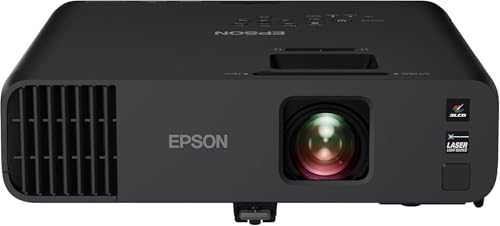
Epson Pro EX11000 — 3LCD colour with its own built-in speaker
Epson writes its brightness claim the way colour scientists wish everyone would: 4600 lumens of colour brightness and 4600 of white brightness, stated separately in the title. That pairing matters in a sanctuary, where the image is not only white text but hymn slides in liturgical colours, photographs from the mission trip and the deep red of a Remembrance display. A machine whose colour output matches its white output keeps those images saturated in lit rooms, and Epson’s 3-chip 3LCD engine exists to make exactly that promise.
The Pro EX11000 is also the most self-sufficient machine in this guide. Wireless is in its title, Miracast is named for cable-free presenting, two HDMI ports and USB power are listed, and a built-in 16W speaker gives the projector a voice of its own. A church hall that hosts everything from toddler groups to Alpha courses can run a video, a talk and a slideshow from this one fixture without a sound system negotiation, and that versatility is a different kind of brightness: operational brightness.
Full HD 1080p resolution suits worship content precisely. Lyrics and scripture are large-type media, and at sanctuary distances the congregation reads words, not pixels. Where the EX11000’s specification spends its money, on colour integrity and wireless convenience, shows up in every service; where it declines to spend, on resolution beyond Full HD, shows up almost nowhere a congregation sits.
Laser light underwrites the whole package with the class’s usual gifts: instant on for the early service, steady output across years, no lamp budget line in the church accounts. For a building whose media team is two volunteers and a laptop, a projector that simply appears, at full brightness, every time the building wakes is worth more than a specification triumph nobody on the rota can operate.
Photographs are where the Epson’s colour honesty will be noticed without anyone naming it. A baptism’s white gown against a red banner, a mission partner’s sunlit village on the screen, the harvest table’s oranges and greens: congregations judge those images by whether they look like the day itself, and a machine that states its colour brightness as proudly as its white brightness was built by people who knew that judgement was coming.
The honest limits sit in the comparison table. At 4600 stated lumens the Epson carries the lowest figure in this guide, so the largest and brightest sanctuaries should size carefully, favouring the Panasonic or LG claims, or control their light. Its talents point at the broad middle of church life: the hall, the mid-size sanctuary, the multi-purpose building where one projector must be all things to all ministries.
Wireless presenting warrants a closing pastoral note. Guest preachers, visiting choirs and conference speakers arrive with laptops that have never met the building. A Miracast-capable, USB-powering projector shortens the awkward ten minutes that so often open a visiting session, and in ministry, where the first ten minutes set the room’s temperature, that shortening is a genuine feature.
Read the listing for throw and mounting particulars, weigh the current price on Amazon against the brighter rivals, and buy this Epson for the building whose life is varied rather than vast.
- Brightness: 4600 lumens colour and white brightness stated
- Engine: 3-chip 3LCD stated
- Resolution: Full HD 1080p stated
- Wireless: Miracast, 2 HDMI ports, USB power stated
- Audio: built-in 16W speaker stated
Strengths
- Colour and white brightness stated as equals
- Built-in speaker and wireless make it self-sufficient
- Laser light with instant-on volunteer manners
Trade-offs
- Lowest stated lumen figure in this guide
- No lens shift or LAN control in its title
- Full HD ceiling for detail-heavy conference use
Best for: a multi-purpose church hall where one projector must present, play and speak without a supporting cast.
Not suited for: a vast, glass-bright cathedral space needing the guide’s maximum output.

Panasonic PT-VMZ61 WUXGA Laser Projector 6200 Lumens — The output leader
Panasonic’s title is the shortest in this guide and the loudest: WUXGA, LCD, laser, 6200 lumens, white. Six thousand two hundred is the highest stated figure among the six, and it comes from a maker whose installation projectors furnish lecture theatres and control rooms for a living. A church with a genuinely large, genuinely bright room, the kind where the back pew sits in another postcode of light, should start its shortlist here and make the others argue their way in.
WUXGA is the resolution of the data world, a widescreen format taller than Full HD, and it earns its place on detailed content: the spreadsheet behind the treasurer’s report, the conference slide with its small print, the streamed service graphic with lyrics over imagery. Churches increasingly host weekday tenants, training providers, schools, conferences, and a projector that serves the sanctuary on Sunday and the seminar on Tuesday justifies its mount twice.
LCD, in Panasonic’s professional line, carries the colour argument in the same direction as Epson’s: simultaneous colour handling that keeps images rich when the room refuses to darken. The title does not split its brightness into colour and white figures as the Epson does, so the 6200 stands as a single stated output, to be weighed as Panasonic’s claim and tested, as all these claims should be, against the buyer’s own room in the planning stage.
The brevity of the title cuts both ways, and honesty requires naming the gap plainly. No zoom figure, no lens shift claim, no network language and no geometry tools are printed, which means the facilities team must extract the entire installation story from the listing and Panasonic’s documentation. Professional buyers are accustomed to that division of labour, datasheets exist for it, but a volunteer media coordinator should know the homework is theirs before the order is signed.
White, the stated finish, is the installation aesthetic of bright modern worship spaces and halls. Against a pale ceiling the machine recedes; in a traditional dark-beamed nave it will announce itself, and buildings with heritage constraints should picture it honestly before choosing. Aesthetics are a legitimate line in a church specification, because the projector will hang in photographs of weddings for a decade.
Overflow rooms are this machine’s quiet second parish. A growing church that relays its service to a hall next door needs a projector whose image still looks authoritative on a second screen, and a data-grade, high-output machine gives the relay the same clarity as the sanctuary feed. The congregation in the overflow should feel like participants, not like an audience watching through a window, and headroom in the main machine is what makes that dignity affordable.
What the PT-VMZ61 promises, stripped to its title, is headroom: the most stated light in the guide, a data-grade resolution, and a professional lineage. Headroom is the quality large rooms actually need, because it lets the machine run below its maximum, preserving colour and calm, instead of straining at its ceiling every bright Sunday.
Do the datasheet reading this concise title demands, confirm the throw and lens arrangements for your screen, and take the current price from Amazon in the same session, because at this level the projector is a capital decision and deserves capital-decision paperwork.
- Brightness: 6200 lumens stated
- Resolution: WUXGA stated
- Engine: LCD laser stated
- Finish: white stated
- Zoom and shift figures: Not stated in the listing title — verify with the manufacturer documentation
Strengths
- Highest stated output in this guide
- WUXGA headroom for detailed weekday content
- Professional installation lineage from Panasonic
Trade-offs
- Title omits all installation geometry details
- White finish will show in dark traditional interiors
- Specification homework falls entirely on the buyer
Best for: a large, bright sanctuary or a church earning weekday income from conferences and training.
Not suited for: a small chapel where its output and size are simply more than the room asks.

LG ProBeam BU60RG 6000 Lumens 4K Laser Projector — Lens shift and 4K for difficult rooms
Lens shift is the phrase in this title that installation professionals will read first, and it is printed without hedging: vertical and horizontal lens shift, beside a 1.6x zoom. Lens shift moves the image optically, without the resolution tax that digital keystone correction charges, so a projector mounted off-centre, as historic buildings so often demand, can still place a perfect, full-resolution rectangle on the screen. In a listed nave where the mount must go where the mount can go, that is not a refinement; it is the whole ballgame.
Six thousand stated lumens place the BU60RG a breath behind the Panasonic at the top of this guide’s output band, and 4K UHD resolution places it alone at the top of the detail band. The combination serves the modern large church precisely: lyrics and scripture at absolute clarity, streamed services and film events with cinema headroom, and a screen big enough to make the back row feel included rather than informed.
webOS Signage, named in the title, reveals the machine’s second citizenship. This is a ProBeam built for the signage and business world, where screens run all day and content is managed centrally. A church with a foyer display culture, notice screens, welcome loops, service relays to overflow rooms, will recognise the platform’s usefulness, and a media team already fluent in LG’s ecosystem gains a projector that speaks its language.
The 1.6x zoom multiplies the lens shift’s freedom. Between them, the installer gains a generous volume of space in which the mount can live while the image still lands exactly on the screen at full quality. Buildings that have defeated lesser projectors, the fan in the wrong place, the beam in the only place, the chandelier with seniority, are the natural constituency of this machine, and its specification reads as if LG interviewed them.
Streamed services have changed what a sanctuary projector must survive. The camera sees the screen as the congregation does, and a dim or skewed image now travels to the housebound, the hospitalised and the curious far beyond the parish boundary. A 4K, high-output machine with optically true geometry gives the stream a screen worth broadcasting, and churches that have become broadcasters without ever deciding to will find this pick quietly designed for their new reality.
Honesty requires the counterweight. This is the most ambitious machine in the guide, and its talents are wasted on a forty-seat chapel. Small rooms need neither 6000 lumens nor 4K nor a signage platform, and the budget a small church saves by choosing the Ricoh or the Epson below and above it can fund the screen, the mount and the cabling that make any projector good. Buy the BU60RG for the building that can use it.
Support lineage completes the case. LG’s ProBeam line serves corporate installation at scale, with the documentation and service expectations that world demands. A church investing at this level is buying into that world’s infrastructure, and for a fixture expected to serve a decade of Sundays, infrastructure is a form of brightness too.
Confirm the shift range and throw figures against your screen position in the listing’s documentation, and check the asking price on Amazon while the measurements are open, because this machine should be bought with a tape measure in the other hand.
- Brightness: 6000 lumens stated
- Resolution: 4K UHD stated
- Lens: vertical/horizontal lens shift and 1.6x zoom stated
- Platform: webOS Signage 6.0 stated
- Light source: laser stated
Strengths
- True lens shift solves off-centre historic mounts
- 4K detail with near-top stated brightness
- Signage platform serves foyer and overflow screens
Trade-offs
- Over-specified for small chapels and halls
- Premium positioning within this guide
- Platform features exceed simple worship needs
Best for: a large or architecturally difficult church where the mount cannot be centred and the screen must be perfect anyway.
Not suited for: a forty-seat chapel with a simple, centred ceiling.

Ricoh PJ WXL5860 Compact DLP Laser Projector — The compact room’s laser
Compact is the first promise in Ricoh’s title, and in church life compact is a strategy, not a compromise. The PJ WXL5860 is a DLP laser projector stating 4700 lumens, vertical lens shift, 360-degree installation, up to 20,000 hours of light and a screen range of 30 to 300 inches, finished with two 8W stereo speakers. Read whole, it describes the machine for the church hall, the chapel of ease, the youth room and the growing congregation in a rented school: real installation features, honestly scaled.
Vertical lens shift in a compact machine earns applause, because shift usually deserts buyers as size and price fall. Even a modest shift range lets an installer hang the projector where the ceiling allows and then walk the image down onto the screen optically, preserving the picture that keystone correction would spend. Ricoh kept the feature in the compact class, and small churches with awkward ceilings are the beneficiaries.
The screen range, 30 to 300 inches, printed in the title, tells a sizing story in one line. The same model can serve a committee room at the small end and a hall at the large end, which is fleet logic for a parish with several spaces: one model to learn, one remote to find, one relationship with the documentation. Churches run on volunteers, and standardising the fleet is how volunteers stay sane.
Up to 20,000 hours, stated in the title, translates into church time generously. A building running its projector ten hours a week consumes roughly five hundred hours a year; the stated life therefore describes decades of ordinary service, which reframes the purchase from equipment to furnishing. The laser’s instant manners suit the pattern too, short uses scattered across the week rather than one long weekly burn.
Two 8W stereo speakers close the title, and for the rooms this machine targets they matter. A hall without an installed sound system, a youth room, a chapel used for film afternoons, can run entirely on the projector’s own voice for speech and simple music. It will not fill a nave, and the title does not claim it will; it claims a compact machine that arrives complete, which is exactly the brief of the smaller worship space.
Youth work makes the compact case emotionally. A youth room’s projector is set up by teenagers, aimed at a wall that was a noticeboard an hour ago, and expected to show lyrics, games and a film clip in one evening. A compact laser with shift to rescue the alignment and speakers to carry the room removes the adult-with-a-ladder from that picture entirely, and a machine the young people can run themselves will be run ten times as often.
DLP is the engine, the only DLP in this guide, with the format left for the listing to detail beyond the WXL in the model name, which this review will not decode into a resolution claim. Buyers should take the resolution and throw figures from the listing, as with the Panasonic, and weigh this machine on its stated virtues: size, shift, hours, range and completeness.
Check those figures and the current price on Amazon together, and if your building’s rooms are many and modest, this compact Ricoh may be the most parish-shaped purchase in the guide.
- Brightness: 4700 lumens stated
- Engine: DLP stated; compact body
- Lens: vertical lens shift stated
- Life: up to 20,000 hours stated; 30-300 inch screen range
- Audio: 2x 8W stereo speakers stated; 360-degree install
Strengths
- Lens shift survives into the compact class
- Stated screen range suits a multi-room parish fleet
- Built-in stereo speakers complete small rooms
Trade-offs
- Output is mid-band, so vast bright naves outgrow it
- Resolution detail must come from the listing
- Compact class means fewer flagship features overall
Best for: a parish of smaller rooms, halls, chapels and youth spaces, wanting one laser model across them all.
Not suited for: a single vast sanctuary needing the guide’s maximum output and detail.
Comparison
| Pick | Headline facts from its listing title | Building it suits first |
|---|---|---|
| ViewSonic LS740HD | 5500 lumens, 1080p laser, corner adjustment, 360 projection | A mid-to-large church with an awkward ceiling |
| ViewSonic LS741HD | 5000 lumens, 1.6x zoom, LAN control, 24/7 operation | A busy building managed from an office |
| Epson Pro EX11000 | 4600 lumens colour and white, 3LCD, Miracast, 16W speaker | A multi-purpose hall serving every ministry |
| Panasonic PT-VMZ61 | 6200 lumens, WUXGA, LCD laser | A large bright sanctuary or conference church |
| LG ProBeam BU60RG | 6000 lumens, 4K UHD, lens shift, 1.6x zoom | A difficult historic room needing optical freedom |
| Ricoh PJ WXL5860 | 4700 lumens, DLP, vertical shift, 20,000 hours | A parish of smaller rooms on one fleet model |
How Do You Size a Projector to a Sanctuary?
Measure the throw and the screen before reading a single lumen figure. The projector will hang where the building permits, often above the platform or partway down the nave, and the screen will live where the congregation can see it without craning. The distance between those two fixed points, divided into the screen’s width, is the throw the lens must achieve, and the zoom and shift figures in the titles above exist to make that arithmetic forgiving.
Size the screen to the back pew’s reading, not to the wall’s vanity. Song words must be legible to the oldest eyes in the last row, which sets a minimum image height for text long before it sets a maximum for drama. A screen sized by that rule, fed by a projector from this guide’s brightness band, will serve every service; a screen sized by ambition will make the same projector look weak and start an argument the machine did not cause.
Then audit the light honestly at service time. A sanctuary at 11 a.m. in June, sun through clear glass, is a different room from the same sanctuary at a candlelit evening service, and the projector must be bought for the harder hour. Blinds, where the building allows them, are brightness bought once and used forever, and they belong in the same budget conversation as the lumens.
Why Does Laser Light Suit Churches So Well?
Because church use is the opposite of cinema use: frequent, brief, unpredictable and operated by volunteers. A laser projector wakes at full brightness for a fifteen-minute rehearsal, a funeral at short notice, a toddler group’s video, and never asks the operator to think about warm-up, cool-down or a lamp’s remaining hours. Across a year of that pattern, the absence of lamp management is the feature the building feels most.
Steadiness is the second gift. Lamp output declines across its life, so a church slowly acclimatises to a dimming image and blames the screen, the windows or the slides. Laser output holds its level across a far longer span, which means the picture the congregation saw at installation is the picture they still see years later, and the media team’s settings stop drifting with the lamp’s age.
What Should a Church Check Before the Installer Arrives?
The mount point, the power and the signal path, in that order. Confirm the ceiling or truss can carry the machine where the throw demands it, with a route for power that satisfies the building’s regulations and its insurers. Run the signal cable, HDMI over the distances churches need often means an extender or a fibre solution, before the scaffold comes down, because returning to height for a forgotten cable is the most expensive sentence in installation.
Agree the screen and the sightlines in the same meeting. The bottom of the image must clear the heads of a standing congregation, the top must sit below the architecture it would fight, and the preacher’s position must not shadow the words during the sermon. Walk the room with a tape and a tall volunteer, and let the building, not the brochure, fix the geometry.
How Do You Plan the Screen Itself?
The screen is the projector’s partner, and in churches it is often the neglected half of the marriage. A wall can serve a small hall honourably if it is smooth, pale and free of radiators, but a proper screen returns brightness and contrast that plaster quietly eats, and in a bright nave that returned light is worth real lumens. Motorised screens that descend for services and vanish for weddings suit buildings whose beauty is also their function, while a fixed screen suits halls where the wall has no other job.
Gain is the screen specification to discuss with the installer. A modest gain lifts the image for the congregation seated in front of it, while very high gain narrows the viewing cone and can leave the side aisles watching a dimmer picture than the centre. Church seating is wide by design, so viewing angle usually matters more than peak brightness, and a screen chosen for the whole congregation rather than for the best seat will serve every service better.
Placement completes the partnership. The screen should hang where the architecture already draws the eye, clear of windows that would strike it directly, high enough that standing heads do not crop its lower lines and low enough that the front row is not reading at a cricketer’s angle. In many sanctuaries that position is inherited from a previous screen, and the wise buyer questions the inheritance once, with a tape and a tall volunteer, before the new machine is aligned to an old mistake.
What Does a Decade of Ownership Actually Look Like?
Mostly, it looks like nothing happening, which is the point. A laser installation projector asks for dusting, filter attention where its documentation prescribes it, and an annual check that the mount is true and the image still lands square. The media team’s knowledge becomes the maintenance schedule: one person who knows the remote’s habits, one who knows the input the laptop prefers, and a laminated card near the sound desk that turns a substitute operator into a competent one in five minutes.
Budget the decade honestly at the start. The projector’s figure is the headline, but the mount, the cabling, the screen work and the installer’s day are the supporting lines, and a church that funds all of them at once gets a system that behaves as one thing. Churches that fund the machine alone and improvise the rest spend the following decade paying the difference in volunteer frustration, which is the most expensive currency a congregation has.
Plan also for the building’s changing life. A congregation that streams its services, hosts a food bank in the hall or rents the sanctuary for concerts will ask new things of an old projector, and the installation features threaded through these titles, network control, generous zoom, shift, 360-degree mounting, are the machine’s answers to questions nobody has asked yet. Buying a little more flexibility than this year’s services need is how a fixture survives a decade of ministry it cannot foresee.
How Should the Media Team Be Trained Around a New Projector?
Train for the ordinary Sunday, then for the two extraordinary ones. The ordinary Sunday needs a startup sequence so simple it survives a volunteer’s holiday: power, input, slides, words. Write it down, laminate it, and rehearse it with every person on the rota, because a projector’s reliability in a congregation’s eyes is exactly the reliability of its least-rehearsed operator on the morning the usual one is ill.
The extraordinary Sundays are the wedding and the funeral. Both arrive with emotion high, preparation scattered and guests who will remember the building’s competence kindly or otherwise. A team that has practised switching to a guest’s laptop, recovering from a wrong input and dimming the image gracefully during a quiet moment will serve those days well, and the practice takes one evening with pizza and the remote passed hand to hand.
Finally, teach the building’s memory. Keep the projector’s documentation, the installer’s notes and the alignment settings in one folder that lives with the sound desk, not in a departed volunteer’s email. Churches think in decades and staff their rotas in years, and the folder is how the machine’s knowledge outlives the people who installed it, which, for a fixture bought to serve a generation, is the most important specification of all.
Common Mistakes
Buying lumens before measuring the room is the classic church projector error. A vast figure in a small hall wastes money and can overwhelm a modest screen, while a modest figure in a glass nave starts a decade of squinting. The sizing sequence in this guide, screen, light, then lumens, exists because buildings differ more than projectors do.
Forgetting the volunteers is the second failure. A projector that needs a technician’s temperament will be operated, in reality, by a rota of the willing, and its menus, remote and startup behaviour are therefore part of the specification. Laser light and simple geometry tools, the traits threaded through these six titles, are volunteer features disguised as engineering.
Neglecting the sound path comes third. Words on a screen carry half the service; the spoken and sung word carries the rest, and a projector plan that ignores how audio reaches the congregation, whether through the building’s system or, in the Epson’s and Ricoh’s cases, a speaker in the machine itself, will be revisited at the first funeral where the back row cannot hear.
Heritage buildings reward the team that asks the fabric committee early, not the team that arrives with a drill. Listed buildings, faculty permissions and conservation officers all have views about mounts, cabling and white boxes on ancient ceilings. Raise the projector in that conversation at the start, with the lens shift and flexible mounting options from these titles as your negotiating tools, rather than after the installer has drilled the first hole.
Final Recommendation
For the largest and brightest rooms, begin with the Panasonic PT-VMZ61’s stated 6200 lumens and WUXGA headroom, and with the LG ProBeam BU60RG where the building’s geometry is the real opponent, since its lens shift and 6000 lumens solve the two problems historic churches actually have. The ViewSonic pair splits the broad middle: the LS740HD for output and corner forgiveness in an awkward ceiling, the LS741HD for the networked, always-on building that wants its projector managed from a desk.
Epson’s Pro EX11000 is the multi-purpose heart of the guide, colour-honest, wireless and carrying its own speaker, ideal for the hall that hosts everything. Ricoh’s compact DLP is the parish fleet pick, shift-equipped and long-lived, sized for the many smaller rooms where most church life quietly happens. Every one of the six will still be serving when the hymn books are replaced; they differ in which building they serve best.
Measure the room, respect the building, choose the laser whose stated gifts match both, and the words on the screen will simply always be there, which is all a congregation ever asked.
Years from now, nobody in the building will remember the meeting where the projector was chosen, and that forgetting is the purchase succeeding. The words will be on the screen for the hundredth baptism and the thousandth hymn, the visiting preacher’s laptop will connect without a story, and a new volunteer will learn the remote in an afternoon from a laminated card. Installation projectors are bought to become invisible inside the life of a place, and the six lasers in this guide are six different routes to that same blessed invisibility, each sized and shaped for the building it will disappear into.
So walk the nave with a tape measure before opening a single listing, count the windows at the hour of the main service, and let the building itself cast the deciding vote between output, shift and network sense. The right laser, chosen that way, will outlast the committee that approved it and serve congregations who never learn its model number, which is the finest epitaph any church technology can earn, and the surest sign that the money was spent on the congregation’s attention rather than on the machine’s vanity. Buy it once, install it properly, train the rota kindly, and then let the projector join the long list of things the building simply has, like the roof, the organ and the kettle that has outlived three vicars, present at every gathering, noticed by nobody, and missed instantly on the single morning anything about it ever goes wrong, which, if this guide has done its work, is a morning your congregation will wait a very long time to meet, somewhere beyond the horizon of rotas, hymnals and hall bookings yet to be imagined by anyone currently on the church council or likely to join it soon.
Frequently Asked Questions
How many lumens does a church actually need?
It depends on the screen size and the light at service time, which is why this guide prints the stated band, 4600 to 6200, rather than a single answer. A controlled hall thrives at the band’s lower end on a modest screen; a large, window-bright nave should shop at the top and budget for blinds as part of the same purchase.
What is lens shift, and why does it matter in old buildings?
Lens shift moves the projected image optically, up, down or sideways, without tilting the projector or spending resolution on digital correction. Old buildings rarely permit a perfectly centred mount, so shift, offered by the LG in both directions and by the Ricoh vertically, lets the installer put the machine where the building allows and the image where the congregation needs it.
Can one projector serve both services and weekday hires?
Yes, and several picks here are titled for exactly that double life. The Panasonic’s WUXGA suits conference data, the Epson’s wireless and speaker suit visiting presenters, and the ViewSonic LS741HD’s LAN control and 24/7 rating suit a building that rents its rooms. Weekday versatility is often what justifies the purchase to a finance committee.
Why not simply buy the brightest model in the guide?
Because brightness is one variable in a system. Screen size, room light, throw distance and the volunteers who run the machine all share the verdict, and an over-bright machine in a small hall wastes budget that the screen and mount needed. The guide’s sizing sections exist to spend the money in the order the room will feel it.
How long will a laser projector serve a church?
The Ricoh’s title states up to 20,000 hours, and at typical church usage that arithmetic runs to decades rather than years. Laser light also holds its brightness across that span instead of fading like a lamp, so the realistic planning horizon is the building’s, not the bulb’s, which is precisely why this class has become the default for worship installations.
Related Guides
Large-room projection is a family of problems, and the neighbouring guides cover its other members: android projectors with bluetooth for the smart end of projection that small churches and home groups often start with, beginner 35mm film cameras for those documenting church life the traditional way, and automatic compact film cameras for the pocket cameras that record the fête, the pilgrimage and the choir tour.


