What's inside
- Key Takeaways
- Quick Picks
- How did we choose these picks?
- Why does OLED change the conversation at 65 inches?
- What size of room and seating distance suits a 65-inch screen?
- How do the platforms behave when the screen becomes the household’s front door?
- What should you expect from sound when the picture grows this large?
- Which of these six deserves your main wall?
- What does living with a 65-inch screen change about the room itself?
- How do the six compare side by side?
- How should you install and set up a 65-inch television?
- What mistakes do buyers make at 65 inches?
- Final Recommendation
- Frequently Asked Questions
- Related Guides
As an Amazon Associate I earn from qualifying purchases. This post may contain affiliate links at no extra cost to you.
widgetverdict.com is reader-supported. When you buy through links on our site, we may earn an affiliate commission.
Where to buy: Amazon hosts the verified listings for all six sets in this guide; follow any pick’s name — in the quick picks, in its full review, or in the comparison table — and you land on the listing that review was written from.
At 65 inches a television crosses a threshold: it is no longer chosen, it is committed to, and the best 65 inch smart TVs repay that commitment by being the most complete screens most households will ever own. The six verified picks here trace the full arc of the class, from Insignia’s LED and QLED Fire TV sets through Roku’s calm QLED and Hisense’s gaming-fluent Hi-QLED, up to two genuine OLED flagships of the imagination — Samsung’s S90H and LG’s OLED evo C6. Every one is a 4K smart television; almost everything else about them is an argument waiting to be had, and this guide intends to have those arguments properly.
Size changes the questions. At 65 inches, viewing angles widen because more seats sit off to the sides, blacks matter because film nights move to the big screen, and the platform matters because this set becomes the household’s default window on everything. The picks divide across Fire TV, Roku and the manufacturers’ own flagship platforms, and the reviews below weigh picture technology first at this size — the reverse of the smaller guides — because a screen this large shows its panel’s character in every scene.
Key Takeaways
- Two of the six picks are OLED — Samsung’s S90H and LG’s OLED evo C6 — and they redefine what black levels and contrast mean in this guide.
- Every pick is a 65-inch class 4K smart TV, so the contest is panel technology, platform and intended room, not resolution.
- Hisense’s E6SR is the gaming-fluent option, its listing putting VRR and a dedicated Game Mode Plus beside Dolby Vision support.
- Insignia fields both the value LED entry and a QLED step-up, letting Fire TV households climb the panel ladder without changing platform.
- Roku’s Select QLED is the shared-family choice, pairing QLED colour with the calmest interface in the group.
- Samsung’s S90H adds a Glare Free claim to its OLED panel, a combination aimed at rooms that are bright by day and cinematic by night.
Quick Picks
| Pick | Badge | Why it earns its place |
|---|---|---|
| Insignia 65 F50 4K Fire TV | The big-screen value pick | LED 4K with Fire TV and Alexa at the size where the room transforms, without panel-tier pricing logic. |
| Roku 65 Select QLED TV | The family-peace pick | A 2026 QLED panel under Roku’s neutral interface, built for shared screens and bright rooms. |
| Hisense 65 E6SR Roku TV | The console-friendly pick | Hi-QLED colour with VRR and Game Mode Plus for consoles, plus Dolby Vision for film, all on Roku. |
| Insignia 65 QF QLED Fire TV | The Fire TV colour pick | Insignia’s QF series brings a QLED panel to Fire TV households ready to step beyond plain LED. |
| Samsung 65 S90H OLED TV | The glare-fighting OLED pick | Samsung’s 2026 OLED with Vision AI and a Glare Free screen treatment for mixed-light rooms. |
| LG 65 OLED evo C6 TV | The film lover’s pick | LG’s OLED evo with Brightness Booster and Perfect Black credentials, the connoisseur’s end of the guide. |
How did we choose these picks?
The gate was verification at flagship scale. Each set’s listing had to state its 65-inch class, its 4K resolution, its panel technology and its platform in its own title, because at this size a vague listing hides expensive misunderstandings. The six that passed span LED, QLED, Hi-QLED and OLED, and that spread is deliberate: 65 inches is the size where panel technology stops being a preference and becomes the picture itself, so a guide that sampled only one technology would fail its readers precisely where the money is largest.
Platform representation followed. Fire TV appears twice through Insignia’s two tiers, Roku twice through the Select and the Hisense, and the two OLEDs carry their makers’ own flagship software environments. That arrangement lets the guide compare like with like: a Fire TV household can weigh LED against QLED without leaving its platform, a Roku household can weigh calm against gaming features, and the OLED pair can be judged against each other on panel philosophy rather than on software novelty.
The final filter was honesty about rooms. A 65-inch screen is bought for a particular wall, a particular sofa distance and a particular pattern of light, and the reviews are organised around those variables — bright-room colour for the QLED sets, dark-room contrast for the OLEDs, gaming fluency for the Hisense, sheer size-per-simplicity for the F50. Where a listing is silent, on refresh rates for the OLED pair in the text available here, for instance, the guide notes the silence instead of filling it with the numbers a reader might hope for.
Why does OLED change the conversation at 65 inches?
An OLED panel lights each pixel individually, which means a black pixel is not a dimmed pixel but an off one. On a 65-inch canvas that distinction stops being a specification and becomes an atmosphere: night scenes gain genuine darkness, stars sit in actual black sky, and contrast becomes effectively bottomless in a dark room. LG’s listing language — Perfect Black, Perfect Color — and Samsung’s Real Black phrasing both point at this same physical fact from different marketing directions. For film lovers who watch with the lights down, no backlight technology in this guide, however fine its zones, reproduces that quality exactly.
The counterweights are room and habit. OLED’s strengths bloom in controlled light; in a sun-drenched open-plan space, the brightness headroom of the best backlit sets can hold a picture together more forcefully at midday, which is why Samsung’s Glare Free treatment on the S90H is such an interesting attempt to widen OLED’s territory. OLED also asks a little more awareness from households that park static content — news tickers, paused menus — on screen for hours daily. Neither point is a verdict; both are the kind of room-and-routine facts this guide exists to surface before the largest screen in the house is chosen.
Between the backlit picks, the ladder is familiar but taller. Plain LED gives size and simplicity, QLED adds colour authority, and Hisense’s Hi-QLED adds gaming and format fluency on top. At 65 inches each rung is more visible than it was at 55, because the canvas forgives less. The wise buyer therefore starts from the room’s light and the household’s darkest, brightest and fastest content, and lets those extremes — not the average evening — choose the technology.
What size of room and seating distance suits a 65-inch screen?
A 65-inch 4K panel rewards seating roughly between two and three metres for film, where its detail resolves and its width fills peripheral vision without overwhelming it. Rooms much smaller can still work — many flats run a 65 as a near-cinematic wall — but the household should rehearse the scale with tape on the wall before ordering, because diagonal numbers consistently understate how large these sets feel in a doorway, on a staircase and finally on the wall itself. Delivery logistics are part of the purchase at this size: measure the route from street to sofa, not just the destination.
Furniture feels the change too. A stand that suited a 49-inch set may leave a 65-inch panel’s feet dangling at its edges, and a wall mount moves from optional to advisable in many rooms, both for stability and for the viewing height it allows. Soundbars need a home in the plan as well, since a screen this size raises the household’s cinematic expectations and the slim cabinet’s speakers rarely rise with them. None of this is an argument against the size; it is the ordinary project management of the most satisfying screen most homes will ever install.
How do the platforms behave when the screen becomes the household’s front door?
At 65 inches the television’s software stops being a feature and becomes infrastructure, touched more often than the front door and judged by people who never chose it. Fire TV’s two Insignias organise the household around Amazon’s services and Alexa, with suggestions leading and live television folded into the same menus as streaming. For homes already speaking that language, the big screen simply becomes the largest voice terminal in the house, and its familiarity is a form of accessibility that should not be underestimated when grandparents and children share the remote.
Roku’s pair take the infrastructure metaphor literally: plumbing, not theatre. The interface presents services in a grid the household arranges once and then forgets, search reports across providers without an obvious favourite, and the whole system changes so slowly that learned habits survive for years. On a screen expected to serve a decade, that conservatism is a design philosophy with real economic value, because interface resentment is the most common reason capable televisions get replaced early.
The OLED pair run their makers’ flagship environments, and both are more ambitious pieces of software — Samsung’s Vision AI framing its processing story, LG’s AI-badged platform serving its cinema ambitions. Households choosing an OLED are usually choosing a picture first and accepting the platform as part of the flagship package, and both environments are polished enough that the acceptance is painless. The honest ordering for most buyers is therefore picture and room first at this size, platform second — the reverse of the smaller guides — with one exception: a household that knows it hates a particular interface should honour that knowledge at any size, because a decade is a long time to dislike a menu.
What should you expect from sound when the picture grows this large?
A 65-inch image creates a promise that slim speakers struggle to keep. Stadium scale, orchestral scores and film sound design all arrive expecting a sonic canvas to match the visual one, and the built-in audio of any set in this guide — engineered into a thin cabinet — will sketch that canvas rather than paint it. Everyday viewing is well served: news, soaps and streamed drama speak clearly from all six. The gap appears exactly where the screen is most exciting, which is why sound planning belongs in the purchase conversation at this size rather than in the regret conversation afterwards.
The staged approach works best. Live with the set through a fortnight of the household’s real programmes, including one big film and one big match, and judge dialogue clarity at the volumes you actually use. If voices ever strain against the room, a soundbar matched to the screen’s width closes the gap more completely than any other single addition, and it does so without disturbing the panel decision, which was made on picture and platform grounds that remain valid. Open-plan rooms with hard surfaces will reach the soundbar conclusion quickly; small, soft rooms may never need it, and their owners should spend the money on the panel tier instead.
Which of these six deserves your main wall?

Insignia 65 F50 4K Fire TV — The big-screen value pick
There is a moment in every household’s life when the television simply needs to be bigger, and the F50 exists for that moment. Its listing is the plainest in this guide — a 65-inch LED 4K UHD panel, Fire TV, an Alexa voice remote — and at this size plainness has a power of its own. The sheer transformation of a room by a 65-inch canvas dwarfs the subtler differences between panel tiers for a great many viewers: sport feels like attendance, streamed series gain presence, and the family stops crowding onto one sofa end to see the score.
Fire TV makes the set immediately operable by the whole household, with Alexa voice search doing the heavy lifting and live television folded into the same menus as the streaming services. For Alexa homes, the television joins the household’s routines without translation. The picture is honest LED work: bright, clean and entirely convincing for news, sport and the streamed drama that fills most evenings, with the class’s known limits in the darkest film scenes, where backlight glow reminds you the panel is lit from behind rather than pixel by pixel.
The F50’s buyer should be clear-eyed about what the saving buys and what it declines. It declines QLED colour authority, OLED blacks and any published gaming refresh story. What it buys is the size itself, today, with a platform the household already trusts — plus whatever the remaining budget does for seating, sound or the room around the screen. In a bright family room where the television is one attraction among many, that allocation is frequently the smartest in this entire guide.
It also suits the decisive upgrader: the household replacing a decade-old set whose only real complaint is that everything feels small and slow now. The F50 answers both complaints in one afternoon — a wall-filling 4K picture and a modern interface — without asking the family to develop opinions about backlight architecture. Some purchases reward research; this one rewards the family that would rather be watching.
Landlords and second-living-room buyers form its quiet second constituency. A large, capable, replaceable screen in a rental or a games room delivers the size experience where it will be used hard and worried about least, and Fire TV’s familiarity means tenants and guests need no induction. The F50 is the guide’s reminder that at 65 inches, even the entry point is a serious television.
One underappreciated F50 virtue is how it handles the household’s mixed broadcast habits. Plenty of 65-inch buyers still watch a great deal of live television alongside streaming, and Fire TV’s integration of live channels into the same programme surface as the apps spares the family the two-remote shuffle that plagues more fragmented setups. The big screen becomes one place where everything lives, which is what a main screen is supposed to be.
- Panel: 65-inch class LED
- Resolution: 4K UHD
- Platform: Smart Fire TV
- Remote: Voice Remote with Alexa
- Noted in listing: stream live TV without cable
Strengths
- The full 65-inch transformation with the simplest ownership story in the guide.
- Fire TV and Alexa make it native to Amazon-centred households from day one.
- Lets the budget flow toward sound and seating, where many rooms need it more.
Trade-offs
- Dark-room film scenes show LED-class blacks rather than OLED depth.
- No QLED colour layer for the most saturated sport and animation.
- The listing publishes no gaming refresh features for console households.
Best for: the household whose brief is simply a much bigger, modern screen for family viewing in a normally lit room.
Not suited for: a dedicated cinema corner, or a console setup chasing the features on the Hisense listing.

Roku 65 Select QLED TV — The family-peace pick
Scale up the household, and interface temperament becomes a governing concern. The Roku Select at 65 inches pairs a QLED panel — the listing specifies a 2026 4K QLED television with a voice remote and Wi-Fi — with the most even-tempered software in this guide, and that pairing is aimed at the shared main screen where five people with five patience levels all expect the television to behave. Roku’s grid does not learn, does not promote and does not rearrange; it simply presents the services, searches them even-handedly, and gets out of the way of the evening.
The QLED panel gives that calm a picture worth gathering around. Colour holds its nerve in bright rooms, which is where most 65-inch family viewing actually happens — weekend afternoons, sport with the curtains open, animated films at teatime. The Select will not match the OLED pair after dark, and its listing makes no gaming refresh claims, but within the bright, shared, everyday centre of family life it is arguably the most completely judged television in this six: nothing about it is extreme, and everything about it is considered.
Stability, in this interface, is a form of durability no panel specification can offer. Menus that change less age better in households, because nobody’s learned habits get confiscated by an update. A grandparent who masters the Select in January still recognises it in December. For the main family screen, that stability compounds quietly across years, and it is why this guide keeps recommending Roku’s restraint at exactly the sizes where the whole household shares one remote.
Choose the Select if the television is a commons. Families with young children, multigenerational homes, and anyone whose last smart TV started arguments will recognise the value immediately. Its compromises live at the extremes — midnight cinema, competitive gaming — and households that rarely visit those extremes will rarely meet them.
One more constituency deserves naming: the household upgrading its main screen after a decade with a much-loved but pre-smart set. The Select’s learning curve is the gentlest in this guide while its picture is a clear generational leap, and that combination — novelty without bewilderment — is precisely what a once-a-decade purchase should deliver.
Holiday gatherings are the Select’s secret audition. A house full of relatives, each with a programme they insist on finding, is where suggestion-led interfaces start arguments and a plain grid ends them: the service is where it always is, the search finds the title, and the television returns to being furniture. Sets that survive Christmas without a single tech-support incident have passed the hardest usability test a family owns.
- Panel: 65-inch class QLED
- Resolution: 4K (2160p)
- Platform: Roku TV
- Remote: voice remote
- Connectivity named in listing: Wi-Fi
- Year: 2026 model
Strengths
- QLED colour keeps bright family viewing vivid at main-screen scale.
- The calmest, most stable interface in the guide for a shared household screen.
- A current 2026 model with software that starts its life up to date.
Trade-offs
- Night-time contrast cannot follow the OLED pair into true black.
- No gaming features are published in the listing for console players.
- Roku’s ecosystem offers less smart-home theatre than Alexa-led alternatives.
Best for: the shared family wall in a bright room, where the interface must please everyone and the colour must survive daylight.
Not suited for: lights-down film purists, or a gaming household reading listings for refresh features.
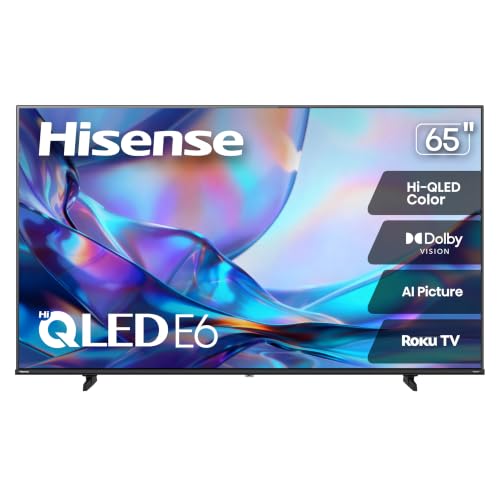
Hisense 65 E6SR Roku TV — The console-friendly pick
The E6SR is what happens when a mid-tier set refuses to act mid-tier. Hisense’s listing for the 65-inch model — a 2026 Hi-QLED 4K UHD Roku television — names Dolby Vision, Game Mode Plus and VRR in one breath, a combination none of the other backlit picks match. At 65 inches those features stop being garnish. Variable refresh rate smooths console output on the big canvas where judder is most visible, a dedicated game mode addresses responsiveness, and Dolby Vision gives the same screen a premium film format for the evenings when the console rests.
Roku underneath keeps the whole apparatus approachable. The household gets a gaming-fluent television that a non-gaming parent can still operate at breakfast, which is a rarer balance than the industry admits. Colour from the Hi-QLED layer stands alongside the Roku Select’s QLED as the vivid tier of the backlit group, with the Hisense adding its format and gaming vocabulary on top. For the teenager whose room is slowly becoming the house’s entertainment centre, or the living room where a console lives permanently under the screen, the E6SR covers the brief with room to spare.
Its limits are the familiar backlit ones, stated plainly: after dark, an OLED will show it what black really is, and its listing’s gaming language, while specific, is a promise to verify in the console’s own settings rather than a laboratory result. Buyers should also note that Roku’s voice world is its own remote, not a whole-home assistant web. None of that displaces the E6SR from its territory. Among backlit 65-inch sets in this guide, it is the one that speaks to the widest range of evenings.
The dual-audience design deserves one more paragraph, because it solves a real household negotiation. One partner games, the other streams prestige drama, the children want animation on Saturday morning. A specialist set serves one of those people and tolerates the rest; the E6SR was plainly specified to serve all three, with the panel colour for the animation, the Dolby Vision for the drama and the VRR for the games. Compromise screens usually satisfy nobody; this one reads like a treaty everybody signed willingly.
Finally, its 2026 model year matters for a set expected to absorb new consoles and services across its life. Starting current is the only reliable way to stay current longest, and a feature list this broad deserves the longest possible runway.
Streaming households should also register what Dolby Vision at this size does to a familiar series. Titles rewatched on the E6SR after years on a smaller, plainer screen reveal highlight detail in skies, lamps and city scenes that the household has simply never seen in its own favourites, and that rediscovery effect is a large part of the pleasure of upgrading to a well-specified 65-inch set.
- Panel: 65-inch class Hi-QLED
- Resolution: 4K UHD
- Platform: Smart Roku TV
- HDR named in listing: Dolby Vision
- Gaming named in listing: Game Mode Plus, VRR
- Model: 65E6SR, 2026
Strengths
- Dolby Vision plus Hi-QLED colour gives film nights the richest backlit treatment here.
- Game Mode Plus and VRR speak directly to console households at main-screen scale.
- Roku keeps the feature list usable by every member of the household.
Trade-offs
- True-black OLED contrast remains a tier above it after dark.
- Roku’s voice ecosystem is narrower than an Alexa-first home may want.
- Households that never game carry features they will not use.
Best for: the living room where a console lives under the screen and film nights run on Dolby Vision titles.
Not suited for: a dark-room purist ready for OLED, or an Alexa-routine household wanting the TV inside that web.

Insignia 65 QF QLED Fire TV — The Fire TV colour pick
Insignia’s second entry in this guide exists to answer a specific upgrade itch: the Fire TV household that loves its platform, has seen what QLED colour does in a bright room, and wants that picture without re-platforming the house. The QF Series listing specifies a 65-inch LED 4K UHD QLED smart Fire TV with an Alexa voice remote, model NS65-UQFL26 — the same ecosystem as the F50, with the colour layer promoted to headline status.
The difference QLED makes at 65 inches is not subtle in the content families watch most. Grass stays green through a whole match rather than fading at the sunny end of the room, animated films hold their saturated palettes, and food and travel programmes — secretly the most colour-demanding genres on television — look appetising rather than approximate. In a bright, open family space, that colour authority is used every day, which is more than can be said for some more exotic specifications.
Against its own sibling the QF’s case is simple: same platform, same remote habits, richer picture. Against the wider field it concedes the OLEDs their darkness and the Hisense its gaming vocabulary, while offering Fire TV loyalists something neither Roku set can — a colour-forward panel inside the ecosystem their home already speaks. Platform loyalty is often mocked in buying guides, yet re-teaching a household its television is a real cost, and the QF prices that cost honestly at zero.
Consider it, too, for the bright second living room — the converted loft, the garden room, the open-plan kitchen extension where a 65-inch screen anchors family life in daylight. Those are the rooms where QLED earns and OLED’s darkness is least often witnessed, and where Fire TV’s live-TV integration keeps broadcast and streaming under one roof for households that still watch both.
The QF is, in short, the considered middle of this guide: not the cheapest route to the size, not the darkest picture after midnight, but the set whose strengths align with the most common 65-inch reality — a bright room, a Fire TV household, and a family that notices colour long before it notices backlight architecture.
The QF also makes a tidy answer for the household whose viewing is mostly sport and broadcast in a bright room. Colour authority and size are the two variables that content stresses, and the QF brings both while keeping the Fire TV routines the family already runs. Not every purchase needs a flagship narrative; some need the right two strengths in the right room, and this is one of those.
- Panel: 65-inch class QLED (QF Series LED)
- Resolution: 4K UHD
- Platform: Smart Fire TV
- Remote: Alexa Voice Remote
- Model in listing: NS65-UQFL26
Strengths
- QLED colour transforms bright-room viewing over the plain LED F50.
- Fire TV households upgrade the picture without relearning the platform.
- Alexa voice control and live TV integration keep daily use friction low.
Trade-offs
- Night scenes remain backlit-class beside the OLED pair.
- No gaming features are named in the listing for console buyers.
- Roku households gain nothing here that would justify switching platforms.
Best for: a bright family room in an Alexa household that wants QLED colour at main-screen scale.
Not suited for: lights-down cinema as the primary use, or a console-first setup.

Samsung 65 S90H OLED TV — The glare-fighting OLED pick
Samsung’s S90H takes OLED into rooms OLED historically avoided. The listing describes a 65-inch OLED 4K smart TV for 2026 with Samsung Vision AI and a screen that is Glare Free with Real Black — a pairing that addresses the technology’s two classic questions in one model. Real Black is the OLED birthright: pixels that switch off completely, giving night scenes a depth no backlight in this guide can counterfeit. Glare Free is the insurgent feature, a screen treatment aimed at the reflections that plague bright living rooms, where a window’s mirror image can haunt a dark scene even on an excellent panel.
Vision AI supplies the processing layer, Samsung’s current system for adapting picture to content, running inside the company’s own flagship smart environment. Households invested in Samsung’s phones and appliances will find the continuity seamless, and the platform’s polish at this level is not in question. What the S90H is selling, taken whole, is OLED’s night-time magic with a serious attempt at daytime manners — the set for the room that hosts Sunday-afternoon sport and Friday-midnight cinema in equal measure and refuses to optimise for only one of them.
Judgement requires the usual OLED footnotes, spoken without drama. The listing text available to this guide publishes no native refresh figure, so console players comparing hard gaming numbers will find the Hisense more forthcoming, and OLED ownership suits households whose viewing varies rather than parking one static image for entire days. Neither footnote dents the S90H’s standing for its intended buyer, who is choosing a picture philosophy — pixel-level light control — and accepting its terms knowingly.
There is also a design gravity to a set like this. A flagship OLED tends to become the room’s visual anchor for a decade, and Samsung’s fit and finish at this tier are built for that role. Buyers furnishing a principal living room for the long term, who watch film seriously but live in a real house with real windows, will find the S90H the most persuasive reconciliation of those two facts in this guide.
Put plainly: if the OLED idea appeals but your room’s brightness has always argued against it, this is the listing written for your objection. Samsung has aimed its flagship directly at the compromise, and the result is the most broadly capable dark-and-light screen in the six.
Buyers torn between the two OLEDs might decide on the window test. Stand where the sofa stands at the brightest hour the room gets used, and picture a dark film scene playing there. If reflections worry you in that rehearsal, Samsung’s Glare Free pitch was written for your room; if the room darkens willingly, LG’s film-first case strengthens. The S90H’s achievement is making that rehearsal survivable for OLED at all.
- Panel: 65-inch class OLED
- Resolution: 4K
- Platform: Samsung Smart TV with Vision AI
- Screen treatment in listing: Glare Free
- Black level in listing: Real Black
- Model: C6, year 2026
Strengths
- True pixel-off blacks give film nights a depth no backlit set here matches.
- Glare Free treatment widens OLED’s usefulness into bright, windowed rooms.
- Vision AI processing and flagship Samsung polish suit a decade-long main screen.
Trade-offs
- No refresh figure is published in the listing text used here for gaming comparisons.
- OLED asks varied viewing habits rather than static images parked all day.
- Its flagship positioning is wasted on a room used only for casual daytime viewing.
Best for: the principal living room that is bright by day and cinematic by night, furnished for the long term.
Not suited for: a static-content screen in a shop or office, or a buyer who needs published gaming numbers before committing.

LG 65 OLED evo C6 TV — The film lover’s pick
LG’s C-series has been the film enthusiast’s default answer for so long that the C6 arrives with a reputation to defend, and its listing defends it in LG’s own vocabulary: a 65-inch OLED evo AI C6 4K smart TV for 2026, with Brightness Booster, Perfect Black and Perfect Color. Translate the slogans and they describe OLED’s core virtues with one historical weakness addressed. Perfect Black is the pixel-off darkness; Perfect Color is colour that holds its accuracy even as brightness changes; Brightness Booster is LG pushing OLED’s luminance upward, into rooms and HDR highlights where earlier generations asked for the curtains drawn.
The C6’s natural habitat is the controlled evening: lights low, a film chosen deliberately, the household quiet. In that habitat nothing else in this guide follows it. Shadow detail in a night scene, the gradient of a dusk sky, the exact red of a coat in a dark street — OLED evo renders these with a finesse that backlit panels approximate and OLED owners simply recognise. LG’s smart platform, with its AI-badged current generation, serves the major streaming libraries that such evenings are built from, and the set’s whole demeanour is that of a cinema instrument adapted for the home.
Its terms are OLED’s terms, and this guide states them as respectfully as Samsung’s: the brightest, sunniest rooms will test any OLED’s headroom despite the Booster, and households should think about their ratio of daylight sport to midnight film before choosing. The listing text used here does not publish a refresh figure either, so the gaming conversation belongs, on paper, to the Hisense. The C6 does not need those territories. It needs the buyer who knows that their best viewing happens after dark and wants the screen that treats those hours as sacred.
There is a collector’s angle as well. Film libraries are increasingly mastered with exactly this class of display in mind, and owning the reference-style screen changes how familiar films look — scenes reveal grading decisions that lesser panels flatten. Rewatching a beloved catalogue on a C6 is a genuine experience, not a marketing line, and for the right household it justifies the flagship end of this guide on its own.
If your evenings are events — the film chosen in advance, the phone in another room, the lights set low — the C6 is the screen this guide was always going to end with. It is the connoisseur’s pick, and it knows it.
There is a ritual dimension to the C6 that specifications miss. Households with a set like this develop a film-night culture around it — the chosen title, the lowered lights, the phones elsewhere — because the screen rewards ceremony. A television that changes how a family spends its Friday evenings has delivered something beyond picture quality, and the C6 is the pick in this guide most likely to be described that way a year after purchase.
- Panel: 65-inch class OLED evo
- Resolution: 4K
- Brightness feature in listing: Brightness Booster
- Black and colour in listing: Perfect Black, Perfect Color
- Platform: LG Smart TV, OLED evo AI C6
- Model year in listing: 2026
Strengths
- Perfect Black contrast gives dark-room film a reference-quality foundation.
- Brightness Booster pushes OLED further into HDR highlights and lighter rooms.
- Colour accuracy holds as scenes darken, where lesser panels drift.
Trade-offs
- Very bright rooms still test OLED headroom more than backlit rivals.
- The listing text used here publishes no gaming refresh figure.
- Its cinema focus is surplus for a household of news and daytime soaps.
Best for: the film-first household whose best viewing happens after dark, with a library worth rewatching properly.
Not suited for: a sun-flooded room as the main screen, or a buyer who wants gaming numbers in writing first.
What does living with a 65-inch screen change about the room itself?
More than the furniture plan suggests. A screen this size becomes the room’s focal point whether the household intends it or not: seating migrates toward it, lamps get repositioned to keep reflections off it, and artwork quietly relocates to lesser walls. Embrace that gravity rather than fighting it. Arrange the main seats on the screen’s axis, keep a light source behind or beside the viewers rather than opposite the panel, and give the wall a calm treatment that does not compete with the picture during dark scenes.
The social geometry changes too. A 65-inch canvas seats more viewers comfortably than the set it replaces, because its picture stays legible from the armchairs at the edges, and households often find film nights and match days becoming larger, more casual gatherings. That is a genuine quality-of-life return on the diagonal, and it is strongest with the picks whose colour and brightness hold up off-axis — another reason the QLED and OLED models earn their places in rooms where the audience spreads wide.
How do the six compare side by side?
| Model | Panel | Platform | HDR / gaming named | Defining trait |
|---|---|---|---|---|
| Insignia 65 F50 | LED | Fire TV | Not specified | Size and simplicity first |
| Roku 65 Select | QLED | Roku | Not specified | Calm interface, bright colour |
| Hisense 65 E6SR | Hi-QLED | Roku | Dolby Vision, Game Mode Plus, VRR | Gaming-fluent all-rounder |
| Insignia 65 QF | QLED | Fire TV | Not specified | Colour step-up for Fire TV homes |
| Samsung 65 S90H | OLED | Samsung Vision AI | Glare Free, Real Black | OLED for mixed-light rooms |
| LG 65 OLED evo C6 | OLED evo | LG Smart TV | Brightness Booster, Perfect Black | Dark-room cinema reference |
The table arranges the guide’s whole argument in six rows. Two platform pairs — Fire TV’s LED-to-QLED ladder and Roku’s calm-to-gaming ladder — serve households that know their software, while the OLED pair serves households that know their light. Notice that the OLEDs’ defining traits concern darkness and glare rather than formats or refresh rates: at flagship level the conversation changes from features to physics, and buyers should let it. If your shortlist crosses between a backlit pick and an OLED, the deciding question is not which is better but which room, at which hour, hosts your favourite viewing.
How should you install and set up a 65-inch television?
Treat installation as a two-person project with a rehearsal stage. Tape the outline on the wall, sit in every real seat, and check the height from the lowest sofa rather than from standing eye level — large screens are habitually mounted too high, and at 65 inches the error is measured in neck aches. Confirm the delivery route before the box arrives, including door widths and stair turns, and decide in advance whether the stand or a mount carries the set, because improvising that decision with a large panel leaning against a wall is how accidents and arguments both happen.
Once installed, spend the setup time on the three profiles a big screen actually lives by: an evening film mode with motion smoothing tamed and brightness set for the dark room, a bright daytime mode for sport and family viewing, and, where the set supports it, a game configuration for the console’s input. On the OLED picks, choose the film-leaning picture mode for movies and let the panels’ pixel-level contrast do the work it was bought for; on the Hisense, enable its game features for the console input and verify them in the console’s display settings. Then set the sound plan: at this size, a soundbar is less an accessory than the second half of the purchase, and several households will hear a bigger difference from it than from any panel step in this guide.
Cable management deserves its paragraph at this size, because a large screen magnifies visual clutter exactly as it magnifies picture. Route the power and device cables once, properly, with enough slack to reach the set’s inputs without tension, and label the console’s lead at both ends. The half hour spent here is the difference between a wall that looks installed and a wall that looks interrupted, and guests can tell the difference even when they cannot name it.
Finish with the household induction. A main screen this capable accumulates small resentments if only one person can drive it, so walk every regular viewer through the voice remote, the input for the console and the whereabouts of live television. Ten shared minutes at installation save a year of shouted questions from the sofa.
What mistakes do buyers make at 65 inches?
The classic mistake is buying for the showroom’s light instead of the living room’s. OLEDs look invincible under controlled lighting and backlit sets look invincible under bright ones, and both impressions are rigged by the environment. The buyer’s own room at its actual viewing hours is the only honest showroom, which is why this guide returns to light so insistently: it is the variable that decides satisfaction at this size more than any specification printed on a box.
The second mistake is underestimating the project around the screen. A 65-inch set can require a new stand, a mount, a longer soundbar, a rearranged sofa and a rethought cable path, and households that budget only for the television end up resenting the accessories that make it sing. Price the whole wall, not the panel. Third comes platform amnesia: at this size the interface becomes the household’s daily front door, and choosing a panel while ignoring its software is how a family ends up streaming everything through a separate box plugged into a very expensive monitor.
A related oversight is forgetting the second life of the room. The 65-inch set often displaces a perfectly good smaller television, and households that plan its onward journey — a bedroom, a relative, a games room — in advance avoid the hallway-leaning purgatory that awaits unplanned screens. Decide the cascade before the new box arrives, and the upgrade feels like a household improvement programme rather than a single purchase with a storage problem attached.
Finally, beware the static-image blind spot with the OLED pair. Households that run news channels with fixed tickers for entire working days, or pause menus for hours, should weigh that habit honestly against OLED’s otherwise unmatched darkness, and backlit buyers should make the mirror-image check: if every favourite memory of television is a dark room and a great film, a backlit set, however good, will keep reminding them of the road not taken.
Final Recommendation
One more lens before the verdict, because 65-inch purchases are unusually emotional: imagine the set three years from now, on an ordinary Tuesday, showing an ordinary programme. The flagship glamour will have faded into familiarity by then, and what remains is whether the interface still feels friendly, the picture still suits the room’s light, and the size still feels like the house’s natural scale rather than its eccentricity. Every pick in this guide can pass that Tuesday test in the right home; the reviews above exist to match each set to the home where it passes most completely.
Decide by darkness. If your defining viewing happens after dark with the lights low, the LG C6 is this guide’s summit and the Samsung S90H its equal for rooms that must also survive daylight — choose between them by glare and by platform taste. If your living room is bright, shared and various, the Hisense E6SR is the backlit pick with the broadest reach, the Roku Select the peacekeeper, the Insignia QF the Fire TV colour upgrade, and the F50 the honest big-screen bargain. A 65-inch television will anchor your room for years; anchor it to the hours you actually watch, and it will feel less like a purchase and more like the house growing a cinema it always meant to have.
Frequently Asked Questions
Is OLED worth choosing over QLED at 65 inches?
For dark-room film viewing, yes — pixel-off blacks are a physical advantage no backlight fully imitates. For bright, mixed family rooms, a good QLED’s colour and brightness may serve more hours of the week. The room’s light, not the technology’s prestige, should cast the deciding vote.
How far away should the sofa be from a 65-inch TV?
Roughly two to three metres suits most viewers for film at 4K, close enough for detail and immersion, far enough for comfort. Tape the outline on the wall and sit in the real seats before ordering; your room’s geometry outranks any chart.
Which pick is best for a games console?
On the evidence of the listings, the Hisense E6SR: it names Game Mode Plus and VRR alongside Dolby Vision. The OLED listings used here publish no refresh figures, so console buyers who need numbers in writing should weight that transparency.
Can a 65-inch TV stand on ordinary furniture?
Only if the furniture is wide and sturdy enough for the set’s feet and weight, which many older TV benches are not. Measure the foot span against the surface before delivery day, and treat a proper mount or a wider stand as part of the purchase when the numbers are close.
How long should a 65-inch purchase be expected to serve?
Plan on it being the household’s main screen for the long haul — this is the size class people keep. That horizon argues for a current model year, a platform the household genuinely likes and panel headroom matched to the room, because small daily frictions and small picture compromises both compound across years of evenings.
Do I still need a streaming stick with a smart TV this size?
No. Every pick runs a full smart platform with the major services built in. A stick only makes sense if a household is deeply attached to an interface none of these sets provides, which is rarer than the accessory market suggests.
Will a 65-inch television overwhelm a small living room?
Less often than feared, provided the seating distance lands near two metres or beyond and the set is mounted or placed at a comfortable height. Modern 65-inch sets are mostly screen with minimal bezel, and rooms adapt to them within a week. The tape-on-the-wall rehearsal remains the reliable test: live with the outline for an evening before committing.
What is the difference between Samsung’s and LG’s OLED approaches here?
On their listings, emphasis. Samsung leads with Glare Free treatment and Vision AI, pitching OLED for mixed-light rooms; LG leads with Brightness Booster and Perfect Black credentials, pitching the film-first screen. Both are pixel-off OLED underneath the language.


