What's inside
- Key Takeaways
- Quick Picks
- How did we choose these picks?
- Why does brightness become the governing specification at 75 inches?
- How should you plan seating, mounting and delivery for a screen this size?
- How do the platforms scale when the screen becomes the room?
- What happens to ordinary broadcast television on a screen this revealing?
- What should you plan for sound when the picture is this cinematic?
- Which of these six deserves the biggest wall in your house?
- How do the six compare side by side?
- How should you set up a 75-inch television once it is on the wall?
- What mistakes do buyers make when going this large?
- Final Recommendation
- Frequently Asked Questions
- Related Guides
As an Amazon Associate I earn from qualifying purchases. This post may contain affiliate links at no extra cost to you.
widgetverdict.com is reader-supported. When you buy through links on our site, we may earn an affiliate commission.
Where to buy: every television in this guide is sold on Amazon and linked from its name wherever it appears — the opening table, the full reviews and the closing comparison — so the set you choose is never more than a click from its verified listing.
Nobody drifts into a 75-inch television by accident, and the best 75 inch TVs are therefore bought by people who have already decided that the screen is the room. What remains is the interesting part: which technology deserves a wall that large, which platform should run a screen that dominant, and how much brightness a canvas of this size needs before daylight stops being its enemy. The six verified picks below answer those questions from six directions — Insignia’s QLED value play, two Samsungs with different ambitions, two Hisenses split between Roku friendliness and Fire TV gaming muscle, and TCL’s Mini LED QM6K carrying its 144Hz flag up the size range.
Every pick is a 75-inch class 4K set, and Mini LED backlighting appears on three of them, because at this diagonal the backlight is no longer a detail. Seating spreads wider, windows loom larger in the picture’s life, and the difference between a panel that manages light in fine zones and one that does not is visible from every chair in the room. Read the guide with your room’s dimensions and daylight in hand; at 75 inches, honesty about the space is worth more than any single specification.
Key Takeaways
- All six picks are 75-inch class 4K televisions, and three carry Mini LED backlights suited to big, bright rooms.
- Hisense’s U6 Pro is the gaming heavyweight here, its listing naming a native 144Hz rate on a Mini-LED ULED panel.
- TCL’s QM6K matches that 144Hz figure with Mini LED brightness and IMAX Enhanced credentials on Google TV.
- Samsung appears twice with contrasting ideas: the M70H’s Mini LED processing and the Q7F’s QLED colour with Object Tracking Sound.
- Hisense’s E6SR keeps Roku’s calm interface and Dolby Vision in play for households that game moderately and stream heavily.
- Insignia’s QF is the value route to the size, bringing a QLED Fire TV panel to a wall that would otherwise cost flagship thinking.
Quick Picks
| Pick | Badge | Why it earns its place |
|---|---|---|
| Insignia 75 QF QLED Fire TV | The big-wall value pick | A QLED panel on Fire TV at 75 inches, for households that want the scale without the flagship ceremony. |
| Samsung 75 M70H Mini LED TV | The processing-led pick | Samsung’s 2026 Mini LED set with Vision AI Companion and a dedicated Mini LED processor. |
| Hisense 75 E6SR Roku TV | The friendly giant pick | Hi-QLED colour, Dolby Vision and game features under Roku’s calm, household-proof interface. |
| Hisense 75 U6 Pro Mini LED TV | The gaming muscle pick | A Mini-LED ULED Fire TV with Hi-QLED colour and a native 144Hz rate for fast content. |
| TCL 75 QM6K Mini LED TV | The bright-room athlete pick | Mini LED brightness at 144Hz on Google TV, with IMAX Enhanced among its listed credentials. |
| Samsung 75 Q7F QLED TV | The polished all-rounder pick | Samsung Vision AI, Quantum HDR and Object Tracking Sound on a 2025 QLED panel. |
How did we choose these picks?
Verification at this size is a financial safeguard as much as an editorial one. Each listing had to confirm the 75-inch class, 4K resolution, panel or backlight type and platform in its own title before a set could enter the guide, and the reviews discuss only what those titles support. A household committing a wall, a mount and possibly a room rearrangement to a television deserves specifications that were read off the listing rather than remembered from a different model year.
Technology spread was the second principle, because 75 inches is where backlight architecture becomes destiny. Three Mini LED sets — from Samsung, Hisense and TCL — anchor the guide’s bright-room argument, while the QLED models from Insignia and Samsung’s Q7F line represent colour-led value and polish, and the E6SR holds the Roku-and-Dolby-Vision position for streaming households. A guide that recommended six versions of the same idea would waste the size class where ideas diverge most visibly.
Model years were weighed openly rather than treated as trivia. Four of the six listings present themselves as 2026 or current-generation sets, and the two Samsungs split across 2026 and 2025, which the reviews note where it matters. A television bought to anchor a room for a decade starts its software life at purchase, and the fresher the starting line, the longer the platform, the apps and the security updates can be expected to feel current. It is rarely the deciding factor between two finalists, yet it is a legitimate one, and this guide would rather state it than let readers discover its importance in year seven.
Finally, the guide weighted the practicalities that scale with diagonal inches: brightness for wide, windowed rooms; refresh credentials for the consoles and PCs that gravitate to the biggest screen; and platforms that a whole household can operate when the television is the room’s centre of gravity. Where a listing is silent — and some are, on particular gaming details — the silence is reported rather than papered over, because at this size a guessed specification can steer a very large purchase wrong.
Why does brightness become the governing specification at 75 inches?
Geometry is the short answer. A 75-inch screen occupies so much of the visual field, and usually so much of a wall shared with windows, that ambient light stops being a condition and becomes a co-author of the picture. Reflections spread across a larger surface, daylight competes with a bigger share of what you watch, and seating angles widen until some viewers are always watching through the room’s brightness rather than past it. Panels that can push light confidently — the Mini LED trio here — hold contrast and colour through those hours instead of waiting for evening to flatter them.
Brightness also buys flexibility of placement. A dimmer set dictates the room: curtains drawn, lamps relocated, seating funnelled into a narrow sweet spot. A brighter set tolerates the room as it is lived in, which for open-plan family spaces is the difference between a television that hosts life and one that interrupts it. This is why the guide treats the Mini LED models’ brightness credentials as everyday features rather than showroom fireworks, and why buyers with controlled, cinema-like rooms can safely discount them and favour colour, processing or platform instead.
Brightness interacts with colour in a way buyers feel without naming. A panel straining against daylight does not merely look dimmer; its colours thin, its shadows fill with reflected room, and the picture’s depth collapses toward the flatness of a poster. The Mini LED sets’ headroom protects the whole image — saturation, contrast and depth together — which is why their advantage in a bright room looks larger in person than any single specification predicts. Conversely, in a room that darkens willingly, that same headroom sits in reserve, and the QLED sets’ colour and the Samsungs’ processing close most of the visible gap.
The third factor is content. Sport in the afternoon, news through the morning, games in a lamplit evening — a 75-inch household screen serves all of it, and its picture must survive the brightest of those appointments, not the average. Judge every pick below against your room’s most hostile hour, and the ranking will usually make itself.
How should you plan seating, mounting and delivery for a screen this size?
Start with the journey, not the wall. A 75-inch box must travel from the street through doors, halls and possibly stairs, and that route has ended more purchases than any specification dispute. Measure it, including the turns, and confirm the set can be handled safely by the people available on the day. Then rehearse the destination with tape: the full outline at the intended height, viewed from every seat the room actually uses, at the hours the room is actually lit. Large screens are chronically mounted too high; the tape rehearsal is how households discover that the mantelpiece position would have taxed every neck in the family.
Seating distance at 4K can be closer than instinct allows — the panel’s detail holds up at ranges where a same-size HD screen would crumble — but comfort is personal, and the tape test from real chairs beats any formula. Furniture follows the screen at this size: stands must be genuinely wide, mounts must be rated and anchored properly, and the soundbar that a cinema-scale picture demands needs its shelf planned before installation day. Budget the whole wall as one project and the television arrives as the satisfying final piece rather than the first problem.
How do the platforms scale when the screen becomes the room?
Fire TV carries three of the six here — the Insignia, the Hisense U6 Pro and, in spirit, every Alexa household’s expectations — and its suggestion-led, voice-first style suits a dominant screen well, because a set this size is often driven from across a room, by voice, by whoever is nearest the remote. Roku’s single entry, the E6SR, counters with the grid’s democracy: on a family room’s main screen, an interface that every generation can drive unaided is a social feature, not merely a software one.
Voice control deserves a specific word at this scale, because the remote for a wall-dominating screen leads a harder life — lost in larger sofas, needed from further away, shared among more people. Every platform here offers a voice route to content, and households should treat that as the primary interface rather than a novelty: speaking a title from the kitchen doorway while the room settles is the 75-inch experience at its most civilised, and it is available on whichever of these sets the picture decision selects.
Google TV on the TCL and Samsung’s own Vision AI environments on the M70H and Q7F represent the curator’s approach — platforms that organise content ambitiously and integrate with their makers’ wider ambitions. Households should choose among these temperaments honestly, because at 75 inches the interface is quite literally the largest piece of software in the home, and its personality will be encountered at wall scale every single day.
What happens to ordinary broadcast television on a screen this revealing?
A 75-inch 4K panel is an unforgiving mirror for its sources. Broadcast channels, older series and hurried streams arrive at resolutions and bitrates far below the panel’s native canvas, and the television’s upscaling — the processing that stretches that material across millions of pixels — becomes the most-used picture feature in the house. This is where processing pedigree stops being a brochure word. Samsung’s Mini LED Processor and Vision AI framing, and the current-generation machinery inside the Hisense and TCL flagships, all exist substantially to make ordinary Tuesday-night television look composed on an extraordinary screen.
The practical consequence for buyers is a reordering of priorities. A household whose diet is mostly broadcast sport, soaps and news will live inside its upscaler far more than inside its HDR showcase scenes, and should weight processing reputation accordingly. A household streaming premium 4K film nightly lives closer to the panel’s native strengths. Neither diet is wrong; they simply promote different picks in this guide, and the reviews below keep returning to that distinction because at 75 inches it decides satisfaction more reliably than any single headline specification.
There is mercy in the geometry, too. Seating distances grow with screen size in most rooms, and distance forgives source softness that a closer seat would prosecute. The household that tapes its outline, sits at its real distance and judges broadcast quality from there is rehearsing the exact experience it is buying, which is the only rehearsal that counts.
What should you plan for sound when the picture is this cinematic?
Expectation scales with diagonal inches. A 75-inch presentation of a stadium, an orchestra or a film’s climax asks the room for sound with comparable physical presence, and every set here carries built-in audio engineered into a slim cabinet — adequate for dialogue-led viewing, outmatched by spectacle. Samsung’s Q7F names the most ambitious built-in answer in this guide with its Object Tracking Sound, an attempt to widen and place audio in step with the image, and even that is best understood as a higher starting line rather than the finish.
The soundbar conversation therefore belongs inside the 75-inch budget from the beginning. A bar matched to the screen’s width, placed where the installation plan already reserved its shelf, closes the gap between what the eyes are promised and what the ears receive, and it does so independently of which panel wins — one reason the value case for the Insignia QF is stronger than it first appears. Households in small, soft rooms may find the built-in sound perfectly sufficient for their programmes; households with open plans and hard floors will reach the bar conclusion within the first film night, and planning for it early turns a disappointment into a delivery.
Which of these six deserves the biggest wall in your house?

Insignia 75 QF QLED Fire TV — The big-wall value pick
The QF at 75 inches is an argument about where money matters. Its listing specifies Insignia’s QF Series: an LED 4K UHD QLED smart Fire TV with an Alexa voice remote, model NS75-UQFL26. The QLED layer is doing real work here, because a value panel stretched across 75 inches has nowhere to hide washed-out colour, and Insignia has clearly decided that colour, not backlight heroics, is the upgrade this audience will actually see. In a bright family room, that judgement looks shrewd within the first afternoon of sport.
Fire TV supplies the daily machinery, with Alexa voice search and live television integrated into the same surface as the streaming apps, and for Amazon households the set requires no cultural adjustment whatsoever. What the QF declines is equally legible: no Mini LED zone story, no published high refresh rate, no flagship processing brand. Its picture is a big, colourful, honest one, and for households whose viewing is series, sport and family film in a normally lit room, the gap between that picture and the Mini LED trio’s is narrower in practice than specification tables imply.
The strategic case is budget geometry. Choosing the QF leaves room in the project for the mount, the soundbar and the seating that a 75-inch installation genuinely needs, and those supporting purchases often contribute more to the finished room than a panel tier would. A flagship screen on a wobbly stand with cabinet speakers is a worse cinema than a QLED Insignia properly mounted with real sound, and this guide will defend that ordering against any specification sheet.
It is also the set for the decisive projector-sceptic: the household that wants cinema scale without a projector’s darkness demands, throw distances and ceiling cables. The QF delivers the wall-filling experience in daylight, on a familiar platform, with a remote the whole family already understands. Some purchases are about the last five percent of picture quality; this one is about the first ninety-five percent of the experience, delivered without fuss.
For a first step into very large screens — a media room conversion, a family room finally getting its anchor — the QF is the lowest-regret doorway in this guide, and doorways matter when the room itself is still being imagined.
Renters of large homes and hosts of large families meet in the QF’s audience. A screen this size in a house that entertains constantly will be driven by dozens of different hands across a year, and Fire TV’s near-universal familiarity means almost every guest arrives knowing the interface. The host’s real luxury is never having to give the television tutorial again.
- Panel: 75-inch class QLED (QF Series LED)
- Resolution: 4K UHD
- Platform: Smart Fire TV
- Remote: Alexa Voice Remote
- Model in listing: NS75-UQFL26
Strengths
- QLED colour keeps a very large picture vivid in bright family rooms.
- Fire TV and Alexa make it instantly operable for Amazon households.
- Lets the project budget fund mounting and sound, where big rooms feel it most.
Trade-offs
- No Mini LED backlight, so the finest contrast control belongs to rivals.
- The listing publishes no high refresh rate for serious gaming.
- Processing pedigree is workmanlike beside Samsung’s flagship machinery.
Best for: the family room going very large for the first time, in daylight, on a Fire TV household’s terms.
Not suited for: a dedicated dark cinema room, or a gaming wall built around published refresh numbers.

Samsung 75 M70H Mini LED TV — The processing-led pick
Samsung’s M70H leads with its engine room. The listing describes a 75-inch Mini LED 4K smart TV for 2026 with Samsung Vision AI Companion and a Mini LED Processor, and that emphasis tells you where Samsung believes a screen this size is won: not in the panel’s raw materials alone, but in the intelligence deciding, zone by zone and scene by scene, what the backlight does with them. Mini LED supplies the fine dimming hardware; the processor is the conductor, and at 75 inches conducting matters because every backlight decision is rendered at wall scale.
Vision AI Companion extends the idea beyond picture into the set’s role in the room — Samsung’s current framing of the television as an aware presence in the household’s digital life. Buyers deep in Samsung’s ecosystem will find that framing natural; others can treat it as polish on a fundamentally picture-led proposition. Either way, the M70H’s heartland is the mixed, bright, modern living space where a huge screen must handle broadcast mornings, streamed evenings and everything between without the household adjusting its habits around the television’s moods.
Against its own sibling in this guide, the Q7F, the M70H is the backlight bet: Mini LED finesse over the Q7F’s QLED-and-sound presentation. Against the TCL QM6K it is the processing bet, Samsung’s machinery against TCL’s published numbers. Its listing is quieter about refresh figures than the gaming picks, and console households should note that honestly. What it promises instead is composure — a very large picture that stays organised in bright rooms and dark ones alike.
Think of the buyer whose room has glass on two sides and a family that watches everything. That buyer does not need the loudest specification; they need the screen least likely to embarrass itself at any hour, and Samsung has built its flagship-adjacent reputation on exactly that reliability. The M70H is the guide’s recommendation for the household that wants the big wall handled, full stop.
Its 2026 freshness completes the case. A set bought to anchor a room for years should start with the maker’s current thinking, and the M70H is precisely that, expressed at 75 inches.
There is a quiet confidence in how the M70H’s listing spends its words — processor first, platform second, no shouting about refresh rates. That is the voice of a set aimed at buyers who have owned big televisions before and know that composure across thousands of varied hours is the flagship trait they actually use. First-time big-screen buyers may underrate it; experienced ones will recognise it immediately.
- Panel: 75-inch class Mini LED
- Resolution: 4K
- Platform: Samsung Smart TV with Vision AI Companion
- Processing named in listing: Mini LED Processor
- Model year in listing: 2026
- Series in listing: M70H
Strengths
- Mini LED backlighting with dedicated processing keeps a huge picture composed in bright rooms.
- Samsung’s current 2026 platform and Vision AI layer suit a long-term main screen.
- Balanced across broadcast, streaming and film without specialising awkwardly.
Trade-offs
- The listing publishes no headline refresh figure for gaming comparisons.
- Samsung’s ecosystem framing rewards Samsung households most.
- Buyers wanting printed gaming numbers will find the Hisense and TCL listings clearer.
Best for: the bright, mixed-use main room that wants a very large screen handled with flagship composure.
Not suited for: a console-first wall, or a household loyal to Fire TV, Roku or Google TV software.

Hisense 75 E6SR Roku TV — The friendly giant pick
Scale changes the social contract of a television, and the E6SR is built for the household side of that contract. Hisense’s 75-inch E6SR listing specifies a Hi-QLED 4K UHD Roku television for 2026 with Dolby Vision, Game Mode Plus and VRR among its credentials — the same feature fluency as its 65-inch sibling, stretched across a wall. On a screen this dominant, Roku’s calm grid becomes a kind of hospitality: any guest, grandparent or child can find their programme on the largest screen in the house without an escort.
The picture credentials are properly grown-up. Hi-QLED colour at 75 inches fills bright rooms with saturated, confident images, Dolby Vision serves the premium streaming catalogue’s film nights, and the gaming vocabulary — a dedicated game mode plus variable refresh — means the family console is not exiled to a smaller screen. Few sets in this guide cover the whole household’s week as evenly: broadcast mornings on a friendly interface, animation in vivid colour, a Dolby Vision film on Friday, games on Sunday.
Its concessions are the backlit class’s usual ones, magnified politely by size. It is not a Mini LED set, so the U6 Pro, QM6K and M70H will out-manage light in the most demanding bright or dark scenes, and its gaming language, while specific, invites the standard verification in the console’s own settings. Neither point displaces it. The E6SR’s territory is the shared family wall, and in that territory breadth plus friendliness beats specialism almost every time.
There is a hosting dimension too. Big screens attract gatherings — finals, finales, family film nights — and gatherings are where interfaces get stress-tested by unfamiliar hands. A television that ten relatives can drive is a television that hosts well, and the E6SR’s Roku heart makes it the best host in this guide while its panel keeps the picture worthy of the audience.
Choose it when the 75-inch decision is really a household decision, taken by people with different tastes who all have to live with the result. It is the compromise candidate that nobody experiences as a compromise.
Multigenerational households should weigh one more E6SR quality: forgiveness. A giant screen that recovers gracefully from the wrong input, the wrong profile, the accidental menu expedition, keeps the peace in a house where confidence varies. Roku’s design makes those recoveries short and obvious, and on the largest screen in the home, forgiveness is a daily feature disguised as a small one.
- Panel: 75-inch class Hi-QLED
- Resolution: 4K UHD
- Platform: Smart Roku TV
- HDR named in listing: Dolby Vision
- Gaming named in listing: Game Mode Plus, VRR
- Model: 75E6SR, 2026
Strengths
- Roku’s interface makes a giant screen operable by the whole household and its guests.
- Dolby Vision and Hi-QLED colour give film and family viewing real richness.
- Game Mode Plus and VRR keep the family console welcome on the big wall.
Trade-offs
- Backlight control stops short of the Mini LED trio in extreme scenes.
- Roku’s voice world is its remote, not a whole-home assistant network.
- Brightness headroom in the sunniest rooms belongs to the Mini LED picks.
Best for: the shared family wall where gatherings happen, tastes differ, and the interface must never start an argument.
Not suited for: a brightness-critical sunroom screen, or an Alexa-centred household wanting the TV in that ecosystem.
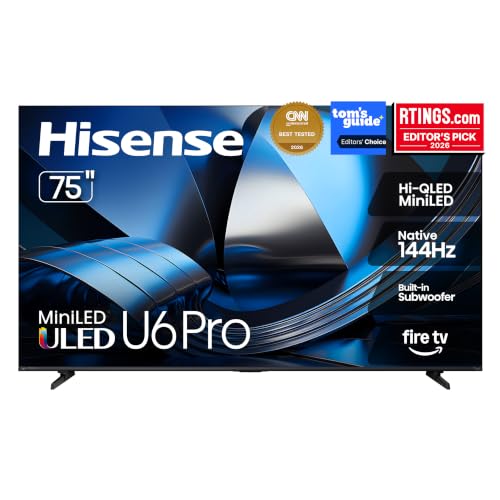
Hisense 75 U6 Pro Mini LED TV — The gaming muscle pick
The U6 Pro is the most assertively specified set in this guide. Read its listing as a challenge: a 75-inch U6 Pro Series Mini-LED ULED 4K UHD HDR gaming AI smart Fire TV for 2026, with Hi-QLED colour and a native 144Hz rate. Every phrase is aimed at a buyer who cross-examines televisions, and the combination — Mini LED backlight authority, quantum colour, and a refresh figure usually found in gaming-monitor conversations — lands differently at 75 inches, where fast motion has the largest canvas on which to either smear or shine.
For console and PC households, this is the big wall that speaks their language fluently. A native 144Hz panel accepts high-frame-rate play at a scale that turns racing and shooters into room events, while Mini LED zones keep HDR highlights and shadow detail simultaneously honest during film. Fire TV underneath supplies the streaming and Alexa layer, so the set’s personality splits cleanly: gaming instrument when the console wakes, family screen when it sleeps. Hisense has been building its reputation on exactly this kind of specification density, and the U6 Pro is that strategy at full stretch.
Balance requires naming what the listing does not emphasise. The U6 Pro’s pitch is power, not calm; households devoted to Roku’s neutrality or Samsung’s processing polish will find their champions elsewhere in this six. Fire TV’s suggestion-led home screen also asks the household to enjoy Amazon’s editorial style at wall scale. And a set engineered for intensity deserves a room that uses it — a dim, small viewing corner will never call on its brightness or its refresh headroom.
Picture its natural home: a media room or open living space with a current console, a gaming PC within reach, sport on bright weekends and blockbuster films after dark. In that home the U6 Pro is not one option among six; it is the shortlist. Specification-led buyers sometimes get accused of buying numbers, yet at 75 inches the numbers on this listing describe experiences — fluidity, brightness, contrast — that the whole room will feel.
Hisense calling it a Pro, and a 2026 model, signals the intent to be judged against flagships rather than against its own price-class history. On the evidence of its listing, that judgement is one it can survive.
PC builders scouting a room-scale display will read the U6 Pro’s listing with particular attention. A native 144Hz Mini LED panel at 75 inches can anchor a living-room gaming rig in a way that blurs the line between television and monitor entirely, and the Fire TV layer means the same screen reverts to family duty without a cable being touched. Dual citizenship at this scale is rare and valuable.
- Panel: 75-inch class Mini-LED ULED
- Colour in listing: Hi-QLED
- Resolution: 4K UHD HDR
- Refresh rate in listing: native 144Hz
- Platform: Smart Fire TV, gaming AI
- Model: 75U6SF Pro, 2026
Strengths
- Native 144Hz motion on a 75-inch canvas transforms console and PC play.
- Mini LED backlighting gives HDR scenes brightness and shadow control together.
- Fire TV and Alexa keep the gaming instrument friendly for the whole household.
Trade-offs
- Its intensity is surplus in small, dim rooms that never stress a panel.
- Fire TV’s promotional rows will not charm interface minimalists.
- Film-processing pedigree shoppers may still audition the Samsung pair first.
Best for: the media room where a console or gaming PC meets the biggest wall, and fast content rules the week.
Not suited for: a quiet, shaded viewing corner, or a household committed to Roku’s calm or Samsung’s ecosystem.
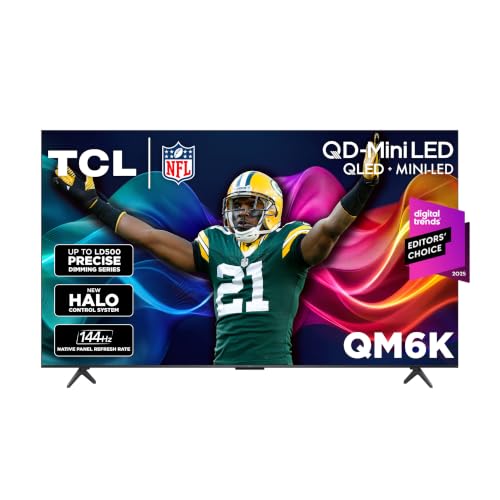
TCL 75 QM6K Mini LED TV — The bright-room athlete pick
TCL’s QM6K carries the formula that defined its smaller sibling up to the size where it matters most. The listing specifies a 75-inch QLED Mini LED 4K HDR Google TV at 144Hz, with high brightness and IMAX Enhanced among its credentials. At 75 inches, brightness stops being a luxury line and becomes the price of admission for rooms with real windows, and the QM6K’s whole engineering posture — Mini LED zones, high light output, fast native refresh — reads as a set designed to win the afternoon as convincingly as the evening.
The 144Hz figure pairs with that brightness to cover the two hardest contents a big screen faces: fast sport in daylight and fast games at any hour. Google TV supplies the discovery layer, with profiles that let a multi-viewer household keep its recommendations separate on the shared wall, and IMAX Enhanced in the listing signals that supported film content gets a presentation standard to aim at. TCL has spent years arguing that flagship sensations should not require flagship rituals, and the QM6K is that argument at its largest and most confident.
Comparisons inside the guide are instructive. Against the Hisense U6 Pro, the QM6K trades Fire TV for Google TV and matches the refresh headline — platform taste may decide between two very athletic sets. Against Samsung’s M70H, it offers printed numbers where Samsung offers processing pedigree. Its own concessions are the class’s: Google TV asks a little configuration to feel personal, and a shaded cinema room will use only a fraction of its brightness arsenal.
The buyer it suits best is easy to picture: a bright, open room, a household that watches afternoon sport with the curtains open, games after dark, and films on the biggest canvas the wall allows. That buyer has historically been told to choose between brightness and motion; the QM6K’s listing declines the choice, and at 75 inches declining it is a serious proposition.
Longevity flatters it too. High native refresh, current Mini LED architecture and a current platform give the QM6K a long runway before either games or services outgrow it, which matters when the screen is a room’s anchor rather than an appliance on rotation.
Sunroom and conservatory owners are the QM6K’s most natural constituency, rooms where other televisions simply concede the afternoon. A panel that holds its picture against that much glass changes how the room gets used — sport moves to the sunniest seat in the house instead of the darkest — and that relocation of family life is the real product being sold here.
- Panel: 75-inch class QLED Mini LED
- Resolution: 4K HDR
- Refresh rate in listing: 144Hz
- Platform: Smart Google TV
- Brightness in listing: high brightness
- Certification named in listing: IMAX Enhanced
- Model in listing: 75QM6K
Strengths
- Mini LED brightness keeps a huge picture authoritative in sunlit rooms.
- A 144Hz native rate serves sport and games with equal fluency.
- Google TV profiles suit multi-viewer households sharing one giant screen.
Trade-offs
- Its brightness arsenal is underused in a controlled, dark cinema room.
- Google TV rewards setup effort that Roku households may not enjoy.
- Processing-led buyers may prefer Samsung’s approach to the same problems.
Best for: the bright open-plan room where afternoon sport and evening games share one very large screen.
Not suited for: a permanently darkened cinema, or a household that wants the simplest possible smart interface.

Samsung 75 Q7F QLED TV — The polished all-rounder pick
The Q7F is Samsung’s other answer in this guide, and it differs from the M70H in philosophy rather than merely in tier. Its listing describes a 75-inch QLED Samsung Vision AI smart TV from 2025 with Quantum HDR and Object Tracking Sound — colour, processing intelligence and audio ambition, without the Mini LED backlight headline. Read together, those phrases describe a set aimed at the complete living-room experience: a vivid QLED picture, Samsung’s current AI-framed processing, and sound that attempts to follow the action across a very wide screen instead of emanating politely from its centre.
Object Tracking Sound deserves its moment, because at 75 inches audio placement stops being a nuance. A ball crossing the screen, a car crossing a scene — sound that tracks the image widens the perceived stage in a way that matters more as the picture grows, and no other listing in this guide names an equivalent ambition. It will not replace a serious sound system, yet it raises the built-in baseline exactly where built-in baselines are most exposed. Quantum HDR, meanwhile, is Samsung’s HDR presentation under its Vision AI umbrella, tuned for the bright, colour-rich viewing this QLED panel is built for.
Where does it yield? To its sibling, on backlight finesse in the most demanding scenes, and to the gaming pair, on published refresh drama. The Q7F is a 2025 model beside several 2026 rivals, which buyers counting software runway should register. What it returns is balance with a famous badge: Samsung’s fit, finish and processing taste applied to a big QLED canvas, with the sound story as its distinguishing flourish. Households that watch everything and specialise in nothing are its natural constituency.
There is a furnishing argument as well. A 75-inch screen dominates a room’s aesthetics for a decade, and Samsung’s design discipline at this level — the slimness, the tidiness of the thing as an object — is part of what its buyers are purchasing. In a carefully kept living room, that object quality is not vanity; it is the difference between a wall that looks designed and one that looks equipped.
Choose the Q7F if your household’s week contains a bit of everything and your taste runs to polish over raw numbers. It is the guide’s most civilised all-rounder, and civilisation at 75 inches is a legitimate ambition.
The Q7F also suits the listener in the family — the one who notices when a soundtrack collapses into the centre of a wide screen. Its tracking-sound ambition speaks directly to that sensitivity, and households where music programmes, concerts and film scores fill the week will hear its distinguishing feature more often than gamers would miss the refresh headlines it declines to publish.
- Panel: 75-inch class QLED
- Resolution: 4K
- Platform: Samsung Vision AI Smart TV
- HDR named in listing: Quantum HDR
- Audio named in listing: Object Tracking Sound
- Model: 75Q7F, 2025
Strengths
- Object Tracking Sound raises built-in audio ambition where big screens need it most.
- QLED colour with Samsung processing gives bright rooms a vivid, composed picture.
- Flagship fit and finish suit rooms where the screen is a design object.
Trade-offs
- No Mini LED backlight, so its sibling keeps the contrast-finesse crown.
- A 2025 model beside 2026 rivals shortens the software runway slightly.
- No headline refresh figure is published for gaming-led comparisons.
Best for: the design-conscious main room that watches a bit of everything and values sound as part of the screen.
Not suited for: a refresh-rate-led gaming wall, or a buyer determined to own the newest model year.
How do the six compare side by side?
| Model | Panel / backlight | Refresh in listing | Platform | Defining trait |
|---|---|---|---|---|
| Insignia 75 QF | QLED | Not published | Fire TV | Value route to the size |
| Samsung 75 M70H | Mini LED | Not published | Samsung Vision AI Companion | Processing-led composure |
| Hisense 75 E6SR | Hi-QLED | Not published | Roku | Household-friendly breadth |
| Hisense 75 U6 Pro | Mini-LED ULED, Hi-QLED | Native 144Hz | Fire TV | Gaming muscle |
| TCL 75 QM6K | QLED Mini LED | 144Hz | Google TV | Brightness with pace |
| Samsung 75 Q7F | QLED | Not published | Samsung Vision AI | Polish plus tracking sound |
The table sorts the six by their governing idea. Brightness and backlight authority live in the Mini LED row of the family — M70H, U6 Pro, QM6K — while colour-led value and polish live with the QF, E6SR and Q7F. Refresh transparency splits the guide cleanly too: the two gaming athletes publish 144Hz, the rest publish nothing, and readers should let that honesty inform them rather than filling silences with hope. Platform, as ever, is the tiebreaker that daily life feels most.
How should you set up a 75-inch television once it is on the wall?
Give the picture three honest presets and teach them to the household: a bright daytime mode that uses the panel’s headroom for sport and family viewing, an evening mode with motion smoothing restrained for series and film, and a game configuration on the console’s input wherever the set provides one — the U6 Pro and QM6K were bought for their refresh credentials, and those credentials only exist when the chain from console to panel is set up to carry them. Verify the console’s own display output after connecting; the handshake is where high-refresh purchases most often fail silently.
Sound at this scale deserves the same deliberateness as the mount. A screen this wide makes built-in audio’s limits obvious in film and stadium scenes, and the Q7F’s tracking-sound ambition is best read as a raised baseline rather than a finished answer. Plan the soundbar’s position and cable path during installation, not after the first disappointing film night, and set dialogue clarity as the test every arrangement must pass at the household’s real listening volume.
One more installation habit separates the settled rooms from the restless ones: photograph the back of the setup before the set goes flat to the wall. Input positions, cable routes and the soundbar’s connections, captured once, save every future device swap from becoming an archaeological dig conducted by torchlight behind a very large screen. Consoles arrive, streaming boxes change, relatives bring things to plug in — the photograph turns each of those moments into a two-minute job instead of a furniture-moving expedition.
Finish with light discipline. Note where the room’s lamps and windows land on the screen at viewing hours, reposition what can be repositioned, and let the Mini LED owners enjoy the headroom they bought while QLED owners choose the evening modes that flatter their panels. A weekend of this calibration turns a delivered television into a room’s settled centre, and it is the cheapest performance upgrade in this entire guide.
What mistakes do buyers make when going this large?
The first is measuring the wall and forgetting the journey — doors, stairs, corners and the human hands available on delivery day. The second is mounting by instinct: at 75 inches, a screen hung at standing eye level taxes every seated neck in the room, and the error is large enough to require re-drilling to fix. Tape first, sit down, and let the sofa set the height.
The third mistake is buying brightness for a dark room or darkness credentials for a bright one. This guide’s Mini LED trio exists for rooms with real daylight; a controlled cinema space can spend the same money on colour, processing or platform and be happier. The fourth is neglecting the supporting cast — mount, stand width, sound, cable paths — and discovering that a flagship panel on inadequate furniture feels like a sports car on borrowed tyres. Budget the wall as a whole project.
There is also the matter of the old television’s afterlife, which at this size is rarely a small matter. The displaced set is usually large enough to need a plan — a bedroom wall, a relative’s living room, a games room — and households that arrange the cascade before the new screen arrives avoid weeks of a spare television leaning in a hallway, silently auditing the purchase. Plan the succession as part of the project and the whole household upgrades at once.
Finally, buyers underestimate how completely a screen this size reorganises family life around itself, for better and worse. It will host gatherings, dominate arguments about what to watch, and become the backdrop of the room’s photographs for a decade. Choose the platform and the picture the household can love at that scale of presence, because at 75 inches there is no ignoring the purchase into the background.
Final Recommendation
A word about confidence before the verdict, because purchases this size attract second-guessing. Every set in this guide was verified against its own listing, every claim in the reviews traces to words the manufacturers themselves published, and the differences that remain between the six are differences of room, light and household rather than of basic competence. A buyer who has measured the wall, rehearsed the height and named the room’s brightest hour has already made the decisions that determine satisfaction; the model choice that follows is the enjoyable part, and it should be enjoyed rather than agonised over.
Let the room cast the deciding vote. Bright, open and game-filled: the Hisense U6 Pro and TCL QM6K are the athletes, separated mainly by Fire TV versus Google TV taste, with Samsung’s M70H as the processing-led choice for households that want composure over headlines. Shared, various and gathering-prone: the Hisense E6SR keeps everyone fluent and happy. Design-conscious all-round viewing points to the Samsung Q7F, and the first step onto a very large wall belongs to Insignia’s QF. Buy the set your brightest hour and your busiest evening both approve of, and a 75-inch screen stops being an extravagance and becomes simply the way your house watches things now. Within a month the wall will look as if it was always waiting for exactly that rectangle of light, and the only remaining question will be why the household waited so long to fill it.
Frequently Asked Questions
Does a television this size need a dedicated stand if it is not wall-mounted?
It needs a stand that is genuinely wide and level, with a surface the set’s feet can occupy fully and a structure rated for the weight. Many older television benches fail the width test before the weight test, so measure the foot span first; a wider, lower bench often suits these sets better than the tall unit the old screen sat on.
Is 75 inches too large for an ordinary living room?
Rarely, once the tape rehearsal has been done from the real seats. At 4K, seating can sit closer than older instincts suggest, and most rooms adapt to the scale within days. The genuine constraints are the delivery route, the wall’s width and the mounting height, all of which this guide asks you to check before ordering.
Why do three of the picks use Mini LED backlights?
Because at 75 inches, fine backlight control and high brightness solve the size’s two hardest problems: daylight competition and wide seating angles. Mini LED is the technology these listings reach for when a very large picture must stay composed in a real, bright room.
Which pick should a serious console player choose?
The two listings that publish native 144Hz rates — the Hisense U6 Pro on Fire TV and the TCL QM6K on Google TV. Choose between them by platform preference and room brightness habits; on published gaming credentials they stand together at the front of this guide.
Do I need a soundbar with a 75-inch TV?
For film and sport at the scale the picture promises, most households conclude yes. Built-in audio, even with the Q7F’s tracking ambitions, sketches what a bar delivers in full. Live with the set for a fortnight of real viewing first; if dialogue ever strains against the room, the decision has made itself.
What viewing distance works best at this size?
Most households settle somewhere between two and a half and four metres for film, near enough for the 4K detail and the sense of envelopment, far enough that the whole picture sits comfortably in view. Your tape rehearsal from the actual seats will find the household’s own number more reliably than any formula, and the seats can usually move a little even when the wall cannot.
Can one person install a 75-inch television?
Plan on two. The panel’s size makes it awkward and fragile to handle alone, whatever its weight, and mounting at this scale is a two-person job by any sensible standard. The rehearsal with tape, by contrast, is a fine solo activity and should happen before delivery day.
Should the television or the room come first when planning?
The room, every time. Its light, its wall, its seating and its delivery route decide which of these six will thrive, and they can all be assessed before a single listing is opened. Buyers who start with the room find the model choice narrows itself; buyers who start with a model often end up negotiating with a wall.
How future-proof is a 75-inch purchase today?
Resolution is settled at 4K for this size, so longevity turns on refresh headroom, backlight quality and platform currency. The 144Hz Mini LED picks and the 2026 models carry the longest runways on paper; matching the panel to your room matters more than any of them.


