What's inside
- Key Takeaways
- Quick Picks
- How We Chose These Picks
- What Is a Pro-Audio Midrange Driver, Exactly?
- How Is a Midrange Different From a Midbass or a Coaxial?
- How Do You Match an Amplifier to Drivers Like These?
- Where Do Multiple Midranges Actually Go?
- What Does a Midrange System Sound Like When It Is Right?
- How Do the Six Compare Side by Side?
- Why Does Efficiency Matter More Here Than Anywhere Else in Car Audio?
- How Should You Cross Over and Power a Midrange System?
- Which Music Gains the Most From a Real Midrange Band?
- A Note on Variants, Impedance and Buying Carefully
- What Are the Most Common Mistakes With Pro Midranges?
- What Does the Installation Sequence Look Like?
- How Long Do Pro Midranges Last in Door Duty?
- When Do Custom Pods and Panels Earn Their Cost?
- Should Rear Passengers Get Midranges Too?
- Final Recommendation
- Frequently Asked Questions
- Related Guides
As an Amazon Associate I earn from qualifying purchases. This post may contain affiliate links at no extra cost to you.
widgetverdict.com is reader-supported. When you buy through links on our site, we may earn an affiliate commission.
Where to buy: Four of the six drivers below carry checked Amazon listings and full links — the PRV 6MR400-4 pair, both DS18 models and the Skar FSX65-4. The remaining two, PRV’s slim 6MR250B and the DS18 PRO-GM6.4B, are covered as prose-only picks: real, current drivers in this class that we could not confirm a clean listing for, so they appear without links rather than with guessed ones.
The best 6.5 inch midrange speakers belong to a different species from the door coaxials in most guides, and confusing the two is the most expensive mistake in this corner of car audio. A midrange driver of the pro-audio school — the kind PRV, DS18 and Skar build for the SPL world — is a single-cone loudspeaker with no tweeter, designed to do one job at extraordinary volume: reproduce the band where voices, guitars, horns and snare drums live, roughly from the low hundreds of hertz up to several kilohertz, with an efficiency no coaxial can approach. It does not play deep bass. It does not play treble sparkle. What it does is get loud — genuinely, windows-down-at-highway-speed, heard-across-a-car-park loud — while staying clear, and it does that job better than any full-range speaker ever will.
That specialisation defines who this guide is for. If you are building a system with separate subwoofers handling the bottom and separate tweeters or bullet tweeters handling the top, and you need the middle to keep up, you are in the right place. If you are replacing factory door speakers and expecting one driver to do everything, you are not — these drivers would leave your music with a hole at each end, and the coaxial guides on this site are where you belong. Read the explainer sections carefully, because in the midrange world the crossover is not an accessory: it is the difference between a driver that sings for years and one that tears itself apart in a weekend.
Key Takeaways
- A pro-audio midrange is one band of a three-way system, not a full-range replacement. It needs a subwoofer below it and a tweeter above it, with crossovers enforcing the borders.
- Efficiency is the headline specification in this class: these drivers convert modest amplifier power into serious volume, which is the entire point of the category.
- The PRV 6MR400-4 is the reference pick — a matched pair with bullet phase plugs, strong power handling and the most balanced voice of the linked drivers.
- Never run these drivers full-range. Bass frequencies below their intended band will destroy them; a high-pass filter is mandatory equipment, not a suggestion.
- Voice-coil size and honest continuous power handling separate the serious drivers here from the merely loud ones; the DS18 PRO-ZXI6.4BM carries the biggest hardware of the linked four.
Quick Picks
| Pick | Badge | Why it earns its place |
|---|---|---|
| PRV Audio 6MR400-4 Bullet | Best overall midrange pair | Balanced, efficient and sold as a matched pair — the default choice for a serious vocal band. |
| DS18 PRO-X6.4BM | Best established workhorse | The red-bullet DS18 that built the brand’s door reputation, with deep installer knowledge behind it. |
| DS18 PRO-ZXI6.4BM | Best for high power | The heaviest motor and voice coil of the linked picks, for systems that will be fed properly. |
| Skar Audio FSX65-4 | Best budget entry | Sold individually at an entry price — the affordable way to learn whether the SPL midrange world suits you. |
| PRV Audio 6MR250B (prose-only) | Best slim fit | A shallow-mount midrange for doors and panels where the deeper bullet drivers will not physically fit. |
| DS18 PRO-GM6.4B (prose-only) | Best paper-cone alternative | A ferrite-magnet midrange with a more traditional cone character for builders who prefer it. |
How We Chose These Picks
Midrange selection starts with the band, not the brand. We looked for drivers whose published response genuinely concentrates on the vocal region — designs that accept a high-pass in the low hundreds of hertz and play cleanly up to where a bullet tweeter or compression driver can take over. Drivers that claim implausibly wide response for a single 6.5-inch cone were treated with suspicion, because in this class honesty about limits is a quality signal: the manufacturers who publish a sensible band are the ones whose drivers survive in real SPL builds.
Efficiency came next, and it is not a vanity metric here. The entire reason to accept a three-way system’s complexity is output per watt in the midrange, so sensitivity figures and the motor designs behind them — ferrite magnet size, voice-coil diameter, cone weight — carried heavy weight. A large voice coil matters for a second reason beyond power handling: it dissipates heat across more area, and heat is what ends loud sessions, either by cooking the coil or by the amplifier protecting itself. We favoured drivers whose thermal hardware matches their marketing.
Finally, we weighed the ecosystem around each driver. Pro-audio midranges are bought by builders who run four, six or eight of them across doors and rear decks, so per-unit versus pair pricing changes real budgets, and shallow variants matter because not every panel swallows a deep bullet driver. The two prose-only picks earned their places on exactly those grounds — fit and cone character — and are labelled plainly so nobody builds a purchase plan around a link that is not there.
What Is a Pro-Audio Midrange Driver, Exactly?
Take a conventional door coaxial apart in your mind: a woofer, a small tweeter on a post, a simple crossover. A pro-audio midrange deletes the tweeter, spends the entire budget on one optimised cone, and borrows its design language from live-sound reinforcement — the world of stage monitors and PA cabinets, where a driver must project a voice clearly across a noisy room. The cone is light and stiff, the suspension is tuned for control rather than deep excursion, the magnet is generous, and many models carry a bullet-shaped phase plug in the centre where a dust cap would sit on a woofer. That bullet is not decoration: it shapes the dispersion of the upper midrange and helps the driver behave at the top of its band, where it hands over to the tweeter.
The consequence that surprises newcomers is how little bass these drivers make. Their suspensions are deliberately too stiff and their excursion too limited for low frequencies, because every millimetre of travel spent chasing bass is clarity lost in the vocal band and heat gained in the coil. Played full-range at volume, a midrange does not just sound thin — it is mechanically abused, bottoming and distorting on notes it was never built to reproduce. This is why every serious build crosses them over, and why the how-to section treats the high-pass filter as part of the product you are buying.
How Is a Midrange Different From a Midbass or a Coaxial?
Three driver types share the 6.5-inch shelf and get confused constantly. A coaxial is a full-range compromise: woofer plus tweeter, designed to play everything passably from one hole. A midbass driver is a specialist for the octave above the subwoofer — the punch region — with a heavier cone, more excursion and a band that reaches down toward the sub and up only into the lower midrange. A midrange is the specialist for the voice itself: lighter, louder per watt, playing higher than a midbass comfortably can, and giving up the punch octave to do it. The companion guide to 6.5 midbass speakers on this site covers that neighbouring speciality in depth; the short version is that midbass feeds the chest, midrange feeds the ears, and a big system may run both, each in its lane.
Choosing between them is choosing which problem you have. If your system has a subwoofer and tweeters but the vocals drown when the volume rises, your problem is midrange. If vocals are clear but drums lack body, your problem is midbass. If everything is simply quiet and thin from one factory hole, your problem is that you need coaxials, and neither specialist will fix it alone.

PRV Audio 6MR400-4 Bullet — Best overall midrange pair
PRV came to car audio from Brazilian pro sound, and the 6MR400-4 is the driver that best explains the company’s reputation. It is sold as a pair — a small thing that matters when you are filling two doors — and each driver pairs a treated paper cone with an aluminium bullet phase plug and a voice coil sized for real continuous power rather than a brochure number. Crossed over correctly and fed from a proper amplifier channel, the pair produces the class-defining effect: vocals that stay articulate and forward at volumes where a coaxial system has collapsed into noise, with headroom still in reserve.
What distinguishes the PRV from the louder-on-paper competition is balance. Its upper midrange does not develop the shout that afflicts some SPL drivers at the top of their band, so long listening at high volume is less fatiguing than the spec sheet predicts. The paper cone deserves a word of defence for readers raised on synthetic materials: in a midrange, treated paper’s combination of lightness, stiffness and internal damping is exactly right, and these drivers live inside doors and panels rather than exposed to weather. Feed it clean power, respect the high-pass, and the 6MR400-4 is the driver the other five are measured against.
- Format: 6.5-inch midrange loudspeaker, sold as a pair
- Impedance: 4 ohm per driver
- Cone: treated paper with aluminium bullet phase plug
- Intended band: midrange only — high-pass filtering required
- Character: high efficiency, balanced upper midrange
Strengths
- The most composed voice here at full tilt — loud without the harsh edge that ends listening sessions early.
- Sold as a matched pair, which simplifies door builds and guarantees left-right consistency.
- Thermal headroom matches its rating; it sustains volume instead of fading as the coil heats.
Trade-offs
- Paper cone demands a reasonably dry mounting environment; it is not a marine driver.
- Depth and magnet size rule out the shallowest panels.
- Pair pricing makes a single replacement or a three-driver layout less convenient than per-unit rivals.
Best for: the core of a serious three-way SPL build, two or four across the front doors. Not suited for: shallow panels, wet locations, or anyone shopping for a full-range factory replacement.

DS18 PRO-X6.4BM — Best established workhorse
The PRO-X6.4BM, with its red aluminium bullet, is close to the default door midrange of the American SPL scene — the driver you see in build after build, which creates a practical advantage no spec sheet captures: everybody knows how it behaves. Installers know where it likes to be crossed, how much power makes it happy, and what it sounds like in multiples across a door. Its rated handling — a substantial continuous figure with roughly double that as maximum — has been validated by sheer population: this model has survived more summers of abuse in more doors than almost anything else in the class.
Its character is a shade more aggressive than the PRV’s. The upper midrange presence that helps it cut through a loud system can edge toward forwardness in a small cabin at close range, which is a tuning matter — crossover point and tweeter level solve it — rather than a flaw. The ferrite motor is not light, and a door carrying four of them is carrying real weight, so check your panel’s fasteners and add deadening with structure in mind. None of that dents the core proposition: if you want the known quantity, the driver with a decade of field evidence behind it, this is the one.
- Format: 6.5-inch midrange loudspeaker, sold individually
- Impedance: 4 ohm
- Bullet: red aluminium phase plug
- Power character: rated for substantial continuous amplifier power
- Magnet: ferrite motor structure
Strengths
- Field-proven at scale — behaviour, crossover points and durability are documented by a huge installed base.
- Cuts through a loud system effortlessly; vocals stay present over serious subwoofer output.
- Per-unit sale suits three, four and six-driver layouts without buying spare pairs.
Trade-offs
- Forward upper midrange needs tuning care in small cabins to avoid fatigue.
- Heavy ferrite motor adds real weight per door in multi-driver builds.
- The red bullet styling is a commitment — it will be seen, and not everyone wants that.
Best for: builders who value proven behaviour and plentiful real-world setup knowledge. Not suited for: listeners sensitive to an aggressive presence band, or weight-critical panels.

DS18 PRO-ZXI6.4BM — Best for high power
Where the PRO-X is the workhorse, the PRO-ZXI is DS18 turning the same idea up: a larger voice coil, a heavier motor and higher rated handling, aimed at systems whose amplifiers have genuine output to spend. The engineering logic is thermal. A midrange at high volume is a heater that occasionally makes sound, and the ZXI’s bigger coil spreads that heat over more metal and former area, which is what allows sustained output where a lesser driver would be smelling of hot glue. In a build with four or more midranges sharing a large amplifier, that margin is the difference between a system that plays all afternoon and one that protects itself quiet.
The condition attached is honest: this driver only justifies itself when the power is real. On a modest amplifier it sounds much like its cheaper sibling while costing more and weighing more, because its advantages live in the region beyond the smaller driver’s limits. Its depth and magnet diameter also make it the most demanding fit of the linked four. Buy it as part of a system whose amplifier, wiring and crossover are already specified to match, and it is the strongest tool here; buy it as a speculative upgrade for a mild system and you have purchased headroom you will never visit.
- Format: 6.5-inch pro-audio midrange, sold individually
- Impedance: 4 ohm
- Voice coil: larger-diameter coil than the PRO-X series
- Power character: the highest rated handling of the linked picks
- Motor: heavy ferrite structure — check mounting depth
Strengths
- Best sustained-output hardware here — built for long, loud sessions on real amplifier power.
- Shares the DS18 ecosystem’s mounting familiarity and availability.
- Headroom means the driver stays composed where smaller coils begin to strain.
Trade-offs
- Pointless overspend on a low-power system; its virtues need watts to appear.
- Largest and heaviest fit of the linked four — measure before committing.
- Still a midrange: the amplifier and crossover budget must grow with it.
Best for: high-power multi-driver builds with amplifiers specified to match. Not suited for: mild systems, shallow doors, or first-time midrange buyers learning the class.
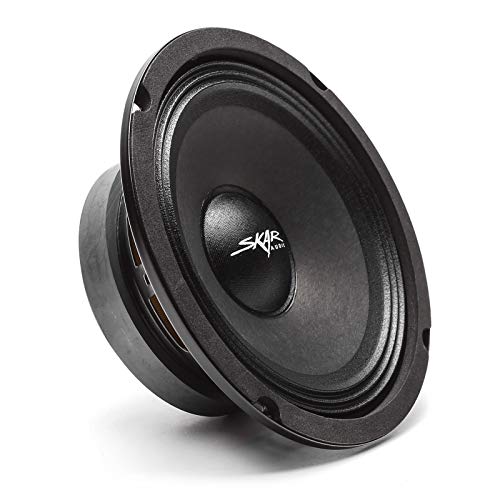
Skar Audio FSX65-4 — Best budget entry
The FSX65-4 is how Skar invites you into the pro-audio midrange world: a single 4-ohm driver, a ferrite magnet, a treated cone with a distinctive surround, and a price that makes a pair an experiment rather than an investment. Its efficiency is genuine — this is unmistakably a member of the loud family, not a coaxial in costume — and for a first three-way build, or for rear-fill midrange duty behind stronger front drivers, it performs well beyond what its cost prepares you for. Skar’s long run with this model also means mounting and crossover experience is easy to find.
The compromises are the expected ones. Its power handling is the most modest of the linked four, so it is the first to reach its limits in a high-output system, and its refinement at the top of its band trails the PRV — there is more edge to its presence region, which a careful crossover point can soften but not erase. Treat it as the class’s honest starter driver and it delights; treat it as a cut-price PRO-ZXI and it will be found out. Many builders start here, learn what their system actually needs, and later move the FSX pair to rear duty when the front upgrades — a career path this driver handles gracefully.
- Format: 6.5-inch pro-audio midrange, sold individually
- Impedance: 4 ohm
- Magnet: ferrite
- Power character: modest continuous handling — the gentlest appetite here
- Role: entry driver and rear-fill duty
Strengths
- The affordable way to find out whether the SPL midrange approach suits your build.
- Real efficiency — unmistakably louder per watt than any coaxial.
- Long production run means plentiful setup knowledge and easy matching replacements.
Trade-offs
- Lowest power ceiling of the linked four; outgrown by serious systems.
- Presence region has more edge than the PRV at the top of its band.
- Sold individually — remember to order the count your layout actually needs.
Best for: first midrange builds, budget three-way systems and rear fill. Not suited for: high-power front stages, or listeners who prize smoothness above output.
PRV Audio 6MR250B (prose-only) — Best slim fit
Every midrange shortlist needs an answer to the door that says no. The 6MR250B is PRV’s slim-profile midrange, built for exactly the panels, shallow doors and tight custom pods where a full-depth bullet driver physically cannot go. It keeps the family recipe — treated cone, efficiency-first design, a voice aimed at clarity — in a shallower basket, accepting the physics that follow: less motor and less thermal mass than the 6MR400, and a lower ceiling on sustained output. Within those limits it is not a consolation prize. A slim midrange that fits is infinitely louder than a great midrange that does not, and in builds where the alternative was no midrange at all, the 250B is the driver that saves the three-way layout.
We cover it without a link because we could not confirm a clean current listing for it at checking time, and in a class where model suffixes multiply, guessing a listing risks sending you to the wrong driver entirely. Source it from a PRV dealer by its exact name, confirm the slim depth against your panel measurement before paying, and cross it over with the same discipline as any other pick here — shallow refers to its basket, not to any exemption from filtering. Doors with limited depth, motorcycle and powersports pods adapted to 6.5-inch drivers, and rear-deck panels over shallow cavities are its natural homes.
- Format: 6.5-inch slim-profile midrange
- Impedance: 4 ohm class
- Design aim: shallow mounting depth for restricted panels
- Power character: below the 6MR400-4 — plan amplifier channels accordingly
- Availability note: prose-only in this guide; buy by exact model name from a dealer
Strengths
- Fits the doors and pods that reject every other driver on this list.
- Keeps PRV’s efficient, vocal-first character in the slim format.
- Enables three-way layouts in vehicles that would otherwise be coaxial-only.
Trade-offs
- Lower sustained-output ceiling than its full-depth sibling.
- No verified link here — sourcing takes a dealer conversation rather than a click.
- Slim basket still needs a proper high-pass; shallowness changes fit, not rules.
Best for: depth-restricted doors and pods that must have a true midrange. Not suited for: maximum-output builds where full-depth drivers fit fine.
DS18 PRO-GM6.4B (prose-only) — Best paper-cone alternative
The PRO-GM6.4B represents the more traditional branch of DS18’s midrange family: a ferrite-motor driver with a paper cone and a conventional dust-cap presentation rather than the shout of a coloured bullet. Builders who have run both styles describe the difference in terms of texture — the GM’s delivery is a little less projected, a little more rounded in the presence band — and in systems that play jazz, acoustic and vocal music loudly rather than chasing maximum SPL, that rounding is a feature. It remains an efficiency-first pro driver in every way that matters: it wants a crossover, it wants a subwoofer beneath it, and it will embarrass a coaxial for volume.
Like the slim PRV, it appears here without a link because a clean listing could not be confirmed, and DS18’s catalogue is large enough that near-name models are a genuine trap. If its character sounds like your system, order by the full model code from an authorised source and verify the impedance — this family includes variants, and a mismatched impedance across a multi-driver door changes what your amplifier sees. As a prose-only pick it also makes a useful benchmark in dealer conversations: describe the system, name this driver, and a good dealer will either supply it or explain precisely what they would substitute and why.
- Format: 6.5-inch midrange loudspeaker
- Cone: paper, conventional dust-cap design
- Magnet: ferrite motor
- Character: slightly rounder presence band than the bullet models
- Availability note: prose-only in this guide; verify variant and impedance when ordering
Strengths
- The gentlest top end among these pro drivers — suits acoustic and vocal material at volume.
- Traditional ferrite-and-paper construction with a long service record in the class.
- Blends more discreetly in builds that avoid the bullet-driver look.
Trade-offs
- No verified link here, and near-name variants make careless ordering risky.
- Gives up a little projection to the bullet designs in very loud systems.
- Paper cone still demands a dry mounting environment.
Best for: loud-but-musical builds that favour texture over maximum projection. Not suited for: buyers who want a one-click purchase, or outright SPL competitors.
How Do You Match an Amplifier to Drivers Like These?
Amplifier matching for pro midranges inverts the usual car-audio problem. With ordinary speakers you hunt for enough power; with drivers this efficient, the amplifier’s job is less about reaching loudness — a modest channel gets painfully loud — and more about control, cleanliness and surviving the load you wire. Start from the final driver count and work backwards. A pair of 4-ohm midranges, one per door on its own channel, is the simplest case and suits the PRV pair or a single DS18 or Skar per side. Two drivers per door wired in parallel halve the impedance the channel sees; the same two in series double it and share power between them. Neither is wrong, but the amplifier must be chosen for the number you actually create, and its output at that impedance is the figure that matters — not the headline figure at the impedance you are not using.
Gain setting deserves more care than it usually gets in this scene. Because these drivers are so efficient, a system can reach damaging listening levels with the gain well below where distortion becomes obvious, and the first warning of excess may be your ears rather than the equipment. Set gains with the crossover already in place, using familiar vocal recordings at the loudest level you genuinely intend to use, then leave them alone. If passengers keep asking you to turn it down, the system is not too loud — your gain structure is simply set for a demonstration you are not giving. The headroom these drivers offer is best spent as cleanliness at sane levels, which is where the PRV’s composure and the ZXI’s thermal margin quietly pay you back every day.
Channel count planning matters too. A four-driver front stage plus tweeters plus a subwoofer is at least a five- or six-channel problem once each band gets its own amplification and crossover control, and builders regularly underestimate the wiring and current draw that follows. None of this is a reason to avoid the class — it is the reason the class delivers what coaxials cannot — but it does mean the midrange purchase should be the second decision, after the system architecture, never the first impulse buy that the rest of the system must then be designed around.
Where Do Multiple Midranges Actually Go?
The classic layout puts one midrange low in each front door, where the factory driver lived, with a bullet tweeter high in the door, sail panel or A-pillar. That two-per-side arrangement — midrange plus tweeter — is the configuration every pick here handles well, and it is where a first build should stop until the tuning is understood. Beyond it, the SPL world adds drivers: a second midrange per door in a custom panel, midranges across the rear doors or deck, sometimes a row of them in a tailgate or demo wall. Each addition multiplies output and multiplies the demands on panel rigidity in equal measure. A door that flexes under two working midranges wastes their output as vibration and adds rattles that no tuning can remove, so panel reinforcement and deadening scale with driver count, not as an afterthought but as part of the same purchase.
Staging is the subtle casualty of enthusiasm. One well-placed midrange per side, crossed and level-matched with its tweeter, images a voice in front of you. Four per side, at slightly different distances and angles, sum into sheer presence — thrilling for demonstration, less precise for imaging. Neither goal is wrong, but they are different goals, and the builder who knows which one they are chasing will choose differently: the PRV pair and careful placement for the imaging build; multiples of the DS18 or Skar for the presence build, where per-unit pricing and proven behaviour in gangs are exactly what the PRO-X and FSX exist for.
What Does a Midrange System Sound Like When It Is Right?
The test material is voices, because voices are the job. A well-tuned midrange band puts a singer in front of the band rather than inside it: consonants are crisp without spitting, chest resonance is present without boom, and a backing choir separates into people instead of blending into wallpaper. Snare drums crack with a woody body under the snap. Electric guitars occupy their own layer, so a second guitar entering does not turn the first to mush. If your system does these things at the volume you actually use, it is right, regardless of what any meter says.
The faults have signatures worth learning. Harshness that grows with volume usually means the top of the band is running too high into cone breakup — lower the low-pass or steepen it. A shouty, honking quality on male vocals points at a peak in the presence region, often helped by crossover adjustment before EQ. Thinness despite loudness means the hand-off below is wrong: the subwoofer or midbass is not meeting the midrange, and the gap sits exactly where vocal body lives. And distortion that arrives as a sudden roughness across everything is almost never the midrange itself — it is the amplifier or source clipping upstream, which efficient drivers reproduce with embarrassing honesty.
How Do the Six Compare Side by Side?
| Model | Sold as | Power ceiling | Character | Fit note |
|---|---|---|---|---|
| PRV 6MR400-4 | Pair | High | Balanced, composed | Standard depth |
| DS18 PRO-X6.4BM | Each | High | Forward, proven | Heavy motor |
| DS18 PRO-ZXI6.4BM | Each | Highest here | Headroom first | Deepest fit |
| Skar FSX65-4 | Each | Modest | Eager, edged | Standard depth |
| PRV 6MR250B | Prose-only | Moderate | Balanced, slim | Shallow |
| DS18 PRO-GM6.4B | Prose-only | High | Rounded, traditional | Standard depth |
The table’s honest message is that these drivers differ less in kind than in ceiling and fit. All six want the same system around them. Choose by the amplifier you own and the panel you must fit: the PRV pair for balance, the PRO-X for proven behaviour, the ZXI when power is abundant, the Skar when budget leads, and the two prose-only drivers when depth or cone character is the deciding constraint.
Why Does Efficiency Matter More Here Than Anywhere Else in Car Audio?
Efficiency is a multiplier on everything else you own. A driver that makes more sound from one watt makes the same sound from a smaller amplifier, draws less current from the car’s electrical system for a given volume, and leaves headroom — the gap between normal level and the edge of distortion — everywhere in the chain. In a midrange system that headroom is spent on transients: the snare crack, the consonant at the start of a word, the horn stab. Those peaks are brief and much louder than the average level, and a system without headroom shaves them off, which the ear hears not as quietness but as dullness. This is the technical core of why a modest amplifier driving efficient PRVs can sound more alive than a large amplifier driving inefficient coaxials: the peaks survive.
It also explains the class’s one genuine danger, mentioned earlier and worth repeating in this context: efficient drivers make high sound levels feel effortless, and effortlessness removes the feedback that normally tells you to stop. Distortion is the body’s usual warning that volume is excessive; remove it, and the warning goes with it. Set a maximum level when you tune the system, mark it mentally, and treat it as a redline. Your future hearing is part of the system’s specifications too.
How Should You Cross Over and Power a Midrange System?
The high-pass filter is the midrange’s seatbelt. Set it in the low hundreds of hertz — the exact point depends on the driver and how hard the system will be driven, with higher crossover points buying safety and output at the cost of handing more work to the midbass or subwoofer. Use the crossover in your amplifier or processor rather than a passive guess, and err steep: a sharp slope keeps bass energy out of the coil far better than a gentle one. The low-pass at the top of the band matters too, handing over to the tweeter before the cone’s natural breakup region; most of these drivers are happiest surrendering the top somewhere in the region where a bullet tweeter wakes up.
Wiring multiples is the other discipline. Two 4-ohm drivers in parallel present a 2-ohm load; four can present 1 ohm or 4 depending on series-parallel arrangement, and your amplifier’s stability and output change completely with each choice. Plan the final impedance before buying the amplifier, not after. Keep gains conservative during the first sessions: pro midranges are efficient enough that a system can be painfully loud before any driver sounds distressed, and your ears are part of the equipment list. If it is loud enough to shout over at arm’s length, it is loud enough to damage hearing over an afternoon — the clarity of these drivers disguises level, which is their charm and their hazard.
Which Music Gains the Most From a Real Midrange Band?
Anything built around a human voice gains first. Soul, country, singer-songwriter material and hip-hop all place the voice at the centre of the mix, and a dedicated midrange returns the favour by giving that voice its own hardware instead of sharing a cone with the kick drum. Live recordings gain disproportionately too: the ambience and crowd of a live album live in the midrange, and a system that reproduces this band cleanly at volume recreates the sense of a room in a way that quiet hi-fi tricks cannot. Rock’s rhythm guitars, jazz horns and brass, and the snare that drives almost every backbeat ever recorded — all midrange citizens.
Electronic music is the interesting edge case. Its leads and pads certainly live in this band, but its identity often sits in the sub-bass, so an EDM-first build should fund the subwoofer before multiplying midranges. Conversely, the listener whose library is talk — podcasts, sports radio, audiobooks — is secretly a midrange listener: intelligibility is a midrange specification, and one of the underreported pleasures of a proper midrange band is speech that stays clear at motorway volume with the windows cracked, where a coaxial system turns commentators into mumbling. If your driving is half music and half voices, weight this guide’s advice more heavily, not less.
A Note on Variants, Impedance and Buying Carefully
This class is sold in a thicket of near-identical model names. DS18 and PRV both offer the same basic driver in different impedances, with and without bullets, in shallow and standard baskets, and a suffix letter is often the entire difference between the driver you planned and the one in the box. The discipline is boring and absolute: order by the full model code, confirm the impedance printed on the delivered driver’s terminal or box before installation, and never mix impedances across a wired group on the assumption that they will average out — they will not; the lower-impedance driver will take more power and the group’s behaviour stops matching anything you planned.
Second-hand midranges are common in this scene and can be good value, with one inspection that matters above all: the cone and surround for signs of bass abuse. A driver that has lived full-range often shows a creased cone edge, a surround separating from the basket, or a voice coil that rubs audibly when the cone is pressed gently and evenly by hand. Any of those means the driver’s history includes exactly the treatment this guide warns against, and its remaining life is borrowed. A clean used pair of 6MR400s with honest history is a better buy than a battered pair of flagship drivers at the same money.
What Are the Most Common Mistakes With Pro Midranges?
Running them full-range is the classic, and it destroys drivers with mechanical inevitability — every bass note below the band slams a suspension that was never given the travel for it. Second is expecting bass from them and then boosting the low EQ to compensate, which is the same mistake administered through the head unit. Third is pairing them with no tweeter plan and complaining the system sounds dull: the dullness is the missing top octave, and it was in the design from the start.
Fourth is buying by maximum wattage, which in this class is the least honest number on any box; continuous handling and voice-coil size are the figures that predict survival. Fifth is wiring four drivers to an impedance the amplifier cannot drive and blaming the speakers when the amplifier shuts down. And sixth — the quiet one — is mounting paper-cone midranges in doors with known water intrusion and no protection, then blaming the cone material when a wet season ends them.
What Does the Installation Sequence Look Like?
Plan the job in the order that prevents rework. First, decide the final driver count and wired impedance, and confirm the amplifier suits both. Second, set the crossovers before the drivers ever play — high-pass engaged, low-pass engaged, gains at minimum — because the most dangerous moment in a midrange’s life is the first full-range test blast from an installer checking whether it works. Third, mount with the panel’s rigidity in mind: a firm baffle, a sealed mounting surface, fasteners that will not loosen under a heavy ferrite motor’s vibration. Fourth, wire tweeters on their own crossover or capacitor arrangement as their design requires, never bare in parallel hope.
Only then power up, at low volume, with a vocal recording you know well. Bring the midrange gain up until the voice sits naturally over the subwoofer, then set the tweeter level against it — most first builds end with the tweeters too loud, because new tweeters are exciting, and a week later the owner wonders why the system fatigues. Live with the tune for several days before judging it; your ears recalibrate, and settings that seemed polite on day one often prove correct. Keep notes of crossover points and gains as you go. In a multi-band system, the difference between a tune you can return to and a tune you once had is a notebook page.
How Long Do Pro Midranges Last in Door Duty?
Used inside their band, these are long-lived drivers — the failure modes are almost all self-inflicted. Bass below the crossover cooks and tears; clipping from an overdriven amplifier overheats coils; water in a door attacks paper cones and terminals. Avoid those three and a set of PRVs or DS18s will outlast the vehicle plan you bought them for. The surround materials in this class are chosen for control rather than excursion, and they age gracefully when not asked to flap. Periodically — once a year is plenty — pull a panel, check fasteners for looseness, look for moisture trails, and confirm the crossover settings in the amplifier have not been bumped by luggage or curiosity. Ten minutes of inspection protects the entire investment, and it catches the slow faults, like a chafing wire in the door jamb, while they are still free to fix.
When Do Custom Pods and Panels Earn Their Cost?
Factory locations were designed for a lightweight full-range driver and a trim panel, not for a row of ferrite motors. The first upgrade — one midrange in the factory hole on a proper baffle — needs nothing custom. Custom work earns its cost at three thresholds. The first is depth: when the driver you want will not clear the window or the panel, a pod that spaces it outward solves geometry that no amount of wishing changes, and it is the honest alternative to the slim-driver compromise. The second threshold is count: the moment a door must carry two midranges and a tweeter, you are designing a panel, and a rigid, well-sealed fabricated panel will outperform any amount of hardware bolted to a flexing factory card. The third is aim: pods let you angle drivers toward the listening position, which matters more in the upper midrange than anywhere else, because that is where dispersion narrows and off-axis seats lose clarity first.
Against that, custom panels are the most over-bought item in this scene. They add weight exactly where hinges and latches least want it, they complicate every future door repair, and a badly sealed pod is acoustically worse than a factory hole done properly. The sequence that serves most builders is unglamorous: factory locations first, tuned well; live with the system for a season; then fabricate only to solve a limitation you can name — depth, count or aim — rather than to match a photograph of someone else’s build. The drivers in this guide will tell you when you have reached that point, because their output makes panel shortcomings audible long before it makes their own.
Should Rear Passengers Get Midranges Too?
In a front-stage-focused build, rear midranges are fill: they keep the cabin’s sound from collapsing toward the front when the fader is centred, and they give rear passengers the same vocal clarity the front enjoys. The sensible specification is a step down from the front — the FSX65-4 was born for this duty, and retired front drivers often migrate here when the front stage upgrades. Keep their level a touch below the front pair so the stage stays anchored ahead of the driver, and cross them identically; a rear band that starts lower than the front’s will boom against the seat backs and muddy the whole cabin. In trucks and SUVs where rear passengers are the point — family duty, crew transport — treat the rear doors as a second front stage instead, with the same sealing discipline and a driver of the front pair’s class. The rule is not really about speakers; it is about deciding whose ears the system serves, and being honest when the answer is everyone’s.
Final Recommendation
Build the system in your head before you buy any single driver: subwoofer below, tweeters above, crossovers at both borders, an amplifier chosen for the final wired impedance. Inside that system, the PRV 6MR400-4 pair is the recommendation for most builders — balanced, efficient and honestly rated. The PRO-X6.4BM is the proven alternative, the PRO-ZXI6.4BM the high-power escalation, and the FSX65-4 the right first step. Fit the slim PRV where depth demands it, and consider the PRO-GM6.4B where texture matters. Do that, and the middle of your music — the voices everything else exists to frame — will finally be the loudest, clearest thing in the car.
Frequently Asked Questions
Can I replace my factory door speakers with these midranges?
Not on their own. A midrange has no tweeter and no bass; swapped into a factory location by itself it leaves the music hollow at both ends. They belong in a system with a subwoofer and separate tweeters. For a one-step factory replacement, choose a coaxial instead.
What crossover settings should I start with?
Start with a steep high-pass in the low hundreds of hertz and a low-pass where your tweeters take over, then adjust by ear at moderate volume. If the drivers sound strained, raise the high-pass point before reaching for the gain. The amplifier or processor manual for your exact models deserves a read — these are starting points, not universal numbers.
How many midranges does a typical build use?
Two across the front doors is the sane starting point; four — two per door or doors plus rear — is common in louder builds. Each addition changes the wired impedance and the amplifier requirement, so plan the end state before the first purchase.
Do midrange drivers need an enclosure?
Generally no sealed box is required; they are designed for door and panel mounting with the cavity behind them. What they need is a firm, sealed mounting surface so the front and back waves stay separated, plus protection from direct water in wet doors.
Do I need a DSP, or is an amplifier crossover enough?
An amplifier’s built-in crossovers are enough to run this class safely and well — they provide the essential high-pass and low-pass borders. A DSP adds time alignment, per-driver level control and precise EQ, which refine an already-working system, particularly the image and the presence-band tuning. Buy the DSP after the basics are right, not instead of them; no processor setting can protect a driver the way a correctly set high-pass does, and protection comes first in every build in this guide.
Why do these drivers use paper cones?
Because for a midrange, treated paper offers an excellent stiffness-to-weight ratio with natural internal damping, which keeps the vocal band clean. It is a deliberate engineering choice in this class, not a cost cut — the trade-off is moisture sensitivity, which mounting location manages.
What tweeter should I pair with these drivers?
A bullet tweeter or small compression driver from the same pro-audio world is the natural partner — it matches the midrange’s efficiency, which a typical car-audio dome tweeter often cannot, leaving the top end quiet relative to the middle no matter how you set levels. Match sensitivities first, then set the crossover where both drivers are comfortable, and expect to pad the tweeter down rather than push the midrange up.
Are 8-ohm versions better for multi-driver doors?
They can be, because wiring arithmetic gets friendlier: pairs of 8-ohm drivers in parallel present a 4-ohm load, which most amplifiers drive happily. The picks in this guide are the 4-ohm versions because they suit one-per-channel layouts, but if your plan is two drivers per channel, the higher-impedance variants of the same families deserve a look — bought deliberately, by exact model code, not by accident.
Related Guides
Best 6.5 Midbass Speakers for Punch in the Doors · Best 6.5 Marine Speakers That Run Without an Amp · Best 6.5 Speakers for Harley-Davidson Touring Fairings



[…] story, read Best 6.5 Door Speakers for Bass Without a Subwoofer; for the vocal specialists, see Best 6.5 Inch Midrange Speakers for Loud, Clear Vocals; and for punch in the doors, continue to Best 6.5 Midbass Speakers for Punch in the […]
[…] Best 6.5 Inch Midrange Speakers for Loud, Clear Vocals · Best 6.5 Midbass Speakers for Punch in the Doors · Best 6.5 Marine Speakers That Run Without an Amp […]