What's inside
- Key Takeaways
- Quick Picks
- How We Chose These Picks
- What Exactly Is Wrong With Factory Speakers?
- How Do You Know Your Car Takes a 6.5 in the Front Doors?
- What Will a Speaker Swap Not Fix?
- How Does Factory Equalisation Change What You Should Buy?
- What If Your Car Already Has Factory Tweeters?
- How Does the Upgrade Interact With Everything Else the Stereo Does?
- Which Factory Upgrades Deserve Your Doors?
- Does the Source Material Change the Verdict?
- How Do the Six Factory Upgrades Compare Side by Side?
- What Tools and Time Does the Job Honestly Take?
- How Do You Do the Swap in a Driveway Without Breaking Trim?
- Will a Speaker Swap Affect Your Warranty, Lease or Resale?
- Fronts Only, or All Four Doors at Once?
- What Mistakes Do Factory Upgraders Keep Making?
- How Should You Judge the Result During the First Week?
- Final Recommendation
- Frequently Asked Questions
- Related Guides
As an Amazon Associate I earn from qualifying purchases. This post may contain affiliate links at no extra cost to you.
widgetverdict.com is reader-supported. When you buy through links on our site, we may earn an affiliate commission.
Where to buy: Each of the six pairs below links to its Amazon listing, and every one was chosen for the same narrow brief — it must run from the stereo your car already has, fit the holes your car already has, and fix the sound you already dislike. If a speaker needed an amplifier or a custom door build to justify itself, it did not make this list.
There is a specific moment that starts most searches for the best 6.5 inch car speakers: a song you know well comes on during an ordinary drive, you turn it up, and the car answers with a thin, buzzy version of it — vocals flattened, bass reduced to a papery thud, the top end either missing or spitting. Nothing is broken. That is simply what factory speakers are: the cheapest drivers a manufacturer could fit that would survive the warranty, usually a paper cone with a foam surround and a magnet the size of a coin, voiced by an equaliser curve designed to make them sound less weak at low volume. The good news hidden in that disappointment is that the factory speaker is the weakest link in the whole chain by a wide margin, so replacing it is the single upgrade that changes the most, for the least money and the least surgery.
This guide is deliberately narrower than a general 6.5 roundup. It assumes you are keeping the factory head unit, keeping the factory wiring, and doing the job in a driveway with hand tools. All six picks are coaxial speakers, because a factory upgrade is about restoring clarity and body to a system that stays otherwise standard, not about rebuilding the front stage. They differ in the ways that matter for that brief: how efficiently they turn a head unit’s modest output into volume, how their voicing suits a cabin full of glass and plastic, how shallow they mount in doors crowded with window hardware, and how gracefully they will age in a car that may change owners twice more before it retires.
Key Takeaways
- Every pick here is a coaxial designed to run on factory head-unit power — no amplifier, no rewiring, no crossover boxes to hide.
- Kicker’s CSC65 is the all-round factory upgrade: balanced, efficient and built with the fitment breadth the CS line is known for.
- Infinity’s REF-6532EX is the shallow-mount answer, a low-profile design for doors where window glass passes close behind the speaker.
- Pioneer’s TS-G1620F is the efficiency specialist, voiced and built to sound lively on the small output of an entry-level factory stereo.
- Rockford Fosgate’s P1650 brings the fullest midbass of the group, for owners whose main complaint is thinness rather than harshness.
- JBL’s GX628 leans bright and energetic, a good match for noisy cabins and soft factory voicings; Skar’s TX65 is the volume-per-dollar outlier with a tougher, pro-influenced build.
Quick Picks
| Pick | Badge | Why it earns its place |
|---|---|---|
| Kicker CSC65 | Best all-round factory upgrade | The CS-series coaxial that improves everything a little and offends in no direction. |
| Infinity REF-6532EX | Best for shallow doors | A reduced-depth Reference design made for tight factory locations. |
| Pioneer TS-G1620F | Best on weak factory stereos | High-efficiency G-series voicing that wakes up low-powered OEM systems. |
| Rockford Fosgate P1650 | Best for fuller midbass | Punch-series weight in the lower midrange where factory systems feel emptiest. |
| JBL GX628 | Best for clarity at speed | An energetic top end that keeps voices intelligible over road and wind noise. |
| Skar TX65 | Best loud-for-the-money build | Elite-series coaxial with a stout motor and a voice that carries. |
How We Chose These Picks
The factory-upgrade brief imposed filters that a general roundup would not use. First, sensitivity at low power outranked power handling at high power: a speaker that needs forty watts to wake up is a liability behind a head unit that delivers a fraction of that cleanly, so every pick here had to be known for sounding complete at modest volume. Second, mounting practicality was scored as heavily as sound — basket depth, the shape of the mounting flange, and whether the design tolerates the adapter brackets that most modern cars require. Third, we favoured rubber surrounds and synthetic cones over foam and paper, because a factory upgrade is often fitted to a car with years of service left, and the replacement should not repeat the original’s failure mode.
We also insisted on tonal variety rather than six versions of the same speaker. Factory systems fail in different directions — some are dull, some are harsh, some are simply thin — and the correct replacement depends on which failure you own. So this list contains a bright pick and a warm pick, a shallow pick and a full-bodied pick, an efficiency pick and a robustness pick. The analyses below describe each speaker’s character in those terms deliberately, because matching the speaker to your car’s existing sins matters more than any ranking. If you take one idea from the choosing process, take that: diagnose first, then shop.
What Exactly Is Wrong With Factory Speakers?
Factory speakers are engineered to a price measured in coins, and the compromises follow a pattern. The cone is usually paper or a paper blend because paper is light, cheap and sounds pleasant for the first year; the surround is foam because foam is compliant and cheap; the magnet is small because ferrite costs money and weight budgets matter across a production run of hundreds of thousands of cars. The system is then equalised at the head unit to disguise the result, typically with a bass lift at low volume that falls away as you turn it up, which is why factory stereos often sound acceptable in the showroom and fall apart on the motorway. None of this is incompetence. It is a rational allocation by a manufacturer who knows most buyers never compare, and it leaves an unusually large amount of quality on the table for the first owner who cares.
Age compounds the design limits. Foam surrounds absorb moisture from the door cavity and ozone from the air, and after some years they begin to crumble at the flex point; a surround that has lost its edge no longer controls the cone, so bass turns flabby and distortion rises at volumes that used to be clean. Paper cones in damp doors soften unevenly. By the time a car is eight or ten years old, its speakers are frequently not performing to even their modest original standard, which is why a replacement at that age can feel disproportionately dramatic — you are not merely upgrading, you are restoring, and the difference between a tired paper driver and any pick in this guide is the difference between a speaker and the memory of one.
How Do You Know Your Car Takes a 6.5 in the Front Doors?
Most cars do, but the label hides three different realities. Some doors take a true 6.5 with a round mounting pattern and generous depth. Some take the oversize variant often sold as 6.75, where a nominal 6.5 fits only on an adapter ring. And a growing number use a factory speaker moulded into a plastic pod or riveted to the door, where the replacement needs a bracket that reproduces the pod’s footprint and standoff height. The reliable checks are a fitment guide for your exact year and trim, or ten minutes with the door card off and a tape measure before ordering: note the diameter of the opening, the depth to the window glass with the glass fully down, and whether the factory unit is screwed, riveted or moulded.
Depth is the figure that catches people out, because it changes with the window’s position. Measure with the glass down — its lowest, most intrusive point — and leave a small margin beyond the magnet. Two picks in this guide exist largely because of this measurement: the Infinity REF-6532EX was designed with a reduced mounting depth for exactly these doors, and shallow choices like it turn a failed install into a finished one. If your car uses rivets, budget for a drill and replacement screws or clips; if it uses a pod, order the bracket at the same time as the speakers rather than discovering the need with the door in pieces on the driveway.
What Will a Speaker Swap Not Fix?
Setting the limits honestly makes the upgrade more satisfying, not less. A speaker swap will not add deep bass: a door-mounted 6.5, however good, rolls off where a subwoofer begins, and owners who expect sub-bass from door speakers will call every pick here a disappointment for a reason that has nothing to do with the picks. It will not fix a head unit whose amplifier clips early and hard, though efficient speakers postpone the clipping point usefully. It will not repair a door that rattles because its clips are broken and its skin is undamped, though the swap is the perfect occasion to address both while the card is off. And it will not move the soundstage up to the windscreen, because the tweeters remain in the doors; owners for whom imaging is the main complaint should be reading about component sets instead.
What it will fix is the broad middle of the experience: clarity of voices, separation between instruments, bass that sounds like notes rather than thuds, treble that exists without spitting, and the ability to listen at motorway volume without the sound hardening into a shout. For most owners that middle is precisely what they meant by better sound, which is why this modest job has the reputation it does. Go in expecting restoration and refinement, do the small installation jobs properly, and the result routinely exceeds the money.
There is one more expectation worth setting, about volume. Louder is the metric of the showroom, but in a car the useful metric is clean volume — how far the knob turns before the sound hardens. Factory speakers reach their distortion early because their small motors and tired surrounds lose control; the picks here stay composed several steps further up the same head unit’s range. Owners often describe the result as the stereo feeling bigger rather than louder, and that phrasing is accurate: the ceiling moved, even though the amplifier did not change at all.
How Does Factory Equalisation Change What You Should Buy?
Modern factory stereos are not neutral sources. Manufacturers voice them with equalisation curves tuned to the specific speakers fitted on the line — often a substantial bass shelf to make small cones sound full at low volume, a dip where the factory tweeter would otherwise shout, and protection that trims bass as volume rises so the cheap drivers survive. When you replace the speakers and keep the head unit, you inherit that curve, and it was drawn for a different speaker. This is why the same replacement can sound balanced in one trim of a car and boomy in another: the hardware is identical, the hidden curve is not, because trims with premium audio carry different tuning again.
The practical response is not despair but method. Begin with every user-facing control flat and any selectable sound modes off, then listen for what the inherited curve is doing: if the bass swells unnaturally at low volume and thins as you turn up, that is the factory loudness-style contour, and the cure is restraint — leave the bass control centred and let the new speakers’ natural output speak. If the midrange sounds scooped, with voices recessed behind instruments, the factory dip for its old tweeter is the suspect, and a speaker with a naturally present midrange, such as the Kicker or JBL here, compensates better than a laid-back one. Owners who later add a processor or an amplifier with input correction can remove the curve entirely, but for a factory upgrade the goal is simpler: choose the speaker whose native character leans against the curve your car already applies, and the two errors cancel into something like honesty.
What If Your Car Already Has Factory Tweeters?
A good number of cars above base trim run a component arrangement from the factory: woofers in the doors and small tweeters in the sail panels or dash corners, fed through a simple factory crossover, sometimes just a capacitor on the tweeter. Fitting door coaxials to such a car creates a doubled top end — the new coaxial’s tweeter firing at your ankles plus the factory tweeter still live above — which can sound busy or phasey, with cymbals and sibilants arriving twice. The symptom is subtle enough that many owners never identify it, describing the result only as less clean than expected for the money spent.
There are three clean ways through. The neatest is to disconnect the factory tweeters when fitting coaxials, letting the new speakers work as designed; the connection is usually a plug at the tweeter itself, reachable when the sail trim comes off. The second is to choose the component route instead and use the factory locations properly, which steps outside this guide’s coaxial brief but is the better engineering answer where the locations exist. The third, acceptable in cars where the factory tweeter is deeply buried, is to keep it and choose a coaxial with a restrained top end — the Rockford’s soft dome is the least likely here to fight the incumbent. What matters is deciding deliberately: count the tweeters your car will have after the upgrade, because the right number is two per side at most, and in a coaxial upgrade it is one.
How Does the Upgrade Interact With Everything Else the Stereo Does?
A factory head unit is no longer just a radio. It carries the reversing-camera beeps, the parking-sensor tones, navigation prompts, phone calls and the car’s warning chimes, all mixed through the same front speakers you are replacing. Better speakers change those sounds too, mostly for the better — navigation voices gain the same midrange clarity as sung ones, and call quality through the car’s system improves in a way passengers on the other end will not hear but you will. There are two cautions. In some cars the chime and alert volumes are calibrated against the factory speakers’ efficiency, so a much more sensitive replacement can make alerts startling until the car’s settings menu tames them. And in cars where the factory system performs active noise management or synthesised engine sound through the speakers, a change in the speakers’ response subtly changes those systems’ behaviour; the effect is rarely dramatic, but owners of such cars should expect the cabin’s artificial soundtrack to wear a slightly different voice.
Phone calls deserve a sentence of their own, because for many drivers the car stereo is now primarily a communications device that also plays music. Speech intelligibility lives between the low hundreds and the few thousand hertz, squarely where worn factory speakers are at their worst — muddy from a softened cone, distorted from a failing surround. Every pick in this guide improves that band, and drivers who take calls on the road often report the upgrade as a safety-adjacent improvement: less repetition, less squinting at sentences, more attention left for the road. It is an unfashionable reason to upgrade speakers and, for a large share of owners, the most honest one.
Which Factory Upgrades Deserve Your Doors?

Kicker CSC65 — Best all-round factory upgrade
If the brief is to name one pair of speakers for the widest range of ordinary cars and ordinary listeners, the CSC65 is the answer this guide keeps returning to. Kicker’s CS line is built around the factory-upgrade job specifically — a polypropylene cone with a ribbed surround that tolerates door life, a balanced dome tweeter that adds the top octave factory speakers omit without turning brittle, and a basket and mounting pattern designed to drop into the greatest possible number of factory locations. The sound is best described as everything the factory system was trying to do, completed: voices gain chest and clarity together, the bass tightens into something with pitch, and the whole presentation holds together at the volume where the original speakers began to buzz and flatten.
The CSC65’s particular virtue for a mixed audience is the absence of a vice to explain away. It is not the brightest pick here, nor the warmest, nor the shallowest; a family car carrying talk radio in the morning, a teenager’s playlist in the afternoon and a podcast at night will find it agreeable in all three shifts. Kicker also supports the CS line with the adapter ecosystem and documentation that first-time installers quietly depend on. Buy it when you do not have a specific complaint beyond the general poverty of the factory sound — it is the recommendation for the car you have not diagnosed because everything about its stereo is equally mediocre, which is most cars.
- Series: Kicker CS, coaxial design in the 160mm size
- Cone: polypropylene with ribbed, UV-treated surround
- Tweeter: balanced dome design for extended top end
- Impedance: 4 ohms, standard factory match
Strengths
- Even-handed improvement across every part of the range
- Fitment breadth and installer support are class-leading
- Sounds complete at the low power factory units provide
Trade-offs
- No single trait leads the group — specialists beat it at their speciality
- Midbass weight is moderate next to the Rockford
- Voicing is safe rather than exciting for enthusiasts
Best for: the general factory upgrade in cars used by several listeners. Not suited for: owners chasing one extreme, whether maximum brightness, depth or bass weight.

Infinity REF-6532EX — Best for shallow doors
The REF-6532EX exists because of a measurement: the distance between a door’s speaker mounting face and the window glass travelling behind it. In a surprising number of modern cars — compacts especially, and anything where the door was designed around side-impact hardware first and audio second — that distance defeats standard-depth speakers, and owners discover it with the door apart. Infinity’s answer in the Reference line is a shallow-mount design that trims the basket and motor depth so the speaker fits where others foul the glass, while keeping the family’s core recipe of a polypropylene cone and an edge-driven textile dome tweeter. Choosing it is not settling; it is the difference between an upgrade and an abandoned project.
Sonically it carries the Reference character — clean, open, a little luminous in the upper midrange — which suits factory systems that sound muffled, as a great many do behind their protective equalisation. Infinity also builds its car speakers at low impedance to draw more from factory amplification, so the 6532EX plays with a liveliness that belies its slim frame, subject to the usual quick check that an older factory amplifier is content with the load. In a deep door, buy it for its sound and enjoy the easy fit as a bonus; in a shallow door, it may be the only pick on this page that fits at all, and it is fortunate for owners of such cars that it also happens to sound this good.
- Profile: shallow-mount coaxial, Reference series
- Cone: polypropylene woofer, edge-driven textile dome tweeter
- Design note: reduced mounting depth for restricted doors
- Impedance: low-impedance design to draw more from factory power
Strengths
- Fits doors that reject standard-depth speakers
- Open, detailed voicing lifts muffled factory systems
- Efficient behaviour on head-unit power
Trade-offs
- Shallow motor gives up some low-end authority
- Low impedance deserves a compatibility thought on old amplifiers
- Bright-leaning balance may need a treble trim in glassy cabins
Best for: compact cars and any door with tight window clearance. Not suited for: buyers whose priority is the heaviest possible midbass from the doors.

Pioneer TS-G1620F — Best on weak factory stereos
Every range has an entry line, and Pioneer’s G-series is usually where the brand’s value engineering is most visible — in the good sense. The TS-G1620F was designed, in Pioneer’s own framing, as a stock upgrade for OEM power: a carbon- and mica-reinforced polypropylene cone that is light and stiff, driven by a motor sized for efficiency rather than bravado, with a balanced dome tweeter completing a speaker that asks very little of the amplifier feeding it. Behind the feeblest factory stereos — the base trims, the older cars, the work vehicles with a radio that seems to apologise — that efficiency is the whole game, because a speaker that sounds full at low drive levels makes the entire system feel less starved.
The G-series voicing is friendly: a gentle presence lift that helps voices through road noise, bass that is tidy rather than deep, and a top end that stays composed because Pioneer does not chase extension the cone cannot support. It is also, frankly, the pick here most likely to be bought twice for one car — fitted to the front doors first, then repeated in the rear once the owner hears the contrast — because its price class makes completing the set painless. Nothing about it pretends to be premium, and that honesty is its charm: it is the correct, unpretentious answer for the car whose stereo simply needs to stop being the worst part of the drive.
- Series: Pioneer G, coaxial two-way
- Cone: carbon/mica-reinforced polypropylene (IMPP)
- Brief: designed expressly as an OEM-power stock upgrade
- Tweeter: balanced dome, integrated
Strengths
- Sounds lively on the weakest factory head units
- Light, stiff cone keeps speech and midrange clear
- Easy to justify across all four doors
Trade-offs
- Build and materials are honest rather than luxurious
- Bass depth is the most limited here
- Amplified systems will outgrow it sooner than rivals
Best for: base-trim cars, older vehicles and low-powered factory stereos. Not suited for: owners planning an amplifier and a long-term system build.
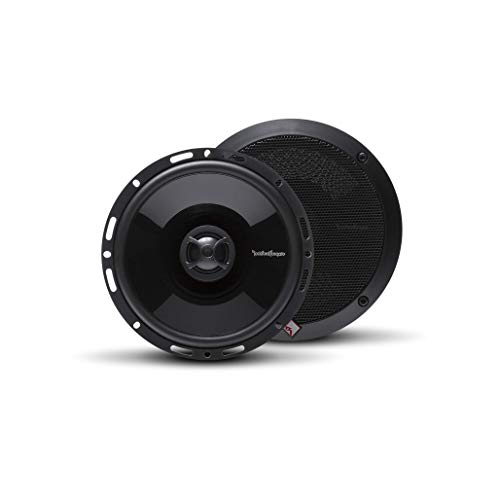
Rockford Fosgate P1650 — Best for fuller midbass
Approached from the factory-upgrade angle rather than the durability angle, the P1650’s claim on this list is weight. Thinness is the most common factory-system complaint after harshness, and it lives in the lower midrange — the region of male voices, cellos, rhythm guitars and the body of a kick drum — where small paper cones in leaky doors simply give up. The Punch coaxial’s mineral-filled cone and comparatively substantial motor produce a fuller account of that region than its rivals here, so a car that sounded like the music was happening in another room gains presence and warmth. Owners whose factory system is inoffensive but bloodless, the kind you keep turning up hoping to feel something, are this speaker’s natural audience.
That fullness is balanced by a presence region with enough lift to keep the sound from turning muddy in a noisy cabin, a balance Rockford has had years of production to settle. In the context of a factory upgrade there is a second, quieter argument for the P1650: it tolerates the factory head unit’s bass-heavy low-volume equalisation better than lighter-coned rivals, staying composed where they flap. Fit it, flatten the tone controls as this guide advises, and the combination is a car that sounds grown-up — not louder in any dramatic way, but filled in, like a sketch that has finally been shaded.
- Series: Rockford Punch, coaxial two-way
- Cone: mineral-filled injection-moulded polypropylene
- Character: fuller lower midrange than the group norm
- Tweeter: soft dome on the woofer axis
Strengths
- Fills in the thin, hollow quality of factory systems
- Composed under factory bass-boost equalisation
- Long production history and predictable behaviour
Trade-offs
- Warmth can crowd detail in already-bassy cabins
- Not the shallowest mount in the group
- Top-end sparkle trails the JBL and Infinity
Best for: owners whose factory sound is thin and distant rather than harsh. Not suited for: listeners whose main complaint is dullness in the treble.

JBL GX628 — Best for clarity at speed
Road noise is a masking sound, and it masks selectively: tyre roar and wind rush sit in the low and middle frequencies and bury exactly the consonants and attack transients that make speech intelligible and music feel alive. The GX628 answers with the classic JBL road-going recipe — an efficient polypropylene woofer using the brand’s Plus One cone-area trick, and a dome tweeter with a presence-forward voicing that keeps voices and detail on top of the noise floor of a moving car. In a quiet showroom that voicing can read as eager; at seventy on coarse tarmac it reads as clarity, and cars are listened to at seventy on coarse tarmac.
The GX line also brings JBL’s low-impedance approach to factory power, extracting more volume from the head unit than a conventional 4-ohm design, so the GX628 suits cars whose stereos feel underpowered as much as those that feel dull. The pairing to avoid is a factory system that is already bright or shouty, where the GX628’s energy compounds the problem; in such cars the Kicker or Rockford is the corrective. But for the common case — a soft, woolly factory voicing in a car with meaningful road noise, driven by someone who listens to speech and guitar music at real speeds — this is the pick that most obviously delivers the thing the owner asked for.
- Series: JBL GX, coaxial two-way
- Woofer: Plus One polypropylene cone for greater effective area
- Impedance: low-impedance design for factory amplification
- Voicing: presence-forward, tuned for noisy cabins
Strengths
- Speech and detail stay clear over road noise
- Strong output from limited head-unit power
- Plus One cone buys back bass for an efficient design
Trade-offs
- Can compound an already bright factory system
- Treble energy may want trimming on smooth roads
- Not the warmest voice for quiet, parked listening
Best for: noisy cars, long motorway commutes and dull factory voicings. Not suited for: factory systems that already sound sharp or shouty.

Skar TX65 — Best loud-for-the-money build
Skar Audio built its name selling to younger buyers who measure an upgrade by how much louder and harder the car plays, and the TX65 from its Elite coaxial line carries that DNA into the factory-upgrade brief. The motor is stout for the class, the cone is a pressed paper design treated for the role — paper, whatever its ageing limits, still gives a lively, efficient midrange — and the silk dome tweeter keeps the top end from the harshness that budget loudness usually brings. On factory power the TX65 plays with a confidence that embarrasses several more expensive speakers, and owners whose cars double as the social vehicle, doors open at gatherings, will understand the appeal immediately.
The trade-offs are the honest reverse of that brief. A paper-based cone asks more care in a wet door than the synthetic cones elsewhere here, and Skar’s voicing prioritises impact over the last degree of refinement, so acoustic music and quiet listening reveal a coarseness the Kicker avoids. Fitment documentation and the adapter ecosystem are also thinner than the big brands’. None of that disqualifies it; it defines it. For a younger car, a tighter budget and a listener whose metric is enjoyment per unit of money at real volume, the TX65 is the pick that makes the driveway install feel like an event rather than a repair.
- Series: Skar Elite (TX line), coaxial two-way
- Cone: premium pressed paper with silk dome tweeter
- Motor: comparatively high-output design for the class
- Power character: rated for strong output, still efficient at low drive
Strengths
- Volume and impact per unit of money lead the group
- Silk tweeter keeps loud listening from turning harsh
- Stout build for a value-line speaker
Trade-offs
- Paper cone is less moisture-tolerant than synthetic rivals
- Refinement trails the Kicker at low volume
- Thinner fitment support than the major brands
Best for: budget-driven upgrades where loudness and fun come first. Not suited for: wet doors, or listeners who prize low-volume delicacy.
Does the Source Material Change the Verdict?
Yes, and it is worth a short detour because owners judge upgrades with whatever the car plays first. Compressed streaming at low quality and talk radio both live in a narrow band where even factory speakers are merely adequate rather than terrible, so an upgrade judged on those sources alone can feel underwhelming on day one. The differences these speakers make widen with the quality and range of the material: a well-recorded album with real bass content and natural cymbals separates the six picks clearly, while a phone call separates them hardly at all beyond basic midrange clarity. If your listening is mostly speech, weight the midrange comments in each analysis and discount the treble ones. If your listening is a broad music library, do the opposite, and if it is bass-led electronic music, accept now that the doors are only half your project and a subwoofer is the other half, whoever’s 6.5s you choose.
How Do the Six Factory Upgrades Compare Side by Side?
| Pick | Factory complaint it answers | Mounting note | Voicing |
|---|---|---|---|
| Kicker CSC65 | Everything is mediocre | Broad, standard fit | Even and agreeable |
| Infinity REF-6532EX | Muffled, and the door is shallow | Reduced depth | Open and clean |
| Pioneer TS-G1620F | The stereo is too weak to judge | Standard, light | Friendly and efficient |
| Rockford Fosgate P1650 | Thin and bloodless | Standard depth | Warm and full |
| JBL GX628 | Dull, and the car is noisy | Standard fit | Bright and energetic |
| Skar TX65 | Too quiet for the money | Standard fit | Loud and punchy |
The table is organised by complaint because that is how factory upgrades should be bought. Read down the second column until you find your car’s failing, and the row beside it is your shortlist of one. Only the genuinely undecided — the owners whose systems fail in every direction at once — need the all-rounder, and for them the CSC65 waits at the top of the list by design.
What Tools and Time Does the Job Honestly Take?
First-timers consistently overestimate the tools and underestimate the clips. The actual kit is short: a set of plastic trim levers, a screwdriver set with the small Torx sizes modern interiors favour, a socket set for the occasional door bolt, a drill only if the factory speakers are riveted, and consumables — foam tape, a few sheets of deadening, replacement clips bought in advance for your model, because some clips will break no matter how careful you are and a card refitted short of clips announces itself for years. Electrical needs are deliberately minimal when harness adapters are used; without them, add crimp connectors and the discipline to match polarity on both doors identically.
Time follows a learning curve steep enough to plan around. The first door of a first install commonly takes the better part of an hour, most of it spent discovering where the hidden screws and clips are and persuading the card to release without violence. The second front door takes half that, because every lesson transfers. Rear doors, if you do them, are usually simpler. Budget a relaxed half day for a first attempt at all four, including the settings reset and a test drive, and resist scheduling anything immediately after: the job that goes wrong is the one being rushed at the end, when a clip gets forced or a connector gets forgotten and the card has to come off again. Work in daylight, keep the removed screws in a tray per door, and the project stays in the category of satisfying maintenance rather than character-building ordeal.
How Do You Do the Swap in a Driveway Without Breaking Trim?
Door cards are held by a conspiracy of hidden screws and optimistic plastic clips, and the difference between a clean job and a rattling one is mostly patience and a trim tool. Find the screws first — behind the handle trim, inside the pull cup, sometimes under a reflector — then work the clips free from the bottom corner upward, supporting the card so its weight never hangs from the wiring. Photograph connector positions before unplugging anything. The factory speaker may be screwed, riveted or clipped into a pod; each has its own removal, and none rewards force. With the speaker out, test-fit the replacement and its adapter, lower the window fully to prove clearance, and only then connect the wiring, using a harness adapter where one exists so the factory plug survives.
While the door is open, do the three small jobs that separate a swap from an upgrade. Press a sheet or two of sound deadening onto the outer skin behind the speaker opening. Seal the speaker’s mounting face with foam tape so its front and rear waves stop meeting through the gap. Replace any clip you broke — a card refitted with missing clips will buzz at exactly the bass frequencies you just improved. Then reset the head unit’s tone controls to flat before the first listen, because the settings that compensated for the old speakers will libel the new ones. Work one door at a time and compare against the untouched side; that A-B check, unfashionable as it is, tells you more about what you bought than any review, including this one.
Will a Speaker Swap Affect Your Warranty, Lease or Resale?
Owners of newer cars reasonably ask whether touching the doors endangers the paperwork. The general position in most markets is that a warranty covers the manufacturer’s defects, and a speaker swap does not void the car’s warranty wholesale — though damage you cause while doing it, a torn vapor barrier or a broken clip that lets water in, is yours, and a dealer may decline a claim for a fault plausibly caused by the modification, such as a window regulator disturbed during the install. The discipline that protects you is the same one that makes the job better: use harness adapters instead of cutting wires, keep every factory part you remove, and disturb nothing beyond the speaker and its mount. A swap done that way is fully reversible in an afternoon, which also answers the lease question — leased cars should be returned in their original specification, so keep the factory speakers in a box and refit them at term end, a job that takes half the time of the original install because you already know where every clip lives.
Resale cuts the other way: a tasteful, well-documented speaker upgrade is at worst neutral to a private buyer and often a small positive, because it signals an owner who maintained the car beyond the minimum. What buyers distrust is evidence of butchery — cut wires, missing trim, rattling cards — which returns the discussion to installation quality. Keep the receipts, keep the old speakers if storage allows, and mention the upgrade plainly when selling; the next owner inherits a car that sounds better and a seller who sounds honest, and both impressions are worth money.
Fronts Only, or All Four Doors at Once?
The staged approach — front doors now, rears later — suits most owners, but it is worth understanding what each stage buys. The front pair delivers the overwhelming share of the perceived improvement for the front seats: clarity, image, presence. The rear pair’s contribution to the front seats is ambience, a sense that the sound occupies the whole cabin rather than arriving from ahead, and at moderate rear levels that ambience is worth having on long journeys. For rear passengers the calculus inverts entirely: they sit close to the rear doors and far from the fronts, so a car that regularly carries adults in the back should budget for all four from the start, choosing the rear pair for smoothness at close range rather than output.
There is also a systems argument for doing all four together in older cars: if the front factory speakers have failed from age, the rears, built identically and living in the same damp, are on the same schedule, and replacing them during the same project avoids repeating the trim work within the year. Conversely, in a young car where the rears are healthy and rarely heard, deferring them is rational economy. The one configuration to avoid is the accidental one — fronts upgraded, rears left at full factory shout — because the fader then becomes a control you must manage rather than set once; either fade the factory rears down deliberately or replace them, but do not leave the mismatch to chance.
What Mistakes Do Factory Upgraders Keep Making?
The most common is replacing speakers in a car whose real problem is a failing source — a head unit with a dying amplifier channel will make new speakers sound broken, so confirm both front channels play cleanly before ordering. Next is ignoring polarity: wire one door backwards and the pair cancels each other’s bass, producing the classic complaint that the new speakers have less low end than the old ones; harness adapters exist largely to make this mistake impossible. Third is judging the result in the driveway with the engine off and the doors open, an acoustic environment nothing like the closed, running car the speakers were bought for. Fourth is fitting the fronts, loving them, and then buying a random different brand for the rears, leaving the car with two tonal accents. And fifth is skipping the window-clearance check and discovering, at the first rainy day, that the glass now meets the magnet — a mistake that converts a satisfying Saturday into a door stripped twice.
How Should You Judge the Result During the First Week?
Do the one-door comparison first, while it is still available: with one side upgraded and one side factory, sit in the driver’s seat, centre the balance, and play a familiar track at your normal road volume, then slide the balance slowly from the new side to the old. The differences that matter announce themselves in that sweep — the voice that steps forward and gains consonants on the new side, the bass line that has pitch on one side and only pulse on the other, the cymbal that exists on the left and is implied on the right. That comparison is worth more than a week of solo listening, because memory of the old sound fades within days and the balance knob is the only honest before-and-after you will ever get.
After both doors are done, give the system a week of ordinary use before forming the final verdict, for two reasons. The speakers themselves change slightly as their surrounds loosen, gaining ease in the low end. And your own hearing recalibrates: the first impression of any upgrade is dominated by the treble, because new top-end detail is the most novel signal, and owners who EQ in the first hour often add bass or cut treble to compensate for a brightness that settles on its own by the weekend. Live with flat settings, notice whether you are turning the volume down less on familiar roads and following lyrics you used to skip past, and only then make small trims. Judged that way, a factory upgrade’s success is measured in attention — how much more of the music you actually hear per mile — and by that measure even the humblest pick in this guide earns its afternoon.
Final Recommendation
Diagnose your car’s particular failing and let it choose. Generally mediocre: the Kicker CSC65. Shallow doors and a muffled sound: the Infinity REF-6532EX. A stereo too weak to judge anything by: the Pioneer TS-G1620F. Thin and bloodless: the Rockford P1650. Dull in a noisy car: the JBL GX628. Quiet where it should be fun: the Skar TX65. Fit whichever pair you choose with the door sealed, the clips intact and the tone controls flattened, and the car will repay you on the very first familiar road — not with audiophile theatre, but with the simple, durable pleasure of songs sounding like themselves again.
Frequently Asked Questions
Can I really fit these myself with no experience?
Yes, in most cars, with a trim tool, basic hand tools and a free afternoon. The work is unbolting and unplugging rather than anything electrical beyond two wires per speaker, and harness adapters remove even that uncertainty. Cars with riveted speakers or moulded pods add a step, not a barrier.
Will new speakers make my factory stereo louder?
Somewhat, if you choose an efficient pick such as the Pioneer, JBL or Skar here, because they convert the same power into more sound. The bigger change is clarity at the volume you already use, since the new speakers distort later than the factory ones did.
Do I need to replace all four door speakers at once?
No. Front doors first is the sensible sequence, because the front stage dominates what the driver hears. Match the rears later from the same brand family so the car’s tonal balance stays consistent front to back. The exception is the older car whose rear speakers are audibly failing — buzzing or silent — where doing all four in one project simply avoids opening the same trim twice in a season.
Why do my new speakers sound worse at first?
Usually the head unit’s settings: bass boost and loudness contours tuned for the old speakers are still engaged. Flatten everything, then trim gently. Also give the surrounds a few hours of playing to loosen before judging the bass.
What if my car has a factory premium audio system?
Proceed carefully. Premium systems often use unusual impedances, dedicated amplifiers and equalisation voiced for the factory drivers, so a straight swap can disappoint. Confirm the factory speakers’ impedance and whether the system has a separate amplifier before choosing from this list.
One side sounds thinner than the other after the swap — what is wrong?
Almost always polarity or sealing on the thin side. If one speaker’s wires are reversed, its bass cancels against its partner’s and the whole system loses low end, with the image wandering oddly. Check that both doors were wired identically, ideally with harness adapters. If polarity is right, look for a missing foam seal or an adapter sitting unevenly on one side, letting air leak around the basket.
Should I add sound deadening at the same time?
If the door cards are coming off anyway, yes — a small amount behind each front speaker is the highest-value addition to the job, tightening bass and quieting the door. It is far easier to fit during the swap than as a separate project later.
Related Guides
For the component route on the same factory power, read Best 6.5 Component Speakers That Run Well Without an Amp; if the factory speakers are damaged rather than merely poor, go to Best 6.5 Replacement Speakers for Worn Factory Doors; and for the wider question of which speakers suit a head unit’s limited output, see Best 6.5 Speakers to Run Off a Head Unit.


