What's inside
- Key Takeaways
- Quick Picks
- How the Bass Shortlist Was Assembled
- Comparison
- Why Does Bass Evaporate Outdoors While the Vocals Carry Across the Field?
- What Is a Passive Radiator, and Why Do So Many of These Speakers Rely on One?
- How Should You Set the EQ Differently for a Podcast, a Film and a Dance Playlist?
- Where Does a Boombox Belong in a Small Home Without Annoying Everyone in It?
- Can Two Medium Speakers Out-Bass One Giant One?
- How Do Sand, Grass and Decking Each Steal a Different Slice of Your Bass?
- What Does the Power-Bank Function on a Big Speaker Actually Change on a Trip?
- Why Do Bass Players and Drummers Hear These Speakers Differently From Everyone Else?
- How Loud Is Loud Enough? A Host’s Guide to Volume Without the Shouting
- What Happens to Bass When a Speaker Gets Wet, Dusty or Old?
- Should a Bass Speaker Double as Your Home Speaker, or Is That Two Purchases?
- Which Bass-Buying Errors Leave People With Boom Instead of Music?
- Final Recommendation
- Frequently Asked Questions
- Related Guides
As an Amazon Associate I earn from qualifying purchases. This post may contain affiliate links at no extra cost to you.
widgetverdict.com is reader-supported. When you buy through links on our site, we may earn an affiliate commission.
The hunt for the best bass bluetooth speakers starts with a disappointment everyone in this category meets sooner or later: bass is the first thing a small speaker loses and the last thing its advertising admits to losing. Low frequencies need air moved in quantity, and moving air takes cabinet volume, driver area and battery. Everything in this guide is therefore an argument about size — how much of it you are willing to carry, and how cleverly each maker spends the size it has. Five linked picks make that argument at five different scales, from a cylinder you can hold in one hand to a boombox that asks for a shoulder and a free afternoon.
One name appears here without a link, and the reason is stated plainly rather than buried. The Ultimate Ears Megaboom 4 is a respected design in this class, but the Amazon listing currently available for it is a renewed listing, so it is covered as prose only: discussed, compared, and left unlinked, because a renewed unit’s battery history is unknown and bass performance at high volume is exactly where an aged battery shows first. Readers who find a new-unit listing through another channel can apply everything said about it here; readers shopping on Amazon today should know what they are actually being offered.
Claims discipline runs through every review below. Wattage, playtime and sealing figures are quoted only where the pick’s own listing states them, and the listings vary in generosity: JBL’s Boombox 4 title talks about deep bass, up to 34 hours of playtime and AI Sound Boost; Soundcore’s Boom 2 Plus title prints a full specification — 140W, a 2+2 channel layout, 20 hours, fast charging, a power bank function and Bluetooth 6.0; Sony’s XG300 title keeps its counsel to an IP67 rating, a 25-hour battery and a retractable handle. Where a listing is silent, the review says what can be judged in words and leaves the number unguessed.
Bass itself needs defining before the picks make sense. What most listeners call bass in a portable speaker is not the subterranean bottom of a recording; it is the weight and punch between roughly the kick drum and the bass guitar’s fundamental, the region that gives music physical presence at a barbecue or a bonfire. Every pick here serves that region with a different recipe — radiators, big woofers, processing, cabinet size — and the right recipe depends on whether your bass must survive a windy field or merely warm a living room.
Key Takeaways
- The JBL Boombox 4 is the heavyweight: its listing promises deep bass, up to 34 hours of playtime, IP68 dustproofing and AI Sound Boost for louder, clearer audio.
- Soundcore’s Boom 2 Plus prints the boldest specification in the set — 140W across a 2+2 channel layout, BassUp 2.0, 20 hours of playtime and a power-bank function.
- The JBL Xtreme 4 pairs massive JBL Pro Sound with up to 24 hours of playtime plus six more via Playtime Boost, and carries by a shoulder strap.
- Sony’s SRS-XG300 is the bass pick with party manners: IP67 sealing, a stated 25-hour battery and a retractable handle for moving it between rooms and gardens.
- The JBL Charge 5 is the smallest route into real low-end weight here, with bold JBL Original Pro Sound, 20 hours of playtime and IP67 sealing.
- The Ultimate Ears Megaboom 4 is covered without a link because its current Amazon listing is a renewed unit; the design discussion still applies if you source a new one elsewhere.
Quick Picks
| Pick | Badge | Why it earns its place |
|---|---|---|
| JBL Boombox 4 | The heavyweight champion | Deep bass by design, up to 34 hours of playtime, IP68 dustproofing and AI Sound Boost, sized for beaches, pools and fields. |
| Soundcore Boom 2 Plus | The specification sheet come to life | A claimed 140W through a 2+2 channel system, BassUp 2.0, 20 hours of playtime, fast charging and a power-bank function. |
| JBL Xtreme 4 | The strap-carried heavy hitter | Massive JBL Pro Sound, up to 24 hours of playtime with six more from Playtime Boost, and a shoulder strap for the walk to the pitch. |
| Sony SRS-XG300 | The civilised party bass | IP67 waterproof and dustproof sealing, a stated 25-hour battery and a retractable handle in Sony’s X-series party format. |
| JBL Charge 5 | The hand-held bass starter | Bold JBL Original Pro Sound with 20 hours of playtime and IP67 sealing in the classic Charge cylinder. |
| Ultimate Ears Megaboom 4 | The respected design on a renewed listing | A tall 360-degree cylinder from the Megaboom line; discussed in full, but its current Amazon listing is renewed, so no link is offered. |
How the Bass Shortlist Was Assembled
Low-end claims are the easiest in audio to inflate and the hardest to verify from a listing, so the shortlist leaned on architecture rather than adjectives. Priority went to designs whose physical recipe supports bass: larger cabinets, multiple channels, passive radiators, and makers whose bass processing — BassUp 2.0, AI Sound Boost — is named in the listing itself. Every candidate also had to survive outdoors, because bass listening in this category happens at barbecues, beaches and building sites far more than in listening rooms; a delicate indoor speaker with lovely low end was not what this keyword promised anyone.
Playtime was weighed as a bass specification, not a convenience. Sustained low frequencies are the most power-hungry part of music, and a speaker that plays for 30 hours at speech volume may halve that figure at party volume with the bass boosted. The stated figures gathered here — 20, 24, 25, 34 hours — are headline claims under each maker’s own test conditions, but their generosity matters: a big battery is the fuel tank that lets a bass speaker be a bass speaker all evening rather than for the first hour.
One further filter deserves recording: every linked pick had to make sense as the only speaker at its size. Bass buyers frequently purchase in sequence — a small speaker first, then a bigger one when the small one fails at a gathering — and a guide that respects budgets should shorten that sequence, not decorate it. Each pick below was therefore asked a blunt question: if this is the one its owner keeps for five years, at its scale, will it still be the right answer? The six names that follow are the ones that answered yes without qualifications their listings could not support.
The Megaboom 4’s treatment was decided by the renewed rule that governs this whole programme. Its listing status is disclosed in its badge, its specification list and its review, and the absence of a purchase link is the honest consequence. Readers lose nothing in information; they simply make the renewed-versus-new decision with their eyes open.

JBL Boombox 4 — The heavyweight champion
There is a point in portable audio where the word portable becomes a courtesy, and the Boombox line has always lived cheerfully past it. The Boombox 4’s listing describes a waterproof Bluetooth speaker built around deep bass, with up to 34 hours of playtime, IP68 dustproofing and AI Sound Boost for louder, clearer audio, aimed at the beach, the pool, the boat and the outdoor party. Notice the order of ambitions: this is a speaker for open spaces first and living rooms second, and its bass strategy is the oldest one in the book — a big cabinet, serious drivers, and a battery large enough to feed them through a very long day.
Thirty-four hours is not a typo to skim past. At party volumes, where lesser speakers quote their playtime under gentle conditions and then fade by midnight, a fuel tank of that size changes the social contract: the Boombox can arrive Friday, play through Saturday’s barbecue and still have something left for Sunday’s clear-up playlist. AI Sound Boost, as JBL describes it, analyses the signal and pushes output while holding distortion in check — processing that matters most exactly where big speakers embarrass themselves, at the top of the volume dial, where bass usually turns to mush. The claim is the maker’s; the logic behind it is sound, because headroom managed intelligently is the difference between loud and merely strained.
IP68 dustproofing with waterproof construction suits the listed habitats. Sand, pool splash and boat spray are the working conditions here, and a speaker of this size also lives outdoors between events more often than its owners admit. What the Boombox 4 asks in return is commitment: two hands or a strong shoulder, boot space in the car, and a household that actually hosts the gatherings it is built for. Bought by the right people it becomes infrastructure, the thing every family event silently assumes will be there. Bought for a bedsit, it is a magnificent mistake.
- Headline promise: deep bass with AI Sound Boost for louder, clearer audio
- Playtime: up to 34 hours stated
- Sealing: waterproof build, IP68 dustproof per the listing
- Intended ground, per the listing: beach, pool, boat and outdoor parties
- Colourway in this listing: black
Strengths
- The largest cabinet and battery in this guide give its bass a physical foundation no processing trick can imitate.
- Playtime headroom means party-volume bass lasts the whole event, not just the first round of drinks.
- Sealing suits a speaker that will live half its life outdoors and be hosed down after beach days.
Trade-offs
- Size and weight end any notion of casual carry; it travels deliberately, by car, or not at all.
- In small rooms its output spends its life throttled, and neighbours become part of the specification.
- The listing does not promise microphone or instrument inputs, so karaoke duty belongs to the party-speaker guide.
Best for: hosts whose gatherings happen outdoors, in numbers, from afternoon to well past dark.
Not suited for: studio flats, cycle touring, or any life measured in carry-on luggage.
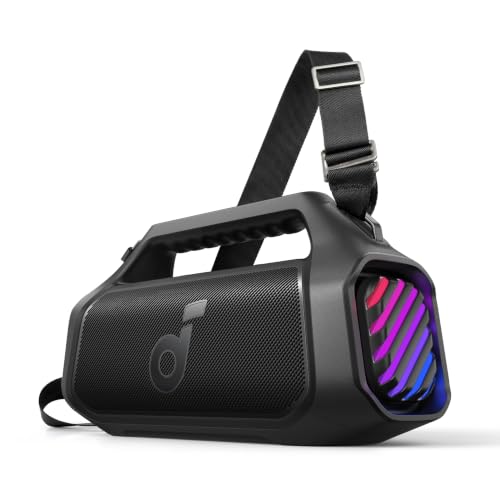
Soundcore Boom 2 Plus — The specification sheet come to life
If the Boombox argues for bass with mass, the Boom 2 Plus argues for it with engineering. Its listing is the most forthcoming in this guide: 140W of output, a 2+2 channel audio layout, BassUp 2.0, 20 hours of playtime, fast charging, RGB lights, a power-bank function, Bluetooth 6.0 and IPX7 waterproofing, aimed at camping and beach use. The 2+2 channel detail is the one to savour. It describes separate drivers handling separate bands in stereo pairs — the architecture of a small hi-fi system folded into a boombox — and it is why this speaker can sound organised at volumes where single-driver rivals smear into noise.
BassUp 2.0 is Soundcore’s real-time low-end processing, and pairing it with a proper multi-driver layout gives the Boom 2 Plus two ways of making bass: physically, from drivers with genuine area, and electronically, by shaping what those drivers are asked to do. The power-bank function completes the outdoor logic — a battery this size might as well rescue a dying phone — and fast charging softens the one weakness of big batteries, the long refill. Twenty stated hours sits below the Boombox’s figure and above nearly everything else here, a deliberate middle: enough for a weekend’s serious listening, in a body a notch easier to move.
Bluetooth 6.0 is the listing’s quiet flex. It will not make the bass deeper, but newer radio standards tend to bring steadier connections and better power behaviour, and in a speaker designed to sit across a campsite from its phone, steadiness is a feature. The RGB lights will divide opinion precisely as lights always do; they can be enjoyed at dusk and ignored at noon, and they cost the audio nothing. Judge this pick as what it is: the most completely specified bass speaker in the guide, from the maker most willing to print its working.
- Output: 140W claimed across a 2+2 channel layout
- Bass system: BassUp 2.0 processing
- Playtime: 20 hours stated, with fast charging
- Sealing: IPX7 waterproof
- Extras from the listing: RGB lights, power-bank function, Bluetooth 6.0
Strengths
- Multi-channel architecture keeps bass, vocals and detail separated at volumes that defeat simpler designs.
- The power-bank function turns its big battery into campsite infrastructure for phones and lights.
- Fast charging answers the big-battery objection before it is raised.
Trade-offs
- IPX7 promises immersion survival but the listing claims no dust grade, so sand deserves respect and a rinse.
- Twenty hours is generous, yet the Boombox 4 and the XG300 both print longer figures for multi-day events.
- Boombox dimensions apply: it is a handle-carry speaker, not a bag speaker.
Best for: campers and beach groups wanting hi-fi manners with boombox muscle.
Not suited for: desert or building-site duty where a printed dust grade is a condition of use.

JBL Xtreme 4 — The strap-carried heavy hitter
The Xtreme line exists for a specific person: someone who wants near-boombox authority but still intends to walk somewhere with it. The Xtreme 4’s listing promises next-level massive JBL Pro Sound from a portable waterproof body, up to 24 hours of playtime with six additional hours available through Playtime Boost, and a convenient shoulder strap. That strap is a specification, not an accessory. It declares the design’s centre of gravity — a speaker heavy enough to need carrying properly, light enough that carrying it remains a pleasure rather than a penance.
Playtime Boost deserves explanation because it reveals honest engineering. Battery life in a big speaker is partly a tuning decision: how hard the processing pushes bass and volume against how long the cell lasts. A boost mode that trades some of that push for six extra hours lets the owner choose, mid-event, between maximum thunder and maximum endurance. At hour twenty of a festival weekend, endurance is the feature; at the Saturday peak, thunder is. Few listings admit this trade exists. This one builds a button on it.
The massive-sound claim should be read against the Xtreme’s place in JBL’s own range: above the Charge, below the Boombox, in the territory where bass becomes a physical sensation at picnic distance without demanding a trolley. Waterproof construction — the listing does not print an IP grade, so none is claimed here — covers the rain shower and the poolside splash that define its working life. For buyers torn between the Charge 5’s handiness and the Boombox 4’s enormity, the Xtreme 4 is the deliberate answer, and its strap tells you so before you read a word.
- Sound promise: massive JBL Pro Sound, in the maker’s words
- Playtime: up to 24 hours, plus 6 hours with Playtime Boost engaged
- Carry: shoulder strap included in the design
- Build: portable waterproof construction
- Colourway in this listing: black
Strengths
- The strap makes genuine mobility possible at a size where bass starts to feel physical.
- Playtime Boost turns the volume-versus-endurance trade into the owner’s choice, event by event.
- It fills the exact gap between hand-held and boombox that group picnics and five-a-side days create.
Trade-offs
- The listing prints no IP grade, so buyers needing a certified rating should look at the IP67 and IP68 picks.
- Engaging Playtime Boost means accepting a leaner sound for those extra hours.
- It remains a two-figure commitment of space in any bag; cyclists will feel every gram of it.
Best for: park gatherings, sports days and beach walks where the speaker must arrive on a shoulder.
Not suited for: insurance or work-site contexts demanding a printed dust-and-immersion grade.

Sony SRS-XG300 — The civilised party bass
Sony’s X-series takes a different view of the party speaker: that it should look at home in a house. The XG300’s listing describes a wireless portable party speaker with IP67 waterproof and dustproof sealing, a 25-hour battery and a retractable handle, in black. The retractable handle is the design’s thesis in miniature — carrying hardware that disappears when the speaker is parked, leaving a clean, low, wide body that sits on a sideboard without shouting about the beach. Under that civilised skin sits Sony’s party brief: a wide cabinet with room for proper drivers and the low-end weight the format allows.
Twenty-five stated hours is the second-longest figure in this guide, and it suits the XG300’s likely rhythm of life. This is the speaker that does Friday’s kitchen disco, Saturday’s garden lunch and Sunday’s bath-time podcast without visiting a charger, then tops up overnight before the next weekend. IP67 sealing — immersion-grade water protection with dust-tight construction — means the garden and the poolside hold no terrors, and the wide, low stance resists the knocks that topple tall cylinders at crowded gatherings.
Where the Boom 2 Plus leads with specifications, the XG300 leads with integration: it is the bass pick for people whose parties happen in homes and gardens rather than fields, who want the low end to arrive without the light show, the trolley wheels or the festival aesthetic. Sony’s tuning in this series traditionally favours a warm, rounded presentation over maximum shout, which flatters long evenings of mixed playlists. If your bass must entertain neighbours’ children at noon and adults at midnight from the same tasteful box, this is the shortlist’s answer.
- Battery: 25 hours stated in the listing
- Sealing: IP67 waterproof and dustproof
- Carry: retractable handle that hides when parked
- Format: wide X-series party cabinet
- Colourway in this listing: black
Strengths
- The longest-battery sealed party format here after the Boombox, in a body that suits indoor life.
- A low, wide stance and disappearing handle make it the easiest big speaker to live with daily.
- Full IP67 grading covers both the dust and the dunk ends of garden accidents.
Trade-offs
- The listing quotes no wattage, so output comparisons rest on format and reputation rather than print.
- No lights, no microphone inputs are promised; entertainers should shop the party guide instead.
- Its width needs a proper shelf or sideboard, not a windowsill.
Best for: house parties and long garden days where the speaker must also behave like furniture.
Not suited for: karaoke nights or any party brief built around a light show.

JBL Charge 5 — The hand-held bass starter
Every category needs its gateway, and in bass speakers the Charge 5 has held that role for years. Its listing promises bold JBL Original Pro Sound, 20 hours of playtime and IP67 waterproof and dustproof sealing in the classic Charge cylinder. The recipe that made the line famous is visible in those three claims: a racetrack woofer and end radiators extracting improbable low-end weight from a one-hand cabinet, a battery sized like a bigger speaker’s, and sealing that lets the whole thing live by sinks, pools and tent doors without ceremony.
Twenty hours from a body this size remains a quietly absurd figure, and it is the foundation of the Charge’s bass credibility. Low end is bought with watts, and watts are bought with battery; a small speaker with a small cell must choose between playing low and playing long. The Charge line’s answer has always been to carry the cell of a larger product, accept the weight, and deliver both. Owners feel the result as confidence: the speaker can be turned up at the beach without a mental countdown to silence.
Set against the giants above it, the Charge 5’s bass is a matter of proximity. At a desk, across a kitchen, around a campfire of four people, its low end is genuinely satisfying — present, rounded, unforced. Across a playing field it is not, and no honesty is served by pretending otherwise. Buy it as the largest speaker you will carry everywhere, not the smallest speaker that can run a party, and it will be loved for years; the number still on the road, in vans and backpacks worldwide, testifies to how often that bargain is struck correctly.
- Sound promise: bold JBL Original Pro Sound
- Playtime: 20 hours stated
- Sealing: IP67 waterproof and dustproof
- Format: the classic Charge cylinder, one-hand portable
- Colourway in this listing: black
Strengths
- Bass weight per litre of cabinet is the best in this guide; nothing smaller here comes close.
- A 20-hour battery in this size removes charging from the weekly routine entirely.
- IP67 sealing plus a shape that fits bottle cages and cup holders makes it the traveller’s bass pick.
Trade-offs
- One cabinet, however clever, cannot pressurise a field; gathering size is its hard limit.
- The listing offers no pairing, lights or power-bank claims to lean on — check the specific listing before assuming extras.
- Its low end flatters at near distances and thins with every metre of open air.
Best for: solo listeners and small groups, after real bass weight in a grab-and-go cylinder.
Not suited for: providing the only music for a large outdoor event.
Ultimate Ears Megaboom 4 — The respected design on a renewed listing
The Megaboom line built its following on a tall-cylinder formula: 360-degree sound thrown from a sealed, buoyant body, sized between the pocket speakers and the boomboxes, with a low-end warmth that made it the default upgrade for years of summer gatherings. The Megaboom 4 continues that formula, and owners of earlier generations speak of it the way people speak of a good tent — as equipment that simply kept showing up and working. In a bass guide, its natural seat is beside the Xtreme 4 and the XG300: a middleweight whose omnidirectional throw suits listeners gathered around it rather than arranged in front of it.
So why does it stand here without a purchase link? Because the Amazon listing currently offered for the Megaboom 4 is a renewed listing — a previously owned, refurbished unit — and this guide links only to listings verified as standard through the site’s pool. That is not a dismissal of the design. It is a warning about the specific transaction. Renewed portable speakers carry two unknowns that matter for bass in particular: the battery’s accumulated cycles, which govern how long high-volume low end can be sustained, and the seals’ history, which governs whether the waterproof promise still holds at full strength.
The practical advice writes itself. If you find the Megaboom 4 new through another retailer, the design case in this section applies in full and it competes honourably in the middleweight class. If you buy the renewed Amazon unit, buy it as a renewed unit: test the battery across a long, loud day inside the returns window, test the sealing gently before trusting it in deep water, and let the saving compensate you for the uncertainty. What this guide will not do is dress that transaction up as a standard listing — the distinction is the entire point of the pool system, and it protects exactly the readers most likely to be disappointed.
- Format: tall 360-degree cylinder from the Megaboom line
- Position in this guide: middleweight bass, gathered-around listening
- Transaction note: the current Amazon listing for this model is a renewed unit
- Guide treatment: discussed in full, deliberately unlinked
Strengths
- Omnidirectional sound suits round-the-speaker gatherings better than any directional rival at its size.
- The line’s sealed, buoyant heritage makes it a natural poolside and campsite citizen.
- Its middleweight scale threads between hand-held and boombox with little compromise at either end.
Trade-offs
- A renewed battery’s remaining capacity is unknowable until tested under load at home.
- Seals on a refurbished unit carry a history; immersion trust must be re-earned gently.
- Buyers wanting a standard new-unit Amazon listing today must choose one of the five linked picks.
Best for: readers who can source a new unit elsewhere and value 360-degree throw.
Not suited for: anyone needing a verified new-unit listing on Amazon right now.
Comparison
| Pick | Bass approach | Playtime stated | Sealing from its listing | Carry |
|---|---|---|---|---|
| JBL Boombox 4 | Deep bass with AI Sound Boost in the largest cabinet here | Up to 34 hours | Waterproof; IP68 dustproof | Two hands, car boot |
| Soundcore Boom 2 Plus | 140W claimed, 2+2 channels, BassUp 2.0 | 20 hours | IPX7 waterproof | Boombox handle |
| JBL Xtreme 4 | Massive JBL Pro Sound in a strap-carried body | 24 hours, +6 with Playtime Boost | Waterproof (no grade printed) | Shoulder strap |
| Sony SRS-XG300 | Wide X-series party cabinet, warm tuning | 25 hours | IP67 waterproof and dustproof | Retractable handle |
| JBL Charge 5 | Bold JBL Original Pro Sound in a one-hand cylinder | 20 hours | IP67 waterproof and dustproof | Hand, cage or pocket |
| Ultimate Ears Megaboom 4 | 360-degree middleweight warmth | Not quoted — the renewed listing is outside the verified pool | Sealed Megaboom design; a renewed unit’s seal history is unknown | Tall cylinder, hand carry |
Why Does Bass Evaporate Outdoors While the Vocals Carry Across the Field?
Stand thirty metres from a speaker indoors and the sound arrives thinned but recognisable, bass included. Stand thirty metres away outdoors and the bass has simply left, while voices and guitars remain eerily present. The physics is unforgiving: long low-frequency waves spread their energy widely and gain nothing from the open sky, while walls and ceilings indoors act as unpaid amplifiers, reflecting low end back into the room and reinforcing it at boundaries. A garden offers a speaker no walls, no ceiling, and an audience of soft bodies absorbing what little warmth remains. The same unit, the same volume, two different planets.
This single fact explains the shape of the whole guide. Outdoor bass is bought with cabinet volume and battery, which is why the credible outdoor picks here are boomboxes and strap-carried heavyweights rather than pocket cylinders. It also explains placement strategy: set a speaker near a fence, a wall or the side of a house and you borrow back some of that boundary reinforcement; set it mid-lawn and you pay full price. Experienced hosts place the big speaker first and arrange the party around it, and the music sounds twice as expensive as it was.
Wind deserves its dishonourable mention. A breeze does not just carry sound away; it scrambles the low frequencies’ already difficult journey, and gusts can make a marginal speaker sound as if it is switching itself off. Sheltered placement — the lee of a building, a hedge, a van — is worth more outdoors than any EQ preset ever sold.
What Is a Passive Radiator, and Why Do So Many of These Speakers Rely on One?
Open the spec talk around portable bass and one component recurs: the passive radiator. It looks like a woofer with no motor — a diaphragm in a frame — and it exists because a sealed small cabinet traps its woofer. When the driven woofer pushes in, internal air pressure rises and fights it; the radiator gives that pressure somewhere productive to go, moving in sympathy and radiating low frequencies the small woofer alone could not produce at useful volume. It is, in effect, a way of borrowing a bigger cabinet’s behaviour without a port, and without a port’s vulnerability to water — which is why sealed outdoor speakers love the design.
The end caps of the Charge-format cylinders are the famous example: watch them pulse with the kick drum and you are watching the bass being made. Radiators have limits — they contribute in a band rather than across the whole low range, and asking them for more than the design intends produces the flabby, one-note thump that gives cheap bass its bad name. The better makers in this guide tune radiator, woofer and processing as one system. When a review below praises bass that stays tidy at volume, that system working as designed is what is being praised.
How Should You Set the EQ Differently for a Podcast, a Film and a Dance Playlist?
Bass-heavy hardware tempts owners to leave the low end boosted for everything, and speech pays the price first. A podcast through a boosted boombox turns woolly: male voices gain a chest resonance the recording never had, and consonants — where intelligibility lives — retreat. For speech, flatten the bass or trim it slightly, raise the presence region a touch if the app allows, and bring the speaker closer rather than louder. The Boom 2 Plus’s app EQ and the Soundcore ecosystem make this a thirty-second job; on speakers without an app, distance and placement do the same work more crudely.
Film sits between the two: dialogue wants the speech treatment, while effects and scores want the weight. A gentle bass shelf — a little lift, not the full party curve — plus a central placement under or beside the screen keeps both halves honest. Dance and electronic playlists are where the full bass armoury earns its keep, and even there, restraint at the very bottom buys clarity everywhere else. The recurring principle: boost buys excitement at the price of detail, and the right price depends on what is playing. Owners who save three presets — speech, film, party — stop re-litigating the question nightly.
Where Does a Boombox Belong in a Small Home Without Annoying Everyone in It?
Big bass speakers in small homes fail socially before they fail acoustically. The Boombox 4 or Boom 2 Plus played at party tuning in a flat will find every resonant surface in the building: floors couple low frequencies into the structure, and neighbours hear the bass line of your evening with unfortunate clarity while missing the melody entirely. The remedies are placement and level. Decouple the speaker from resonant furniture — a solid floor or a dense stand beats a hollow sideboard — keep it off shared walls, and remember that at domestic distances these speakers reach satisfying fullness at a fraction of their dial.
There is also an etiquette of hours that no specification sheet prints. Bass travels through buildings at midnight in a way treble does not, and a household that saves full party tuning for agreed occasions keeps both its neighbours and its own welcome. None of this argues against buying big; the XG300 exists in this guide precisely as the big speaker with domestic manners. It argues for buying big with a placement plan, which is a purchase decision, not an afterthought.
Can Two Medium Speakers Out-Bass One Giant One?
Sometimes, and the answer hinges on coverage rather than depth. Two medium speakers spread across a long garden or a big room fill the space more evenly than one giant in a corner: listeners near each unit hear full-range sound at moderate volume, while the far end of a one-speaker setup hears mostly the frequencies that travel. What two mediums cannot do is reproduce the sheer low-end pressure of the largest cabinet here; physics keeps that crown with the Boombox. For long, thin spaces — terraces, halls, market stalls — the pair often wins the evening. For a dense crowd in a compact area, the giant wins it.
Pairing practicalities decide whether the theory survives contact with Saturday. Linked speakers should be the same model where the maker’s system expects it, charged equally, and tested before guests arrive, with the phone’s position trialled at the far seat. A pair that drops its link mid-party is worse than one honest speaker, which is why the guides on this site keep repeating the unfashionable advice: rehearse your audio like you rehearse nothing else, because nobody remembers the food when the music failed.
How Do Sand, Grass and Decking Each Steal a Different Slice of Your Bass?
Surfaces are silent members of every outdoor sound system. Grass is an absorber: a speaker set directly on a lawn loses its high frequencies into the turf and aims what remains at ankle height, while its low end couples into soft ground and dissipates. The fix costs nothing — a cooler lid, a crate, a folding table — and the improvement sounds like a product upgrade. Sand behaves similarly for placement but adds its own hazard, working into seams and port flaps; a speaker that lives on beaches should be elevated and rinsed, and the IP68 dustproofing claimed for the Boombox 4 or the IP67 grade of the XG300 and Charge 5 is the paperwork that matches that life.
Decking is the opposite problem: a hollow wooden deck is a resonant box, and a powerful speaker placed on it can turn the whole structure into a sounding board. Sometimes that flatters the music, adding a warmth the garden enjoys; sometimes it produces a boomy drone that annoys the household below the deck more than the listeners on it. Moving the speaker a metre, rotating it, or setting it on a dense mat changes the coupling and usually finds the pleasant version. Stone and concrete sit between the extremes — reflective, honest surfaces that return sound predictably, which is why patios flatter every speaker in this guide relative to lawns of the same size.
The habit worth building is a ten-second placement ritual: set the speaker down, walk to the far seat, listen, adjust once. Hosts who do this stop blaming speakers for the crimes of surfaces, and guests never know it happened.
What Does the Power-Bank Function on a Big Speaker Actually Change on a Trip?
The Boom 2 Plus lists a power-bank function, and it sounds like a footnote until the first weekend it saves. A bass speaker’s battery is the largest cell most campers carry; letting it donate charge to a phone, a headtorch or a camera converts dead weight into a shared utility. The phone that runs the playlist is the obvious beneficiary — the music’s source dying at hour nine is the most common party failure of all, ahead of weather — and a speaker that can keep its own source alive removes that failure mode entirely.
There are disciplines to observe. Every phone charged is playtime spent, so the donation should be a decision, not a default: top up the playlist phone, decline the fourth friend’s tablet. Use the function at moderate speaker volumes where the trade is cheapest, and remember that the cable now matters — a forgotten USB-C lead turns the feature back into a brochure line. Packed deliberately, though, a power-bank speaker simplifies the whole kit: one big battery, charged once, serving music and emergency power from the same shell.
Why Do Bass Players and Drummers Hear These Speakers Differently From Everyone Else?
Musicians who work in the low end listen forensically. A bass player hears whether the speaker separates the kick drum from the bass guitar or smears them into one warm fog; a drummer hears whether transients — the attack of a stick, the snap of a snare — survive the bass processing or get rounded off by it. Casual listeners hear the same events as fullness or muddiness without naming them. This is why two honest reviews of the same speaker can disagree: they are reporting different layers of the same sound.
For shoppers, the translation is simple. If your playlists are dense with electronic low end, hip-hop and modern pop, separation matters and the multi-channel architecture of the Boom 2 Plus earns its keep. If your listening is singer-songwriter, jazz trios and classic rock, the warmer single-cabinet tunings — the XG300’s civilised glow, the Charge 5’s rounded punch — will please you at lower cost and size. Neither preference is more sophisticated; they are different recordings asking different questions. Buy for your records, not for an abstract ideal of bass, and the speaker will sound right every time you press play.
How Loud Is Loud Enough? A Host’s Guide to Volume Without the Shouting
Hosts consistently overestimate how much volume a gathering needs, because they judge from beside the speaker while guests judge from their chairs. Conversation at a party sits at a comfortable level only while music stays a few decibels beneath it; push the music above speech and the room’s volume ratchets upward as guests shout over the track, then over each other, until the evening feels exhausting for reasons nobody names. The skilled host sets the speaker so the far chair hears the bass line clearly and the near chair can still talk, then resists the requests to turn it up that arrive with the second round of drinks.
Headroom is what makes that restraint possible. A big speaker at half volume sounds fuller than a small speaker at its limit playing the same playlist at the same measured loudness, because the big speaker’s drivers are cruising while the small one’s are straining. This is the deepest reason the heavyweights in this guide exist, and it inverts the usual assumption: the Boombox at a family barbecue is not the loud option, it is the relaxed one. Buy headroom, spend it on ease, and the bass everyone praises at midnight will be the bass that never had to shout.
What Happens to Bass When a Speaker Gets Wet, Dusty or Old?
Water changes sound before it threatens electronics. A film of water over a grille or a radiator damps its movement, and a speaker pulled dripping from a pool will sound muffled until it dries — a temporary condition owners mistake for damage. The remedy is patience: shake the water out, let the unit air-dry, and the voice returns. Dust works more slowly, loading grilles and seams over a season until high frequencies soften; a rinse and a soft brush restore most of it, which is one more reason the dustproof grades in this guide matter to beach and site workers.
Age attacks the low end first. Radiator surrounds stiffen, battery voltage sags earlier under load, and the deep notes that once arrived with authority begin to arrive with apologies. None of the picks here is immune; the defence is the same custody described throughout this programme — seals rinsed, batteries treated gently, storage cool and dry. A bass speaker is a machine for moving air, and like every machine it rewards owners who keep its moving parts clean and its fuel system healthy.
Should a Bass Speaker Double as Your Home Speaker, or Is That Two Purchases?
The temptation is understandable: a speaker with this much low-end authority seems wasted standing in a garage between parties. Whether one unit can honestly serve both lives depends on its format. The XG300 was practically designed for the double life — handle hidden, stance stable, tuning warm enough for evening listening at low volume, where its bass stays present without dominating a room. The Charge 5 doubles differently, as the speaker that lives on the kitchen counter all week and goes out in a bag at weekends. The Boombox 4 doubles worst, through no fault of its own: a field instrument in a flat is a guest who cannot lower his voice.
Low-volume behaviour is the test nobody runs in the shop. Bass tunings built for open air can sound thick and sleepy at the volumes a home evening uses, because the ear perceives low frequencies as quieter at low levels and party processing compensates in ways that overshoot indoors. If the double life is the plan, audition the candidate quietly, with speech and acoustic music, before auditioning it loudly. The speakers that pass both auditions are the ones still in daily use a year later; the rest become seasonal equipment, which is a perfectly respectable fate — as long as the buyer chose it on purpose.
Which Bass-Buying Errors Leave People With Boom Instead of Music?
The classic error in this category is chasing the largest wattage number in the smallest box, which produces the one-note thump discussed above: impressive for eleven seconds in a shop, exhausting for an evening at home. Bass quality is control — a speaker that starts and stops notes cleanly — and control comes from cabinet, driver and tuning working together, not from a headline figure.
Second comes ignoring the battery behind the bass. Buyers compare playtime claims gathered at gentle volume and then run their speaker at full party tilt, where low frequencies drain the cell far faster; the generous stated figures in this guide — 24, 25, 34 hours — are a deliberate shortlist bias, not a coincidence. Third is placing the speaker mid-lawn and blaming the product, when a fence line or a wall would have doubled its apparent weight for free. Fourth is forgetting the audience’s distance: bass for six people around a fire and bass for sixty across a field are different purchases wearing the same name. And fifth, quietly, is buying a renewed unit without testing it hard inside the returns window — the Megaboom discussion above exists because battery wear is invisible until the first long, loud day exposes it.
Final Recommendation
Choose by the largest gathering the speaker must genuinely serve, and by the surface it will stand on, the distance it must throw and the hours it must last — the four numbers that decide real evenings far more reliably than any wattage printed on a box. The Charge 5 covers the personal and campfire scale with the least fuss and the most carry-anywhere freedom. The Xtreme 4 and the XG300 divide the middle by temperament — strap-carried thunder for the field, civilised weight for the house and garden. The Boom 2 Plus is the engineer’s pick, all architecture and adjustability. The Boombox 4 is the event pick, the one that turns a field into a venue. And if a friend asked which single bass speaker reshaped my own summers, it is the Xtreme 4: the strap sounds like a footnote until the evening you walk a mile to the good spot with the music already playing, and the bass arrives with you, intact, at the far end of the beach.
Frequently Asked Questions
Does more wattage always mean more bass?
No. Wattage figures are measured differently by every maker and describe electrical capacity, not acoustic results. Cabinet volume, driver area, radiator tuning and processing decide how much bass reaches your ears; use the wattage as a rough size class and read the architecture, as the Boom 2 Plus’s 2+2 channel layout illustrates.
Why does my bass speaker sound weaker at the end of a long party?
Sustained low frequencies at high volume are the heaviest load a battery serves. As the cell drains, some speakers also trim output to protect the remaining charge. Generous stated playtime — the 34 hours of the Boombox 4, the 25 of the XG300 — is the practical defence, along with starting the event fully charged.
Is a renewed speaker a sensible way to buy bass for less?
It can be, with testing. The Megaboom 4 section explains the two unknowns — battery cycles and seal history — and the remedy: a long, loud test day and a gentle sealing check inside the returns window. Buy the saving knowingly rather than discovering it.
Will a big bass speaker damage my hearing at a garden party?
Any speaker can be played too loudly at close range for too long. The safer pattern is a bigger speaker at moderate volume over a wide area rather than a small speaker screaming at a few nearby ears — one more reason headroom, used gently, is a health feature as much as a musical one.
Can these speakers play while charging?
Most portable speakers can, but the listings verified for this guide do not state it pick by pick, so treat it as a question to confirm on the specific product page before relying on it for an all-day fixed installation. For event use, a full starting charge remains the dependable plan.
Why does bass sound stronger in a corner of the garden than in the middle of the lawn?
Boundaries reinforce low frequencies. A fence, a wall and the ground together return energy that open air lets escape, so the same speaker at the same volume sounds noticeably weightier near them. Hosts exploit this by placing the speaker first — near a boundary, elevated off the grass — and arranging seating second. It is the cheapest bass upgrade available, and it costs exactly one minute of thought before the guests arrive.
Do I need the biggest speaker here for a twenty-person barbecue?
Probably not. Twenty people in a garden, seated within a dozen metres of the music, sit squarely in Xtreme 4 and XG300 territory, especially with boundary placement helping. The Boombox class earns its size at larger crowds, bigger spaces and longer distances — or when the same speaker must also survive being the only entertainment for a whole weekend away.
Related Guides
When bass alone stops being the whole brief and the evening needs lights, wheels and a microphone, the party speaker guide with its lightshow and input-by-input breakdown takes over. For the days when the low end must survive splashes, drops and a knock into the deep end, our pool speaker roundup where flotation and sealing grades decide the shortlist narrows the field to models that swim. And for readers whose music must survive being bolted to a boat rather than carried to a beach, a boat speaker guide explaining fixed marine audio and how it differs from portable gear is the necessary next read.


