What's inside
- Key Takeaways
- Quick Picks
- How We Chose These Picks
- What Makes a Door “Tight” for Component Speakers?
- Which Component Systems Earn a Place in a Tight Door?
- What Do Crossovers and Tweeters Need in a Small Cabin?
- How Much Power Does a Small-Car Component System Need?
- What Door Treatment Matters Most in a Small Door?
- What Should Play in the Rest of a Small Car?
- How Do the Six Systems Compare for Tight Doors?
- How Do You Plan a Component Install in a Door With No Room?
- What Mistakes Do Tight-Door Component Buyers Make?
- How Do You Choose by the Constraint You Actually Have?
- How Do You Judge the Finished Install in a Small Cabin?
- Final Recommendation
- Frequently Asked Questions
- Related Guides
As an Amazon Associate I earn from qualifying purchases. This post may contain affiliate links at no extra cost to you.
widgetverdict.com is reader-supported. When you buy through links on our site, we may earn an affiliate commission.
Where to buy: Four systems below carry checked Amazon listings and are linked throughout; two are covered in prose only. Every system’s true size is stated exactly as its manufacturer lists it — in a guide about tight doors, an honest quarter-inch is the difference between a tweeter that mounts and a project that stalls.
The best 6 inch component speakers live at the intersection of two scarcities. Component systems are the minority of car speakers to begin with, and doors that are genuinely small — true 6-inch cutouts, or 165mm doors with shallow depth and nowhere to hide a crossover — exclude most of what the component market sells. What remains, and what this guide reviews, is a short and interesting list: one genuine 6-inch component system from Rockford Fosgate that fits the smallest cutouts natively, three shallow-friendly 165mm component systems whose manufacturers state their size honestly, and two prose-only alternatives whose installation manners suit confined doors. If your door has rejected a standard component set already — magnet against glass, tweeter with nowhere to live — this is the list written for that door.
The tight-door problem is worth defining precisely, because it has three separate parts that marketing copy lumps together. The first is cutout diameter, where the true 6-inch minority lives. The second is mounting depth, where window glass patrols the space behind the speaker and shallow design becomes a feature rather than a compromise. The third is real estate: component systems need a home for two tweeters and two crossover networks in doors and cabins that may offer neither a sail panel nor a forgiving kick panel. A system can solve one constraint and fail the others, which is why the reviews below grade each pick against all three — and why the guide’s advice begins, as its companion guide’s does, with a tape measure.
Everything in the pages that follow is organised by that three-part definition. When a review praises a system, it will say which constraint the praise is for; when it warns, it will name the front on which the system loses. Readers who keep their own three measurements beside them as they read will find the verdicts translate directly into a decision, which is all a buying guide for doors like these can honestly promise.
Key Takeaways
- Rockford’s P16-S is a genuine 6-inch component system — the native answer for true 6-inch cutouts, with a soft dome tweeter and real crossover.
- Most “6 inch” component shopping is really 165mm shopping; the JBL Club 602C, Rockford P165-SI and Kicker 51KSS6504 are honest 6.5-inch systems suited to tight doors.
- Depth and crossover real estate constrain tight doors as much as diameter — measure all three before ordering any component set.
- The P165-SI’s integration-friendly design suits factory-system upgrades where tweeter placement options are limited.
- Morel’s Maximo 6 and JL Audio’s C1-650, covered in prose, bring natural tone and installation forgiveness to the bracket-and-shallow end of the market.
- In a tight door, installation planning is the product: rehearse tweeter positions and crossover homes before anything is cut or drilled.
- Spend in constraint order — correct fit, door treatment, clean power, then system tier — and a modest system fitted well will beat a flagship fitted badly.
Quick Picks
| Pick | Badge | Why it earns its place |
|---|---|---|
| Rockford Fosgate P16-S | Best true 6-inch | The genuine article: a manufacturer-specified 6-inch component system for cutouts nothing else fits. |
| JBL Club 602C | Best tight-door 165mm | Club-series component clarity in a package that respects shallow doors and factory power. |
| Rockford Fosgate P165-SI | Best for factory integration | Punch engineering designed to integrate with factory systems and limited tweeter options. |
| Kicker 51KSS6504 | Best premium 165mm | KS-series refinement with a one-inch tweeter for amplified builds in standard-size doors. |
| Morel Maximo 6 | Best natural tone, prose only | The relaxed, musical alternative for listeners who value tone over theatre. |
| JL Audio C1-650 | Most forgiving install, prose only | JL’s entry components with the manners first-time installers in tight doors need. |
How We Chose These Picks
Size honesty governed the list, as it governs the companion guide: each system is classified by its manufacturer’s own stated format, and only the P16-S is claimed as a true 6-inch product. The 165mm systems were then screened against the tight-door brief specifically — mounting depth suitable for shallow doors, crossovers compact enough to place in confined cabins, and behaviour on the factory electronics that small cars usually keep. Systems that are magnificent in a deep, generous door but hopeless in a tight one were excluded without regret; this guide’s reader has the second kind of door.
We also graded the installation ecosystem around each system: the tweeter mounts supplied, the crossover’s size and adjustability, and the quality of documentation for vehicles where nothing is standard. In tight doors the difference between systems is often not how they sound in a demonstration wall but whether they can be fitted at all without fabrication, and a guide that ignored that would be reviewing a different hobby. Every linked system was verified against our verified pool from its manufacturer’s listing; the two prose-only sets are included for their installation manners and tone, and are labelled as unverified here, as our rules require.
Finally, we resisted the temptation to fill the list with the mainstream’s flagship component systems and a footnote saying “may not fit.” Those systems have their own guides and their own doors. Every system here was chosen because a tight door is its natural habitat or a survivable one, and the two that are prose-only earned their places on installation character rather than on specifications — a weighting this category, more than any other in the batch, demands.
What Makes a Door “Tight” for Component Speakers?
Start with the window. In most door designs the glass, fully lowered, passes directly behind the speaker cutout, and the clearance between the door’s inner skin and that glass path is the mounting depth budget — a figure that has shrunk across successive generations of cars as doors gained side-impact structure, larger wiring looms and more elaborate trim. A component woofer is often deeper than the coaxial it replaces, because its motor is built for the excursion and control the format promises; the tight door is where that promise meets the glass. Measuring depth with the window fully down is therefore the first commandment of this guide, ahead of every brand preference.
The second constraint is the tweeter’s home. Component tweeters want height — sail panels, pillar bases, dash corners — and small cars offer the least of all three: sail panels carrying mirror mechanisms, pillars stuffed with airbags whose covers must never be drilled, dashes with no flat acre of their own. The third constraint is the crossover, a box roughly the size of a deck of cards that must live somewhere dry, secure and reachable, in a door or kick panel that may already be fully subscribed. Tight, in short, is a three-front war, and the systems below were chosen by how they fight on each front: native small cutout, shallow-friendly depth, and installation hardware that respects scarce real estate.
One more reality belongs in this section: small cars are often first cars, shared cars and older cars, whose owners are installing components for the first time into doors that have already lived a life. Forgiveness — in mounting tolerance, in documentation, in a crossover that does not demand a laboratory — is a genuine product feature in this segment, and it is weighted in the verdicts that follow alongside the usual questions of tone.
It is also worth stating what “tight” is not. It is not a verdict on the car’s worth or the project’s dignity: some of the most satisfying systems in this hobby live in small, old, inexpensive cars whose owners measured carefully and installed patiently, and they embarrass larger vehicles whose owners bought big and fitted carelessly. The constraint is a design brief, nothing more — and like every design brief in this series of guides, it rewards the owner who reads it accurately far more than the one who spends against it blindly.
Which Component Systems Earn a Place in a Tight Door?
The four linked systems divide by which constraint they solve best: the P16-S solves diameter itself, the JBL and the P165-SI solve the practical 165mm tight door in different spirits, and the Kicker KS solves the standard door that wants premium staging. The prose pair then serve the tone-led and the first-time buyer. No pick here is interchangeable with another, because no two tight doors are tight in quite the same way.
Read the verdict lines with your own constraint in hand. Each review closes with the door and the owner the system suits and the ones it does not, and in this category those lines do more work than the strengths above them: a system can be excellent in every particular and still be wrong for the specific centimetres your door offers. The measurement you took — or are now persuaded to take — is the lens that turns six good systems into one correct purchase.

Rockford Fosgate P16-S — Best true 6-inch
Lead with the fact that defines the product: the P16-S’s woofer is a genuine 6-inch driver, specified as such by Rockford Fosgate, in a Punch-series component system with a one-inch soft dome tweeter and an external crossover. In a door stamped for the true smaller size, that makes it effectively without competition — the one current system that delivers component staging, soft-dome treble and Punch woofer control without cutting metal or improvising brackets. Owners of the minority fitment should read that sentence as the good news it is: your door is unusual, but it is not orphaned, and the system available to it is a serious one rather than a token.
Within a tight door its virtues compound. The smaller woofer’s mounting demands are inherently modest, the soft dome is forgiving of the close, reflective quarters small cabins impose, and the crossover gives the installation a tuning instrument most small-car systems never get. It asks the standard component price — tweeter mounting thought, crossover placement, an afternoon rather than an hour — and it rewards decent electronics the way Punch products do, though it stages convincingly on a head unit while an amplifier is still a plan. If your measurement says true six inches, your shopping is done: this is the system, and the rest of the guide is for the 165mm majority whose doors are tight for other reasons.
- Format: genuine 6-inch component system, Punch series
- Tweeter: 1-inch soft dome, separate housings
- Crossover: external network included
- Fitment note: native for true 6-inch cutouts; measure to confirm yours
Strengths
- The only mainstream component system native to true 6-inch doors.
- Soft dome treble suits small, reflective cabins without harshness.
- Punch control and crossover tuning bring big-system discipline to small doors.
Trade-offs
- Fits loosely in 165mm holes — it is the answer only for the size it names.
- Component installation effort applies in full despite the small door.
- Best results assume at least a competent head unit behind it.
Best for: verified true-6-inch doors whose owners want a genuine front stage. Not suited for: standard 165mm doors, where the systems below fit properly.

JBL Club 602C — Best tight-door 165mm
JBL’s Club series occupies the sensible centre of its range, and the 602C component system brings that sensibility to the standard 165mm door that has no room to spare. Its design brief — component clarity with manufacturer attention to sensitivity and manageable mounting — suits the small cars this guide serves, whose factory head units are modest and whose doors are thin. JBL voices the Club line with its characteristic presence through the vocal range, which in a small cabin reads as clarity rather than pushiness: speech, podcasts and vocals sit forward and intelligible at the low volumes compact cars cruise at, and the separate tweeter lifts that clarity to dash height where a coaxial cannot follow.
Judged against the premium Kicker KS below, the Club gives up the last measure of refinement and amplified headroom; judged against the Rockford P165-SI beside it, it is the more straightforwardly musical system, where the Rockford is the integration specialist. Its crossover is a compact, honest network sized for real doors rather than demonstration boards, and the system’s documentation reflects a brand that expects first-time component installers among its buyers. For the tight 165mm door on factory power — statistically the commonest brief behind this entire search — the 602C is the recommendation with the fewest conditions attached.
- Format: 6.5-inch (165mm) two-way components from the Club range
- Tweeter: separate, with mounting options for small cabins
- Crossover: compact external network
- Fitment note: an honest 165mm system — not a true 6-inch fit
Strengths
- Component clarity engineered for modest factory power and thin doors.
- Vocal presence suits the speech and mixed listening small cars live on.
- Compact crossover and clear documentation ease first-time installs.
Trade-offs
- 165mm sizing: true 6-inch cutouts need the P16-S instead.
- Premium refinement and amplified ceiling belong to the KS system.
- Forward voicing can compound a bright factory head unit’s tuning.
Best for: tight 165mm doors on factory power wanting real component staging. Not suited for: genuine 6-inch holes or high-power amplified builds.

Rockford Fosgate P165-SI — Best for factory integration
The SI in this Punch system’s name signals its brief: integration. Rockford designed the P165-SI for the reality that most component buyers are upgrading a factory system rather than building from a clean sheet, and its details follow that brief — a one-inch tweeter arrangement with mounting flexibility for the limited locations factory interiors offer, and crossover engineering intended to cooperate with factory electronics rather than demand their replacement. In a tight door, where the tweeter’s ideal home may not exist and the head unit is staying, that flexibility is not a convenience; it is the difference between a system that can be installed well and one that can only be installed approximately.
Sonically it is a Punch product, with the series’ controlled woofer and composed presentation, voiced a notch more forgiving than the flagship systems because its designers knew the sources it would meet. Against the JBL it trades a little sparkle for integration depth; against its own P16-S sibling it trades the native small fit for the standard size’s broader vehicle coverage. Owners whose tight door comes attached to a factory system they intend to keep — leased cars, integrated infotainment that cannot be replaced, family vehicles with steering-wheel-everything — will find the SI’s compromises pointed exactly at their constraints, which is the highest compliment an integration product can earn.
- Format: 6.5-inch (165mm) components, Punch engineering
- Tweeter: 1-inch, mounting flexibility for factory locations
- Design brief: integration with factory systems and electronics
- Fitment note: standard 165mm doors, including shallow-leaning installs
Strengths
- Mounting flexibility solves the tight door’s missing tweeter home.
- Voiced and engineered to cooperate with factory head units.
- Punch woofer control in a system that asks little of the car.
Trade-offs
- 165mm format — not the native answer for true 6-inch cutouts.
- Integration focus concedes the last refinement to dedicated audiophile sets.
- Forgiving voicing may underwhelm listeners seeking JBL-style presence.
Best for: factory-system upgrades in tight 165mm doors with limited tweeter options. Not suited for: clean-sheet amplified builds, which should take the KS or the P16-S route.
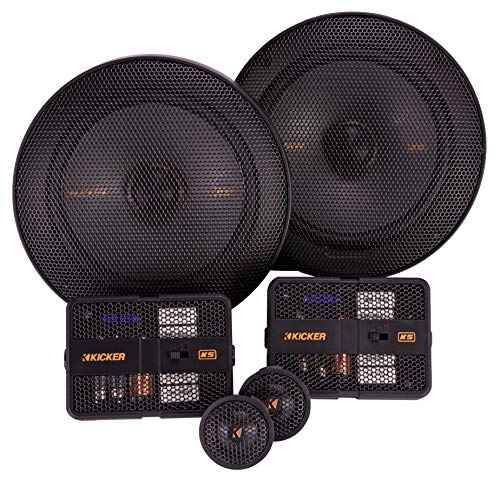
Kicker 51KSS6504 — Best premium 165mm
Where the door is a standard 165mm with adequate depth and the owner’s ambitions are not standard at all, the KS-series 51KSS6504 is the premium answer in this guide: a component system with a one-inch tweeter, KS-grade crossover work and a woofer built to be amplified. Its character is scale — a soundstage with more body in the lower treble, midrange with weight, and a ceiling that stays composed when a compact amplifier turns a small car’s front stage into a serious listening seat. In a tight-door guide it represents the boundary condition: the system you buy when “tight” describes your cutout options, not your aspirations.
That positioning carries honest warnings. The KS gives its best to amplified, attentive systems and returns less of its price on a factory head unit at commuting volume, where the JBL Club is the smarter spend. Its installation assumes the full component discipline — tweeter rehearsal, secure crossovers, wiring through the boots — in doors that may resist all three. And it is unambiguously a 165mm system, irrelevant to true 6-inch doors except as a reminder of what the mainstream size offers. Buy it as the destination of a deliberate build in a standard door, and it is the finest linked system here; buy it casually, and you have purchased headroom as a decoration.
- Format: 6.5-inch components from Kicker’s KS line
- Tweeter: 1-inch, separate housings
- Crossover: external network, KS grade
- Fitment note: standard 165mm doors with adequate measured depth
Strengths
- Finest staging and composure among the linked 165mm systems.
- One-inch tweeter adds body and scale smaller domes cannot match.
- Ceiling high enough for a fully amplified small-car build.
Trade-offs
- Price and talents are wasted on gentle factory-power listening.
- Full component installation discipline required in confined doors.
- Not a candidate for true 6-inch cutouts under any circumstances.
Best for: deliberate, amplified builds in standard-size doors that happen to be tight on space. Not suited for: factory-power commuters or genuine 6-inch fitments.
Morel Maximo 6 — Best natural tone, prose only
Morel’s Maximo 6 returns in this guide under a different light: not as a bracket curiosity but as the tonal alternative for small cabins, where its relaxed, soft-dome-led presentation suits close listening distances better than more theatrical systems. Small cars put the listener near the speakers, and near a speaker is where forced treble and hyped presence stop being exciting and start being tiring; the Maximo’s natural voicing — voices rendered gently, treble that declines to shout — is engineered, whether by intention or happy accident, for exactly that geometry. Owners of compact cars who listen long and closely consistently describe this set the way home listeners describe good small-room speakers: easy to live with at length.
Its fitment story in this guide is the 165mm one — a standard-size system that asks the usual tight-door questions about depth and crossover room — and it is covered without a link under our verification rule, so confirm the current listing yourself if it tempts you. Against the linked systems it concedes JBL’s presence and Kicker’s scale in exchange for its ease, a trade that makes no sense on a specification sheet and complete sense at the end of a two-hour drive. In tight doors, where the listener is always in the near field, that trade deserves more respect than it usually gets.
- Format: 6.5-inch component system — standard 165mm fit
- House character: natural, relaxed, soft-dome-led
- Best environment: small cabins and close listening distances
- Listing status: prose only — verify availability independently
Strengths
- Unforced tone that suits near-field listening in small cabins.
- Soft dome treble stays composed over long drives.
- A genuinely different character from every linked system here.
Trade-offs
- No verified link in this guide; sourcing is your own work.
- Relaxed presentation undersells systems that thrive on excitement.
- Standard 165mm fit — no help for true 6-inch cutouts.
Best for: tone-first listeners in compact cars who drive long and listen closely. Not suited for: buyers wanting a checked link or a lively, theatrical stage.
JL Audio C1-650 — Most forgiving install, prose only
The C1-650 closes the list as the first-timer’s component system, a role it plays in this guide’s tight-door context with specific relevance: confined doors punish installation errors, and JL’s entry system is engineered and documented to absorb them. Its woofer behaves in imperfect, untreated doors; its tweeter’s smooth presentation forgives the aiming compromises small cabins impose; and JL’s documentation — the deepest of any brand in this article — walks a first-time installer through decisions that other manuals assume away. For the owner whose tight door is also their first component project, those manners are worth more than a specification advantage they cannot yet install well enough to hear.
Sonically the C1 aims at correctness: balanced, clean, unlikely to fatigue or to thrill, and content to be the foundation of a system that grows around it. It is a 165mm system, covered in prose under the same verification rule as the Morel, and its ceiling with future amplification is honest rather than high. None of that diminishes its candidacy for the reader this guide most expects — the small-car owner, door apart, learning as they go — for whom the best component system is reliably the one that ends the weekend installed, aligned and playing, rather than the one with the finest brochure.
- Format: 6.5-inch component system — standard 165mm fit
- House character: balanced, correct, uncoloured
- Support: documentation depth leads this guide’s brands
- Listing status: prose only in this guide
Strengths
- Installation forgiveness engineered for first-time component buyers.
- Balanced voicing that no listener or genre objects to.
- Documentation that respects the tight door’s real difficulties.
Trade-offs
- Correctness over character — less warmth than Morel, less scale than KS.
- Unverified here, so availability needs your own confirmation.
- 165mm only; true 6-inch doors belong to the P16-S.
Best for: first component installs in tight doors, where a finished job beats a theoretical one. Not suited for: listeners shopping for a distinctive sonic signature.
What Do Crossovers and Tweeters Need in a Small Cabin?
A component system’s crossover is where its designer spent the money you cannot see, and in a small cabin its quality is unusually audible because you sit so close to the handover region’s effects. A proper network — as fitted to every linked system here — controls the woofer’s roll-off and the tweeter’s protection and level as a designed pair of curves, keeping voices coherent as they cross between drivers. The audible signature of a cheap network, by contrast, is a voice that changes character as it rises in pitch, and in a compact car that signature sits a metre from your ear with nowhere to hide. When comparing systems for a tight door, the crossover’s substance is a legitimate reason to step up a series, and its physical size is a legitimate reason to plan the installation before ordering.
Tweeters in small cabins live a paradox: they are closer to the listener, which makes their staging magic more dramatic, and closer to reflective glass and plastic, which makes their temperament more consequential. Soft domes — the P16-S’s choice — forgive that environment; livelier domes reward careful aiming and, where offered, level adjustment. The rehearsal method matters more here than anywhere: a tweeter temporarily mounted and heard from the driver’s seat will tell you in one track whether its position flatters or fights the cabin, and the cost of the experiment is a few pieces of removable adhesive. Owners who skip it in a small car are gambling with the most directional, least forgiving driver in the system, at the shortest possible range.
Level balance between the two sides deserves a sentence of its own in compact cars, because the distances are so asymmetric: the near tweeter may be half as far from the driver as the far one. Time alignment, where an aftermarket head unit offers it, is the elegant fix; where it does not, careful aiming and the balance control recover most of the centre image. The component systems here cannot solve geometry for you, but the good ones give you the adjustment points — mounts that angle, crossovers that trim — to solve it yourself, and in a tight cabin those points are worth real money.
How Much Power Does a Small-Car Component System Need?
Less than in any other context in this series, because the cabin itself is an amplifier of sorts: a compact interior needs little acoustic power to reach a satisfying level, and every system here except the KS is designed to reach it from a factory head unit. What power buys in a small car is not loudness but composure — the ability to reproduce a peak without the head unit’s small amplifier clipping into harshness that a close listener hears immediately. Owners who listen at motorway volume with the windows open are the ones who will find the factory source’s limit, and for them a compact amplifier is a clarity purchase rather than a volume one.
Sensitivity is therefore the specification to read first in this class, and design brief the second: the Club 602C and P165-SI are engineered around factory power and deliver their best within it, the P16-S splits its loyalties, and the KS system’s ceiling assumes power that a stock small car does not have. Buying the KS for a factory system is the mirror error of buying the Club for an amplified build — both are good systems stranded in the wrong ecosystem. Match the system to the electronics it will actually live with, and the tight door’s component market becomes a short list of right answers rather than a field of compromises.
There is a small-car corollary worth pocketing: because the cabin needs so little power, the factory head unit’s quality matters more than its quantity. A clean, modest source will satisfy every system here except the KS at full ambition, while a noisy, heavily processed one will be exposed by all of them — component resolution is democratic that way. If an upgrade budget exists beyond the speakers, a source improvement will usually outrank an amplifier in a compact car, which reverses the order most larger builds follow.
What Door Treatment Matters Most in a Small Door?
Small doors are thin doors, and thin doors drum. The woofer’s rear wave excites the outer skin, the inner skin carries access holes large enough to leak the enclosure the driver thinks it has, and the door card itself is often a light moulding that adds its own commentary at volume. A component system resolves enough detail to expose all of it, so the treatments that are optional behind a coaxial approach essential here: deadening mat on the flattest areas of the outer skin, sealing of the largest inner-skin openings, and foam rings coupling the woofers to their grille openings. None requires stripping the door; targeted coverage delivers most of the benefit, and in a small door the material quantities are mercifully small as well.
Sequence matters because the door will only be open once if you plan it so: measure first, treat the panels while the speakers are out, rehearse the tweeters before final mounting, and set levels after the trim returns. Owners who treat the door as part of the component system — which, acoustically, it is — routinely report results a full tier above the parts list. Owners who skip it and judge the bare hardware are reviewing their door and blaming their speakers, the most common misattribution in this entire corner of car audio.
There is a weight discipline to observe in small doors that truck owners never face: hinges, checks and window regulators in compact cars are built to tighter margins, and enthusiasm with deadening material has a real, if modest, cost in door effort and long-term sag. Apply treatment where the panel drums — found by knocking around the skin and listening for the hollow spots — rather than wallpapering every surface. Precision, here as everywhere in this guide, beats quantity.
What Should Play in the Rest of a Small Car?
A small car’s rear speakers are usually close to the front listeners — sometimes uncomfortably close, in hatchbacks where the rear locations sit just behind the front seats. That geometry argues for restraint: rear fill in a compact car should be a competent coaxial run well down in level, contributing envelopment without relocating the stage to the back of the driver’s head. The economy coaxials from the companion guide’s 165mm families serve perfectly here, and brand-matching them to the front components keeps the tonal family coherent at the low levels where fill operates.
Subwoofers in small cars deserve a similarly honest paragraph. The temptation is real, the space is not: a compact powered unit under a seat or a small enclosure in the boot corner can supply the bottom octave the door speakers cannot, and crossed over properly it relieves the components of excursion they were wasting. But many small-car owners find that a well-fitted component front stage, in a treated door, in a small cabin, satisfies without one — the cabin’s own gain does quiet work at low frequencies. Live with the components for a month before deciding; the door speakers you chose by measurement may have already answered the question.
How Do the Six Systems Compare for Tight Doors?
| Pick | True size | Tight-door talent | Power it suits | Choose it when |
|---|---|---|---|---|
| Rockford P16-S | 6-inch, genuine | Native small cutout | Head unit or amplifier | Your cutout is a true six inches |
| JBL Club 602C | 6.5-inch (165mm) | Compact, factory-friendly | Factory head unit | Your 165mm door and radio are both modest |
| Rockford P165-SI | 6.5-inch (165mm) | Integration flexibility | Factory systems | Tweeter locations and electronics are constrained |
| Kicker 51KSS6504 | 6.5-inch | Premium staging | Amplifier preferred | The build is deliberate and the door is standard |
| Morel Maximo 6 | 6.5-inch | Near-field tone | Head unit or amplifier | Natural sound matters more than spectacle |
| JL Audio C1-650 | 6.5-inch | Install forgiveness | Factory head unit | It is your first component project |
How Do You Plan a Component Install in a Door With No Room?
Planning is the installation, in a tight door; the physical work is the easy half. Begin with the three measurements this guide opened with — cutout, depth with the window fully down, and a survey of tweeter and crossover real estate — and write them down with the candidate system’s published dimensions beside them. Then rehearse the tweeter: temporary adhesive mounts at the sail panel, pillar base and dash corner, a listening session from the driver’s seat, and a decision made by ear before any surface is cut. In small cabins the dash corner often wins, because the distances to both front seats are the most equal there, and equal distances are what imaging is made of.
Crossovers in tight doors usually live in one of three places: inside the cabin side of the vapour barrier, in the kick panel, or secured beneath the dash near the door’s wiring pass. Choose by dryness and reachability, route the tweeter leads through the factory door boot, and leave enough slack at every connection for the door card to come off again without disconnecting anything — because in a project car, it will. Work one side to completion and audition it against the untouched side; the comparison exposes reversed polarity and level errors while the procedure is fresh, and it converts the second side from an experiment into a repetition.
Finish with the small-door rituals: foam rings coupling the woofers to their grilles, deadening on the drummiest panel areas if the door is apart anyway, tone controls flattened, and a fortnight-later check of every screw you drove. A tight door assembled with that discipline sounds like a bigger door — which is, in the end, the entire ambition of this guide.
Keep notes as you go — which tweeter position won the rehearsal, where each crossover lives, what the depth margin turned out to be. Tight-door knowledge is vehicle-specific and perishable, and the owner who documents it owns an asset the next project, the next owner and the inevitable forum question will all draw on. It takes two minutes per door, and it converts one install’s hard-won lessons into the car’s permanent record.
What Mistakes Do Tight-Door Component Buyers Make?
The first is ordering by the search term instead of the measurement — buying a 165mm system for a true 6-inch cutout, or the reverse — and discovering it with the door apart. The second is checking diameter and forgetting depth, so the woofer’s magnet meets the window glass on the first rainy day. The third is drilling a pillar or sail panel for a tweeter before rehearsing the position, converting a reversible experiment into a permanent hole in the wrong place; in cars with airbags behind the pillar trim, it is also a safety error, and those trims should be understood before they are touched.
Fourth, owners mount crossovers loose in the wettest part of the door because it is the only space they noticed, and meet the consequences at the first winter. Fifth, they judge the finished system with factory tone processing still compensating for the old speakers, and conclude the components changed little. And sixth, they buy the premium system for a door whose constraints they have not measured, when the honest sequence — measure, classify the constraint, then choose the system engineered for it — would have spent less and sounded better. Tight doors reward method more than money, which is good news disguised as discipline.
Seventh, and specific to small cars: forgetting the passenger. A stage tuned entirely around the driver’s asymmetric seat can leave the passenger in a tweeter’s near field with a presentation that is all treble and no body. Check the passenger seat during the rehearsal, aim for the compromise that flatters both, and remember that in a compact cabin the two seats are close enough that a genuinely shared stage is achievable — one of the small car’s quiet advantages over the wide truck cab.
How Do You Choose by the Constraint You Actually Have?
Reduce the decision to the constraint your measurement exposed, and the six systems sort themselves. If the constraint is the cutout itself — a true six inches — the decision is already made: the P16-S, full stop, with gratitude that it exists at its quality level. If the constraint is depth in a 165mm door, favour the systems engineered compact and integration-minded — the Club 602C and the P165-SI — and verify their published depths against your window clearance with a margin for the wiring behind the magnet. If the constraint is real estate for tweeters and crossovers, the P165-SI’s integration flexibility and the C1-650’s forgiving documentation are the relevant talents, ahead of any specification on a box.
If the constraint is budget — a real one, in cars that are often their owners’ first — the Club 602C and the prose C1-650 deliver component staging without demanding anything else of the car, and the money saved belongs in door treatment and harness adapters rather than in a dearer system installed worse. And if there is no constraint but ambition — a standard door, a deliberate build, an amplifier already owned — the KS system is waiting at the top of the list with the ceiling to justify itself. The discipline running through every branch is identical: name the constraint honestly, buy the system engineered for it, and refuse to buy a solution to a problem your door does not have.
One final branch deserves naming, because it is the one pride resists: the door that should not get components at all. A car being sold within the year, a door whose panel is too fragile for repeated work, a system whose head unit cannot be made to sound clean — in those cases a good coaxial from the companion guide is the honest purchase, and components are money spent impressing a future owner. Knowing when not to buy the architecture this entire article celebrates is part of buying it well.
How Do You Judge the Finished Install in a Small Cabin?
Judge it at the distances you actually listen from, which in a small car means unforgiving ones. Sit in both front seats with three familiar recordings — one vocal, one dense, one with real bass movement — and ask the questions in order. Does the voice sit in one place, centred and stable, rather than wandering toward whichever tweeter is nearer? Does the treble stay composed at your real cruising volume, or does closeness turn it insistent in a way that a level trim or a few degrees of tweeter angle would settle? Does the midbass have definition at low volume, where small cabins listen most, instead of only arriving when the system is loud?
Then run the silence tests that expose installation faults music hides: source paused at volume for hiss and whine, a rough road with the system off for rattles and buzzes, windows exercised through their full travel to prove the clearance you measured survived the real door. Every fault those tests find is cheaper today than in a month, and in a tight door — where everything is close to everything else — they find more than pride expects. Finish by living with the system for a week before final level decisions; small cabins recalibrate their owners quickly, and the settings that survive the week are the true ones.
Final Recommendation
Let your measurement make the first decision. If the cutout is a genuine six inches, buy the Rockford P16-S and enjoy owning the simplest shortlist in car audio — it is a serious system native to your unusual door. If the door is the standard 165mm in its tight form, buy the JBL Club 602C for factory-power clarity, the Rockford P165-SI when integration with a factory system is the constraint, and the Kicker 51KSS6504 when the build is amplified and deliberate. Take the Morel Maximo 6 for near-field naturalness and the JL Audio C1-650 for a forgiving first project, verifying their listings yourself as their prose status requires. And whichever system earns the door, rehearse the tweeters, house the crossovers dry, and seal the woofers like you mean it — in a tight door, the install is not the prelude to the sound, it is most of the sound, and a carefully fitted mid-priced system will outplay a flagship squeezed in carelessly every time you turn the key.
Small doors ask more of their owners than any other fitment in this series — more measuring, more planning, more patience with trim designed by people who never imagined a crossover. They repay it at a rate the easy sizes cannot match, because every improvement is audible at the close distances small cabins impose. Do this job once, do it by measurement, and the little door that started as the problem becomes the reason the system sounds the way it does.
Frequently Asked Questions
Do I need to replace both sides at once?
Yes — component systems are voiced and sold as pairs, and a single new system beside an old one unbalances the stage beyond what any balance control can repair. If budget forces staging the project, do the front pair together and let every other location wait; never split a pair across the front doors.
Will a component system drain more power or need new wiring?
No special wiring is required for the systems here on factory electronics: they connect to the existing speaker wiring through their crossovers, and their current demands are those of ordinary speakers. Amplified builds add the amplifier’s own power wiring, which is a separate, well-documented job — and one more reason to decide the build’s ambition before the doors come apart.
Should I deaden a small door before or after choosing the system?
The treatment and the system are independent decisions, but the labour is shared: since the door must come apart for the speakers anyway, treat it in the same session, targeted at the panels that drum when knocked. Choosing the system first is still the right order — its depth and crossover size may change what treatment fits — but never close a tight door twice when once will do.
What if my door is tight but my budget is not?
Then spend in the order the constraints demand: the correct system for your cutout first, door treatment second, clean power third, and only then a step up in system tier. A KS system in an untreated, rattling door underperforms a Club system in a treated one, and the gap embarrasses the more expensive purchase. Constraints before luxury is the whole method of this guide in one sentence.
How long does a tight-door component install take?
Budget half a day for a first install: the woofer swap is quick, but tweeter rehearsal, crossover placement and careful routing in confined doors set the pace. Rushing the rehearsal is the false economy this guide warns against — the positions you choose in that hour are the ones you will listen to for years.
My small car has airbags in the A-pillars. Can I still mount tweeters there?
Do not drill or mount into airbag covers, and treat pillar trim on such cars as off-limits for hardware. Use the sail panel, dash corner or surface-mount pods instead — all positions this guide’s rehearsal method can evaluate safely — and consult the vehicle’s documentation if you are unsure what lives behind any trim panel.
Are there really so few true 6-inch component systems?
Yes. The genuine 6-inch fitment is a minority of a minority, and Rockford’s P16-S is the mainstream system that serves it. Most component choice lives in the 165mm class — which is why this guide grades those systems against tight-door constraints rather than pretending they are something they are not.
Can I fit a 165mm component system in a true 6-inch door?
Not without enlarging the cutout or accepting a poor mount. The honest options for a true 6-inch door are the P16-S in component form or its coaxial sibling; cutting is possible but permanent, and should be a deliberate decision rather than a mid-install surprise.
Where do crossovers go when the door has no room?
Inside the cabin side of the vapour barrier, in a kick panel, or under the dash near the door boot — anywhere dry, secure and reachable. Avoid loose placement in the wet door cavity, and keep them accessible for any level adjustment and future troubleshooting.
Do tight doors need shallow-mount component woofers?
Only if your measured depth demands it. Compare the system’s published mounting depth against your clearance with the window fully down; where the margin is thin, favour systems designed with compact mounting in mind, and never discover the answer by lowering the window onto a magnet.
Is a component system worth it in a small car?
Often more than in a large one. Small cabins put listeners close to the speakers, where a coaxial’s low, door-bound image is most obvious and a raised tweeter’s staging is most dramatic. The P16-S and Club 602C exist for exactly that geometry.
Can these systems run from a factory head unit?
The JBL Club 602C, the P165-SI and the C1-650 are all at home on factory power, and the P16-S stages well on it too. The Kicker KS is the exception in spirit: it works, but its price buys a ceiling that only amplification reveals, so match it to a build that includes power.
Related Guides
Readers who apply the same measure-first discipline to the rest of their technology will find it in our storage guides: Best 1TB SSDs: NVMe Picks for Speed and Value for the mainstream upgrade, Best 2TB Internal SSDs for Games, Work and Storage for larger libraries, and Best 2.5 Inch SSDs to Revive an Older Laptop for the older machine that deserves a second life.


