What's inside
- Key Takeaways
- Quick Picks
- How We Chose These Picks
- Comparison
- Why Does 43 Inches Suit So Many Rooms Better Than 55?
- What About the 42-Inch OLED Sitting Just Below This Class?
- Which Platform Fits a Household That Hates Fiddling?
- How Do You Mount and Place a 43-Inch Set Well?
- What Does HDR Mean at 43 Inches, Realistically?
- How Should a Second-Room TV Differ From the Main One?
- What Sound Makes Sense for a Television This Size?
- When Is a 43-Inch Set the Wrong Purchase?
- How Do Guests and Grandparents Fare on These Platforms?
- What Should Renters and Frequent Movers Look For?
- How Does a Small Screen Change Family Viewing Habits?
- What Does the First Evening With a 43-Inch Set Require?
- Why Do Small TVs Deserve the Same Buying Care as Large Ones?
- How Will a 43-Inch Purchase Age Over Five Years?
- Which of These Six Belongs in a Kitchen-Adjacent Family Room?
- Common Mistakes
- Final Recommendation
- Frequently Asked Questions
- Related Guides
As an Amazon Associate I earn from qualifying purchases. This post may contain affiliate links at no extra cost to you.
widgetverdict.com is reader-supported. When you buy through links on our site, we may earn an affiliate commission.
Forty-three inches is the most honest size in television. The best 43 inch 4k hdr tvs are not failed living-room sets or oversized monitors; they are the screens that fit the rooms modern life actually contains — the bedroom that doubles as a home office, the studio flat where the sofa is also the dining area, the gaming corner, the kitchen-adjacent family room, the spare room that became a den. At typical distances for those rooms, one and a half to two metres, a 43-inch 4K panel resolves fully, HDR has room to breathe, and the television remains a piece of furniture rather than a renovation project. This guide’s six picks were verified against their listings, and they divide the size class by platform and panel ambition: Samsung’s Crystal UHD, Sony’s Bravia 3, Insignia’s and Toshiba’s Fire TV sets, and the Roku-powered Hisense E6SR and TCL R7D.
One clarification belongs at the top, because the size class attracts it: a well-known premium alternative sits just below this class — LG’s C4 OLED exists at 42 inches, and this guide discusses it in the buying sections as exactly that, a 42-inch set, not a 43-inch one. It is not among the picks because this guide’s picks are the verified 43-inch listings, but buyers cross-shopping the boundary deserve the comparison made honestly, with the inch counted correctly. Within the six, specifications are quoted only as their listings state them — the Hisense E6SR’s title, unusually for this class, names Dolby Vision, Game Mode Plus, VRR, and ALLM outright, while other listings headline their platforms and processors instead. The guide follows each listing’s lead.
Key Takeaways
- Platform is the first fork at 43 inches: Google TV on the Sony, Fire TV on the Insignia and Toshiba, Roku on the Hisense and TCL, and Samsung’s own platform on the U8000F.
- The Hisense E6SR carries the most explicit gaming listing in this class — Dolby Vision, Game Mode Plus, VRR, and ALLM all named in its title.
- QLED arrives at this size through the Toshiba M450 and TCL R7D, both quantum-dot sets per their listings, with the Hisense’s Hi-QLED alongside them.
- Sony’s Bravia 3 is the film-leaning pick, with Dolby Vision and Atmos, a 4K Processor X1, Triluminos Pro, and PlayStation 5 features named in its listing.
- Samsung’s U8000F counters with its Crystal UHD panel, MetalStream Design, Knox Security, and an endless-free-content pitch in its title.
- At 43 inches, viewing distance flatters everyone: 4K detail resolves at the one-to-two-metre distances these rooms impose.
Quick Picks
| Pick | Badge | Why it is here |
|---|---|---|
| Samsung U8000F 43 | Samsung’s polished all-rounder | Crystal UHD, MetalStream Design, Knox Security, and free-content depth at 43 inches. |
| Sony Bravia 3 43 | The film and PlayStation pick | Dolby Vision and Atmos, Triluminos Pro colour, and PS5 features on Google TV. |
| Insignia F50 43 | Fire TV simplicity | A straightforward Fire TV set with an Alexa voice remote for cable-free streaming. |
| Toshiba M450 QLED 43 | QLED colour on Fire TV | Quantum-dot colour in the Fire TV ecosystem at this size. |
| Hisense E6SR 43 | The gaming-ready Roku set | Hi-QLED, Dolby Vision, Game Mode Plus, VRR, and ALLM — all stated in its listing. |
| TCL R7D 43 | Bright Roku QLED | QLED with high brightness, Motion Rate 240, and both Google Cast and AirPlay 2. |
How We Chose These Picks
Size came first and admitted no exceptions: every pick is a verified 43-inch listing, because a guide that quietly substitutes a 40- or 50-inch set has failed its only promise. Within the size, the selection maps the real decision tree a buyer faces. Platform is the largest branch — five different smart ecosystems appear across six sets — so the picks were chosen to give each major platform a credible champion rather than to crown one and pad the rest. Panel ambition is the second branch: straightforward LED sets for streaming-first rooms, quantum-dot sets where colour and HDR impact matter more, and one listing — the Hisense — that brings explicit gaming features into a size class that rarely gets them.
Evidence discipline follows the pattern of our other television guides. Features are attributed to a set only where its listing states them: the Sony’s Triluminos Pro and PS5 features, the Samsung’s Knox Security, the Hisense’s VRR and ALLM, the TCL’s Motion Rate 240 — that last figure quoted as the listing’s own motion-rate language rather than translated into a native refresh claim it does not make. Prices are left to the product pages, where they belong; check price on Amazon for the set that fits your room.

Samsung U8000F 43 — Samsung’s polished all-rounder
Samsung’s entry in this class leads with polish. The listing describes a 43-inch Class Crystal UHD U8000F 4K Smart TV (2025) with endless free content, a named processor, a MetalStream Design, Knox Security, and Alexa built in. Crystal UHD is Samsung’s mainstream 4K panel line — an LED-backlit LCD tuned for clean colour and brightness at sensible money — and at 43 inches it is in its element: bedrooms, offices, and second rooms where the television must look smart on the wall, wake quickly, and stream without ceremony. The MetalStream Design language signals the set’s slim, metal-finished presentation, which matters more at this size than at any other, because a 43-inch set is often wall-mounted in a room where it is seen from the side all day.
The endless-free-content pitch in the title deserves translation: Samsung’s platform aggregates free ad-supported channels and streaming services into its home screen, so a household cutting the cable cord finds a channel-surfing life still available without subscriptions. Knox Security — Samsung’s security platform, named in the listing — is the other grown-up detail, relevant because a smart TV is a networked computer with a microphone-adjacent remote, and a named security architecture is a reasonable thing to value in a bedroom or office set. Alexa built in covers voice control for households in that ecosystem.
As an HDR performer the U8000F plays the mainstream role honestly: bright, colourful, and composed for series, sport, and streamed films at this size, without the dimming hardware or format list of the class’s premium names — Dolby Vision is not part of its listing’s story, and buyers with a Dolby Vision-centred library should weigh the Sony and Hisense picks. For the room it targets, the trade is coherent: Samsung’s platform polish and design at the size where those qualities are the daily experience.
- Panel: Crystal UHD (LED-backlit LCD), 43-inch class
- Design: MetalStream Design per listing
- Security: Knox Security named in listing
- Content: endless free content via Samsung’s platform; Alexa Built-in
- Model year: 2025
Strengths
- Samsung’s platform and free-channel depth suit cord-cutting households immediately.
- Slim metal-finished design looks deliberate in bedrooms and offices.
- Named security architecture is a thoughtful inclusion for a networked second-room set.
Trade-offs
- Dolby Vision is not part of its listing — format-led buyers should compare the Sony and Hisense.
- Mainstream panel hardware means HDR impact is composed rather than dramatic.
- Samsung’s platform recommendations will not suit viewers who prefer Roku’s plainness.
Best for: bedrooms, offices, and second rooms wanting Samsung polish and free streaming depth.
Not suited for: a Dolby Vision film library seeking its most faithful small screen.

Sony Bravia 3 43 — The film and PlayStation pick
Sony’s Bravia 3 brings the brand’s cinema instincts down to 43 inches without diluting them past recognition. The listing describes a 43-inch BRAVIA 3 LED 4K HDR Smart Google TV (K-43S30) with Dolby Vision and Atmos, exclusive features for PlayStation 5, a 4K Processor X1, Triluminos Pro colour, and included 4K movie credits. Read that list as a priorities statement: both premium Dolby formats present, a named colour technology — Triluminos Pro is Sony’s wide-colour system — a proven processor generation, and the PlayStation relationship that Sony builds into its televisions. In a size class where many sets are specified for the shelf rather than the viewer, the Bravia 3 reads like a small television for people who care about pictures.
Film behaviour is where that shows. Dolby Vision support means the premium streams in a modern library arrive with their scene-by-scene guidance intact, and Sony’s processing temperament — restrained, natural, protective of skin tones and shadow gradation — suits a bedroom cinema or a den where films are watched properly rather than glanced at. The PlayStation 5 features named in the title make it the natural partner for a console kept in a smaller room, a common arrangement the size class serves: the main television belongs to the household, the Bravia 3 and the console belong to the player. Google TV supplies the platform, with the app depth and household profiles that implies.
The honest limits are panel-class limits. An LED set at this position does not carry local-dimming heroics, so the darkest HDR scenes rely on the panel’s native contrast, and brightness serves the room rather than conquering it. Buyers whose 43-inch room is bright and gaming-led should compare the Hisense E6SR’s stated feature list. Buyers whose room is dim and film-led have found the class’s connoisseur answer.
- Panel: LED, 43-inch class
- Processor: 4K Processor X1; Colour: Triluminos Pro
- Formats named in listing: Dolby Vision, Dolby Atmos
- Console: exclusive features for PlayStation 5 per listing
- Platform: Smart Google TV; Model: K-43S30
Strengths
- Dolby Vision and Atmos both present — rare completeness at this size and position.
- Sony’s natural processing flatters films and skin tones in dim rooms.
- PlayStation 5 integration suits the console-in-a-small-room arrangement perfectly.
Trade-offs
- No local-dimming heroics — dark HDR scenes rest on native panel contrast.
- Gaming features are PlayStation-flavoured; PC players should read the Hisense entry closely.
- Brightness is room-appropriate rather than room-conquering at midday.
Best for: film viewers and PlayStation households equipping a bedroom, den, or gaming room.
Not suited for: a bright family room needing maximum daylight punch from 43 inches.

Insignia F50 43 — Fire TV simplicity
The Insignia F50 is the set for the buyer who has stopped pretending to enjoy television shopping. Its listing is refreshingly short: a 43-inch Class F50 Series LED 4K UHD Smart Fire TV with a voice remote with Alexa, able to stream live TV without cable. That brevity is the product’s philosophy. Fire TV is the platform — Amazon’s interface, its app store, its voice assistant in the remote — and the set exists to deliver that platform at this size with the least possible friction between the box and the first evening’s viewing. For a guest room, a rental property, a kitchen-family room, or a household member content with the streaming services and nothing else, that focus is a feature.
Daily life on the F50 is Fire TV life: Prime content surfaced naturally, Alexa answering from the remote’s button, live TV options aggregated for the cord-cutter the listing explicitly addresses. The LED panel delivers 4K and HDR in the mainstream register — series, sport, and streamed films look clean and bright at 43 inches in ordinary light — and the set asks nothing of its owner beyond a network connection and an Amazon account’s worth of setup. In multi-set households it pairs naturally with Fire TV sticks elsewhere, keeping one interface across every room, which households consistently underrate until they have lived with three different platforms.
The trade-offs are the honest price of the position. Picture processing and HDR finesse sit in the mainstream tier, below the Sony’s film polish and the quantum-dot sets’ colour ambition, and the listing makes no gaming claims — console players should treat it as a display that will show their games pleasantly rather than a gaming television. Buyers who know that about it, and whose brief is streaming simplicity, will find the F50 the least demanding purchase in this guide.
- Panel: LED, 43-inch class
- Platform: Smart Fire TV
- Remote: Voice Remote with Alexa
- Positioning per listing: stream live TV without cable
- Series: F50
Strengths
- Fire TV simplicity — the shortest path from box to streaming in this guide.
- Alexa voice remote suits households already in Amazon’s ecosystem.
- Consistent interface for homes standardising on Fire TV across rooms.
Trade-offs
- Mainstream picture processing; HDR finesse trails the Sony and QLED picks.
- No gaming features are claimed in its listing.
- Fire TV’s home screen promotes Amazon’s content priorities prominently.
Best for: guest rooms, rentals, and streaming-first households wanting zero-fuss Fire TV.
Not suited for: console players or film purists shopping the class for its ceiling.
Toshiba M450 QLED 43 — QLED colour on Fire TV
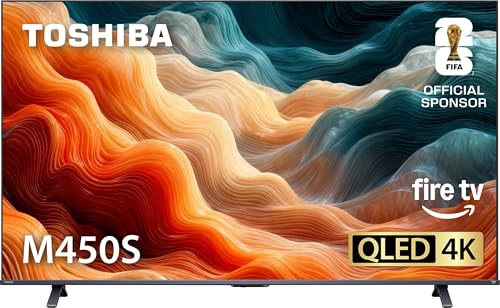
Toshiba’s M450 answers a specific combination no other pick here offers: quantum-dot colour inside the Fire TV ecosystem. The listing describes a 43-inch Class M450 Series QLED 4K UHD Smart Fire TV with a voice remote with Alexa and the same stream-live-TV-without-cable positioning as its platform sibling. The QLED designation — explained in full in our QLED guide and summarised below — means an LCD panel with a quantum-dot layer for richer, purer colour, and at 43 inches its arrival matters because small sets are usually last in line for colour technology. A nature documentary, an animated film, a football kit in sunlight: the M450’s colour ambition shows in exactly the content small-room televisions spend their lives showing.
Fire TV supplies the familiar half of the proposition — Alexa in the remote, Amazon’s app depth, live TV aggregation — so the M450 slots into the same households as the Insignia F50 while aiming a tier higher on picture. That internal comparison is the useful one: two Fire TV sets, one mainstream LED and one quantum-dot, and the buyer chooses how much colour and HDR conviction their room’s content deserves. Sport and animation argue for the Toshiba; news and casual series argue that the Insignia’s simplicity suffices.
The M450’s listing is platform-and-panel focused, making no gaming or premium-format claims, and this guide keeps it that way: Dolby Vision is not named in its title, and players with format or gaming checklists should compare the Sony and Hisense entries, whose listings speak to those briefs directly. Within its own brief — Fire TV households wanting better colour from a 43-inch screen — the M450 is a clean, well-aimed answer.
- Panel: QLED (quantum-dot LCD), 43-inch class
- Platform: Smart Fire TV
- Remote: Voice Remote with Alexa
- Positioning per listing: stream live TV without cable
- Series: M450
Strengths
- Quantum-dot colour lifts HDR and saturated content above mainstream LED at this size.
- Fire TV familiarity for Amazon households, with Alexa voice control in the remote.
- A clear step-up path within the Fire TV camp without changing platforms.
Trade-offs
- Its listing names no Dolby Vision or gaming features — those briefs point elsewhere here.
- Panel ambition is colour-led; brightness remains in the size class’s normal range.
- Fire TV’s promotional home screen is part of the platform bargain.
Best for: Fire TV households wanting richer colour from a bedroom or family-room 43-inch set.
Not suited for: a checklist that starts with Dolby Vision or console gaming features.
Hisense E6SR 43 — The gaming-ready Roku set
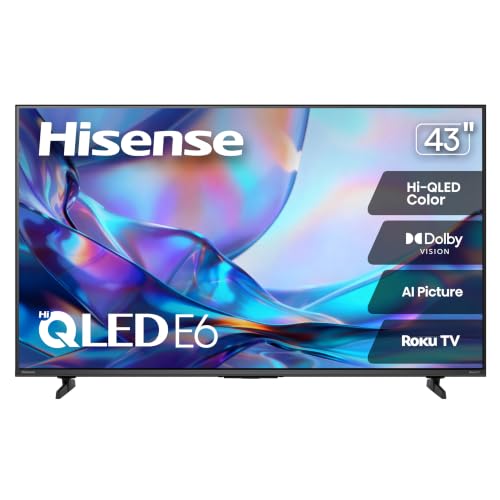
The E6SR’s listing does something almost unheard of at 43 inches: it treats the buyer like a specification reader. Hisense describes a 43-inch Class E6SR Series Hi-QLED 4K UHD Smart Roku TV (43E6SR, 2026) with Dolby Vision, Game Mode Plus, VRR, ALLM, DTS Virtual:X, Apple AirPlay, and compatibility with Alexa and Google Assistant. Unpack the gaming pair, because they are the headline: VRR — variable refresh rate — lets the panel sync to a game’s fluctuating frame output, and ALLM — auto low latency mode — lets the set recognise a console and switch itself into its fastest picture mode without the player digging through menus. Both are named in the listing, which is why this guide can claim them for this set and, following its evidence rule, for no other pick in this article.
The supporting specification tells the same serious story. Hi-QLED is Hisense’s quantum-dot colour branding, Dolby Vision covers the premium HDR format the class often skips, and DTS Virtual:X works the audio side, spatialising the set’s speakers for games and films. Roku is the platform — the plainest, most neutral interface in this guide, with an app catalogue deep enough for any household and a home screen that respects the viewer’s intentions. AirPlay support plus Alexa and Google Assistant compatibility make it the most ecumenical set here for mixed-device homes: iPhones cast, either assistant answers, Roku minds its own business in the middle.
For a gaming corner or a bedroom console setup, this is the class’s most complete small answer — a 43-inch screen that takes games seriously without requiring the room to become a gaming den. Its limits are the class’s: brightness and panel scale are 43-inch mainstream, and the largest film nights will still belong to a bigger screen elsewhere in the house. Within the size, the E6SR is the pick that asks the fewest apologies.
- Panel: Hi-QLED (quantum-dot LCD), 43-inch class
- Gaming features named in listing: Game Mode Plus, VRR, ALLM
- Formats named in listing: Dolby Vision; Audio: DTS Virtual:X
- Platform: Smart Roku TV; Apple AirPlay; works with Alexa and Google Assistant
- Model: 43E6SR, 2026
Strengths
- VRR and ALLM named in the listing — genuine console features at a size that rarely gets them.
- Dolby Vision plus quantum-dot colour covers the film brief as well as the gaming one.
- Roku’s neutral platform with AirPlay suits mixed-device households best in this guide.
Trade-offs
- Brightness stays within the 43-inch mainstream — daylight rooms should compare the TCL’s high-brightness claim.
- Roku’s simplicity means fewer platform extras than Google TV or Samsung’s ecosystem.
- As a 2026 model, long-term owner history is still being written.
Best for: console players and mixed households wanting one small screen that does everything properly.
Not suited for: viewers devoted to a single voice-assistant ecosystem’s native television platform.

TCL R7D 43 — Bright Roku QLED
TCL’s R7D closes the guide with the second Roku set and a brightness-forward take on the size. The listing describes a 43-inch R7D Series QLED 4K UHD HDR Smart Roku TV (43R7D, 2026) with high brightness, Motion Rate 240, Google Cast and AirPlay 2, and a live TV channel guide for streaming live news, sports, and movies. Two phrases need honest handling. High brightness is the listing’s own claim and it matters in the rooms 43-inch sets inhabit — kitchens’ edges, bright bedrooms, offices with real windows — where a dim small screen disappears at noon. Motion Rate 240 is TCL’s motion-processing language as listed; this guide quotes it as such and does not translate it into a native refresh figure the listing does not state.
The casting double — Google Cast and AirPlay 2 both named — makes the R7D the most phone-friendly set in the guide alongside the Hisense, and the distinction between them is instructive: the Hisense leads with gaming and Dolby Vision, the TCL with brightness and casting, both on Roku’s calm platform. A household that throws videos, photos, and music from phones to the television daily will feel the R7D’s casting support constantly, while a console household will feel the E6SR’s VRR and ALLM. TCL’s QLED colour underpins both kinds of evening, and the live TV guide in the listing speaks to the cord-cutting household that wants channel-surfing to survive the streaming transition.
As with its platform sibling, the R7D’s listing makes no Dolby Vision or gaming-mode claims, and film-first buyers should weigh the Sony accordingly. As a bright, cast-friendly, quantum-dot Roku set, it is the class’s daylight champion — the 43-inch screen for the room where the sun gets a vote.
- Panel: QLED (quantum-dot LCD), high brightness per listing, 43-inch class
- Motion: Motion Rate 240 as listed (manufacturer motion figure, not a native refresh claim)
- Casting: Google Cast and AirPlay 2 named in listing
- Platform: Smart Roku TV with live TV channel guide
- Model: 43R7D, 2026
Strengths
- High-brightness positioning suits the bright bedrooms and offices this size inhabits.
- Both major casting systems named — the most phone-friendly pick here.
- Roku platform plus a live TV guide keeps cord-cutters oriented.
Trade-offs
- No Dolby Vision or gaming features are claimed in its listing.
- Motion Rate language requires care — it is not a native 240Hz panel claim.
- Film purists in dark rooms will prefer the Sony’s processing and format list.
Best for: bright rooms and phone-casting households wanting QLED colour on Roku.
Not suited for: console players needing the VRR and ALLM feature set the Hisense lists.
Comparison
| Model | Panel | Platform | Named in listing | Character |
|---|---|---|---|---|
| Samsung U8000F | Crystal UHD LED | Samsung platform | MetalStream Design, Knox Security, Alexa Built-in | Polished all-rounder |
| Sony Bravia 3 | LED, Triluminos Pro | Google TV | Dolby Vision/Atmos, PS5 features, X1 processor | Film and PlayStation |
| Insignia F50 | LED | Fire TV | Voice Remote with Alexa | Streaming simplicity |
| Toshiba M450 | QLED | Fire TV | Voice Remote with Alexa | Quantum-dot colour |
| Hisense E6SR | Hi-QLED | Roku TV | Dolby Vision, Game Mode Plus, VRR, ALLM, AirPlay | Gaming-ready all-rounder |
| TCL R7D | QLED | Roku TV | High Brightness, Motion Rate 240, Cast and AirPlay 2 | Bright casting-friendly set |
Why Does 43 Inches Suit So Many Rooms Better Than 55?
Geometry and humility. A 55-inch screen wants roughly two and a half metres of viewing distance before 4K resolves as intended and the frame stops overwhelming the eye’s comfortable field; many second rooms, bedrooms, and studio flats simply do not contain that distance along any wall. A 43-inch screen reaches its best at a metre and a half to two metres — the exact span between a bed and its opposite wall, a desk chair and a shelf, a small sofa and a media unit. In those rooms the larger set is not more luxurious; it is merely closer than its design intends, with pixels, compression artefacts, and sheer presence all magnified past the point of pleasure.
There is also the room’s dignity to consider. A 43-inch television can share a wall with art, shelves, and windows without annexing them, can sit on furniture that already exists, and can be moved by one person when the room’s purpose changes — as second rooms’ purposes constantly do. The size is not a compromise position between a monitor and a cinema; for the rooms it serves, it is the correct instrument, and the six sets above are its current best expressions.
What About the 42-Inch OLED Sitting Just Below This Class?
It deserves its paragraph, clearly labelled: LG’s C4 OLED is sold at 42 inches — forty-two, one inch below this guide’s class — and it is the premium alternative a buyer researching 43-inch sets will inevitably meet. As an OLED it offers per-pixel blacks and response that none of the LCD sets here can match, and as a C4 it carries that line’s gaming pedigree and smart platform. For a desk-bound player or a film viewer at close range in a dim room, that 42-inch set may genuinely be the better purchase, and no honest guide should hide it to protect a size boundary.
The reasons it is a comparison rather than a pick here are equally plain: it is not a 43-inch television, its price position sits above this class’s mainstream, and its OLED care considerations around static content apply. Buyers for whom the inch is negotiable should read our OLED guide’s treatment of it and decide with both guides open. Buyers who need exactly 43 inches — for a fitted space, a measured wall, a defined room — have their six above, and the boundary has been respected rather than blurred.
Which Platform Fits a Household That Hates Fiddling?
Roku, on the evidence of these six sets, remains the interface that asks the least of its owner: a home screen of apps in a grid, search that reaches across services without favouring a shop, and settings that stay where they were left. The Hisense E6SR and TCL R7D both ride on it, differing in their hardware ambitions rather than their daily manners. Fire TV — the Insignia and Toshiba — is nearly as simple and better for households whose media life already runs through Amazon, accepting a more promotional home screen as the price. Google TV on the Sony offers the deepest discovery and household profiles at the cost of the busiest home screen, while Samsung’s platform on the U8000F counters with its free-channel depth for viewers who still think in channels.
The meta-advice is consistency. One platform across the household’s televisions ends the remote-and-menu relearning that makes second-room sets feel foreign, and it is worth real money in daily patience. If your main room already runs one of these ecosystems, let that fact weigh heavily at 43 inches, where the platform is honestly half the product.
How Do You Mount and Place a 43-Inch Set Well?
Centre the screen at seated eye level — lower than most people instinctively hang it — and let the room’s main seat dictate the spot rather than the wall’s symmetry. At this size a tilting mount earns its keep in bedrooms, where viewing from a bed raises the eye-line geometry, and in offices, where the same screen serves a desk chair by day and an armchair by night. Keep the set out of direct window strike where possible; where impossible, the brighter picks — the TCL R7D’s high-brightness positioning, the quantum-dot sets generally — forgive more. On furniture, confirm the stand’s footprint against the unit’s depth, since 43-inch sets increasingly use wide feet that assume a modern media bench.
Cabling at this size is mercifully simple: power, network if wired — recommended, as ever, for a fixed screen — one console or streaming device, and perhaps a compact soundbar, whose addition transforms a bedroom set’s film nights more than any picture setting. Route cables before the mount’s final tightening, photograph the set’s rear labels for future reference, and keep the box until the panel has shown dark and bright scenes without complaint.
What Does HDR Mean at 43 Inches, Realistically?
It means range and colour rather than spectacle. A 43-inch panel will not flood a room with highlight intensity the way an 85-inch flagship does, and it does not need to: at close viewing distances, the eye reads contrast relationships, not absolute luminance. HDR on these sets shows itself as a sunset with gradations instead of bands, a night scene where a lamp is a light source rather than a white blob, colours in animation and sport that hold their saturation in bright passages. Dolby Vision, named in the Sony and Hisense listings, refines that further by guiding the set scene by scene — a meaningful advantage at this size, where tone mapping decisions are a large share of what the viewer perceives as quality.
The honest boundary is brightness headroom in sunlit rooms, which is why the TCL R7D’s high-brightness positioning and the quantum-dot sets’ colour efficiency matter in this class. A buyer whose 43-inch room is a dim bedroom will extract the full HDR story from any pick here; a buyer whose room faces the afternoon sun should weight brightness claims in the listings accordingly and treat HDR as a colour-and-contrast benefit first.
How Should a Second-Room TV Differ From the Main One?
In manners more than muscle. The main television can demand a soundbar, a darkened room, and the household’s schedule; a second-room set must be gracious at low volume at midnight, quick to wake, simple for a guest to drive, and content with broadcast and streaming rather than a disc library. That is why platform temperament weighs so heavily in this guide’s verdicts, and why sets like the Insignia F50 — limited on paper, effortless in a spare room — earn their places. A second-room set should also forgive neglect: no calibration rituals, no firmware babysitting, no care regime beyond a dusted screen.
It should not, however, be the household’s punishment screen. The modern 43-inch class — quantum dots, Dolby Vision, stated gaming features, real processors — has closed the dignity gap entirely. The correct ambition for a second room is a smaller version of the main room’s standards, chosen from this list by platform and light, rather than a cast-off justified by the room’s rank. Guests, teenagers, and night-shift workers all notice the difference, and so will you on the first evening the main room is occupied by somebody else’s programme.
What Sound Makes Sense for a Television This Size?
Start with what the set offers, because small rooms forgive speakers that large rooms expose. Dialogue at two metres needs clarity more than power, and several picks here address it directly — the Hisense’s DTS Virtual:X spatialises its output for games and films, and every set’s night and dialogue modes deserve a try before money moves. A compact soundbar is the natural upgrade when films migrate into the room regularly: it lifts dialogue out of the mix, adds the low end a thin cabinet cannot, and at 43 inches a modest bar matches the screen’s width and the room’s scale without turning a bedroom into a showroom.
Headphones and earbuds deserve mention in this size class specifically, since 43-inch sets live in bedrooms and shared flats where one person’s film night is another person’s sleep. Every platform here can route audio to Bluetooth or a connected device in some fashion — check the product page for the exact arrangement on your finalist — and a household that plans for late-night listening at purchase time avoids the midnight volume negotiation entirely.
When Is a 43-Inch Set the Wrong Purchase?
When the room is secretly a main room. A household that gathers five people nightly at three metres, watches films as events, and has simply always owned a smaller television is not a 43-inch household waiting to be convinced; it is a 65-inch household under-equipped, and no pick in this guide — however good — will change that geometry. The tell is seating: if viewers regularly sit beyond two and a half metres, or if the screen must serve a wide seating spread, size up and consult our wider smart TV guide. The other wrong purchase is the fitted-space error in reverse: a 43-inch set bought for an alcove or cabinet measured for it should be verified against the product page’s full dimensions including feet, since a centimetre of optimism is still a centimetre.
Finally, a dormitory-style warning: a 43-inch set is large enough to be a household’s main screen and small enough to be carried out by one person, which makes it a frequent mover between rooms and homes. Buy the set for the room it will live in next year, not the room it lands in this month, and its size will keep making sense after the furniture changes its mind.
How Do Guests and Grandparents Fare on These Platforms?
Better than the television industry usually manages, provided the household sets the stage. Roku’s grid — on the Hisense and TCL — is the interface a visitor decodes fastest, with Fire TV’s voice remote a close second for anyone willing to talk to it: press, ask for the programme, watch. Google TV and Samsung’s platform reward their owners with deeper discovery and ask slightly more of a stranger. The practical kindnesses are universal: sign into the household’s services before guests arrive, pin the three apps visitors actually use to the front row, and leave the set on the input or home screen a guest should land on, rather than the console’s dashboard.
Voice control quietly solves the rest. Alexa is built into the Samsung’s listing and rides in the Fire TV remotes; the Hisense answers to Alexa and Google Assistant alike; AirPlay and Cast let a guest’s phone become the remote entirely. A 43-inch set in a guest room, prepared this way, stops being an appliance with instructions taped to it and becomes what hospitality intends — entertainment that asks nothing of the entertained.
What Should Renters and Frequent Movers Look For?
Portability with dignity. A 43-inch set is the largest television one person can move confidently and the smallest that still feels like a real television in the new place, which is why this size class dominates first flats and rented rooms. Renters should favour stand-friendly sets over wall-dependent designs, confirm the feet fit the furniture that travels with them, and keep the box — a 43-inch box stores flat-packed sets of regrets in every mover’s history, and the original packaging remains the safest way to move a panel. Platform portability matters too: a Roku or Fire TV set reconstitutes a household’s streaming life in a new postcode within minutes of meeting the new network.
Damage avoidance is the unglamorous core: screens travel face-protected, never flat under weight, and the first check in any new room is the same dark-scene, bright-scene inspection from delivery day. A set from this list, moved with that much care, can serve three homes in a decade without the picture noticing — one of the size class’s least advertised and most real virtues.
How Does a Small Screen Change Family Viewing Habits?
It decentralises them, mostly for the better. A good 43-inch set in a second room ends the tyranny of the single schedule: the match and the drama can coexist in one household on one evening, a teenager’s series stops colonising the main screen, and a parent working late can catch the news in the office without annexing the living room. The risk is the mirror image — a household scattered across rooms and screens, watching everything separately. The sets in this guide cannot legislate family togetherness, but their quality removes the usual excuse for defection: nobody flees the main room because the second screen is miserable anymore.
Practically, households should expect the 43-inch set to become the most-used television they own by hours, precisely because it fits the solo and paired viewing that dominates real life. Buy it with that destiny in mind — platform consistency with the main set, a comfortable remote, sound that respects thin walls — and the small screen stops being the spare and becomes the workhorse.
What Does the First Evening With a 43-Inch Set Require?
Less than an hour, honestly spent. Place the set, connect power and network — wired if the room allows — sign into the platform and the household’s two or three real services, and run the update check manually. Choose the film or cinema picture mode for the streaming input, disable motion smoothing for films, and set a sensible brightness for the room’s evening light rather than accepting the vivid default. If a console lives in the room, connect it, and on the Hisense confirm that its ALLM behaviour — named in the listing — switches the set into game mode as intended; on the Sony, walk the PlayStation features the listing promises.
Then watch something the room was bought for, from the seat that will actually be used, at the distance that actually exists. Adjust the height or tilt if necks complain, route the one cable that offends, and put the box somewhere it can be retrieved for a fortnight. A 43-inch set set up this way disappears into the room’s life by the second evening, which is the entire ambition of its size class.
Why Do Small TVs Deserve the Same Buying Care as Large Ones?
Because hours are the currency that matters, and small televisions accumulate them relentlessly. The main-room flagship may host two film nights a week; the 43-inch set in the bedroom or office hosts the morning news, the working-from-home background, the late series episode, the console’s daily session — a river of ordinary viewing that adds up to the majority of a household’s screen life. A poor small set taxes that river daily in small coins: a clumsy platform, a washed picture in daylight, sound that strains dialogue. A good one, chosen with the same seriousness as the flagship, pays the household back in the same small coins, compounded.
That is the editorial premise of this entire guide, and it is why the picks were verified, compared, and argued over rather than listed from a catalogue. The size is modest. The role is not.
How Will a 43-Inch Purchase Age Over Five Years?
The panel will outlast the platform’s fashion, as with every smart television, and the remedies are the same: the interface can be refreshed by a streaming stick whenever it tires, while the screen — quantum-dot colour on three of these picks, Dolby Vision on two, stated gaming features on one — remains the substance of the purchase. Rooms will change around it; a set this size migrates gracefully from flat to house, from bedroom to den to a child’s first room of their own, and each migration rewards the buyer who chose a platform the household speaks and a panel with genuine headroom.
Care is minimal and mostly geometric: keep it out of sustained direct sun, dust it with a dry cloth, and let its standby updates happen. Five years on, a well-chosen 43-inch set from this list should still be the screen its room reaches for first — not because it was expensive, but because it was matched, deliberately, to a distance, a light, and a life.
Which of These Six Belongs in a Kitchen-Adjacent Family Room?
The room that cooks, eats, and watches simultaneously imposes a particular brief: the screen is viewed at angles, in bright mixed light, at conversational volume, often with hands too occupied for remotes. Voice control stops being a novelty there — the Alexa support woven through the Samsung, Insignia, and Toshiba listings, and the dual-assistant compatibility of the Hisense, all earn their keep mid-recipe. Brightness and angle tolerance matter more than cinema credentials, which favours the TCL R7D’s high-brightness positioning and the quantum-dot sets’ colour strength, while Roku’s and Fire TV’s live-TV aggregation suits the news-and-weather rhythm of a family room’s mornings.
Sound should be judged at conversation distance rather than cinema distance: dialogue clarity over a dishwasher’s hum is the real specification, and a compact soundbar remains the reliable answer when the set’s own speakers lose that contest. Choose for the room’s loudest hour and its commonest content, and the kitchen-adjacent screen becomes the household’s informal headquarters — which, in most homes, is precisely the role it was bought to fill.
Common Mistakes
Calling every small premium set “43-inch” leads the errors, and this guide has flagged the honest exception: the celebrated LG OLED in this neighbourhood is a 42-inch television, and buyers comparing it should compare it as such, not as a rounding error. The second mistake is buying a 43-inch set for a main room with a three-metre sofa distance, then blaming 4K for looking ordinary — the size was wrong, not the resolution. Third is platform drift: adding a third ecosystem to a household’s televisions to save a small sum, then paying the difference in daily friction for years.
Specification literalism runs fourth. A listing’s silence — on Dolby Vision, on gaming features — is information, and this guide has treated it as such; buyers should do the same rather than assuming a feature must be present because a rival lists it. Finally, mounting a bedroom set at standing eye height, cinema-poster style, guarantees a cricked neck by the second film. Eye level means the eyes that will actually watch, in the posture they will actually hold.
Final Recommendation
The Hisense E6SR is this guide’s central recommendation for a 43-inch room that does a bit of everything: quantum-dot colour, Dolby Vision, stated VRR and ALLM for the console, Roku’s calm platform, and casting for everyone’s phone. Film-led rooms should take the Sony Bravia 3 and its Dolby pairing; Fire TV households split between the Insignia F50’s simplicity and the Toshiba M450’s colour; bright rooms and casting-heavy homes belong to the TCL R7D; and Samsung loyalists equipping a second room will find the U8000F’s polish and free-content depth exactly pitched. Readers whose inch is negotiable and whose budget stretches should also weigh the 42-inch OLED discussed above — as a 42-inch set, on its own considerable merits.
Measure the distance, choose the platform your household already speaks, and let the panel follow. At 43 inches, that order of decisions almost never disappoints. And spare a thought for what the right small television quietly does to a home: it gives every room its own window without giving any room an excuse, it lets the household’s tastes run in parallel without friction, and it turns the spare room, the bedroom, and the little den from afterthoughts into places people choose. That is a great deal of domestic happiness to hang on forty-three inches of glass — which is precisely why choosing those inches carefully, from a list argued over rather than merely assembled, is time well spent. Order the set that fits your room’s light and your household’s platform, set it up at seated eye level on the first evening, and by the end of the week the little screen will have stopped being the second television and started being, simply, the one in the room where life happens — the morning headlines with coffee, the console session after work, the film that ends the day, each arriving at exactly the size the room always wanted and the distance always implied, with nothing left to upgrade but the watchlist itself and nothing left to explain to anyone who sits down, picks up the remote, and simply finds the picture right. That quiet rightness — no squinting, no menu-diving, no apologies to the person in the corner chair — is the standard this size class can meet every single day, and meeting it is worth every deliberate choice recorded in the pages above, from the first measurement of the wall to the last cable tucked behind the stand on the evening it all came together and the room finally felt finished, furnished, and ready for the ordinary, happy traffic of mornings, evenings, guests, and quiet hours that a well-chosen small television serves without ever asking to be thanked for it.
Frequently Asked Questions
Is 43 inches big enough for 4K to matter?
Yes — at the one-to-two-metre distances these rooms impose, 4K detail resolves fully on a 43-inch panel and HDR does the rest of the visible work. It is at longer distances that 43 inches undersells 4K, which is a room-matching issue rather than a resolution flaw.
Which of these sets is best for a games console?
The Hisense E6SR, whose listing names Game Mode Plus, VRR, and ALLM outright — features this guide can therefore claim for it directly. PlayStation households should also weigh the Sony Bravia 3, whose listing names exclusive features for PlayStation 5, accepting that its gaming story is integration rather than VRR.
What is the difference between the two Fire TV picks?
Panel ambition. The Insignia F50 is a mainstream LED set built around Fire TV simplicity; the Toshiba M450 adds a QLED quantum-dot panel for richer colour in the same ecosystem. Households choose between them by how much colour and HDR conviction their content deserves.
And between the two Roku picks?
Emphasis. The Hisense E6SR leads with Dolby Vision and stated gaming features; the TCL R7D leads with high brightness and both Google Cast and AirPlay 2. Both share Roku’s platform, so the choice is hardware character, not interface.
Is the LG C4 a 43-inch TV?
No. The small C4 is a 42-inch television, and this guide refers to it as such wherever it appears. It is a legitimate premium alternative for buyers whose size requirement is flexible, discussed in the section above, but it is not one of this guide’s 43-inch picks and should never be sold or searched for as one.
Can a 43-inch set work as a computer monitor?
Comfortably, for media, console-style PC gaming, and general use at a metre or so, where its 4K resolution stays crisp. Text-heavy all-day work deserves attention to the set’s picture mode for PC input and your own eyes’ verdict over a long session; the Hisense’s gaming features make it the most natural crossover candidate among these six.
Should a 43-inch TV have a soundbar in a bedroom?
Only if films live there regularly. For series, news, and late-night viewing at modest volume, the sets here are adequate, and headphone listening may serve a shared bedroom better than any speaker. Where a film habit takes root in the room, a compact bar transforms dialogue clarity at exactly the low volumes bedrooms demand — buy it after a fortnight of listening, against the specific lack you have noticed, rather than automatically with the television.
Related Guides
When the budget leads, continue to the affordable 4K television picks; for the gear that shares a desk with a small screen, see the longest-lasting smartwatches and the GPS smartwatch selection.



[…] gaming rooms are covered by the 43-inch 4K HDR television selection, budgets by the affordable 4K TV lineup, and the play session’s other screen — the one on […]