What's inside
- Key Takeaways
- Quick Picks
- How We Chose These Picks
- Comparison
- What Do Refresh Rate and VRR Actually Change in Play?
- Which Connections Should a Gaming TV Buyer Verify First?
- How Do You Configure HDR for Games Without Washing Out the Picture?
- How Does HDR Change the Way Games Actually Look?
- What Should Desk and Bedroom Gamers Do Differently?
- How Do You Split One Screen Between Gaming and Family Viewing?
- What Does a Gaming TV Owe the Films Watched on It?
- Why Does Input Lag Matter Less Than It Used To — and Still Matter?
- How Should a PC Gamer Choose Between the Stated Ceilings Here?
- What Changes When the Gaming TV Is Also the Sports TV?
- How Do You Future-Proof a Gaming TV Without Overspending?
- What Should the First Gaming Session on a New Set Include?
- Where Does a Headset Fit in a Television Gaming Setup?
- Common Mistakes
- Final Recommendation
- Frequently Asked Questions
- Related Guides
As an Amazon Associate I earn from qualifying purchases. This post may contain affiliate links at no extra cost to you.
widgetverdict.com is reader-supported. When you buy through links on our site, we may earn an affiliate commission.
A gaming television lives a double life, and the best 4k hdr gaming tvs are the sets that refuse to make either life feel like a compromise. By day — or by film night — the screen must be a proper HDR television, with the contrast and colour that make a streamed epic look expensive. By session, it must become a gaming display: responsive enough that inputs feel wired to your hands, smooth enough that a camera pan does not tear or stutter, and bright enough in HDR that a sunlit racetrack and a torch-lit dungeon both hold their detail. This guide’s six picks were chosen for that double life, and it follows a strict evidence rule throughout: refresh rates, variable refresh figures, and gaming features are claimed for a specific set only where that set’s verified listing states them, in the listing’s own words.
That rule produces an honest map of the field. The Hisense U8QG’s listing states Native 165Hz and VRR 288; the Hisense U7SF’s states Native 165Hz and VRR 330; the TCL QM8L and QM6K listings state 144Hz; the LG C4’s listing leans on its OLED evo panel and series reputation rather than printing a refresh figure; the Samsung QN90F’s listing names Gaming Hub without a hertz number. Where a listing is silent, this guide says what can still be known — panel type, platform, format support — and tells you exactly what to check on the listing page first. Gaming buyers are specification-literate; they deserve a guide that behaves the same way.
Key Takeaways
- Two Hisense sets carry the highest stated gaming figures here: the U8QG lists Native 165Hz with VRR 288, the U7SF lists Native 165Hz with VRR 330.
- TCL’s QM8L and QM6K both state 144Hz in their listings — headroom that gaming PCs can use and consoles partially can.
- The LG C4 is the OLED entry: its gaming case rests on per-pixel response and contrast rather than a printed refresh figure in its listing.
- Samsung’s QN90F names Gaming Hub in its listing, gathering cloud gaming and consoles into one destination at 50 inches.
- Consoles cannot feed the highest ceilings listed here; PC players are the audience for 144Hz-and-above panels.
- HDR format support is checkable per listing — Dolby Vision appears in the Hisense and TCL titles, HDR10+ in the U8QG’s — and matters for game libraries as much as film ones.
Quick Picks
| Pick | Badge | Why it is here |
|---|---|---|
| LG C4 OLED evo 55 | The OLED gaming choice | Self-lit pixels, instant response, and perfect blacks for dark game worlds at 55 inches. |
| Hisense U8QG 65 | Highest stated VRR pairing | Native 165Hz and VRR 288 in its listing, plus up to 5000 nits and 4.1.2 channel audio. |
| TCL QM8L 65 | 144Hz flagship all-rounder | SQD-Mini LED, a stated 144Hz, Google TV with Gemini, and Dolby Vision IQ. |
| Samsung QN90F Neo QLED 50 | Gaming Hub at 50 inches | Glare Free Neo QLED with Gaming Hub named in its listing, for smaller gaming rooms. |
| Hisense U7SF 65 | VRR 330 on Fire TV | Native 165Hz, VRR 330, anti-reflection, and 2.1.2 channel audio per its listing. |
| TCL QM6K 65 | 144Hz below the flagship | A stated 144Hz, Mini LED, Dolby Vision, and a listing that calls out premium gaming. |
How We Chose These Picks
Gaming relevance was the entry ticket, and it had to be evidenced rather than vibes-based: a set qualified through a stated refresh or VRR figure in its listing, a named gaming platform feature, or — in the LG C4’s case — a panel technology whose response characteristics are the gaming feature, from a line with an established console pedigree. HDR credibility was the second gate, because a gaming TV that fumbles HDR fumbles half the modern games catalogue; every pick here carries a serious HDR story in its listing, from Dolby Vision IQ to Neo Quantum HDR+. The third gate was the double-life test: each set had to remain a television a household would choose for films and sport with the console switched off.
One deliberate omission of method deserves stating: input lag figures appear in none of these listings, so this guide does not rank by them and does not invent them. Serious competitive players should read the product pages for the current measurements of their finalists. What a guide can do honestly — and this one does — is map the panel ceilings, the stated gaming features, the formats, and the rooms, then hand the final verification to the buyer with a checklist, which the buying-guide sections below provide.

LG C4 OLED evo 55 — The OLED gaming choice
Every gaming-TV conversation eventually arrives at OLED, because the technology’s core trait — each pixel switching its own light almost instantly — is precisely what fast games crave. The LG C4’s listing describes a 55-inch Class OLED evo C4 Series Smart TV (OLED55C4PUA, 2024) with a 4K processor, Magic Remote, AI-powered features, and Alexa built in; it does not print a refresh figure, and this guide will not supply one on its behalf. What can be said from the panel itself is substantial: motion clarity on OLED comes from response speed rather than refresh alone, so a panning shot in a shooter stays legible, and HDR gaming in dark environments — the cave systems, night drives, and space stations modern games love — gains a depth that backlit panels approximate with dimming and OLED simply has.
The C4 line’s console pedigree is the other half of its case. LG’s C series has been the default OLED recommendation for console generations, with game-focused menus and the panel behaviour players describe as connected — inputs that feel immediate because the display adds so little visual smearing between frames. At 55 inches it suits the desk-adjacent and living-room gaming setups most households actually have, and its smart platform keeps it a complete television when the console sleeps. Buyers should verify the current gaming specification — refresh, VRR range, port allocation — on the product page, since the listing title here is quiet on those numbers; that verification is a two-minute job and this guide flags it rather than papering over it.
The OLED caveats apply with gaming-specific edges. Static HUD elements are the one content type OLED asks owners to treat thoughtfully over very long sessions, and the care habits in our OLED guide — varied content, standby maintenance, sensible brightness — cover gaming households comfortably. Bright-room gaming at midday yields some ground to the Mini-LED picks below. For evening play in a dimmed room, which is where most serious sessions happen, the C4’s contrast is the experience the other sets are measured against.
- Panel: OLED evo, self-lit pixels, 55-inch class
- Processor: 4K processor per listing
- Gaming note: refresh and VRR figures are not stated in the listing title — verify on the product page
- Remote: Magic Remote; Alexa Built-in
- Model: OLED55C4PUA, 2024
Strengths
- Pixel response keeps fast motion clean in a way backlit panels work much harder to match.
- Perfect blacks transform dark game environments and HDR night scenes.
- A complete film and streaming television when the console is off.
Trade-offs
- Its listing prints no refresh or VRR figure — the product page must confirm your requirements.
- Very long sessions on one static HUD deserve the usual OLED care habits.
- Midday brightness in a sunlit gaming room trails the Mini-LED picks.
Best for: evening console and PC play in a dimmed room, plus film nights on the same screen.
Not suited for: marathon static-interface gaming in a permanently bright room.

Hisense U8QG 65 — Highest stated VRR pairing
The U8QG’s listing is the loudest document in this guide, and for once the volume is information. Hisense describes a 65-inch U8 Series ULED Mini-LED 4K UHD Smart Google TV (65U8QG) with QLED colour, Native 165Hz, VRR 288, up to LD5600, 5000 nits, HDR10+, Dolby Vision IQ and Atmos, IMAX Enhanced, and 4.1.2 channel audio. For a gaming buyer the operative pair is the first two figures: a panel that refreshes natively at 165Hz, with variable refresh support listed as VRR 288. A gaming PC with a strong graphics card is the hardware that can exploit that ceiling — high frame rates in competitive titles, VRR smoothing the dips — and on this set those capabilities meet a backlight with the dimming scale and brightness to make HDR games look violent in the best sense: muzzle flash, lightning, and neon against properly dark surroundings.
The supporting cast matters to the double life. Dolby Vision IQ and HDR10+ both appearing means game and film libraries in either HDR ecosystem are spoken for. The 4.1.2 channel built-in audio is the strongest sound claim in this guide, relevant because gaming audio — positional cues, dialogue, soundtrack — usually defaults to a headset, and a television that can carry a room when the headset comes off is a genuine rarity. Google TV runs the platform side without fuss.
Restraint is the buyer’s homework here. A set with this much headroom invites maximum settings everywhere, and its film modes exist to civilise it for drama. Console-only households should also be clear-eyed: their machines will use a generous slice of this panel’s range, not its ceiling, and the purchase makes most sense when a PC, a future console, or simply the desire for headroom justifies it. As a statement of where LCD gaming televisions now stand, the U8QG is the guide’s exhibit A.
- Panel: ULED Mini-LED with QLED colour, 65-inch class
- Refresh: Native 165Hz per listing
- VRR: listed as VRR 288
- Brightness and dimming: up to 5000 nits, up to LD5600, per listing
- Formats named in listing: HDR10+, Dolby Vision IQ, Dolby Atmos, IMAX Enhanced
- Audio: 4.1.2 channel built-in system; Platform: Google TV
Strengths
- The stated 165Hz native refresh and VRR 288 give gaming PCs the most headroom here.
- Brightness and dimming scale make HDR game highlights genuinely dramatic.
- Built-in 4.1.2 audio carries gaming and film sound further than rival cabinets.
Trade-offs
- Consoles cannot reach its ceiling — the premium buys headroom, not console performance.
- Maximum-impact defaults need taming in the film modes for quieter content.
- Its specification invites endless settings exploration; some players just want to play.
Best for: gaming-PC owners who also want a flagship HDR television for the same wall.
Not suited for: console-only households counting value strictly against what their machine can feed.

TCL QM8L 65 — 144Hz flagship all-rounder
TCL’s QM8L approaches the gaming brief from the flagship direction. Its listing describes a 65-inch QM8L Series SQD-Mini LED QLED 4K Smart Google TV (65QM8L, 2026) at 144Hz, with Google TV and Gemini, Dolby Vision IQ, Dolby Atmos, and IMAX Enhanced. The stated 144Hz is the gaming headline: beyond the console ceiling, squarely aimed at PC players, and useful to everyone else as motion headroom. Behind it sits the SQD-Mini LED backlight, whose dimming gives HDR games the contrast structure that separates a flagship from a bright ordinary set — dark levels in a game world stay dark while the HUD and highlights burn bright, the exact mixed scene that defeats cheaper backlights.
Dolby Vision IQ earns a gaming mention it does not always get: by adapting HDR to ambient light, it keeps a game’s HDR presentation honest in a room that is neither cinema-dark nor office-bright, which describes most gaming rooms at 7 p.m. Google TV with Gemini handles the non-gaming life — the deepest app bench in this guide, cross-service search for the post-session film, and a platform that treats the television as a household screen rather than a monitor with ambitions. As a film set it carries the flagship TCL character described in our QLED guide: emphatic brightness, hard-working dimming, and dark scenes that are very good rather than OLED-perfect.
The QM8L’s gaming compromises are the honest flagship ones. Its listing does not print a VRR range figure, so PC players with specific VRR requirements should confirm the current specification on the product page — a recurring theme in this guide, because listings vary in what they choose to headline. And like the U8QG, it offers ceiling beyond console reach. What it offers that the Hisense does not is TCL’s particular balance: a flagship that feels engineered for the whole evening, game first and film after, without asking the household to reorganise around either.
- Panel: SQD-Mini LED QLED, 65-inch class
- Refresh: 144Hz per listing
- VRR: no range figure stated in the listing title — verify on the product page
- Platform: Google TV with Gemini
- Formats named in listing: Dolby Vision IQ, Dolby Atmos, IMAX Enhanced
- Model: 65QM8L, 2026
Strengths
- Stated 144Hz plus dense Mini-LED dimming serves PC gaming and HDR contrast together.
- Dolby Vision IQ adapts game and film HDR to the room’s actual light.
- Google TV makes the post-game streaming life effortless for the whole household.
Trade-offs
- VRR specifics are not printed in the listing — confirmation needed for exacting PC builds.
- Darkest game scenes still show LCD dimming behaviour beside the OLED pick.
- Flagship position in TCL’s range, with pricing behaviour to match its ambitions.
Best for: PC and console players sharing one flagship screen with a streaming household.
Not suited for: players whose first demand is a printed VRR range before any other virtue.

Samsung QN90F Neo QLED 50 — Gaming Hub at 50 inches
Samsung’s QN90F makes its gaming argument through ecosystem rather than arithmetic. The listing for the 50-inch Class Neo QLED 4K QN90F Series (2025, 50QN90F) names Vision AI, a Mini LED backlight, Neo Quantum HDR+, Object Tracking Sound Lite with Dolby Atmos, a Glare Free panel, Gaming Hub, and Alexa built in — and prints no refresh figure, a silence this guide respects by discussing what is actually claimed. Gaming Hub is the claim with daily consequences: it gathers cloud gaming services, connected consoles, and game-related content into a single home screen, so the television becomes the front door to a household’s whole gaming life rather than merely the console’s display. For households mixing a console, a cloud subscription, and casual games, that consolidation is the feature they will touch most.
The panel underneath suits the gaming room’s realities. Fifty inches is the classic dedicated-gaming size — large from a desk chair or a close sofa, manageable on a bedroom wall — and the Glare Free treatment plus Neo QLED brightness answer the fact that gaming rooms are rarely light-controlled cinemas. Daytime sessions, overhead lights, a window behind the player: the picture holds. Samsung’s processing character, vivid and confident, flatters modern game art direction, and the LCD architecture shrugs at static HUDs across long sessions. Console players should confirm the set’s current gaming specification on the product page — refresh and VRR details are exactly the kind of figures listings rotate — and PC players with 144Hz ambitions should look first at the TCL and Hisense picks whose listings state their ceilings outright.
As the double-life candidate at this size, the QN90F is strong: Neo Quantum HDR+ for films, Dolby Atmos support for the soundbar it pairs well with, and Samsung’s current Vision AI platform for the household’s streaming. It is the pick for the gaming household that values the front door as much as the engine room.
- Panel: Neo QLED, Mini LED backlight, Glare Free treatment, 50-inch class
- Gaming feature named in listing: Gaming Hub
- Refresh: no figure stated in the listing title — verify on the product page
- HDR: Neo Quantum HDR+; Audio: Object Tracking Sound Lite with Dolby Atmos
- Model: 50QN90F, 2025
Strengths
- Gaming Hub unifies cloud services and consoles into one starting point.
- Glare Free brightness suits real gaming rooms with ordinary, uncontrolled light.
- Flagship Neo QLED picture at the 50-inch size dedicated setups prefer.
Trade-offs
- No refresh or VRR figure in the listing — exacting players must verify before ordering.
- PC players chasing stated 144Hz-plus ceilings are better served by the TCL and Hisense picks.
- Object Tracking Sound Lite is the range’s lighter audio trim; a bar still helps films.
Best for: mixed console-and-cloud gaming households in bright, smaller gaming rooms.
Not suited for: specification-first PC builders who buy by printed refresh ceilings.

Hisense U7SF 65 — VRR 330 on Fire TV
The U7SF is the U8QG’s sibling with a different accent, and its listing is nearly as forthcoming: a 65-inch U7 Mini-LED ULED 4K UHD Premium Gaming HDR Smart Fire TV (65U7SF, 2026), with Hi-QLED colour, Native 165Hz, VRR 330, Dolby Vision IQ and Atmos, IMAX Enhanced, an anti-reflection panel, 2.1.2 channel audio, and Alexa+. Two figures lead. Native 165Hz matches its sibling’s refresh ceiling, and VRR 330 — the variable refresh figure as Hisense lists it — exceeds it, describing VRR headroom aimed at the most demanding PC gaming signals. The listing literally calls the set a premium gaming TV, and for once the marketing phrase and the specification sheet agree with each other.
Where the U7SF diverges from the U8QG is platform and finish. Fire TV replaces Google TV, which will delight households already living in Amazon’s ecosystem — Prime content surfaced first, Alexa+ as the voice layer, the familiar Fire TV app store — and give Google households a genuine decision to make. The anti-reflection treatment is the other divergence, answering the bright-room question directly at the panel surface. Audio drops a step to 2.1.2 channels as listed, still a substantial built-in system with height channels, still ahead of most rivals’ cabinets. Dolby Vision IQ and IMAX Enhanced keep the film credentials flagship-grade.
Choosing between the Hisense pair is therefore unusually rational: the U8QG counters with its higher stated brightness and dimming figures and the fuller audio, the U7SF with the higher stated VRR figure, the anti-reflection finish, and Fire TV. Neither answer is wrong, and the deciding factor — platform loyalty or room light — is one the buyer already knows. That is how a product family ought to differentiate, and it makes the U7SF the easiest specialist recommendation in this guide.
- Panel: Mini-LED ULED with Hi-QLED colour, anti-reflection, 65-inch class
- Refresh: Native 165Hz per listing
- VRR: listed as VRR 330
- Platform: Smart Fire TV with Alexa+
- Formats named in listing: Dolby Vision IQ, Dolby Atmos, IMAX Enhanced
- Audio: 2.1.2 channel built-in system
- Model: 65U7SF, 2026
Strengths
- VRR 330 as listed is the highest variable-refresh figure in this guide.
- Anti-reflection panel suits gaming rooms that cannot control their light.
- Fire TV with Alexa+ serves Amazon-ecosystem households natively.
Trade-offs
- Fire TV is a genuine switch for households invested in Google TV habits.
- Stated brightness and dimming figures sit below the U8QG’s headline numbers.
- Its gaming ceiling, like its sibling’s, waits for PC hardware to exploit it.
Best for: Fire TV households and PC players, with the highest stated VRR figure in this guide.
Not suited for: Google TV loyalists who would rather keep their platform than gain the VRR headroom.
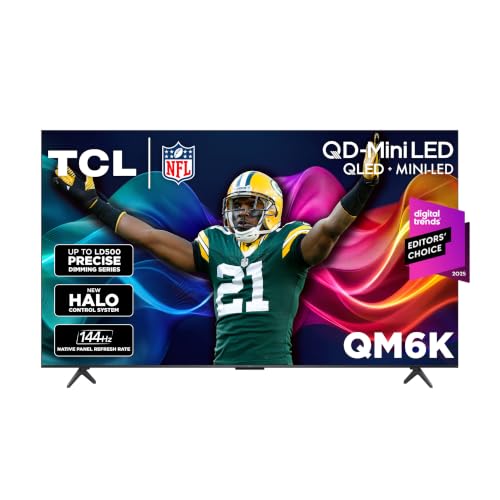
TCL QM6K 65 — 144Hz below the flagship
The QM6K is where TCL’s gaming specification descends from the flagship tier into the range’s sensible middle, and its listing does not hide the intent: a 65-inch QM6K Series QLED Mini LED 4K HDR Smart Google TV (65QM6K) at 144Hz, described with high brightness, IMAX Enhanced, HDR10, Dolby Vision, Dolby Atmos audio, a voice remote, and the words “Premium Gaming” in the title itself. A stated 144Hz at this position in the range is the story — the refresh ceiling that flagship buyers celebrate, available without flagship commitment, on a Mini-LED panel with the dimming behaviour HDR games need.
Daily life on the QM6K is Google TV again, so the app catalogue and household profiles match the QM8L’s, and the format list — Dolby Vision present, IMAX Enhanced present — keeps film nights respectable. The differences from the flagship concentrate where they should: peak brightness and dimming refinement sit a rung down, which shows in the most extreme HDR highlights and the most difficult dark scenes, and barely anywhere else. For gaming specifically, the QM6K’s proposition is that the frame-rate experience — the thing players feel in their hands — is preserved whole, while the picture’s outer extremes are trimmed. That is a trade most players, offered it explicitly, would sign.
It also makes the QM6K the natural recommendation for the console-plus-PC household that games daily and watches films weekly, in a room with ordinary light, without a flagship’s budget logic. Verify the VRR details on the product page, as its listing headlines the refresh rate rather than a VRR range, and pair it eventually with a soundbar, as with every set here except perhaps the U8QG. The rest is gaming, nightly, at a ceiling your PC can actually reach.
- Panel: QLED Mini LED, 65-inch class
- Refresh: 144Hz per listing
- VRR: no range figure stated in the listing title — verify on the product page
- Platform: Smart Google TV; voice remote
- Formats named in listing: HDR10, Dolby Vision, Dolby Atmos, IMAX Enhanced
- Model: 65QM6K
Strengths
- Stated 144Hz gaming ceiling below the flagship tier — the feel of play is preserved.
- Mini-LED dimming and Dolby Vision keep HDR games and films convincing.
- Google TV platform matches the flagship’s app depth and household features.
Trade-offs
- Peak brightness and dimming finesse step down from the QM8L by design.
- VRR range needs product-page confirmation for demanding PC configurations.
- Built-in audio is the range’s standard offer; films will ask for a soundbar.
Best for: daily gaming households wanting a stated 144Hz panel without flagship pricing logic.
Not suited for: judging a set by its brightest highlight rather than its frame delivery.
Comparison
| Model | Size | Panel | Refresh / VRR (per listing) | Platform | Gaming identity |
|---|---|---|---|---|---|
| LG C4 | 55″ | OLED evo | Not stated in listing title | LG smart platform | Response and contrast first |
| Hisense U8QG | 65″ | ULED Mini-LED QLED | Native 165Hz / VRR 288 | Google TV | Ceiling plus brightness |
| TCL QM8L | 65″ | SQD-Mini LED QLED | 144Hz / range not stated | Google TV with Gemini | Flagship all-rounder |
| Samsung QN90F | 50″ | Neo QLED Mini LED | Not stated in listing title | Samsung Vision AI, Gaming Hub | Ecosystem and glare control |
| Hisense U7SF | 65″ | Mini-LED ULED Hi-QLED | Native 165Hz / VRR 330 | Fire TV, Alexa+ | Highest stated VRR |
| TCL QM6K | 65″ | QLED Mini LED | 144Hz / range not stated | Google TV | 144Hz value in the range |
What Do Refresh Rate and VRR Actually Change in Play?
Refresh rate is the panel’s heartbeat — how many times per second it can draw a new frame. At 60Hz the heartbeat is 60; the listings in this guide state 144Hz and native 165Hz figures, and each step upward shortens the time between your input and its visible consequence while smoothing motion’s texture. The gains are largest in fast camera movement and competitive play, and they require a source that produces the frames: a gaming PC can, current consoles target lower ceilings, and a film never will, since cinema runs at 24 frames regardless of the panel beneath it. Buying refresh is therefore buying for your most demanding source, not your average one.
Variable refresh rate solves the mismatch problem. Games rarely hold a perfectly steady frame rate; without VRR, the display’s fixed heartbeat forces frames to wait or tear. With VRR, the panel syncs its heartbeat to the game’s output within a range — the figures quoted in the Hisense listings, VRR 288 and VRR 330, are those sets’ stated ceilings as listed. The felt result is smoothness that survives busy scenes: the open-world city that dips under load stays fluid instead of juddering. When a listing does not print its VRR range, as with the TCL pair and the Samsung here, the product page is where the figure lives, and PC players in particular should read it before ordering.
Which Connections Should a Gaming TV Buyer Verify First?
The gaming input, singular, deserves the scrutiny — because on many televisions the full gaming specification lives on specific HDMI ports rather than all of them. Before ordering, confirm on the product page which inputs carry the set’s full refresh and VRR capability, how many such inputs exist, and whether the audio-return channel shares one of them, since a soundbar on the same port can evict a console from the best seat. Households with two consoles and a PC should count carefully; households with one console and a soundbar should still confirm the arithmetic, because two devices is exactly where port layouts start to matter.
Cabling is the silent partner in this check. High-refresh 4K signals demand certified high-bandwidth HDMI cables, and the cable bundled with a console is the safest starting point; a drawer cable from an older setup is the most common cause of a gaming TV mysteriously refusing its best modes. Auto low-latency behaviour — the set detecting a console and switching itself into game mode — is the other convenience to confirm on the product page, since it decides whether the household’s least technical member gets the low-lag picture automatically or watches games through film processing forever. None of the listings above prints these details, which is normal; all of them are one product-page visit away, which is the point of checking.
How Do You Configure HDR for Games Without Washing Out the Picture?
Start at the source, not the television. Both current consoles and gaming PCs offer HDR calibration routines — patterns that ask you to set the point where a symbol disappears — and those routines exist because panels differ in peak brightness and tone mapping. Run the routine on the input the console actually uses, with the television in its game mode, and resist re-running it on a different picture mode afterwards, since the calibration belongs to the pairing of source, input, and mode. On the television side, choose the game-oriented HDR tone behaviour where the menu offers a choice between the set following the source’s instructions or applying its own dynamic mapping; following the source is usually the calmer, more accurate path for games.
Then judge with a game you know in two scenes: the brightest exterior and the darkest interior in your regular rotation. Highlights should retain texture — sunlit stone, snow, chrome — rather than clipping to white, and dark scenes should separate shadow detail from black instead of crushing both into one. If the bright scene clips, the console’s calibration ceiling is set too high for the panel; if the dark scene glows, the set’s black or dimming settings need attention. Ten minutes of this beats an evening of slider tourism, and the result holds for every game that follows.
How Does HDR Change the Way Games Actually Look?
HDR — high dynamic range — widens the distance between the darkest and brightest parts of the image while enriching the colour that lives between them, and games exploit it more aggressively than films because their worlds are rendered rather than photographed. A cave mouth at noon, a neon district at midnight, a cockpit crossing from shadow into sun: HDR lets all three hold detail at both ends simultaneously, where SDR forces a choice. The sets in this guide pursue that range through different machinery — OLED’s per-pixel light, Mini-LED’s dimming zones and brightness — and the format badges in their listings, Dolby Vision and HDR10+ among them, describe scene-by-scene guidance systems that tell the panel how each moment should be mapped rather than leaving one setting to govern a whole game.
The practical consequence for buyers is that HDR gaming rewards panel quality more than raw resolution does. A 4K SDR image on a fine panel looks sharp; an HDR image on the same panel looks dimensional. When a listing states a brightness ceiling like the U8QG’s up to 5000 nits, the gaming translation is highlight conviction — explosions, headlights, and spell effects that read as light rather than as white shapes. When a listing is quieter, as the C4’s is, the OLED translation applies instead: darkness so complete that modest highlights feel luminous by contrast. Both are HDR working as intended, through opposite doors.
What Should Desk and Bedroom Gamers Do Differently?
Respect the distance. A desk setup places the screen a metre away, where a 50- or 55-inch panel fills the visual field completely and a 65-inch set forces head movement that competitive play punishes. The QN90F at 50 inches and the C4 at 55 are this guide’s natural desk-adjacent and bedroom candidates, and both bring a second virtue to small rooms: they remain complete televisions, so the bedroom screen handles evening streaming without a second device. Brightness settings deserve a gentler hand at close range — a panel tuned for a bright showroom will fatigue eyes at a metre — and the film or cinema modes make a good starting point even for games played after dark.
Audio geometry changes too. At a desk, a soundbar may crowd the workspace, and the built-in systems here — particularly the Hisense pair’s multi-channel arrangements — get a fairer hearing than in a large room, while a headset remains the competitive default for voice and positional detail. Cable management is the final desk discipline: a high-refresh signal wants its certified cable run short and unstressed, and a console, PC, and monitor-adjacent TV sharing one desk will test anyone’s routing patience. Plan the runs before the set arrives and the setup stays invisible, which is the highest compliment a desk can pay.
How Do You Split One Screen Between Gaming and Family Viewing?
By inputs and by modes, agreed in advance. Give the console its own input with its game mode configured once — HDR calibrated, motion processing set for play — and give the household’s streaming its own input or app environment with film-friendly settings, so nobody’s preferences overwrite anybody else’s. Every set here remembers settings per input, which turns a potential nightly argument into a one-time setup. The platform layer helps too: household profiles on Google TV sets keep recommendations sane, and Samsung’s Gaming Hub gives games a front door that does not disturb the family’s home screen.
Scheduling is the social layer no specification covers. A 65-inch flagship in a shared room will be wanted by everyone at 8 p.m., and the households that thrive with one great screen tend to treat gaming sessions and film nights as calendar citizens rather than ambushes. The television cannot solve that negotiation, but the right one — bright enough for the afternoon match, dark enough for the evening film, fast enough for the late session — at least ensures the argument is about time, never about capability.
What Does a Gaming TV Owe the Films Watched on It?
Accuracy, patience, and a proper film mode. Gaming televisions are tuned and marketed around speed and impact, and the risk is a set that treats a quiet drama like a boss fight — oversaturated, over-sharpened, motion-smoothed into soap. The six picks here were chosen partly because each carries a credible film life: Dolby Vision support across the TCL and Hisense listings, Neo Quantum HDR+ behind the Samsung, OLED’s native cinema character in the LG. The buyer’s part is to use the film modes for films, letting game settings live on the game’s input, and to disable motion smoothing for cinema content, where it does the most aesthetic damage.
Sound completes the debt. Game audio through a headset can hide a television’s modest speakers for years, until the first film night exposes them. The U8QG’s 4.1.2 channel system postpones that reckoning furthest among these picks; the rest will eventually introduce their owners to the soundbar market, which our other guides cover. A gaming TV that respects films is not a compromise — it is the actual product being bought, since few households game on every hour the screen is lit.
Why Does Input Lag Matter Less Than It Used To — and Still Matter?
Input lag is the delay between a button press and its visible result, and a generation ago it separated gaming televisions from unusable ones by hundreds of milliseconds. Modern game modes have compressed that gap across the serious market, which is why this guide — following its listings, which print no lag figures — treats responsiveness as a threshold to verify rather than a ranking to publish. Below a certain threshold, differences become the territory of competitive specialists playing frame-critical titles; above it, every player feels the disconnect in menus, aiming, and rhythm games alike. The verification is simple: the product page and reputable measurements for your finalist, read once, settle it permanently.
What players often mistake for lag is actually motion behaviour — a panel can respond to input promptly yet smear the moving image, which is where response speed and refresh rate earn their keep. OLED’s per-pixel speed and the high stated refresh ceilings of the Mini-LED picks attack the same sensation from different directions. Judge the combination in play, on a fast game you know, and trust your hands over any single number a forum quotes without a methodology.
How Should a PC Gamer Choose Between the Stated Ceilings Here?
By the graphics card’s honest output, title by title. A card that drives competitive games at very high frame rates can use the Hisense pair’s native 165Hz, and their stated VRR figures describe the smoothing available when rates dip below the ceiling in heavier scenes. A card that lives nearer 100–144 frames in the games you actually play makes the TCL pair’s stated 144Hz the rational ceiling — paying for headroom your hardware never visits is specification collecting, not gaming. Resolution ambition belongs in the same calculation: chasing 4K at maximum refresh is the most expensive habit in PC gaming, and a television cannot rescue a card asked to do too much.
Desk geometry returns as the tiebreaker. A PC gamer at a desk may find the 50-inch QN90F or 55-inch C4 the right canvas and should then verify their gaming specifications on the product pages, since their listings headline other virtues. A PC gamer on a sofa at two metres belongs on the 65-inch sets. The ceiling question, answered honestly, usually resolves into a room question — as most television questions eventually do.
What Changes When the Gaming TV Is Also the Sports TV?
Mostly the audience and the hour. Sport arrives in daylight, in company, at broadcast quality, and it rewards exactly the virtues gaming rooms cultivate: brightness for the afternoon, motion handling for the pans, and a screen large enough that tactics read from every seat. The Mini-LED picks here are doubly suited, since their panels hold bright static score graphics indefinitely and their stated refresh headroom keeps fast play clean. The OLED pick counters with angle stability for the gathered room and darkness for the evening fixtures. Households should also set a dedicated sports picture mode — a touch more motion processing than film tolerates, colour vivid but not lurid — on the broadcast input, so match day does not inherit the game’s settings or the film’s.
How Do You Future-Proof a Gaming TV Without Overspending?
By separating the futures that arrive from the futures that are marketed. Refresh headroom is a real future: consoles and graphics cards climb steadily, and a panel whose stated ceiling exceeds today’s sources — the pattern across the Hisense and TCL listings — will still be unbothered by the next hardware cycle. Format support is another real future, since a library bought in Dolby Vision stays in Dolby Vision. Platform features are the perishable layer by contrast; Gaming Hub, Gemini, Fire TV, and Vision AI will all be redesigned within the set’s life, and none should carry a purchase on its own. Ports deserve the coldest eye of all: count the full-specification inputs against the hardware you plausibly own in three years, because that count cannot be upgraded later.
The discipline is to pay for ceilings and connections, which age slowly, and to accept the software as it comes, since it ages quickly and can be supplemented by a console, a PC, or a streaming device at any time. A gaming TV bought on that principle in this guide will still be the right screen when the next console generation is unboxed beneath it.
What Should the First Gaming Session on a New Set Include?
A checklist disguised as an evening. Begin with the console or PC connected to the input the product page designates for full gaming specification, using the cable supplied with the source. Confirm the set has recognised the device and engaged its game mode; then run the source’s HDR calibration from scratch, because the routine belongs to this exact pairing of hardware. Set the output resolution and refresh to the highest the source and panel share, and verify in the source’s own display settings that the signal the television reports matches what you intended — mismatches here are silent and common.
Then play three things: a fast title you know by muscle memory, to feel response; a dark title, to judge HDR shadow handling; and a bright title, to see highlights behave. Adjust only one setting family between tests. Finish by playing something purely for pleasure, because a gaming television that survives its checklist still has to pass the only review that matters — yours, controller in hand, an hour later than you meant to stop.
Where Does a Headset Fit in a Television Gaming Setup?
Alongside the screen, not instead of it — and the television still matters when the headset is on, because voice chat and positional audio do not excuse a smeared picture. The arrangement most gaming households settle into is dual-purpose: the set’s speakers or a soundbar for solo and spectated play, where the room shares the game’s sound, and a headset for late sessions and team communication. Several picks here ease that duality — the Hisense pair’s built-in multi-channel systems carry a room respectably, while every set’s audio-return output lets a soundbar take over without cable swapping. Decide the audio path when you decide the screen, because the port it occupies is part of the same arithmetic as the console’s input.
Common Mistakes
Buying a refresh ceiling your hardware cannot feed is the signature error of this category: a console-only household gains nothing tonight from the difference between a stated 144Hz and a higher figure, however satisfying the number looks. The mirror error is starving a gaming PC with a panel that caps below the graphics card’s output, then blaming the card. Match the ceiling to the source you own or genuinely plan to buy within the set’s early life. A second error is forgetting the port question until the console, PC, and soundbar are all plugged in and one of them is exiled to a lesser input — the connections section above exists to be read before the order, not after the argument.
Third comes HDR neglect: unboxing a set this capable and playing through its vivid showroom mode with the console’s HDR calibration never run, which is the gaming equivalent of leaving the protective film on the screen. Fourth, judging a gaming TV by its film performance alone, or a film TV by its gaming specification alone, when the entire premise of these six picks is the double life. Test both lives in the first week, while returns are still a theoretical comfort rather than a logistical project.
Final Recommendation
PC players should start at the Hisense pair and choose by platform and room: the U8QG for Google TV, the higher stated brightness, and the fuller audio; the U7SF for Fire TV, the anti-reflection finish, and the highest stated VRR figure in the guide. TCL’s QM8L is the flagship all-rounder for households that game hard and stream harder, and the QM6K delivers its stated 144Hz experience a rung lower, which for many players is the smartest money in this guide. The LG C4 remains the evening player’s OLED — unmatched darkness and response for the hours gaming actually happens — and the Samsung QN90F is the 50-inch ecosystem pick for console-and-cloud households in bright rooms.
Whichever set you choose, run the console’s HDR calibration, confirm the gaming input, and play something you love before you judge it. A gaming television proves itself in the hands, not on the page. Give it a week of real sessions — the late-night dungeon, the Saturday tournament with friends crowded onto the sofa, the quiet Sunday drive through an open world — and notice how rarely the screen crosses your mind at all. That invisibility is the true specification every figure in this guide was chasing: a panel fast enough, bright enough, and honest enough that the game is the only thing left in the room. When the screen disappears, what remains is the session you bought it for — the comeback in the final round, the boss beaten on the last attempt, the friend on the sofa shouting at a replay — and a television that can hand you those evenings without once asking to be noticed has earned every hertz, every nit, and every careful word spent choosing it. Play well, and let the screen do the same. The best compliment any of these six sets can earn, a month from now, is that nobody in your house talks about the television anymore — they talk about the games, the goals, the films, and the nights, which is precisely what a screen this capable was always supposed to make possible for the people gathered in front of it, season after season, console after console, one saved game at a time, starting tonight, controller charged, headset ready, and the next session already calling from the save file you swore you would leave until the weekend.
Frequently Asked Questions
Can a PlayStation or Xbox use a 165Hz panel fully?
Current consoles target refresh ceilings below the native 165Hz figures listed for the Hisense pair, so they use a portion of the panel’s range — with full benefit from its VRR behaviour, brightness, and response. The headroom serves gaming PCs today and stands ready for whatever future hardware asks of it.
What does VRR 330 mean on the Hisense U7SF?
It is the variable refresh figure stated in the U7SF’s own listing — the ceiling Hisense quotes for its VRR support. In practical terms it describes headroom for high-refresh PC gaming signals; the product page carries the detailed specification, and this guide quotes the listing’s figure exactly as printed rather than translating it into a promise.
Is OLED or Mini-LED better for gaming?
OLED, represented here by the LG C4, offers the fastest pixel response and perfect blacks for dark games. Mini-LED sets offer higher stated refresh ceilings in these listings, greater brightness for daytime play, and no static-HUD considerations. Competitive PC players lean toward the stated ceilings; evening console players lean toward the OLED’s darkness. Both instincts are defensible.
Why do some listings here not state a refresh rate?
Because manufacturers choose different headlines for different models — the Samsung QN90F’s listing leads with Gaming Hub and its Glare Free panel, the LG C4’s with its OLED evo panel and remote. Silence in a title is not evidence of absence; it is an instruction to check the product page, which this guide repeats deliberately wherever it applies.
Does Gaming Hub replace a console?
No — Samsung’s Gaming Hub, named in the QN90F’s listing, gathers cloud gaming services and connected consoles into one home screen. Cloud services can indeed play without local hardware, which suits casual and travelling play, while a console remains the choice for owned libraries and the lowest-latency experience. The Hub’s value is making both doors open from the same hallway.
What size suits a gaming room?
Distance decides. At desk-adjacent and close-sofa distances, the 50-inch QN90F and 55-inch C4 fill the view without overwhelming it. At ordinary living-room distances the 65-inch sets come into their own. Peripheral vision is immersion’s friend in racing and open-world games, so err toward the larger size when the distance genuinely supports it.
Do these TVs need bias lighting or a dark room to shine?
Neither is required, and the Mini-LED picks are built for ordinary lit rooms. A darkened room flatters the OLED pick most and improves perceived contrast on every set, while a gentle bias light behind the screen reduces eye strain during long evening sessions on any of them. Treat room lighting as seasoning rather than a prerequisite: the panels in this guide were chosen to perform in the rooms gamers actually have, at the hours they actually play, with the lamps they actually own.
Related Guides
Smaller gaming rooms are covered by the 43-inch 4K HDR television selection, budgets by the affordable 4K TV lineup, and the play session’s other screen — the one on your wrist between matches — by the long-battery smartwatch picks.


