What's inside
- Key Takeaways
- Quick Picks
- How We Chose These Picks
- Wired or Wireless: Which Suits How Your Switch Gets Played?
- What Should You Know About Switch Voice Chat Before Buying?
- How Do the Six Switch Headsets Compare Side by Side?
- How Do You Choose Between the Two Turtle Beach Wireless Routes?
- What Should Parents Check Before Buying a Headset for a Child?
- How Do You Set Up a Headset on a Switch, Docked and Handheld?
- How Does Audio Latency Work on Switch, and When Will You Notice It?
- What Changes When the Headset Is for a Switch Lite?
- How Should You Look After Cushions, Cables and Batteries?
- What Does a Second Headset Add to a Shared Console?
- How Do You Test a New Switch Headset in the First Week?
- How Do You Balance Game Audio Against Chat on a Switch?
- Which Switch Games Actually Reward a Good Headset?
- What Mistakes Do Switch Headset Buyers Keep Making?
- Final Recommendation
- Frequently Asked Questions
- Related Guides
As an Amazon Associate I earn from qualifying purchases. This post may contain affiliate links at no extra cost to you.
widgetverdict.com is reader-supported. When you buy through links on our site, we may earn an affiliate commission.
Where to buy: every headset in this guide is sold on Amazon, and the six split cleanly into wired models that plug into the console’s 3.5mm jack and wireless models that pair over Bluetooth or a USB dongle, so your first decision is about cables, not brands.
Finding the best nintendo switch headsets starts with a quirk most console guides skip: the Switch is really three machines in one. It is a handheld with a headphone jack on top, a docked console feeding a television across the room, and a tabletop screen propped on a kickstand at a kitchen table. A headset that is perfect for one of those shapes can be quietly wrong for another. A wired model is effortless in handheld mode and useless from a sofa ten feet from the dock. A Bluetooth model solves the sofa and then has to prove its microphone works in the games your household actually plays.
This guide judges the six picks against all three shapes of play. Three are wired, led by two headsets built and licensed specifically for Nintendo’s consoles, and three are wireless, covering Bluetooth pairing and low-latency 2.4GHz dongle connections. Every pick carries a microphone, because voice chat, party games, and a quick call with a friend between matches are part of Switch life now. Comfort gets weighted heavily too: Switch sessions skew long and often involve younger players, so weight and clamp pressure matter as much as driver size.
Who is this for? Parents replacing the earbuds a child has outgrown, commuters who play on trains, and docked players tired of television speakers after everyone else has gone to bed. If you also game on a PlayStation or PC, two of the wireless picks and one wired pick travel across platforms, and the reviews flag exactly where each headset’s compatibility stops.
Key Takeaways
- Wired headsets are the simplest Switch choice: the 3.5mm jack works in handheld and tabletop mode with zero setup.
- The Turtle Beach Airlite Fit and Recon 70 are licensed for Switch, with flip-to-mute microphones parents will appreciate.
- Wireless freedom comes two ways here — the Stealth 500’s Bluetooth, or a 2.4GHz dongle on the Ozeino and AOC.
- All six picks use drivers around 40mm and lightweight frames, because Switch play is often mobile and long.
- Docked players should choose wireless; a cable cannot stretch from a television dock to a sofa.
- Multiplatform households get the most value from the Recon 70, Ozeino, or AOC, which also serve PC and PlayStation.
Quick Picks
| Pick | Badge | Why it earns its place |
|---|---|---|
| Turtle Beach Airlite Fit | Best wired headset made for Switch | Built for Switch 2, Lite and OLED with a flip-to-mute mic and the console’s own neon colours. |
| PDP Gaming LVL40 Airlite | Best on-ear fit for younger players | A light on-ear frame with a noise cancelling microphone and Mario neon styling children actually want to wear. |
| Turtle Beach Recon 70 | Best wired all-rounder across platforms | Licensed for Switch yet genuinely multiplatform, with soft earpads and the same flip-to-mute trick. |
| Turtle Beach Stealth 500 | Best wireless pick for Switch 2 | Bluetooth freedom, memory foam cushions and a 40-hour battery in a headset licensed for Switch 2. |
| Ozeino Wireless Gaming Headset | Best dongle wireless for mixed households | A 2.4GHz USB and Type-C connection that hops between Switch, PS5 and PC without re-pairing rituals. |
| AOC 2.4GHz Wireless Gaming Headset | Best battery life in a white finish | 45 hours per charge, Bluetooth 6.0 as backup, and virtual 7.1 surround for docked film-length sessions. |
How We Chose These Picks
We started from the console’s connection map rather than from brand catalogues. The Switch family offers a 3.5mm jack, Bluetooth audio, and USB ports on the dock, and a credible shortlist has to cover all three routes because households use all three. That produced the wired trio and the wireless trio, and it is why no pick here depends on a connection the console does not actually offer.
Licensing was the second filter for the Nintendo-specific models. The Airlite Fit, Recon 70 and Stealth 500 are licensed for Switch or Switch 2, which means their plugs, pairing behaviour and microphone handling were built against Nintendo’s hardware rather than adapted from a PC design and hoped for the best. The two unlicensed wireless picks earned their places differently: the Ozeino and AOC bring proper 2.4GHz dongle audio, the lowest-latency wireless route available to a docked Switch.
Finally, we weighted the unglamorous properties that decide whether a headset is still used in six months: weight on a child’s head, cushions that survive being stuffed into a backpack, microphones that mute with a gesture instead of a menu, and batteries that outlast a holiday journey. Sound quality matters, but on this console it is table stakes; fit and connection decide.
We also deliberately left out two categories that crowd Switch accessory shelves. Standalone headphones without microphones were excluded because chat is now central to the console’s social games, and a headset guide that cannot support a conversation fails its readers. Heavy esports headsets built for PC tournaments were excluded for the opposite reason: their weight, software dependence and desk-bound design answer questions Switch players are not asking. What remains is the middle ground where this console actually lives.
Wired or Wireless: Which Suits How Your Switch Gets Played?
The wired case is simplicity itself. Plug into the jack on top of the console and everything works: game audio, chat in supported titles, no pairing, no charging, no battery anxiety on a long flight. Wired headsets are also the lightest option because they carry no battery, and they cost less for the same build quality. For a child whose Switch lives in handheld mode, or a commuter whose console never sees the dock, wired is not the budget compromise — it is the correct engineering answer.
The wireless case begins at the dock. The moment the console sits under a television, a headphone cable becomes a tripwire, and Bluetooth or a dongle in the dock’s USB port is the only sane route to private audio. Wireless also wins at the other extreme, the tabletop kickstand session across a café table, where a cable drags through coffee rings. The costs are charging discipline and, on plain Bluetooth, a microphone caveat: some games handle chat through the console differently, so check your main title’s chat route before assuming any wireless mic behaves like a wired one.
A practical split used by many households: a wired headset that lives in the console’s carry case for travel, and a wireless headset that lives by the television. If the budget stretches to only one, choose by where the console spends most evenings, not by which headset looks better in photographs.
What Should You Know About Switch Voice Chat Before Buying?
Voice chat on Nintendo’s consoles has always been the awkward relative. Some games route chat through the headset normally, others historically pushed chat through a phone app, and the situation varies by title and by console generation. The practical advice is unglamorous: a flip-to-mute wired microphone is the most predictable chat tool on the platform, because the 3.5mm path is the one every chat implementation understands. Wireless buyers should test their main game in the first week, while returns are painless.
Microphone design matters more than microphone marketing here. All six picks use boom-style microphones that sit near the mouth, which is what keeps a player’s voice intelligible over a living room. Three of them mute by flipping the boom upward — a gesture a parent can see from across the room and a child can perform without looking. When we assessed chat readiness, that visible, physical mute counted for more than any noise-cancelling claim printed on a box.
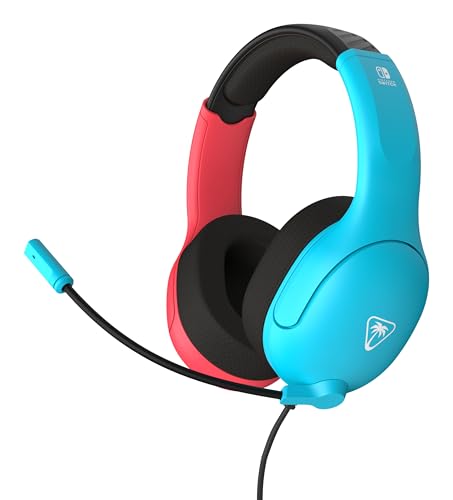
Turtle Beach Airlite Fit — Best wired headset made for Switch
The Airlite Fit is the headset Nintendo would probably bundle with the console if Nintendo bundled headsets. It is wired, lightweight, finished in the neon blue and red the Switch made famous, and licensed across the family — Switch 2, Lite and OLED are all named in its title, which removes the compatibility guessing that haunts third-party accessories. The 40mm speakers are tuned for the bright, effects-heavy sound of Nintendo’s own games, where dialogue and jingles sit forward and bass stays polite.
Two details carry its case for family play. The flip-to-mute microphone silences chat when the boom swings up, giving parents a visible off switch and children a gesture they cannot fumble. The ear cushions are soft enough for a full film-length session, and the whole frame is light enough that a younger player forgets it during handheld play. Because it is wired, it also survives the school-run test: no charge state to check at the door, no pairing to redo in the car.
Its limits are the wired limits. Docked play from a sofa is out unless an extension cable enters the picture, and the on-console volume depends on the console’s own controls. Players who split time with a PlayStation will find the plug works there too via a controller jack, but this headset’s heart is clearly Nintendo-shaped. Households buying one headset for one console should start here.
Its sound signature suits the platform’s catalogue in a way generic headsets miss. Nintendo’s games mix dialogue, bright effects and music that sits high in the register, and the Airlite Fit’s 40mm speakers keep that material clear at the modest volumes handheld play encourages. Explosions in action titles have enough body to register without swamping the cues a player actually needs. It is a tuning for clarity over spectacle, which is the correct priority for a console whose biggest games are conversations with characters as much as contests.
- Connection: Wired 3.5mm
- Drivers: 40mm speakers
- Microphone: Flip-to-mute boom mic
- Compatibility: Switch 2, Switch Lite, Switch OLED
- Finish: Neon Blue and Red
Strengths
- Licensed fit across the whole current Switch family.
- Flip-to-mute boom is easy for children to use correctly.
- Lightweight frame suits long handheld sessions.
Trade-offs
- Cable rules out sofa-distance docked play.
- Styling is unmistakably Nintendo, which older players may outgrow.
- No wireless option at any setting.
Best for: families wanting the official-feeling wired headset for a Switch-first household. Not suited for: docked players who sit across the room from the television.
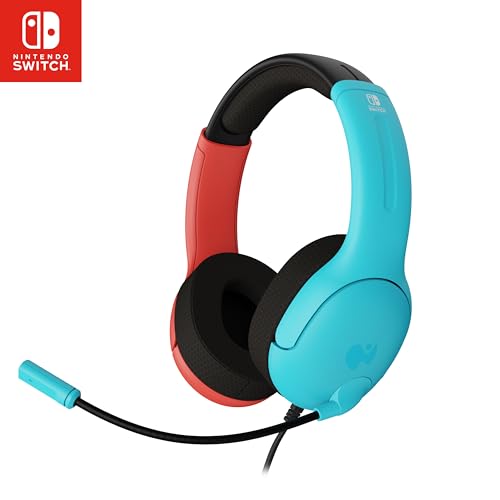
PDP Gaming LVL40 Airlite — Best on-ear fit for younger players
PDP’s LVL40 Airlite takes the other wearing style: on-ear rather than over-ear, which changes the headset’s whole personality. The cups sit on the ear instead of sealing around it, so a player still hears a parent calling from the kitchen — a feature, not a flaw, in most family homes. The Mario neon red and blue finish matches the Airlite Fit’s energy, and the wired connection keeps setup at the level a seven-year-old can manage alone.
The microphone is the surprise on a headset at this level: PDP fits a noise cancelling mic, so a child’s voice stays clear to teammates even with a television murmuring in the same room. The soft on-ear cushions keep pressure gentle, and the light frame avoids the neck fatigue that oversized adult headsets cause on smaller heads. For handheld and tabletop play, where sessions are shorter and awareness matters, the on-ear pattern is honestly the better tool.
What it gives up is isolation and low-end weight. On-ear cups leak sound both ways, so a noisy train carriage pushes the volume up and a quiet bedroom hears the game leaking out. Bass is thinner than the over-ear picks deliver. Teenagers who have graduated to late-night docked sessions will want more of both. As a first proper headset for a younger Switch player, though, the LVL40’s balance of awareness, weight and mic quality is hard to argue with.
It also moonlights well outside gaming. The same wired plug serves a tablet for video calls with grandparents and a laptop for the occasional school task, and the on-ear awareness that suits a living room suits a classroom-adjacent setting too, where a child may need to hear a teacher or parent mid-session. PDP’s long history in licensed Nintendo accessories shows in the details: the colours match the console’s Joy-Con palette closely enough that the headset looks like part of the kit rather than an afterthought, which matters more to its intended wearer than any specification in this review.
- Connection: Wired
- Microphone: Noise cancelling mic
- Wearing style: On-ear, soft comfort cushions
- Compatibility: Switch, Switch Lite, Switch OLED
- Finish: Mario Neon Red and Blue
Strengths
- On-ear fit keeps players aware of the room.
- Noise cancelling microphone at a family-friendly tier.
- Very light frame for smaller heads.
Trade-offs
- Sound leaks in and out by design.
- Bass presence is modest beside over-ear rivals.
- Wired only, like the other junior picks.
Best for: younger players whose parents want awareness kept and weight low. Not suited for: noisy commutes or players chasing cinematic low end.
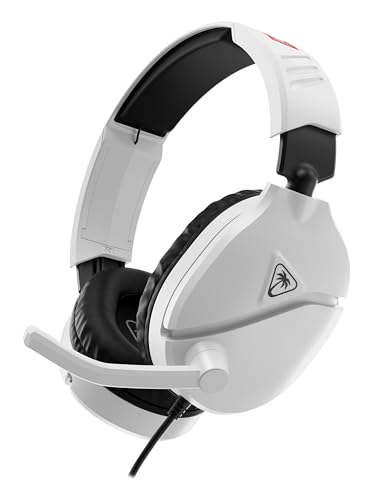
Turtle Beach Recon 70 — Best wired all-rounder across platforms
The Recon 70 is the pragmatist’s wired headset. It is licensed for Switch — Switch 2, Lite and OLED are all covered — yet it was designed as a multiplatform tool, so the same headset serves a PlayStation controller, an Xbox controller, a PC and a phone without adapters or arguments. In a house with three consoles and one accessories drawer, that universality is worth more than any single sonic flourish.
Turtle Beach fits the same flip-to-mute microphone as the Airlite Fit, and the same 40mm driver size, but wraps them in a more grown-up black and white shell with soft earpads that seal better than the PDP’s on-ear cups. The result is a headset that a teenager can wear for docked handheld hybrid play — jack into the console on the sofa arm, jack into a controller for the other machine — without feeling dressed for a children’s party.
Because it is a jack-of-all-trades, it is the master of none: the Airlite Fit feels more Nintendo-native, the Stealth 500 adds wireless, and dedicated PC headsets add software. The Recon 70’s argument is economic and logistical. One purchase covers the household’s whole fleet, spares are trivially sourced, and nobody fights over whose headset is whose. For multi-console families, that settles most arguments before they start.
Travel makes its case from another angle. A single wired headset that serves the Switch on the train, a phone for films and a laptop at the destination replaces three lesser accessories rattling in a bag, and because it needs no charging it is ready on the last day of the holiday exactly as it was on the first. The soft earpads also seal well enough to take the edge off cabin noise, which the on-ear LVL40 cannot do. For a teenager whose gaming life is spread across machines and places, the Recon 70 is less a compromise than a system.
- Connection: Wired, multiplatform
- Drivers: 40mm speakers
- Microphone: Flip-to-mute boom mic
- Cushions: Soft earpads, over-ear
- Compatibility: Switch 2, Lite, OLED and other platforms
- Finish: Black and White
Strengths
- One headset serves every console in the house.
- Licensed for Switch while staying platform-neutral in looks.
- Flip-to-mute mic shared with the Airlite Fit.
Trade-offs
- No wireless route for distant docked play.
- Less Nintendo character than the Airlite Fit.
- Jack-of-all-trades tuning pleases everyone, thrills no one.
Best for: multi-console households standardising on one wired headset. Not suited for: buyers who want a headset that feels designed for a single machine.

Turtle Beach Stealth 500 — Best wireless pick for Switch 2
The Stealth 500 is where this guide crosses to the wireless side, and it does so with Nintendo’s blessing: it is licensed for Switch 2 and connects over Bluetooth, so there is no dongle to lose and no cable to trail from a docked console to the sofa. Memory foam cushions replace the standard foam of the wired picks, and the difference shows in hour three of a session, when cheaper cushions have flattened into warm discs.
Battery life is rated at 40 hours, which in real household terms means charging becomes a monthly habit rather than a nightly one — long enough that the headset is simply always ready. The flip-to-mute microphone carries over from Turtle Beach’s wired line, keeping the family-friendly mute gesture, and the 40mm drivers keep continuity with the rest of the range. The charcoal black finish also makes this the easiest pick here for an adult to wear on a train without feeling costumed.
Bluetooth is its strength and its caveat. Pairing is simple and the connection serves both Switch generations, but Bluetooth audio latency, while fine for Nintendo’s catalogue, is not the tool a rhythm-game perfectionist would choose, and chat behaviour varies by title as discussed earlier. Buyers whose play is mostly docked and social will not care. Buyers who want one headset for Switch and serious PC play should look at the dongle picks below instead.
Docked life is where its design coheres. The headset pairs once, lives beside the television, and turns an evening session into something that disturbs nobody — a partner reading in the same room hears nothing, and the player hears the game at full richness rather than at television-speaker politeness. Memory foam earns a specific mention for glasses wearers: the cushions mould around frames instead of pressing them into the temples, which is the difference between a two-hour session and a forty-minute one for a large share of adult players.
- Connection: Wireless Bluetooth
- Drivers: 40mm
- Battery: 40 hours
- Microphone: Flip-to-mute boom mic
- Cushions: Memory foam
- Compatibility: Licensed for Switch 2
- Finish: Charcoal Black
Strengths
- Licensed wireless freedom with no dongle to misplace.
- Memory foam comfort for the longest sessions here.
- 40-hour battery turns charging into a rare chore.
Trade-offs
- Bluetooth latency is not ideal for rhythm titles.
- Chat support depends on each game’s implementation.
- Single-platform focus beside the dongle all-rounders.
Best for: Switch 2 owners who play docked and want cable-free comfort. Not suited for: players needing one headset for Switch and competitive PC alike.
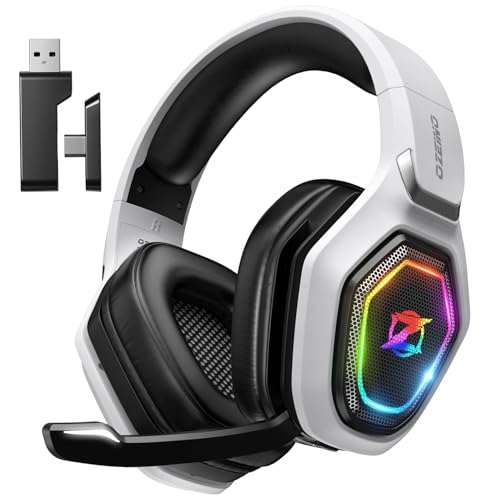
Ozeino Wireless Gaming Headset — Best dongle wireless for mixed households
The Ozeino attacks the wireless problem with a dongle instead of Bluetooth: a 2.4GHz connection over USB and Type-C that the listing describes as lossless audio, built for the dock-and-desk shuffle of a household where the same headset serves a Switch under the television, a PS5 beside it, and a PC in the next room. Dongle audio is the low-latency route, so footsteps and effects land when they should, and the receiver moving between machines is the entire setup ritual.
Battery life matches the Stealth 500 at 40 hours, and Ozeino adds a genuinely useful trick: play and charge, so a flat battery mid-session means plugging in rather than sitting out. The flip microphone keeps the family mute gesture, and compatibility stretches to PS4, Mac, laptops and mobile alongside the Switch family. For FPS and RPG players — the audiences the listing names — the combination of low latency and cross-platform reach is the whole argument, and it is a strong one.
The compromises are about polish rather than function. The dongle is a small object in a household that loses small objects, and a lost receiver is a bigger problem than a lost cable. The brand also lacks Turtle Beach’s licensing and long Nintendo history, so Switch buyers are trusting the USB standard rather than a badge. Neither point dents its role here: it is the wireless pick for homes where the Switch is one machine among several.
The Type-C side of its dongle deserves attention, because it quietly future-proofs the headset. The receiver can serve the Switch dock, a modern laptop and a handheld console without adapters, so the headset follows the player from desk to sofa to travel bag with one small piece of hardware. Work calls benefit too: the same headset that handled a squad match on Saturday handles a Monday video call with a flip of the mic, and nobody on the call needs to know it was bought for games.
- Connection: 2.4GHz wireless, USB and Type-C dongle
- Battery: 40 hours, play and charge
- Microphone: Flip mic
- Compatibility: Switch, PS5, PS4, PC, Mac, mobile
- Audio: Lossless audio over the dongle link
Strengths
- Low-latency dongle audio for docked and PC play.
- Play-and-charge ends the flat-battery dead end.
- Widest platform reach of the wireless picks.
Trade-offs
- Dongle is losable, and the headset depends on it.
- No Nintendo licence behind the Switch support.
- Less refined fit and finish than the Turtle Beach pair.
Best for: mixed-console homes wanting one low-latency wireless headset. Not suited for: households that reliably lose small USB accessories.

AOC 2.4GHz Wireless Gaming Headset — Best battery life in a white finish
AOC’s entry is the endurance pick: 45 hours of battery, the longest figure in this guide, delivered over a 2.4GHz wireless link with Bluetooth 6.0 waiting as the second connection when the dongle is elsewhere. The white finish is not a trivial detail either — in a market of black headsets, a white one that matches a white console setup or a bright desk is a legitimate reason to choose, and AOC leans into it.
The feature list aims at docked spectacle. Virtual 7.1 surround widens the soundstage for the big single-player games and streamed films a Switch shares a television with, and the noise cancelling microphone keeps chat presentable when the room is not. Compatibility spans PS5, PS4, PC and Switch, so like the Ozeino it can serve as the household’s shared wireless headset rather than a single-console accessory.
Virtual surround deserves an honest footnote: it is processing, not seven speakers, and competitive players often prefer plain stereo for clean positional cues. The headset’s size and spec sheet also tilt it toward older players and desk setups rather than a child’s carry case. Within its lane — long battery, big sound, shared across machines, worn at a desk or sofa — it is the most generous package here, and the one least likely to be found flat on game night.
Film and streaming duty flatters it further. A Switch docked under a television doubles as a streaming box in many homes, and the AOC’s wide virtual stage and long battery suit a film in a way the junior wired picks were never aimed at. The Bluetooth 6.0 connection then covers the phone and tablet viewing that happens away from the dock. Buyers building a bright, white-finished gaming corner will also find it the only pick here that looks like it belongs in the photograph.
- Connection: 2.4GHz wireless plus Bluetooth 6.0
- Battery: 45 hours
- Microphone: Noise cancelling mic
- Audio: 7.1 virtual surround
- Compatibility: Switch, PS5, PS4, PC
- Finish: White
Strengths
- Longest battery life in this guide at 45 hours.
- Dual wireless routes: dongle first, Bluetooth as backup.
- Virtual surround suits docked films and epics.
Trade-offs
- Virtual surround is processing some players will switch off.
- Desk-scale build is less carry-case friendly.
- White finish shows travel grime faster than black.
Best for: docked players who charge rarely and share the headset with a PC or PS5. Not suited for: young players needing a light headset for a school bag.
How Do the Six Switch Headsets Compare Side by Side?
| Headset | Connection | Microphone | Battery | Best setting |
|---|---|---|---|---|
| Turtle Beach Airlite Fit | Wired 3.5mm | Flip-to-mute boom | None needed | Handheld family play |
| PDP LVL40 Airlite | Wired | Noise cancelling | None needed | Younger players, on-ear |
| Turtle Beach Recon 70 | Wired multiplatform | Flip-to-mute boom | None needed | Multi-console homes |
| Turtle Beach Stealth 500 | Bluetooth | Flip-to-mute boom | 40 hours | Docked Switch 2 play |
| Ozeino Wireless | 2.4GHz dongle | Flip mic | 40 hours | Switch, PS5 and PC sharing |
| AOC 2.4GHz Wireless | 2.4GHz plus Bluetooth 6.0 | Noise cancelling | 45 hours | Long docked sessions |
How Do You Choose Between the Two Turtle Beach Wireless Routes?
Strictly, only one Turtle Beach pick here is wireless — the Stealth 500 — but buyers routinely cross-shop it against the dongle models, so the real question is Bluetooth versus 2.4GHz. Bluetooth wins on elegance: nothing to plug in, nothing to lose, pairing handled by the console itself. It is the right choice when the headset belongs to the Switch alone and the games are Nintendo’s own, where a whisper of latency goes unnoticed.
The dongle route wins on physics and flexibility. A 2.4GHz receiver in the dock gives lower latency and a connection the console treats like a wired USB device, and the same receiver pattern works on PC and PlayStation. Choose the Ozeino or AOC when the headset will migrate, when shooters dominate the library, or when Bluetooth chat quirks in a favourite title have already bitten once. Choose the Stealth 500 when the headset’s home is one console and simplicity is the feature.
What Should Parents Check Before Buying a Headset for a Child?
Three checks, in order. First, weight and fit on the actual child’s head: a headset that slides during handheld play will be abandoned within a week, whatever its specifications promise. The wired Airlite Fit and the on-ear LVL40 exist precisely because adult headsets fail this test on smaller heads. Second, the mute: a flip-to-mute boom gives a child a physical, visible way to silence chat, which is both a safety feature and a courtesy to the household. Third, volume habits: teach a comfortable level on day one, keep sessions broken up, and prefer cushions that seal gently so the game does not need to be loud to be heard.
Durability deserves a sentence of its own. Children’s headsets live in backpacks, under sofa cushions and occasionally in the car footwell. A wired headset has fewer failure points than a wireless one — no battery to age, no dongle to lose — which is a quiet argument for the wired trio as first headsets, with wireless as the upgrade a player grows into.
How Do You Set Up a Headset on a Switch, Docked and Handheld?
Handheld setup is a non-event for the wired picks: plug the 3.5mm connector into the jack on top of the console, set the volume with the console’s buttons, and flip the boom down to talk. For tabletop mode the same plug works, though routing the cable behind the kickstand keeps it out of the play area. Test the microphone in the console’s settings or a quiet game lobby before the first real match, so a chat problem is discovered at the kitchen table rather than mid-game.
Docked setup divides by wireless type. Bluetooth models pair through the console’s Bluetooth audio settings while the Switch sits in the dock — pair once at home, not at a friend’s house under time pressure. Dongle models want their receiver in one of the dock’s USB ports; the console then treats the headset as its audio device whenever the receiver is present. A household routine worth adopting: the dongle lives in the dock permanently, the headset lives on a hook beside the television, and charging happens on the same night each week whether the battery looks low or not.
Two small settings repay attention after the first connection. Set the console’s volume limit deliberately if younger players use the headset, because a headset at close range reaches a given loudness with less effort than television speakers do. Then check the microphone level in a real game rather than a silent menu: background television noise that seems trivial in a quiet room at setup time becomes the dominant sound in your teammates’ ears once the household wakes up. A boom positioned a finger’s width from the corner of the mouth, angled slightly upward, is the position every pick in this guide was designed around, and thirty seconds spent finding it pays off on every call that follows.
How Does Audio Latency Work on Switch, and When Will You Notice It?
Latency is the gap between something happening on screen and its sound reaching your ears, and the Switch’s three connection routes sit at different points on that scale. A wired connection through the 3.5mm jack is effectively instant — the signal travels as electricity, not data. A 2.4GHz dongle adds a small, engineered delay that the Ozeino and AOC keep low enough that action games feel responsive. Standard Bluetooth adds the most, because the audio is compressed, transmitted and decoded, and while modern implementations have narrowed the gap, it remains the route most likely to show itself.
Whether you notice depends entirely on genre. In a role-playing game, a strategy title or a farming sim, even Bluetooth’s delay is invisible, because nothing on screen demands frame-perfect sound. In a rhythm game, where a drum hit must land on the beat your fingers already played, the same delay is unplayable. Shooters sit between: most players adapt unconsciously, but the crack of a shot arriving a fraction late can feel subtly wrong to experienced ears. This is why the guide’s wireless split matters — the dongle picks exist for players whose libraries lean competitive.
The practical test if you are unsure which camp you are in: play your most timing-sensitive game for ten minutes on the new headset, then ten minutes on television speakers. If your performance and comfort feel unchanged, latency is a non-issue for your library and Bluetooth’s convenience wins. If the game suddenly feels like playing through treacle, you are a dongle or wired player, and no specification sheet would have told you as honestly as those twenty minutes.
What Changes When the Headset Is for a Switch Lite?
The Lite reshapes the buying logic because it deletes two of the console’s three shapes. There is no dock and no television output, so the whole wired-versus-wireless debate collapses into handheld questions: weight, cable behaviour on the move, and whether Bluetooth pairing is worth it for a machine that lives in a bag. A wired headset’s cable, mildly annoying on a sofa, becomes genuinely well-behaved on a train, where the console never leaves your hands.
Fit also tightens as a criterion. Lite players skew younger and sessions happen in cars, waiting rooms and relatives’ sofas, where a headset gets put on and taken off constantly. The on-ear LVL40 and the light Airlite Fit suit that rhythm; the desk-scale AOC does not, whatever its battery promises. Bluetooth still earns a place for one scenario — the Lite propped on a table for a video call or a streamed show, where a cable across the screen is a daily irritation — and the Stealth 500 covers it.
One Lite-specific habit worth forming: because the console and headset travel together, buy a case with room for both, and let the wired headset live in it permanently. A headset that is always with the console gets used; a headset that must be fetched from a drawer gets forgotten, and forgotten headsets are how children end up playing at full volume in the back of a car.
How Should You Look After Cushions, Cables and Batteries?
Headsets rarely die electronically; they die mechanically and cosmetically, and a little routine care doubles their useful life. Ear cushions are the first casualty — sweat and skin oils break down foam and pleather, especially on headsets worn daily by children. Wipe cushions with a barely damp cloth weekly, let them dry fully before the next session, and treat flaking cushions as a consumable to replace rather than a reason to replace the headset.
Cables fail at their ends, where bending concentrates. Teach the household to unplug a wired headset by the plug, never by yanking the cord, and to coil loosely rather than wrapping tight around the frame, which twists the internal conductors. The flip-to-mute booms on the Turtle Beach picks should be flipped by the boom’s base, not flicked by the tip — the gesture is the same, the hinge wear is not.
Wireless care is mostly battery manners. The 40- and 45-hour batteries in this guide forgive almost any routine, but they age fastest when left flat for months or cooked in a hot car. Charge before long storage, store the headset indoors, and keep dongles in the dock rather than in a pocket that goes through the wash. None of this is exciting, which is rather the point: headsets that are looked after boringly keep working boringly, for years.
What Does a Second Headset Add to a Shared Console?
Households with one Switch and several players often discover that the second headset matters more than the first. A shared console means shared sessions — siblings in the same game, a parent joining a child’s world, two players on a long car journey splitting one screen. Two wired headsets and an inexpensive splitter let both players hear the game properly without the television negotiating with the rest of the room, and two matched headsets end the argument about whose is better.
The pairing strategy that works: one flexible headset and one specialist. The Recon 70 as the household’s wired all-rounder plus the Stealth 500 for docked evenings covers nearly every scenario this guide discusses, at a combined cost below many single flagship headsets. Alternatively, match two of the same wired pick for siblings, because identical equipment is the only known cure for accessory envy.
There is also a quieter benefit. A second headset is a spare. When the primary headset’s cable finally fails the night before a holiday journey — and cables schedule their failures with malicious precision — the household with a backup in the drawer shrugs, and the household without one pays airport prices. In a shared-console home, redundancy is not indulgence; it is logistics.
How Do You Test a New Switch Headset in the First Week?
Run four tests while returns are still easy. First, the fit test: wear the headset for the length of your longest typical session, not five minutes in a shop’s spirit. Pressure points announce themselves at minute forty, not minute four. Second, the chat test: join your main game’s voice channel with a friend and ask the only question that matters — how do I sound, honestly — then record a clip if the game allows it and listen back yourself.
Third, the shape test: use the headset in every configuration your household actually uses — handheld on the sofa, tabletop at the kitchen table, docked at night — because a headset can pass two shapes and fail the third. Fourth, the family test: hand it to the smallest and largest heads in the house. A headset that only fits its buyer is a future argument in a shared home.
Keep the packaging until all four tests pass. If the headset fails one, the fix is usually a different pick from this same guide rather than a different category of product — the six here were chosen to cover each other’s weaknesses, so a failed fit on the LVL40 points to the Airlite Fit, and a failed Bluetooth chat test points to a wired pick or a dongle model, not to despair.
How Do You Balance Game Audio Against Chat on a Switch?
Every multiplayer player eventually fights the same battle: the game is loud, the teammate is quiet, and the settings menu is three layers deep. On Switch, balance options vary by game more than by headset, which is why the practical skills matter more than any single product feature. Start with the game at a level where effects are clear at moderate volume, then bring chat up to sit above it — voices should win every contest, because a missed callout costs a match while a quieter explosion costs nothing.
Headset design quietly helps or hinders. A boom microphone positioned consistently near the mouth keeps your own voice strong without shouting, which lets you run your incoming volume lower and still hold a conversation. Cushions that seal, like the Recon 70’s earpads or the Stealth 500’s memory foam, lower the game’s perceived volume floor by shutting the room out, so chat needs less boosting. On-ear and open fits demand more volume discipline from the player, which is the honest trade for their awareness.
Households can set one norm that solves most of it: if you cannot hear a person speaking to you in the room at normal volume with the headset on and the game paused in a menu, the game is too loud for family play. It is a crude test, and it has settled more living-room negotiations than any audio setting ever shipped.
Which Switch Games Actually Reward a Good Headset?
Some of the console’s biggest games are quietly transformed by private audio. Story-driven adventures with full voice acting — the kind a household television usually drowns under conversation — become intimate at headset distance, and performances that were written to be heard closely finally are. Horror and exploration titles gain the most: their sound designers bury cues in the mix, footsteps and distant machinery that warn or guide, and a television across the room flattens exactly the details the designers laboured over.
Competitive titles reward a headset differently. In shooters and arena games, directional audio is information: the side a rival approaches from, the distance of a reload, the ult sound a split second before it lands. The dongle picks and the wired trio deliver that information most promptly, but even the Stealth 500 over Bluetooth sharpens it compared with television speakers, because the ears are simply closer to the source and the room is shut out. Party and racing games sit at the other end — a headset there is mostly about not disturbing the house, which is its own legitimate victory.
There is a social category worth naming too: the online game played with a specific friend or sibling, where the headset is really a telephone. For those sessions the microphone is the product, the game audio is background, and the flip-to-mute booms on the Turtle Beach picks — with their visible, physical off switch — are worth more than any driver specification in this guide.
What Mistakes Do Switch Headset Buyers Keep Making?
The commonest mistake is buying for the console’s least-used shape — a wired headset for a docked household, discovered the first evening the cable reaches halfway to the sofa. The second is assuming voice chat behaves like it does on other consoles; Switch chat varies by game, and a five-minute test in the main title prevents a month of frustration. Third, buyers overvalue driver size and undervalue weight, then wonder why a headset with impressive specifications spends its life in a drawer.
Fourth, households buy one premium wireless headset for a child and a cheap wired one for the television, when the actual usage pattern demanded the opposite. Fifth, nobody checks the second console: a headset bought for Switch that also serves the family PC or PlayStation, like the Recon 70 or the Ozeino, quietly doubles its value. Finally, buyers forget the mute. In a family home, a flip-to-mute boom is not a gaming feature; it is how a player answers a parent without broadcasting the conversation to a lobby.
Final Recommendation
Match the headset to the console’s dominant shape and this choice makes itself. Handheld-first households should take the Turtle Beach Airlite Fit for its licensed fit and flip-to-mute calm, or the PDP LVL40 if the player is young enough that hearing the room matters more than sealing it out. Multi-console homes get the Recon 70 wired or the Ozeino wireless, depending on whether the sofa is in cable range of anything.
Docked Switch 2 players should take the Stealth 500 and enjoy the memory foam and the monthly charging rhythm. The AOC is the connoisseur’s alternative for the longest sessions and a shared PC. Whichever you choose, test the microphone in your main game during the first week — on this platform, that single check separates a headset that settles into the household from one that gets returned, and the six above all deserve the chance to settle. A Switch headset earns its place at the speed of family life, and these six were chosen to keep up with it.
One last filter before ordering: count the players, not just the consoles. A headset in a one-player household can be as specialised as it likes; a headset in a four-player household should be the one nobody objects to wearing, with a mute everyone understands and a fit that adjusts across heads without a manual. The picks above were sequenced with that household test in mind, which is why the licensed, simple, flip-to-mute models lead the guide and the more specialised wireless designs follow for the players who know exactly why they want them.
Frequently Asked Questions
Do all six headsets work with the original Switch as well as Switch 2?
The wired picks work with any model carrying a 3.5mm jack, which covers the original Switch, Lite and OLED. The Airlite Fit, Recon 70 and Stealth 500 name Switch 2 and earlier models in their listings. The Ozeino and AOC list Switch compatibility generally, and their dongles work through the dock’s USB ports on either generation.
Can I use a Bluetooth headset’s microphone for voice chat on Switch?
It depends on the game. Some titles handle chat over the Bluetooth connection, others route chat differently or expect a wired path. The Stealth 500’s microphone is fully functional hardware; whether a specific game uses it is that game’s decision. Test your main title early, and keep a wired pick in the house if chat is mission-critical.
Which headset is best for a seven-year-old?
The PDP LVL40 Airlite, for its on-ear fit, low weight and noise cancelling microphone, with the Turtle Beach Airlite Fit close behind for children who prefer over-ear cushions. Both are wired, which removes charging and pairing from a child’s routine entirely.
Is a 2.4GHz dongle better than Bluetooth for Switch gaming?
For latency, yes: the dongle route on the Ozeino and AOC reacts faster than Bluetooth, which matters in shooters and rhythm games. For convenience, Bluetooth wins because there is nothing to plug in or lose. Most Nintendo-catalogue play never reveals the difference; competitive cross-platform play does.
How long do the wireless batteries really last between charges?
The Stealth 500 is rated at 40 hours, the Ozeino at 40 hours with play-and-charge as a safety net, and the AOC at 45 hours. In household terms, even a heavy player charging monthly is realistic for all three. Battery ratings assume moderate volume; marathon docked weekends at high volume will shorten them, but none of these headsets makes charging a weekly anxiety.
Do I need a licensed headset, or will any headset work?
Any 3.5mm wired headset works in the jack, and most USB and Bluetooth audio devices function. Licensing, as on the Airlite Fit, Recon 70 and Stealth 500, means the maker built and tested the product against Nintendo’s hardware specifically — it is a confidence marker, not a gate.
Related Guides
Players who like hearing the room around them should read our guide to best open ear gaming headsets, where the designs split into open-back cups and open-ear buds. For the school-day side of family audio, best headsets for online school covers volume-limited picks for children at laptops. And when the call is work rather than play, best wireless telephone headsets rounds up the DECT headsets built for desk phones.


