What's inside
- Key Takeaways
- Quick Picks
- How We Chose These Picks
- Why Do Harley Fairings Need Their Own Speakers?
- Which Years Fit Which Speaker?
- What Changes When You Ride Two-Up?
- How Do Fairing Speakers Survive Real Weather Touring?
- How Do the Six Compare Side by Side?
- Do You Need an Amplifier on a Touring Harley?
- How Does the Install Go?
- How Should You Tune a Fairing System at Cruise?
- What Music Survives the Road Best?
- What Are the Most Common Mistakes in Harley Audio?
- What Comes After the Fairing Pair?
- Should You Keep the Factory Speakers?
- How Do Helmets and Windshields Change What You Hear?
- A Note on Electrical Load and Older Bikes
- Buying a Used Touring Harley? Audit the Audio Like the Engine
- A Word on Group Riding and Being Heard Responsibly
- Final Recommendation
- Frequently Asked Questions
- Related Guides
As an Amazon Associate I earn from qualifying purchases. This post may contain affiliate links at no extra cost to you.
widgetverdict.com is reader-supported. When you buy through links on our site, we may earn an affiliate commission.
Where to buy: Checked Amazon listings cover four of the picks in this guide, all drawn from Rockford Fosgate’s TMS family of Harley-specific speakers — the TMS65, the newer TMS14-65, the TMS6SG and the TMS6RG. The remaining two, from Hogtunes and Cicada Audio, are covered as prose-only picks: respected names in Harley audio that we could not confirm a clean listing for. Check your bike’s model year against the pick before ordering anything, because in this guide the year is not a detail — it is the product selection itself.
The best 6.5 speakers for Harley-Davidson touring fairings are not car speakers in any sense that matters. A touring Harley — Street Glide, Electra Glide, Road Glide, Ultra — presents a listening environment with no equivalent elsewhere in audio: the speakers sit in a fairing inches from the rider, the engine and exhaust provide a permanent backing band, the wind at highway speed is a third musician, and the whole system must survive weather that a car door never sees, on a charging system with less spare capacity than a car’s. Ordinary 6.5-inch coaxials bolted into that fairing disappoint in a predictable order: they are not loud enough at speed, their grilles and mounts do not match the fairing’s openings, and their construction treats rain as an accident rather than a commute.
That is why this guide is built around purpose-made Harley speakers. Rockford Fosgate’s TMS line dominates the linked picks because it is the deepest factory-fit range in the business: each model is engineered for a specific fairing generation, with mounting that uses the factory locations, grilles that match the fairing’s openings, weather-resistant construction throughout, and efficiency tuned for the output Harley head units and modest amplifiers can actually deliver. The Hogtunes and Cicada entries mark the respected alternatives — a Canadian specialist with a long Harley-only history, and a newer performance brand the bagger world takes seriously — covered honestly without links. Match the pick to your model years first; everything else in this guide is refinement.
Key Takeaways
- Model year is the first specification. The TMS6RG covers 1998–2013 Road Glides, the TMS6SG covers 2006–2013 Street Glide and Electra Glide models, and the TMS65 and TMS14-65 serve the 2014-and-later generation — similar boxes, different fairings, not interchangeable.
- Harley fairing speakers are a distinct product class: factory-fit mounting, weather-sealed construction and efficiency for stock head units. Car coaxials are none of those three.
- The TMS65 is the established default for 2014+ bikes; the TMS14-65 is its newer, element-ready successor for the same generation — choose between them by availability and how hard your weather is.
- At highway speed, clarity in the vocal and guitar band matters more than bass, which wind and engine take regardless of speaker. Efficiency and placement beat low-frequency ambition in a fairing.
- An amplifier transforms any of these picks, but every linked pick here is chosen to satisfy on the stock system first — the upgrade path is optional, not required.
Quick Picks
| Pick | Badge | Why it earns its place |
|---|---|---|
| Rockford Fosgate TMS65 | Best for 2014+ fairings | The proven Power-series factory-fit speaker for the Rushmore-generation touring bikes. |
| Rockford Fosgate TMS14-65 | Best newest generation | The updated element-ready design for 2014+ fairing and Tour-Pak locations. |
| Rockford Fosgate TMS6SG | Best for 2006–2013 batwing | Factory-fit for the pre-Rushmore Street Glide and Electra Glide fairings. |
| Rockford Fosgate TMS6RG | Best for 1998–2013 Road Glide | The frame-mounted shark-nose fairing gets its own dedicated speaker — this is it. |
| Hogtunes 6.5-inch fairing speakers (prose-only) | Best specialist alternative | The Harley-only Canadian brand with decades of fairing-specific fitments. |
| Cicada Audio 6.5-inch fairing speakers (prose-only) | Best performance alternative | The newer high-output choice for amplified bagger systems. |
How We Chose These Picks
Fitment honesty came before sound. A Harley fairing speaker is defined by the generation it bolts into: the pre-2014 batwing fairings of the Street Glide and Electra Glide, the frame-mounted Road Glide fairing fitted across 1998–2013, and the redesigned 2014-onward generation that arrived with the Rushmore programme. The four linked Rockfords map exactly onto that history, which is why a single brand anchors the list — not favouritism, but the reality that Rockford built the deepest generation-by-generation catalogue. Each pick is described only for the years its listing claims, and the guide repeats the warning because the fairings look similar in photographs and differ in the hand.
Weather construction was the second filter, applied as strictly as in the marine guide elsewhere in this series: sealed, element-resistant designs with materials that tolerate sun, rain and pressure-washer enthusiasm. A fairing is not a dry place; it is a styled funnel that admits weather at speed. Third came the stock-system test — every pick must produce satisfying volume and clarity on the factory head unit, because most touring bikes run exactly that, and a speaker that only works with an amplifier fails this guide’s readers. Amplified performance is noted where it changes the ranking, and for the prose-only Cicada it is the entire point.
Finally, we considered the ecosystem a touring owner actually lives in: Tour-Pak and lower-fairing locations that want matching speakers, lids with speaker cutouts on bagger builds, and the reality that a fairing pair is usually the first step of a system rather than the whole of it. The TMS family’s breadth across locations is part of why it anchors the recommendations.
Why Do Harley Fairings Need Their Own Speakers?
Start with geometry. A car door speaker fires at your legs from a sealed-ish cavity; a fairing speaker fires at your chest and face from a shallow, oddly shaped shell that also houses instruments, wiring and a windshield’s worth of wind management. The mounting depth is limited, the openings are model-specific shapes rather than round holes, and the grille is part of the motorcycle’s face — a generic grille looks wrong on a forty-thousand-dollar motorcycle in a way no car owner ever has to consider. Purpose-built fairing speakers answer all of that: shallow, shaped, styled to the fairing, with mounting hardware that uses the factory points so the job is an afternoon rather than a fabrication project.
Then the environment. At seventy miles an hour, the fairing’s job is to move air around the rider, and the speakers live in that managed turbulence while rain arrives horizontally and the engine’s heat and vibration come free with every mile. Efficiency matters more here than in any car, because the noise floor at speed is enormous and the stock electrical system is not generous. And the listening itself is different: you are hearing music through a helmet, over an exhaust, in the open. The band that survives that — vocals, guitars, the melody — is the band these speakers are voiced to project, and bass, which the open air confiscates, is wisely not where their budget is spent.
Which Years Fit Which Speaker?
This is the section to read twice. The Road Glide’s frame-mounted “shark nose” fairing ran in its original form from 1998 through 2013, and the TMS6RG is built for those bikes. The batwing fairing of the Street Glide and Electra Glide in its pre-Rushmore form is served by the TMS6SG for the 2006–2013 models its listing specifies — earlier batwing bikes exist outside that window and need their own checking, because Harley revised details within generations as well as between them. For 2014 and later — the Rushmore redesign and everything since — the fairing and Tour-Pak locations take the TMS65 and its newer sibling the TMS14-65.
Two cautions belong with that tidy map. First, special editions, CVO models and police bikes occasionally carry different factory audio — including amplified systems with different speaker impedances — so a CVO owner should confirm what the factory fitted before assuming the standard pick applies. Second, if your fairing is aftermarket, or the bike is a Road King with an added fairing, the fitment follows the fairing, not the badge on the tank. Tell any seller which fairing you actually have. These warnings are not fine print; in Harley audio they are the difference between a bolt-in afternoon and a return shipment.

Rockford Fosgate TMS65 — Best for 2014+ fairings
The TMS65 is the speaker that defined the modern Harley upgrade: a Power-series 6.5-inch full-range driver engineered for the 2014-and-later fairing and Tour-Pak locations, with a carbon-fibre-reinforced polypropylene cone, a Santoprene surround, a neodymium motor that keeps the unit light and shallow enough for the fairing’s tight quarters, and weather-resistant construction throughout. Its grille and mounting are modelled on the factory parts, so the finished install looks like the factory intended it — which, on a touring Harley, is half the product.
Its sound is voiced for the road with unusual honesty about the environment: efficient enough that the stock head unit produces real volume, present in the bands that survive wind, and composed at the levels highway listening demands. Owners stepping from the factory speakers describe the same first ride — lyrics intelligible at cruise for the first time, guitars with edges, a system that no longer needs its maximum setting as its only setting. With an amplifier it scales gracefully, which is why so many stay in systems for years. If your bike is a 2014+ touring model and you want the proven answer, the conversation starts and usually ends here.
- Fitment: select 2014-and-later Harley touring fairing and Tour-Pak locations
- Format: 6.5-inch full-range coaxial, Power series
- Cone: carbon-fibre-reinforced polypropylene, Santoprene surround
- Motor: neodymium — light and shallow for fairing depth
- Construction: element-ready, weather-resistant throughout
Strengths
- The proven 2014+ answer — factory fit, factory look, road-voiced sound.
- Efficient on the stock head unit; scales properly when an amplifier arrives.
- Neodymium motor keeps weight and depth fairing-friendly.
Trade-offs
- Strictly for its generation — it is not a universal Harley speaker.
- Premium pricing against car coaxials that do not fit anyway.
- Tour-Pak and fairing locations may want two pairs; budget the system, not the pair.
Best for: 2014+ Street Glide, Electra Glide, Road Glide and Ultra owners upgrading from factory speakers. Not suited for: pre-2014 bikes — see its two older siblings below — or CVO amplified systems without an impedance check.

Rockford Fosgate TMS14-65 — Best newest generation
The TMS14-65 is Rockford’s updated answer for the same 2014+ generation: a two-way full-range design carrying the Element Ready brief — built explicitly to shrug off dust, UV, water and vibration — with the family’s factory-fit mounting for fairing and Tour-Pak locations. Think of it as the TMS65’s brief rewritten by a decade of warranty claims and rider feedback: the same job, specified harder against the environment, with the refinements in materials and construction that a newer platform allows.
Choosing between the two 2014+ picks is refreshingly uncomplicated. If both are available at similar money, the newer design is the rational buy, particularly for bikes that live outdoors, tour in all weather, or sit in sun that eats motorcycle trim for breakfast. If the TMS65 is the one in stock at a keener price, you are not buying yesterday’s mistake — it remains a fully current answer with the longer service record. What you should not do is mix the decision with the older generations: neither of these speakers fits a pre-2014 fairing, however similar the photographs look, and that sentence has been paid for by enough riders to be worth repeating in every section of this guide.
- Fitment: select 2014-and-later Harley touring models
- Format: 6.5-inch two-way full-range, fairing or Tour-Pak
- Construction: Element Ready — dust, UV, water and vibration resistant
- Role: current-generation successor in the TMS65’s position
- Mounting: factory locations, factory-style fit and finish
Strengths
- Newest environmental specification in the family — built for all-weather touring.
- Same factory-fit ease as the TMS65, with updated materials.
- Coherent with current Rockford Harley amplifiers and kits if the system grows.
Trade-offs
- Newer means a shorter field record than the TMS65’s decade of proof.
- Availability and pricing vary more than the established model.
- Still generation-locked to 2014+ — no help to older bikes.
Best for: 2014+ owners who tour in real weather and keep bikes for years. Not suited for: pre-2014 fitments, or buyers who value the longest possible service record over the newest specification.
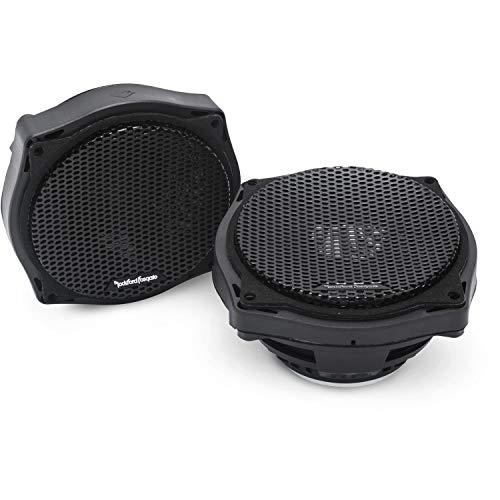
Rockford Fosgate TMS6SG — Best for 2006–2013 batwing
The pre-Rushmore batwing fairing — the Street Glide and Electra Glide shape that defined Harley touring for a generation — has its own speaker, and the TMS6SG is it. Built for the 2006–2013 models its listing specifies, it brings the same Power-series recipe to the older fairing: a weather-resistant, efficient full-range driver on a mounting pattern and grille shaped for that fairing’s openings, voiced to give a stock system of that era the clarity at speed it never had from the factory. These bikes are now old enough that their original speakers have lived a decade and a half of sun and vibration; the difference a fresh, purpose-built pair makes on them is routinely the largest of any pick in this guide, simply because the starting point has aged the furthest.
Respect the window. The 2006–2013 specification is the listing’s, and batwing bikes outside it — earlier models especially — should not assume the fit. Within the window, the install is the family’s usual bolt-in affair, and the result modernises the one part of a well-kept older Harley that most betrays its age at highway speed. If the rest of the bike has been maintained the way these usually are, the TMS6SG is how its audio catches up.
- Fitment: select 2006–2013 Harley Electra Glide and Street Glide models
- Format: 6.5-inch full-range fairing speaker, Power series
- Construction: weather-resistant, fairing-specific mounting and grille
- Voicing: efficiency for stock systems of the era
- Role: the pre-Rushmore batwing answer
Strengths
- Purpose-built for the older batwing — no adapters, no fabrication, no apologies.
- Transforms aged factory systems more dramatically than any other pick here.
- Same road-first voicing and weather construction as the newer family members.
Trade-offs
- The 2006–2013 window is strict — earlier batwing bikes must look elsewhere.
- Older bikes may reveal tired head units and wiring once the speakers improve.
- No path to the newer models’ ecosystem extras; it is a speaker, complete in itself.
Best for: 2006–2013 Street Glide and Electra Glide owners keeping a good bike current. Not suited for: Road Glides of any year, or batwing bikes outside the stated window.

Rockford Fosgate TMS6RG — Best for 1998–2013 Road Glide
The Road Glide is the connoisseur’s Harley — frame-mounted fairing, steadier at speed, unmistakable profile — and its fairing is a different shape from the batwing in every dimension that matters to a speaker. The TMS6RG exists because of that difference: a Power-series fairing speaker built for the 1998–2013 Road Glide models, with mounting and grille geometry drawn from that fairing rather than adapted from the Street Glide’s. That it reaches back to 1998 makes it the widest-window pick in the guide, serving bikes that have now been touring for over twenty-five years.
Road Glide owners will recognise the listening brief: the frame-mounted fairing sits further forward, the speakers fire from a different angle, and the wind management differs from the batwing’s — which is precisely why a dedicated model matters and a generic 6.5 disappoints here more than anywhere. On the stock system the TMS6RG delivers the family’s signature improvement, clarity at cruise, and it pairs naturally with the same era’s Tour-Pak locations on Ultra-spec Road Glides. If you ride the shark nose, this is your speaker; the batwing’s TMS6SG, for all its virtues, is not.
- Fitment: select 1998–2013 Harley Road Glide models
- Format: 6.5-inch full-range fairing speaker, Power series
- Geometry: mounting and grille shaped for the frame-mounted fairing
- Construction: weather-resistant throughout
- Role: the shark-nose specialist
Strengths
- The only linked pick drawn for the Road Glide fairing’s actual shape.
- Widest year window here — serves bikes back to 1998.
- Road-tested voicing for the forward fairing’s distinct acoustics.
Trade-offs
- Road Glide only — useless to the batwing majority, by design.
- Very old bikes may need head-unit and wiring attention to hear its best.
- Post-2013 Road Glides belong to the TMS65 generation instead.
Best for: 1998–2013 Road Glide owners, including Ultra-spec tourers. Not suited for: any batwing model, or the redesigned 2015+ Road Glide.
Hogtunes 6.5-Inch Fairing Speakers (prose-only) — Best specialist alternative
Hogtunes is the Harley audio story the big brands are not: a Canadian company that has made speakers and systems exclusively for Harley-Davidson motorcycles for decades, selling fitment knowledge as much as hardware. Their 6.5-inch fairing speakers for the touring generations are designed around the same factory locations the Rockfords serve, with a reputation among owners for conservative ratings, honest efficiency on stock systems and support from people who ride the bikes in question. For the owner who prefers a specialist’s counter to a conglomerate’s catalogue, Hogtunes is the first alternative conversation to have.
We cover the range without a link because we could not confirm a clean listing for a specific current model at checking time, and Hogtunes sells through dealers and its own channels in ways that make marketplace listings a poor guide to what is current. Buy by generation, exactly as with the Rockfords: state your model and year, confirm the fairing — batwing or Road Glide — and let the fitment be specified in writing. Their speakers also make a natural pairing with the brand’s own amplifiers and lid kits if a whole-system purchase from one specialist appeals.
- Fitment: Harley touring generations — specify model and year when ordering
- Format: 6.5-inch fairing speakers, Harley-only range
- Character: conservative ratings, stock-system efficiency
- Availability note: prose-only in this guide; dealer and direct channels
- Ecosystem: matching amplifiers and lid kits from the same specialist
Strengths
- Harley-only focus — fitment knowledge is the company’s whole business.
- Reputation for honest performance on stock head units.
- Whole-system coherence for owners who like one specialist’s hand.
Trade-offs
- No verified link here; buying takes a dealer conversation.
- Range and availability vary by region more than Rockford’s.
- Model naming across generations requires the same year discipline.
Best for: owners who value a Harley-only specialist and dealer support. Not suited for: one-click buyers, or anyone unwilling to confirm fitment by year before paying.
Cicada Audio 6.5-Inch Fairing Speakers (prose-only) — Best performance alternative
Cicada Audio arrived in the Harley world with a performance brief: high-efficiency, high-output fairing speakers for the amplified bagger scene, where systems run serious power and the speakers must convert it into clarity at speeds and volumes the stock world never contemplates. Their 6.5-inch fairing drivers are built in that image — pro-audio-influenced efficiency, weather-aware construction for the fairing environment, and a following among builders of loud, clean touring systems. If your bike already runs, or will run, a real amplifier and your complaint is that fairing speakers run out of composure before the road runs out of noise, Cicada is the name your builder will mention.
The prose-only status is the usual one — no clean listing confirmed — and the buying advice is the performance world’s: through a dealer or builder who will specify the model against your amplifier and fairing generation, because these speakers’ virtues are system virtues. On a stock head unit they are wasted money; the Rockfords serve that brief better for less. In their intended habitat, they represent where the top of this category currently sits, and a guide to Harley fairing speakers that omitted them would be describing the market with its loudest corner missing.
- Fitment: Harley touring fairings — generation specified by dealer
- Format: 6.5-inch high-output fairing speakers
- Character: pro-audio efficiency for amplified systems
- Availability note: prose-only in this guide; builder and dealer channels
- Power brief: designed for amplifiers, not stock head units
Strengths
- The output ceiling of this list — built for amplified bagger systems.
- Efficiency philosophy matches how loud touring systems actually work.
- Strong builder-network knowledge for system-level specification.
Trade-offs
- Pointless on a stock system — its virtues need an amplifier to exist.
- No verified link here, and specification is a professional conversation.
- Premium, system-level pricing once amplification is honestly counted.
Best for: amplified, high-output touring builds with professional setup. Not suited for: stock-system upgrades, or buyers shopping by pair price alone.
What Changes When You Ride Two-Up?
A passenger changes the acoustic map completely. The fairing speakers were placed for the rider; the passenger sits behind and above, in a different wind shadow, hearing the fairing pair as a distant front stage and the exhaust as a near one. This is why the Tour-Pak locations exist and why the TMS65 and TMS14-65’s dual fitment — fairing or Tour-Pak — matters beyond convenience: a couple that tours together needs the rear pair to give the passenger a system of their own, level-matched so neither seat has to shout over the other’s music. If your touring is mostly two-up, budget the fairing and Tour-Pak pairs as one purchase from the start; the half-finished version, all front and no rear, satisfies the person who chose it and nobody behind them.
Communication is the other two-up variable. Many touring couples split their attention between speakers for music and an intercom for speech, and the two coexist best when the speakers are clear at moderate level rather than loud at maximum — clarity is what lets the music sit under a conversation instead of competing with it. Every pick here was admitted on clarity-at-cruise, which is also clarity-at-conversation. Set the system so a normal speaking voice remains possible over it at your cruising speed, and both riders arrive less tired; arrive deafened and arguing about volume, and the audio system has subtracted from the tour it was bought to decorate.
How Do Fairing Speakers Survive Real Weather Touring?
The element-ready brief is not tested by a summer shower; it is tested by the third day of a front, by the pressure washer in a motel car park, by the sun at altitude in August and the frost on a mountain pass in October. The TMS family’s construction — sealed designs, surrounds and cones in weather-stable synthetics, corrosion-aware terminals — is specified for exactly that accumulation, and the ownership habits that protect it are few: keep connectors sealed at install, because the fairing admits driven water; rinse road salt off the bike as you would anyway, grilles included; and if the bike winters outside under a cover, accept that every trim item ages faster and speakers are simply on that list, at the durable end of it.
Vibration is the quieter enemy, and a Harley provides it generously. Mounting hardware should be checked whenever the fairing is off for any other service — a speaker that has loosened in its mount buzzes on bass notes and worries its owner into imagining driver failure, when the cure is a minute with a driver bit and thread-lock where the service manual allows it. The speakers themselves, built for this motorcycle’s shake, outlast the fasteners’ grip if the fasteners are neglected. Put the check on the same mental list as the belt and the primary oil, and it will never become a problem with a story attached.
How Do the Six Compare Side by Side?
| Pick | Fitment | Stock system? | Character |
|---|---|---|---|
| Rockford TMS65 | 2014+ fairing/Tour-Pak | Excellent | Proven all-rounder |
| Rockford TMS14-65 | 2014+ fairing/Tour-Pak | Excellent | Newest weather spec |
| Rockford TMS6SG | 2006–2013 batwing | Very good | Older-bike transformer |
| Rockford TMS6RG | 1998–2013 Road Glide | Very good | Shark-nose specialist |
| Hogtunes 6.5 | By generation, dealer-fit | Very good | Specialist alternative |
| Cicada 6.5 | By generation, dealer-fit | Needs an amp | Performance ceiling |
The table’s lesson is that this category is sorted by birth certificate before it is sorted by quality. Find your row by year and fairing; only then does the second question — stock or amplified, proven or newest — choose within it. Riders who respect that order almost never buy the wrong speaker. Riders who shop by photograph do, regularly.
Do You Need an Amplifier on a Touring Harley?
Not to be satisfied — every linked pick here was admitted on its stock-system merits. An amplifier buys three things when it comes: headroom, so the loud passages at highway speed stay clean instead of hardening; control, so the speakers keep their composure when the road gets loud for an hour rather than a minute; and the ability to drive additional locations — Tour-Pak, lowers, lids — without the head unit dividing its modest output into homeopathic portions. If your touring is solo, fairing-only and mostly below motorway speed, the stock system with TMS speakers is a complete answer. If it is two-up, interstate, multi-location, the amplifier stops being an upgrade and becomes the system, and the Cicada conversation starts to make sense.
Electrical honesty belongs in the decision. A Harley’s charging system has less surplus than a car’s, and a big amplifier, heated gear and auxiliary lights all draw from the same account. Quality Harley-specific amplifiers are built with that budget in mind; car amplifiers adapted to bikes are where charging problems and weather failures breed. Whichever route you take, the speakers in this guide were chosen to be correct at both stages — satisfying now, still correct when the amplifier arrives — because that is how touring bikes are actually built: in seasons, not in one order.
How Does the Install Go?
The fairing job is the friendliest in this series of guides. The outer fairing comes off with hand tools and patience, the factory speakers unbolt from their locations, and the TMS models mount to the same points with the factory-style fit their design promises. Work on a soft surface — fairing paint is expensive — keep every fastener accounted for, and photograph the wiring before you disturb it, because Harley looms of different eras route differently and your memory is not a service manual. Check the foam seals and the fairing’s own mounting points while you are in there; a speaker upgrade is the natural moment to cure the buzz that has been joining your rides since last season.
Before the outer fairing goes back on, test at road volume with the engine running — the only honest test condition this category has. Listen for clarity on a familiar vocal track at the volume you cruise at, check both speakers are balanced, and confirm nothing rattles against the new drivers’ greater energy. Then button it up and take the long way home. If a Tour-Pak pair is part of the plan, the same discipline applies back there, with extra attention to the harness connections that flex every time the pack opens.
How Should You Tune a Fairing System at Cruise?
Tuning a Harley happens at sixty, not in the driveway, and the procedure respects that. Pick a familiar road with your normal cruising speed and a playlist of three songs you know completely — one vocal-led, one guitar-led, one with a strong rhythm section. Set the tone controls flat and the volume where you honestly cruise. The vocal song is the reference: the singer should sit clearly in front of the instruments with words intelligible through your helmet. If the words blur, the answer is usually a small presence-region lift or simply less bass boost — the factory loudness curve smears the middle to flatter the ends, and flattening it is the single most effective free adjustment on a stock Harley system.
Then ride the same road at your fastest normal pace and check what the wind took. Every fairing system loses ground as speed rises; the question is whether it loses clarity or merely volume. If clarity goes first, the speakers are straining — gains, an amplifier or lower expectations of that speed are the honest options, in that order of cost. Write down the settings that work at both speeds, because you will find them by experiment exactly once and forget them by spring. And re-check after any change of windshield or seat: the rider’s head position relative to the fairing is part of the acoustic system, and a taller screen moves the calm air — and the sweet spot — with it.
What Music Survives the Road Best?
Recordings with strong midrange survive; recordings that live in the extremes do not, and no speaker purchase changes that physics. Classic rock, country, blues and singer-songwriter material — voice, guitars, drums with body — are the fairing’s native repertoire, and a good TMS install makes them sound genuinely rich at speed. Heavily produced pop with sub-bass foundations will feel thinner than it does in a car, because the foundation is the part the wind takes; the melody and vocal still arrive. Talk and podcasts are the surprise winners of a clarity-first system: speech intelligibility at cruise is the fairing speaker’s party trick, and many touring riders quietly become audiobook people after the upgrade, because a narrator they can finally hear is a narrator they can finally follow across a state.
Build your road playlists with that filter and the system will seem better than it is; fight it with bass-led material at maximum volume and the same system will seem broken. The speakers did not change. The road’s editing did — and the mature touring setup accepts the edit and plays the records that tour well.
What Are the Most Common Mistakes in Harley Audio?
Buying by photograph instead of by year is the first, and it is not close. The second is fitting car speakers with adapter rings and calling it a saving — the result is wrong-looking, weather-exposed and usually quieter than the factory-fit speaker it replaced. The third is judging the system in the garage: every fairing system sounds mighty at a standstill, and the only verdict that counts arrives at cruise, with a helmet on. Tune and judge there, or do not judge at all.
Fourth is ignoring the CVO and factory-amplified variants, whose different impedances and crossovers can make a standard speaker behave badly or play quietly. Fifth is chasing bass in a fairing — adding EQ boost that distorts the midrange to summon low end the open air will confiscate anyway. Sixth is weather complacency: leaving connectors unsealed inside a fairing that admits driven rain, then blaming the speakers in October. The fairing is a motorcycle part first and a speaker cabinet second, and the installs that respect both facts are the ones still working in five years.
What Comes After the Fairing Pair?
The fairing pair is chapter one of most touring systems, and the order of later chapters matters. Tour-Pak speakers come next for two-up bikes, for the reasons above. Lower-fairing speakers follow on bikes that have the lowers — they fill the rider’s near field and add the midrange body the fairing pair’s position cannot. Saddlebag lid speakers are the bagger world’s signature and its most committed step: they serve the passenger and the parking-lot social scene more than the rider at speed, they ask for an amplifier almost by definition, and they involve cutting lids, which is why they belong last in any sane sequence, after the rider has confirmed the system’s direction with the reversible steps.
Through all of it, tonal matching is the discipline: a system built inside one family — the TMS range across locations, or a Hogtunes system, or a Cicada build — sounds like one system, while a system assembled from whichever speaker was on offer at each stage sounds like a committee. Decide whose committee you are joining at the fairing stage, even if the later chapters wait a season each. That foresight costs nothing at purchase one and saves the most expensive sentence in motorcycle audio: “we ended up replacing all of it.”
Should You Keep the Factory Speakers?
Yes — boxed, labelled with the bike’s year, and stored dry. Factory Harley parts have a way of mattering later: a future buyer who wants originality, a warranty conversation, a trade-in where the dealer values stock. The TMS install is reversible precisely because it uses factory mounts, and reversibility is worth preserving as an asset. The same logic applies to the factory grilles and hardware. Motorcycles outlive their owners’ plans for them, and the rider who keeps the original parts keeps every future option open — including the option of selling the upgraded system separately, which Harley audio, unusually among accessories, often allows at a respectable fraction of its cost.
How Do Helmets and Windshields Change What You Hear?
More than any component in this guide. A full-face helmet attenuates the top of the spectrum and cups the ears in a small reflective shell; an open helmet leaves the ears in the wind’s hands; no helmet leaves them in the weather entirely. The same fairing system is therefore three systems, and riders who swap helmets between weekday and tour should tune for the touring helmet, since that is the configuration that accumulates the miles. Windshield height moves the turbulent boundary layer relative to your ears — a screen that puts calm air at helmet height can make a stock system sound upgraded, while a short, stylish screen that dumps turbulence exactly at ear level can make a premium system sound ordinary. Before spending on speakers twice, spend once on the screen that puts your ears in the quiet the fairing was designed to make.
This is also why rider reports of the same speaker vary so wildly in owner forums. Two riders with identical bikes and identical TMS65s — one behind a tall screen in a full-face, one behind a blade screen bare-headed — are reviewing different acoustic systems that happen to share a parts list. Read their reports for reliability and fitment, which transfer; discount their volume verdicts, which do not. Your ears, your helmet, your screen, your road: the test in the install section is written the way it is because there is no other laboratory for this category.
A Note on Electrical Load and Older Bikes
The linked Rockfords ask nothing unusual of a Harley electrical system — they are driven by the head unit the bike already has, and their efficiency means the stock setup works less hard for a given volume than it did with tired factory speakers. The caution belongs to the system’s growth: amplifiers, lid speakers, lighting and heated accessories accumulate, and on the older generations — the TMS6SG and TMS6RG bikes — the charging system and the battery are also older. Before the second season of upgrades, have the charging output and battery health honestly tested. It is the least glamorous line in this guide and the one most likely to decide whether a well-speakered motorcycle starts on a cold morning in the mountains, which is, in the end, the first feature of any touring bike.
Buying a Used Touring Harley? Audit the Audio Like the Engine
The older picks in this guide serve bikes that now change hands constantly, and a used touring Harley’s audio deserves the same scepticism as its service records. Factory speakers of the TMS6SG and TMS6RG eras are fifteen to twenty-five years old; cones and surrounds that old are living on borrowed time regardless of how the bike was kept, so a used-bike budget that includes a fairing pair from this guide is simply realistic ownership arithmetic. Test the system at cruise on the test ride, not in the seller’s driveway — driveway audio hides every fault this category has. Check both speakers play, check the head unit’s buttons and display, and look inside the fairing if the seller permits: previous owners’ wiring ranges from factory-neat to archaeological, and what you find there prices the audio side of the purchase as surely as tyre tread prices the chassis side.
The encouraging news is that audio is the cheapest system on a touring Harley to make new again. An engine’s history is unknowable; a fairing’s speakers are an afternoon and a known sum. Buyers who understand that can shop the older generations with confidence — find the bike whose mechanical story is right, let the TMS6SG or TMS6RG be a planned first-month job, and the motorcycle’s second life starts with its sound already sorted.
A Word on Group Riding and Being Heard Responsibly
Touring Harleys travel in company, and a fairing system that is finally clear at cruise is also, unavoidably, clear to the rider beside you at the fuel stop and the motel courtyard at dawn. The community norm is easy to state and worth printing in a guide that sells clarity: the volume that serves you at seventy serves nobody at seven in the morning outside a row of motel doors. Turn it down in shared spaces with the same instinct you use for the throttle. The systems in this guide make that painless in a way the old, strained factory systems never did — because a clear speaker sounds satisfying at moderate level, where a muddy one only ever sounded satisfying loud. Clarity, it turns out, is also the polite specification.
Final Recommendation
Read your bike’s year off the frame, then buy its speaker. That discipline — year first, fairing second, brand third — sounds too simple to be the whole method, but in this category it genuinely is, because every disappointment in Harley audio begins with a speaker bought for a motorcycle it was never drawn for, and every success begins with the opposite. For 2014 and later, the TMS65 is the proven default and the TMS14-65 its newer, harder-weather sibling — either will transform the stock system. For the 2006–2013 batwing, the TMS6SG; for the 1998–2013 Road Glide, the TMS6RG, and no substitutions across those lines. Talk to Hogtunes if a Harley-only specialist’s support appeals, and to a Cicada builder if an amplifier and real output are the plan. Fit them carefully, test them at cruise with your touring helmet on and your normal screen fitted, write the settings down somewhere the bike keeps them, and the next thousand miles will sound like the brochure promised the first time — which is all any rider has ever asked a fairing to do on any road, in any weather, in any state of the union.
Frequently Asked Questions
Will these speakers fit my Harley?
Only the generation named for each pick: TMS65 and TMS14-65 for 2014+ touring models, TMS6SG for 2006–2013 Street Glide and Electra Glide, TMS6RG for 1998–2013 Road Glide. Outside those windows — earlier bikes, CVO variants, aftermarket fairings — confirm fitment with the seller against your exact model before ordering.
Can I install fairing speakers myself?
Yes — it is one of the more approachable jobs on a touring bike, needing hand tools, a soft work surface and patience with the fairing fasteners. The factory-fit design of the TMS range means no cutting or fabrication. Photograph wiring as you go and test with the engine running before reassembly.
Do I need to replace the head unit too?
No. These speakers are chosen to transform the stock system’s sound on their own. A head unit upgrade adds features — navigation, modern connectivity — and an amplifier adds headroom, but neither is a condition of the speakers doing their job.
Why not just use cheaper car speakers with adapters?
Because the saving buys three problems: weather exposure the car speaker was never built for, a grille and mount that do not match the fairing, and efficiency voiced for a quiet cabin rather than an open road. Riders who try it usually buy the proper speaker within a season, paying twice.
What about speakers for the Tour-Pak and saddlebag lids?
The TMS65 and TMS14-65 are built for Tour-Pak locations as well as fairings, which keeps a multi-location system tonally matched. Lid speakers are a further step, usually with an amplifier, and belong to the system-planning conversation — the fairing pair remains the right first purchase either way.
My bike is a CVO with the factory amplified system. What changes?
Potentially the impedance and the crossover the factory system expects, which can make a standard speaker play quietly or behave oddly. CVO and factory-amplified bikes are the exception this guide keeps flagging: identify exactly what the factory fitted — many owners find a model-specific Rockford or specialist kit exists for their system — before ordering the standard pick for the year.
How long do fairing speakers last?
From these ranges, plan on many seasons: the construction brief is sun, rain and vibration, and the TMS family’s service history on touring bikes is measured in years of exactly that. The perishable items around them — foam seals, mounting hardware grip, ageing head units — usually ask for attention first, and the install section’s habit of checking fasteners whenever the fairing is off keeps the speakers’ environment as durable as the speakers.
Should I replace all four speakers at once on an Ultra?
If the budget allows, yes — fairing and Tour-Pak speakers of the same age fail on the same schedule, and a matched set keeps the rider’s and passenger’s sound consistent. If it does not, do the fairing pair first: the rider’s position is the system’s reference point, and a strong front stage with tired rears still tours better than the reverse.
Does an aftermarket exhaust change which speaker I should buy?
It changes the volume your system must produce, not the fitment. A louder exhaust raises the noise floor the speakers compete with, which pushes the decision toward the most efficient pick for your generation and makes the amplifier conversation arrive sooner. It does not change your year window, your fairing or your mounting — buy the same speaker you would have bought, and be honest about the headroom your exhaust now requires.
Can I hear the difference between the TMS65 and TMS14-65?
In a back-to-back garage test, most riders hear two competent members of the same family rather than a revelation — the differences live in materials, environmental specification and detail voicing rather than in a different character. That is why this guide frames the choice around weather exposure, availability and service record instead of promising an audible leap. Buy the newer specification if your touring is hard on equipment; buy the proven one if it is not, and spend the difference on fuel.
What tools do I need for the swap?
Less than you fear: the Torx and hex drivers Harley fairings are assembled with, a soft cloth or towel for the work surface, a small container for fasteners — fairing screws are talented at disappearing into gravel — and electrical tape or connectors for tidy joins. A service manual or a model-specific video for your exact year is worth more than any tool on the list, because fairing removal sequences differ in detail between generations even when the speakers do not.
Related Guides
Best 6.5 Speakers for Truck Cabs and Crew Doors · Best 6.75 Car Speakers for Oversized Factory Holes · Best 6.75 Component Speakers for a Stepped-Up Front Stage


