What's inside
- Key Takeaways
- Quick Picks
- How We Chose These Picks
- Which of These Six Deserves Your Hundred Dollars?
- What Should You Check Before Spending at This Tier?
- How Do You Get a Budget Headset Set Up Properly?
- Why Does Comfort Matter More Than Any Specification Here?
- What Actually Makes a Microphone Sound Good?
- Should You Care About Driver Size and Other Printed Numbers?
- How Do These Headsets Handle Music, Film, and Work?
- What Does Ownership Look Like After the First Month?
- How Should You Split the Budget Between Headset and Everything Around It?
- What Changes Between Playing Alone and Playing With a Squad?
- How Does Platform Choice Change Which Pick Is Right?
- What Should You Do in the First Week With a New Headset?
- When Is the Right Answer to Wait or Buy Differently?
- How Do You Tell a Genuine Step Up From a Reskin?
- What About Players Who Wear a Headset All Day?
- How Should You Think About Warranties and Support at This Tier?
- Why Do Two Players Hear the Same Headset Differently?
- Which Buying Mistakes Catch People at This Price?
- Final Recommendation
- Frequently Asked Questions
- Related Guides
As an Amazon Associate I earn from qualifying purchases. This post may contain affiliate links at no extra cost to you.
widgetverdict.com is reader-supported. When you buy through links on our site, we may earn an affiliate commission.
Shopping for the best $100 headsets used to mean accepting a compromise you could hear. A generation ago, this budget bought plasticky shells, microphones that made you sound like a drive-through speaker, and ear cushions that flattened into cardboard within a season. That era is over. The six headsets below sit at or under the hundred-dollar line as a class, and several of them borrow drivers, microphones, and frame designs from models that cost far more when they launched. What separates them now is not raw competence — all six are competent — but fit: which one matches your platforms, your session length, and the way your voice needs to travel.
Treat the hundred-dollar figure as a fence around the category rather than a promise about any single product. Prices drift with seasons and sales, so each pick here is judged on whether its design belongs in this tier: wired flagships from a few years back, current wireless models built around efficient radios, and one featherweight wired headset that spends its entire budget on sound and a good microphone instead of features. If a headset needed a permanent discount on a premium price to sneak under the fence, it did not make this list.
Where you buy matters less than what you check before paying. Amazon listings for headsets in this tier are generally the reference point because returns are painless when a headband shape fights your head, and because platform variants — PlayStation versus Xbox licensing on wireless models — are spelled out on the listing. Check price on Amazon for the exact variant your console needs, confirm whether the box includes the USB adapter your PC requires, and keep the packaging until you have worn the headset through one full session. Comfort problems rarely announce themselves in the first ten minutes.
Key Takeaways
- The HyperX Cloud III is the safest single purchase in this tier: wired, metal-framed, and comfortable enough that most owners stop thinking about it entirely.
- SteelSeries’ Arctis Nova 5 is the wireless pick for households juggling a PC, a PlayStation, and a phone, thanks to fast device switching and genuinely long battery life.
- Razer’s BlackShark V2 X proves how far a wired esports design can stretch a small budget — it is light, its microphone punches well above the tier, and it asks for nothing but a 3.5mm jack.
- The Turtle Beach Recon 70 is the console-first option: flip-to-mute convenience and a tuning that flatters game dialogue on PlayStation and Xbox alike.
- Two prose-only picks, the Arctis Nova 3 and Logitech G435, cover wired RGB flair and ultra-light wireless respectively, for buyers whose priorities sit outside the linked four.
Quick Picks
| Pick | Badge | Why it earns its place |
|---|---|---|
| HyperX Cloud III | Best overall | Aluminium frame, plush memory foam, and a clear detachable microphone make it the wired headset this tier is measured against. |
| SteelSeries Arctis Nova 5 | Best wireless | Dual 2.4GHz and Bluetooth connections with quick switching, plus app-based EQ presets tuned per game. |
| Razer BlackShark V2 X | Best for competitive play | A 240-gram esports frame with a cardioid microphone that rejects room noise better than most rivals here. |
| Turtle Beach Recon 70 | Best for consoles | Flip-to-mute mic, on-ear volume wheel, and a multiplatform wired design that just works on every controller jack. |
| SteelSeries Arctis Nova 3 | Best wired with lighting | RGB earcup rings and USB-C connectivity for players who want a desk setup that looks deliberate. |
| Logitech G435 LIGHTSPEED | Lightest wireless | Weighs barely more than a phone case, with wireless and Bluetooth modes sized for younger players and small heads. |
How We Chose These Picks
The hundred-dollar tier is crowded with headsets that share internal parts and differ mostly in logo, so the selection started by grouping near-identical models and keeping only the version with the better microphone, the better frame, or the saner cable. From that reduced field, each candidate was weighed on five things: how its microphone handles a room with a fan and a keyboard in it, whether its clamp and cushion design survives a three-hour session, how honestly its tuning treats dialogue and music rather than only explosions, what its connection story looks like across PC and both console families, and how replaceable its wear parts are. A headset that failed any two of those tests did not stay on the list, whatever its brand recognition.
Availability shaped the final list as well. A headset that cannot be bought from a mainstream seller with a normal returns policy is a rumour, not a recommendation, so every linked pick below was confirmed as a live, orderable listing through the site’s own verification pool before it earned its place, and the two picks we could not confirm were demoted to prose-only status rather than linked on faith. That discipline is why the list stops at six strong names instead of stretching to ten weaker ones: in this tier, certainty about what you are buying is worth more than another logo in a table, and a shortlist you can trust beats a catalogue you cannot, every single time.
Surround-sound branding was deliberately ignored as a selection criterion. At this budget, virtual surround is software, and the same processing can be added to almost any stereo headset through platform features on PC and PlayStation. What cannot be added later is a good capsule in the microphone, a yoke that does not creak, or ear cushions deep enough for glasses. Those physical qualities decided the ranking, which is why two wired models sit at the top of a list written in a wireless decade: the wire is where the money went to work.
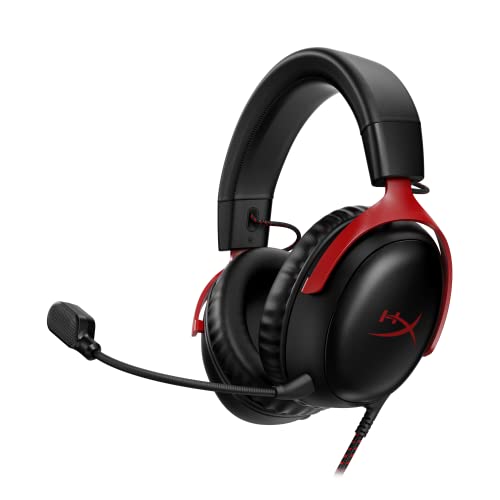
HyperX Cloud III — Best overall
The Cloud III is what happens when a manufacturer refines one design for a decade instead of reinventing it yearly. The aluminium yokes flex without creaking, the headband distributes weight across a wide padded strap, and the memory foam cushions are deep enough that glasses arms stop being a pressure point after the first hour. HyperX tuned the 53mm drivers toward clarity rather than spectacle: footsteps and reload sounds sit forward, bass is present without smearing dialogue, and long sessions stay easy on the ears because nothing in the tuning shouts. It is a headset that disappears, which is the highest compliment a wired model can earn.
The detachable 10mm microphone is half of its charm. It carries an LED mute indicator you can actually see from the corner of your eye, a mesh pop filter built into the capsule, and a voice character that teammates describe as clear rather than impressive — exactly right for callouts and work calls alike. Because the mic detaches and the headset connects over 3.5mm, USB-C, or USB-A with the included adapters, one purchase covers a PC, both console families, and a laptop bag. The wired connection also means there is no battery to age, no firmware to babysit, and no wireless variant confusion at checkout.
- Drivers: 53mm dynamic, tuned for clarity across games and calls
- Connections: 3.5mm, USB-C, and USB-A adapter included in the box
- Microphone: detachable condenser with LED mute light and pop filter
- Frame: aluminium yokes with memory foam cushions and headband
- Controls: volume wheel and mute button on the earcup
Strengths
- Comfort holds up through marathon sessions, glasses included
- Microphone quality leads the wired field at this tier
- Every adapter a PC or console owner needs is already in the box
Trade-offs
- No wireless option at any price within this model line
- Tuning is polite; bass-heavy music listeners may want more low-end weight
- Earcup controls are minimal compared with app-driven rivals
Best for: players and remote workers running one wired headset across every machine they own.
Not suited for: couch gaming far from the screen, where a cable becomes a trip hazard and a leash.

SteelSeries Arctis Nova 5 — Best wireless
The Arctis Nova 5 answers the question the Cloud III cannot: what if the cable itself is the problem? Its 2.4GHz dongle handles PC and PlayStation with low latency, Bluetooth covers the phone, and a button press hops between them — take a call mid-game, then drop back into the match without touching a menu. SteelSeries rates the battery in the sixty-hour neighbourhood, and the headset supports fast charging for short-notice sessions. The companion app carries a library of per-game EQ presets, which sounds like a gimmick until a preset pulls vehicle rumble out of a shooter’s dialogue channel and you hear a callout you would have missed.
Comfort comes from the ski-goggle headband SteelSeries has used for years: a suspended strap that floats the frame and adjusts with a simple slider, paired with fabric cushions that breathe better than leatherette in warm rooms. The retractable ClearCast microphone hides completely in the left earcup, extends when needed, and uses AI-assisted noise handling on PC to trim keyboard clatter from your transmissions. Sound from the neodymium drivers is balanced rather than bass-led, and the headset remembers EQ settings per connection type, so your phone and your PC can sound different without re-tuning.
- Drivers: 40mm neodymium magnetic drivers
- Connections: 2.4GHz USB-C dongle plus Bluetooth, with quick switch
- Battery: around sixty hours per charge, USB-C fast charging
- Microphone: retractable ClearCast Gen 2.X boom
- Extras: Sonar app with per-game EQ presets on PC
Strengths
- Switching between game audio and phone calls is genuinely one-press simple
- Battery life measured in days, not sessions
- Suspended headband suits long wear and warm rooms
Trade-offs
- Xbox support requires checking the specific variant before buying
- Fabric cushions leak more sound than sealed leatherette
- App features are PC-centred; console players get a smaller subset
Best for: multi-device households where one headset must serve a gaming PC, a PlayStation, and a phone in the same evening.
Not suited for: shared rooms, where maximum isolation from — and for — the people around you is the priority.

Razer BlackShark V2 X — Best for competitive play
Razer built the BlackShark V2 X by taking an esports brief literally: strip everything that does not help a player hear a footstep or call it out. The result weighs about 240 grams, clamps with a light but secure pressure, and uses memory foam cushions wrapped to seal well without cooking your ears. Its TriForce drivers split the frequency range across tuned sections of the diaphragm, and the practical effect is separation — gunfire, footsteps, and voice chat occupy distinct spaces instead of blending into a wall of midrange. For competitive players on a strict budget, this is the headset that treats their genre as the main event rather than a preset.
The fixed HyperClear cardioid microphone deserves its reputation. Cardioid pickup concentrates on your mouth and rejects sound arriving from the sides and rear, so a mechanical keyboard and a roommate’s television intrude far less than on the omnidirectional mics common at this price. The trade is that the boom does not detach, which makes the BlackShark an awkward travel companion and a strange choice for music on a train. It is a tool for a desk and a controller, and within that role very little at this tier touches it. A single 3.5mm connection keeps it compatible with practically everything that has a jack.
- Drivers: Razer TriForce 50mm with split-frequency tuning
- Weight: roughly 240 grams, among the lightest full-size picks here
- Microphone: fixed cardioid boom with strong side-noise rejection
- Connection: single 3.5mm plug for PC, console controllers, and mobile
- Cushions: memory foam with passive isolation focus
Strengths
- Positional clarity for shooters is the best in this group
- Microphone rejects room noise that cheaper mics happily broadcast
- Light frame stays comfortable through long ranked sessions
Trade-offs
- Non-detachable microphone limits use away from gaming
- No USB connection, so PC software surround needs your platform’s own tools
- Bass response is lean for cinematic single-player games
Best for: competitive players whose budget is fixed and whose priority is hearing — and being heard — in team shooters.
Not suited for: anyone planning to wear the same headset on calls at a café or on a commute.

Turtle Beach Recon 70 — Best for consoles
The Recon 70 is the headset controllers were designed around. It plugs into a PlayStation or Xbox controller, draws no battery of its own, and puts a volume wheel exactly where your thumb expects it. Its signature convenience is the flip-to-mute microphone: swing the boom up and you are muted, with a tactile certainty no software toggle matches when a parent, partner, or delivery driver appears mid-match. Turtle Beach tunes the 40mm drivers with game dialogue and effects in mind, and the synthetic leather cushions seal well enough to keep a living room’s television from leaking into your game audio.
Build is where the budget shows, and honesty matters here: the frame is plastic, the headband adjustment is notched rather than smooth, and this is not the headset to lend to someone who treats gear roughly. What you get instead is a featherweight design that younger players can wear for hours and a price-class position that makes it a painless second headset for a guest setup or a sibling’s console. The wired 3.5mm connection also means it works on PC and Switch without adapters, and the mic — while not detachable — folds out of the way cleanly for single-player sessions.
- Drivers: 40mm over-ear drivers tuned for game audio
- Microphone: flip-to-mute boom, fixed to the left earcup
- Connection: 3.5mm wired, works across PlayStation, Xbox, PC, Switch, mobile
- Controls: master volume wheel on the earcup
- Cushions: synthetic leather over foam, passive isolation
Strengths
- Flip-to-mute is the fastest, clearest mute gesture in this group
- Featherweight build suits younger players and long console sessions
- Truly platform-agnostic through the controller jack
Trade-offs
- Plastic frame feels less durable than the metal picks above
- Microphone clarity is good, not class-leading
- No wireless or USB option in this model
Best for: console players after a dependable, controller-powered headset with a trustworthy mute gesture.
Not suited for: PC players set on software EQ, USB surround processing, or a detachable mic for desk calls.
SteelSeries Arctis Nova 3 — Best wired with lighting
The Nova 3 exists for the player whose desk is also a display. Its earcup RGB rings are tasteful rather than carnival-bright, the USB-C connection suits modern laptops and handhelds, and the same AirWeave-style fabric cushions from its Nova siblings keep it cool through summer sessions. We could not confirm a pool listing for it at writing time, so it appears here without a link — worth a search if the look of your setup matters to you and the Nova 5’s wireless premium does not fit the plan.
Sonically it shares the family’s balanced house tuning: clear mids, controlled bass, and a detachable ClearCast microphone that performs respectably for squad chat and casual streaming. The honest limitation is value arithmetic — part of its price buys light, and players indifferent to RGB will find the Cloud III’s frame and microphone a better spend of the same money. Buy the Nova 3 because the whole desk pleases you when it glows in unison, not because the lighting improves a single match.
- Connection: USB-C wired with 3.5mm fallback via adapter
- Lighting: Prism RGB rings on both earcups
- Microphone: detachable ClearCast boom
- Cushions: fabric AirWeave-style ear cushions
- Platforms: PC, PlayStation, Switch, mobile over USB-C
Strengths
- Desk-friendly looks with lighting that can be dimmed or disabled
- Fabric cushions stay cooler than leatherette
- Detachable mic makes it presentable for video calls
Trade-offs
- Part of the budget buys illumination rather than audio
- No wireless mode at all
- RGB control lives in PC software, limiting console tweaking
Best for: desk-setup builders matching a wired headset to a lit PC build inside this tier.
Not suited for: buyers counting every dollar toward sound and microphone quality alone.
Logitech G435 LIGHTSPEED — Lightest wireless
The G435 weighs about 165 grams, which changes what a headset feels like after hour two: closer to a cap than a clamp. It pairs Logitech’s LIGHTSPEED wireless dongle with a Bluetooth mode, runs its beamforming microphones from the earcup instead of a boom, and comes in colours that younger players actually choose for themselves. It is listed here prose-only because no pool listing could be confirmed, but for smaller heads and casual play it fills a gap none of the linked four address — wireless freedom at a weight children and petite adults can forget.
Set expectations correctly and it delights. The 40mm drivers are tuned for games and video rather than critical listening, maximum volume is deliberately capped with hearing safety in mind, and the boom-free microphone is fine for chat but will not flatter a stream. Battery life stretches across days of mixed use, and the whole thing is built substantially from recycled plastics. As a first wireless headset or a travel spare, its lightness is not a gimmick — it is the feature everything else orbits.
- Weight: roughly 165 grams, the lightest pick in this guide
- Connections: LIGHTSPEED USB dongle plus Bluetooth
- Microphone: dual beamforming mics built into the earcup, no boom
- Battery: multi-day mixed use per charge
- Build: largely recycled plastic construction
Strengths
- Weight that younger players and small heads can wear indefinitely
- Two wireless modes cover console, PC, and phone
- No boom to snap, store, or lose
Trade-offs
- Built-in mics are noticeably weaker than any boom in this guide
- Volume ceiling may frustrate listeners in loud environments
- Sound tuning is casual rather than competitive
Best for: younger players, smaller heads, and anyone whose main complaint about headsets is that headsets are heavy.
Not suited for: competitive squads where microphone clarity carries tactical information.
Which of These Six Deserves Your Hundred Dollars?
| Headset | Connection | Microphone | Strongest suit | Watch out for |
|---|---|---|---|---|
| HyperX Cloud III | Wired, three connector types | Detachable boom | All-round polish and comfort | The cable itself |
| SteelSeries Arctis Nova 5 | 2.4GHz plus Bluetooth | Retractable boom | Device switching and battery | Variant selection for Xbox |
| Razer BlackShark V2 X | Wired 3.5mm | Fixed cardioid boom | Competitive clarity per dollar | Mic never comes off |
| Turtle Beach Recon 70 | Wired 3.5mm | Flip-to-mute boom | Console convenience | Plastic frame |
| SteelSeries Arctis Nova 3 | Wired USB-C | Detachable boom | Looks and cool cushions | Paying partly for light |
| Logitech G435 | Wireless plus Bluetooth | Built-in beamforming | Featherweight comfort | Modest mic and volume |
Read down the connection column first, because it quietly decides the purchase. If your play happens at one desk, the wired trio will outlast and out-clarify everything else here for the same money. If your evenings migrate between a console, a PC, and a phone, only the Nova 5 and G435 follow you without a cable, and they serve very different heads. The microphone column matters next, and it matters most to the people who listen to you: a detachable or retractable boom is worth real money if your voice carries a team’s decisions or a stream’s entertainment.
What Should You Check Before Spending at This Tier?
Start with your head, not the spec sheet. Headband architecture — suspended strap, padded band, or hybrid — determines whether hour three feels like hour one, and no review can fully predict your skull. Buy from a seller with painless returns, wear the headset through your longest typical session within the return window, and pay attention to jaw pressure and the top-of-head hotspot, the two complaints that surface latest. Glasses wearers should prioritise cushion depth and low clamp force; the Cloud III and Nova 5 are the kindest designs here, while the BlackShark’s competitive clamp assumes shorter, focused sessions.
Then audit your platforms honestly. A headset that works on “everything” through a 3.5mm jack gives up software features on PC; a USB model may not talk to an Xbox controller at all; a wireless model’s PlayStation and Xbox variants are sometimes different products wearing the same name. Write down the machines you will actually use weekly — not the ones you might buy someday — and let that list veto picks. Finally, think about the second year: replaceable cushions, a detachable cable or microphone, and a frame without fragile hinges are what separate a headset that gets replaced from one that gets repaired with a small parts order.
How Do You Get a Budget Headset Set Up Properly?
Begin with levels. Set your system volume around three-quarters, use the headset’s own wheel for fine adjustment, and position the microphone boom two finger-widths from the corner of your mouth rather than directly in front of it — plosives soften and clarity rises. On PC, choose the headset explicitly as both output and input device; operating systems love defaulting to a webcam microphone. Test with a recording, not a friend’s patience: thirty seconds of your normal voice, played back, reveals more than any settings screen.
Surround features deserve a sceptical afternoon. Try your platform’s spatial audio — Windows Sonic or Dolby Atmos on PC and Xbox, Tempest 3D on PlayStation — with the same game scene repeated, and keep it only if directional cues genuinely sharpen for you. Stacking multiple surround processors (console setting plus headset software plus game setting) muddies everything; pick one layer and disable the rest. If your headset offers EQ, resist the bass shelf: a small cut to low frequencies usually clarifies footsteps more honestly than a boost anywhere else.
Why Does Comfort Matter More Than Any Specification Here?
Every headset in this guide can reproduce a footstep. The ones owners keep are the ones still comfortable when the match, the meeting, or the film enters its third hour, and comfort is a system rather than a single feature. Clamp force decides how firmly the cushions seal; too little and bass escapes while the headset slides, too much and your jaw aches by the second hour. Cushion material decides heat: leatherette seals tightly and isolates well but traps warmth, while fabric breathes at the cost of leakage. Weight distribution decides the rest — a suspended strap like the Nova 5’s spreads load across the whole crown, while a padded band like the Cloud III’s concentrates it more narrowly but pads the contact generously.
Head shape quietly arbitrates all of it. Players with wider heads often find Razer’s frames generous and SteelSeries’ straps short; smaller heads reverse the verdict. This is why the strongest advice in this entire category is unglamorous: order from somewhere with free returns, and test with your longest realistic session, not a ten-minute unboxing impression. A headset that feels merely fine at minute ten and wonderful at hour three is a better buy than one that dazzles instantly and pinches later. Your future self, deep in a campaign at midnight, will not care about the driver diameter printed on the box. It will care that nothing hurts.
What Actually Makes a Microphone Sound Good?
Microphone quality in this tier is decided less by the capsule than by geometry and processing. A boom places the capsule close to your mouth, where your voice is loud relative to the room; that single advantage explains why every boom-equipped pick here out-transmits the G435’s earcup beamforming, clever as it is. Pickup pattern comes next: cardioid booms like the BlackShark’s reject the keyboard behind them, while simpler designs hear the whole room and rely on your platform’s noise suppression to clean up. Ask teammates which they prefer and they will describe the same thing in different words — your voice present and steady, the room absent.
Processing can rescue a mediocre capsule or ruin a good one. Aggressive noise gates clip the beginnings of words; heavy compression makes a calm voice sound like a sports broadcast. The Cloud III and HS80-class microphones succeed partly because they need little rescue: the raw capture is already close to broadcast politeness. When you test a new headset, record yourself typing while talking, then talking with a fan or television running. If the recording keeps your voice in front of both, the microphone will survive your real environment, not just a quiet showroom demo.
Should You Care About Driver Size and Other Printed Numbers?
Driver diameter is the most advertised and least informative number on a headset box. A well-tuned 40mm driver in the Nova 5 or Recon 70 can sound cleaner than a sloppy 53mm design, and the Cloud III’s larger drivers earn their keep through tuning rather than size alone. Frequency-response ranges printed on packaging describe what a driver can produce under test conditions, not what you will hear at sane volumes. Impedance and sensitivity matter mainly for whether a phone or controller can drive the headset loudly enough — every pick here is designed for exactly those sources, so the question answers itself.
The numbers that do predict experience are weight, battery hours on wireless models, and cable length on wired ones. Weight you feel every minute. Battery claims you should discount gently — real-world life at high volume with the microphone active lands below the laboratory figure on every wireless headset, though the Nova 5’s margin is large enough to absorb the discount. Cable length decides whether a wired headset reaches a PC tower under a desk or demands an extension; measure your run before assuming. Treat everything else on the box as marketing until your ears rule on it.
How Do These Headsets Handle Music, Film, and Work?
Gaming tuning and musical tuning overlap less than brands suggest. Game-focused headsets push the presence region where footsteps and dialogue live, which flatters podcasts and video calls but can make dense music sound forward and tiring. The Cloud III is the most even-handed listener here, its restraint paying off across a workday that mixes calls, a film trailer, and a playlist. The Nova 5’s app EQ lets PC users build a warmer music preset and swap back for games, a flexibility the purely wired picks cannot match without system-level software.
For film, what matters is dynamic control: quiet dialogue intelligible without the next explosion arriving as an assault. Every pick here manages that balance acceptably, with the BlackShark’s lean bass the most dialogue-friendly and the Recon 70’s livelier low end the most cinematic. For work, the calculus narrows to microphone and manners — a detachable or retractable boom, a mute you can verify at a glance, and a silhouette that does not announce “esports” to a client call. On those terms the Cloud III leads, the Nova 5 follows, and the fixed-boom designs ask you to accept their gaming identity in professional settings.
What Does Ownership Look Like After the First Month?
The honeymoon ends when a cushion splits, a cable frays, or a battery starts fading — and the picks here diverge sharply on what happens next. HyperX and SteelSeries both sell replacement cushions for their frames, and the Cloud III’s detachable cable and microphone turn the two most common failures into parts orders instead of replacements. The Recon 70’s fixed cable is its long-term wager: when it fails, the headset is done, which its low tier position partly excuses. Wireless owners should expect the Nova 5’s battery to define the headset’s lifespan; storing it neither fully drained nor perpetually at a full charge slows the decline.
Hygiene is the other ownership reality nobody prints on boxes. Fabric cushions absorb sweat and can be removed and washed gently; leatherette wipes clean but eventually flakes, sooner in humid rooms. A headset worn daily rewards a weekly wipe and a stand or hook that keeps it off the desk’s coffee zone. None of this is exciting, and all of it decides whether a hundred-dollar purchase serves for one year or four — the difference between a bargain and a subscription to your own dissatisfaction.
How Should You Split the Budget Between Headset and Everything Around It?
A headset rarely arrives alone in a setup, and the hundred-dollar fence invites a useful question: is one headset at the top of the tier wiser than a cheaper headset plus the accessories that complete it? The honest answer depends on what you already own. A player with no stand, no spare cushions, and a controller that eats batteries might genuinely be better served by the Recon 70 plus the small comforts than by a flagship-tier frame used bare. But accessories cannot repair a weak microphone or an aching clamp, and those are the flaws owners cite when a headset lands in a drawer. Buy the frame and the voice first; decorate later.
There is one accessory that earns its place in the same order: a simple stand or wall hook. Headsets die by being dropped, sat on, and drowned in desk clutter more often than by electronic failure, and the cheapest stand prevents the majority of those endings. A second set of cushions bought a year in — when the originals have flattened — restores most of the new-headset comfort for a small fraction of a replacement’s cost. Beyond that, restraint is the strategy. The tier’s whole appeal is that a single, well-chosen purchase ends the shopping; turning it into a collecting hobby defeats the point of the fence.
What Changes Between Playing Alone and Playing With a Squad?
Solo players can optimise shamelessly for immersion: a wider soundstage, warmer bass, a microphone that exists only because the box includes one. Squad players live under different physics. Your microphone becomes part of your teammates’ experience, your headset’s leakage becomes your household’s problem at midnight, and your comfort must survive not your session length but the group’s. That is why this guide weights microphone quality and sealed cushions as heavily as it does — four of the six picks serve the squad scenario first, because it is the scenario where a weak headset taxes other people.
Open-back designs, beloved by solo audiophiles, are conspicuously absent here for exactly that reason: they leak your game into the room and the room into your game, and almost none exist at this tier with a microphone worth using. If your play is genuinely solitary and your room is quiet, a wired open-back headphone plus a separate microphone is a legitimate alternative path — but it is a different purchase from a different category, and comparing it against these six all-in-one headsets confuses more than it clarifies. Within the headset category, the sealed, boom-equipped designs above are what shared walls and shared matches demand.
How Does Platform Choice Change Which Pick Is Right?
PC players swim in options because the platform forgives everything: USB, 3.5mm, and wireless dongles all work, software EQ and spatial audio come from a half-dozen sources, and a headset that disappoints can be re-tuned rather than returned. For them the Cloud III’s adapter kit and the Nova 5’s app ecosystem are genuine luxuries, and the BlackShark’s plain analogue connection is no handicap at all, since Windows and third-party tools supply any processing they want. The PC question is really about the desk: cable management, dongle ports, and whether a wireless headset’s charger will live within arm’s reach.
Console players face a licensing map instead. PlayStation accepts most USB and 2.4GHz wireless headsets and adds Tempest 3D audio on PS5, which flatters every stereo pick in this guide. Xbox restricts wireless to licensed products, which is why the wired trio — Cloud III, BlackShark, Recon 70 — are the safe cross-platform currency, working through the controller with zero pairing drama. Switch and mobile players should think in terms of Bluetooth and 3.5mm: the Nova 5 and G435 cover wireless handheld play, while any wired pick works docked or through a phone’s jack or adapter. Naming your primary platform first, and your secondary one honestly, eliminates half this list in a way no sound test can.
What Should You Do in the First Week With a New Headset?
Day one belongs to fit. Wear the headset for a full session with the headband adjusted one notch looser than your instinct suggests; most owners over-tighten initially, and a looser fit that stays put is the one you can live with. Note any hotspot at the crown or pressure behind the jaw, then adjust cushion position before concluding anything — small shifts of the earcups change which part of the cushion carries the load. If glasses are part of your life, test with the frames you actually wear, including sunglasses-shaped spares if you use them at the desk.
The rest of the week belongs to calibration. Record your voice daily in different rooms until microphone placement becomes muscle memory. Build one EQ profile for your main game and one for music, and resist building more; profile sprawl is how good headsets end up sounding wrong in the name of optimisation. Charge wireless models before they beg — a headset that dies mid-session teaches you its battery’s true size in the worst way. By day seven you should know three things: whether the fit survives your longest session, whether your squad hears you clearly without being asked, and whether you reach for this headset without thinking. That last one is the verdict that matters.
When Is the Right Answer to Wait or Buy Differently?
Sometimes the correct purchase at this tier is patience. Headset lines refresh on predictable cycles, and a model near replacement often sees its successor launch with the previous design’s lessons baked in — the Cloud III itself is the product of exactly that patience at HyperX. If your current headset still works and a refresh is rumoured for the line you favour, waiting a season costs little. Conversely, if your microphone has died or your frame has cracked, the calculus flips: a season of bad calls and duct tape costs more than any launch discount will save.
Buying differently is the other honest answer. A player who has outgrown headsets entirely — who wants a studio headphone and a desk microphone — should not force this category to be what it is not; the six picks here are the best of the all-in-one form, not a substitute for separates. A buyer whose real problem is a noisy room should spend on the room: a cardioid microphone helps, but no headset fully defeats a television three metres away. Knowing which problem you actually have is the cheapest upgrade in this entire category, and it is available before you spend anything at all.
How Do You Tell a Genuine Step Up From a Reskin?
This tier is full of familiar names wearing new shells, and telling a real advance from a reskin is a learnable skill. A genuine step up changes something physical: a new driver with measurably cleaner separation, a redesigned yoke that removes a known crack point, a microphone capsule that records visibly flatter in voice tests. A reskin changes colours, box art, and the number after the name. The Cloud III earned its numeral with a revised frame and a new microphone; plenty of rivals’ sequels amount to a fresh coat of branding on the same acoustic skeleton. When a successor launches, look for what the manufacturer admits changed — the honest ones list it, and the list is either engineering or upholstery.
The same scepticism applies to limited editions and streamer-branded variants, which at this tier are almost always the standard headset in a costume, priced as though the costume were a feature. Buy the costume if it delights you, but price it as decoration in your own ledger. The headsets in this guide were chosen in their standard forms precisely because their value survives the removal of novelty — a test worth applying to anything this category tries to sell you next season.
What About Players Who Wear a Headset All Day?
Remote workers and students quietly became this tier’s heaviest users, and their needs reorder the ranking. Eight hours exposes what two conceal: total weight, heat build-up, and any tuning sharpness that turns listening into labour. For all-day wear the Cloud III’s plush neutrality and the Nova 5’s floating strap are the standouts, and both hide or remove their microphones gracefully between calls. The BlackShark’s competitive clamp and the Recon 70’s firmer pads, perfectly reasonable for a match, become negotiations across a workday.
All-day wearers should also think about rotation and hygiene more seriously than gamers do. A second set of cushions — one drying while the other works — extends cushion life and keeps the headset pleasant in summer. Volume discipline matters more across eight hours than two: listening fatigue is cumulative, and the player who keeps levels moderate keeps their hearing and their concentration. If your headset is effectively office equipment, treat it with office seriousness, and this tier will repay you with years rather than seasons of service.
How Should You Think About Warranties and Support at This Tier?
Nobody comparison-shops warranty terms at a hundred dollars, and that is a small mistake, because support quality is one of the few things that genuinely differs between the brands in this guide. The large names here — HyperX, SteelSeries, Razer, Turtle Beach, Logitech — all run real replacement programmes, sell spare cushions and cables, and publish firmware and software that stays maintained for years. That infrastructure is part of what the money buys, and it is invisible until the week you need it. Keep your receipt somewhere findable, register the product if the brand offers it, and photograph the serial label while it is still legible; headsets live hard lives and labels fade.
Support also shapes the second-hand question. A used flagship from a brand with available spare parts can be a smarter buy than a new budget model with none — cushions and a cable refresh a used Cloud III into something close to its younger self. The reverse is true for wireless models with sealed batteries: a used wireless headset’s remaining life is written in a battery you cannot inspect. Buy wired used with confidence, buy wireless new with a warranty, and the tier’s economics tilt further in your favour.
Why Do Two Players Hear the Same Headset Differently?
Because ears, heads, and expectations all differ, and this category’s arguments mostly reduce to that. Ear shape changes how a driver couples to your hearing; a headset one player calls spacious, another calls distant. Hearing itself varies — age trims high frequencies first, which is why younger listeners often find bright tunings exciting and older listeners find the same tuning harsh. Neither is wrong, and no review, including this one, can fully mediate between two different auditory systems. What a guide can do is describe a headset’s character accurately enough that you can map it onto your own hearing: the Cloud III’s restraint, the BlackShark’s forward clarity, the Recon 70’s livelier low end are descriptions to triangulate with, not verdicts from on high.
Expectation is the third variable, and the sneakiest. A player upgrading from earbuds hears any of these six as a revelation; a player downgrading from studio gear hears compromises in the same six. Knowing which direction you are travelling tells you how much weight to give superlatives — yours and ours. The practical takeaway is to trust comparative descriptions over absolute ones, to weight the experiences of players whose setup resembles yours, and to let the return window arbitrate what words cannot. That is not a hedge; it is how this category actually works, and shopping as though it were otherwise is how good headsets get returned and mediocre ones get kept.
Which Buying Mistakes Catch People at This Price?
Wireless tempts buyers into solving a problem they do not have. If you play at a desk, the wire buys you a better microphone, a better frame, and zero charging discipline for the same money — the Cloud III exists precisely because that trade still favours cable for most people. The second error is trusting the box’s surround logo as a hardware feature; at this tier it is software, often a trial, and never a reason to choose one frame over another. Third, shoppers ignore variant labels: an Xbox-licensed wireless headset and its PlayStation twin can share a name and a shelf while being mutually incompatible.
Fourth, people audition headsets with music alone, then discover the microphone in their first match. Any headset here sounds acceptable playing a favourite track; they diverge wildly when a fan, a keyboard, and a excited teammate enter the picture. Judge the mic with the same seriousness as the drivers. Finally, there is the sizing mistake: adult competitive headsets clamp hard on younger players, and youth-sized designs like the G435 cap volume in ways that frustrate adults. Match the headset to the head it will actually sit on.
Final Recommendation
Buy the HyperX Cloud III unless you have a specific reason not to — it is the most complete headset in this tier, with the frame, cushions, microphone, and adapter kit to serve years of mixed gaming and work. Choose the Arctis Nova 5 when your devices multiply and the cable genuinely gets in the way; choose the BlackShark V2 X when competitive clarity outranks every other virtue; choose the Recon 70 for a console-first household that values a flip-to-mute boom and painless sharing. The Nova 3 and G435 are specialists — one for the lit desk, one for the lightest possible wireless wear — and both reward buyers who know exactly which specialism they are paying for.
One closing thought on value: the hundred-dollar tier rewards decisiveness. The differences between these six are real but narrow, and every week spent deliberating is a week spent on the headset you already dislike. Pick the one whose strengths match your loudest complaint about your current setup — the aching ears, the muddy microphone, the cable across the keyboard — and let that single, honest criterion drive. Buyers who shop that way report the highest satisfaction in this category, because they solved the problem they actually had instead of the one a spec sheet told them to want.
Frequently Asked Questions
Is wired or wireless better under $100?
Wired buys more audio and microphone quality per dollar because none of the budget funds radios and batteries; the Cloud III and BlackShark V2 X demonstrate the gap clearly. Wireless buys freedom and multi-device convenience, which the Nova 5 delivers well. Decide by where you sit: one desk favours wire, a living room favours wireless.
Do I need 7.1 surround on a headset in this tier?
No. At this budget, surround is software processing rather than hardware, and your PC or console already offers spatial audio that works with any stereo headset. Spend on drivers, cushions, and the microphone instead — those cannot be downloaded later.
Which of these works best for work calls as well as games?
The Cloud III, because its detachable microphone sounds professional, its frame looks neutral on camera, and its USB adapters suit laptops. The Nova 5 is the wireless alternative if you take calls away from the desk.
How long should a headset at this price last?
Three to five years is a fair expectation for the metal-framed picks with replaceable cushions. Batteries are the lifespan limiter on wireless models, and hinges are the weak point on all-plastic frames like the Recon 70’s — handle those with a little more care.
Can one headset really cover PlayStation, Xbox, and PC?
Yes, if it connects by 3.5mm — the Recon 70 and BlackShark V2 X do exactly that through controller and PC jacks. Wireless is where platform licensing splits the market, so verify the variant before buying any wireless model for cross-console use.
Are replacement cushions worth buying for a headset in this tier?
Yes — cushions are the wear item that ages fastest, and a fresh set restores both comfort and the seal your bass depends on. For the Cloud III and Nova lines, official replacements exist and fit exactly; generic cushions can change the sound by altering the seal, so match the model when you order.
Does a more expensive headset always sound better than these?
Not always, and not by the margin the price gap suggests. Above this tier you mostly buy wireless refinement, premium materials, and features like active noise cancelling rather than a different class of clarity. Many listeners who upgrade report appreciating the extras while admitting the sound itself improved modestly — which is precisely why this tier is the category’s sweet spot.
Related Guides
Still narrowing the field? Our best 3D audio headsets guide covers spatial sound in depth, the best $60 headsets roundup shows what a smaller budget keeps and gives up, and the best affordable microphone headsets picks lead with voice quality above all else. Each of them starts from the same six headsets ranked above, so the reading stays consistent.
Related guide: Best Bose Headsets
Related guide: Best Plantronics Headsets


