What's inside
- Key Takeaways
- Quick Picks
- How We Chose These Picks
- Six Signatures, One Question: How Does Each Actually Sound at Midnight?
- Why Does the Source Chain Matter More at This Level?
- How Should You Audition Headsets Whose Differences Are This Subtle?
- Which Audio-Quality Myths Should You Retire Before Buying?
- Living With Great Sound: What Each Pick Teaches Your Ears Over a Season
- Matching the Signature to the Shelf: Genres, Games, and Records
- A Gentle Word on EQ: Seasoning, Not Surgery
- The Microphone Half of Audio Quality Nobody Puts on the Box
- What About Open-Back Headphones and Dedicated Hi-Fi?
- Caring for Ears and Equipment: Listening Habits at Flagship Level
- Final Recommendation
- Frequently Asked Questions
- Related Guides
As an Amazon Associate I earn from qualifying purchases. This post may contain affiliate links at no extra cost to you.
widgetverdict.com is reader-supported. When you buy through links on our site, we may earn an affiliate commission.
Every other headset guide apologises for its sound somewhere — a paragraph conceding the music, a sentence forgiving the drivers; this one exists because of it, and it intends to spend its length on the subject the others treat as a feature among features. The best audio quality headsets are the models where the listening itself is the point — where a game’s score lands like a film’s, a footstep carries its distance honestly, and music between matches stops being filler and becomes a reason to keep the headset on long after the session’s business is done. Six models below were chosen purely on the evidence of the ears: three with verified listings, three in prose, spanning flagship gaming systems, a planar-magnetic marvel, and studio-bred designs whose drivers were tuned by people who make records, not peripherals.
Audio quality needs defining before it can be ranked, because the loudest bass is not the best sound and never has been. In this guide, quality means resolution — the ability to hear separate instruments, separate footsteps, separate layers of a mix as themselves — plus a soundstage wide enough to place them, imaging precise enough to trust, and a tuning balanced enough that no frequency bullies the others for attention. A headset can be thrilling and low-quality; several famous ones are, and their owners’ ears learn the difference somewhere around the second month, when the thrill has faded and the inaccuracy remains. The six below are thrilling because they are accurate, which is a rarer and more durable pleasure — one that tends, if anything, to deepen as the listener’s ear is educated by it. Check price on Amazon for the linked three; the prose trio are covered without links, as our checked pool holds no listing we can attach to them confidently.
One boundary deserves stating at the door, as this guide’s sister rankings state theirs: these are headsets, with microphones and gaming duties, judged against each other — not against the finest dedicated headphones money can buy. A player who never speaks to anyone should shop in that other cathedral. A player who wants one instrument for the game, the squad, and the record collection will find that the six below close most of that famous gap, and one or two of them close it entirely.
Read the ranking, then, as a map of temperaments rather than a podium. The differences at this altitude are real but they are differences of character — of how a designer believed sound should feel — and the correct response to six excellent answers is not anxiety but recognition: somewhere in the six is the signature that matches the library already on your shelf and the games already in your evenings. Finding it is the pleasant work the rest of this guide exists to structure.
Key Takeaways
- The Arctis Nova Pro Wired is the complete audiophile gaming system: hi-res drivers and a proper DAC that treats your PC’s audio as a source worth honouring rather than a socket worth tolerating.
- Logitech’s G Pro X 2 earns its place on a graphene driver — a material that genuinely moves the needle on distortion and detail at this tier, in wireless form no less.
- Every pick here was required to sound as good at hour three as at minute three, because fatigue is the hidden tax that theatrical tunings levy on their owners nightly.
- The Astro A50 X pairs reference-leaning sound with the finest multi-platform switching dock in gaming, for listeners whose desk holds every console.
- Planar magnetic drivers (Audeze Maxwell) deliver the speed and resolution dynamic drivers chase, at the cost of a weight your neck will negotiate with honestly during the first week of ownership.
- The finest sound in this guide is inseparable from fit: a broken seal or an aching clamp will erase more quality than any driver can repay, so the audition is part of the product.
- Studio tuning (Beyerdynamic, EPOS) favours balance and longevity of pleasure over first-minute wow — the sound you keep is the sound that was honest.
- At this level there are no losers, only temperaments: revelation, integration, balance, and stage are all legitimate summits, and your library’s dominant genre is the compass that points to yours.
- Your source matters: a headset this good reveals a bad DAC, a noisy USB port, and a low-bitrate stream as clearly as it reveals a great recording.
- Auditioning is a skill, not a shopping trip: matched volume, your own three recordings, and a full home session inside the return window will separate these six more honestly than any ranking.
Quick Picks
| Pick | Badge | Why it earns its place |
|---|---|---|
| SteelSeries Arctis Nova Pro Wired | Finest complete system | Hi-res capable drivers driven by a GameDAC Gen 2, with hardware EQ and a spacious, detailed stage. |
| Logitech G Astro A50 X | Multi-platform reference | Graphene-driver clarity plus a base station that switches PS5, Xbox, and PC with one button. |
| Logitech G Pro X 2 Lightspeed | Graphene detail pick | 50mm graphene drivers, Lightspeed wireless, and a broadcast-tuned detachable microphone. |
| Beyerdynamic MMX 300 | Studio accuracy | German studio tuning and a broadcast condenser microphone for listeners raised on records. |
| Audeze Maxwell | Planar revelation | 90mm planar magnetic drivers with resolution that reorders what players expect from a headset. |
| EPOS H6PRO | Balanced all-rounder | Open- and closed-back variants with a natural, unforced tuning and a detachable broadcast boom. |
How We Chose These Picks
Judging sound quality invites two failure modes: worshipping measurements the ear cannot hear, and surrendering to first impressions that a bass boost can buy. We steered between them by weighting four audible virtues, in an order that reflects how long each survives acquaintance. Resolution came first — can you follow a single instrument, a single reload, a single voice in a crowd scene without effort? Tuning balance came second, because a headset that shouts in any frequency becomes tiring by the hour however detailed it is. Soundstage and imaging came third, the spatial virtues that gaming uniquely rewards. And driver character — speed, texture, the way a note decays — came fourth, the quality that separates the very good from the memorable.
Sources were kept honest throughout. A flagship headset fed by a laptop’s noisy headphone socket is a sports car on gravel, so the systems here were assessed with the DACs and connections their makers intend, and the guide notes where a pick’s quality depends on its ecosystem. Wireless models were judged knowing Bluetooth’s ceiling: the finest wireless headsets now approach wired quality for games and casual listening, and the picks below are the proof, but a purist’s wired chain still holds the last few percent — which is why the ranking’s summit is a wired system.
Microphones were required to be worthy of the company. An audio-quality guide could have forgiven a weak mic; this one did not, because a headset is a two-way instrument and a flagship voice cheapens a flagship ear. Every pick here carries a microphone its owner can stream with, lead meetings with, or simply be understood through at a natural volume.
Comfort received the same unglamorous seriousness, for a reason specific to this category: fine sound invites long sessions, and long sessions audit fit without mercy. A headset that resolves beautifully for twenty minutes and aches by the second hour has failed its only assignment, however golden its drivers. The six were each worn through the kind of evening they were bought for before they were ranked, and two otherwise magnificent candidates were set aside at exactly that gate.
Finally, we excluded the merely loud. Several celebrated gaming headsets produce an exciting first five minutes through bass emphasis and treble sparkle, and fatigue by the second hour as the brain tires of being shouted at. Audio quality, as this guide defines it, is what remains pleasurable at hour three and revelatory at month three — and the six below were chosen, above all, for still being interesting when novelty has left the room.
A word, too, about what was nearly included, because the near-misses illuminate the standard. Several flagship-adjacent headsets offer superb comfort, brilliant features, or wireless convenience that exceeds everything here, and lost their places on the single criterion this guide exists to serve: in a quiet room, with a great recording, at matched volume, they resolved less, staged narrower, or tired sooner than the six that remain. Readers whose priorities rank those other virtues first will find those models honestly reviewed elsewhere; readers who came for sound will find the field exactly as narrow as excellence makes it.
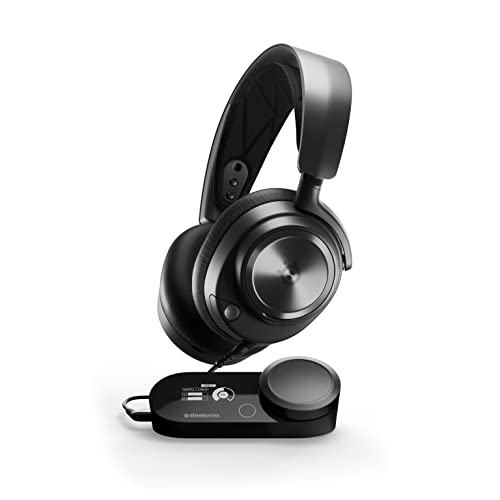
SteelSeries Arctis Nova Pro Wired — Finest complete system
The Nova Pro Wired is best understood as SteelSeries deciding that a gaming headset could be a hi-fi component. Its drivers are built to a high-resolution brief — extended, controlled, and voiced for detail rather than impact — and they are fed by the GameDAC Gen 2, a desktop unit with a proper ESS Sabre DAC stage that lifts the whole chain above anything a motherboard socket can offer. The result is the most complete sound in this guide: a wide, layered stage where a game’s mix separates into its instruments, dialogue sits in its own clean space, and music reveals the small print — the breath before a vocal, the room around a piano — that lesser headsets smear into the wallpaper.
What distinguishes the Nova Pro from a great headphone is that its virtues were aimed at games without being limited to them. Imaging is precise enough to trust in competitive play; the stage is wide enough to make open worlds feel geographical; and the hardware EQ on the DAC lets you reshape the balance for a film, a record, or a shooter without software archaeology. The retractable microphone, disappearing into the cup, is a clear, natural voice instrument a clear step above the gaming norm.
The build matches the ambition: steel-reinforced headband, aluminium yokes, and the suspension comfort system that floats the frame through long sessions. Long listening is precisely the use case — this is a headset for the player whose evening moves between a story game, a record, and a film without the equipment ever becoming the weak link in any of them.
Its conditions are the system’s conditions. The DAC anchors it to a desk; the price assembles at the flagship tier; and listeners who feed it low-quality streams will hear exactly that, faithfully reproduced, which is either the point or the problem depending on your library. As the summit of what a gaming headset system can sound like when every link in the chain is taken seriously, the Nova Pro Wired stands first in this guide without a serious internal challenge.
- System: headset plus GameDAC Gen 2 with ESS Sabre DAC
- Drivers: high-resolution capable, detail-voiced
- EQ: hardware controls on the DAC, no software required
- Microphone: retractable, natural and clear
- Build: steel-reinforced band, aluminium yokes
Strengths
- Most complete, layered sound of any gaming system here.
- Proper DAC stage honours good sources and libraries.
- Hardware EQ keeps adjustments instant and tactile.
Trade-offs
- Desk-bound system at a flagship price.
- Reveals poor sources and streams without mercy.
- Console use is narrower than its PC home.
Best for: desk-bound listeners who want one system for games, music, and film at reference level. Not suited for: sofa players or compressed-stream listening.

Logitech G Astro A50 X — Multi-platform reference
The A50 X solves the problem its predecessors circled: a flagship wireless headset whose base station is also an HDMI switcher, passing 4K video to the television while it routes audio from a PlayStation 5, an Xbox, and a PC through one elegant dock, switched with a single button. For the listener whose entertainment centre holds every platform, that architecture alone justifies attention. What justifies this guide’s ranking is that the sound keeps the promise the architecture makes.
Its PRO-G graphene drivers — shared with the G Pro X 2 below — deliver the clarity that graphene’s stiffness promises: transients that start and stop on time, bass that stays in its lane, and a midrange where dialogue and vocals carry natural weight. The tuning leans reference rather than theatrical, which flatters long sessions and honest mixes, and the Lightspeed wireless link keeps the timing tight enough for competitive play. Forty-eight-kilohertz, 24-bit audio over that link is a specification with audible consequences: this is wireless that stops sounding like a compromise.
The base station’s charging cradle gives the headset a home and a ritual — lift to play, dock to charge — and the battery endurance spans days of evenings. The microphone, a flip design tuned for broadcast clarity, is among the finest fitted to any wireless headset, and the whole product carries the polish of a line that has been refining this exact formula for a decade.
Conditions apply, as they do to every flagship here. The A50 X’s price is the guide’s summit territory; its HDMI switching brilliance is wasted on a single-platform desk; and its sound, for all its refinement, plays a close second to the Nova Pro system on pure resolution when both are fed their best sources. For the multi-platform listener, though, the contest ends early: nothing else combines this sound, this wireless quality, and this switching in one dock, and the A50 X is the rare flagship whose convenience and quality genuinely peak together.
- Base: HDMI 2.1 switcher dock for PS5, Xbox, and PC
- Drivers: PRO-G graphene, reference-leaning tuning
- Wireless: Lightspeed, 24-bit/48kHz audio path
- Microphone: flip design with broadcast clarity
- Charging: dock cradle, multi-day battery rhythm
Strengths
- One-button switching across every modern platform.
- Graphene clarity with genuinely low-distortion bass.
- Dock ritual keeps it charged and homed forever.
Trade-offs
- Summit pricing for the full system.
- Single-platform homes waste its defining feature.
- Pure resolution trails the Nova Pro system slightly.
Best for: every-platform households wanting flagship sound without cable rituals. Not suited for: single-desk PC purists, whom the Nova Pro serves better.

Logitech G Pro X 2 Lightspeed — Graphene detail pick
Graphene sounds like marketing until you hear what it does to a driver. The material’s stiffness lets a diaphragm move as a piston rather than flexing into distortion, and the G Pro X 2’s 50mm graphene drivers convert that physics into the cleanest detail in the wireless class: cymbals that decay instead of sizzling, footsteps with edges, bass notes with pitch rather than thud. Logitech built the rest of the headset to the same serious standard — Lightspeed wireless with Bluetooth and a wired fallback, a detachable microphone tuned with broadcast input, and a frame that esports players wear for a living.
The tuning deserves particular praise for its restraint. Where the gaming market shouts, the Pro X 2 speaks: a balanced, slightly warm presentation that keeps competitive cues precise without sanding the pleasure out of music. DTS Headphone:X spatial processing is available for players who want the stage widened, and the headset sounds correct with it off — the mark of a tuning that was finished before the effects were added. Battery endurance, measured in days of play rather than hours, removes the wireless tax that older flagship buyers paid nightly.
Comfort follows the professional brief: memory foam in leatherette or fabric finishes, a frame that distributes its moderate weight evenly, and controls that stay where a hand expects them. The microphone detaches for listening-only hours, and its quality — full, natural, resistant to the thinness that plagues wireless booms — makes the Pro X 2 a legitimate streaming instrument as well as a team one.
Its honest limits are the wireless class’s limits, approached but not abolished: a wired Nova Pro system still resolves the last layer of a great recording, and the Pro X 2’s price puts it against that system for desk buyers. For players who want flagship detail with wireless freedom and a microphone that flatters them, it is the most complete answer Logitech has ever shipped — and the graphene headline, unusually for this industry, understates itself.
- Drivers: 50mm PRO-G graphene design
- Wireless: Lightspeed plus Bluetooth, wired fallback
- Battery: multi-day endurance between charges
- Microphone: detachable, broadcast-tuned
- Spatial: DTS Headphone:X 2.0 available
Strengths
- Graphene drivers deliver class-leading wireless detail.
- Balanced tuning serves games and music equally.
- Microphone quality suits streaming, not just squads.
Trade-offs
- Flagship price overlaps wired systems that out-resolve it.
- Leatherette cushions warm up in summer sessions.
- Full software features live on PC.
Best for: wireless players who refuse to accept wireless sound as a compromise. Not suited for: desk purists chasing the final percent of resolution.
Beyerdynamic MMX 300 — Studio accuracy
There is a particular pleasure in a headset tuned by people who have spent a century making microphones and studio headphones, and the MMX 300 delivers it undiluted: a balanced, unhyped presentation where nothing is exaggerated and everything is present. Bass is firm rather than fat, treble is extended rather than sparkling, and the midrange — where voices, dialogue, and most instruments live — has the natural weight that makes long listening feel like rest rather than stimulation. Players raised on gaming’s theatrical tunings sometimes need an evening to adjust; by the second evening, the theatrics of their old headset sound like shouting.
The closed-back design isolates honestly, and the soundstage, while narrower than open-back studio models, images with the precision that closed competitive play demands. The broadcast condenser microphone is, once again in this guide’s company, a genuine instrument — the voice pick of the six for anyone who records, streams, or simply refuses to sound like they are calling from inside a tin.
The MMX 300 is covered without a link because the pool checked for this batch holds no entry for it; pro-audio channels stock it, and its German hand-built construction with a deep spares catalogue means the purchase is a decade-scale decision. It is wired, it appreciates a decent source, and it offers no wireless or software theatre whatsoever. What it offers instead is the sound of a company that has never needed theatre — accuracy as a house style, maintained across generations, now fitted with a microphone and sent into gaming. For listeners, it may be the most quietly satisfying product in this guide.
- Tuning: balanced studio presentation, nothing hyped
- Microphone: broadcast condenser, the voice pick here
- Build: hand-built in Germany, deep spares support
- Isolation: closed-back, honest passive sealing
- Connection: wired, appreciates a capable source
Strengths
- Natural balance that never fatigues across long sessions.
- Broadcast microphone outperforms gaming booms clearly.
- Decade-scale build and parts support behind the sound.
Trade-offs
- Soundstage is intimate rather than expansive.
- No wireless, no software, no effects — by design.
- Premium price for deliberately plain presentation.
Best for: record-raised listeners who want gaming to sound like music. Not suited for: bass devotees or wireless households.
Audeze Maxwell — Planar revelation
The first hour with the Maxwell rearranges expectations, because planar magnetic drivers do something dynamic drivers physically cannot: they move as a uniform plane, driven across their whole surface, and the result is speed — transients with no overhang, bass that starts and stops like a switch, and a resolution that reveals the mix’s architecture. Audeze fitted 90mm planar drivers into a wireless gaming headset with a low-latency dongle, Bluetooth, and a battery that runs for eighty hours and beyond, and in doing so produced the headset that dedicated headphone listeners most often name as the one that ended their search.
Games benefit in ways that surprise even prepared listeners. Distant sounds carry their distance honestly; layered battlefields stay layered instead of collapsing into noise; and music — the Maxwell’s home turf — plays with a fidelity that makes the gaming frame around it feel like a disguise. The microphone, detachable and AI-assisted in its noise rejection, is better than a planar flagship needed to bother being, and the build is dense, serious, and unmistakably premium.
The costs are physical and they are real. The Maxwell is heavy — the heaviest serious gaming headset most players will ever lift — and while its suspension strap distributes that weight intelligently, necks negotiate with it for the first week and smaller players may never sign the treaty. It is covered without a link here because the batch pool carries no entry for it; Audeze and hi-fi retailers stock it, in distinct PlayStation and Xbox variants whose naming matters at purchase, since console licensing differs between them.
Buy the Maxwell when resolution is your religion and your neck is willing; it is the closest a gaming headset has come to the dedicated-headphone summit, and for many listeners it does not merely approach that summit — it renders the distinction academic. Everyone else should audition with respect and a honest self-assessment, because the finest sound in this guide is only the finest if you can wear it through the session it was bought for.
- Drivers: 90mm planar magnetic, flagship resolution
- Wireless: low-latency dongle plus Bluetooth
- Battery: around 80 hours and beyond
- Microphone: detachable with AI noise rejection
- Weight: the heaviest here — audition essential
Strengths
- Planar speed and detail beyond dynamic-driver rivals.
- Enormous battery matches its flagship ambitions.
- Music playback rivals dedicated headphones.
Trade-offs
- Weight challenges smaller players and long sessions.
- Console variants differ — buy the exact platform model.
- Summit-tier price for the privilege.
Best for: resolution devotees with the neck for it, across music and games alike. Not suited for: younger players or weight-sensitive listeners.
EPOS H6PRO — Balanced all-rounder
The H6PRO is the connoisseur’s quiet recommendation: a headset from EPOS — heir to Sennheiser’s gaming line — offered in open-back and closed-back variants, tuned for a naturalness that never calls attention to itself. The open version trades isolation for one of the widest, most effortless soundstages in gaming, a genuine advantage for players in quiet rooms who want positional audio to breathe; the closed version seals for shared spaces and keeps a surprising amount of that spacious character. Both share a detachable broadcast-quality boom and a build that feels engineered rather than assembled.
Its tuning philosophy is the opposite of the demo-floor wow: balanced, textured, and patient, revealing itself over evenings rather than minutes. Dialogue is exemplary — the H6PRO is the headset most likely to make a player realise how much voice acting their old headset was flattening — and its drivers handle dense mixes with a composure that flatters strategy games, RPGs, and film scores equally. Comfort is long-session grade, with cushions and clamp tuned by a company that has fitted headsets to professionals for decades.
The H6PRO sits outside the batch pool, so it is written up without a link; EPOS channels stock both variants, and choosing between them is the buyer’s main work — open for the quiet-room listener who values stage above all, closed for everyone whose household makes noise back. It is wired, unadorned with software theatre, and priced at the serious end without reaching the flagships’ summit.
In a guide of extroverts — DAC systems, graphene, planar magnets — the H6PRO is the introvert that listeners keep. It will not win a five-minute comparison against a bass-tuned rival, and it will win the five-month one against almost anything, because balanced sound is the kind that never gives you a reason to take it off. For the player whose taste runs to the natural, it may be the most satisfying recommendation on this page.
- Variants: open-back for stage, closed-back for isolation
- Microphone: detachable broadcast-quality boom
- Tuning: natural, balanced, dialogue-exemplary
- Build: engineered feel, long-session comfort
- Connection: wired, console- and PC-ready cables
Strengths
- Open variant’s soundstage is among gaming’s widest.
- Balanced tuning rewards long-term listening.
- Broadcast boom detaches for pure listening.
Trade-offs
- Open variant leaks sound in and out — quiet rooms only.
- No wireless or DAC system story.
- Understated style hides its price from admirers.
Best for: natural-sound listeners in quiet rooms, especially dialogue-heavy gamers. Not suited for: loud households needing the closed variant’s pricier rivals.
Six Signatures, One Question: How Does Each Actually Sound at Midnight?
| Headset | Driver story | Stage character | Tuning temperament | Finest hour |
|---|---|---|---|---|
| Nova Pro Wired | Hi-res dynamic + Sabre DAC | Wide, layered, precise | Detailed and composed | A great recording, lights low |
| Astro A50 X | Graphene dynamic | Broad, cinematic | Reference-leaning, warm edge | Blockbuster game on the big screen |
| G Pro X 2 | 50mm graphene dynamic | Open, well-imaged | Balanced, professional | Competitive play that still sounds musical |
| MMX 300 | Studio dynamic | Intimate, exact | Neutral, unhyped | A record you know by heart |
| Audeze Maxwell | 90mm planar magnetic | Vast, architectural | Fast, resolving, honest | The mix you thought you knew |
| EPOS H6PRO | Studio-derived dynamic | Widest (open variant) | Natural, patient | A dialogue-rich RPG evening |
The temperament column is where a buyer should linger, because tuning is taste rendered in engineering. The Nova Pro and Maxwell chase revelation — detail as an end in itself — and reward listeners who collect recordings the way others collect wines. The Beyerdynamic and EPOS chase truth of a calmer kind: nothing added, nothing hidden, a sound you can live inside for years without a single frequency declaring war on your attention. The two Logitech designs split the difference with professional polish, tuned by people who know that a headset worn eight hours a day must never once become annoying.
Notice, too, what no column contains: a loser. At this altitude the differences are of character rather than competence, which is why the audition advice later in this guide matters more than the ranking itself. The finest sound for your ears is the signature that matches your library — and each of these six is the finest sound for somebody’s.
Why Does the Source Chain Matter More at This Level?
Every headset in this guide can resolve more than a careless source can deliver, which inverts the usual shopping logic: at this tier, your chain — the DAC, the connection, the files themselves — becomes part of the product you are buying. The Nova Pro answers the problem by including its answer, the GameDAC, in the box. The Maxwell and the Logitech pair answer it with high-quality wireless links that bypass a computer’s noisy interior entirely. The wired studio picks leave the question to you, and reward owners who answer it with even a modest dedicated DAC.
Streaming quality deserves the same honesty. A heavily compressed stream through a flagship headset sounds like a heavily compressed stream, faithfully reproduced — the headset is a window, and windows do not improve weather. Listeners whose libraries live in high-quality files, lossless services, or well-produced game audio will hear these six at their best; listeners on free-tier streams will hear a smaller fraction of what they paid for, and should weight that arithmetic before blaming or crediting any model.
The encouraging corollary is that upgrading the chain later upgrades the headset you already own. A Nova Pro bought today grows with a better source tomorrow; a Maxwell fed by a fine player in a year reveals layers its first evening only promised. Audio quality at this level is not a purchase but a trajectory, and these six were chosen partly for how well they travel along it.
How Should You Audition Headsets Whose Differences Are This Subtle?
Bring three recordings you know completely: one dense and orchestral, one intimate and vocal, one electronic and spacious. Play the same ninety seconds of each through every contender, at matched volume — loudness flatters, and the louder headset in any comparison wins unfairly until levels are equalised. Listen for the second layer: the harmony under the vocal, the room around the drums, the effect tail behind the game sound. Resolution announces itself there, not in the headline moments every headset handles.
Then play a game you know — not a demo, your game, your settings, your ears’ memory of how its world should sound. Check the dialogue first, because voices are the reference every listener carries internally, and check the quiet moments second, because stage and imaging live in quiet moments rather than explosions. Finish by wearing the finalist through a full session at home inside the return window. Subtle differences declare themselves across hours; the headset that keeps revealing small pleasures in week two is the one the ranking means by quality.
Above all, distrust any audition — including a review’s — that crowns a winner in five minutes. Bass can win five minutes. Tuning balance, comfort, and resolution win the months, and months are what flagship money buys.
Which Audio-Quality Myths Should You Retire Before Buying?
The driver-size myth dies first: a 50mm badge guarantees nothing, as the Maxwell’s planar architecture and the Beyerdynamic’s modest studio drivers prove from opposite directions — implementation, materials, and tuning decide what a diaphragm of any size actually does. The frequency-range myth follows it: figures extending beyond human hearing describe a datasheet, not an experience, and no pick here was chosen for its arithmetic.
The surround myth deserves a respectful burial. Virtual surround processing can widen a stage and please film watchers, and several picks offer it — but the finest positional audio in this guide comes from excellent stereo imaging honestly rendered, and processing layered over poor imaging produces only wider confusion. Buy the stereo quality; treat the processing as seasoning you may or may not use.
Finally, retire the idea that quality must be fatiguing — that detail means brightness and accuracy means coldness. The six above refute it nightly: the Maxwell resolves without glare, the Beyerdynamic balances without blandness, the Nova Pro reveals without shouting. If a ‘detailed’ headset hurts by the hour, the detail was distortion wearing a crown, and the return window is your friend.
Living With Great Sound: What Each Pick Teaches Your Ears Over a Season
Fine headsets are educators. A season with any of these six changes what a listener notices everywhere else — in cinemas, in cars, through the earbuds at the gym — and each teaches a slightly different curriculum.
The Nova Pro Wired teaches layering. Owners describe re-hearing their favourite games first: ambient systems they had never noticed, score arrangements hiding under effects, the acoustic signature of spaces the art department built and the old headset discarded. Its DAC-centred life also teaches source discipline — owners start curating their libraries, because the system makes quality audible enough to be worth curating. By season’s end, its listener has become the friend who notices the cinema’s sound is misaligned, and is only slightly sorry about it.
The A50 X teaches integration. Its lesson is that quality need not be a ceremony: the dock, the switch, the graphene clarity become a single gesture repeated nightly, and the multi-platform listener stops thinking about audio routing entirely. Owners praise it in the language of furniture rather than instruments — it is simply where sound lives in their room — and that domestication of flagship quality is its own kind of triumph.
The G Pro X 2 teaches that wireless grew up. Its owners are often converts who arrived sceptical, carrying a wired flagship’s memory, and its season-long lesson is how small the remaining gap has become: small enough that freedom wins their evenings, small enough that the wired set gathers the honourable dust of a reference kept for special recordings. Its microphone teaches a parallel lesson to their audiences, who start asking what changed.
The MMX 300 teaches balance. A season inside its unhyped presentation recalibrates its owner’s sense of what recordings actually contain, and returning to theatrical tunings afterwards feels like returning to a restaurant that salts everything twice. Its owners buy fewer headsets and more records. The microphone’s lesson lands on everyone they talk to, which is why this unassuming studio headset keeps appearing in the equipment lists of creators who could afford anything.
The Maxwell teaches resolution as revelation — and teaches its limits with equal honesty. Owners rave, accurately, about hearing their libraries anew; they also develop opinions about headband padding, session lengths, and the precise weight at which revelation must pause for tea. It produces the most evangelical owners in this guide and the most realistic ones, sometimes in the same paragraph.
The H6PRO teaches patience, the rarest curriculum of all. Nothing about it shouts in week one; by month three its owners have quietly stopped browsing headset reviews, because dialogue sounds right, stages feel honest, and evenings end without fatigue. It is the headset as a well-made chair — unremarked, indispensable, and understood completely only by the person who sits in it daily.
Matching the Signature to the Shelf: Genres, Games, and Records
Orchestral and film-score listening rewards stage and layering above all, which crowns the Nova Pro and the open H6PRO in quiet rooms: both let a score’s architecture stand in space rather than queue in a line. Electronic music rewards speed and controlled bass, the Maxwell’s home ground, with the G Pro X 2’s graphene discipline a close and lighter-wearing second. Vocal and acoustic records reward midrange truth — the Beyerdynamic’s entire religion, with the EPOS at its shoulder — while rock and pop’s energy flatters the A50 X’s warm-edged polish.
Games divide along the same lines their music does. Cinematic single-player titles — the scored, acted, atmospheric kind — play best on the wide-stage picks: Nova Pro, A50 X, open H6PRO. Competitive titles reward imaging precision and restraint, where the Pro X 2 and the closed H6PRO earn their keep and the Maxwell’s resolution turns information into advantage for players who can wear it. Dialogue-driven RPGs belong to the Beyerdynamic and EPOS by acclamation: hundreds of hours of voice acting deserve the two headsets that treat the human voice as the main event.
The practical conclusion is liberating: there is no rematch to schedule. Name your dominant genre honestly — the one that fills your actual evenings, not your aspirational ones — and the table above names your headset. The runner-up for your shelf will still be a magnificent second pair someday, which is how collections, and this hobby, properly begin.
A Gentle Word on EQ: Seasoning, Not Surgery
Every system here offers equalisation somewhere — in the DAC, the app, or the console — and the audio-quality owner’s rule is restraint. Use EQ to correct your specific situation: a decibel or two where your room, your glasses’ seal, or your hearing asks for it, applied in broad, gentle strokes. Resist the sculptural presets that promise to transform the headset; a flagship’s tuning is its maker’s thesis, and rewriting it wholesale buys a different, usually worse, headset at the same price.
The one experiment worth everyone’s time is subtraction: listen for a week with everything flat and every effect off, until the headset’s native voice is your reference. Then add processing — spatial, bass, presence — one element at a time, keeping only what survives a full evening. Owners who follow that order end up with settings that look boring and sound wonderful, which is the natural resting state of good audio.
The Microphone Half of Audio Quality Nobody Puts on the Box
Audio quality runs in two directions, and this guide has quietly graded both. Your outgoing voice is audio too — your squad, your stream, and your meeting hear a version of you that your headset composes — and the six divide instructively. The Beyerdynamic’s condenser boom stands first, a broadcast instrument that flatters diction and survives plosives. The EPOS boom follows closely, with the A50 X’s flip microphone the wireless class’s finest. The G Pro X 2’s detachable boom serves streamers credibly, the Nova Pro’s retractable design prizes naturalness and convenience, and the Maxwell’s detachable, noise-rejecting microphone outperforms the low expectations planar flagships usually set.
The buyer’s rule mirrors the listening rule: judge the voice with your own ears, by recording. Thirty seconds through each candidate, played back honestly, exposes thinness, sibilance, and room echo more reliably than any specification. Creators should weight this test as heavily as the listening one — audiences forgive a stream’s graphics and never forgive its voice — while pure listeners can let the microphone be the tiebreaker it deserves to be rather than the headline it rarely is.
What About Open-Back Headphones and Dedicated Hi-Fi?
The neighbouring cathedral deserves its paragraph. Dedicated open-back headphones, driven by proper amplification, still hold the absolute summit of soundstage and naturalness, and a listener who never needs a microphone, never plays competitively, and listens only at a quiet desk should visit that cathedral with this guide’s blessing. The H6PRO’s open variant is the bridge product — most of the openness, plus the boom — and the Maxwell is the argument that the gap has narrowed to a matter of taste and use rather than class.
What the six here offer that the cathedral cannot is completeness: one instrument for the game, the call, the console, and the collection, without an amplifier’s furniture or a separate microphone’s desk invasion. Most listeners’ lives are that shape. The purist’s life is a beautiful exception, and it is no failure of shopping to discover, honestly, that yours is not it.
Caring for Ears and Equipment: Listening Habits at Flagship Level
Great headsets make loud listening feel safe, because distortion — the usual warning sign — is absent; the volume that remains comfortable at this quality can still be too much for a lifetime of hearing. The discipline worth adopting is the quiet one: listen at the lowest level that still reveals the detail you bought, take the headset off for a few minutes each hour, and treat any post-session ringing as the invoice it is. The six here reward that discipline doubly, because their resolution delivers the detail at modest volumes that lesser headsets need loudness to fake.
The equipment asks for the same gentleness in return. Cushions are the consumable of this tier as of every tier — replace them when the seal thins, and the flagship you bought is the flagship that remains. Store the Maxwell and its planar kin flat and unhurried, keep the Nova Pro’s DAC dusted and its cable unstressed, and let the studio pair’s replaceable everything do what it was designed to do across the years. Flagship sound, maintained like this, is not an expense that repeats; it is a standard that, once set, quietly governs every listening decision after it.
Final Recommendation
For the listener building one definitive desk, the Arctis Nova Pro Wired is this guide’s summit: a complete system whose DAC, drivers, and tuning were engineered together, and whose sound honours games, records, and films with the same seriousness. It asks for a desk and a flagship budget, and it repays both with the most complete listening in the category.
Let the last consideration be time, because it is the one flagship audio consistently wins. Features date, wireless standards turn over, and styling cycles — but resolution, balance, and an honest stage are not fashion, and a headset bought for them does not embarrass its owner when the next generation launches. The six above were chosen to be lived with through several of those generations, by listeners whose standards, once raised by exactly this kind of sound, never willingly come back down.
Choose the Astro A50 X when the desk holds every console and the dock’s switching will be used daily; choose the G Pro X 2 when wireless freedom and graphene detail must coexist; choose the Maxwell when resolution is a religion and your neck signs the treaty; and choose the Beyerdynamic or the EPOS when your taste was formed by records and you want gaming to finally sound like them.
A last word on money, because this guide’s tier invites the question: flagship audio is the rare technology purchase whose pleasure does not depreciate on a schedule. These six will sound as fine in five years as tonight, their makers support them accordingly, and their cost divides across thousands of evenings into something close to nothing per hour of genuine revelation. Buy once, at the level your listening life honestly describes, and let the purchase close the subject. There is no wrong door among the six — only the wrong one for your library, your platforms, and your head. Audition with your own recordings, at matched volume, inside the return window, and the finest sound you have ever heard from a headset will identify itself: it is the one still surprising you in the second month, in the quiet passage, when the game goes silent and the score carries the whole scene alone.
Frequently Asked Questions
Do I need a DAC or amplifier for these headsets?
The Nova Pro includes its DAC in the system, and the wireless picks carry their own conversion inside — neither needs anything. The wired studio picks (MMX 300, H6PRO) play happily from most sources and reward a modest dedicated DAC with cleaner backgrounds and better control, particularly from computers. Buy the headset first, live with your existing source, and upgrade the chain only if a specific weakness — hiss, low volume, flatness — actually appears.
Are planar magnetic drivers really better?
They are genuinely different: faster, lower in distortion, and capable of a resolution dynamic drivers strain for, as the Maxwell demonstrates. ‘Better’ depends on the listener and the neck — planars are heavier and pricier, and a superb dynamic design such as the Nova Pro’s can still win a given listener’s evening. Audition both technologies with your own recordings before letting the physics decide for you.
Will these headsets make my music sound better too?
Yes — that is half their purpose. Every pick here was chosen partly on musical merit, and the Maxwell, MMX 300, and Nova Pro in particular serve a record collection as seriously as a game library. The honest caveat is the source: high-quality files or lossless streams let them shine, while heavily compressed audio will be reproduced with unforgiving accuracy.
Is virtual surround worth using for competitive play?
Opinions and results vary by game and by listener. The imaging of these headsets in plain stereo is precise enough that many strong players never enable processing; others prefer the widened stage DTS and similar systems provide. Test both across a week of your main game and keep the setting your own results — not a forum’s certainty — support.
Why is the top pick wired in a wireless age?
Because the last layer of resolution still lives on the wire, and the Nova Pro’s DAC system removes the wire’s usual inconveniences at a desk. The wireless picks here are superb — the G Pro X 2 and A50 X would headline most guides — but this ranking’s single question was audio quality, and judged on that question alone, the complete wired system keeps its crown by a length its rivals themselves would acknowledge.
How much better are these than a mid-priced gaming headset?
Noticeably, and in specific places: the second layer of a dense mix, the decay of a note, the distance written into a sound effect, the natural weight of a voice. The gap is not in loudness or bass quantity — mid-priced headsets compete there happily — but in separation and truth, and it grows more obvious the longer and quieter you listen. Players who game in short, loud bursts may honestly never cash the difference; listeners who live in their headsets will cash it nightly.
Should I buy the Maxwell for PlayStation or the Xbox variant?
Buy the variant named for your console — the licensing and wireless behaviour differ between them, and the wrong one will not give your console its full connection. PC players can choose either, though the same rule of naming applies at resale. It is the one purchase in this guide where reading the exact variant name on the box matters as much as the model name itself.
Do these headsets need a break-in period?
The drivers change little with use; the listener changes a great deal. What owners call break-in is mostly ear education — your hearing recalibrating to a balanced, detailed presentation after theatrical tunings — plus cushions softening into their seal over the first weeks. Give any of the six a fortnight of honest listening before final judgement, which is also why the return window, used patiently, is the flagship buyer’s best tool.
Related Guides
Round out the desk with our guides to everyday 15.6-inch laptops chosen for work rather than play, to 3TB hard drives for media archives that outgrow internal storage, and to 4TB hard drives for serious game and music libraries — the storage your high-quality listening habit will eventually demand, since lossless libraries grow the way game libraries do: quietly, constantly, and always one beloved recording beyond the space you planned for them.


