What's inside
- Key Takeaways
- Quick Picks
- How did we choose these picks?
- What does a high refresh rate actually change?
- How do consoles and PCs each use these panels?
- Native rate, VRR and processing claims: how should you read them?
- What should film lovers take from a gaming-led class?
- Which 2160p high-refresh TVs are worth your money?
- How do the six picks compare side by side?
- How do you set up a high-refresh TV for games and sport?
- What mistakes do high-refresh TV buyers keep making?
- Final Recommendation
- Frequently Asked Questions
- Related Guides
As an Amazon Associate I earn from qualifying purchases. This post may contain affiliate links at no extra cost to you.
widgetverdict.com is reader-supported. When you buy through links on our site, we may earn an affiliate commission.
Where to buy: five televisions below are backed by verified Amazon listings and linked throughout the guide. Samsung’s 43-inch QN70H, the sixth, is handled in prose under an explicit caution about refresh-rate claims, because its listing title states no native high-refresh figure and this guide does not invent one.
Resolution is only half of a modern television’s promise; the other half is time. The best 2160p 120Hz TVs pair the 4K pixel count — 2160p is the vertical resolution of the 4K standard — with panels that refresh fast enough to keep games fluid and sport legible, and the pairing has become the dividing line between televisions that merely display modern content and televisions that do it justice. A console feeding a 60Hz panel is a sports car in traffic. This guide gathers the verified high-refresh sets at the sizes where the class is most interesting right now: three generations of LG’s 42-inch OLED, two large Hisense Mini-LED gaming sets whose titles advertise native rates above the guide’s headline figure, and one Samsung Mini-LED covered in prose under a caution this review will explain carefully.
A word about numbers before the reviews begin, because refresh rate is the most abused figure in television marketing. Panels have a native refresh rate — the speed the hardware actually cycles — and around it orbits a weather system of processed, interpolated and variable figures. This guide’s rule is strict: a native rate is claimed for a set only where its verified listing title states it. Where the title states a variable-refresh figure, the review says exactly that. Where the title is silent, the review says that too, and treats the set’s gaming case on its other merits. Readers should hold every television guide, including this one, to that standard.
Key Takeaways
- 2160p and 4K are the same canvas; the 120Hz half of the title is what separates gaming-and-sport sets from ordinary 4K televisions.
- Three LG OLED generations anchor the guide at 42 inches: the C4, the C5, and the C6, whose title states a 165Hz VRR figure.
- Hisense’s U8 and U7 at 55 inches carry titles stating Native 165Hz, with high VRR figures — the guide’s large-screen gaming picks.
- Samsung’s QN70H at 43 inches is a prose-only caution: a Mini-LED set whose title does not claim a native 120Hz rate, so none is claimed for it here.
- Native rate, variable refresh range and processing claims are three different things; this guide never lets one impersonate another.
- Room and diet decide the pick: OLED at a desk or in a dark room, big Mini-LED for bright shared sport and gaming spaces.
Quick Picks
| Pick | Badge | Why it earns its place |
|---|---|---|
| LG 42-inch OLED evo C4 | The compact OLED gamer | The 42-inch 4K OLED that brought high-refresh gaming to desk and bedroom scale. |
| LG 42-inch OLED evo C5 | The refined OLED | The 2025 generation, with AI upscaling and full HDR format support around the same compact canvas. |
| LG 42-inch OLED evo C6 | The 165Hz VRR OLED | The 2026 generation, whose title states 165Hz VRR and a Brightness Booster, in a bundle listing. |
| Hisense 55-inch U8 | The big native-165Hz set | A 55-inch Mini-LED whose title states Native 165Hz, VRR 288 and serious brightness credentials. |
| Hisense 55-inch U7 | The gaming-first 55 | A 2026 Mini-LED gaming set whose title likewise states Native 165Hz, on Fire TV. |
| Samsung 43-inch QN70H | The prose-only caution | A Neo QLED Mini-LED 4K set considered here without any native 120Hz claim, because its title makes none. |
How did we choose these picks?
The brief was a resolution and a refresh class, and the pool was filtered by verification before enthusiasm. A pick needed a confirmed listing; its title needed to establish its size and 4K class; and its refresh story needed to be statable in the title’s own terms or honestly describable without one. That discipline produced a list with a shape worth noticing: the high-refresh class at verified listings is currently an OLED story at 42 inches and a Mini-LED story at 55, with the middle sizes represented by a prose caution rather than by a claim this guide could not source. The shape is the market’s, not the editor’s.
The three LG generations are included together deliberately. High-refresh OLED at 42 inches is a young category, and its rapid generational turnover — C4, then C5, then a C6 whose title advertises a 165Hz VRR figure — is itself the news. Comparing them lets the guide show what a year buys in this class: processing, brightness claims, refresh headroom. The two Hisense sets similarly pair a flagship-leaning U8 with a gaming-first U7, both at 55 inches, both with native-rate claims printed in their titles where readers can check them.
The Samsung’s prose treatment follows the guide’s refresh rule to its logical end. The QN70H is a serious Mini-LED 4K television, discussed respectfully below; what it is not, on the evidence of its own title, is a set this guide can certify for a native high-refresh panel. Rather than drop a good television or inflate its claim, the guide does the third thing: includes it, labelled, as the cautionary pick. Prices appear nowhere, per house policy.
What does a high refresh rate actually change?
For games, it changes the relationship between your hands and the screen. A panel refreshing at high speed displays the game’s frames with less delay and less smearing between them, so aiming, steering and timing feel connected rather than approximate. Modern consoles and gaming PCs are built to feed such panels, and variable refresh technology — VRR in the titles below — lets the panel match the game’s fluctuating output instead of forcing the game to match the panel, which removes the tearing and judder that used to be the tax on variable performance. The benefit is not subtle in fast titles, and once a player has felt it, a 60Hz panel reads as a compromise thereafter.
For sport, the same physics serves a different master: legibility in motion. A ball crossing a bright pitch, a puck in a fast break, a racing car through a chicane — high refresh keeps edges coherent where a slower panel smears them into suggestion. Broadcast sport is not delivered at the panel’s full rate, and honest reviewing should say so; the panel’s processing and its native headroom nonetheless govern how composed the picture remains when the action peaks, and the difference is visible from the sofa, not merely from a test bench.
For film and ordinary viewing, the effect is quieter: smoother camera pans, interfaces that glide, a general sense of the picture being awake. Nobody should buy this class for menu animations. But the household whose set serves games on Friday, sport on Saturday and film on Sunday is buying one panel for three duties, and high refresh is the specification that serves the first two without taxing the third.
How do consoles and PCs each use these panels?
The two gaming tribes feed a television differently, and the guide’s picks serve both without pretending they are the same. Consoles live in the living room’s grammar: one cable, a controller, a sofa, frame rates that vary by title and scene. For that tribe, variable refresh is the kind technology, forgiving the fluctuations, and the set’s job is to be large, bright and welcoming — the Hisense pair’s brief, and the reason their titles lead with native rate and VRR together. PCs live at a desk, close to the screen, with frame rates the player controls and interfaces full of fine text. For that tribe the panel must behave like a monitor: sharp at arm’s length, composed in motion, honest in colour. That is the 42-inch OLEDs’ brief, and it explains why this guide’s size split is not a pricing ladder but a map of two different rooms where games are played.
Households containing both tribes — a desk PC upstairs, a console downstairs — should resist the urge to crown one set the household’s gaming television. The technologies divide by posting as cleanly as any in this batch of guides: OLED near, Mini-LED far, each at its best where the other is merely adequate. Buy for the chair the player actually sits in, and let each room’s set be the right answer to its own question rather than a compromise negotiated between two.
Native rate, VRR and processing claims: how should you read them?
Three phrases circulate in this class and they are not interchangeable. A native rate describes the panel hardware itself — how many times per second the screen can genuinely refresh — and it is the figure that matters, the one this guide claims only from titles. A VRR figure describes the variable-refresh window the set supports, the range within which it can synchronise to a game’s output; a set can advertise a VRR ceiling as a headline while its native panel story is told elsewhere, which is why this guide quotes VRR figures as VRR figures, in their own words. Processing claims — motion enhancement, interpolation, branded clarity numbers — describe software manufacturing intermediate frames, a legitimate technology with a different feel that players usually disable for games because it adds delay.
The buyer’s defence is simply to ask, of any figure, which of the three it is. Titles that state a native rate plainly, as the two Hisense listings do, earn trust by their grammar. Titles that state a VRR figure, as the C6’s does, are making a narrower claim that may still be excellent news for console players. Titles silent on refresh, like the Samsung prose pick’s, are making no claim, and the correct response is to verify the figure from the maker’s specification sheet before letting it influence the purchase — which is precisely the instruction this guide gives for that set.
What should film lovers take from a gaming-led class?
More than the marketing suggests. The same panels that keep games composed keep cinema’s slow pans smooth, the same processors that upscale games upscale the back-catalogue, and the HDR formats named across these titles — Dolby Vision in its variants, HDR10 and HDR10+ — are film formats before they are gaming ones. A household that buys this class for a player and discovers its film evenings have quietly improved is experiencing the normal economics of a flagship specification: it is bought for one duty and inherited by all the others. The OLED pair make the point most strongly, since their contrast was cinema’s argument before it was gaming’s, but the Hisense sets’ film certifications show the same inheritance at the larger size.
The caution runs the other way for sound. Gaming-led sets advertise processing and channel counts, and their built-in audio is voiced for clarity and effect rather than for the warmth a film room eventually wants. Every pick here will serve a season of evenings honourably; the household that settles into film as its main diet should budget, in time, for the soundbar conversation, confident that the panel it bought for games will not need to be revisited when the sound grows up.
Which 2160p high-refresh TVs are worth your money?

LG 42-Inch Class OLED evo C4 Series 4K Smart TV (OLED42C4PUA, 2024) — The compact OLED gamer
The C4 at 42 inches is the set that made this guide’s size class possible: a true 4K OLED, verified title confirming the 42-inch class, LG’s 4K processor, Magic Remote and Alexa built in, in a panel small enough for a desk, a bedroom or a compact gaming room. Its presence in a high-refresh guide rests on the C-series’ established role as the compact gaming OLED — the screen PC and console players adopted when they wanted OLED contrast and fast-panel behaviour without surrendering the room to a flagship diagonal. This review discusses that role in the guide’s terms and claims no refresh figure beyond what the class and the set’s reputation support; the title’s own words are about the panel, the processor and the platform, and they are impressive enough.
OLED’s gaming virtues are structural. Per-pixel light control gives the contrast that dark game worlds are drawn with, and the panel technology’s inherent responsiveness keeps fast scenes composed. At 42 inches the set doubles as a monitor in a way no 55-inch pick here can: it sits at desk distance, fills the player’s view, and then reverts to television duty in the evening. Households furnishing one screen for a study that games and streams in equal measure have, in the C4, the guide’s most versatile single object.
The 2024 model year places it as the elder of the three LGs, with the virtues of seniority: a deep record of owner experience, accessories and settings knowledge accumulated across a full generation. Its successor below adds the newest processing; the C6 adds a stated VRR headline. The C4’s case is that the fundamentals — OLED, 4K, compact size, gaming pedigree — were already complete in its generation, and buyers who find it well positioned against its successors are not buying yesterday’s set so much as the class’s founding document.
Choose it for a desk, a bedroom gaming corner, or a compact room where one screen must do everything and do the gaming properly. In a bright, shared living room, the larger Mini-LED picks below argue their case with brightness; in the C4’s own postings, its argument is close to complete.
Long ownership flatters this C4 in one specific way worth recording. A dual-duty screen — monitor by day, television by night — accumulates hours at a rate single-duty sets never meet, and a settled generation with known behaviour is the rational choice for that workload. The settings knowledge matters too: a model year of accumulated player wisdom about which modes serve which consoles is a genuine asset, available for this generation in a depth its successors will take a year to match.
- Size and class: 42-inch class OLED, true 4K (2160p), per the verified listing title
- Processing and platform: LG 4K processor; Magic Remote; Alexa built in
- Model: OLED42C4PUA, 2024
- Refresh note: discussed as the class’s compact gaming OLED; no native figure is quoted beyond its title
Strengths
- OLED contrast and responsiveness at a desk-friendly 42 inches.
- The versatile single screen for study, gaming and evening television.
- A settled generation with a deep owner record.
Trade-offs
- Elder of three generations in this guide, beside two successors.
- Bright-room households may prefer Mini-LED’s higher luminance.
- Pointer-style Magic Remote remains a matter of household taste.
Best for: desk gamers, compact rooms and one-screen studies. Not suited for: bright shared living rooms wanting maximum size and brightness.

LG 42-Inch OLED evo AI 4K C5 Series Smart TV (OLED42C5PUA, 2025) — The refined OLED
The C5 refines the compact OLED formula with 2025 processing, and its verified title is a catalogue of that refinement: AI Super Upscaling, Dolby Atmos and Dolby Vision, HDR10, Filmmaker Mode, Wow Orchestra and Alexa built in, around the same 42-inch OLED evo canvas. In a high-refresh guide its role is the connoisseur’s version of its predecessor: the set for the player-viewer who wants the compact gaming OLED and also cares how the panel treats film, broadcast and the back-catalogue during the week’s other evenings.
AI Super Upscaling is the feature with daily wages. Games arrive at native resolution and need no help; everything else in a household’s diet benefits from a processor that raises it gracefully toward 4K, and LG’s current AI-branded processing is the company’s best attempt at that unglamorous, essential work. Dolby Vision and HDR10 cover the formats streamed films actually use, Filmmaker Mode presents them as their makers intended, and the combination means the C5’s evenings are as considered as its gaming sessions.
Sound follows the same pattern of considered adequacy with an upgrade path: Dolby Atmos processing in the set, Wow Orchestra waiting if a compatible LG soundbar joins the room. At 42 inches, in the bedrooms and studies this set will inhabit, that staging is honest engineering — serve the room as it is, provide for the room as it might become.
Against the C4, the step buys processing and a year’s runway; against the C6 below, the C5 is the generation before the VRR headline entered the title. Players for whom that headline is the point should read on; players whose gaming is console-based and whose evenings are film-rich may find the C5 the balanced centre of the three generations, which is a distinguished place for a middle child to occupy.
Buyers torn between the C5 and the C6 should frame the choice as a question about their own hardware’s horizon. A household whose consoles and PC are current, and whose next upgrade is years away, is buying for today’s frame rates, where the C5’s balance of processing and polish is complete. A household that upgrades its gaming hardware eagerly is buying headroom, and headroom is precisely what the C6’s stated VRR reach represents. Neither answer is the cautious one; both are simply addressed to different futures, and the guide’s sympathy is with whichever future is actually yours.
- Size and class: 42-inch class OLED, true 4K (2160p), per the verified listing title
- Processing: AI Super Upscaling; Dolby Vision, HDR10, Filmmaker Mode
- Sound: Dolby Atmos; Wow Orchestra integration
- Model: OLED42C5PUA, 2025
Strengths
- The compact OLED with its film and upscaling game fully considered.
- Full HDR format support and Filmmaker Mode for evening viewing.
- 2025 processing with a soundbar upgrade path built in.
Trade-offs
- Sits between a settled predecessor and a headline successor.
- No refresh figure is stated in its title for this guide to quote.
- Premium positioning within the compact class.
Best for: player-viewers who split their evenings between games and film. Not suited for: anyone who wants the newest refresh headline or the elder model’s value.

LG 42-inch OLED evo C6 4K Smart TV (2026) — The 165Hz VRR OLED
The C6’s verified title says the quiet part out loud: a 42-inch OLED evo C6 4K smart TV, 2026, with an alpha-11 AI Gen3 processor, Dolby Vision, and — the phrase this guide has been waiting three reviews to quote — 165Hz VRR, alongside a Brightness Booster. The listing is a bundle form, packaged with an extended protection plan, HDMI cables and a home theatre guide, and the review notes that packaging so buyers compare the set itself against its siblings fairly. Strip the bundle away and the proposition is the compact OLED grown a refresh headline: variable refresh support stated to 165Hz, in the title, where a sceptical reader can verify the claim’s exact wording.
Precision about that wording is this guide’s whole method, so let it be precise. The title states a VRR figure — the variable-refresh window’s reach — and this review reports it as such, neither inflating it into a native-rate claim nor diminishing it into nothing. For console and PC players, a VRR window reaching that high is meaningful headroom: games whose frame rates fluctuate across a wide band stay synchronised and tear-free, and the panel’s OLED responsiveness does the rest. Buyers who need the native panel figure for their own checklist should take it from LG’s specification sheet for this model, as the guide instructs for every set whose title speaks in VRR terms.
The Brightness Booster in the title addresses OLED’s traditional caveat, and its presence in the newest generation signals where LG’s engineering effort now goes: keeping the technology’s contrast crown while raising its performance in real, lamplit rooms. The alpha-11 AI Gen3 processor continues the processing story the C5 advanced. Together the claims describe a mature technology being pushed on exactly its former weaknesses, which is what third generations are for.
Choose the C6 if you are buying the compact OLED in its current year and the VRR headroom matches your gaming hardware’s ambitions. The bundle packaging should be priced as packaging — useful to some households, inert to others — and never mistaken for the television’s own value.
The bundle form of the C6’s listing deserves one more practical instruction, because bundles confuse comparison in a predictable direction. Price the television in your head as a television, treat the protection plan as a separate insurance decision you would make on its own merits for any set in this guide, and treat the cables and guide as the small conveniences they are. A buyer who performs that separation can compare the C6 against its siblings cleanly; a buyer who lets the bundle’s total glow stand in for the set’s value will misjudge one of the three LGs, and the misjudgement will not be the bundle’s fault.
- Size and class: 42-inch OLED, true 4K (2160p), per the verified listing title
- Refresh language: title states 165Hz VRR — a VRR figure, quoted as such
- Processing: alpha-11 AI Gen3; Dolby Vision; Brightness Booster
- Listing form: bundle with protection plan, cables and guide; 2026 model
Strengths
- The compact OLED with its refresh headroom stated in its own title.
- Brightness Booster answers OLED’s bright-room caveat in the newest generation.
- Current-year model with the class’s longest runway.
Trade-offs
- Bundle listing complicates like-for-like price comparison with its siblings.
- The quoted figure is VRR; native-rate sticklers must check the maker’s sheet.
- Newest generation carries the newest positioning in the class.
Best for: players wanting the current compact OLED and its VRR headroom. Not suited for: buyers who dislike bundle listings or need a title-stated native rate.

Hisense 55-inch U8 Series ULED Mini-LED 4K UHD Smart Google TV (55U8QG) — The big native-165Hz set
Scale changes the conversation, and Hisense’s U8 changes it with the most explicit title in this guide. The verified listing states, in order: a 55-inch U8 series ULED Mini-LED 4K UHD smart Google TV, QLED, Native 165Hz, VRR 288, a local-dimming figure in the thousands, a peak-brightness figure in the thousands of nits, HDR10+, Dolby Vision IQ and Atmos, IMAX Enhanced, and a multi-channel audio configuration. Native is the load-bearing word. Where the C6’s title offers a VRR figure, the U8’s title claims the panel’s native rate outright — 165Hz, above this guide’s headline class — and this review can therefore say, within its own rules, that the U8 is a native high-refresh television, full stop.
Mini-LED at 55 inches with that rate and that brightness describes a set built for the shared gaming and sport room: the living room where consoles gather, where daylight competes, where a match fills the wall for a group. Local dimming in depth keeps dark scenes honest for an LED architecture, Dolby Vision IQ adapts HDR to the room’s light, and IMAX Enhanced certification speaks to the film side of the room’s life. Google TV supplies the platform, with its recommendation-led manners and cross-service search, so the set’s software is as mainstream as its hardware is ambitious.
The VRR figure deserves its sentence of precision: the title’s VRR number extends beyond the native rate, which is the normal grammar of these specifications — the synchronisation window’s processing reach — and the guide reports it as the title states it without building claims on it. The native claim is the foundation; the rest is headroom language, and the foundation here is the strongest in the guide.
Choose the U8 when the room is large, bright and shared, and when the household’s gaming wants a panel whose native speed is printed on its own title page. It is the guide’s flagship argument that high refresh at 2160p is no longer a niche specification but a headline one, argued by a mainstream maker in plain words.
The U8’s brightness figures, quoted in its title in the thousands of nits, should be read as headroom rather than as a promise about your retinas. Peak figures describe brief highlights — the sunlit edge, the explosion’s core — and their value is that the set need not dim the whole picture to honour them. In a bright room that headroom is the difference between HDR that reads as HDR and HDR that reads as a rumour, and it is why the flagship’s specification, properly parsed, is a room argument rather than a numbers contest.
- Size and class: 55-inch ULED Mini-LED, 4K UHD (2160p), per the verified listing title
- Refresh language: title states Native 165Hz, with a VRR figure quoted as stated
- Picture: QLED, HDR10+, Dolby Vision IQ, IMAX Enhanced, deep local dimming
- Platform and sound: Google TV; Dolby Atmos; multi-channel audio configuration
Strengths
- A native high-refresh claim stated plainly in its own title.
- Brightness and dimming credentials for bright, shared rooms.
- Film credentials — Vision IQ, IMAX Enhanced — beside the gaming ones.
Trade-offs
- 55 inches excludes the desk and compact postings the LGs serve.
- Specification abundance demands a careful read; not every figure is a native one.
- Mini-LED blacks, however well dimmed, differ in kind from OLED’s per-pixel dark.
Best for: bright shared gaming and sport rooms wanting a stated native rate. Not suited for: desks, small rooms or dark-room contrast purists.
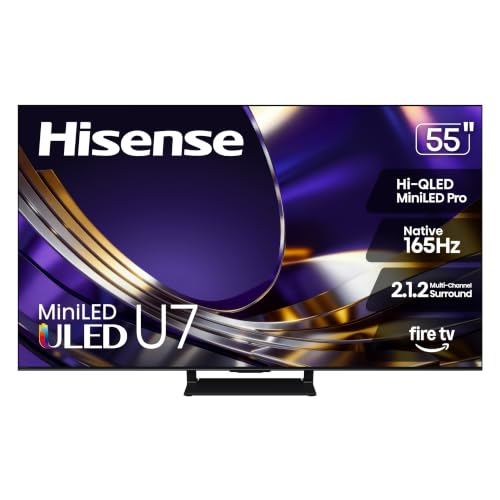
Hisense 55-inch U7 Mini-LED ULED 4K UHD Gaming Smart Fire TV (55U7SF, 2026) — The gaming-first 55
If the U8 is the flagship argument, the U7 is the gaming brief written without apology. Its verified title calls it a premium gaming HDR smart Fire TV, a 55-inch Mini-LED ULED 4K UHD set, 2026 new, with Hi-QLED, Native 165Hz, VRR 330, Dolby Vision IQ and Atmos, IMAX Enhanced, anti-reflection treatment and a multi-channel audio arrangement, with Alexa integration. Native 165Hz appears here too, stated in the title, so the guide can make the same unhedged statement for the U7 as for its sibling: this is a native high-refresh panel by its maker’s own printed claim, aimed at players first and at everyone else immediately afterward.
The differences from the U8 are of emphasis rather than of kind, and emphasis is a legitimate product strategy. Fire TV replaces Google TV, which moves the set into Amazon’s ecosystem and Alexa’s voice world — a platform decision households should make by their existing accounts, exactly as this site’s smaller guides argue. Anti-reflection treatment earns its mention for the rooms gaming actually happens in, where lamps, windows and the players’ own screens conspire against the picture. The VRR figure, quoted as the title states it, again describes the synchronisation window’s reach rather than the panel, and again the native claim beneath it is the load-bearing fact.
Two Hisense sets in one guide might look like duplication until the platform split is noticed: the maker is offering the same gaming hardware philosophy in the two big ecosystems, letting the household’s software allegiance choose between near-identical ambitions. That is consumer-friendly engineering, and the guide rewards it with both places.
Choose the U7 over the U8 if Fire TV and Alexa run your house, or if its gaming-first tuning and anti-reflection treatment match your room’s light. Choose the U8 for Google TV and its flagship trimmings. Either way, the native-rate sentence in the title is doing the same honest work, and players can buy on it.
The U7’s anti-reflection treatment deserves a second look from a specific household: the one whose gaming room is also the family room, with lamps behind the sofa and a window that cannot be curtained without a domestic treaty. Reflections are the silent tax on every panel statistic, because a screen showing the room cannot show the game, and a set that fights reflections with its surface rather than only with brightness preserves contrast where it is actually lost. Players choosing between the Hisense siblings on a spreadsheet of figures should add their room’s light map to the spreadsheet; it may be the deciding column.
- Size and class: 55-inch Mini-LED ULED, 4K UHD (2160p), per the verified listing title
- Refresh language: title states Native 165Hz, with a VRR figure quoted as stated
- Picture: Hi-QLED, Dolby Vision IQ, IMAX Enhanced, anti-reflection
- Platform and sound: Fire TV with Alexa integration; Dolby Atmos; multi-channel audio
Strengths
- Native high-refresh claim in the title, tuned gaming-first.
- Anti-reflection treatment suits lamplit, windowed gaming rooms.
- Fire TV edition of the maker’s big gaming philosophy.
Trade-offs
- Platform allegiance decides between it and its U8 sibling more than hardware does.
- 55 inches is a commitment in smaller rooms.
- Gaming-first tuning asks film-first buyers to confirm the balance suits them.
Best for: Alexa and Fire TV households with a serious gaming room. Not suited for: Google TV households — take the U8 — or compact postings.
Samsung 43-inch QN70H Neo QLED Mini-LED 4K — The prose-only caution
This pick is in the guide to teach its readers how to read, and it deserves a respectful hearing on those terms. The QN70H at 43 inches is a Neo QLED Mini-LED 4K smart television, 2026, whose verified title speaks of Samsung Vision AI, Quantum Mini-LED, full colour volume with Quantum Dot, an NQ4 AI processor, 4K upscaling and Alexa built in. That is a serious specification for a bright-room 4K set, and in this site’s neighbouring guide it earns a linked place on exactly those merits. What its title does not contain — search it as carefully as this guide did — is any statement of a native refresh rate. No native figure, no VRR figure, no motion claim at all.
The caution follows mechanically, and it is a caution about evidence rather than about the television. This guide does not call the QN70H a native 120Hz set, because the source it is permitted to use does not say so. The set may well carry gaming credentials in Samsung’s full specification; many Mini-LED sets in its position do. But a buyer choosing specifically for high-refresh gaming should take the refresh figure from Samsung’s own specification sheet for this exact model, confirm whether it describes a native rate or a processing figure, and only then weigh the set against the titled claims of the Hisense pair and the OLED line. That is not a dismissal. It is the same instruction this guide would give for any product whose headline claim arrives by rumour rather than by print.
On its stated merits, the QN70H remains attractive: Mini-LED brightness and colour volume for bright rooms, Samsung’s processing and platform polish, a 43-inch size that fits the postings the 55-inch pair cannot. A household whose diet is sport and film in a sunlit room, and whose gaming is casual, may rationally choose it over every set above. The guide’s only insistence is that the high-refresh box, if it matters to you, be ticked from the maker’s documents rather than from a guide’s goodwill — including this guide’s.
There is a fairness point in the Samsung’s favour that the caution should not bury. Samsung is hardly alone in letting refresh claims live in specification sheets rather than listing titles; the entire industry writes its shopfront language loosely, and this guide’s rule is deliberately stricter than the market’s custom. The QN70H is penalised here for the guide’s discipline, not for any established deficiency, and a buyer who performs the verification the review prescribes may find the set fully competitive. Rules that occasionally cost a good product its headline are still the right rules, because the alternative — certifying claims by reputation — is how buyers end up with processing figures where their native panels should be.
- Size and class: 43-inch class, Neo QLED Mini-LED, true 4K, per its listing title
- Refresh language: none stated in the title — no native rate is claimed here
- Processing: NQ4 AI processor, Samsung Vision AI, 4K upscaling
- Buying route: verify refresh specifications from the maker’s sheet; no link in this guide
Strengths
- Mini-LED brightness and colour volume for bright rooms at 43 inches.
- Samsung’s processing and ecosystem polish in the newest model year.
- A serious all-round 4K set for sport and film diets.
Trade-offs
- No native refresh figure in its title, so high-refresh buyers must verify elsewhere.
- Covered in prose here; gaming certification is the buyer’s own homework.
- Casual-gaming households will not miss what dedicated players require.
Best for: bright-room sport and film viewers who will verify refresh claims from the maker’s sheet. Not suited for: players who need a title-stated native rate from this guide.
One more distinction between the OLED and Mini-LED camps belongs in the record, because it decides real purchases and rarely appears in titles: viewing angle under speed. Fast content watched from a room’s edge — the second sofa, the kitchen doorway during a match — holds together differently across panel families, with OLED’s wide honest angles flattering the off-centre seats that shared rooms are full of. Mini-LED’s brightness counters by sheer presence. Groups should audition from the worst seat in the room rather than the best, a rule this batch of guides has applied at every size and which matters most exactly here, where the audience is largest and the action is fastest.
How do the six picks compare side by side?
| Pick | Size and panel | Refresh language — exactly as titled | Platform |
|---|---|---|---|
| LG C4 | 42-inch OLED | No figure in title; class gaming OLED | LG with Magic Remote |
| LG C5 | 42-inch OLED | No figure in title; processing-led generation | LG with Magic Remote |
| LG C6 | 42-inch OLED | 165Hz VRR stated in title | LG, 2026 generation |
| Hisense U8 | 55-inch Mini-LED | Native 165Hz stated in title | Google TV |
| Hisense U7 | 55-inch Mini-LED | Native 165Hz stated in title | Fire TV |
| Samsung QN70H | 43-inch Mini-LED | No refresh figure in title — verify | Samsung |
How do you set up a high-refresh TV for games and sport?
Begin with the cable and the port, because high-refresh gaming is a chain and the chain breaks at its oldest link. Use the cable supplied with the console or a certified equivalent, connect to the port the set designates for its full gaming features — sets differ in which sockets carry the complete specification — and then, in the set’s menus, find the game mode and enable it for that input. Game mode is not a picture preset to admire; it is the switch that strips processing delay out of the path between your hands and the panel, and playing without it on a fast panel is buying a racing bicycle and riding it with the brakes on.
Enable variable refresh in both the console’s settings and the set’s, since the handshake requires both ends to agree, and confirm the arrangement with the fastest game you own rather than with a menu screen. For sport, take the opposite path through the same menus: motion processing that players disable can genuinely help broadcast’s lower frame rates look composed, and many sets let you keep separate picture settings per input, so the console’s socket can stay raw while the broadcast socket stays smoothed. Finally, sit at the distance the size deserves — close enough that the 2160p canvas resolves, far enough that your eyes take in the whole pitch or arena — and set the room’s light for the panel you bought: dim for OLED’s strengths, free for Mini-LED’s.
Finally, a word about the viewing distance at which this entire class justifies itself, because it is nearer than living-room tradition assumes. High refresh and 2160p resolution are close-range virtues: they reward the desk chair, the front sofa, the gaming chair pulled toward the screen for a final. A household that watches everything from across a long room will receive a smaller share of what these panels offer, and should weight brightness, size and sound more heavily than refresh in its decision. The guide’s picks are ordered by claim and by room rather than by a single ladder for exactly this reason — the best set in this list is the one whose virtues your chair can actually reach.
That distance principle has a cheerful corollary for the compact OLEDs. A player who sits near enough to read a game’s smallest interface text is sitting exactly where the panel’s speed and resolution compound, which is why desk players describe these sets with a loyalty that puzzles their living-room friends. The friends are not wrong about their rooms, and the players are not exaggerating about theirs; they are reporting from different distances, and distance, in this class more than any other in the batch, is destiny.
What mistakes do high-refresh TV buyers keep making?
The first is reading any large hertz number as a native rate. VRR ceilings, processing brands and native panels all wear the same unit, and this guide’s comparison table exists to keep them separated; carry that separation into every listing you read after this one. The second is buying the panel and starving the chain: an elderly cable, the wrong port, a console setting left at its default can each quietly cap the experience the set was bought for, and the setup section above is the antidote. Third, players leave game mode off or motion processing on for games, inverting the two settings that matter most, because nobody told them the menus were the product.
Fourth, buyers choose size by ambition rather than by room, putting a 55-inch set at a distance where its pixel structure and its brightness both become arguments, or squeezing the compact OLED into a bright barn of a room and blaming the technology. Fifth, and most avoidable: buyers assume a respected badge certifies the specific claim they care about. The prose pick in this guide is a respected badge attached to an unstated figure, and the discipline of checking the maker’s sheet for the exact model is the difference between a gaming television and a television that games happen on.
A note on households where the player is not the purchaser — the parent buying for a teenager, the partner furnishing a shared room — because this class generates more mismatched purchases than any other in the batch. The player’s vocabulary will be frame rates and response, the purchaser’s will be size and sense, and both are half right. The reconciliation this guide offers is its structure: let the player verify the refresh claim in the title’s own words, and let the purchaser verify the room — distance, light, the furniture’s honest dimensions. A set that passes both verifications will not be argued about in month three, which is the true definition of a successful family purchase in this category.
Resale and hand-me-down value close the economic survey with a point in the class’s favour. High-refresh 4K panels are the specification the second-hand market asks for by name, because gamers shop used equipment with a checklist and this class is the checklist. A set bought on a stated native claim documents itself to its next owner in a way a processing-branded set cannot, and households that rotate equipment through children, rentals and second rooms will find these televisions unusually liquid citizens of the household fleet. Buy the claim in print and the set keeps its story; buy the claim by rumour and the story dies with the listing page.
Final Recommendation
Choose by the claim you can read and the room you actually have. For a desk or a compact gaming room, the LG line is the guide’s heartland: the C4 as the settled founding set, the C5 for the player who also lives for film, and the C6 when the current generation’s stated VRR headroom and brightness work match your hardware’s ambitions. For a bright, shared room where games and sport fill a wall, the Hisense pair state their native rates in plain print — the U8 for Google households, the U7 for Fire TV ones — and plain print is what this guide trusts most. The Samsung QN70H remains a fine bright-room 4K television for the viewer who will do the refresh homework from the maker’s own sheet, and it stays in prose as a standing reminder of why the homework matters. High refresh is a promise about time, and promises should be read in the wording they were made in; buy the set whose wording you have actually read, and the games will feel like the future the box described.
Frequently Asked Questions
Is 2160p the same as 4K?
Yes, in consumer terms: 2160 is the vertical pixel count of the 3840 by 2160 resolution the industry markets as 4K and UHD. The keyword’s phrasing simply names the resolution by its height, as broadcast standards do. Every set in this guide is a 2160p set, including the prose pick.
What is the difference between a native rate and a VRR figure?
A native rate is the panel hardware’s own refresh speed. A VRR figure describes the variable-refresh window within which the set can synchronise its display to a game’s fluctuating output. Both matter to players, they are not the same number, and this guide quotes each only in the terms its listing title uses.
Do I need high refresh for watching sport?
It helps, through motion legibility rather than through the broadcast’s own frame rate. Fast action stays composed on a high-refresh panel with appropriate processing, and the benefit is visible from an ordinary sofa. Players need the feature more urgently than spectators, but spectators are not imagining the difference.
Why is the Samsung only covered in prose?
Because its listing title states no refresh figure, and this guide claims native rates only from titles. The QN70H is treated as what its title supports — a serious Mini-LED 4K set — and high-refresh buyers are directed to Samsung’s specification sheet for the exact model before weighing it against the titled claims elsewhere in the guide.
Which size suits a gaming desk?
The 42-inch OLEDs, by design. They sit at desk distance without overwhelming it, double as evening televisions, and carry the contrast and responsiveness desk players prize. The 55-inch Hisense sets belong across a room, where their brightness and scale serve groups rather than a single chair.
Will these sets make older consoles or broadcasts look worse?
No — upscaling quality is where the current processors earn their keep, and the LG and Hisense picks here all advertise their upscaling programmes in their titles. Older material will not gain detail it never had, but it will be presented cleanly, and high refresh does not penalise low-rate sources when the set’s per-input settings are arranged sensibly.
How long will a high-refresh set stay current?
Longer than most technology, because the class’s two halves age slowly: 2160p is the settled broadcast and mastering canvas for the foreseeable cycle, and high native refresh with variable sync is the gaming standard consoles and PCs are built around. A set bought on a stated native claim today is aligned with the direction of both industries, which is the practical definition of future-proofing that survives contact with reality.
Does high refresh increase input lag concerns?
The opposite, when the set is configured correctly. High refresh shortens the time between the game’s frame and its display, and game mode removes the processing that adds delay. Lag complaints on fast panels almost always trace to settings — a missed game mode, a processing feature left engaged — rather than to the panel, which is why this guide’s setup section treats the menus as part of the product.
Related Guides
Continue with Best 10.1 Inch Tablets for Movies, Reading and Everyday Apps, Best 10.5 Inch Tablets: The In-Between Size That Still Works and Best 11 Inch Tablets for Work, Play and Everything Between.


