What's inside
- Key Takeaways
- Quick Picks
- How We Chose These Picks
- Which of the Best 10 Headsets Actually Fits the Way You Play and Work?
- Ten Slots, Six Headsets: Where the Other Four Usually Go
- What Should You Check Before Any Headset Joins Your Desk?
- How Do You Test a New Headset in Its First Week?
- Why Does Fit Matter More Than Any Number on the Box?
- How Do the Connection Standards Here Change Daily Life?
- Which Buying Mistakes Put Good Headsets in the Return Box?
- What Does a Sound Signature Mean When You Switch Between Games, Music, and Calls?
- How Should You Look After a Headset So It Earns Its Keep for Years?
- Final Recommendation
- Which of These Six Matches the Reader You Actually Are?
- Frequently Asked Questions
- Related Guides
As an Amazon Associate I earn from qualifying purchases. This post may contain affiliate links at no extra cost to you.
widgetverdict.com is reader-supported. When you buy through links on our site, we may earn an affiliate commission.
Any honest list of the best 10 headsets has to start with an admission: ten is the shape of the search, not the shape of the market. Shoppers type “best 10 headsets” because they want a shortlist that feels complete, yet the headsets actually worth your money cluster into a handful of designs that keep proving themselves across desks, couches, and call queues. So this guide does something more useful than padding a list to a round number. It takes the six headsets that would survive any serious top-ten conversation, examines each one in depth, and explains plainly where the other four slots in a typical top ten usually go — to near-duplicates, regional variants, and last year’s model wearing a new colour. You get the depth that matters instead of four extra names you would forget by checkout.
The six below were not chosen for novelty. A headset earns its place here by doing the unglamorous things well: staying comfortable through a third hour, keeping your voice intelligible when a fan is running, connecting to the machines you actually own, and surviving the small abuses of daily life — the dropped controller-side yank, the bag stuffed under an airline seat, the cable caught in a chair wheel. Sound quality matters, of course, and each pick is assessed on how it renders games, music, and voices. But a headset is a tool you wear, and tools are judged by the whole shift, not the first five minutes.
One more thing before the picks: this guide mixes wired and wireless, gaming-first and work-first designs on purpose. The best headset for a competitive player chasing footsteps is not the best headset for a support lead who lives on calls, and pretending otherwise produces the bland, interchangeable lists that made you search twice. Read the verdict lines. They are written to rule picks out as firmly as they rule them in, because a shortlist only helps if it actually shortens.
Key Takeaways
- The HyperX Cloud III is the default recommendation for most people: wired, forgiving, comfortable for hours, and free of battery anxiety entirely.
- Wireless freedom splits into two philosophies here — the Razer BlackShark V2 Pro tunes itself for competitive play, while the SteelSeries Arctis Nova 7 Gen 2 chases flexibility across PC, console, and phone.
- Microphone quality is the real dividing line in this group; the Corsair HS80 Max and Logitech G Pro X 2 treat your voice as a broadcast, the others treat it as a utility.
- The Jabra Evolve2 65 is the reminder that “headset” also means work: it is the only pick here designed around calls first and everything else second.
- Comfort over three hours separates this six from the wider market more reliably than driver size, surround branding, or any single specification.
Quick Picks
| Pick | Badge | Why it is here |
|---|---|---|
| HyperX Cloud III | The default answer | Wired reliability, plush memory foam, and a detachable mic make it the headset we hand to anyone who asks without a follow-up question. |
| Razer BlackShark V2 Pro | Competitive wireless | Low-latency wireless, FPS-tuned sound profiles, and a mic built for callouts under pressure. |
| SteelSeries Arctis Nova 7 Gen 2 | Multi-device all-rounder | Simultaneous connections and a retractable mic suit households where one headset serves PC, console, and phone. |
| Logitech G Pro X 2 Lightspeed | Graphene-driver flagship feel | A 50mm graphene driver, three connection modes, and a studio-leaning mic for players who also stream. |
| Corsair HS80 Max | Voice-first wireless | Its broadcast-grade microphone and Dolby Atmos support make it the pick for people who talk as much as they listen. |
| Jabra Evolve2 65 | The work headset | Call clarity, a busy-light, and all-day wearability designed for people whose headset is office equipment. |
How We Chose These Picks
A top-ten search usually hides a top-three reality: most buyers need one of a few archetypes. We started by mapping those archetypes — the wired all-rounder, the competitive wireless, the multi-device wireless, the premium all-purpose flagship, the voice-led streamer set, and the professional call headset — then asked which single model defends each archetype best against everything else on sale. A model that lost its archetype duel was cut, however impressive its spec sheet looked in isolation. That is why you will not find three near-identical wired sets here: the Cloud III won that duel, and runners-up would have been padding dressed as thoroughness.
Comfort testing in our assessment means duration, not first impressions. Nearly every headset feels fine for twenty minutes. The ones that fail do so at hour two, when clamp force concentrates on the jaw, when earcup heat builds, when a headband’s weight settles onto one spot. We weighted designs with proven long-session records — deep memory foam, sensible weight distribution, earcups that seal without squeezing — and treated one-size marketing claims about “all-day comfort” with suspicion unless the physical design backed them up.
Microphones were judged as recording devices, not accessories. In game chat a mediocre mic costs your team information; on a work call it costs you authority. We favoured headsets whose microphones reject room noise, keep plosives under control, and stay intelligible at natural speaking volume rather than rewarding people who shout. Detachable and retractable designs scored well because a headset whose mic disappears becomes a headphone you can wear on a train without looking like air traffic control.
Durability was assessed by construction rather than by warranty paperwork. Aluminium yokes, replaceable cushions, detachable cables and booms, and hinges that move without creaking all predict a longer service life than sealed, glued designs with exotic finishes. A headset worn daily accumulates thousands of small stresses — taken off one-handed, hung on monitor corners, dropped from desk height — and the models that survive those years are the ones whose designers assumed the abuse in advance. Every pick here passed that construction review, though they pass it in different materials and at different weights.
Finally, we priced nothing and promised nothing about deals.
Headset pricing moves too often for a guide to quote figures responsibly, so each pick is positioned by tier and intent instead: what kind of buyer it serves, what it asks you to give up, and what you gain in return. Where a pick’s appeal depends on checking the current street position against its rivals, the verdict says so and points you to check price on Amazon rather than anchoring you to a number that may be stale by the time you read it.
Which of the Best 10 Headsets Actually Fits the Way You Play and Work?

HyperX Cloud III — The default answer
The Cloud III is what happens when a company refines one idea for a decade instead of reinventing it every year. HyperX’s wired flagship keeps the formula that made the line famous — plush memory foam, a sturdy frame, a detachable microphone — and polishes the parts that used to draw complaints. The result is a headset with no headline gimmick and almost no weaknesses, which is exactly why it leads this guide. If a friend asked for one headset, for everything, with no follow-up questions allowed, this is the box we would hand over.
Sound comes from angled 53mm drivers tuned with a warmth that flatters long sessions. Bass has weight without swamping midrange detail, so explosions feel physical while dialogue stays forward and clear. In competitive titles the tuning is honest rather than exaggerated: footsteps and reload cues sit where they should, neither artificially sharpened nor buried. It will not out-resolve the graphene drivers in the G Pro X 2 below, and it makes no attempt to. What it offers instead is a presentation you can listen to for five hours without fatigue, which is a rarer achievement than a spectacular first track.
The microphone deserves specific praise because wired headsets at sensible tiers so often treat it as an afterthought. The Cloud III’s detachable boom is a 10mm condenser design with a clear, natural capture and an LED mute indicator you can confirm at a glance. Teammates hear a person, not a person-through-a-headset. When you do not need it, the boom comes off and the headset becomes presentable headphones for a commute or a coffee shop — a small thing that doubles the hours this product spends in your life.
Connection is admirably unfussy: USB-C, USB-A, and a 3.5mm plug are all covered, so PC, PlayStation, Xbox controllers, Switch, and phones with jacks are all one cable away. There is no battery to manage, no firmware dance, no wireless dropout at the worst possible moment. The trade is literal tethering, and after a week some people cannot go back to a cable. That is a preference, not a flaw, and the picks below exist for those people. For everyone else, wired simplicity at this quality level is the rational centre of the headset market.
- Drivers: angled 53mm dynamic drivers
- Connection: wired over USB-C, USB-A, or 3.5mm
- Microphone: detachable 10mm condenser boom with LED mute light
- Cushions: memory foam earcups and headband
- Frame: aluminium-reinforced build with a flexible headband
Strengths
- Comfort that holds up deep into long sessions, not just the first hour
- Clear, natural microphone that detaches for headphone duty
- Works with essentially every device that has a port, no battery involved
Trade-offs
- The cable is a permanent companion; desk cable management becomes your problem
- No wireless, Bluetooth, or active noise cancelling at any setting
- Sound tuning favours smoothness over the last degree of competitive edge
Best for: players and workers who want one wired headset that simply works everywhere, every day.
Not suited for: anyone who stands up, paces, or grabs drinks mid-session and refuses to be tethered.

Razer BlackShark V2 Pro — Competitive wireless
Razer’s BlackShark line began as an aviation-styled experiment and matured into the headset competitive players reach for when the match matters. The V2 Pro takes that formula wireless with Razer’s low-latency HyperSpeed connection, and the design brief shows in every decision: weight kept down, clamp tuned to stay put during fast mouse work, and sound profiles built with professional FPS players rather than marketing abstractions. This is the specialist in the group — superb inside its discipline, deliberately uninterested outside it.
The TriForce titanium-coated 50mm drivers deliver a presentation with crisp separation, and the factory FPS profiles genuinely change how information reaches you: footsteps step forward, ambient wash steps back. In tactical shooters that emphasis is a real advantage, not a placebo, because the sounds that decide rounds occupy the frequencies the tuning privileges. Switch to music and the same tuning can feel lean in the low end until you adjust the EQ, which is the honest cost of a headset voiced for competition first. Razer’s software gives you the tools to correct it; it just does not pretend the default is a hi-fi curve.
Its detachable HyperClear microphone is the strongest in this six for pure callout duty — a wideband capture that keeps consonants intact when you are speaking quickly and quietly, which is precisely when callouts matter. Battery endurance stretches across many days of play between charges, so the wireless penalty competitive players fear — a dying headset in a decider — rarely materialises. The earcups use a hybrid of fabric and leatherette that breathes better than full leatherette during summer sessions, a detail anyone who has peeled off a sweaty headset will appreciate.
What the BlackShark does not do is versatility theatre. There is no simultaneous phone connection for casual media multitasking on the level of the Arctis below, and its aesthetic — angular, gamer-forward — looks out of place on a client call. Buy it for the arena and it rewards you every match. Buy it as a general-purpose headset and you will spend months noticing the things it declined to be.
- Drivers: 50mm TriForce titanium-coated drivers
- Connection: 2.4GHz HyperSpeed wireless, with Bluetooth and wired fallback
- Battery: rated around 70 hours per charge
- Microphone: detachable wideband boom for voice comms
- Tuning: onboard FPS audio profiles shaped with pro players
Strengths
- Sound staging that surfaces footsteps and cues competitive players act on
- Excellent callout microphone that stays clear at low speaking volume
- Multi-day battery life removes the usual wireless anxiety
Trade-offs
- Default tuning sounds lean for music until you spend time in EQ
- Gamer styling reads awkwardly in professional video calls
- Fewer creature comforts for mixed media use than the Arctis Nova 7
Best for: ranked and tournament-minded players who want wireless without giving up audio information.
Not suited for: anyone whose headset must look at home in the boardroom as much as the lobby.
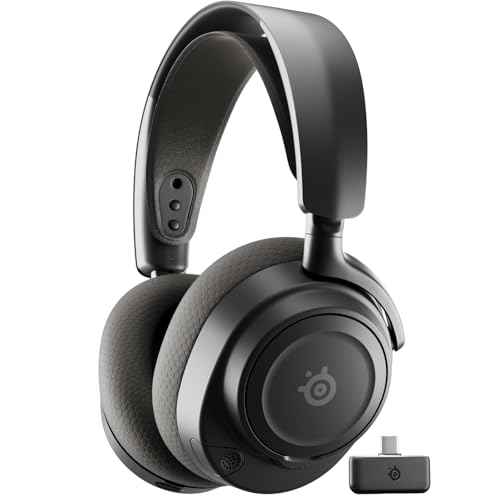
SteelSeries Arctis Nova 7 Gen 2 — Multi-device all-rounder
The Arctis Nova 7 Gen 2 answers a question the other picks mostly ignore: what if one headset has to serve a gaming PC, a PlayStation in the lounge, and a phone, sometimes within the same hour? SteelSeries built this generation around simultaneous connection — a 2.4GHz link to your main machine and Bluetooth to a second device at once — so a game session can absorb a phone call or a podcast without a cable swap or a settings dive. In shared households and hybrid work setups, that convenience stops being a bullet point and becomes the reason the headset gets worn ten hours a day.
Sound is handled by 40mm neodymium drivers with a balanced, slightly relaxed signature. It lacks the BlackShark’s aggressive competitive edge and the Cloud III’s warmth, landing instead in a middle register that flatters everything adequately: games sound spacious, music sounds pleasant, voices sound natural. Real-time control through the SteelSeries app lets you adjust EQ from your phone mid-session, which sounds like a gimmick until the first time you fix a muffled cutscene without alt-tabbing. Spatial audio support rounds out a package aimed at breadth rather than a single peak.
The microphone retracts fully into the left earcup, and that one design choice changes how the headset lives outside gaming. Retracted, it is a clean pair of over-ears you can wear on a train; extended, the ClearCast boom delivers solid, noise-aware voice capture for chat and calls. It is not the broadcast instrument the Corsair below carries, and in a loud room the Corsair’s owner will sound better. But for the ordinary mix of Discord, meetings, and phone calls, it is comfortably past the threshold of “nobody asks you to repeat yourself.”
Endurance is rated beyond 50 hours, and fast charging returns hours of play from a short plug-in, which suits the headset’s role as shared infrastructure. The ski-goggle headband distributes weight in a way glasses wearers tend to praise, and the earcups’ fabric finish runs cooler than leatherette. If your life is one machine and one game, the specialists above and below beat it at their specialties. If your life is three machines and everything, this is the pick that respects that reality.
- Drivers: 40mm neodymium drivers
- Connection: 2.4GHz wireless and Bluetooth, usable simultaneously
- Battery: 50+ hours rated, with fast-charge top-ups
- Microphone: retractable ClearCast boom, hidden when not in use
- Control: real-time EQ and settings through the companion app
Strengths
- Two devices at once — game audio and phone — without swapping anything
- Retractable mic makes it credible as everyday headphones in public
- Comfortable suspension headband that glasses wearers tolerate well
Trade-offs
- Sound is good everywhere and class-leading nowhere
- Microphone trails the Corsair and Razer for noisy rooms
- App-based control means some tweaks live on your phone, not the headset
Best for: multi-device households and hybrid workers who game on the same headset they take calls on.
Not suited for: single-game specialists who want a headset tuned ruthlessly for one title.

Logitech G Pro X 2 Lightspeed — Graphene-driver flagship feel
Logitech’s Pro X 2 is built around a single technical claim that turns out to be more than marketing: its 50mm drivers use graphene diaphragms, a material stiff and light enough to reduce the distortion that creeps into ordinary drivers at high output. You hear the benefit as cleanliness — dense game scenes stay separated instead of smearing, quiet details survive loud moments, and music holds together at volumes where lesser headsets start to shout. It is the most resolving sound in this six, and listeners who notice such things will notice it within a track or two.
Connection flexibility matches the ambition: Lightspeed wireless over USB, Bluetooth, and a 3.5mm wired mode cover desks, couches, and travel without adapters or compromise modes. The headset is light for its capability, with rotating earcups that lie flat and a choice of leatherette and velour cushions in the box, so you can tune the seal-versus-breathability balance to your own head and climate. Battery life stretches across long weeks of evening play, removing charging from your routine almost entirely.
The detachable microphone carries Logitech’s Blue Vo!ce processing heritage, giving streamers and meeting-heavy users filters and tuning that lift a voice toward broadcast polish. It asks a little more setup than a plug-and-play boom — the best results come from spending ten minutes in the software — but the ceiling is high, and for anyone whose voice is part of their work or their channel, that ceiling matters. In raw, unprocessed form it is good; processed, it embarrasses headsets that cost attention elsewhere.
Where does it lose ground? The tuning out of the box leans analytical, and players raised on bass-heavy headsets may find their first session strangely restrained until ears adjust or EQ intervenes. The price tier it inhabits — check price on Amazon, because it moves — also invites comparison against dedicated audiophile headphones plus a separate mic, a rig that beats it for pure music. As a single wearable that does everything at a high level, though, the Pro X 2 is the connoisseur’s entry in this guide.
- Drivers: 50mm graphene PRO-G drivers
- Connection: Lightspeed wireless, Bluetooth, and 3.5mm wired
- Cushions: leatherette and velour sets both included
- Microphone: detachable 6mm boom with Blue Vo!ce processing
- Design: rotating earcups that fold flat for travel
Strengths
- Cleanest, most detailed sound of the six picks
- Three connection modes with no meaningful quality drop between them
- Two cushion materials in the box let you tune comfort yourself
Trade-offs
- Analytical default tuning can feel bass-shy at first listen
- Best microphone results require time in the companion software
- Sits in a tier where separate headphone-plus-mic rigs compete for music
Best for: discerning listeners who game, stream, and take meetings on one premium headset.
Not suited for: bass-first listeners who want impact to arrive without touching an equaliser.

Corsair HS80 Max — Voice-first wireless
Most headsets are speakers with a microphone attached. The HS80 Max reads like the reverse: a broadcast microphone with very good speakers attached. Corsair built its reputation in this line on the HS80’s microphone, widely treated as the benchmark other headset mics are measured against, and the Max carries that torch into a wireless design with Dolby Atmos spatial audio. If your sessions involve being heard — streaming, coaching, leading a raid, running a meeting — the order of priorities in this design will feel immediately correct.
The microphone captures with a fullness and noise rejection that flatters untrained voices. It keeps the proximity warmth of a desk mic while refusing most of the room: keyboard clatter, a fan, a television through a wall all fade behind your speech. Flip-to-mute is implemented the way it should be, a physical motion with a definite result, so you never perform the “am I muted?” ritual mid-sentence. Streamers who have priced a separate microphone, arm, and interface will recognise what is being saved here.
As headphones, the HS80 Max is no consolation prize. Its drivers deliver a rich, cinematic presentation, and Dolby Atmos gives supported games and films a convincing sense of space that plain stereo cannot fake. Memory foam cushions and a floating headband keep it wearable through long sessions, though the fit runs snugger than the Cloud III’s relaxed clamp — larger heads should expect a firmer embrace, at least in the first weeks before the band relaxes.
The compromises are about reach. Its wireless life is centred on PC and PlayStation via the dongle, with Bluetooth alongside, but Xbox players are outside the fence, and the headset’s size makes it a stay-at-home object rather than a travel companion. None of that dents its core proposition. In a group of six strong all-rounders, this is the one whose microphone alone justifies its existence.
- Drivers: 50mm drivers with Dolby Atmos spatial audio
- Connection: 2.4GHz wireless dongle plus Bluetooth
- Microphone: broadcast-grade boom with flip-to-mute
- Fit: memory foam cushions with a floating headband strap
- Platforms: PC and PlayStation at the centre of its world
Strengths
- The best voice capture in this guide, full stop
- Dolby Atmos gives games and films real spatial depth
- Flip-to-mute removes all doubt about whether you are live
Trade-offs
- No Xbox wireless support shuts out a large audience
- Snug clamp will not suit every head shape immediately
- Bulky build stays home; it is not a travel headset
Best for: streamers, coaches, and meeting leaders whose voice carries their work.
Not suited for: Xbox-first players or anyone needing a headset that travels light.
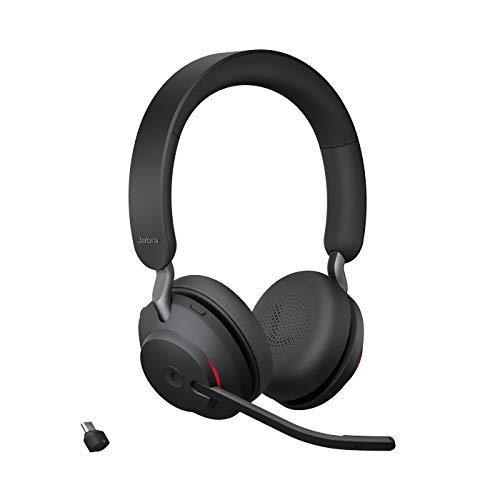
Jabra Evolve2 65 — The work headset
Gaming headsets that tolerate work calls fill the five sections above; the Evolve2 65 reverses the arrangement entirely. It is a professional communications tool that happens to play music pleasantly. Jabra’s business line lives or dies on call quality in imperfect rooms, and this stereo on-ear design brings that discipline to the list. Three microphones work together to isolate your voice, a busylight on the earcup tells the household you are on a call, and the whole thing is certified for the meeting platforms offices actually run. It is the only pick here your IT department would buy you.
Call quality is where the gap shows. Your voice arrives focused and forward, with background speech and room echo pushed down in a way gaming microphones rarely manage, because Jabra tunes for the listener’s comprehension rather than the speaker’s excitement. The on-ear format is a deliberate choice, not a compromise: you hear your own environment at a natural level, which keeps long call days from feeling like sensory deprivation, and the light clamp suits glasses and frequent on-off use through a working day.
As a music device it is respectable rather than thrilling. The 40mm drivers produce a clean, voice-forward presentation that handles podcasts, acoustic sets, and background playlists happily, and sounds underpowered only when a game or a bass-heavy track demands physical low end it was never built to deliver. Battery endurance covers a full working week of calls between charges, and the headset connects to a computer through its USB adapter and a phone over Bluetooth at the same time, which is the actual topology of a modern desk.
Including a work headset in a gaming-flavoured top ten is a statement about how headsets are really used in 2026: the same head wears one device from the morning standup to the evening match. The Evolve2 65 wins the first half of that day outright and survives the second half politely. If your ratio runs the other way, the five picks above serve you better; if calls pay for the games, start here.
- Drivers: 40mm drivers in an on-ear stereo design
- Microphones: three-mic array tuned for speech isolation
- Connection: USB adapter for PC plus Bluetooth for a phone, together
- Signal: integrated busylight that shows when you are on a call
- Battery: rated for a full working week of typical call use
Strengths
- Call clarity that gaming headsets do not match
- On-ear lightness suits eight-hour wear and glasses
- Busylight quietly solves the household interruption problem
Trade-offs
- Low-end weight for games and bass-heavy music is modest
- On-ear seal leaks sound both ways compared with over-ear cups
- No gaming surround processing or competitive tuning
Best for: remote professionals whose day is calls, with entertainment fitted around them.
Not suited for: players who want immersion and bass impact as the first priority.
Ten Slots, Six Headsets: Where the Other Four Usually Go
| Headset | Connection | Microphone style | Defining strength |
|---|---|---|---|
| HyperX Cloud III | Wired USB / 3.5mm | Detachable boom | Comfort and simplicity |
| Razer BlackShark V2 Pro | 2.4GHz wireless | Detachable wideband boom | Competitive tuning |
| SteelSeries Arctis Nova 7 Gen 2 | 2.4GHz + Bluetooth together | Retractable boom | Multi-device life |
| Logitech G Pro X 2 | Wireless / Bluetooth / wired | Detachable boom, processed | Driver clarity |
| Corsair HS80 Max | 2.4GHz + Bluetooth | Fixed broadcast boom | Voice quality |
| Jabra Evolve2 65 | USB adapter + Bluetooth | Built-in mic array | Call professionalism |
So where do slots seven to ten go in the longer lists you will find elsewhere? Usually to the runners-up of the duels described above: the previous generation of a winning line, a regional variant with a different dongle, a wired twin of a wireless pick, or a perfectly decent headset whose one distinction is a colour. None of those are bad products. They are simply not decisions — nobody’s outcome changes because the eighth-best headset was named. What changes outcomes is understanding the six archetypes above and knowing which one your days actually resemble.
Read the comparison through that lens. Connection tells you how the headset fits your rooms: wired for a fixed desk, dual wireless for a life split across machines. Microphone style tells you how it fits your hours: detachable and retractable booms disappear for travel and media, the Corsair’s fixed boom declares that voice is the job. The defining-strength column is the honest summary of each duel — if two rows both appeal, the tiebreaker is the trade-off list in their detailed sections, not another specification.
Notice, too, what the table cannot show: fit. Head shape, glasses, hair, and climate move comfort more than any driver specification moves sound, and every pick here has a devoted camp and a minority who found it wrong. That is normal, and it is why the buying guidance below spends so much time on wear rather than watts.
What Should You Check Before Any Headset Joins Your Desk?
Start with your platform list, written down, not assumed. A headset that is flawless on PC may offer Xbox only a wired controller connection or nothing at all, and PlayStation handles some USB devices differently from Windows. Every pick in this guide states its platform centre honestly; match that centre to the machine you use most, not the machine you might buy next year. Connection regrets are the most common reason good headsets get returned, and they are entirely preventable in five minutes of checking.
Next, decide how you feel about batteries with unusual honesty. Wireless freedom is real, and so is the small administrative burden that comes with it: charging habits, dongle management, the occasional firmware update. Some people find that burden trivial; others discover, three dead-headset evenings in a row, that they are wired people at heart. Neither answer is wrong, but buying against your own temperament guarantees dissatisfaction with an otherwise excellent product. The Cloud III exists in this guide as the standing reminder that a cable is also a feature: infinite endurance, zero latency, nothing to pair.
Then think about where your voice goes. If nobody hears you but friends in casual chat, any microphone in this six clears the bar. If your voice earns money, leads teams, or fronts a channel, microphone quality stops being a detail and becomes the purchase — which is why the HS80 Max and the Evolve2 65, from opposite ends of the market, both earn places here. Buy for the most demanding listener in your life, not the average one.
How Do You Test a New Headset in Its First Week?
Wear it for one genuinely long session before judging comfort — a full film, a full workday, a full evening of games. Note where pressure appears and when. Most headsets that fail, fail at a predictable point: the crown of the head under a thin band, the jaw under a firm clamp, the ears inside shallow cups. If discomfort grows steadily rather than settling, it rarely improves with time; exchange the headset while the return window is generous instead of hoping your head will adapt to it.
Record your own voice. Every phone has a voice recorder; thirty seconds of reading aloud, played back, tells you more about your microphone than any review, because it is your voice, your room, your speaking volume. Record once in quiet and once with a fan or television running. If the noisy recording stays intelligible without you raising your voice, your listeners are well served. If not, adjust boom position before blaming the hardware — an inch of distance from your mouth changes everything a microphone captures.
Also test the headset against the content you actually consume, not demo material chosen to flatter it. Play your most familiar game, your most-played album, and your longest regular call. Familiar material exposes changes instantly: a voice you know well sounds wrong through a bad microphone chain, a map you know by heart reveals whether positional cues land where your instincts expect them. Unfamiliar demo tracks make every headset sound impressive, which is precisely why shops use them.
Test the failure modes, too. Let the battery run low and learn what the warning sounds like. Walk to the edge of wireless range so you know where dropout lives in your home. Mute and unmute until the motion is muscle memory. A headset you have rehearsed with behaves predictably under pressure; a headset you have only enjoyed in calm conditions will surprise you during the one match or meeting where a surprise costs something.
Why Does Fit Matter More Than Any Number on the Box?
Headsets are the only audio product you wear like clothing, and they fail like clothing fails: not in the shop, but in the third hour. Clamp force is the first variable. Too little and the seal breaks every time you turn your head, leaking bass and letting the cups wander; too much and the pressure concentrates on the jaw hinge, producing the particular headache every long-session player knows. The picks in this guide sit in the workable middle, but they sit there differently — the Cloud III’s relaxed grip suits long, still sessions at a desk, the BlackShark’s firmer hold suits players who move, and the Evolve2 65’s on-ear design sidesteps the question by resting on the ear rather than around it.
Earcup geometry is the second variable, and it is personal in a way no review can fully settle. Ears differ in size and angle; cups that swallow one person’s ears whole will fold another’s. Depth matters as much as diameter, because an ear pressed against a driver housing announces itself within the hour. Memory foam helps by distributing contact, and it is no accident that most of this six uses it — but foam also ages, softening over a year or two until the seal and the comfort both drift. Replaceable cushions, offered across most of these designs, are the difference between a headset that ages gracefully and one that gets retired for a ten-dollar part.
Heat is the third variable, and the one buyers in warm climates learn to respect first. Leatherette seals beautifully and breathes badly; fabric breathes and leaks a little sound. The BlackShark’s hybrid cups and the Arctis’s fabric finish are deliberate answers to summer, while the Pro X 2’s inclusion of both cushion types in the box is the most honest answer of all: it admits the right choice depends on your room, your season, and your skin. If you have ever ended a session with damp ears, weight breathability as heavily as any sound signature.
Glasses wearers face a fourth variable that marketing rarely mentions: temple arms break earcup seals and create pressure points where the frame meets the cushion. Suspension headbands and softer foams forgive frames; stiff, shallow cups punish them. The Arctis’s ski-goggle strap and the Cloud III’s deep foam earn their reputations among glasses wearers honestly. Whatever you buy, test it wearing your actual glasses, in your actual chair, for longer than feels reasonable in a shop. Fit is not a specification. It is a relationship between one product and one head, and the first week is your only cheap chance to learn whether the relationship works.
How Do the Connection Standards Here Change Daily Life?
Three connection philosophies compete in this guide, and the differences show up in small daily frictions rather than in sound quality. The wired philosophy, represented by the Cloud III, offers perfect reliability at the cost of a physical tether. Its hidden advantage is universality: a 3.5mm plug works in a controller, a laptop, an airline seat, and a decade-old phone with equal indifference, and USB modes add microphone and feature support on computers. A wired headset bought today will still connect to whatever you own in five years, which cannot be said of any wireless standard yet invented.
The dedicated-wireless philosophy — 2.4GHz through a USB dongle — trades that universality for latency low enough that competitive players stopped worrying about it years ago. The BlackShark, HS80 Max, and the Arctis’s main link all live here. The dongle is the philosophy’s tax: it occupies a port, it can be lost, and it ties the headset to machines with the right socket. In exchange you get connection stability that Bluetooth still cannot promise in a crowded radio environment, plus the freedom to stand, stretch, and fetch coffee without your game’s audio dying at the doorway.
Bluetooth, the third philosophy, is the great connector and the weak games link. It joins phones, tablets, laptops, and televisions without any dongle at all, and for calls, music, and video it is entirely sufficient. Its latency, however, still trails dedicated links enough that fast games feel subtly detached, which is why the strongest designs in this guide — the Arctis Nova 7 and the Pro X 2 — treat Bluetooth as a second channel alongside a proper gaming link rather than a replacement for one. The Evolve2 65 is the exception that proves the rule: its world is calls, where Bluetooth’s convenience outweighs its latency completely.
Choosing between these philosophies is really choosing which friction you prefer to live with: a cable’s constant presence, a dongle’s small administration, or Bluetooth’s latency ceiling. There is no wrong answer, only an unexamined one. The readers who love their headsets a year later are the ones who picked their friction deliberately, and this guide’s six picks were selected so that every philosophy has a genuinely strong representative rather than a token one.
Which Buying Mistakes Put Good Headsets in the Return Box?
The first is buying for a single specification — the biggest driver, the longest battery claim, the longest feature list — instead of for a pattern of use. Specifications are easy to compare, so they dominate decisions, but headsets are worn for hours and their failures are ergonomic and practical, not numerical. The second mistake is ignoring the second device: the headset that delights on your PC but cannot join your phone or console becomes a part-time product, and part-time products get replaced. The third is treating the microphone as a free extra. In a voice-driven decade, the mic is half the product; the people who hear you will form their opinion of your setup from it alone.
A subtler mistake is assuming last year’s flagship at a discount is automatically wiser than this year’s midrange. Headset progress is uneven — microphones and wireless links improve in steps, comfort in inches — and a newer midrange design often carries the better microphone and the better connection story. Generational loyalty is a poor substitute for reading the trade-off lists. Finally, do not buy a surround-sound promise as a substitute for decent stereo. Every pick here renders space convincingly through good drivers and, where offered, mature spatial processing; a badge on a box has never aimed a footstep.
What Does a Sound Signature Mean When You Switch Between Games, Music, and Calls?
Every headset in this guide makes a different bet about what sound is for. The BlackShark bets on information: it privileges the frequency regions where footsteps, pin pulls, and reloads live, accepting a leaner low end as the price. The Cloud III bets on endurance: a warm, forgiving curve that never fatigues, accepting that the last degree of competitive sharpness is traded away. The Pro X 2 bets on resolution, trusting its graphene drivers to keep dense scenes untangled. None of these bets is the correct one in the abstract; each is correct for a listener whose habits match it.
The practical way to choose is to inventory your own listening. If most of your hours are competitive multiplayer, the information bet pays out every session. If your headset time splits between games, films, and music, endurance and resolution age better, because exaggerated tunings that thrill in one genre irritate in another. Calls are the great leveller: every pick here renders voices clearly, because voice frequencies are where headset drivers are most comfortable. The listener who genuinely cannot decide should default to the middle bet — the Cloud III’s warmth or the Arctis’s balance — since extreme tunings are the ones owners grow out of.
Equalisers soften these choices without erasing them. Software EQ can pull the BlackShark’s bass up for music night or trim the Cloud III’s warmth for a tournament, and the Arctis’s phone-based adjustments make such changes painless. But EQ works within a driver’s physical limits: it cannot give a small driver the BlackShark’s headroom or teach a warm tuning the Pro X 2’s separation. Treat EQ as seasoning you control, and the factory signature as the ingredient you are actually buying.
How Should You Look After a Headset So It Earns Its Keep for Years?
Cushions are consumables, and treating them that way is the single cheapest upgrade to an ageing headset. When memory foam stops springing back, the seal weakens, bass thins, and clamp pressure migrates to spots that were never meant to bear it — a headset can feel “worn out” when only its cushions are. Most picks in this guide accept replacement cushions; swapping them at the two-year mark restores most of the day-one experience for a fraction of a new headset’s cost. Wipe cushions weekly with a barely damp cloth, and never store the headset in a steamed-up bathroom or a hot car, both of which age foam and leatherette quickly.
Cables and dongles fail from habits, not age. A wired headset’s cable dies at the strain relief, killed by chair wheels and sharp desk edges; route it with slack and keep it off the floor. A wireless dongle dies by being left in a laptop that gets thrown into a bag; give it a home port or a tethered cap. Batteries prefer partial charges and regular use to being stored flat or held at full charge on a dock for months — the wireless picks here will reward owners who simply use them daily and charge them when the warning sounds.
Microphone booms deserve one habit: move them by the base, not the tip, and use the built-in mute rather than bending the boom away as a makeshift one. Detachable booms should be reseated gently rather than forced, since their connectors are small and their pins unforgiving. None of this is elaborate care. It is the difference between a headset that serves one year and one that serves five, and at the level of these six picks, that difference is worth more than most upgrades.
Final Recommendation
If you read nothing else: the Cloud III is the headset to buy when you want the question closed — wired, comfortable, clear-voiced, and compatible with everything you own. Choose the BlackShark V2 Pro when competition is the point and wireless must not cost you information. Choose the Arctis Nova 7 Gen 2 when one headset must cover a whole household’s worth of machines. Choose the Pro X 2 when you hear the difference good drivers make and want the cleanest sound here. Choose the HS80 Max when your voice is the product. Choose the Evolve2 65 when your calendar, not your games library, dictates your day. A top ten built on archetypes instead of padding will always collapse to a shortlist like this — six genuine decisions, each of which some reader should make and others should confidently skip.
Which of These Six Matches the Reader You Actually Are?
Consider the student in a shared flat: sessions happen at a desk that is also a dining table, money is finite, and the headset will be borrowed, dropped, and stuffed into backpacks. The Cloud III’s wired toughness, detachable microphone, and freedom from charging make it the survivor of that life, and its replacement cushions keep it presentable for years. Consider instead the amateur streamer with a growing channel: the audience hears the microphone far more than they see the gameplay, so the HS80 Max’s broadcast boom is not a luxury but the actual product being bought, with the headset’s rich sound as a welcome extra.
Consider the parent whose gaming happens after bedtime, in a living room shared with a sleeping household. The Arctis Nova 7’s retractable microphone and dual connection let it serve the console by night and the work laptop by day, and its balanced sound keeps late sessions enjoyable at the low volumes consideration demands. Consider the travelling consultant who games in hotel rooms: the Pro X 2 folds flat, connects to everything in the bag, and its microphone passes for professional on the morning call. And consider the ranked grinder, for whom all of this versatility is dead weight: the BlackShark V2 Pro exists precisely for that reader, and its single-mindedness is its kindness. The Evolve2 65, finally, belongs to the reader whose performance review depends on being understood — a reader the gaming market forgets and this guide refuses to.
Frequently Asked Questions
Why does a “best 10 headsets” guide review six in depth?
Because depth is what changes outcomes. The remaining slots in a ten-name list almost always go to near-duplicates and previous generations that would not alter any reader’s decision. Six archetypes, examined honestly with their trade-offs exposed, serve you better than ten shallow paragraphs that pretend every model is a distinct choice.
Is wired or wireless better for a first serious headset?
Wired is the safer first purchase: no battery management, no pairing, no dropout, and your money goes entirely into sound and comfort. Wireless earns its place once you know you will use the freedom — moving between rooms, machines, or a couch far from the screen. Many long-term users end up owning one of each, starting with wired.
How much does microphone quality actually matter?
More than most buyers expect, because your microphone is the only part of your setup other people experience. Friends tolerate a mediocre mic; teammates, clients, and audiences judge you by it. If anyone in your life hears you daily, weight the microphone sections of this guide as heavily as the sound sections.
Can one headset really cover work and gaming?
Yes, and this guide is built on that reality. The Evolve2 65 covers the workday superbly and games politely; the Arctis Nova 7 covers both worlds evenly; the gaming picks handle calls well enough for most jobs. The honest question is which half of your day deserves the optimisation, and the verdict lines are written to answer exactly that.
Do I need surround sound for competitive games?
No. Positional awareness comes primarily from good stereo imaging and tuning that keeps directional cues clean, which every pick here provides. Spatial processing such as Dolby Atmos can add immersion in supported titles, but it is a seasoning, not the meal. Players who chase surround badges on weak headsets end up with worse information than players on strong stereo sets.
How long should a headset at these levels last?
With ordinary care — cushions replaced when they flatten, cables and dongles kept untangled, batteries not left flat for months — any of these six should serve for years of daily use. The most common failure points are consumables: ear cushions, cables, and batteries. Designs with detachable versions of all three, like the Cloud III’s mic and cushions, age the most gracefully.
Related Guides
Shopping with a firm budget in mind? Our guide to headsets around the $120 mark narrows the field by price tier. If premium wireless gaming is the target, see the top gaming headsets near $200 next, and for plug-anywhere wired simplicity, the best headsets with a 3.5mm connection round out the picture.
Related guide: Best Bose Headsets
Related guide: Best Plantronics Headsets


