What's inside
- Key Takeaways
- Quick Picks
- How We Chose These Picks
- Sixty Hours or Eighty? Sorting the Six by Battery, Weight, and Wireless Manners
- Does a Dongle Still Beat Bluetooth for Actual Gaming?
- How Do You Keep a Wireless Headset Behaving for Years?
- Where Do Affordable Wireless Buyers Most Often Go Wrong?
- What Does Living With Each of These Headsets Actually Feel Like by Month Six?
- Which Wireless Signature Suits Shooters, Stories, and Streaming?
- How Far Will the Signal Really Reach Around a House?
- Two Headsets, One Sofa: What Happens When a Household Plays Together?
- What Exactly Does the Next Tier Up Buy — and Should You Care?
- Setting Up on PlayStation, PC, Switch, and Phone Without the Usual Twenty Minutes of Swearing
- A Quick Word on Trying Before the Return Window Closes
- Final Recommendation
- Frequently Asked Questions
- Related Guides
As an Amazon Associate I earn from qualifying purchases. This post may contain affiliate links at no extra cost to you.
widgetverdict.com is reader-supported. When you buy through links on our site, we may earn an affiliate commission.
Cutting the cable is the easy part; finding the best affordable wireless headsets that stay comfortable, stay connected, and keep your voice clear for teammates is where the shopping gets interesting. Wireless freedom at the sensible end of the market used to mean tinny sound, a battery that died mid-session, and a dongle that vanished into a sofa. The six headsets below show how completely that picture has changed — and where the remaining compromises honestly sit.
Two of the six carry verified listings and open the guide, because between them they cover the two great wireless philosophies: a multi-system headset built around a fast 2.4GHz dongle with a companion app full of per-game audio presets, and a console-friendly all-rounder with a flip microphone and battery life measured in days of play. The other four are covered in prose, since our checked pool holds no listing we can attach to them confidently; each still earns its place by doing one thing the linked pair does not — weighing almost nothing, costing very little, travelling everywhere, or serving PlayStation owners in particular. Check price on Amazon for the linked models; in this class, affordability means strong wireless engineering without flagship decoration.
A word on what wireless should mean in 2026. A gaming headset earns the label properly when it offers a low-latency 2.4GHz connection for play — Bluetooth alone adds enough delay to desync footsteps and lip movement — plus Bluetooth as the second channel for phones and handhelds. Every wireless model in this guide follows that pattern or explains its exception, because a headset that only speaks Bluetooth is a pair of headphones with a microphone, not a gaming tool. That distinction is the single most useful filter a first-time buyer can apply in this category: it separates headsets designed around the timing demands of games from general audio products wearing gaming colours, and every disappointment we have seen in this tier traces back to a purchase that ignored it.
Key Takeaways
- The Arctis Nova 5 is the feature champion of the affordable tier: dual wireless modes, a huge battery, and an app carrying over a hundred game-specific audio presets.
- Turtle Beach’s Stealth 600 answers with simplicity — one headset happily serving Xbox, PlayStation, PC, and phone, with a flip-to-mute microphone anyone can master.
- Weight is a feature: the Logitech G435 disappears on smaller heads and younger players in a way full-size headsets cannot imitate.
- Razer Barracuda X treats the headset as luggage, folding a proper 2.4GHz dongle and a detachable microphone into a design built for bags and travel.
- At this tier, spend on connection quality and battery before drivers; a stable link and a charged headset beat exotic speaker materials every session.
- Platform licensing is not fine print: an Xbox household and a PlayStation household are shopping in overlapping but genuinely different wireless worlds, and the right pick depends on naming yours first.
Quick Picks
| Pick | Badge | Why it earns its place |
|---|---|---|
| SteelSeries Arctis Nova 5 | Best overall value | 2.4GHz plus Bluetooth, roughly 60 hours of battery, and an app full of tuned game presets. |
| Turtle Beach Stealth 600 | Best multi-platform pick | One headset for Xbox, PlayStation, PC, and mobile, with an 80-hour battery and flip-to-mute mic. |
| Logitech G435 | Featherweight champion | Weighs barely more than a pair of sunglasses, with Lightspeed wireless and Bluetooth in one small frame. |
| HyperX Cloud Stinger Core Wireless | Sensible budget starter | Straightforward 2.4GHz wireless and the Cloud family’s comfort at the gentle end of the tier. |
| Razer Barracuda X | Travel-first design | Detachable microphone and a dongle that stores neatly, built for commutes as much as couches. |
| JBL Quantum 350 | PlayStation-leaning pick | Quantum sound tuning and a comfortable fit aimed squarely at console players. |
How We Chose These Picks
Wireless headsets fail in ways wired ones never can: a link that stutters when the microwave runs, a battery that fades during the final boss, a dongle orphaned in a drawer. Our selection weighted those failure modes as heavily as sound quality, because an affordable wireless headset that behaves itself is worth more than a brilliant one that demands babysitting.
Connection architecture came first. We required a genuine low-latency 2.4GHz path for gaming — via USB dongle — and treated Bluetooth as the companion channel for phones, handheld consoles, and music. Models offering quick switching between the two scored well, since the modern living room asks a headset to jump from console to phone call and back without a pairing ritual. Proprietary console licensing also mattered: an Xbox-compatible wireless headset is a different product from a merely Xbox-shaped one, and the picks below respect that divide honestly.
Battery endurance formed the second filter, with a twist: we cared less about the headline figure than about charging behaviour. A headset that plays for days but takes all night to refill behaves worse, week to week, than one with a slightly smaller battery and fast top-ups. USB-C charging was effectively mandatory; micro-USB survivors were cut regardless of other virtues.
Comfort and microphone quality shared third place. Affordable headsets live on heads for entire evenings, so clamping force, cushion depth, and total weight were judged over long sessions rather than first impressions. Microphones were judged on team chat realism — your squad hears the microphone, not the drivers — favouring clear midrange capture and sensible noise handling over broadcast pretensions this tier cannot honestly sustain.
The affordability line was drawn at the point where wireless engineering stops improving and decoration begins. Above this tier you buy metal yokes, hot-swappable batteries, and simultaneous console-PC mixing; below it you start losing the dongle, the battery, or the microphone. The six below sit on the productive side of that line, each one defensible as the only headset a particular kind of player needs to own.

SteelSeries Arctis Nova 5 — Best overall value
The Nova 5’s party trick is not hardware at all — it is the companion app, which carries more than a hundred audio presets tuned for specific games and lets you switch between them mid-session from your phone. A preset that lifts footsteps in a shooter, applied without leaving the match, changes what affordable headsets are allowed to be: the Nova 5 competes on intelligence rather than on exotic materials, and for most players that trade pays out every single evening.
The wireless design underneath the software is properly sorted. A USB-C dongle delivers the 2.4GHz link for PC, PlayStation, and Switch play, while Bluetooth 5.3 handles the phone in your pocket, and a button press hops between them. Battery endurance lands around sixty hours, which in real households means charging becomes a weekly background chore rather than a nightly ritual, and a fifteen-minute top-up restores several hours of play when you forget. The retractable ClearCast microphone, in its second-generation form, pulls into the ear cup when you are listening solo and deploys with a positive, practised click.
Sound from the 40mm neodymium drivers is clean and separation-friendly: dialogue sits forward, effects spread wide without smearing, and the default tuning stays flatter than the bass-heavy norm of the tier, which is precisely why the preset library works — there is headroom to shape. Comfort follows the Arctis formula of a ski-goggle-style suspension band that floats the frame on your head, distributing weight so effectively that glasses wearers and long sessions both fare well. The build is plastic, honestly so, with a lightness that reads as practical rather than cheap once it is on your head.
Two limitations deserve plain statement. Xbox players get no native wireless path here — the Nova 5’s dongle story covers PC, PlayStation, and Switch, and Xbox households should look at the Stealth 600 below instead. And the app, for all its power, asks you to live inside SteelSeries’ software ecosystem for updates and preset management; players who hate companion apps on principle will use the presets rarely and should value the headset on its hardware, where it remains strong but less singular.
- Drivers: 40mm neodymium, tuned for clarity over boom
- Wireless: 2.4GHz via USB-C dongle, plus Bluetooth 5.3
- Battery: around 60 hours, fast top-up over USB-C
- Microphone: retractable ClearCast Gen 2 design
- Software: mobile app with 100+ game audio presets
Strengths
- Game presets you can swap mid-match genuinely change play.
- Dual wireless modes cover console, PC, handheld, and phone.
- Suspension-band comfort holds up across marathon sessions.
Trade-offs
- No native Xbox wireless support in this configuration.
- Full value depends on using the companion app.
- Plastic build lacks the premium feel of pricier Arctis models.
Best for: PC, PlayStation, and Switch players who tinker with audio and play many genres. Not suited for: Xbox-first households needing native console wireless.
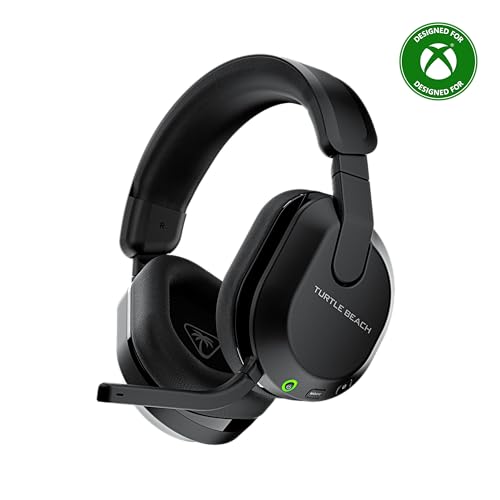
Turtle Beach Stealth 600 — Best multi-platform pick
Households with more than one games machine develop a specific headache: headsets accumulate per platform, each with its own dongle, its own charging cable, and its own opinions. The Stealth 600 in its current generation was designed as the cure — a single headset whose wireless covers Xbox, PlayStation, PC, and mobile, with Bluetooth riding alongside for the phone. One hook by the television, one cable, one headset that simply follows the player from machine to machine.
The flip-to-mute microphone defines daily use. Down is live, up is muted, and the gesture is visible to everyone in the room and unambiguous to the headset itself — no hunting for a button mid-firefight, no muted monologues. Microphone quality is clear and team-appropriate, with Turtle Beach’s monitoring letting you hear your own voice at a natural level so you stop shouting during excited moments. The 50mm drivers deliver the fuller, warmer sound the brand is known for, with a low-latency mode for competitive play and the company’s long-standing spatial audio processing for immersion.
Battery life is the quiet headline: around eighty hours between charges turns wireless anxiety into a monthly afterthought. A quick-switch button hops between the 2.4GHz link and Bluetooth without a menu dive, and the memory foam cushions with glasses-friendly channels keep long sessions civilised. Controls sit in a row along the ear cup — volume wheel, mode, power — learnable by touch within a week.
Honest limits: the Stealth 600’s app and fine-tuning story is thinner than SteelSeries’, so inveterate EQ tinkerers get fewer toys. Its sound signature leans warm and bass-generous out of the box, which flatters action games and film more than forensic competitive listening. And while the frame is sturdy, it is not the lightest here — smaller heads should try before committing. As a one-headset answer for a multi-machine house, though, nothing else in this guide argues its case as completely.
- Drivers: 50mm, warm and full-bodied tuning
- Wireless: 2.4GHz low-latency plus Bluetooth, quick-switch button
- Battery: around 80 hours between charges
- Microphone: flip-to-mute with voice monitoring
- Platforms: Xbox, PlayStation, PC, and mobile in one unit
Strengths
- Genuinely replaces a drawer of platform-specific headsets.
- Flip-to-mute is the fastest, clearest mute in the guide.
- Battery endurance measured in weeks of evenings.
Trade-offs
- Fine-tuning and app depth trail the Nova 5.
- Warm tuning needs EQ help for strict competitive listening.
- Frame size suits medium and larger heads best.
Best for: multi-console households and Xbox players wanting one headset for everything. Not suited for: preset tinkerers or very small heads.
Logitech G435 — Featherweight champion
Lift the G435 and the specification that matters announces itself before you read a single number: it weighs around 165 grams, roughly half a typical gaming headset, and that absence of mass rewrites long sessions for smaller heads, younger players, and anyone whose neck complains by hour two. Logitech built it from the start as a lightspeed-wireless headset for the underserved end of the size chart, and the result is the most genuinely different product in this guide.
The wireless pairing is the real Lightspeed system — the same low-latency 2.4GHz technology as Logitech’s pricier models — backed by Bluetooth for phones and handhelds. Sound comes from 40mm drivers tuned light and clear rather than thunderous; competitive cues read easily, music sounds pleasant, and only bass devotees will feel short-changed. There is no boom microphone: beamforming microphones in the ear cups capture your voice instead, which keeps the silhouette clean and the weight down, at the cost of voice clarity that trails boom-equipped rivals in noisy rooms. Team chat in a quiet bedroom? Fine. Team chat beside a television and a sibling? The boom headsets above will serve you better.
The G435 is covered without a link because the pool checked for this batch holds no entry for it; it is sold through every major gaming retailer, so buy by exact model name. Battery life lands under a day of continuous play — around eighteen hours — which suits evening players and asks daily charging of all-day users. The frame is sized small deliberately: adults with large heads should treat it as a try-first product. For the player it fits, nothing else at the tier feels this effortless.
- Weight: roughly 165 grams, the lightest here by far
- Wireless: Lightspeed 2.4GHz dongle plus Bluetooth
- Microphone: dual beamforming, no boom arm
- Battery: around 18 hours per charge
- Sizing: compact frame aimed at smaller heads
Strengths
- Half the weight of rivals; neck fatigue simply vanishes.
- Full Lightspeed wireless, not a cut-down substitute.
- Colourful, youthful styling younger players actually like.
Trade-offs
- Boomless microphone struggles in noisy rooms.
- Battery is the shortest in this guide.
- Small frame excludes large heads outright.
Best for: younger players, smaller heads, and long sessions where weight is the enemy. Not suited for: noisy shared rooms or large-headed adults.
HyperX Cloud Stinger Core Wireless — Sensible budget starter
The Stinger line exists to answer a plain question: how much of the Cloud family’s comfort and competence can be kept while the price falls to the gentle end of the wireless tier? The Stinger Core Wireless keeps more than you would expect. The 2.4GHz connection is stable and lag-free for PC and PlayStation play, the 40mm drivers carry the family’s clear, game-first tuning, and the ear cushions deliver a recognisable echo of the famous Cloud comfort at a far smaller outlay.
What the budget removes is mostly surface. The frame is lighter plastic with a simpler headband, the microphone is fixed rather than detachable — though it flips up to mute, which remains the most foolproof mute gesture ever fitted to a headset — and the feature list stops at the essentials: power, volume, charge. Battery endurance sits around seventeen hours, enough for a week of evenings if not a fortnight. There is no Bluetooth second channel, so this headset lives with your console or PC and does not moonlight with your phone.
That focus is the point. First wireless headsets get bought for one machine and one player, and the Stinger Core Wireless serves exactly that brief without embarrassing itself on sound or comfort. It is written up without a link, since the batch pool carries no entry we can tie to it; HyperX distribution is wide, so sourcing by exact name is easy. Players who later upgrade tend to keep it as the household spare — a fate that says more about its competence than any benchmark could.
- Connection: 2.4GHz wireless for PC and PlayStation
- Drivers: 40mm with the family’s clear house tuning
- Microphone: fixed boom, flips up to mute
- Battery: around 17 hours of play per charge
- Build: lightweight plastic, simplified headband
Strengths
- Real Cloud comfort DNA at the tier’s gentle end.
- Flip-up mute cannot be fumbled mid-game.
- Simple controls suit first-time wireless owners.
Trade-offs
- No Bluetooth channel for phones or handhelds.
- Fixed microphone cannot be removed for listening.
- Battery asks for a weekly charging habit.
Best for: first-time wireless buyers on PC or PlayStation with one machine to serve. Not suited for: phone-switchers or multi-device households.
Razer Barracuda X — Travel-first design
Most gaming headsets are furniture; the Barracuda X is luggage. Razer designed it for the player whose gaming happens in more than one postcode — a detachable microphone, a USB-C dongle that handles the 2.4GHz link, and a frame light enough to wear through a train journey without arriving with a sore neck. At home it behaves like a proper gaming headset; packed, it becomes the travel headset that also games, which is a rarer and more useful thing.
The detachable HyperClear microphone is the enabling detail. Removed, the Barracuda X passes as ordinary street headphones; attached, it delivers clear team chat with the noise rejection Razer’s gaming line is known for. Battery endurance stretches impressively — up to around fifty hours in the current generation — so a week of commuting plus evening sessions runs on a single charge. A 3.5mm cable in the box covers aeroplanes, older controllers, and dead-battery emergencies, a small inclusion that frequent travellers learn to love.
Sound tuning is balanced with a gentle warmth, and the TriForce drivers keep dialogue, effects, and music separated cleanly. The Barracuda X is covered without a link because the batch pool holds no entry for it; Razer’s retail presence is broad, so buy by exact model name and generation. Its compromises are domestic rather than travel-related: no simultaneous Bluetooth mixing for phone calls over game audio in the way pricier models manage, and a fit that favours medium heads. For the player with a bag always half-packed, those are easy trades.
- Design: lightweight frame built for bags and commutes
- Microphone: detachable HyperClear boom
- Wireless: USB-C 2.4GHz dongle, plus 3.5mm cable fallback
- Battery: up to roughly 50 hours per charge
- Use pattern: street headphones and gaming headset in one
Strengths
- Detachable mic converts it to discreet travel headphones.
- Long battery suits weeks built around movement.
- Cable fallback covers planes and flat batteries.
Trade-offs
- No simultaneous phone-over-game audio mixing.
- Fit favours medium heads over large ones.
- Fewer gaming-specific app features than the Nova 5.
Best for: commuters, students, and anyone whose gaming travels with them. Not suited for: a fixed battlestation where its portability earns nothing.
JBL Quantum 350 — PlayStation-leaning pick
JBL arrives in gaming from the loudspeaker world, and the Quantum 350 sounds like it: the tuning carries the company’s energetic, presentational character, with spatial processing designed to widen the perceived stage for console play. It connects by 2.4GHz dongle with PlayStation as its home turf — PC works too — and it aims squarely at the console player who wants a recognisable audio brand’s idea of fun rather than a tournament tool.
Daily handling is well judged. The detachable boom microphone keeps chat clear, the memory foam cushions and moderate weight support evening-length sessions, and battery life around twenty-two hours covers a week of play between charges. Controls are simple and the whole headset has the unfussy solidity of a product from a company that ships millions of headphones a year. Quantum’s software on PC adds EQ and spatial settings for players who split time between console and desktop.
The Quantum 350 sits outside the batch pool entirely, so it is covered here without a link; JBL’s retail reach makes it easy to source by exact name. Its limits mirror its focus: Xbox wireless is not its game, the app story lives mainly on PC, and the exuberant tuning that flatters single-player spectacle needs taming for players who want forensic footsteps. Console-first households that value big, enjoyable sound will forgive all three without a thought.
- Focus: PlayStation-first 2.4GHz wireless, PC supported
- Sound: energetic JBL tuning with spatial processing
- Microphone: detachable boom for chat and solo listening
- Battery: around 22 hours between charges
- Fit: memory foam cushions, moderate overall weight
Strengths
- Big, enjoyable sound that flatters single-player games.
- Detachable microphone keeps the design flexible.
- Backed by a mainstream audio brand’s build standards.
Trade-offs
- Not an Xbox wireless solution.
- Default tuning is too exuberant for strict competitive play.
- Software extras concentrate on the PC side.
Best for: PlayStation households wanting lively sound from a known audio name. Not suited for: Xbox players or forensic competitive listeners.
Sixty Hours or Eighty? Sorting the Six by Battery, Weight, and Wireless Manners
| Headset | Wireless paths | Battery | Microphone | Defining trait |
|---|---|---|---|---|
| Arctis Nova 5 | 2.4GHz dongle + Bluetooth | ~60 hours | Retractable boom | Preset app intelligence |
| Stealth 600 | 2.4GHz + Bluetooth | ~80 hours | Flip-to-mute boom | Every platform, one headset |
| Logitech G435 | Lightspeed + Bluetooth | ~18 hours | Beamforming, boomless | 165-gram featherweight |
| Cloud Stinger Core Wireless | 2.4GHz only | ~17 hours | Flip-up boom | Budget simplicity |
| Razer Barracuda X | 2.4GHz dongle + cable | ~50 hours | Detachable boom | Travel-ready design |
| JBL Quantum 350 | 2.4GHz dongle | ~22 hours | Detachable boom | PlayStation-first fun |
The battery column splits the six into two lifestyles. The Nova 5, Stealth 600, and Barracuda X treat charging as an occasional event; their owners plug in when reminded, not when forced. The G435, Stinger Core, and Quantum 350 ask for a weekly rhythm — no hardship, but a habit that must exist, ideally anchored to a fixed day and a cable that lives where the headset lives. Neither lifestyle is superior in the abstract; the honest question is whether you are the sort of person who maintains charging rituals gladly or resents them silently.
Weight tells a parallel story. The G435’s 165 grams is not a marginal improvement on the field — it is a different category of object, and it converts players who believed they simply disliked headsets. At the other end, the fuller frames of the Stealth 600 and Quantum 350 buy their comfort with size, rewarding larger heads and punishing smaller ones. The microphone column, finally, is where team players should linger: every boom design here will out-communicate the G435’s beamforming pair in a noisy room, and squads who play in shared spaces should weight that row accordingly.
Does a Dongle Still Beat Bluetooth for Actual Gaming?
Yes, and the reason is physics rather than snobbery. Standard Bluetooth audio carries a delay — latency — that can push past a tenth of a second once codecs and buffering have their say. In music that delay is invisible; in a game it separates a gunshot from its muzzle flash and a footstep from the enemy producing it. The 2.4GHz dongle connections used by every gaming pick here cut that delay to a small fraction, restoring the synchronisation your reflexes assume.
Bluetooth still earns its socket. It is the universal language of phones, tablets, and handhelds in their portable modes, and it handles voice calls and music beautifully. The correct affordable architecture — demonstrated by the Nova 5 and Stealth 600 — is both: dongle for the machine you play on, Bluetooth for everything else, and a painless way to hop between them. Headsets offering only one path force a compromise you will feel weekly.
Two practical corollaries follow. First, keep the dongle visible and dedicated; a dongle buried in a rear port behind a metal case loses range and invites interference, while a front port or a short extension cable keeps the link honest. Second, expect the 2.4GHz band to be shared with your home Wi-Fi — modern headsets hop channels intelligently, but a dongle placed inches from a router is asking for an argument it will occasionally lose.
How Do You Keep a Wireless Headset Behaving for Years?
Charge with rhythm and moderation. Lithium batteries age fastest when left flat or cooked full for weeks; the easy routine — charge when the low warning appears, unplug when full, never store the headset dead — keeps any of these six healthy for years. The long-battery models make this simple because their warnings arrive rarely and with days of grace.
Protect the dongle like a key, because functionally it is one. A lost dongle can orphan an otherwise perfect headset, and replacements range from awkward to impossible depending on brand. Habits that work: the dongle lives in the console or PC permanently, travels in the headset’s case rather than a pocket, and gets photographed — model and serial — the day the box opens, so a replacement search starts from facts.
Firmware updates deserve a calendar note rather than enthusiasm. Update when the maker fixes a problem you actually have, or adds a feature you actually want; read the notes before applying anything mid-season. And keep cushions fresh: compressed foam changes both comfort and the seal that bass response depends on, so a cushion swap in year two restores a headset that owners often mistake for worn out.
Where Do Affordable Wireless Buyers Most Often Go Wrong?
Buying for the wrong console leads the list. Xbox wireless is a licensed world of its own; a headset that is wireless on PlayStation and PC may be cable-only on Xbox, and the disappointment arrives at unboxing. The Stealth 600 in this guide covers Xbox natively — if your house is Xbox-first, that fact should steer the whole decision before sound is even discussed.
Judging by driver size is the second error. A 50mm driver is not automatically better than a well-tuned 40mm one, and at this tier tuning and seal matter more than diameter. The Nova 5’s smaller drivers out-resolve several larger rivals precisely because SteelSeries spent its budget on tuning and software rather than on a bigger number for the box.
The third error is ignoring the return window on fit. Wireless headsets are worn for hours, head shapes vary enormously, and no review can tell you whether a specific frame pinches your specific glasses. Buy from a seller with painless returns, wear the headset through your longest normal session, and let that evening — not the first five minutes — cast the deciding vote.
What Does Living With Each of These Headsets Actually Feel Like by Month Six?
Wireless headsets accumulate small reputations. By month six, owners no longer talk about specifications; they talk about the dongle they never think about, the charge they forgot for a fortnight, the cushion that flattened. Each of these six develops a distinct domestic personality, and matching that personality to your household matters as much as any launch-day impression.
The Nova 5 becomes the tinker’s companion. Its owners genuinely use the preset library — a shooter preset on Friday, a film-friendly curve on Sunday — and the app’s presence on their phone turns audio into a hobby rather than a setting. The retractable microphone’s click becomes muscle memory, the dongle lives permanently in the PC or console, and the sixty-hour battery settles into a charge-it-on-the-first-Sunday rhythm. The owners who drift away from it are the ones who never opened the app after week one; for them it remains a good headset that another household would have loved more completely.
Stealth 600 ownership is defined by absence — absence of charging anxiety, absence of platform confusion, absence of mute mishaps. It is the headset recommended between siblings and handed between rooms, and its eighty-hour battery makes it the last device in the house anyone worries about. Over months, its warm tuning becomes the household reference sound, the one other headsets get compared against at the kitchen table. Its app stays unopened on most owners’ phones, which Turtle Beach would presumably accept as the compliment it is: the hardware answers questions before software is consulted.
The G435 develops a fiercely loyal niche. Owners who fit its small frame describe something close to relief — gaming sessions that end because the game ended, not because their neck filed a complaint. Its beamforming microphone teaches a compensating habit: G435 owners learn to play in the quieter room, to close the door, to keep the television low, and most consider that a fair rent for the comfort. The daily charging rhythm becomes as automatic as plugging in a phone, and the headset’s colours — chosen cheerfully rather than tactically — mark it as the one piece of gaming gear that younger players treat as personal rather than technical.
Stinger Core Wireless owners tell the simplest story of the six: it works, it is comfortable, it was not expensive, and it is still here. This is the headset that survives being borrowed, dropped onto carpet, and left in standby for a week of holiday. Its flip microphone’s mute gesture gets used hundreds of times without a single failure of understanding, and its lack of Bluetooth stops mattering because its owners never asked it to be a phone headset — they asked it to be the console’s headset, a job it performs with a steadiness that embarrasses pricier gear.
The Barracuda X accumulates travel stories. It is the headset found in work bags, in student rucksacks, in the seat-back pocket photograph from a holiday. Its detachable microphone lives in a small pouch its owner bought in month two, after one fright in a coat pocket; its battery gets charged in airports and on trains as often as at desks. Owners speak of it the way they speak of a good suitcase — not the most luxurious object they own, but the one that has been everywhere with them. At home it holds its own perfectly well, yet its identity is motion.
Quantum 350 ownership centres on the PlayStation it serves. Its owners picked a sound — big, present, cinematic — and six months on, that sound is what they praise, while the headset’s mechanics fade into unremarkable reliability. It is the least discussed headset in this guide among its owners, which in product terms is a kind of success: nothing about it demands discussion. When its owners upgrade, they tend to stay inside the same sound signature at a higher tier, having learned from the 350 exactly what their ears enjoy.
Which Wireless Signature Suits Shooters, Stories, and Streaming?
Sound signatures at this tier differ more than marketing admits, and the differences map onto genres. Competitive shooters reward restraint: a flatter midrange, controlled bass that never masks a footstep, and treble that places reloads and armour swaps precisely. The Nova 5’s default tuning — especially with a shooter preset loaded — is built on exactly that philosophy, and the G435’s light, clear balance serves the same games on smaller heads, provided the room is quiet enough for its microphone to keep up with your callouts.
Narrative and open-world games reward the opposite virtues: warmth, scale, and bass that gives weather and engines their physicality. Here the Stealth 600’s generous low end and the Quantum 350’s presentational energy turn long story sessions into something closer to cinema, and players who live in single-player worlds will find the forensic tunings of the competitive picks oddly joyless by comparison. Neither preference is more audiophile than the other; they are different sports asking for different shoes.
Streaming and content creation add a third requirement that cuts across both: your microphone is your instrument. Creators on a budget should weight the boom designs — Nova 5, Stealth 600, Barracuda X — and accept their tuning compromises, because an audience forgives ordinary game audio instantly and ordinary voice audio never. The Barracuda X’s detachable microphone also wins creators who record in more than one place, since the same voice follows them from desk to trip.
Music, finally, is where expectations need the firmest management. Every model here plays music pleasantly; none replaces a good pair of dedicated headphones for critical listening, and the affordable wireless tier should not be asked to. Judge these six on the blend — games first, chat always, music as a welcome extra — and the tier stops disappointing and starts impressing.
How Far Will the Signal Really Reach Around a House?
Range claims deserve translation into domestic geography. A 2.4GHz headset link typically holds through one or two interior walls and across the open plan of a living space — enough to fetch a drink from the kitchen mid-match in most flats, marginal in a long house with the console at one end and the kettle at the other. The dongle’s position decides more than the radio’s strength: a dongle at the front of a console, roughly at seated head height, with nothing metal in the way, will outperform a theoretically stronger radio buried behind a television.
Bluetooth range behaves similarly but pairs differently: it tolerates movement around a room gracefully and suits the phone-in-pocket pattern of the Nova 5, Stealth 600, and G435 when they are in their Bluetooth modes. What neither technology forgives is a body of water — an aquarium, a large houseplant wall, your own body at the wrong angle — interposed on the path, which is why the occasional kitchen-dropout is a physics report rather than a product defect.
The practical test takes one evening: wear the headset through your real routes — desk to kettle, sofa to bathroom, console to door — during an actual session, and note where the link thins. If a dropout spot matters, moving the dongle on a short USB extension almost always cures it. If the route itself is simply long, accept the boundary gracefully; even the best affordable wireless is a room-and-next-room technology, and headsets that promise whole-house coverage at this tier are describing their optimism, not their radio.
Two Headsets, One Sofa: What Happens When a Household Plays Together?
Shared gaming households stress wireless gear in ways solo players never meet. Two headsets on two machines in one room means two 2.4GHz links sharing airspace with the router, the neighbours’ networks, and a microwave with no respect for anyone’s ranked match. Modern headsets handle this coexistence well — channel hopping is mature technology — but the household habits around them matter: dongles placed a metre apart rather than stacked in adjacent ports, routers kept out of the immediate headset cluster, and charging cables distributed so both headsets are not competing for one socket on the night before a long session.
Cross-platform households add a social wrinkle the Stealth 600 was clearly designed by someone who had lived: when one headset serves every machine, the argument about whose headset works with the visiting console disappears. A Nova 5 and a Stealth 600 in the same house make a natural pair — the tinkerer takes the SteelSeries, the roamer takes the Turtle Beach, and the G435 often joins as the third headset for the youngest player, whose head it fits and whose sessions it survives. The Stinger Core and Quantum 350 settle into single-machine loyalties, which suits households where each player has a home platform and defends it cheerfully.
Voice chat across a shared room deserves one honest warning. Two players in one room, both in the same online party, will hear each other twice — once naturally, once through the party with a few milliseconds of delay — unless one of them mutes their microphone in the party or the pair coordinate who speaks to the squad. Open-back habits do not exist at this tier to save you; the fix is procedural, and households that learn it in week one stop noticing it by week three.
What Exactly Does the Next Tier Up Buy — and Should You Care?
Stepping above this guide’s tier purchases four things, and it is worth naming them precisely so you can decide whether any of them is secretly your real requirement. First, simultaneous connections: flagships mix console audio and a Bluetooth phone call at once, rather than switching. Second, hot-swappable batteries: a charged spare clicks in and the flat one charges on the base, making battery life effectively infinite. Third, materials — metal yokes, denser foams, finer headbands — that change feel more than function. Fourth, base stations and docks that give the headset a home and a charging ritual in one object.
Notice what the list does not contain: categorically better game audio. The Nova 5’s drivers and presets, the Stealth 600’s endurance, and the Barracuda X’s travel manners are not embarrassed by their pricier relatives; the gap lives in convenience architecture, not in the sound of a footstep. That is precisely why this tier is the intelligent place to buy. Spend flagship money when simultaneous mixing or swappable batteries describes your actual week — streamers taking live calls, professionals marooned in voice chat all day — and spend affordable money with confidence when it does not.
There is also a longevity argument for the tier that rarely gets made. Affordable headsets get replaced on a technology cycle — new consoles, new wireless standards, new licensing — while flagship prices tempt owners to keep gear past its natural life out of sheer sunk cost. Buying the Nova 5 or Stealth 600 today and its successor in four years usually lands a household with newer technology across the decade than one flagship nursed through the same period. Affordable, bought well, is a strategy rather than a compromise.
Setting Up on PlayStation, PC, Switch, and Phone Without the Usual Twenty Minutes of Swearing
On PlayStation, the ritual is mercifully short: dongle into a front USB port, console audio output set to the headset, microphone level adjusted in the quick menu while speaking at your real gaming volume rather than a careful test voice. That last detail matters — set levels with the excitement you actually play with, or your first firefight will clip. The Nova 5, Stinger Core, Quantum 350, and Stealth 600 all present themselves cleanly to the console; the remaining work is choosing whether game and chat balance lives on the headset or in the system menu, and picking one place so future-you is not hunting through both.
PC setup rewards five extra minutes. Install the maker’s software once — Sonar-adjacent tools for the Nova 5, Logitech’s hub for the G435 — set the headset as the default device for both output and input, then open your chat app of choice and select the headset explicitly there too, because chat applications love defaulting to a webcam microphone across the room. Disable any ‘enhancements’ your operating system offers to apply on your behalf; layered processing from two masters serves neither.
Switch and mobile play is where the second wireless channel earns its existence. The Switch accepts the USB-C dongle of the Nova 5 and Barracuda X directly in handheld mode, turning a train journey into a proper gaming session, while Bluetooth covers the phone for calls and music on every model so equipped. Pair the phone on day one even if you expect to use it rarely: the day a call interrupts a session, you will be grateful the pairing already exists and the quick-switch button has something to switch to.
Whatever the platform, finish setup with a recording. Thirty seconds of your voice, captured through the app your squad actually uses, played back at honest volume, tells you more than every level meter combined. Adjust once, save the settings, and then leave them alone — wireless headsets reward owners who set them properly once and then simply play.
A Quick Word on Trying Before the Return Window Closes
Wireless headsets compress three separate purchases into one object — headphones, microphone, and radio — so a fair home trial has to exercise all three. Spend one session in your loudest normal gaming conditions to judge the microphone through a friend’s ears or a recording. Spend one in your longest normal session to judge comfort honestly, at the end rather than the beginning. And spend one moving through your real routes around the house to judge the link where you actually live. A headset that passes all three evenings is not a gamble any longer; it is a known quantity, and the six above were chosen because each passes that triple test for the player it was designed for. The ones that fail your version of the test should go back without sentimentality — at this tier, the right model exists for every head, and settling for the almost-right one is the only genuinely expensive mistake available.
Final Recommendation
Start with the SteelSeries Arctis Nova 5 unless your house is Xbox-first: its dual wireless, sixty-hour battery, and preset library deliver the most capability per unit of money in this guide, and its comfort suits the widest range of heads and the longest range of evening sessions imaginable. Xbox households, and anyone juggling several machines, should take the Turtle Beach Stealth 600 instead and enjoy the eighty-hour battery and the flip-to-mute life.
The remaining four answer narrower briefs beautifully. The G435 is the pick when weight is the complaint, the Stinger Core Wireless when the budget is the complaint, the Barracuda X when the headset must travel, and the Quantum 350 when a PlayStation household wants its sound big and joyful.
One last piece of buying discipline applies to all six: purchase the headset your household’s machines, heads, and habits actually describe, rather than the one with the longest feature list in a comparison video. Wireless headsets are unusually personal equipment — worn for hours, spoken through nightly, charged by routine — and the model that fits your life will outperform a technically richer rival that fights it. Wireless done this well, at this tier, means the cable’s last argument — reliability — now belongs to whichever of these six you keep charged, and a headset that is always ready when the squad logs on is worth more than a flagship that is always flat.
Frequently Asked Questions
Can I use these headsets with my phone as well as my console?
Mostly yes. The Nova 5 and Stealth 600 carry Bluetooth alongside their gaming links, and the G435 pairs Lightspeed with Bluetooth too, so phone calls and music slot in easily. The Stinger Core Wireless and Quantum 350 focus on their dongle connection and do not court phones; the Barracuda X covers travel with its cable and dongle instead.
Will a 2.4GHz dongle work through a USB hub?
Usually, but a direct port is safer. Hubs — especially unpowered ones shared with hungry devices — can introduce dropouts that look like headset faults. Plug the dongle into the console or PC itself, ideally a front or top port with clear line of sight to where you sit.
How much latency difference will I actually feel?
On a dongle connection, effectively none — audio lands with the picture. On Bluetooth, rhythm games, shooters, and video dialogue can all feel subtly out of step. That is why every gaming pick here leads with its 2.4GHz path and treats Bluetooth as the companion channel.
What happens when the battery dies mid-game?
Most of these headsets can play while charging over USB-C, and the Barracuda X adds a 3.5mm cable that keeps sound flowing with no battery at all. The long-battery models make the scenario rare: an eighty-hour Stealth 600 warns you days before it gives up.
Is the Nova 5 or the Stealth 600 better for a mixed console house?
The Stealth 600, because its wireless covers Xbox as well as PlayStation and PC in one unit. The Nova 5 is the stronger pick for PC, PlayStation, and Switch players who will use its preset app; it simply does not offer native Xbox wireless in this configuration.
Do wireless headsets interfere with home Wi-Fi?
They share the 2.4GHz neighbourhood with older Wi-Fi networks, baby monitors, and microwave ovens, and modern headsets hop channels to stay out of trouble. Dropouts blamed on interference usually trace back to a dongle hidden behind a metal console or placed beside the router itself. Give the dongle a front port and a little air, and the two technologies coexist in the overwhelming majority of homes without either noticing the other.
How long do the batteries in these headsets last before wearing out?
Expect several years of evening play before capacity fades noticeably, provided the battery is not left flat for long stretches or charged in punishing heat. The long-endurance models age most gracefully in practice, because a battery cycled gently between warnings — rather than drained to empty nightly — accumulates far fewer damaging deep cycles across the same number of gaming hours.
Can I replace the ear cushions when they wear out?
On most of these models, yes — cushions are treated as wear parts and spares are sold by the makers or by well-established third parties. Fresh cushions restore the seal that bass response depends on and make a two-year-old headset feel startlingly new, so it is worth confirming cushion availability for your exact model before you buy, especially on the budget picks where accessory support varies.
Related Guides
Three neighbouring roundups extend this one naturally: console players should continue to affordable Xbox headsets that keep wireless simple for the licensed-connection details, noise sufferers will want Bluetooth headsets with active noise cancelling ranked for quieter rooms and commutes, and anyone whose headset must survive years of daily drops should finish with the most durable gaming headsets we recommend.
Related guide: Best HyperX Wireless Headsets
Related guide: Best Wireless Call Center Headsets
Related guide: Best Cross Platform Wireless Gaming Headsets


