What's inside
- Key Takeaways
- Quick Picks
- How the Endurance Shortlist Was Ranked
- Comparison
- Why Does a 24-Hour Speaker Die by Midnight at a Real Party?
- How Should You Charge a Speaker to Keep Its Battery Young?
- What Does Playtime Boost Teach About Every Other Speaker Here?
- How Do You Plan Battery for a Three-Day Trip With No Power?
- Which Battery Habits Quietly Shorten a Speaker’s Life?
- How Many Hours Does a Household Actually Spend Listening Each Week?
- What Happens to Battery Claims When Two Speakers Pair Up?
- How Should You Read a Battery Figure on a Listing Like a Sceptic?
- Why Do Speakers Seem to Lose Their Battery Nerve at Exactly the Wrong Moment?
- What Role Does the Speaker Play During a Power Cut or an Emergency?
- How Do You Choose Between Endurance and Sound When the Budget Forces One?
- What Should You Do in the First Charge Cycles of a New Speaker?
- How Does a Speaker’s Battery Shape the Way a Whole Trip Sounds?
- Final Recommendation
- Frequently Asked Questions
- Related Guides
As an Amazon Associate I earn from qualifying purchases. This post may contain affiliate links at no extra cost to you.
widgetverdict.com is reader-supported. When you buy through links on our site, we may earn an affiliate commission.
Ranking the best battery-powered bluetooth speakers sounds simple until you ask what a battery claim actually promises. Every figure in this guide comes from the pick’s own listing, quoted exactly: 20 hours for the JBL Charge 5, up to 24 hours plus six more with Playtime Boost for the JBL Xtreme 4, 24 hours for the Soundcore Boom 2, a 24-hour battery for the Sony SRS-XE300, up to 12 hours for the Bose SoundLink Flex (2nd Gen), and 16 hours for the Soundcore Boom 3i. Those numbers were each measured under the maker’s own conditions, at the maker’s own chosen volume, so this guide treats them the way an honest fuel-economy figure deserves: as a comparison of tank sizes, not a promise about your particular journey, your particular playlist, or the temperature on the particular mountain where your tent happens to be pitched this weekend.
That framing matters because battery life is where portable speakers keep or break their promises to real life. A speaker’s battery decides whether it joins the whole camping weekend or just the first evening, whether it lives ready in a kitchen drawer or lives tethered to a socket, and — over years — whether the product ages gracefully or becomes e-waste with a grille. The six picks below were chosen as a spread of answers to that one question: two 24-hour-class all-rounders from rival camps, a strap-carried heavyweight with a trick for stretching its charge, the classic 20-hour cylinder, a sealed swimmer at 16 hours, and a hi-fi outlier whose 12 hours buy refinement instead of endurance.
Readers in a hurry can take the table at face value and shop well. Readers planning a specific expedition — three days off-grid, a week on a boat, a season of site work — should read the budgeting sections before the reviews, because the expedition, not the speaker, is where battery plans are actually made, and a mediocre plan will defeat a magnificent battery every time it is tried.
One discipline governs every number below. Where a listing prints hours, the guide prints hours. Where a listing describes charging, pairing or sealing, the guide repeats that and no more. No pick is credited with a rival’s fast charging, a sibling’s power-bank trick or a predecessor’s battery figure, because battery specifications are precisely where generations and model lines get quietly confused in second-hand write-ups — and where a disappointed buyer discovers the confusion at hour nine of a festival.
Key Takeaways
- Three picks here claim a full day: the Xtreme 4 at up to 24 hours (plus six via Playtime Boost), the Boom 2 at 24 hours, and the XE300 with a 24-hour battery — each under its own maker’s test conditions.
- The Charge 5’s stated 20 hours in a one-hand cylinder remains the endurance benchmark for grab-and-go speakers.
- The Boom 3i trades headline hours for environment: 16 stated hours behind IP68 sealing, saltwater resistance and floating playback.
- The SoundLink Flex (2nd Gen) is the deliberate short-distance pick — up to 12 hours, spent on hi-fi tuning rather than marathon capacity.
- Playtime Boost on the Xtreme 4 is the most honest feature in the category: an admitted trade of sound weight for six extra hours, made by the owner, mid-event.
- Real-world hours shrink with volume, bass content and cold; the sections below explain how to budget a stated figure against an actual weekend.
- Every hour figure in this guide is tied to a named listing in the sources file, so a reader can trace each claim back to the exact product page wording it came from before spending anything.
Quick Picks
| Pick | Badge | Why it earns its place |
|---|---|---|
| JBL Xtreme 4 | The endurance heavyweight | Up to 24 hours of playtime with six more available from Playtime Boost, massive JBL Pro Sound and a shoulder strap. |
| Soundcore Boom 2 | The 24-hour boombox | A stated 24 hours behind an 80W claim, IPX7 sealing, a floatable body and a custom EQ in the Soundcore app. |
| Sony SRS-XE300 | The armoured day-tripper | A 24-hour battery claim with IP67 waterproof, dustproof and shockproof construction in Sony’s X-series format. |
| JBL Charge 5 | The 20-hour classic | Twenty stated hours with bold JBL Original Pro Sound and IP67 sealing in the cylinder that defined its class. |
| Soundcore Boom 3i | The sealed swimmer | Sixteen stated hours with IP68 sealing, saltwater resistance, floating playback and TWS pairing. |
| Bose SoundLink Flex (2nd Gen) | The refinement-over-endurance pick | Up to 12 hours of battery life funding hi-fi audio claims, in a waterproof and dustproof portable body with USB-C. |
How the Endurance Shortlist Was Ranked
Stated playtime was the entry ticket, never the whole judgement. A claim had to survive three questions. First, what does the number cost? Hours are bought with battery mass, so a 24-hour claim inside a boombox and a 20-hour claim inside a hand cylinder are different achievements, and the ranking honours the ratio as much as the figure. Second, what surrounds the number? Sealing, carry method and build decide whether the hours can actually be spent where the owner wants to spend them — a marathon battery in a speaker that cannot go to the beach is a marathon run indoors. Third, what does the maker admit? Listings that describe their endurance honestly — a boost mode that trades output for hours, a figure tied to a named generation — were trusted further than listings that merely shout a number.
Equally deliberate was what the shortlist refused to do. It refused to average the makers’ test conditions into a fake league table, refused to import battery figures from earlier generations of the same model names, and refused to treat the shortest claim here — Bose’s 12 hours — as a defect rather than a decision. Endurance is a budget, and budgets are spent on different goods: the Flex spends its battery on refinement at conversational volumes, the Boom 2 spends its on volume and light, the XE300 spends its on armour. The reviews grade each pick on whether its spending matches its buyer’s life.
One more consideration separated the final six from a longer list of candidates: what the speaker becomes when its battery is no longer the story. Every pick here had to remain worth owning on an ordinary Tuesday — as a kitchen radio, a workshop companion, a bathroom singer — because a battery is a means, and the end is a speaker woven into a household’s routines. Models whose only argument was a number, with nothing to say for their sound, their sealing or their carry, were set aside even when their numbers were large. The six that remain each pair their figure with a second virtue: a lever, a float, an armour rating, a classic’s rhythm, a swimmer’s paperwork, a hi-fi voice. That pairing is what a reader is actually buying, and it is what will still be true of the product when the battery is three years old and the brochure is forgotten.
Longevity formed the final lens. A battery is the one component in a speaker guaranteed to age, so the guide favours picks whose stated hours are generous enough that a cell at three-quarter health still covers the owner’s real days. That is the quiet argument for buying one size up in endurance: not the first summer’s bragging rights, but the fourth summer’s unremarkable reliability.

JBL Xtreme 4 — The endurance heavyweight
The Xtreme 4’s listing contains the most interesting battery sentence in this guide: up to 24 hours of playtime, plus six hours with Playtime Boost. That second clause is a confession the whole category usually hides — that endurance and output are the same budget spent two ways — turned into a feature the owner controls. Run the speaker at full JBL Pro Sound conviction and the tank reads 24 hours; decide at hour twenty that the evening matters more than the thunder, engage the boost, and the tank stretches toward thirty. No other pick here hands its owner that lever, and for festival weekends, multi-day boat trips and events with no socket in the story, the lever is worth more than a larger printed number would be.
The rest of the design supports the endurance brief physically. This is a portable waterproof speaker in JBL’s massive-sound format, carried by a shoulder strap because a battery and cabinet of this consequence have honest weight. The strap is part of the battery story: endurance you cannot transport is endurance that stays home, and the Xtreme’s whole proposition is a big tank that travels — to the far pitch, the beach’s good end, the campsite across the field. Waterproof construction means the tank also works in the rain that sends lesser plans indoors.
Set against its rivals, the Xtreme 4’s claim to the top of this guide is the combination, not any single figure: the joint-longest base claim, the only extension mechanism, and a format built to spend those hours at gathering volume rather than at background murmur. Owners who measure their listening in weekends rather than evenings will recognise their speaker. Owners whose listening is a daily hour in the kitchen should buy smaller and spend the difference on dinner — the Charge 5 below exists for them, and oversizing the purchase would help nobody.
- Stated playtime: up to 24 hours from the listing
- Extension: six further hours available via Playtime Boost
- Sound banner: massive JBL Pro Sound
- Build: portable waterproof body, shoulder strap for carry
- Colourway in this listing: black
Strengths
- The boost lever converts a fixed battery claim into a strategy the owner adjusts mid-event.
- A 24-hour base claim at gathering-capable volume covers full weekends without socket anxiety.
- The strap keeps a heavyweight tank genuinely mobile, so the hours travel with the owner.
Trade-offs
- Boost hours are bought with leaner sound; the trade is honest but real.
- The listing prints no IP grade, so certification sticklers should consult the product documentation.
- Its scale is wasted on listeners whose longest session is a podcast in the bath.
Best for: festival-goers, campers and hosts whose events run past a single day.
Not suited for: desk and kitchen listeners who will never spend a tenth of its tank at once.

Soundcore Boom 2 — The 24-hour boombox
Soundcore’s Boom 2 states its endurance plainly — 24 hours of playtime — and then spends the surrounding listing explaining what those hours will sound like: an 80W outdoor speaker with BassUp 2.0, IPX7 waterproofing, a floatable body, RGB lights, USB-C charging and a custom EQ through the Soundcore app, aimed at camping and the beach. The combination defines a particular kind of battery confidence. This is not a speaker that lasts 24 hours by being quiet; it is a boombox whose tank was sized for the volume it advertises, which is the only kind of 24-hour claim worth planning a weekend around.
The app EQ plays a battery role that rarely gets discussed. Bass is the most power-hungry ingredient in music, and an owner who can trim the low end for a podcast morning or a speech-heavy afternoon is, without knowing it, practising energy management. Conversely, the full BassUp treatment for the evening’s peak spends the tank exactly where the spending shows. USB-C charging keeps the refill simple — the same cable family as the phone — and the floatable, IPX7-sealed body means the hours can be spent in the wet places where camping and beach weekends actually happen.
Against the Xtreme 4, the Boom 2 answers with simplicity: no modes, no levers, just a large claim and a large sound in a handle-carried body. Against the Charge 5, it answers with scale. Its natural owner runs group days outdoors — the beach shelter, the campsite’s communal table — and wants one charge to be a non-topic from Friday’s arrival to Sunday’s departure. In this guide’s terms, it is the endurance pick for people who think in gatherings rather than in journeys.
- Stated playtime: 24 hours
- Output banner: 80W with BassUp 2.0
- Sealing: IPX7 waterproof; the body floats
- Charging: USB-C
- Tuning: custom EQ via the Soundcore app; RGB lights fitted
Strengths
- A full-day claim attached to genuine boombox output, not to a quiet mode.
- Flotation and IPX7 sealing let the long hours be spent beside water without supervision.
- App EQ doubles as a battery tool, trimming the most power-hungry frequencies for speech.
Trade-offs
- No dust grade is claimed in the listing, so sandy camps deserve a rinse routine.
- Boombox bulk ends pocket carry; the tank travels by handle or not at all.
- There is no boost-style extension mode — the 24 hours are the whole strategy.
Best for: camping groups and beach gatherings that plan in whole weekends.
Not suited for: commuters, or a coat pocket as the carrying plan.
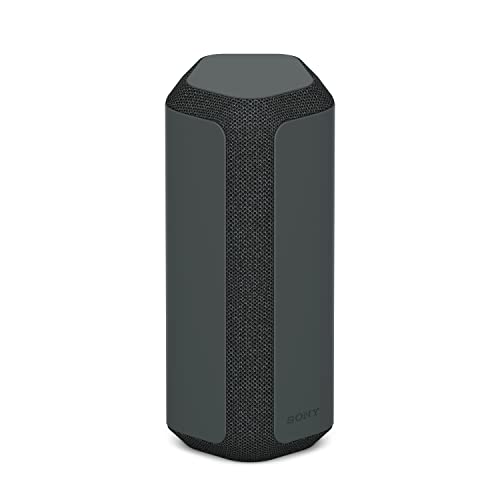
Sony SRS-XE300 — The armoured day-tripper
Sony’s XE300 makes its battery claim in the company of armour: a 24-hour battery, per its listing, inside an X-series body rated IP67 waterproof, dustproof and shockproof. That trio of protections reframes what the hours are for. A speaker can post a long playtime and still live a sheltered life; the XE300’s paperwork describes hours that survive drops onto stone, dust storms at the site or the beach, and immersion-grade water exposure — endurance of the clock and endurance of the cabinet, claimed in the same breath. For owners whose listening happens on building sites, boat decks, trailheads and other places where equipment is handled with gloves and dropped without ceremony, that combination is the product.
The X-series format suits the brief: a vertical, grippable body that stands in a corner of a van or a tent and throws sound across a working area, in black, without decorative ambitions. Twenty-four stated hours covers the longest working day and the evening after it, which for site and outdoor workers is the actual requirement — the speaker that starts with the crew at dawn and is still playing when the tools are packed has done something a 12-hour unit, however refined, cannot imitate. Shockproofing deserves its emphasis: falls are the leading cause of speaker death in working environments, ahead of water, and Sony is the only maker in this guide whose listing names the threat.
What the listing does not name is equally clear: no output wattage, no pairing system, no lights. The XE300 is a tool-specification speaker — protection grades and a battery figure, stated plainly, in a body built to be knocked about. Buyers who want their endurance dressed in features have the Boom 2; buyers who want their endurance dressed in armour have this.
- Battery claim: 24 hours, as printed in the listing
- Protection: IP67 waterproof and dustproof, plus shockproof construction
- Line: Sony X-series portable format
- Colourway in this listing: black
Strengths
- Shockproofing joins the sealing grades — the only pick here armoured against drops as well as water and dust.
- A 24-hour claim sized for working days, not just leisure evenings.
- The upright format stands securely in vans, tents and site cabins where space is fought over.
Trade-offs
- The listing quotes no wattage, so output comparisons must rest on format and series.
- No pairing, lights or app features are promised; the specification is deliberately plain.
- Its working brief is overbuilt for gentle indoor listening.
Best for: site workers, boat crews and outdoor households whose speakers get dropped as often as rained on.
Not suited for: feature collectors wanting lights, apps and pairing systems.

JBL Charge 5 — The 20-hour classic
The Charge line was named for its battery before batteries were fashionable, and the Charge 5’s listing keeps the faith in three short claims: bold JBL Original Pro Sound, 20 hours of playtime, IP67 waterproof and dustproof sealing. Twenty hours in a cylinder you can hold in one hand remains a remarkable density of endurance — the product of a design that has always treated the cell as a headline component rather than packing material. The consequence in daily life is a speaker that leaves its owner’s thoughts entirely: charged on Sunday, it covers the week’s showers, kitchens, garden evenings and the Saturday trip, and asks for its cable again the following weekend like a polite appliance.
That rhythm is the Charge’s real specification, and it explains the model’s longevity on roads and in bags worldwide. Endurance at this scale is not about heroic single sessions; nobody listens for twenty consecutive hours. It is about the interval between charges stretching past the threshold where charging becomes a chore to remember, into the territory where the speaker is simply always ready. The IP67 sealing supports the same philosophy — the always-ready speaker must also be the never-worried-about speaker, indifferent to the sink’s splash and the tent’s damp corner.
In a guide that also contains 24-hour boomboxes, the Charge 5’s role needs stating plainly: it is the endurance champion of the carry-everywhere class, not of the whole field. Its hours are spent at personal and small-group volumes, in bottle cages and backpack pockets, across weeks of ordinary life rather than single epic weekends. Measured by hours per litre and by days between charges in real routines, it remains the pick the others are compared against — which is why it anchors this guide’s middle rather than apologising from its edge.
- Stated playtime: 20 hours
- Sound banner: bold JBL Original Pro Sound
- Sealing: IP67 waterproof and dustproof
- Format: one-hand Charge cylinder
- Colourway in this listing: black
Strengths
- The best endurance-to-size ratio in the guide; a week of ordinary listening per charge.
- IP67 sealing makes the always-ready routine weatherproof as well as charge-proof.
- A shape that fits the world’s bottle cages, cup holders and pockets without accessories.
Trade-offs
- Group gatherings at distance will spend its hours faster and its volume sooner than the boomboxes’.
- The listing names no fast-charge or power-bank claims to lean on for trip planning.
- Newer siblings and rivals post longer figures; this is the balanced classic, not the record holder.
Best for: daily listeners on a calm weekly charging rhythm, carrying everywhere they go.
Not suited for: powering a whole campsite’s evenings from one unit.
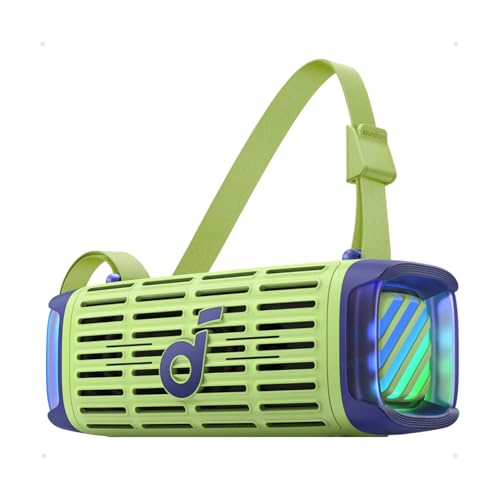
Soundcore Boom 3i — The sealed swimmer
Sixteen hours is the Boom 3i’s stated figure, and in this guide it must defend itself against rivals claiming twenty and twenty-four. The defence is that hours are only spendable where the speaker can go, and the Boom 3i goes where the others should not: its listing claims IP68 waterproofing, saltwater resistance, floating playback, a 50W output with BassUp 2.0, Bluetooth 5.3 and TWS pairing, aimed at kayaking, fishing and camping. A 24-hour speaker left in the car because the day involves salt water delivers zero hours. The Boom 3i’s sixteen are delivered in the water, on the water, beside the water — the environments where its owners’ listening actually lives.
The battery arithmetic of a water day also flatters the figure. Sixteen hours is two full days afloat at realistic listening levels, or one very long day with the volume doing honest work against wind and splash. TWS pairing, where a second unit joins, spends both batteries in parallel rather than draining one hero unit, which is a legitimate endurance strategy for groups: capacity distributed across two hulls. Bluetooth 5.3 keeps the connection’s own power draw modern and modest, a small but real contribution when the phone is also the navigation, the camera and the weather forecast.
Choose the Boom 3i when the environment, not the clock, is your binding constraint — when the question is not how long the speaker plays but whether it is still playing after the capsize, the spray and the salt. Its sixteen hours, honestly framed by its listing and spent in the harshest conditions in this guide, are worth more to a paddler than any larger number quoted for a freshwater life.
- Stated playtime: 16 hours
- Sealing: IP68 waterproof, saltwater-resistant
- Water behaviour: floating playback
- Output banner: 50W with BassUp 2.0
- Wireless: Bluetooth 5.3, TWS pairing
Strengths
- Hours that remain available in salt water and after capsizes, where rivals’ hours are theoretical.
- IP68 is the strongest sealing grade in this guide, dust included.
- Pairing a second unit doubles as an endurance strategy for group trips.
Trade-offs
- Sixteen hours trails the 24-hour class for socket-free multi-day trips on dry land.
- Its talents are priced for the water; a purely indoor buyer funds armour they will never use.
- No hands-free calling is claimed in the listing.
Best for: paddlers, anglers and sailors whose listening happens in and around salt water.
Not suited for: week-long dry-land expeditions planned around a single charge.
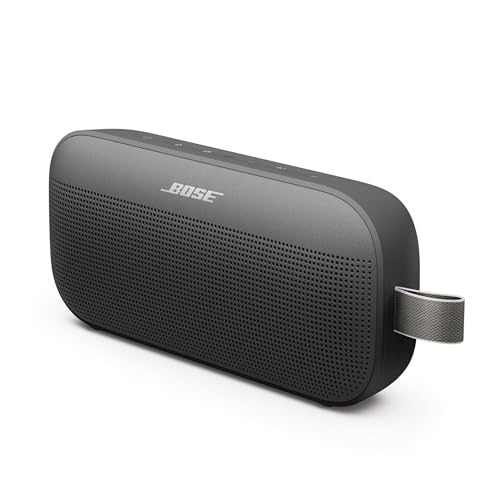
Bose SoundLink Flex (2nd Gen) — The refinement-over-endurance pick
Every endurance guide needs its honest dissenter, and the SoundLink Flex (2nd Gen) dissents in Bose’s listing language: a portable outdoor speaker with hi-fi audio, waterproof and dustproof construction, USB-C charging and up to 12 hours of battery life. Twelve hours is the shortest claim in this guide by a wide margin, and it is printed without apology, because the battery was spent elsewhere — on the tuning and composure that make this the pick for listeners whose sessions are measured in evenings rather than weekends. A dinner party, a morning of laps and coffee, a hotel room’s working day: the Flex covers the units of listening its owners actually buy, at a quality of sound the marathon runners do not attempt.
The practical consequence is a charging rhythm, and it should be chosen knowingly. The Flex lives nearer its cable than the Charge 5 does — a top-up every few days of regular use, overnight before a trip — and in exchange it asks for the least space, sits the most stably, and sounds the most refined at the low and middle volumes where its life is spent. USB-C charging at least makes the rhythm painless, sharing the phone’s cable on the nightstand or in the travel kit. Waterproof and dustproof construction, claimed without a printed IP grade in this listing, covers the poolside and the garden; the guide notes the missing grade rather than supplying one, as it does wherever a listing is silent.
Buy the Flex if your honest diary shows short, frequent, quality listening and a home base every night. Its 12 hours are not a failed 24; they are a different product philosophy, printed in the open, and the readers this guide most respects are the ones who can look at the smallest number in the table and recognise their own life in it.
- Stated battery life: up to 12 hours
- Sound banner: hi-fi audio
- Construction: waterproof and dustproof (grade not printed in the listing)
- Charging: USB-C
- Colourway in this listing: black
Strengths
- The most refined sound claim in the guide, for sessions where quality outranks duration.
- A compact, stable format that lives gracefully on counters, desks and pool stone.
- USB-C charging keeps its more frequent top-ups to a single shared cable.
Trade-offs
- Twelve hours is a weekend’s evening, not a weekend; trips need a charging plan.
- No IP grade is printed, so the paperwork is thinner than the sealed rivals’.
- It does not float, and its talents are wasted as a campsite’s only speaker.
Best for: evening listeners and travellers with nightly access to a socket.
Not suited for: multi-day off-grid use as the group’s sole source of music.
Comparison
| Pick | Playtime as its listing states it | Sealing as listed | Endurance character |
|---|---|---|---|
| JBL Xtreme 4 | Up to 24 hours, +6 with Playtime Boost | Waterproof (no grade printed) | The adjustable tank |
| Soundcore Boom 2 | 24 hours | IPX7 waterproof; floats | The boombox that lasts the weekend |
| Sony SRS-XE300 | 24-hour battery | IP67 waterproof, dustproof, shockproof | The armoured workday |
| JBL Charge 5 | 20 hours | IP67 waterproof and dustproof | The weekly-charge classic |
| Soundcore Boom 3i | 16 hours | IP68, saltwater-resistant; floating playback | The hours that survive the water |
| Bose SoundLink Flex (2nd Gen) | Up to 12 hours | Waterproof and dustproof (no grade printed) | The evening-quality pick |
Why Does a 24-Hour Speaker Die by Midnight at a Real Party?
Because the printed figure and the party were measured in different worlds. Listing playtimes come from controlled playback at moderate volume, often with a gentle playlist; a party demands high volume, bass-heavy music and hours of it, and each of those demands draws harder on the cell. Bass is the expensive ingredient — low frequencies move the most air and consume the most power — so the same speaker can plausibly deliver its full claim on a speech-and-acoustic weekend and half of it on a dance weekend. Cold takes a further tithe: lithium cells deliver less in winter temperatures, a fact every camper learns once.
The budgeting rule this guide recommends is deliberately crude: plan on two-thirds of the stated figure for mixed use, and half of it for loud, bass-heavy, outdoor use, and you will rarely be surprised in the wrong direction. By that arithmetic the 24-hour picks are honest full-weekend machines, the Charge 5 is a long day with margin, and the Flex is an evening — which matches the roles their reviews assign them. Owners who budget this way stop experiencing battery figures as lies and start experiencing them as what they are: tank sizes, honestly printed, awaiting a journey plan.
How Should You Charge a Speaker to Keep Its Battery Young?
Lithium cells age by cycles, heat and time spent at the extremes of charge. The gentle routine costs nothing: charge after substantial use rather than letting the speaker sit flat for weeks; unplug it when it is full rather than leaving it baking on a charger through a hot month; keep it out of sun-baked cars and freezing garages, where temperature does the damage owners later blame on the brand. A speaker stored for a season prefers a partial charge and a cool drawer, and a monthly hour of play keeps both the cell and the owner’s habits alive.
Charging hardware matters at the margins. Use the cable and a sane power source; let a wet port dry completely before any cable goes near it, because corrosion in a charging socket is the quietest battery-killer in this entire category. Where a listing names fast charging or a modern connector — the Boom 2’s USB-C among them — the benefit is convenience on the day you forgot, not a licence to live forgetfully. The owners whose speakers still hold their hours in year four are not lucky; they are merely the ones who treated a battery like a battery instead of like a wall socket with a handle.
What Does Playtime Boost Teach About Every Other Speaker Here?
JBL’s boost mode is the category’s one public admission that playtime and performance are a single budget, and once seen, it cannot be unseen in rival claims. Every speaker in this guide makes the same trade internally: tuning that pushes bass and volume spends the cell faster, and figures quoted at gentle settings flatter the tank. The Xtreme 4 simply hands the dial to the owner. Read in that light, the honest shopper’s question changes from “how many hours?” to “hours at what?” — hours at the volume and bass weight my life actually uses, in the cold my trips actually meet, through the seals my water actually tests.
There is a shopping consequence. A speaker whose maker admits the trade, prints its conditions plainly or offers the owner control of it has told you something about its engineering culture that no wattage figure can. Prefer the makers who confess; their other numbers tend to deserve the same trust. And when you compare a boost-equipped 24-plus-6 against a flat 24, compare them as strategies, not sums: the flat claim is simpler, the lever is more capable, and your own events — do they peak early or run long? — know which one you need.
How Do You Plan Battery for a Three-Day Trip With No Power?
Start with the budget rule above and multiply by your real listening: most groups play music for five to eight hours a day on a trip, not around the clock, so a 24-hour pick budgeted at half its claim covers two heavy days and wants a top-up strategy for the third. That strategy has three honest forms. Bring the vehicle: a car’s socket during a driving day refills more than pride admits. Bring a power bank sized for the speaker, accepting the weight as the price of the third day. Or bring the division of labour: two speakers alternating days, each resting while the other works, which also insures the trip against a single failure.
Discipline stretches any plan further than hardware does. Download playlists so radios idle less; keep the speaker shaded, because heat is a tax on both playback and cell health; lower the bass for background hours and spend it at the evening peak; and let silence have its scheduled moments — dawn coffee does not need a soundtrack, and the battery that survives to the final evening is remembered longer than the one that narrated every minute and died on the last night. Trip batteries, like trip water, reward the party that rations with a smile.
Which Battery Habits Quietly Shorten a Speaker’s Life?
The flat-storage habit is the champion: a speaker run to empty at the season’s end and left in a drawer until spring returns with a cell that has aged years in months. The heat habit follows — the speaker that lives on a sunny windowsill or in a car boot is being slow-cooked between uses. The wet-charge habit corrodes the port that every future charge depends on. And the permanent-tether habit, a speaker plugged in for months as a makeshift home unit, holds the cell at full charge in warm conditions, the precise posture lithium chemistry least enjoys.
Each habit has the same shape: it is free today and billed later, with interest, in the currency of hours. The counter-habits in the charging section above are equally free. Owners rarely get to choose whether their battery ages — only how fast, and whether the speaker’s fourth summer still sounds like its first. In a guide devoted to battery-powered speakers, that may be the most practical sentence available: the stated figure buys the tank, but the owner’s habits decide how much of it is still there when it matters.
How Many Hours Does a Household Actually Spend Listening Each Week?
Fewer than the brochures assume, and the honest count changes what you should buy. Time a normal week and most households land between six and fifteen hours of speaker listening: radio over breakfast, a podcast in the bath, two evenings of music, a weekend afternoon in the garden. Against that diary, even the Flex’s 12 stated hours — budgeted at two-thirds — cover a week of ordinary life on one or two charges, and the Charge 5’s 20 hours become a fortnight’s freedom. The marathon figures earn their premium only when the diary concentrates: the camping weekend that compresses twenty hours of listening into three days, the festival, the boat trip, the power cut.
This is why the guide refuses to mock the shortest claim in its table. A speaker bought for a diary it matches will be charged calmly, used constantly and kept for years; a speaker bought for an imaginary diary of expeditions will spend its life either tethered or flat. Count your hours before you count the listings’. The arithmetic takes one honest week and saves the most common disappointment in the category — not a bad speaker, but a mismatched tank.
What Happens to Battery Claims When Two Speakers Pair Up?
Pairing divides the work and multiplies the bookkeeping. Two speakers in a stereo or broadcast pair each draw on their own cells, so the system’s endurance is set by whichever battery is weaker, older or was charged less carefully — a chain with two links, both load-bearing. The Boom 3i’s TWS claim makes the arrangement explicit for its owners, and the practical rules are the same wherever pairing exists: charge both units fully before the event, start them together, and resist the temptation to pair a fresh speaker with a half-charged partner and call the sum a system.
There is an endurance dividend hidden in the geometry, though. Two speakers covering a space can each play more quietly than one speaker straining to cover it alone, and quieter playback is cheaper playback — the pair can outlast the single unit’s heroic effort while sounding better doing it. Hosts who pair regularly learn to treat the two units as one battery with two compartments: charged together, stored together, and retired from an event together when the first of them fades.
How Should You Read a Battery Figure on a Listing Like a Sceptic?
Begin with the words around the number. “Up to” is doing heavy work wherever it appears — the Xtreme 4’s up-to-24 and the Flex’s up-to-12 both confess that the figure is a ceiling reached under favourable conditions, and the honest reader budgets beneath every ceiling. A figure with no qualifier, like the Boom 2’s flat 24 hours or the XE300’s 24-hour battery, still comes from the maker’s own test, with the maker’s own volume and playlist; scepticism there is not cynicism, just the recognition that no standard forces the brands onto one test bench.
Then read what the figure is standing next to. A playtime printed beside output, sealing and charging details — as in the Boom 2’s listing — belongs to a maker describing a whole product; a playtime shouted alone, with the rest of the specification vague, belongs to a marketing department. Cross-check the generation: battery figures migrate between model years in second-hand articles more faithfully than any other specification, and the listing in front of you, for the unit in the basket, is the only testimony that counts. This guide’s sources file records exactly which listing each figure came from, so any reader can audit the chain.
Why Do Speakers Seem to Lose Their Battery Nerve at Exactly the Wrong Moment?
Because the wrong moment is when the demand peaks. A battery’s voltage sags under load, and the load is never higher than at the party’s loudest hour, in the cold, with the bass boosted — the precise conditions of the moment everyone remembers. The speaker that cruised all afternoon at background level meets its real examination at nine in the evening, and a cell with any age on it shows the examination no mercy. This is not a defect in any pick here; it is electrochemistry keeping its appointments.
The defences are the ones scattered through this guide, gathered: start full, budget at two-thirds, spend bass deliberately, keep the speaker out of extremes of heat and cold, and own enough stated tank that an ageing cell still graduates. Owners who internalise those five habits stop telling stories about speakers dying at midnight — not because their batteries became immortal, but because their planning quietly absorbed the truth about how batteries behave.
What Role Does the Speaker Play During a Power Cut or an Emergency?
An unglamorous one that owners remember gratefully: a charged speaker is a radio, a light-adjacent comfort and a morale device that runs for a day without touching the house’s precious remaining power. During outages, the households in this guide’s audience reach for exactly the qualities ranked here — a big stated tank, a full charge maintained by habit, and a device that plays the news and the evening’s music without drama. The Boom 2 and Xtreme 4 class of speaker, kept charged in a kitchen or a hall cupboard, becomes part of the household’s quiet preparedness alongside the torches and the batteries for everything else.
Preparedness argues for one specific habit: a speaker that lives charged, not a speaker that lives charging. The distinction is the custody line drawn earlier in this guide — top the tank after use, store it part-to-fully charged in a cool place, exercise it monthly — and it converts a leisure product into infrastructure without spending anything. When the storm takes the grid down at midnight, the difference between the two habits is the difference between music and news until morning, and silence.
How Do You Choose Between Endurance and Sound When the Budget Forces One?
Read your diary again, because the diary decides. Listening dominated by long, away-from-power sessions makes endurance the sound quality that matters most — a refined speaker that is silent by hour thirteen has, for that owner, the worst sound in this guide. Listening dominated by evenings at home, where a socket is always within reach, reverses the verdict entirely: the Flex’s refinement will be enjoyed nightly, while a marathon tank’s extra hours sit unused in the cell, depreciating. Neither answer is a compromise position; each is the correct engineering response to a different life.
The middle path exists and it is the Charge 5’s whole career: endurance comfortably past the weekly threshold, sound that satisfies at the distances it serves, in the format that travels. When the budget forces one purchase for an unexamined life, buy the middle — then examine the life, and let the second purchase, if there ever is one, be the specialist the diary actually describes. Most households discover the middle was the destination all along, which is why the classic in this guide has outlived several generations of record-holders.
What Should You Do in the First Charge Cycles of a New Speaker?
Modern lithium cells do not need the ritual conditioning that older battery chemistries demanded, but the first weeks still set the owner’s habits and reveal the unit’s character. Charge the speaker fully before its first serious outing, then run one honest long day — your volume, your music, your environment — and note where the tank stands at the end of it. That single observation calibrates the listing’s figure against your life more usefully than any review, including this one: if the speaker ends your hardest day at half a tank, your budgeting rule for trips writes itself.
Use the same weeks to build the infrastructure of readiness: the cable’s permanent home, the shelf or drawer where the speaker lives charged, the household’s shared understanding of who tops it up after a big day. Speakers die of neglect in the gaps between owners — everyone assumed someone else charged it — far more often than they die of chemistry. A named shelf and a household habit are battery technology too, and they are the only kind that improves with age instead of degrading.
How Does a Speaker’s Battery Shape the Way a Whole Trip Sounds?
Quietly, and completely. A group that trusts its speaker’s tank plays music generously — background at breakfast, company on the trail, the full evening session — because nobody is rationing an invisible resource. A group that doubts the tank develops a recognisable anxiety: volumes creep down, someone asks whether the music should rest, the speaker is checked like a fuel gauge on a mountain road. The difference between the two trips is rarely the playlist or the weather; it is the confidence that comes from a stated figure with headroom behind it, bought honestly and budgeted with the two-thirds rule.
That is the deepest argument for the endurance class gathered here. The Xtreme 4’s lever, the Boom 2’s flat day, the XE300’s armoured day and the Charge 5’s weekly rhythm all purchase the same invisible good: the absence of battery conversation. Nobody at a great gathering has ever praised a battery. They praise the evening — and the evening, more often than the guests know, was the battery’s work.
Final Recommendation
Buy the tank your longest real day requires, with the budget rule applied, and then stop counting — because the owners who enjoy these speakers most are the ones who thought hard about the battery for exactly one week, the week of the purchase and the first calibration day, and then arranged a shelf, a cable and a habit that let them forget the subject for the next several years. Weekend and festival listeners, and anyone whose events are measured in days rather than evenings, belong with the Xtreme 4’s adjustable 24-plus-6 or the Boom 2’s flat 24; working and outdoor households whose speakers get dropped weekly with the XE300’s armoured 24; daily carriers with the Charge 5’s calm weekly rhythm; water people with the Boom 3i’s sealed 16; and evening listeners with the Flex’s refined 12, chosen proudly rather than apologetically, in full knowledge of what the smaller tank buys them every single night at home. The speaker I would lend a friend for a three-day off-grid trip is the Xtreme 4 — not because its number is the longest, but because on the third evening, when the tank ran low and the fire was lit, its boost lever let the music finish the night at exactly the moment every other strategy in the guide would have gone quietly and apologetically silent.
Frequently Asked Questions
Are the playtime figures in listings measured the same way by every brand?
No shared standard governs them, which is why this guide quotes each figure as its own listing states it and recommends budgeting two-thirds for mixed use. Volume, playlist content and temperature all move the real result. Compare figures as tank sizes within a maker’s range first, and across brands with a margin of scepticism.
Does playing at low volume really extend battery life that much?
Yes — output power rises steeply with volume, and bass-heavy material at high volume is the most expensive listening there is. Background-level playback can multiply a speaker’s endurance several times over compared with party duty. It is the cheapest battery upgrade available and the reason quiet mornings cost a trip’s budget almost nothing.
Can I replace the battery when my speaker gets old?
Most sealed portable speakers are not designed for owner battery replacement, and opening a sealed unit usually ends its water resistance. The practical defences are the custody habits in this guide and buying enough stated endurance that an aged cell still covers your days. Treat the battery as the product’s lifespan and shop accordingly.
Is it bad to use the speaker while it charges?
Occasional use while charging is a normal pattern for most owners, but it generates heat, and heat is the battery’s enemy over time. For an all-day fixed installation it is better to start fully charged and let the tank do its work. If you rely on charge-while-playing regularly, keep the speaker ventilated and out of direct sun while it does both jobs.
Why does my speaker’s battery drain faster in winter?
Lithium cells deliver less capacity in the cold and recover much of it when warmed. A speaker that seems tired on a January hike may be entirely healthy by the fire. Store and charge batteries at room temperature where you can, and budget winter trips with the cold tithe included in the plan.
Should I buy the speaker with the longest stated playtime just to be safe?
Only if your diary contains the days that need it. Excess tank is bought with size, weight and money, and a marathon speaker carried reluctantly is a speaker left behind — the worst endurance outcome of all. The safer purchase is the one whose budgeted hours cover your longest real day with margin: for most households that is the 20-to-24-hour class; for evening listeners it can honestly be twelve.
Do RGB lights and other extras noticeably drain the battery?
Everything powered draws from the same cell, and lights, boosted bass modes and charging a phone from the speaker all spend the tank faster than plain playback. The effect is a budgeting matter rather than a scandal: if the evening needs the lightshow, plan the hours with the show included, the way the Boom 2’s owners learn to do across a camping weekend. Features you love are worth their watts; features you ignore are worth switching off.
Related Guides
When the long weekend ends and the projects move from the campsite to the workbench, the same habit of reading listings literally pays off elsewhere on this site: a beginner-friendly 3D printer guide that separates first-machine promises from fine print is the gentlest place to start. Readers ready to build a home workshop around a printer will want our home 3D printer roundup weighing space, noise and enclosure choices next. And for those who enjoy the engineering arguments as much as the objects, an FDM 3D printer guide comparing CoreXY and bedslinger architectures closes the loop between this season’s speakers and next season’s making.



[…] the days when the water is a swimming pool rather than a harbour, our battery-powered speaker guide comparing stated playtime across portable picks covers the carry-aboard alternative in full. When the boat comes out of the water and the projects […]