What's inside
- Key Takeaways
- Quick Picks
- How We Chose These Picks
- Comparison
- What Makes a Speaker “Active” Rather Than Merely Powered in Spirit?
- How Much Power Do the Best Active Bookshelf Speakers Need for a Real Room?
- Which Inputs Should You Count Before an Active Pair Arrives?
- Where Should Active Speakers Sit to Earn Their Stereo Image?
- How Do You Add a Television, a Turntable and a Phone to One Pair?
- What Changes When the Listening Seat Moves From Desk to Sofa?
- How Should You Test a New Pair During Its First Evenings?
- Which Setup Errors Make Good Active Speakers Sound Ordinary?
- Final Recommendation
- Frequently Asked Questions
- Related Guides
As an Amazon Associate I earn from qualifying purchases. This post may contain affiliate links at no extra cost to you.
widgetverdict.com is reader-supported. When you buy through links on our site, we may earn an affiliate commission.
Shopping for the best active bookshelf speakers starts with a liberation: no receiver, no separate amplifier, no rack of boxes between you and the music. The amplification lives inside the cabinet, the volume knob sits on the speaker itself, and a pair on a shelf or a desk becomes a complete system the moment a source is plugged in. That simplicity is the whole appeal, and it is also where the differences hide, because every maker decides for itself how much power to build in, which inputs to offer, and whether the tuning should flatter a living room or tell the truth at a mixing desk.
Active pairs divide along a line that matters more than any single specification. On one side sit lifestyle speakers from Edifier, Audioengine and Kanto, tuned to sound generous with streamed music, television and vinyl, and fitted with remotes, Bluetooth and subwoofer outputs. On the other side sit near-field monitors from JBL and Edifier’s monitor line, tuned flat for close listening, sold for desks and small studios, and usually missing the remote control and the wireless extras entirely. Neither side is better in the abstract. A monitor on a TV stand can feel austere, and a lifestyle pair at a mixing desk can flatter a recording into lies.
Six pairs make up this guide, and between them they cover the wired purist, the Bluetooth streamer, the vinyl listener and the home producer. Every power figure and input named for a linked pick below is taken from that pick’s own Amazon listing title, checked against the listing data this site pulls from Amazon’s own catalogue feed. Where a listing title stays quiet about a detail, the guide describes that detail in ordinary words rather than guessing a number, because an invented specification is worse than no specification at all.
Prices move too often in this category to anchor a recommendation, so this guide judges value by what a pair includes and how long it is likely to serve, and leaves the live figure to the listing itself — check price on Amazon for any pick that reaches your shortlist.
Key Takeaways
- Edifier’s R1280T is the wired anchor of the set: a 42 watts RMS powered pair in brown, with no Bluetooth to distract from a turntable, a television or a computer feeding it by cable.
- The S1000MKII is Edifier’s heavyweight, a 120w active pair with Bluetooth 5.0 and aptX HD plus an optical input, built for a main listening seat rather than a desk corner.
- Audioengine’s A5+ Wireless brings hand built wood cabinets, Bluetooth with hi-res audio support and a subwoofer output, which makes it the easiest pair here to grow into a larger system.
- Kanto’s YU6 is the vinyl listener’s shortcut, pairing Bluetooth with a built-in phono preamp so a turntable plugs straight in without another box.
- The JBL 305P MkII pair is the studio entry: two 5-inch two-way powered monitors that expect balanced sources, close seating and no remote control at all.
- Edifier’s MR4 shrinks the monitor idea to a 4-inch woofer format with a 1-inch silk dome tweeter, sized for desks where larger monitors would crowd out the screen.
Quick Picks
| Pick | Badge | Why it earns its place |
|---|---|---|
| Edifier R1280T | The wired starting point | A 42 watts RMS powered pair in a brown finish, sold as 2.0 active near field monitors, for listeners whose sources all arrive by cable. |
| Edifier S1000MKII | The heavyweight Edifier flagship | A 120w audiophile active pair with Bluetooth 5.0 and aptX HD, an optical input and a Class D amplifier, aimed at a main listening chair. |
| Audioengine A5+ Wireless | The living-room all-rounder | Hand built wood cabinets, Bluetooth with hi-res audio support and a subwoofer output, for rooms that mix records, streaming and television. |
| Kanto YU6 | The turntable-friendly pair | A matte black powered pair with Bluetooth and a phono preamp built in, so a turntable connects directly with no extra box in the chain. |
| JBL 305P MkII (Pair) | The studio monitor pair | Two 5-inch two-way powered studio reference monitors, sold as a pair, for producers and listeners who sit close and want the recording unvarnished. |
| Edifier MR4 | The compact near-field monitor | A powered studio monitor pair with a 4-inch composite woofer and a 1-inch silk dome tweeter, hi-res audio certified in its listing, for tight desks. |
How We Chose These Picks
Selection began with a simple filter: each pair had to be genuinely active, with its amplification built in, and each had to be sold as a stereo pair or, in the JBL case, as a matched bundle of two powered monitors. Passive speakers that merely sit on a bookshelf were excluded, however good they are, because they answer a different question — one this site covers in its passive guides. What remained was then sorted by the job each pair actually does, so the six slots went to six different kinds of buyer rather than six near-identical boxes at slightly different sizes.
Inputs carried as much weight as drivers. A modern active pair may be fed by a phone over Bluetooth, a television over optical, a turntable through a phono stage, or a computer over an analogue cable, and a pair that accepts only one of those sources forces its owner into adapters and workarounds. The six picks below were checked input by input against their listing titles, and the guide says plainly which wireless and wired paths each one offers. Power figures were treated the same way: quoted only where the listing title itself states them, and otherwise left as a qualitative judgement about room size and listening distance.
Finally, each pair was judged at the distance it was designed for. Near-field monitors earn their keep inside a metre or so of the listener, where their flat tuning reads as clarity. Lifestyle pairs earn theirs across a room, where a remote, a subwoofer output and a forgiving treble matter more than laboratory flatness. Mixing those two standards produces nonsense reviews, so the analysis under each pick states its intended distance first and judges everything else from there.
One more discipline governed the shortlist: no pair earned a place on reputation carried over from a different product category. A brand’s portable speakers, soundbars or headphones say nothing reliable about its bookshelf pairs, so each model here stands on its own listing details and its own design brief. Readers comparing this guide with general brand roundups should notice the difference in method — six specific pairs, each with a named job, rather than a logo ranking that happens to have speakers attached.

Edifier R1280T — The wired starting point
The R1280T has become a default first pair for a reason that has little to do with fashion: it removes every decision except placement. Edifier’s listing describes a powered bookshelf pair rated at 42 watts RMS, finished in brown, and positioned as active near field monitors, which tells you the intended seat is close — a desk, a small listening corner, a bedroom shelf near the bed. There is no Bluetooth in this design, and the guide treats that absence as a feature worth naming rather than a gap to apologise for. A wired pair cannot be hijacked by a neighbour’s phone, never needs pairing again after a router change, and sounds exactly the same on the thousandth play as on the first.
At near-field distance the R1280T’s presentation is tidy and unforced. Vocals sit forward enough to follow lyrics without effort, acoustic instruments keep their edges, and the small cabinets avoid the boomy thickness that plagues cheap powered speakers pushed against a wall. Bass is honest about the cabinet’s size: kick drums have shape and pitch, but the lowest octave of electronic music is suggested rather than delivered, and no tone control will change that physics. Listeners who mostly watch dialogue-heavy television, play games at a desk or spin records in a small room rarely miss what is not there. Listeners building a dancefloor in a lounge will, and they should start further down this list.
Living with the pair is deliberately old-fashioned. Volume lives on the speaker, sources arrive by cable, and the system wakes up exactly as it was left. That suits a turntable shelf or a desktop far better than a television across a room, where walking over to change volume grows tiresome within a week. Buyers with a TV-first plan should note the absence of an optical input and a remote in this design and weigh the S1000MKII or the A5+ Wireless instead. Buyers whose sources sit within arm’s reach get a calm, durable simplicity that fancier pairs sometimes lose.
Owners often ask whether a pair this simple can anchor a small vinyl setup, and the answer is yes with one condition: the turntable needs its own phono stage, either built into the deck or in a small separate box, because the R1280T’s job begins at line level. Given that stage, records sound composed and unhurried through this pair, and the absence of wireless circuitry means the only sound in quiet passages is the record’s own surface, which is exactly as it should be.
- Format: powered 2.0 bookshelf pair, sold as active near field monitors
- Output stated in the listing title: 42 watts RMS
- Finish named in the listing title: brown
- Wireless: none claimed in the listing title — plan on wired sources
- Amplification: built into the cabinets, so no receiver is required
Strengths
- Wired-only design means zero pairing friction and identical behaviour every session
- Near-field tuning suits desks and small rooms where listeners sit close
- Built-in amplification keeps a first system to two boxes and a cable
Trade-offs
- No Bluetooth, so phones and tablets need a cable or a separate streamer
- No remote control mentioned for this design, which suits desks better than sofas
- Small cabinets set a firm ceiling on deep bass, whatever the source
Best for: a desk, a turntable shelf or a bedroom corner where every source sits within cable reach
Not suited for: a television across a lounge, where volume changes happen from the sofa
Edifier S1000MKII — The heavyweight Edifier flagship
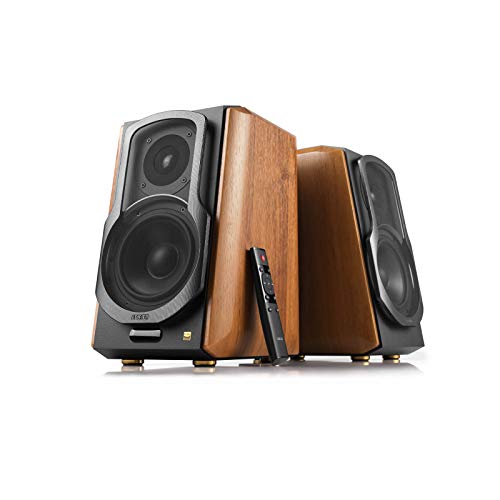
Where the R1280T whispers, the S1000MKII clears its throat. Edifier’s listing title calls this an audiophile active bookshelf pair, states 120w of output, and lists Bluetooth 5.0 with aptX HD alongside an optical input and a Class D amplifier. Those are main-system credentials, and the cabinets behave like it: this is a pair for stands or a sturdy sideboard, facing a sofa, in a room where music is the evening’s main event rather than background to something else. Putting a pair of these on a shallow desk wastes most of what the money bought and crowds the workspace besides.
The aptX HD support matters for listeners who stream from Android phones or dedicated players that can send it, because it carries more data than basic Bluetooth audio and keeps cymbals and room ambience cleaner at distance. The optical input is the television path, giving a lounge a two-box system that handles films and music without a soundbar’s compromises or a receiver’s menus. Driven by a good recording, the S1000MKII sounds composed at volumes that would rattle smaller powered pairs into harshness, and that composure — not raw loudness — is what the flagship money actually buys.
Restraint is still required with placement. A powerful active pair placed hard against a wall or stuffed into a bookcase corner will thicken its own bass and blur the stereo image its angled cabinets work to create. Give the pair air behind and beside them, keep the tweeters near ear height at the listening seat, and the system rewards the effort out of proportion to the ten minutes it takes. Owners upgrading from a small desk pair will notice the difference most on familiar albums: backing vocals separate, bass lines gain pitch definition, and quiet passages stop sounding like filler between choruses.
Film dialogue deserves a mention, because the optical path makes this pair a soundbar alternative with genuine stereo separation. Voices anchor to the screen, effects move between the cabinets instead of hovering in a mono blur, and late-night listening benefits from the composure at low volume: the pair stays intelligible turned down, so subtitles can stay off and neighbours stay asleep. A dedicated centre channel would still win for sprawling action mixes, but for drama, comedy and most streaming series, two good cabinets beat one wide bar convincingly.
- Format: active 2.0 bookshelf pair, described as audiophile in its listing title
- Output stated in the listing title: 120w
- Wireless named in the listing title: Bluetooth 5.0 with aptX HD
- Digital input named in the listing title: optical
- Amplifier type named in the listing title: Class D
Strengths
- Flagship output and composure suit a main listening seat in a medium room
- aptX HD support rewards phones and players able to send higher-quality Bluetooth
- Optical input gives televisions a clean two-box path without a receiver
Trade-offs
- Size and weight demand stands or furniture sturdier than a typical desk
- Output this strong is wasted, and can overwhelm, in a tiny bedroom
- Streamers limited to basic Bluetooth codecs cannot use the aptX HD path
Best for: a living-room listening chair fed by a television over optical and a phone over Bluetooth
Not suited for: a narrow desk already crowded by two monitors and a laptop dock

Audioengine A5+ Wireless — The living-room all-rounder
Audioengine builds its case on cabinet craft and system flexibility. The A5+ Wireless listing points to hand built wood cabinets, Bluetooth connectivity, hi-res audio support and a subwoofer output, and that last item quietly changes the pair’s future: when a room outgrows the bass a bookshelf cabinet can make, a subwoofer joins through a dedicated output instead of forcing a whole new system. Few active pairs in this guide offer that growth path, and for buyers who keep speakers for a decade it may matter more than any single listening impression.
The wood cabinets are not decoration for its own sake. A rigid, well-braced box colours the sound less than a thin plastic shell, and the A5+ pair has a reputation for a warm, easygoing balance that suits long listening — records in the evening, streamed radio through the day, television at night — without the treble glare that makes some detailed speakers tiring by the second hour. Bluetooth covers the casual sources, while wired inputs cover the serious ones, so a turntable, a streamer and a phone can share one pair without a switchbox forest on the shelf.
Buyers should understand what the A5+ Wireless is not. It is not a studio monitor and does not pretend to be one: its tuning flatters rather than audits, which makes home producers better served by the JBL or MR4 picks below. It is also a substantial pair that wants real shelf depth or stands, not a mantelpiece ledge. Judged as a living-room system, though, it threads a needle few rivals manage — domestically acceptable, musically generous, and expandable the day a subwoofer joins the room.
Gamers should not overlook this pair simply because it lacks gaming branding. Stereo imaging this honest makes footsteps, weather and ambient detail easy to place in open-world titles, and the wired analogue path adds no wireless latency to worry about. Console players will route sound through the television or a controller output depending on setup, while PC players connect directly. Either way, the A5-sized footprint of its rivals is larger; this flagship needs its space planned before it arrives, not discovered afterwards.
- Format: powered bookshelf pair with Bluetooth, per its listing title
- Cabinet note from the listing title: hand built wood cabinets
- Audio note from the listing title: hi-res audio support
- Expansion named in the listing title: subwoofer output
- Suggested uses in the listing title include desktop and living room listening
Strengths
- Subwoofer output lets the system grow instead of being replaced
- Wood cabinets and a warm balance suit long, mixed listening days
- Bluetooth plus wired paths cover streaming, records and television together
Trade-offs
- Flattering tuning is the wrong tool for mixing or mastering work
- Cabinet depth needs stands or a deep shelf, not a narrow ledge
- Bass from the pair alone still obeys bookshelf physics in big rooms
Best for: a shared living room where records, streaming and films all pass through one pair
Not suited for: a production desk where a mix must translate honestly to other systems

Kanto YU6 — The turntable-friendly pair
The YU6 solves the vinyl problem that stops many first turntable systems before they start: the phono stage. A record player’s output is too quiet and too oddly equalised to plug into an ordinary input, which is why traditional systems hide a phono preamp inside the amplifier. Kanto’s listing states plainly that the YU6 carries Bluetooth and a phono preamp, so a turntable — including the many popular models sold without a built-in stage — connects straight to the speakers. One less box, one less cable, one less purchase between a new listener and a first record played properly.
That convenience does not confine the pair to vinyl. Bluetooth handles phones and tablets for the streaming hours, and the matte black finish named in the listing sits discreetly on shelves and sideboards where glossy cabinets would shout. The YU6’s character suits its intended homes: clear and lively at the modest volumes of flats and shared houses, with enough low-end weight for rock and soul records without inviting complaints through the wall. Apartment listeners who play music all evening at conversation-plus levels will find the balance well judged.
Two planning notes deserve attention before ordering. First, a turntable still needs correct setup — tracking force, alignment, a level shelf away from the speakers’ vibration — and no phono stage, built in or otherwise, rescues a badly set-up deck. Second, the phono input serves one turntable; listeners with a growing stack of sources should count inputs across the whole system before assuming the pair replaces a receiver forever. Within its brief, though, the YU6 remains the shortest honest route from a boxed turntable to music in the room.
A phono input also invites a second-hand turntable, which is where many YU6 systems actually begin. Older decks in good order often outperform new budget players, and the built-in stage means the money saved can go to a fresh stylus and records instead of electronics. Check any vintage deck for a working ground wire connection and a cartridge in decent health, set it level, and the Kanto pair will report the results faithfully. Few upgrades in a small system are as satisfying per pound or dollar spent.
- Format: powered bookshelf pair, sold as a pair in matte black
- Turntable feature named in the listing title: built-in phono preamp
- Wireless named in the listing title: Bluetooth
- Amplification: built in, so a turntable needs no separate amplifier stage
- Finish named in the listing title: matte black
Strengths
- Built-in phono preamp removes a whole box from a first vinyl system
- Bluetooth covers streaming sources when the turntable rests
- Matte finish and compact footprint suit flats and shared rooms
Trade-offs
- One phono input serves one turntable, so multi-deck collectors need more
- Apartment-friendly output will not fill a large open-plan space
- Turntable setup errors remain audible; the preamp cannot correct them
Best for: a first or returning vinyl setup, with phone streaming filling the hours between records
Not suited for: a collector running several turntables and a wall of separate components

JBL 305P MkII (Pair) — The studio monitor pair
This pick differs from its five companions in a way the listing makes explicit: it is a bundle of two individual powered studio monitors, each a 5-inch two-way design, rather than a master-and-passive stereo pair. Each cabinet carries its own amplification and expects its own signal, which is standard practice in studios and slightly more demanding at home. Balanced connections from an audio interface suit the pair best, the volume relationship between the two cabinets must be set with care, and there is no remote control, because engineers reach for the interface knob instead. None of that is a flaw. It is a job description.
At a desk, roughly an arm’s length away, the 305P MkII pair does the thing monitors exist to do: it shows you the recording. Vocal sibilance that a warmer speaker smooths over stays audible, reverb tails can be followed to their ends, and a bass line’s pitch is easier to judge than its weight. Home producers learning to mix gain a reference that travels well — decisions made on this pair tend to survive playback on cars, earbuds and kitchen radios. Listeners who simply enjoy hearing into recordings, from jazz trios to densely layered electronic music, get the same clarity without needing the producer’s excuse.
Distance is the condition that makes or breaks this pick. Across a living room, the pair’s directness thins out, the sweet spot narrows to a single seat, and the missing remote becomes a daily annoyance rather than a footnote. The monitors also reveal poor recordings and noisy sources without mercy, so a hissy laptop output or a compressed stream will sound exactly as bad as it is. Keep the JBL pair at a desk with a decent interface, and it is arguably the most capable listening tool in this guide. Move it to a sofa, and three of its companions serve that room better.
Treat the first week with this pair as calibration rather than judgement. Set both cabinets to the same volume mark, centre them on the desk, and work through familiar material before touching any tone shaping at the interface. Small level mismatches between separately powered cabinets are the most common cause of a wandering centre image, and they are cured by thirty seconds of care, not by new equipment. Once the image locks, it tends to stay locked, and the pair disappears into the work.
- Format: two individual powered studio monitors bundled as a pair
- Driver size stated in the listing title: 5-inch, two-way design
- Role stated in the listing title: studio reference monitors
- Connections: each cabinet takes its own signal, as studio monitors do
- Amplification: built into each cabinet, with no receiver involved
Strengths
- Reference tuning exposes detail that flattering speakers smooth away
- Each cabinet powered separately, matching ordinary studio practice
- Five-inch format balances desk size against genuine low-end reach
Trade-offs
- No remote control, and volume discipline lives at the source
- Balanced, per-cabinet cabling is fussier than a single speaker wire pair
- Unforgiving of noisy sources and poor recordings, by design
Best for: a home production desk with an audio interface and a chair that stays put
Not suited for: a family lounge where several seats and a remote control matter daily
Edifier MR4 — The compact near-field monitor
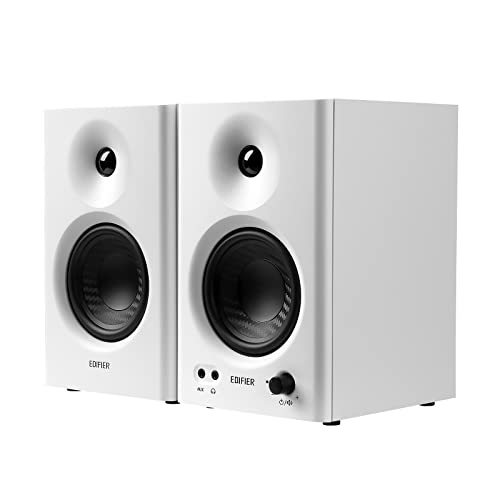
The MR4 answers a specific geometry problem: a desk deep enough for a keyboard and a monitor, but not for the JBL pair above. Edifier’s listing describes a powered studio monitor with a 4-inch composite woofer and a 1-inch silk dome tweeter, carrying hi-res audio certification, which places it in the honest-monitor camp rather than the lifestyle camp. Its cabinets leave room for a screen between them without forcing the listener into a cramped triangle, and that triangle — two speakers and a head, roughly equidistant — is where near-field listening either works or falls apart.
Silk dome tweeters tend toward a smoother top end than metal domes, and in the MR4 that smoothness is a practical mercy: long editing, writing or gaming sessions at close range punish treble glare quickly. The 4-inch woofer sets the expected limit lower down, trading deep bass for a footprint that fits student rooms, spare-room offices and bedroom desks. Podcasts, acoustic music, video calls and most game soundtracks live comfortably inside that trade. Producers working on bass-heavy electronic music should treat the MR4 as a detailed midrange tool and check low-end decisions on headphones as well.
As with the JBL pair, expectations should be set by the monitor brief. This is a wired, work-first design that assumes a computer or interface as its hub; buyers wanting Bluetooth couch streaming should look at the S1000MKII or the A5+ Wireless instead. What the MR4 offers in exchange is focus: a small, truthful window onto whatever the computer plays, in rooms and on desks where a larger window simply would not fit. For the growing number of people whose main listening seat is also their work seat, that focus is the point.
Cables deserve a final word for the MR4, because a compact desk invites a tangle that can hum, buzz or simply look like a nest. Route the power and signal leads in separate bundles, keep the pair’s interconnect clear of laptop power bricks, and leave enough slack to angle the cabinets without strain. A tidy desk is not vanity here: it is how a small near-field system stays quiet in the silences between tracks, which is where cheap setups most often give themselves away.
- Woofer stated in the listing title: 4-inch composite driver
- Tweeter stated in the listing title: 1-inch silk dome
- Certification named in the listing title: hi-res audio
- Format: powered active near-field studio monitor pair
- Amplification: built in, intended to pair with a computer or interface
Strengths
- Small footprint preserves the near-field triangle on shallow desks
- Silk dome tweeter keeps long close-range sessions comfortable
- Monitor tuning suits editing, production and critical listening
Trade-offs
- Four-inch woofer cannot reproduce the deepest bass notes
- Wired, work-first design omits the couch-streaming conveniences
- Bass decisions for electronic music need a headphone cross-check
Best for: a compact work desk where the screen, keyboard and speakers must share depth
Not suited for: a lounge corner expected to fill the room for film nights
Comparison
| Pick | Power and connections | Drivers and cabinet | Where it fits best |
|---|---|---|---|
| Edifier R1280T | Powered pair, 42 watts RMS as stated in its listing, wired sources only | Compact near-field cabinets in a brown finish | Desks and small rooms, listened to from close range |
| Edifier S1000MKII | Powered pair stating 120w, Bluetooth 5.0 with aptX HD, optical input, Class D amp | Large flagship cabinets for stands or a sideboard | Main-room music and television from a sofa-distance seat |
| Audioengine A5+ Wireless | Powered pair with Bluetooth and hi-res audio support, subwoofer output included | Hand built wood cabinets, larger than desk-first rivals here | Living rooms that may add a subwoofer in a later season |
| Kanto YU6 | Powered pair with Bluetooth and a phono preamp inside the cabinet | Matte black pair sized for shelves and sideboards | Vinyl-first rooms that stream between record sessions |
| JBL 305P MkII (Pair) | Two separately powered 5-inch two-way studio monitors in one bundle | Studio cabinets voiced flat for close, single-seat listening | Desks and small studios at roughly an arm’s length |
| Edifier MR4 | Powered monitor pair, 4-inch composite woofer, 1-inch silk dome tweeter | Smallest cabinets in this guide, hi-res audio certified per its listing | Tight desks and single-seat near-field listening |
What Makes a Speaker “Active” Rather Than Merely Powered in Spirit?
An active bookshelf speaker carries its amplification inside the cabinet, so the signal cable from a phone, computer or turntable is the only connection it needs besides mains power. That single fact reorganises a whole system: no receiver to house, no speaker wire to run, no amplifier output figure to match against a speaker’s sensitivity. The amplifier inside was chosen by the same engineers who chose the drivers, and it drives them directly, which is one reason modest active pairs often sound more composed than a budget receiver lashed to passive speakers of similar size.
The internal layout varies, and the variation explains this guide’s two families. Lifestyle pairs usually build amplification into one cabinet and send a speaker-level signal to its partner, keeping a remote control, tone adjustments and input switching in the master cabinet. Studio monitors more often power each cabinet separately and leave control at the source. Both are legitimately active designs. The practical differences are convenience and cabling, not a hierarchy of authenticity, and buyers serve themselves best by choosing the layout that matches their room rather than the one with the more serious vocabulary.
One consequence deserves emphasis: an active pair’s amplifier cannot be upgraded separately. When the sound no longer satisfies, the whole pair is replaced, whereas a passive system lets its owner change one component at a time. For most rooms that trade is worth it — simplicity now outweighs upgrade paths never taken — but listeners who enjoy swapping components as a hobby should recognise that active speakers politely close that door, and this site’s passive guides exist for exactly those readers.
How Much Power Do the Best Active Bookshelf Speakers Need for a Real Room?
Power figures mislead more buyers than any other line on a speaker listing, because a wattage number says nothing by itself about how loud a pair plays in a given room. Loudness at the seat depends on the speaker’s sensitivity, the distance to the listener, and how much of the amplifier’s output is clean rather than strained. Doubling distance from a speaker costs far more volume than a modest power difference can repay, which is why a small pair at a desk can sound commanding while a stronger pair across a large lounge feels merely adequate. Distance, not wattage, is the first variable to fix.
The figures quoted in this guide come only from listing titles, and they illustrate the range honestly: Edifier states 42 watts RMS for the wired R1280T and 120w for the flagship S1000MKII. Those numbers describe different rooms more than different worth. The smaller figure serves a listener a metre away in a bedroom; the larger serves a sofa across a living room with headroom for film peaks. Chasing the bigger number for a desk buys distortion-free volume nobody uses, while under-buying for a lounge leaves a pair straining at exactly the moments — choruses, explosions, crescendos — that should feel effortless.
A practical test beats any calculation. Note your real listening distance, be honest about how loud your loudest sessions actually get, and leave headroom above that level rather than at it. Amplifiers sound their worst in their final stretch of output, so a pair loafing at half effort through your favourite record will satisfy longer than a pair redlining through it. The picks above were chosen so that each one loafs, at its intended distance, through the music its buyer actually plays.
Which Inputs Should You Count Before an Active Pair Arrives?
Make a list of sources before admiring drivers, because an active system’s inputs are its constitution: whatever cannot connect, cannot play. A typical modern household wants a phone or tablet over Bluetooth, a television over optical where offered, a computer by cable or USB on some designs, and perhaps a turntable, which needs either a built-in phono stage or one inside the turntable itself. The YU6’s built-in phono preamp and the S1000MKII’s optical input exist in this guide precisely because those two connections decide whole purchases.
Check the television path with particular care. Many televisions output digital audio over optical, and a pair without a digital input needs the TV’s headphone or analogue output instead, which varies in quality and sometimes disables the TV’s own volume logic in awkward ways. Where a pair offers a subwoofer output, as the A5+ Wireless does, note it even if no subwoofer is planned today; rooms change, and the option costs nothing until used. Where a pair is wired-only, like the R1280T, confirm that a cable run from each source is genuinely convenient, not merely possible.
Finally, think about who controls volume for each source. A remote that adjusts the speakers suits television and sofa listening. A knob on the cabinet suits a desk. An interface or computer volume control suits a studio. Systems feel broken when the control lives somewhere the listener is not, and no sound quality compensates for standing up six times an evening. Match the control to the chair, and the system disappears into the music the way it should.
Where Should Active Speakers Sit to Earn Their Stereo Image?
Stereo is a geometry trick: two speakers and a listener forming a rough triangle, tweeters near ear height, cabinets angled inward so their axes cross near the listening seat. Get that triangle approximately right and voices lock into a phantom centre, instruments take positions, and recordings acquire the depth their engineers built in. Get it wrong — one speaker on a shelf, its partner on the floor, both firing past the listener’s ears — and even excellent speakers collapse into two unrelated sources of noise. Placement is the cheapest upgrade in audio because it is free, and it is the one most often skipped.
Boundaries matter next. A speaker close to a wall gains bass from that wall whether the recording wants it or not, and a speaker in a corner gains it twice over. Lifestyle pairs with generous tuning can turn boomy in corners, while small monitors can benefit from a little boundary help at a desk. There is no universal distance to prescribe, only a method: start with the cabinets a hand’s span or more from the wall behind them, listen to a familiar track, then move them in small steps, trusting the version where bass lines have pitch and voices sound human-sized.
Surfaces complete the picture. Speakers on a hollow desk or a resonant shelf borrow that furniture’s voice, adding buzzes and thickness that no equaliser fully removes. Sturdy stands, a solid sideboard, or simple isolation pads under desk cabinets all serve the same purpose: letting the speaker’s own cabinet be the only box singing. The ten minutes spent on triangle, boundaries and surfaces will do more for any pair in this guide than the price gap between several of them.
How Do You Add a Television, a Turntable and a Phone to One Pair?
Start with the source used most hours, wire it by the best path the pair offers, and build outward. For most households that anchor is the television, ideally over optical into a pair like the S1000MKII, with the TV set to output stereo PCM so the speakers receive a clean two-channel signal. Next add the turntable: straight into the YU6’s phono input if that is the pair, or into a line input from a turntable with its own stage. Phones and tablets then join over Bluetooth for the casual hours, with pairing treated as a guest connection rather than the system’s backbone.
Cable discipline keeps a multi-source system pleasant. Run power cables away from turntable leads, which are sensitive to hum; keep the interconnect between a pair’s two cabinets unstrained and away from foot traffic; and label the inputs at the back once, in daylight, rather than memorising them by feel during a film. When a hum appears, change one thing at a time — a different socket for the turntable, a re-seated cable — because shotgun changes hide causes. Most hums in small systems trace to a ground loop or a cable running beside a power brick, both fixable in minutes once isolated.
Accept one limit gracefully: an active pair is not a home-theatre receiver. It will not decode surround formats, run a centre channel or calibrate a room with a microphone. What it gives instead — honest stereo, simple control, no rack of electronics — is what most music-first households actually use, films included. Viewers who later crave full surround can move the pair to a bedroom or study, where it will serve for years, rather than regretting a purchase that did its first job well.
What Changes When the Listening Seat Moves From Desk to Sofa?
Distance rewrites a speaker’s character. At a desk, the direct sound from the cabinets dominates what reaches the ears, room reflections play a supporting role, and small speakers sound larger than they are. Across a lounge, the room itself becomes a partner in every note: reflections arrive from walls, floor and ceiling, bass gathers in corners, and the pair must work harder to keep voices clear at the far seat. That is why the same active pair can delight its owner at a desk and disappoint after a promotion to television duty, without anything about the speaker changing at all.
The practical response is to buy for the farther seat whenever a pair must serve both. A pair with headroom, a remote and a subwoofer output — the A5+ Wireless pattern — crosses from desk to lounge gracefully, while a small monitor asked to fill a room will strain and sour. Conversely, a flagship pair exiled to a desk wastes its talents at volumes a bedroom cannot use. Readers choosing between this guide’s two families should picture the chair they will actually occupy in six months, not the chair in front of them today, and let that chair decide.
How Should You Test a New Pair During Its First Evenings?
Begin with three recordings you know intimately: one voice-forward, one with genuine bass, one recorded live with room around the instruments. Play them at your normal volume before changing any setting, and note where voices sit, whether bass lines have pitch or merely thump, and whether the live recording’s space survives. Those three judgements, written down in plain words, become the baseline against which every placement tweak is measured. Without a baseline, adjustments chase each other in circles and the pair gets blamed for the room.
Then change exactly one variable per evening. Move the cabinets a few inches from the wall and replay the same three tracks. Angle them toward the seat, then straight ahead, and compare. Swap the television from its default audio setting to stereo PCM if the pair is wired that way. Slow testing feels unglamorous beside unboxing excitement, but it is how owners end up with a system tuned to their room instead of a system tuned to a showroom. By the fourth evening, most pairs in this guide will have found the placement they keep for years.
Which Setup Errors Make Good Active Speakers Sound Ordinary?
Stuffing the cabinets into a bookcase is the quietest way to waste a good pair. A shelf cavity acts like a second, badly designed cabinet, thickening bass and smearing the stereo image, and the effect is worse with powerful pairs like the S1000MKII. If shelves are the only option, pull the cabinets forward until their front faces sit flush with or ahead of the shelf edge, and leave air above and behind them. The difference is audible within one familiar song.
Feeding a monitor pair from a noisy source and blaming the monitors runs a close second. The JBL and MR4 picks reveal hiss, ground noise and compressed streams exactly as they are, which new owners sometimes mistake for speaker faults. Test with a clean source and a good recording before judging any revealing speaker; if the noise vanishes, the chain upstream was the problem, and it usually costs less to fix than the speakers did.
Volume habits cause the third failure: running a small pair at its limit for hours because the room is too big for it. Strain sounds like harshness in the treble and a general sense of effort, and it shortens a speaker’s comfortable life. The cure is matching pair to room at purchase — this guide’s room notes under each pick exist for that reason — rather than heroic volume afterwards. A pair working easily always sounds more expensive than a pair working hard.
A fourth error hides in the shopping itself: buying a pair for the inputs it might grow into rather than the sources on the shelf today. A turntable planned for next year does not justify living without Bluetooth this year, and a television upgrade on a vague horizon should not veto a wired pair that suits every current source. Systems serve the present household or they serve nobody, and the used market forgives a change of direction far more cheaply than a year of daily inconvenience does.
Final Recommendation
If one pair must be named for the widest range of readers, the Audioengine A5+ Wireless takes the role: wood cabinets that suit a shared room, Bluetooth for the casual hours, wired paths for the serious ones, and a subwoofer output that lets the system grow instead of being replaced. It asks only for a proper shelf or stands and a listener who values ease over laboratory flatness.
Choose differently when your seat is a desk chair and your work is sound itself: the JBL 305P MkII pair for a production desk with an interface, or the MR4 where that desk is small. Choose the YU6 when a turntable is the heart of the system, the S1000MKII when a living room wants flagship weight with optical television sound, and the R1280T when wired simplicity at close range is the whole requirement. My own shelf would take the A5+ Wireless for the room the whole household shares, because the best system is the one everybody in the house actually uses.
Whichever pair lands on the shelf, give placement and input-checking the same evening the boxes are opened, because those two free steps decide more of the final sound than the gap between several of these models. An active system’s promise is that the complicated decisions were made by its designers; the owner’s remaining decisions are few, close to free, and worth making carefully.
Frequently Asked Questions
Do active bookshelf speakers need a receiver or amplifier?
No — that absence is the definition of the category. The amplification is built into the cabinets, so a source connects directly and mains power is the only other requirement. A receiver can still feed an active pair from a pre-out in some systems, but it is optional rather than necessary, and most owners of the pairs in this guide will never connect one.
Can active speakers connect to a television without extra boxes?
Usually, yes, provided the inputs line up. A pair with an optical input, like the S1000MKII in this guide, takes a television’s digital output directly; set the TV to stereo PCM and the speakers handle the rest. Pairs with only analogue inputs can use a TV headphone or line output where one exists. Check the specific pair’s inputs against your television’s outputs before ordering, because that single compatibility question decides how smooth the first evening goes.
Are studio monitors a poor choice for ordinary listening?
Not poor — specialised. Monitors such as the JBL 305P MkII pair and the Edifier MR4 are tuned to reveal rather than flatter, and at a desk that honesty is enjoyable as well as useful. Across a room, from several seats, their narrow sweet spot and missing remote control become daily friction. The same pair can be the best tool in one room and the wrong purchase in another, which is why this guide names a listening distance for every pick.
Does Bluetooth quality differ between the wireless pairs here?
It can, because Bluetooth is a family of codecs rather than a single quality level. The S1000MKII’s listing names aptX HD support, which carries more data than basic Bluetooth audio when the sending device also supports it. Phones limited to basic codecs will still work with such a pair, simply at the standard quality level. Wired connections remain the reference for critical listening on every pair in this guide, wireless or not.
Should a first pair include a subwoofer output?
Treat it as a tiebreaker rather than a requirement. A subwoofer output, such as the one on the A5+ Wireless, keeps a future upgrade open without replacing the speakers, which matters in rooms that may grow. In a small flat where deep bass would trouble neighbours anyway, the option may never be used and should not outweigh placement, inputs or tuning that suit the room today.
How long should an active pair be expected to last?
The cabinets and drivers in a decent active pair can serve for many years, and the electronics usually set the practical lifespan. Keeping the pair ventilated, avoiding sustained maximum volume, and protecting it from power surges all extend that life. Wireless standards age faster than amplifiers, which is one quiet argument for wired pairs like the R1280T in rooms where the sources never change.
Related Guides
Three neighbouring guides continue the shelf-sized theme from different directions — one narrows the search to the desk itself, one shrinks the room around the speakers, and one sets a firm pair budget for the shortlist: bookshelf speakers chosen specifically for desk duty compact pairs that behave in small rooms a bookshelf shortlist held to a pair budget