What's inside
- Key Takeaways
- Quick Picks
- How We Chose These Picks
- Comparison
- Why Do Small Rooms Punish Bass That Large Rooms Forgive?
- How Do You Choose a Compact Amplifier for a Passive Pair?
- Where Should Speakers Go When the Room Barely Fits the Furniture?
- What Volume Is Honest in a Small Room — and Why Is Less Often More?
- How Can Furnishings Do the Work of Expensive Acoustic Treatment?
- How Long Should a Small-Room System Be Expected to Serve?
- What Should a Small Room Do About Television Sound?
- Which Small-Room Errors Turn a Promising Pair Into a Boomy Disappointment?
- Final Recommendation
- Frequently Asked Questions
- Related Guides
As an Amazon Associate I earn from qualifying purchases. This post may contain affiliate links at no extra cost to you.
widgetverdict.com is reader-supported. When you buy through links on our site, we may earn an affiliate commission.
Choosing the best bookshelf speakers for a small room inverts the usual hi-fi instincts. In a spare bedroom, a studio flat or a box room turned office, the walls are close, the listening seat is closer, and the bass that sounds thrilling in a showroom can arrive home as a thick, restless boom that follows every note. Small rooms reward restraint: modest cabinets, honest low end, and speakers that stay composed at the gentle volumes neighbours and thin walls impose. The good news is that a small room also flatters a well-chosen pair, because the listener sits near enough to hear detail that a large space would dilute.
Five of the six pairs in this guide are passive, which means each needs an amplifier or receiver to make sound — a small extra box that this guide treats as part of the system rather than a footnote. Passive designs suit small rooms particularly well right now, because compact amplifiers have become genuinely good and genuinely tiny, and because a passive pair can start with a modest amp and grow with a better one later. The sixth pick is a long-standing budget favourite included in prose only, for a listing reason explained in its own section below.
Every design detail credited to a linked pick comes from that pick’s Amazon listing title, checked title by title before this guide was written. Where a title is brief — and some famous names are remarkably brief — the guide says what can be said honestly about the design’s class and role, and declines to invent figures the maker did not publish in the listing. Small-room buying punishes invented numbers more than most, because a driver size or a sensitivity figure guessed wrong can put a wholly unsuitable cabinet against a very near wall.
Readers arriving from larger rooms should also recalibrate their sense of value: in a small room, the cheapest meaningful upgrade is rarely a bigger speaker and often a better position, a quieter amplifier or a rug. The six designs below were chosen to respond to those honest upgrades rather than to demand a larger room as their price of admission.
Key Takeaways
- KEF’s Q1 Meta leads the set: a passive compact hi-fi pair, two-way bass reflex in black, bringing the maker’s current Meta-era design language to small-room scale.
- Wharfedale’s Diamond 12.1i in walnut continues the Diamond line’s small-room vocation, a two-way bookshelf pair with a long reputation for forgiving, musical balance.
- Edifier’s P12 is the wall-friendly passive pair: its listing states plainly that it needs an amplifier or receiver, and notes a built-in wall-mount bracket in a wood finish.
- Klipsch’s R-41M pair is the lively option, a compact Reference-series design in black for listeners who want small-room music to feel awake at low volume.
- Polk’s Signature Elite ES15 is the home-entertainment all-rounder, a passive pair in black pitched at films and music alike, including surround duties.
- The Micca MB42X G2 appears in prose only: the Amazon listing currently offered for it is a renewed listing, so this guide discusses the design without linking that listing.
Quick Picks
| Pick | Badge | Why it earns its place |
|---|---|---|
| KEF Q1 Meta | The compact KEF flagship of the set | A passive compact hi-fi pair in black, two-way bass reflex, positioned by its listing for music, gaming, television and films. |
| Wharfedale Diamond 12.1i | The forgiving Diamond | A two-way bookshelf pair in walnut from Wharfedale’s Diamond line, a series with a decades-long brief for small rooms and modest systems. |
| Edifier P12 Passive | The wall-mountable passive pair | A passive two-way pair in a wood finish whose listing states it needs an amplifier or receiver, with a built-in wall-mount bracket for tight rooms. |
| Klipsch R-41M | The lively compact pair | A compact passive Reference-series pair in black, for small rooms where music should feel alert and present even at neighbour-friendly volume. |
| Polk ES15 | The home-entertainment all-rounder | A passive Signature Elite pair in black whose listing pitches it at home entertainment, home theatre, wall and surround duties as well as stereo music. |
| Micca MB42X G2 | The budget favourite, discussed without a link | A compact passive entry point discussed in prose only, because the Amazon listing currently offered for this model is a renewed listing. |
How We Chose These Picks
Small-room suitability was tested against three realities: a listening distance of roughly one to two metres, walls never far from the cabinets, and volume levels capped by neighbours, children or thin construction. Pairs that need room to breathe — large cabinets voiced for open spaces — were set aside even when their pedigrees impressed, and compact designs with controlled bass behaviour took their places. The result leans passive, partly because the strongest current small-room designs are passive, and partly because a separate compact amplifier gives small-room owners a volume control, tone options and input switching sized to their space.
Amplifier honesty governed the writing throughout. Every passive pick below states its need for an amplifier or receiver in its own section, and the buying-guide sections explain how to choose a compact amp without overspending — because a passive speaker’s price is only part of a system’s price, and guides that hide that arithmetic mislead exactly the first-time buyers who can least afford the surprise. Readers who want amplification built in instead will find this site’s active-speaker guide a better starting point, and it is linked at the foot of this page.
The prose-only Micca was retained deliberately. Its design remains one of the most discussed entry points into passive hi-fi, and a small-room guide that pretended it did not exist would fail readers who will meet its name everywhere else. It is discussed fully — strengths, limits, amplifier needs — with the single difference that no purchase link is offered, because the listing currently available is a renewed one and this guide links only listings it can stand behind as new.
A note on finishes rounds out the method, because small-room speakers are furniture whether their makers admit it or not. The set deliberately spans black pairs that disappear beside screens and wood finishes that warm a lived-in room, and readers should choose with the room’s light and furniture in mind. A speaker looked at happily for a decade is a better purchase than a marginally finer one that irritates its owner daily from the corner of an eye.
Finally, every pick was asked a renter’s question: could this pair move to a different small room next year and still make sense? Designs tied to one exotic placement or one proprietary partner failed that test, while the six survivors — shelf, stand or wall, with amplifiers of many kinds — all travel well. Small-room life is mobile life, and equipment that moves gracefully is equipment that stays in service.

KEF Q1 Meta — The compact KEF flagship of the set
KEF’s Q1 Meta carries the most ambitious engineering in this guide into the smallest rooms. The listing describes a passive compact hi-fi bookshelf pair in black, built as a two-way bass-reflex design, and aimed at music, gaming, television and films — a breadth that suits small rooms, where one pair of speakers typically serves every form of entertainment the household consumes. Being passive, the Q1 Meta needs an amplifier or receiver between any source and the cabinets; budget for that partner from the start, and choose one with the inputs your television and streamer require.
KEF’s long-running design theme is coincident drivers — treble produced from the heart of the midrange cone — and the listening benefit in a small room is focus: voices and instruments hold a precise position between the cabinets even when the listener sits closer than ideal or slightly off to one side. Box rooms and spare rooms rarely permit a perfect centred chair, and a pair that keeps its composure for a listener on the bed, at the desk or in the corner armchair earns gratitude daily. The Meta generation is the maker’s current refinement of that theme, and the Q1 is its compact entry point.
Bass behaviour is where small rooms judge harshest, and a compact two-way bass-reflex cabinet like this one walks a line: enough low-end presence to give music body at modest volume, without the oversized output that excites a small room’s resonances into boom. Placement still matters — a little air behind the cabinets, rather than hard contact with the wall, keeps the reflex tuning honest — but the Q1 Meta starts from a scale that suits the room instead of fighting it. Paired with a decent compact amplifier, it is the pair in this guide most likely to end a small-room owner’s search outright.
One more consideration favours this pick in tight spaces: a single pair doing everything removes the temptation to add a soundbar for television and keep separate speakers for music, a duplication small rooms can rarely house gracefully. Fed from an amplifier with an HDMI or optical television input, the Q1 Meta becomes the room’s only speakers, and the shelf space saved is as real a benefit as any in its sound.
Second-hand amplifiers deserve a mention beside this pick, because a compact KEF pair fronted by a well-kept used integrated amplifier is one of the classic small-system recipes. Check any used amplifier for quiet volume controls, clean switches and honest ventilation, and the pairing can deliver main-system composure in a room that seats two. The speakers will outlast several such partners, which is precisely the passive bargain working as intended.
- Format stated in the listing title: passive compact hi-fi bookshelf pair
- Configuration stated in the listing title: two-way bass reflex
- Finish named in the listing title: black
- Partner equipment required: an amplifier or receiver, as with any passive pair
- Suggested uses in the listing title include music, gaming, TV and movies
Strengths
- Precise imaging holds together for off-centre seats in awkward rooms
- Compact scale suits small-room distances and modest volumes
- One pair can cover music, gaming and television without duplication
Trade-offs
- An amplifier or receiver is a necessary extra purchase
- Bass-reflex tuning still prefers some air behind the cabinets
- Entry point to a premium line, priced by ambition rather than by size
Best for: a box room or spare room where one pair must do every listening job well
Not suited for: a buyer expecting sound from the box with no amplifier in the house

Wharfedale Diamond 12.1i — The forgiving Diamond
Few speaker lines have served small rooms as long as Wharfedale’s Diamonds, and the 12.1i in walnut continues that assignment. The listing is terse — a two-way bookshelf speaker in a walnut finish — so this guide describes the design by its lineage and role rather than by invented figures: Diamonds are passive speakers, and this pair needs an amplifier or receiver like the other passive picks here. What the line has always sold is balance that forgives: forgiving of modest amplifiers, of imperfect recordings, of rooms with hard floors and bare walls, which is to say, forgiving of exactly the conditions small rooms provide.
The walnut finish deserves its sentence, because small-room speakers are seen as much as heard. In a spare room or studio flat, cabinets sit within the eyeline all day, and a warm wood finish reads as furniture where black boxes read as equipment. Households furnishing a room to live in, rather than a studio to work in, consistently underrate how much that daily visual tone matters to long-term satisfaction with a system.
Musically, the Diamond approach suits small-room hours: an easy, unforced presentation that keeps long listening pleasant at the low-to-moderate volumes small spaces impose. Streaming radio through a working day, records in the evening, a film at considerate level — the pair stays composed and unshowy through all of it. Listeners chasing the last degree of forensic detail should look to the KEF pick; listeners who want music to feel welcome in the room, hour after hour, are the Diamond’s natural constituency and have been for generations of this line.
Amplifier pairing is undemanding in principle: a compact integrated amp or a small receiver with enough inputs for the room’s sources will wake the pair properly. Because the Diamond brief is friendliness, even an older amplifier pressed back into service can anchor a satisfying system, which makes this pick a gentle route for readers reviving equipment they already own.
There is also a generational point in the Diamond’s favour: a line refined across decades tends to arrive with its manners already learned. Owners rarely report Diamonds dominating a room or demanding exotic partnering equipment, and in small spaces that predictability is a form of luxury. Buyers furnishing a first real system, in a room they are still learning, could do far worse than choose the pair least likely to surprise them unpleasantly.
- Configuration stated in the listing title: two-way bookshelf speaker
- Finish named in the listing title: walnut
- Format: passive pair — an amplifier or receiver is required
- Lineage: Wharfedale’s Diamond series, long associated with smaller rooms
- Amplification: none built in; the partner amplifier supplies all power
Strengths
- Forgiving balance suits modest amplifiers and imperfect rooms
- Walnut finish integrates with lived-in rooms better than black boxes
- Easy long-session character matches small-room listening hours
Trade-offs
- Listing brevity leaves specification hunters with little to read
- Ultimate detail retrieval trails the KEF pick in this guide
- Passive design adds an amplifier to the shopping list
Best for: a studio flat or spare room furnished for living, with music playing most of the day
Not suited for: a detail-obsessed listener building a forensic near-field rig
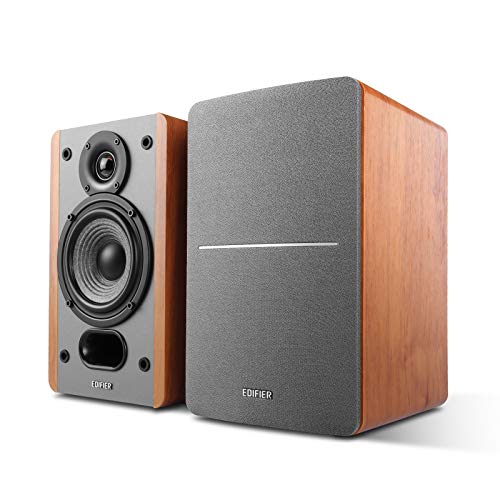
Edifier P12 Passive — The wall-mountable passive pair
Edifier is better known for powered speakers, which makes the P12’s honesty in its listing title refreshing: this is a passive two-way bookshelf pair, in a wood finish, that needs an amplifier or receiver to operate, and it carries a built-in wall-mount bracket. That bracket is the pick’s reason for being in a small-room guide. Rooms short on shelf depth and floor space often have exactly one underused surface — the wall — and a speaker designed to mount there tidily, rather than perch on a wobbling aftermarket bracket, solves the placement problem at the design stage.
Wall mounting carries acoustic consequences worth planning for. A cabinet against a wall gains bass reinforcement from that boundary, which can flatter a compact passive pair at low volume or thicken it at higher volume depending on the room. The small-room owner’s countermeasures are placement height — tweeters near seated ear level — and a modest amplifier with tone controls for the final adjustment. Managed that way, a wall-mounted pair frees an entire piece of furniture, which in a box room can be the difference between a listening chair fitting and not fitting.
As a passive design, the P12 also suits rooms wired into a wider system: a spare room fed by a receiver in the lounge, a kitchen extension of a main system, a rental where speakers must leave no trace beyond small bracket fixings. The wood finish keeps the mounted pair looking intentional rather than industrial. Buyers should simply walk in with eyes open about the amplifier requirement — the listing itself insists on it — and treat a compact amp as part of this pick’s true cost, exactly as with its passive companions here.
A practical mounting note: brackets belong in studs or proper wall fixings, never in plasterboard alone, and speaker cable can be run in slim trunking that paints to match the wall. An hour of careful installation buys years of reclaimed shelf space, and in the smallest rooms that trade is often the whole ballgame.
Renters in particular should note the P12’s double life: mounted in a long-term home it reclaims shelf space, while in a short let the same pair can sit conventionally on furniture with the brackets simply unused. Few speakers adapt to both housing situations without compromise, and small-room life is often a sequence of exactly such situations. Flexibility of placement, like flexibility of amplification, compounds in value as rooms change.
- Format stated in the listing title: passive bookshelf pair, two-way
- Requirement stated in the listing title: needs an amplifier or receiver to operate
- Mounting feature stated in the listing title: built-in wall-mount bracket
- Finish described in the listing title: wood colour
- Amplification: supplied entirely by the partner amplifier or receiver
Strengths
- Built-in bracket solves placement where shelves and stands cannot go
- Wall position frees furniture space in the smallest rooms
- Passive design can join a wider receiver-based system
Trade-offs
- Wall proximity boosts bass, which may need tone adjustment
- Mounting is a semi-permanent installation decision
- Amplifier purchase is mandatory, not optional
Best for: a box room or kitchen-diner where the wall is the only free surface
Not suited for: a renter forbidden from making any wall fixings at all

Klipsch R-41M — The lively compact pair
Klipsch builds speakers for listeners who find polite hi-fi a little sleepy, and the R-41M brings that house character to small-room scale. The listing presents a Reference bookshelf pair in black; as a passive design it needs an amplifier or receiver, and its compact cabinets are sized for the shelves and sideboards small rooms actually have. Klipsch’s long-standing design signature — horn-loaded treble — is associated with an efficiency and liveliness that pays a specific small-room dividend: music that retains its sparkle and presence at low volume, when lesser pairs turn grey and distant.
That low-volume life matters more in small rooms than any maximum loudness figure, because small-room listening happens at modest levels by necessity. A pair that only wakes up when driven hard is a pair at war with its own room. The R-41M’s alertness at gentle levels suits evening listening in flats, desktop-adjacent shelves in spare rooms, and television dialogue that must stay clear without turning the set up. Rock, pop and film scores — material that thrives on immediacy — flatter the design’s instincts.
Balance expectations honestly: a lively treble-forward character divides listeners, and those who prefer a laid-back, warm presentation for classical marathons may find the Klipsch manner restless over hours. The cure for uncertainty is the room itself — small, furnished rooms with soft surfaces tame liveliness naturally, while bare, echoey box rooms amplify it. Furnishings, in other words, are part of this pick’s tuning, and a rug and curtains are legitimate hi-fi purchases in a small hard room.
Amplifier matching is straightforward, since an efficient-leaning design does not demand a powerhouse; a compact integrated amplifier with clean low-volume behaviour serves better than a brute with a coarse volume control. Spend the system budget on the amplifier’s manners rather than its muscle, and the R-41M pair will sound like the upgrade small-room owners hope for.
Television sports are an underrated test that the R-41M passes with ease. Crowd noise, commentary and the thump of a ball all live in the presence region where this design is most awake, so matches stay intelligible and exciting at volumes a flat can sustain on a Sunday afternoon. Owners whose small-room listening mixes music with a heavy fixture list will find the Klipsch character consistently on their side.
- Format from the listing title: Reference bookshelf speakers, sold as a pair
- Finish: black, exactly as the listing title states
- Power: none on board; the partner amplifier supplies everything
- Design character: Klipsch’s horn-loaded approach, associated with lively efficiency
- Amplification: none built in; partner amplifier supplies all power
Strengths
- Stays vivid at the low volumes small rooms impose
- Compact cabinets fit ordinary shelves and sideboards
- Dialogue clarity flatters television duty in small spaces
Trade-offs
- Lively treble character will not suit every listener or bare room
- Still needs an amplifier, despite the compact footprint
- Warm-presentation seekers should audition the Diamond first
Best for: a flat’s living corner where evening listening must stay considerate yet awake
Not suited for: a bare, echoey room paired with a settled taste for a mellow, distant balance

Polk ES15 — The home-entertainment all-rounder
Polk’s Signature Elite ES15 arrives with the broadest job description in this guide. Its listing calls it a passive bookshelf pair for home entertainment, and goes on to name home theatre, wall and surround roles alongside ordinary stereo music. That versatility maps neatly onto small-room reality, where a single pair may begin as the stereo system, graduate to front channels beside a television, and eventually move to surround duty when a room’s ambitions grow — a career path few speakers can offer, and one that protects the purchase against the owner’s own future plans.
In black, per the listing, the ES15 keeps a low visual profile beside a television, which is where many small-room pairs spend their lives. As a passive design it needs an amplifier or — for the theatre path — an AV receiver, and that requirement should shape the system plan from day one: a stereo amplifier serves the music-first room today, while a receiver keeps the surround door open for tomorrow. Either partner wakes the pair; the choice is about the room’s direction, not the speakers’ demands.
Sonically, Polk’s Signature Elite brief is mainstream in the complimentary sense: a balanced, broadly appealing presentation tuned for the mixture of films, streamed series and music that small-room systems actually play, rather than for a single audiophile genre. Dialogue sits naturally, effects have scale without aggression, and music avoids the eccentricities that make some specialist pairs tiring across a whole evening of varied content. Generalists are sometimes sneered at in hi-fi; in a small room that must do everything, generalism is the specialty.
Buyers building toward a matched home-theatre set will also value that the ES15 belongs to a wider Signature Elite family, so centre and surround partners with the same voicing exist when the time comes. Matched voicing across channels is what makes film sound pan seamlessly, and starting with a family member rather than an orphan design keeps that future simple.
The ES15 also earns a note for households where the television is the true centre of the room and music arrives through it — streamed concerts, music channels, games with serious scores. A pair voiced for entertainment handles those hybrids gracefully, without the analytical edge that can make broadcast audio sound threadbare. In small rooms, where the screen and the speakers are rarely more than a glance apart, that grace is a daily quality rather than a specification.
- Line named in the listing title: Signature Elite ES15 bookshelf pair
- Format stated in the listing title: passive bookshelf speakers
- Colour named by the listing: black (stunning black, in the listing’s words)
- Roles named in the listing title include home theatre, wall and surround use
- Partner equipment required: an amplifier for stereo, a receiver for theatre paths
Strengths
- Career path from stereo pair to theatre channels protects the purchase
- Broadly balanced tuning suits mixed film, series and music diets
- Matching family members exist for future centre and surround additions
Trade-offs
- Generalist tuning offers less character than specialist rivals
- Theatre ambitions require a receiver, raising system cost
- Black finish is the listing’s offer; décor-led rooms may prefer wood
Best for: a small living room where stereo today may become home theatre next year
Not suited for: a purist two-channel listener with no interest in film duties
Micca MB42X G2 — The budget favourite, discussed without a link
The Micca MB42X G2 has introduced more listeners to passive hi-fi than almost any rival, which is why a small-room guide cannot honestly skip it — and why its presentation here needs care. The Amazon listing currently offered for this model is a renewed listing rather than a new one, so this guide discusses the design in prose only and offers no purchase link for it. Readers who find the model elsewhere should check exactly what condition and warranty a given listing represents before paying; the design’s reputation was built by new units sold through ordinary retail channels.
As a design, the MB42X G2 is a compact passive bookshelf speaker: it needs an amplifier or receiver, like the linked passive picks above, and its small cabinets were always aimed at desks, shelves and modest rooms. The second-generation update refined the original’s crossover and balance, and the pair built its following on a simple proposition — that a genuinely listenable stereo system could begin with inexpensive speakers and a small amplifier, leaving money for the music itself. In a small room, that proposition remains attractive, because the distances involved forgive a compact speaker’s limits.
Those limits should be stated as plainly as the listing situation. Bass from cabinets this size is modest, maximum volume in anything beyond a small room is not on offer, and the design’s following sometimes oversells it into rivalries with speakers several times its size, which it cannot win. What it can do — and what made it famous — is present a coherent, enjoyable stereo picture at a desk or in a bedroom for very little system money, especially when paired with a compact amplifier bought used or on offer.
Readers set on this model have three honest routes: wait for a new listing through a channel they trust, buy the renewed listing with eyes open about what renewed means for warranty and cosmetics, or take the design as a signpost toward the linked passive picks in this guide, several of which occupy neighbouring territory with listings this guide can link without qualification. Any of the three is defensible; pretending the listing situation does not exist would not be.
One more honesty note completes the Micca picture: because no link is offered here, readers comparing prices should be careful to compare like with like — a renewed unit against the new listings of rival designs is not a fair fight in either direction. Judge the design by the role described in this section, judge any particular listing by its stated condition and warranty, and keep the two judgements separate. That separation is the whole reason the pick appears in prose.
- Format: compact passive bookshelf design — an amplifier or receiver is required
- Generation: the G2 update of the MB42X design
- Intended territory: desks, shelves and modest rooms
- Coverage in this guide: discussed in prose, with no purchase link offered
- Amplification: none built in; a compact partner amplifier is the usual match
Strengths
- Long-standing entry point into passive hi-fi for small spaces
- Compact cabinets suit desks and bedroom shelves
- Simple system recipe leaves budget for a decent small amplifier
Trade-offs
- Currently offered Amazon listing is renewed, so no link is given here
- Small cabinets cap bass and volume in the usual way
- Reputation sometimes inflates expectations beyond its class
Best for: a patient first-time buyer assembling a small passive system on a tight budget
Not suited for: any purchase that requires a linked, new listing with ordinary warranty terms today
Comparison
| Pick | Power and connections | Drivers and cabinet | Where it fits best |
|---|---|---|---|
| KEF Q1 Meta | Passive pair needing an amplifier, two-way bass reflex, black finish | Compact hi-fi cabinets from KEF’s current Meta generation | Small rooms wanting a single do-everything pair |
| Wharfedale Diamond 12.1i | Passive two-way pair needing an amplifier, walnut finish | Diamond-line cabinets voiced for friendliness over analysis | Lived-in small rooms and revived older amplifiers |
| Edifier P12 Passive | Passive two-way pair, amplifier required, wall bracket built in | Wood-finish cabinets designed to mount rather than perch | Rooms trading shelf space for wall space |
| Klipsch R-41M | Passive Reference pair needing an amplifier, black finish | Compact cabinets with a lively, efficient-leaning character | Small furnished rooms and low-volume evening listening |
| Polk ES15 | Passive Signature Elite pair, amplifier or receiver required, black | Entertainment-first cabinets pitched at theatre and surround roles too | Small rooms planning a gradual theatre build |
| Micca MB42X G2 | Compact passive design, amplifier required, covered without a link | Small cabinets from a well-known budget line, second generation | Desks and bedrooms, for buyers comfortable with the listing situation |
Why Do Small Rooms Punish Bass That Large Rooms Forgive?
A small room is not a quiet large room; it is a different acoustic instrument. Every room reinforces certain bass frequencies determined by its dimensions, and in small rooms those reinforcements land squarely in the range where music’s bass energy lives, turning notes into booms that linger and blur the notes around them. The closer the walls, the stronger and more uneven the effect. This is why a speaker that sounded lean and precise in a dealer’s open floor can arrive in a box room and appear to have gained a woofer it does not own.
The practical defences are selection, placement and volume. Selection means choosing compact designs whose natural output suits the room — the premise of this entire guide. Placement means keeping cabinets out of corners, where two walls and a floor conspire to triple the reinforcement, and giving rear-venting designs a little air. Volume means accepting that small rooms reach satisfying loudness early, so the extra output that excites the room’s worst behaviour is simply never requested. Owners who internalise those three defences stop fighting their rooms and start enjoying the intimacy small spaces offer: detail, presence and a sense of musicians playing nearby.
Tone controls and amplifier equalisation can trim the worst excess, and a compact amplifier with a simple bass adjustment is worth favouring for a small room for exactly this reason. But equalisation trims; it cannot relocate a speaker out of a corner or shrink a cabinet. Spend the first effort on the free physical fixes, and let electronics handle only what remains.
How Do You Choose a Compact Amplifier for a Passive Pair?
Begin with inputs, because they decide what the system can hear. A small-room amplifier typically needs a television path — optical or HDMI where offered — a streaming path, which may be Bluetooth or a separate streamer, and an analogue input for a turntable or a computer. Count the sources the room actually holds, add one spare, and reject any amplifier that falls short, however charming its dial. Then consider volume behaviour: small rooms live at the bottom of the volume range, so a control that moves in fine, even steps at low settings is worth more than a headline power figure.
Power itself needs demystifying for compact systems. At small-room distances and volumes, even modest amplifiers deliver satisfying loudness through typical bookshelf pairs, and the lively Klipsch pick in this guide asks particularly little. What better amplifiers buy is not volume but composure — cleaner low-level performance, quieter backgrounds, better control of the speaker at the moments music gets busy. A sensible budget split gives the speakers the larger share and the amplifier enough to be composed, rather than starving the speakers to fund an amplifier whose talents the room cannot use.
Form factor is the final filter, and small rooms make it decisive. Compact and desktop amplifiers exist precisely for shelves that cannot house a full-width receiver, while AV receivers — the ES15’s theatre path — justify their bulk only when surround is a genuine plan rather than a vague someday. Buy the box the room can house and the plan actually requires, and the system stays welcome in its own space.
Where Should Speakers Go When the Room Barely Fits the Furniture?
Start from the chair, not the wall. Mark where the listener actually sits for music — a bed’s headboard end, a desk chair, one beloved armchair — and build the stereo triangle from there, even if the result is a small triangle in one corner of the room rather than a grand arrangement spanning its width. A modest triangle honestly arranged beats a wide, lopsided layout every time, because the ear cares about symmetry and distance, not about how impressively the speakers occupy the room.
Height is the small-room owner’s free adjustment. Cabinets on low furniture fire at knees; raised to seated ear level on stands, shelves or the P12’s wall brackets, the same pair gains clarity and image focus that no purchase can match pound for pound. Where stands cannot fit, tilt becomes the substitute: angling a low cabinet upward toward the listener recovers much of the tweeter’s direct sound. Foam pads or a folded cloth under the front edge achieve the tilt for pennies.
Finally, treat the wall behind the listener as part of the system. A seat hard against a rear wall receives a slap of reflected sound that smears detail, so even thirty centimetres of breathing room — a chair pulled slightly forward, a bed’s listening position nearer its middle — pays audible dividends. Small rooms rarely allow ideal geometry, but they reward every honest approximation of it, and the owners who experiment patiently end up with sound their floor plans said was impossible.
What Volume Is Honest in a Small Room — and Why Is Less Often More?
Small rooms reach satisfying loudness at levels that would vanish in a hall, because the listener sits close and the walls return energy instead of letting it escape. That efficiency is a gift: amplifiers loaf, speakers stay composed, and hearing stays safe across long sessions. The trap is importing large-room habits — turning up until the sound feels physical — which in a small room means distortion from the room’s resonances long before the speakers themselves strain, plus a neighbour-relations bill arriving shortly after.
A useful discipline is the conversation test. Music at a level where a spoken sentence across the room remains intelligible will carry detail, bass pitch and stereo depth without exciting the room’s worst behaviour, and most small-room listening happily lives near that level. Films ask for a little more during peaks and a little less during dialogue, which is why a conveniently placed volume control — on the amplifier, within reach of the chair — is a small-room feature of genuine importance.
Listeners who consistently crave more volume in a small room are often craving something else: clarity. When detail is buried by boom or bad placement, turning up feels like the only lever, yet it worsens the burial. Fix the placement, trim the bass, sit in the triangle — and the same music at the same level suddenly satisfies. Volume is the last dial to reach for in a small room, and the owners who learn that order keep both their hearing and their systems longer.
How Can Furnishings Do the Work of Expensive Acoustic Treatment?
A small room’s sound is largely the sound of its surfaces, and most small rooms begin life acoustically bare: painted walls, a hard floor, one window. Music in such a room sounds bright and busy not because the speakers are harsh but because every note arrives several times, milliseconds apart, from each reflective surface. The traditional cures are furnishings rather than products — a rug between speakers and listener, curtains over the window, a bookcase along a side wall, upholstered seating. Each soft or irregular surface absorbs or scatters reflections, and together they calm a room more completely than any single gadget.
The order of operations matters for morale as much as for sound. Start with the floor, because the rug also makes the room pleasanter to live in, then the window, then consider what the wall behind the speakers or behind the listener can accept. Listen after each change with the same familiar recording, and stop when voices sound natural and handclaps in the room itself stop fluttering. Owners are often surprised to discover their speakers were never the problem — the room was simply unfinished, and finishing it improved everything placed inside it.
How Long Should a Small-Room System Be Expected to Serve?
Passive bookshelf speakers are among the longest-lived objects in a home, because they contain nothing that software can obsolete and little that ordinary use can wear. A pair bought for a box room today can serve a flat, a house and a study across decades, changing amplifiers and sources as fashions move while the cabinets simply continue. That longevity reframes the purchase: the relevant comparison is not this month’s budget against a listing, but the cost of the pair spread across the rooms it will inhabit. Check price on Amazon for the linked designs, then divide by the years a well-kept pair realistically serves, and the arithmetic often justifies reaching one step higher than planned.
Care is mostly a matter of environment. Keep cabinets out of sustained direct sunlight, which fades finishes and ages driver surrounds; keep them dry, dusted and away from radiators; and avoid the slow damage of amplifiers driven into distortion at parties, which harms tweeters more reliably than any accident. None of this asks expertise, only the same mild attention given to wooden furniture — which, in a small room where the speakers are always in view, they effectively are.
What Should a Small Room Do About Television Sound?
Television is the source small-room systems most often serve and most often serve badly, because the set’s own speakers face downward or backward and the room’s real speakers sit idle beside it. The fix is architectural rather than expensive: route the television’s audio through the amplifier that drives the bookshelf pair, using an optical or HDMI path where the equipment offers one, and set the television to hand its sound over permanently. Dialogue immediately gains a dedicated, forward-facing pair of drivers at ear level, and the nightly volume drops because clarity no longer has to be bought with loudness.
Placement for television follows the screen. The pair should flank the set at roughly equal distances, at a height that serves both the viewing seat and the music chair — usually the same seat in a small room, which simplifies everything. Where the screen sits in a corner, accept an asymmetric compromise for films while keeping the music triangle honest, or choose the seat that matters most and optimise for it. Small rooms forgive many things, but they reward the owner who decides which seat is the throne and builds around it.
Which Small-Room Errors Turn a Promising Pair Into a Boomy Disappointment?
Choosing by showroom impression leads the list. A pair auditioned in a large open space — or judged by reviews written in one — arrives in a box room with bass behaviour nobody predicted. Small-room buyers should weight compact designs, controlled low end and close-distance performance over the spacious drama that wins demonstrations, and should treat any review that never mentions room size as incomplete evidence for their purposes.
Forgetting the amplifier in the budget is the financial version of the same error. Passive speakers are half a system, and a buyer who spends everything on cabinets and feeds them from an inadequate afterthought has built disappointment into the invoice. The honest comparison is always system against system: passive pair plus suitable amplifier, weighed against an active pair at the same total. This guide’s linked picks were chosen to win that honest comparison in small rooms, but the comparison must still be made with real totals.
The third error is corner placement by default — speakers shoved where they fit rather than where they sound. Corners maximise exactly the bass reinforcement small rooms already overproduce, and the resulting boom gets blamed on the speakers. Even a hand’s breadth of relocation, out of the corner and away from the wall, can transform the same pair. Placement is free, reversible and immediate; there is no excuse for skipping it and several decibels of boom for those who do.
One last caution concerns volume promises made by well-meaning friends with larger rooms, whose advice to buy for the house you might own someday saddles the room you actually inhabit with speakers it cannot digest.
A fourth small-room error is buying the amplifier last and the cables never — discovering on delivery day that the television’s output and the amplifier’s inputs do not meet, or that the speaker cable run falls a metre short of the only sane cabinet position. Measure the runs, list the connections, and order the unglamorous parts with the glamorous ones. Systems fail on delivery day for want of a cable far more often than for want of quality.
Final Recommendation
Forced to furnish one small room from this guide, the KEF Q1 Meta takes the assignment: compact, precise, composed at modest volume, and versatile enough to cover the music, gaming and television a small room concentrates into a single pair. Add a compact amplifier with the inputs the room needs, place the cabinets with a little air around them, and the system will embarrass many larger installations.
Other rooms will choose otherwise, and rightly. The Diamond 12.1i suits the lived-in flat that plays music all day, the P12 suits the room whose only free surface is a wall, the R-41M suits the listener who wants low-volume evenings to stay lively, and the ES15 suits the room quietly planning a theatre future. My own spare room would take the Q1 Meta, because small rooms reward precision above all else — and precision, once heard at close range, is difficult to give up.
Whichever pair is chosen, resist judging it on the first evening in an unfurnished room at an ambitious volume. Small rooms tell the truth slowly: place carefully, furnish kindly, listen at honest levels, and a compact system will repay the patience with a closeness to the music that large rooms spend heavily to imitate.
Frequently Asked Questions
Do passive speakers always need a separate amplifier?
Yes — passive means the cabinets contain no amplification, so an amplifier or receiver must supply the power and the volume control between the source and the speakers. That is true of the KEF, Wharfedale, Edifier P12, Klipsch, Polk and Micca designs in this guide. The amplifier need not be large or costly for a small room; a compact integrated model with the right inputs completes the system, and the guide’s amplifier section explains how to choose one.
Why is the Micca MB42X G2 not linked like the other picks?
Because the Amazon listing currently offered for that model is a renewed listing rather than a new one, and this guide links only listings it can present without qualification. The design itself is discussed fully in its section — its amplifier requirement, its small-room strengths and its limits — so readers can judge it on merit and decide for themselves whether a renewed listing, a wait for a new one, or a linked alternative suits them best.
Can a small room handle a subwoofer with bookshelf speakers?
Occasionally, but it is rarely the first upgrade a small room needs. A subwoofer adds the deepest bass, yet small rooms already over-reinforce low frequencies, so placement and level discipline become critical and the gains are easily lost to boom. Most small-room owners get more from correct speaker placement and a composed amplifier. Rooms used heavily for films, with space to place a subwoofer away from corners, are the reasonable exception.
How close to the wall can small-room speakers sit?
Closer than large-room advice suggests, but rarely touching. A little air behind a bass-reflex cabinet keeps its tuning honest, while wall mounting — the P12’s party trick — is a designed exception where boundary reinforcement is part of the plan and tone adjustment may be needed. Experiment in small steps with familiar music: the position where bass lines gain pitch and lose thump is the right one for that room.
Are compact speakers loud enough for films in a small room?
Yes, at small-room distances the pairs in this guide reach film levels comfortably, especially through a receiver or amplifier with a television input. Dialogue clarity matters more than raw level in a small space, and bookshelf pairs generally beat televisions’ built-in speakers by an embarrassing margin. Viewers building toward surround can start with the ES15 path described in this guide and add matched channels later.
Should a small room choose passive or active speakers?
Both routes work, and the choice is about system shape. Passive pairs, the focus here, offer amplifier choice, upgrade paths and the strongest current compact designs, at the cost of an extra box. Active pairs simplify the shelf and the cabling, and this site’s active guide covers them fully. Small rooms with an existing amplifier, or owners who enjoy component choices, lean passive; rooms craving minimalism lean active.
Related Guides
Small-room questions rarely stay small for long — the neighbouring guides take the same shelf-sized speakers to the desk, and then ask what a defined pair budget does to the shortlist: bookshelf pairs held to a defined pair budget bookshelf speakers at the high end of the range wireless bookshelf pairs on a tight budget


