What's inside
- Key Takeaways
- Quick Picks
- How We Chose These Picks
- Comparison
- How Can You Tell a Genuinely Bluetooth Pair From a Wired Lookalike?
- Optical, HDMI ARC or AUX: Which Television Path Should a Budget Pair Use?
- What Does a Wattage Figure Mean on a Budget Bookshelf Listing?
- Where Should a Budget Pair Sit in a Bedroom, Kitchen or Student Room?
- How Should You Set Up a Budget Pair on Its First Evening?
- How Do You Share a Budget Pair Between a Household’s Phones?
- What Should You Check in the First Week Before the Return Window Closes?
- Which Budget Bluetooth Mistakes Send the Most Pairs Back?
- Final Recommendation
- Frequently Asked Questions
- Related Guides
As an Amazon Associate I earn from qualifying purchases. This post may contain affiliate links at no extra cost to you.
widgetverdict.com is reader-supported. When you buy through links on our site, we may earn an affiliate commission.
The best bluetooth bookshelf speakers under 100 — dollars, as the topic’s budget frame — answer a very modern wish: a real stereo pair, with real separation and a shelf-friendly footprint, that a phone can feed without cables, at a total that does not require a savings plan. The figure in this guide is a frame for the shortlist, not a price stamped on any individual model, because listings drift with promotions and finishes; check price on Amazon for any pair that reaches your own final two, and spend the comparison effort on connections, drivers and build, which are the parts of the purchase that stay true after the promotion ends.
Bluetooth bookshelf pairs at this level are all powered designs, with amplification built into the cabinets, so no receiver joins the bill. That architecture suits the rooms these speakers serve — bedrooms, kitchens, student flats, spare rooms, desks that moonlight as entertainment centres — where a phone or a television is the source and simplicity is a feature rather than a compromise. The differences among the six picks below are differences of emphasis: one brings an optical input and a subwoofer line out, one brings an HDMI ARC television connection and a remote, one is a studio monitor that happens to carry modern Bluetooth, and one is discussed without a link for a pool reason explained in its own section.
Every specification credited to a linked pick traces to that pick’s Amazon listing title, verified through this site’s Creators API pool — wattage where the title states wattage, Bluetooth versions where the title names them, inputs where the title lists them. Where a title is silent, the guide stays silent too, because at this end of the market invented figures are the most expensive kind of free.
Key Takeaways
- Edifier’s R1280DBs leads the set: an active Bluetooth pair with an optical input, a stated 42W RMS and a subwoofer line out, in a wood grain finish.
- Neumi’s BS5P-ARC is the television specialist, a powered pair stating 75W with Bluetooth, HDMI ARC, a 5-inch woofer, a 1-inch tweeter, USB, optical and coaxial inputs, and a remote control.
- Sanyun’s SW208 is the compact PC-friendly pair: 3-inch active Bluetooth 5.0 cabinets with a built-in 24-bit DAC, a stated 60W, and USB plus 3.5mm AUX inputs.
- MEVOSTO’s active 5-inch pair brings Bluetooth 5.4 with RCA and AUX for televisions, USB audio for PCs, dual 1-inch silk-dome tweeters and bass and treble adjustment.
- Edifier’s MR3 is the monitor-grade option, a hi-res certified powered speaker with Bluetooth V5.4, a headphone output, and RCA, AUX and balanced TRS inputs.
- The Bestisan SR04 is covered in prose only: no verified listing for it sits in this site’s pool, so the guide discusses the design without offering a link.
Quick Picks
| Pick | Badge | Why it earns its place |
|---|---|---|
| Edifier R1280DBs | The complete budget package | An active Bluetooth pair with an optical input, a stated 42W RMS, a subwoofer line out and a wood grain finish — the set’s all-rounder. |
| Neumi BS5P-ARC | The television specialist | A powered pair stating 75W, with Bluetooth, HDMI ARC, a 5-inch woofer, 1-inch tweeter, USB, optical and coaxial inputs, a remote and a dark wood finish. |
| Sanyun SW208 | The compact PC-friendly pair | A 3-inch active Bluetooth 5.0 pair with a built-in 24-bit DAC, a stated 60W, carbon fibre drivers, and USB plus 3.5mm AUX inputs, in black. |
| MEVOSTO Active Bookshelf Speakers (5-Inch) | The tone-adjustable newcomer | An active 5-inch pair with USB audio for PC, Bluetooth 5.4 with RCA and AUX for televisions, dual 1-inch silk-dome tweeters and bass and treble controls. |
| Edifier MR3 | The monitor-grade Bluetooth option | A hi-res certified powered monitor with Bluetooth V5.4, a headphone output, and RCA, AUX and balanced TRS inputs — studio manners inside the frame. |
| Bestisan SR04 | The forum favourite, covered without a link | A powered Bluetooth bookshelf design discussed in prose only, because no verified listing for it sits in this site’s pool. |
How We Chose These Picks
The frame did the first sort: candidates had to be powered Bluetooth bookshelf pairs whose established territory sits inside this topic’s budget, from listings this site could verify through its Creators API pool. That pool discipline produced the guide’s one prose-only pick, retained because readers will meet the model in every forum discussion of this category and deserve an honest account of it, link or no link. Everything else on the list earned its place on connections and drivers first, because at this level the difference between a satisfying pair and a returned pair is usually an input the buyer assumed and the speaker did not have.
Bluetooth itself was examined rather than assumed. Versions named in listing titles — 5.0, 5.4 — were recorded exactly as published, and the guide distinguishes the genuinely wireless pairs from wired models with similar names and cabinets, a confusion this category is famous for and which the buying sections address directly. A model that shares a silhouette with a Bluetooth sibling is not a Bluetooth speaker, and buyers should verify the wireless claim in the specific listing’s own title before paying for it.
Finally, each pair was imagined into its likely room: a television in a bedroom, a PC desk in a student flat, a kitchen shelf, a spare room that hosts everything. Pairs that served one room brilliantly and others awkwardly were ranked below pairs that served several rooms well, because budget purchases rarely get the luxury of a single purpose. Versatility, at this level, is not the enemy of quality — it is the form quality takes when money must work twice.
Readers should also know what was excluded and why: portable Bluetooth speakers with batteries, however popular, are a different category covered elsewhere on this site, and soundbars were left to their own guides, because this topic promises a bookshelf pair — two cabinets, genuine stereo, amplification built in. Keeping the category honest is what makes the frame’s comparisons meaningful.
Edifier R1280DBs — The complete budget package
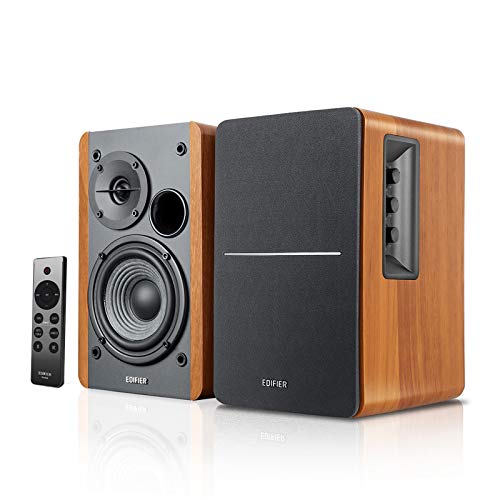
The R1280DBs is what happens when a maker takes a proven budget bookshelf design and adds the connections modern rooms actually use. Edifier’s listing describes an active Bluetooth bookshelf pair with an optical input, a stated 42W RMS of output, a subwoofer line out and a wood grain finish, sold as a 2.0 wireless studio monitor speaker. Each item on that list answers a real household: Bluetooth for the phone, optical for the television, the line out for the day a subwoofer joins, and a finish that sits comfortably on living-room furniture rather than shouting about itself.
At the modest volumes bedrooms and flats impose, the pair’s stated output is ample, and its presentation follows the monitor word in its listing — orderly, clear, with voices forward enough for dialogue and podcasts to stay intelligible without the volume creeping up. Music benefits from the same tidiness: acoustic and pop recordings sound composed, and the pair resists the boom that budget cabinets often substitute for bass. Listeners whose diet runs to bass-heavy electronic music at party levels should be honest that a compact pair has limits, and should note the subwoofer line out as this design’s built-in answer to exactly that appetite.
The optical input deserves its own emphasis because it is the feature budget buyers most often discover they needed after purchase. A television feeding a pair digitally, with the speakers handling volume, replaces the set’s own feeble speakers so completely that returning to them feels like a punishment — and at this budget, that transformation is the single largest quality jump available anywhere in a home entertainment system. The R1280DBs delivers it inside the frame, with Bluetooth left free for the phone rather than consumed by the television.
Wood grain, finally, is a small mercy worth naming at this level, where black plastic is the default uniform. A finish with some warmth lets the pair live on a sideboard or a kitchen shelf without reading as borrowed office equipment, and budget systems live or die by how welcome they are in their rooms. Complete, versatile and domestically acceptable: the R1280DBs is the pair this guide would hand to the widest range of readers.
Gamers in bedroom setups should note the wired paths behind the Bluetooth headline. A console or PC feeding this pair over optical or analogue keeps audio delay at zero for competitive play, while Bluetooth remains free for the phone’s music between matches. That division of labour — wires for timing, wireless for convenience — is how a budget pair serves a multi-device room without compromise, and the R1280DBs offers both sides of it in one cabinet design.
- Output stated in the listing title: 42W RMS
- Wireless on the listing: Bluetooth streaming
- Television-friendly input: optical
- Expansion named in the listing title: subwoofer line out
- Finish described in the listing title: wood grain; format is an active 2.0 pair
Strengths
- Optical input transforms television sound inside the budget frame
- Subwoofer line out keeps a future bass upgrade open
- Bluetooth and wired paths cover phone, television and computer together
Trade-offs
- Compact cabinets set the usual ceiling on deep bass
- Party-level volume in a large room exceeds the design’s brief
- Wood grain finish will not match every interior scheme
Best for: a bedroom or flat living space where one pair must serve television and phone alike
Not suited for: a large open-plan room expecting dancefloor levels from a bookshelf pair

Neumi BS5P-ARC — The television specialist
Neumi’s BS5P-ARC publishes the longest connection list in this guide, and its listing reads like a television’s wish fulfilled: a powered bookshelf pair stating 75W, with Bluetooth, HDMI ARC, a 5-inch woofer and a 1-inch tweeter, plus USB, optical and coaxial inputs, a remote control and a dark wood finish. HDMI ARC is the headline for TV-first rooms, because it lets the television and the speakers behave like one appliance — the set’s own remote governs volume, the speakers wake with the screen, and the nightly ritual of juggling remotes disappears. At this budget, that domestic integration is a luxury usually reserved for soundbars, delivered here by a genuine stereo pair.
The 5-inch woofer gives the pair the largest driver in this guide, and the benefit lands where television and film live: dialogue body, effects weight, a foundation under music that smaller cabinets approximate. In a bedroom or a modest living room, the BS5P-ARC covers film nights without a subwoofer for most viewers, while the remote — a small object budget pairs often omit — acknowledges that its audience is on a sofa or a bed, not at a desk within arm’s reach of a knob.
Bluetooth covers the second life every television pair leads: phones streaming music and podcasts while the screen rests. The spread of digital inputs — USB, optical, coaxial alongside ARC — means almost any source a household owns can find a digital home here, which protects the purchase against the next television or console reshuffle. Few pairs at any level are this accommodating; inside this frame, the Neumi stands alone for sheer connective generosity.
The dark wood finish suits the television rooms it targets, reading as furniture beneath a screen rather than as computer equipment on tour. Buyers should simply give the pair the placement its woofer deserves — shelf or stands flanking the set, a little air around the cabinets — and the BS5P-ARC will repay the courtesy by making the television sound like the main event it already is visually.
A soundbar comparison is inevitable at this level, and the Neumi clarifies it. A bar offers a single wide object and simpler cabling; a genuine pair offers stereo separation a bar cannot reproduce, with voices anchored between two cabinets and music arranged across a stage. Rooms that watch films and play music in roughly equal measure usually end happier with the pair, and the BS5P-ARC’s ARC connection removes the bar’s last convenience advantage by handing volume to the television remote.
- Output stated in the listing title: 75W powered pair
- Television connection named in the listing title: HDMI ARC, alongside Bluetooth
- Drivers stated in the listing title: 5-inch woofer, 1-inch tweeter
- Inputs named in the listing title: USB, optical and coaxial, plus a remote control
- Finish named in the listing title: dark wood
Strengths
- HDMI ARC makes the television remote govern the whole system
- Largest woofer here gives films and music extra foundation
- Digital input spread future-proofs the pair against source changes
Trade-offs
- Television-first design is more than a pure music desk requires
- Larger cabinets need shelf or stand space beside the screen
- Remote-dependent control suits sofa listening better than studio work
Best for: a television in a bedroom or modest lounge that deserves real stereo
Not suited for: a recording desk where balanced inputs and forensic tuning lead
Sanyun SW208 — The compact PC-friendly pair
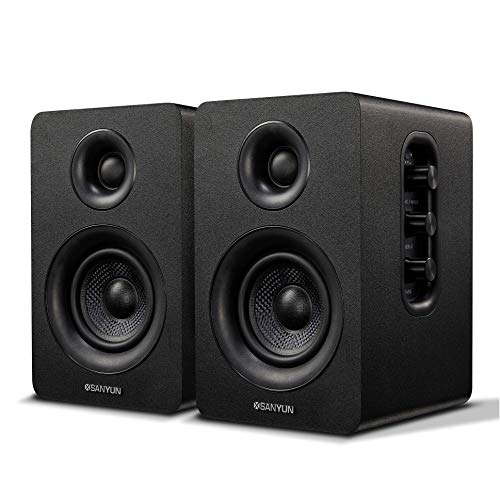
Judged as a budget Bluetooth pair rather than as a desk accessory, the SW208’s argument is completeness at small scale. Sanyun’s listing describes 3-inch active Bluetooth 5.0 bookshelf speakers with a built-in 24-bit DAC, carbon fibre speaker units, a stated 60W, and USB and 3.5mm AUX inputs, sold as a black pair. The built-in DAC is the feature that lifts the design above anonymous budget rivals: connected over USB, the pair converts a computer’s digital signal itself, so a laptop with a hissy headphone output stops being the weakest link in the chain — a real-world upgrade that owners hear in the first quiet passage.
Bluetooth 5.0 covers the phone and tablet hours, and the pairing is the pair’s second daily role: the same cabinets that serve the computer all day take over music and podcasts in the evening without a cable swap. The listing’s mention of a dynamic 3D surround character should be read as a spatial flavouring for games and films — enjoyable width from two small cabinets — rather than as literal surround sound, and purists can simply favour the unadorned wired paths. Budget guides owe readers that translation, because marketing adjectives at this level inflate faster than anywhere else in audio.
The carbon fibre drivers and stated output give the small cabinets more composure than their size suggests, and the pair stays tidy at the volumes small rooms and shared flats allow. Bass remains the honest limit of a 3-inch format — present and tuneful, not physical — and listeners should choose this pair for its completeness and footprint rather than for low-end heroics. In student rooms, spare bedrooms and small gaming corners, those priorities are usually the right way round.
Value at this level is measured in problems not encountered: no amplifier to buy, no DAC to add, no input missing when a console or an older laptop arrives. The SW208 collects those non-problems into one small black pair, and inside this budget frame that collection is a compelling definition of a bargain.
Second computers are this pair’s quiet constituency: the study laptop, the children’s homework machine, the spare-room PC whose own speakers were an afterthought. A small USB-and-Bluetooth pair transforms any of them into a respectable listening station for the cost of the desk space it occupies, and it can migrate between those machines across the years as households reshuffle. Few budget purchases offer that kind of portable usefulness.
- Drivers: 3-inch units in carbon fibre, per the listing
- Digital conversion happens inside, via a built-in 24-bit DAC
- Listed output: 60W
- Wireless generation: Bluetooth 5.0
- Wired paths: USB plus a 3.5mm AUX socket; the pair is finished in black
Strengths
- Built-in DAC rescues computers with poor analogue outputs
- Bluetooth, USB and AUX cover the sources a small room owns
- Compact cabinets fit rooms the larger pairs cannot
Trade-offs
- Three-inch drivers cap bass depth regardless of stated output
- Spatial processing flavour will not please purist listeners
- Small scale cannot serve a large room’s film nights
Best for: a student room or small gaming corner fed by a computer and a phone
Not suited for: a bass-led music diet in a room with space for larger cabinets

MEVOSTO Active Bookshelf Speakers (5-Inch) — The tone-adjustable newcomer
MEVOSTO’s entry in this frame competes on adjustment and connection breadth. The listing describes an active bookshelf pair built around a 5-inch format, with USB audio for a PC, Bluetooth 5.4 alongside RCA and AUX for compatible televisions, dual 1-inch silk-dome tweeters, and bass and treble adjustment on the cabinet. Tone controls are the feature to notice at this level, because budget rooms are acoustically uncooperative — cabinets end up against walls, in corners, on resonant shelves — and a pair that lets its owner trim the bass or lift the treble can be tuned into its actual placement instead of merely enduring it.
Silk-dome tweeters, doubled in this design per the listing, tend toward a smoother top end than the metal domes sometimes fitted at this level, which suits the long, close listening sessions desks and bedrooms impose. The 5-inch format matches the Neumi for driver scale, giving music and film a foundation smaller pairs approximate, while the USB audio path gives PC owners the clean digital connection that the SW208’s DAC path also provides — the two pairs are this guide’s answers for computer-first rooms, differing mainly in cabinet scale and tone control.
Bluetooth 5.4 is the current-generation wireless named in the listing, and it serves the phone-streaming hours with the stability modern versions provide. RCA and AUX keep older televisions and consoles welcome. The design’s overall brief — multi-device stereo for PC and TV, in the listing’s own framing — matches the multi-use rooms this budget serves, where a pair may take a work call at noon, a game at six and a film at nine without any of those duties feeling like an imposition on the equipment.
As a newer name in a field of institutions, MEVOSTO asks buyers to weight its feature list against rivals’ longer track records, and this guide presents it on exactly those terms: the specification, as published in its listing, is genuinely strong for the frame. Owners who value tone adjustment and current Bluetooth, and who are comfortable choosing a younger brand on the strength of a published design, will find this pair the frame’s most adaptable option.
Tone controls also rescue the classic rental problem of the television on a sideboard against a wall, where boundary bass can thicken dialogue at night. A small trim restores clarity without moving furniture the room cannot spare, and the adjustment lives on the cabinet rather than in an app — reachable in the dark, mid-film, without a phone. Budget design that respects the moment of use, not just the moment of purchase, deserves the credit this pair gets.
- Format described in the listing title: active bookshelf pair, 5-inch
- Wireless named in the listing title: Bluetooth 5.4, with RCA and AUX for televisions
- Computer path named in the listing title: USB audio for PC
- Tweeters stated in the listing title: dual 1-inch silk-dome
- Adjustment named in the listing title: bass and treble controls; finish is black
Strengths
- Bass and treble controls tune the pair to difficult placements
- USB audio gives PCs a clean digital path
- Current Bluetooth version plus analogue inputs cover new and old sources
Trade-offs
- Younger brand lacks the long ownership record of rival names
- Five-inch cabinets need more room than the compact picks
- Tone controls invite fiddling that good placement would prevent
Best for: a multi-use room where placement is awkward and sources change daily
Not suited for: any purchase decided by decades-long brand track records over published features

Edifier MR3 — The monitor-grade Bluetooth option
The MR3 is the pick for buyers who suspect, correctly, that a studio monitor’s discipline might serve a budget room better than a lifestyle pair’s enthusiasm. Edifier’s listing describes a powered studio monitor with hi-res audio certification and Bluetooth V5.4, plus a headphone output and RCA, AUX and balanced TRS inputs, in black. Bluetooth in a monitor is still a pleasant surprise — the category historically wired everything — and version 5.4 makes the wireless path a citizen rather than a guest: phones stream to a pair whose tuning stays honest, so the music arrives as recorded rather than as flattered.
That honesty is the MR3’s gift and its condition. At the close distances of desks, bedsides and small-room chairs, a flat, detailed presentation makes voices — calls, podcasts, lectures, dialogue — exceptionally clear, and keeps long sessions free of the treble emphasis that budget lifestyle pairs use to sound exciting for a minute and tiring for an evening. The balanced TRS input, unique in this guide, future-proofs the pair for an audio interface, so a bedroom listener can become a bedroom producer without replacing the speakers — a growth path no other pick here offers inside the frame.
The headphone output completes the small-room diplomacy kit: late listening, early calls and shared flats all become easier when the pair can hand over to headphones without a cable excavation behind the computer. Taken together — monitor tuning, current Bluetooth, balanced and unbalanced inputs, headphone output — the MR3 is the most professionally equipped pair in this guide, and its presence inside a budget frame is the kind of trickle-down that makes this category worth shopping carefully.
Buyers should simply know which pleasure they are choosing. The MR3 will not warm a cold recording or inflate a small room with borrowed bass; it presents what it is given, beautifully when the source is good. Listeners who want their speakers to editorialize should take the R1280DBs or the Neumi. Listeners who want to hear their library — and perhaps one day add to it with recordings of their own — should take the monitor.
There is an upgrade story hidden in the MR3’s input list that deserves spelling out: a listener can begin with a phone over Bluetooth, add a computer over AUX, then graduate to an interface over TRS for recording, all through the same pair. Each stage costs only its own component, and the speakers — usually the budget’s largest single item — never need replacing along the way. Systems that grow in stages are how small budgets assemble serious setups, and this pair is built for the staircase.
- Title certification: hi-res audio
- Bluetooth generation on the listing: V5.4
- Analogue and studio inputs: RCA, AUX and balanced TRS
- A headphone socket is built in for silent hours
- Cabinet colour: black; the design is an active 2.0 monitor pair
Strengths
- Monitor honesty keeps voices and long sessions clear
- Balanced TRS input opens a genuine production growth path
- Headphone output respects shared and late-night households
Trade-offs
- Flat presentation will not flatter poor recordings
- Studio brief omits the television-remote conveniences of rivals
- Bass is presented accurately rather than generously
Best for: a small room that listens closely and may start recording later
Not suited for: a film-first lounge wanting warmth and one-remote ease
Bestisan SR04 — The forum favourite, covered without a link
The Bestisan SR04 appears in this guide the way it appears in most readers’ research: by reputation. It is one of the names budget hunters meet repeatedly in forum threads about powered Bluetooth bookshelf speakers, and a guide that ignored it would leave readers to evaluate that reputation alone. No verified listing for the SR04 sits in this site’s Creators API pool, however, so the design is discussed here in prose only and no purchase link is offered — the same discipline this site applies whenever a model cannot be verified through its own pool.
As a design, the SR04 belongs to the straightforward school of budget powered pairs: cabinets with amplification built in, Bluetooth for phone streaming, wired inputs for a television or computer, and a remote in the box in the versions most commonly described by owners. That recipe is the category’s baseline for a reason — it covers the bedroom-television-and-phone pattern that most budget buyers actually live — and the SR04’s following rests on delivering that recipe without drama at the aggressive end of the frame.
Readers comparing it against the linked picks should notice what verification buys. The five linked designs above carry listing titles this guide could check line by line — wattage, Bluetooth versions, inputs — while the SR04’s details reach this page only as general owner report, and listings for budget models are revised often enough that yesterday’s specification may not describe today’s box. Anyone set on the model should read the specific listing they are buying from with unusual care, confirming the wireless claim, the input list and the remote in that listing’s own text before paying.
None of that makes the SR04 a poor design; it makes it an unverified one, which is a different judgement and the only one this guide is positioned to make. Buyers comfortable doing their own listing diligence may find it a perfectly serviceable budget pair. Buyers who prefer their research pre-verified will find the same recipe, with checkable credentials, in the R1280DBs and Neumi picks above — which is, in the end, why pool discipline exists.
Owner reports about the SR04 also carry a recurring practical note worth passing on: budget pairs live or die by their remote and their standby behaviour, because a system that needs waking by hand at the cabinet gets used less, whatever it sounds like. Anyone auditioning the model through a listing should confirm those domestic details — remote included, auto-standby behaviour, input memory — in the listing text, since they decide daily satisfaction more reliably than any specification on the page.
- Format: powered bookshelf design with amplification built into the cabinets
- Wireless: Bluetooth streaming is the design’s commonly described centrepiece
- How this guide treats it: prose discussion only, and no link
- Verification status: no listing for this model sits in this site’s pool
- Partner equipment: none required beyond the source itself
Strengths
- Long-standing forum reputation among budget hunters
- Straightforward powered recipe covers television and phone duties
- Aggressive positioning within the budget frame, per owner report
Trade-offs
- No verified pool listing, so no link and no checked specifications here
- Budget listings for such models are revised without notice
- Buyers must perform their own listing diligence in full
Best for: a confident bargain hunter willing to verify a listing line by line
Not suited for: shoppers preferring every single specification pre-checked before any purchase
Comparison
| Pick | Power and connections | Drivers and cabinet | Where it fits best |
|---|---|---|---|
| Edifier R1280DBs | Active Bluetooth pair stating 42W RMS, optical input, subwoofer line out | Wood grain cabinets in a compact 2.0 format | Bedrooms and flats mixing TV and streaming |
| Neumi BS5P-ARC | Powered pair stating 75W, Bluetooth plus HDMI ARC, remote included | 5-inch woofer and 1-inch tweeter in dark wood cabinets | Television rooms wanting one-remote simplicity |
| Sanyun SW208 | Active 3-inch pair stating 60W, Bluetooth 5.0, built-in 24-bit DAC | Carbon fibre drivers in compact black cabinets | Small rooms fed digitally by USB and wirelessly by phone |
| MEVOSTO Active Bookshelf Speakers (5-Inch) | Active 5-inch pair, Bluetooth 5.4, USB audio, RCA and AUX inputs | Dual silk-dome tweeters with bass and treble adjustment, black finish | PC-and-TV rooms with difficult cabinet positions |
| Edifier MR3 | Powered monitor with Bluetooth V5.4, RCA, AUX and balanced TRS inputs | Hi-res certified cabinets with a headphone output, black | Close listening, calls and budding production work |
| Bestisan SR04 | Powered Bluetooth design covered without a link or checked figures | Baseline budget recipe as described by its owner community | Bedroom television and phone duty, for diligent shoppers |
How Can You Tell a Genuinely Bluetooth Pair From a Wired Lookalike?
This category’s most expensive misunderstanding wears a familiar cabinet. Several famous budget designs exist in wired and wireless versions whose names and boxes differ by a letter or a suffix, and listings, photographs and even some reviews blur the two. A buyer who orders the wired twin of a Bluetooth design discovers the mistake at unboxing, when the phone has nothing to pair with. The defence is unglamorous and absolute: find the word Bluetooth — ideally with its version — in the specific listing’s own title or specification for the exact variant being bought, and treat its absence as an answer rather than as an oversight.
The picks in this guide were subjected to exactly that test. The R1280DBs carries Bluetooth in its listing title alongside its optical input; the Neumi lists Bluetooth beside HDMI ARC; the SW208 names Bluetooth 5.0; the MEVOSTO names Bluetooth 5.4; the MR3 names Bluetooth V5.4. Those published claims are why these pairs are here, and the habit of demanding them is worth more than any single recommendation on this page, because it protects every future purchase in the category as well.
A related check concerns what Bluetooth is being asked to do. A pair may accept Bluetooth audio while offering no wireless control of volume beyond the phone’s own, and a television may or may not send its sound over Bluetooth at all — most prefer a cable, which is why the optical and HDMI ARC inputs on the Edifier and Neumi picks matter. Buy the connection the source actually speaks, and let Bluetooth serve the devices that speak it natively: phones, tablets and computers.
Optical, HDMI ARC or AUX: Which Television Path Should a Budget Pair Use?
HDMI ARC is the most domesticated path where it exists, as on the Neumi BS5P-ARC: the television’s remote controls the speakers’ volume, the system wakes and sleeps with the screen, and guests can operate it without instruction. For a main television in a shared room, that integration is worth prioritising, because a system everybody can drive is a system everybody uses. ARC also keeps the audio digital end to end, which keeps dialogue clean at the low volumes bedrooms demand.
Optical is the universal digital alternative, offered by the R1280DBs, and it suits televisions without ARC or setups where the ARC socket is already committed. Volume then lives on the speakers or their remote rather than the television’s control, a small ritual most households absorb within a week. Optical’s virtue is reliability: it carries no control negotiations, works across decades of equipment, and sounds identical to ARC for the stereo material bookshelf pairs reproduce.
AUX — the humble headphone-style connection — remains the fallback that never fails, available on the SW208 and MEVOSTO pairs for televisions with a headphone output and for every other ageing source in the house. Its quality depends on the television’s analogue stage, which varies, but its universality is unmatched. The budget buyer’s rule is simple: prefer ARC for a main set, accept optical happily, keep AUX for the sources nothing else will feed, and confirm the chosen pair actually offers the path the television speaks before the order is placed.
What Does a Wattage Figure Mean on a Budget Bookshelf Listing?
Listings in this frame state figures from 42W to 75W among this guide’s picks, and the honest reading of those numbers is comparative rather than absolute. A stated wattage describes the amplification a maker built in, under measurement conditions the listing rarely specifies, so it cannot be converted into a loudness promise for a particular room. What it does indicate is design intent: the R1280DBs’ stated 42W RMS suits close and medium listening in modest rooms; the Neumi’s stated 75W accompanies a larger woofer aimed at television duty; the SW208’s stated 60W serves a compact pair at desk and bedroom levels.
Room and distance dominate the real experience. A pair listened to from a metre away needs a fraction of the output that the same pair needs across a lounge, and budget pairs are overwhelmingly used at the closer distances where they are comfortable. Buyers should therefore read wattage alongside driver size and intended seat: a modest figure with the right inputs in a small room will satisfy more completely than a heroic figure in a pair missing the television connection the household needed.
Distrust, finally, any budget listing whose wattage dwarfs its price peers while its driver sizes stay tiny — physics collects its debts regardless of marketing. The figures quoted in this guide come from verified listing titles and sit within the plausible range for their cabinets, which is one more reason the pool discipline behind the picks matters: a checked number can be weighed, while an invented one can only be believed.
Where Should a Budget Pair Sit in a Bedroom, Kitchen or Student Room?
Small and shared rooms impose placements that hi-fi advice rarely imagines: a kitchen worktop corner, a bedroom chest of drawers, a student shelf already holding textbooks. The principles survive the translation. Keep the pair symmetric around the listening spot where possible, keep tweeters somewhere near the ear height of the seat that matters — bed, desk chair, sofa — and keep cabinets out of the deepest corners, where bass thickens into the boom that gives budget speakers a bad name. Even a few centimetres of air behind and beside a cabinet pays audible rent.
Surfaces deserve a thought at this level, because budget rooms offer resonant ones: hollow wardrobes, thin shelves, kitchen worktops over cupboards that drum along. A pair of foam pads, a folded mat, even a thick book under each cabinet interrupts the furniture’s contribution and tightens the sound noticeably. Owners often credit the speakers for the improvement; the furniture stopped singing, and the speakers were finally audible alone. At this budget, that may be the highest-value accessory in the entire system.
Kitchens add their own footnotes: keep cabinets clear of steam’s direct path and of the splash zone behind a sink, and favour the pairs whose controls can be reached without moving them. Student rooms add another: a pair that can move rooms each term without drama — compact, self-contained, quick to reconnect — will serve its owner better than a marginally finer pair that resents relocation. Budget life is mobile life, and the speakers should be packed for it.
How Should You Set Up a Budget Pair on Its First Evening?
Resist the urge to judge within the first song. Place the pair symmetrically, connect the main source by its best path — ARC or optical for a television, USB for a computer, Bluetooth for a phone — and set a sane volume relationship between source and speakers, with the source healthy and the speakers’ control doing the daily work. Then play three familiar things: a voice, a favourite song, a scene from a film the household knows. Note where voices sit and whether bass lines have pitch, because those two observations organise every adjustment that follows.
Adjust one thing at a time across the first week. A few centimetres of placement, a degree of inward angle, a touch of tone control where the pair offers it — the MEVOSTO’s bass and treble exist for exactly this week. Most budget pairs find their position by the third evening and keep it for years, and owners who rush the process often blame the speakers for a placement that was never finished. The frame rewards patience precisely because its pairs have less margin to waste: set up well, a budget system disappears into daily life, which is the entire point of buying one.
How Do You Share a Budget Pair Between a Household’s Phones?
A Bluetooth pair in a shared room becomes a small commons, and commons need manners. Most pairs remember one primary device and reconnect eagerly to it, which delights its owner and baffles everyone else until the household learns the ritual: disconnect or disable Bluetooth on the phone that is finished, then pair from the phone that is starting. Households that teach that ten-second habit once enjoy years of peaceful sharing; households that do not will stage a nightly negotiation in front of the speakers, usually during the opening scene of a film.
Where sharing is constant — a kitchen pair serving whoever cooks — consider giving the television or a household tablet the permanent wired or digital seat and letting phones visit over Bluetooth only when the screen is dark. That division keeps the pair’s default behaviour predictable, which is the real luxury in a shared system. Budget equipment earns its place by being understood by everyone in the house, and a connection routine simple enough for a guest is the final specification no listing prints.
What Should You Check in the First Week Before the Return Window Closes?
Budget purchases deserve a deliberate first week, because the faults that matter announce themselves early and politely. Test every input the household will use — not just the favourite — with the actual sources: the television’s ARC or optical path through a dialogue-heavy scene, Bluetooth from each phone in the house, the computer over its intended cable. Check for hiss at listening distance during quiet passages, confirm the remote governs what it should, and verify the pair wakes and sleeps the way the household expects. Each test takes minutes; together they convert surprises into decisions while decisions are still free.
Listen, too, for the room’s verdict rather than the showroom’s. Play the household’s real diet at real volumes — a streamed series, a playlist, a game — from the real seats, and ask the only question that predicts the next five years: does anyone reach for the old way of listening instead? If the pair has quietly become the room’s default voice for everything, it has passed. If it is used only for special occasions, something in the chain — placement, connection, control — is wrong, and the first week is when fixing it costs nothing but attention.
Which Budget Bluetooth Mistakes Send the Most Pairs Back?
Ordering the wired lookalike of a wireless design leads the returns parade in this category, and the guide’s earlier section exists because of it. Names within a budget family differ by suffixes that look like trim levels and are actually different products. The cure costs ninety seconds: read the exact listing’s title for the wireless claim, the input list and the version being bought, and let absence of evidence be evidence of absence. No other check in this category repays its time as reliably.
Expecting a compact pair to fill a large room at party volume is the second classic disappointment. Budget bookshelf pairs are engineered for bedrooms, desks, kitchens and modest lounges at honest levels, and their stated figures assume those rooms. A buyer whose real brief is a big open-plan space should save toward a larger system rather than punishing a small pair for a job description it never applied for — the frame is a frame, and rooms vote on purchases just as budgets do.
Neglecting the television connection until delivery day is the third trap. A pair bought for a bedroom set must speak the set’s language — ARC, optical or AUX — and discovering a mismatch with the boxes open turns a happy purchase into an adapter hunt. List the sources, match the inputs, and the system works on its first evening, which is when budget systems either become household furniture or become returns.
Households also return pairs for a reason nobody lists on a specification sheet: controls that hide in an app when a knob would do, or a standby light bright enough to read by in a dark bedroom. Live with the pair’s manners in mind when choosing, because manners are the part of the system encountered most often.
One last return-window regular deserves naming: the pair bought for a phone that was about to be replaced, on the assumption that all Bluetooth is identical, without checking that the new device and the speakers pair cleanly in the shop’s listing details. Modern versions interoperate broadly, yet the ninety-second verification habit described throughout this guide exists precisely because assumptions are the category’s favourite trap, sprung weekly on otherwise careful shoppers in every town and market across the whole country today.
A fourth mistake is quieter: connecting everything at maximum convenience and minimum quality — the television over a crackly analogue lead because the cable was already there, the computer over Bluetooth while a USB path sits unused. Budget pairs have less performance to spare, so the free gains of the best available connection matter more, not less. Spend one session routing the best path neatly, and the system’s best sound becomes its everyday sound.
Final Recommendation
One pair takes the general recommendation: the Edifier R1280DBs. Bluetooth for the phone, optical for the television, a subwoofer line out for the future, a finish that behaves in a living room, and a stated output sized honestly for the rooms this budget serves. It is the pair with the fewest ways to disappoint a first-time buyer, which at this level is the highest praise available.
Specialists should specialise confidently. The Neumi BS5P-ARC for a television that deserves ARC simplicity and a remote, the MR3 for close listeners with production in their future, the SW208 for the smallest computer corners, the MEVOSTO for awkward placements that need tone adjustment, and the SR04 for diligent hunters comfortable verifying their own listing. My own spare room would take the R1280DBs, because a budget pair’s first duty is to be used every day without friction — and friction, not sound, is what kills budget systems.
Give the chosen pair its first week at honest volumes in its real position before comparing it with anything, because budget systems are judged by households over months of evenings — and the pair that wins those months is rarely the pair that shouted loudest in the first five minutes.
Frequently Asked Questions
Are speakers in this frame loud enough for a bedroom or small lounge?
Yes — the rooms this budget serves are exactly the rooms these pairs were designed for. At bedroom and small-lounge distances, the stated outputs in this guide deliver comfortable film and music levels with headroom to spare. The boundary is the large open-plan space played loudly, where any compact pair strains; buyers with that brief should plan a larger system rather than expecting a budget pair to defy its cabinet size.
Can a Bluetooth bookshelf pair connect to a television?
Usually, but the cable paths are often better than the wireless one. Many televisions do not transmit Bluetooth audio, or do so with delay, so the dependable routes are the ones this guide emphasises: HDMI ARC on the Neumi, optical on the R1280DBs, or AUX from a headphone output on the other pairs. Reserve Bluetooth for phones, tablets and computers, which speak it natively, and the television will behave from the first evening.
Does the Bluetooth version change the sound?
The version mainly governs connection stability, range behaviour and efficiency; sound quality is shaped more by the codec in use and by the speakers themselves. The versions named in this guide’s listings — 5.0 on the SW208, 5.4 on the MEVOSTO and MR3 — are all modern enough for stable, room-wide connections from a phone. Buyers should weight inputs, drivers and placement above version arithmetic, while still confirming that Bluetooth is genuinely present in the exact listing being bought.
Why is one pick in this guide not linked?
The Bestisan SR04 has no verified listing in this site’s Creators API pool, and this guide links only what it can verify. The model is discussed in prose — its design recipe, its reputation and its caveats — so readers who meet its name elsewhere can judge it with open eyes and perform their own listing checks. The five linked picks carry specifications this guide could confirm line by line, which is the difference the prose treatment marks.
Do these pairs need a separate amplifier or a subwoofer?
No amplifier — every pair here is powered, with amplification built into the cabinets, so a source and a mains socket complete the system. A subwoofer is optional everywhere and necessary nowhere in the rooms this frame serves; the R1280DBs’ subwoofer line out simply keeps that door open for bass-led listeners. Most owners will find placement and a clean connection improve their sound more than any addition.
How long should a budget pair like these be expected to last?
Years of daily service with ordinary care, because powered bookshelf pairs have few moving parts beyond their drivers and no batteries to exhaust. Keep them ventilated, avoid sustained maximum volume, and protect them from kitchen steam and bathroom humidity. Bluetooth standards will age faster than the speakers themselves, which is one more reason the wired inputs on every pick here matter: a pair that also speaks optical, USB and AUX cannot be stranded by a wireless fashion.
Related Guides
Budget wireless questions tend to pull readers onward to the colour laser guide where home offices get their own shortlist: colour laser printers for a home office black-and-white laser printers for everyday documents compact laser printers for small desks


