What's inside
- Key Takeaways
- Quick Picks
- How We Chose These Picks
- Comparison
- Passive Flagship or Active Flagship: Which Contract Should You Sign?
- What Amplifier Does a High-End Passive Pair Actually Deserve?
- Why Do Imaging and Soundstage Dominate High-End Bookshelf Listening?
- How Should High-End Pairs Be Placed When the Room Is Also a Home?
- What Does Break-In Mean for a High-End Pair — and What Is Just Ritual?
- What Should a High-End Buyer Expect From Finishes and Cabinet Craft?
- How Do You Audition High-End Speakers Without Fooling Yourself?
- Which Expensive Errors Do High-End Buyers Still Make?
- Final Recommendation
- Frequently Asked Questions
- Related Guides
As an Amazon Associate I earn from qualifying purchases. This post may contain affiliate links at no extra cost to you.
widgetverdict.com is reader-supported. When you buy through links on our site, we may earn an affiliate commission.
The best high-end bookshelf speakers make an argument that floor-standing towers cannot answer: that a compact cabinet, engineered without the compromises of a budget line, can deliver the essential experience of serious hi-fi — imaging, tonal truth, dynamic composure — into rooms where towers would dominate the furniture and the conversation. High-end in this guide does not mean the most expensive objects that fit on a shelf. It means designs where the money visibly went into the sound: advanced driver engineering, cabinets built like instruments, crossovers treated as the soul of the speaker rather than a parts list, and finishes that acknowledge these objects will be looked at for twenty years.
The six pairs divide into two philosophies, and the division is the most important idea in the guide. Four are passive — KEF’s LS50 Meta and Q Concerto Meta, Wharfedale’s Denton 85th, ELAC’s Debut Reference DBR62 — and each needs an amplifier worthy of it, because a high-end passive speaker is a lens that shows the electronics behind it without mercy. Two are active — Edifier’s S1000MKII and Audioengine’s HD6 — carrying their amplification inside, tuned by their own designers, complete the day they are unboxed. Neither philosophy is the senior one. They are different contracts with the owner, and the guide’s buying sections exist to help readers sign the right one.
Details credited to a linked pick come only from that pick’s Amazon listing title, verified in the site’s own ASIN pool, which is built from Amazon’s Creators API. High-end listings are often models of restraint — one famous pick below is described in its title by little more than its name and finish — and this guide honours that restraint, discussing design lineage and listening character in qualitative terms rather than decorating famous names with figures their makers did not publish in the listing.
Prices at this level should be read as the cost of a decade or two rather than a season, and they move with finishes and availability often enough that this guide leaves the live figure to the listing — check price on Amazon for any pair that reaches the final audition, and weigh it against the years of service the design is built to give.
Key Takeaways
- KEF’s LS50 Meta in carbon black is the reference point: a passive hi-fi pair from the Meta generation, widely treated as the modern benchmark for compact loudspeaker design.
- KEF’s Q Concerto Meta in brown walnut is the three-way alternative, a premium passive pair with a three-way bass-reflex design for listeners wanting scale with KEF precision.
- Edifier’s S1000MKII is the active flagship route: a 120w powered pair with Bluetooth 5.0 and aptX HD, an optical input and a Class D amplifier, complete without extra boxes.
- Wharfedale’s Denton 85th in walnut is the heritage choice, an anniversary design whose traditional craftsmanship and warm lineage suit listeners who value character alongside fidelity.
- ELAC’s Debut Reference DBR62 pairs a black baffle with a walnut cabinet, the reference-grade evolution of the Debut idea for listeners stepping up from budget ELACs.
- Audioengine’s HD6 in white is the powered lifestyle flagship, a Bluetooth pair pitched at turntables, home stereo and streaming in design-conscious rooms.
Quick Picks
| Pick | Badge | Why it earns its place |
|---|---|---|
| KEF LS50 Meta | The modern reference | A passive hi-fi pair in carbon black from KEF’s Meta generation, positioned by its listing for high-resolution music, television and film sound. |
| KEF Q Concerto Meta | The three-way KEF | A premium passive hi-fi pair in brown walnut with a three-way bass-reflex design, for music, gaming, television and film in larger spaces. |
| Edifier S1000MKII | The active flagship | An audiophile active pair stating 120w, Bluetooth 5.0 with aptX HD, an optical input and a Class D amplifier — high-end sound with no separate amp. |
| Wharfedale Denton 85th | The heritage anniversary design | An anniversary-edition passive pair in walnut from Wharfedale, celebrating traditional British loudspeaker craft for listeners who value character. |
| ELAC Debut Reference DBR62 | The reference-grade step up | A passive pair with a black baffle and walnut cabinet, the Debut Reference evolution for listeners outgrowing budget speakers. |
| Audioengine HD6 | The powered lifestyle flagship | A powered Bluetooth pair in white whose listing pitches it at turntables, vinyl records, home stereo and music streaming in design-led rooms. |
How We Chose These Picks
High-end selection began by excluding mere expensiveness. Candidates needed a design story that explained their price in engineering terms — a driver technology, a cabinet programme, a lineage refined across generations — and several prestigious names were set aside where the story turned out to be mostly finish and branding. What survived divides, as the introduction promised, into passive designs that assume serious amplification and active designs that internalise it, and the guide weighs the two philosophies against each other rather than pretending one ranking can serve both kinds of owner.
For the passive four, amplifier honesty was a selection criterion in itself: each pick is capable of revealing the difference between a competent amplifier and a fine one, which is precisely what high-end buyers are paying to hear. That capability cuts both ways, and the guide says so under each pick — a revealing speaker fed by careless electronics will report the carelessness faithfully. For the active two, the criterion was completeness: whether the internal amplification and inputs genuinely finish the system, so the owner’s remaining decisions are placement and sources rather than another round of shopping.
Finally, each pair was judged as a long-term resident. High-end bookshelf speakers are bought against a horizon of decades, moved between rooms, inherited, resold and re-partnered. Designs with a service culture behind them, finishes that age gracefully and characters that do not chase a season’s fashion scored accordingly. Novelty, at this level, is a cost disguised as a feature.
One more criterion quietly shaped the six: none of these designs depends on an app, a subscription or a network service to perform its core duty. High-end money should buy objects that will work in twenty years regardless of any company’s server decisions, and every pick here — passive by nature, or active with its essential functions on board — honours that principle. Longevity is not only mechanical; in modern audio it is also digital independence.

KEF LS50 Meta — The modern reference
Some products become the yardstick for their category, and the LS50 Meta is the current yardstick for compact loudspeakers. KEF’s listing is restrained — a passive hi-fi bookshelf pair in carbon black, for high-resolution sound across music, television and movies — and the restraint suits a design whose reputation was built in listening rooms rather than in copy. The Meta generation refined an already celebrated design with absorption technology aimed at the distortions that smear fine detail, and the result is a speaker whose party trick is disappearance: the cabinets vanish from the listener’s awareness and a stage of musicians takes their place.
That disappearing act depends on the system around it, which is the LS50 Meta’s defining condition. As a passive design it needs an amplifier, and not a token one: a high-quality integrated amplifier with a quiet background and honest current delivery, because this pair reports the character of its electronics with unusual fidelity. Owners upgrading amplifiers hear the improvement immediately and completely, which makes the LS50 Meta both a destination and a diagnostic tool. Budget the partnership properly — the amplifier section later in this guide exists for exactly this pairing — and the system competes with installations several times its size.
Placement rewards equal seriousness. On proper stands, at ear height, with space to breathe behind and beside them, the pair produces imaging that has become a reviewer’s cliché because it keeps being true: a vocalist located with almost physical certainty, instruments arranged in depth, a soundstage wider than the cabinets’ separation suggests. In smaller rooms the effect is heightened by proximity; in larger ones the pair stays composed to surprising levels for its scale, though listeners who regularly fill big spaces at high volume should audition the three-way Q Concerto alongside it.
The carbon black finish completes a design that expects to be looked at as carefully as it is listened to. This is the pick for the listener who has stopped browsing — who wants the reference, intends to partner it properly, and expects the question of bookshelf speakers to stay settled for a very long time.
There is a secondhand dimension to this pick that high-end buyers quietly rely on: reference designs with reputations hold their value, so the cost of changing direction later is softened by a queue of listeners waiting for a used pair. That liquidity does not make the LS50 Meta a financial instrument, but it does make it a lower-risk flagship than an obscure design of equal quality, and risk belongs in any honest account of a purchase at this level.
- Format stated in the listing title: passive hi-fi bookshelf speakers, a pair
- Finish named in the listing title: carbon black
- Generation named in the product name: Meta
- Partner equipment required: a high-quality amplifier or receiver
- Suggested uses in the listing title include music, TV and movies in high resolution
Strengths
- Benchmark imaging and tonal evenness in a compact cabinet
- Reveals amplifier improvements, so the system can grow around it
- Design and finish suit a decade-plus residence in a main room
Trade-offs
- Demands a genuinely good amplifier to show its quality
- Stands and careful placement are effectively mandatory
- Revealing nature exposes weak sources without diplomacy
Best for: a committed listener building a main system around a compact reference pair
Not suited for: a casual setup where the amplifier is an afterthought in a cupboard
KEF Q Concerto Meta — The three-way KEF
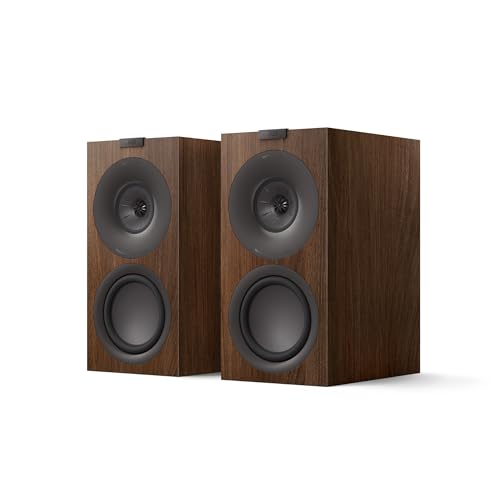
Where the LS50 Meta pursues purity in a two-way format, the Q Concerto Meta pursues range. KEF’s listing describes a premium passive hi-fi pair in brown walnut, built as a three-way bass-reflex design for music, gaming, television and movies within a versatile home theatre system. The three-way architecture is the engineering headline: dedicating separate drivers to bass, midrange and treble lets each work in the band it handles best, and the audible dividend is composure — complex passages stay separated, bass carries weight without thickening voices, and the pair keeps its poise at volumes and in rooms where compact two-ways begin to negotiate.
That makes the Q Concerto the natural KEF for larger rooms, mixed entertainment duties and listeners whose taste runs to orchestral scale or cinematic dynamics. It shares the family’s imaging discipline — the point-source character that keeps the picture coherent for off-centre seats — while adding the headroom a three-way design provides. In a home theatre context the listing’s own framing applies: this is a pair that can anchor front channels in a serious system as readily as it serves stereo music, and that dual citizenship protects a high-end purchase against the owner’s evolving room.
The brown walnut finish signals the intended setting: a furnished main room where speakers are part of the interior rather than appliances tolerated by it. Passive, like its sibling, the Q Concerto needs an amplifier or receiver of real quality, and theatre ambitions point toward a capable receiver or a stereo amplifier with a proper television path. Either way, the partnership principle is unchanged — electronics chosen to the speakers’ standard, not beneath it.
Choosing between the two KEFs in this guide is a question of appetite. The LS50 Meta is the purist’s instrument, optimised for the centred seat and the stereo recording. The Q Concerto is the household’s flagship, trading a measure of that forensic focus for scale, flexibility and finish. Both are high-end answers; they simply answer listeners who sit differently.
Home theatre builders should note the family advantage once more: a Meta-generation centre and surround ecosystem lets this pair graduate into a matched cinema system without a voicing seam across the front stage. Stereo buyers rarely plan that migration on day one, yet rooms evolve, screens grow, and the pair that can lead both lives protects its owner from starting again. Flexibility at this level is not a compromise feature; it is insurance bought with foresight.
- Format stated in the listing title: premium passive hi-fi bookshelf pair
- Configuration stated in the listing title: three-way bass reflex
- Finish named in the listing title: brown walnut
- Partner equipment required: a quality amplifier, or a receiver for theatre builds
- The listing’s suggested duties: music, gaming, television and film
Strengths
- Three-way design keeps complex passages composed at scale
- Family imaging discipline serves group seating and theatre duty
- Walnut finish integrates with furnished main rooms
Trade-offs
- Larger appetite for room and amplifier budget than its sibling
- Forensic focus slightly traded for scale and flexibility
- Theatre ambitions can pull the system budget upward quickly
Best for: a main room mixing serious music with a growing home theatre
Not suited for: a small study where a compact two-way already fills the space
Edifier S1000MKII — The active flagship
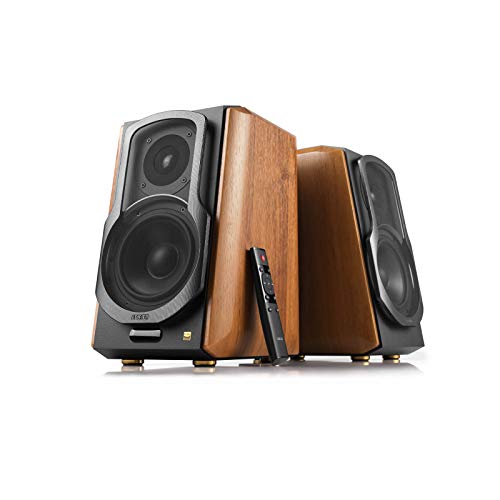
High-end buyers who distrust component matching have an honourable alternative in the S1000MKII, and this guide places it among the passives deliberately: Edifier’s flagship active pair competes at this level on results, not on architecture. Its listing states the credentials plainly — an audiophile active bookshelf design with 120w of output, Bluetooth 5.0 with aptX HD, an optical input and a Class D amplifier built in. The system is complete at unboxing. The amplifier was voiced for these cabinets by the people who designed both, and the owner’s high-end decisions shrink to placement, sources and the listening chair.
That completeness is a genuine engineering argument, not merely convenience. A passive pair’s performance is a negotiation among speaker, amplifier and cable assembled by the buyer; an active flagship removes the negotiation and guarantees the pairing its designers intended. Listeners who have heard expensive passive systems underperform behind mismatched electronics will recognise the appeal immediately. The S1000MKII sounds composed, weighty and controlled in the manner of a well-matched separates system, because that is what it is — separates that happen to share a pair of cabinets.
The input set serves a main-room life. Optical takes the television cleanly, aptX HD rewards phones and players that can send it with cleaner wireless sound than basic Bluetooth, and wired paths serve the serious sources. At sofa distance the pair delivers the scale high-end buyers expect — orchestral weight, film dynamics, voices with body — while staying free of the strain that marks smaller powered designs pushed beyond their brief. It is the largest commitment in this guide that arrives without a second purchase attached, and for many main rooms that finality is the luxury actually being bought.
The trade is the active architecture’s eternal one: the amplification cannot be upgraded separately, and when tastes change the whole pair changes. Buyers who enjoy the component journey — amplifier auditions, incremental upgrades — should sign the passive contract instead. Buyers who want the destination without the journey will find the S1000MKII the most direct route in this guide to a finished, flagship-grade system.
Readers upgrading from Edifier’s smaller powered pairs will recognise the family handwriting — clarity, composure, a refusal to shout — executed at flagship scale. That familiarity shortens the adjustment period to a single evening, after which the differences announce themselves in the margins that matter: the decay of a piano note, the room tone under a film scene, the third harmony in a choral recording that smaller pairs politely omit.
- Power on the listing: 120w from the built-in amplifier
- Streaming: Bluetooth 5.0, with aptX HD named in the title
- Television path: an optical input
- Amplifier architecture: Class D, housed inside the cabinets
- System shape: a complete active 2.0 pair, with nothing else to buy for power
Strengths
- Flagship composure with the amplifier pairing guaranteed by design
- Optical television path and aptX HD streaming cover a main room’s sources
- Complete at unboxing; no second purchase hides behind the first
Trade-offs
- Amplification cannot be upgraded separately from the speakers
- Large cabinets need stands or substantial furniture
- Component hobbyists lose the amplifier-swapping pastime
Best for: a main room chasing genuine flagship results without component matching
Not suited for: an upgrade hobbyist devoted to auditioning amplifiers as a pastime

Wharfedale Denton 85th — The heritage anniversary design
High-end does not have to mean laboratory modernism, and the Denton 85th is the guide’s proof. Wharfedale’s listing is almost comically brief — an anniversary edition in walnut — because the design trades on a different currency: heritage. The Denton name reaches back to an era when British loudspeakers defined the domestic hi-fi sound, and the 85th anniversary edition reissues that tradition with modern engineering inside traditional cabinetry. As a passive design it needs an amplifier, and it pairs most happily with electronics chosen in the same spirit — quality without ostentation, warmth without sloppiness.
The listening character follows the lineage. Where the KEF picks pursue forensic precision, the Denton pursues musicality: a presentation that flatters voices, strings and the recorded catalogue of the last seventy years, keeping long sessions humane and older recordings kind. That character is not imprecision — the anniversary engineering is modern where it counts — but a voicing decision, made deliberately, that music’s emotional content outranks its diagram. Listeners whose collections run deep into jazz, folk, classical and classic rock will recognise the priorities as their own.
Walnut cabinetry of traditional cut makes the pair furniture in the heirloom sense, suited to rooms with books, wood and lamplight rather than glass and chrome. In such rooms the Dentons do not merely fit; they complete. High-end buyers furnishing a study, a library or a traditional sitting room often discover that the modern reference designs, for all their virtues, look like visitors from another house. The Denton looks like it was always there, which for a twenty-year purchase is a virtue beyond fashion.
Choose this pair when the system’s centre of gravity is the catalogue rather than the test disc, and when the amplifier shelf holds — or will hold — electronics with a similar respect for music over measurement. The Denton 85th will not win a specification argument in this guide. It was never entering one. It is here for the listener who believes a loudspeaker should have a point of view, and who has been waiting for a high-end design to share theirs.
A note on partnering electronics suits the Denton particularly well: valve-flavoured and warmly voiced amplifiers have a long association with this kind of British design, and the pairing can be magical for acoustic catalogues, provided the amplifier’s quality is genuine rather than merely thematic. Equally, a clean modern amplifier keeps the Denton honest for listeners who want heritage looks without heritage softness. The speaker permits both readings, which is part of its charm.
- Edition named in the listing title: 85th Anniversary
- Cabinet finish: walnut, in the traditional manner
- Power source: entirely external, from the amplifier it is paired with
- Lineage: Wharfedale’s Denton tradition of British bookshelf design
- Amplification note: pairs best with quality electronics of a musical character
Strengths
- Musical voicing flatters voices and the classic recorded catalogue
- Traditional walnut cabinetry completes furnished, bookish rooms
- Modern engineering inside a heritage design avoids period weaknesses
Trade-offs
- Character-first balance trails the KEF picks for forensic detail
- Listing brevity gives specification readers almost nothing
- Traditional styling will not suit minimalist interiors
Best for: a study or sitting room where the catalogue matters more than the test disc
Not suited for: a minimalist media room chasing laboratory neutrality

ELAC Debut Reference DBR62 — The reference-grade step up
ELAC’s Debut Reference DBR62 answers the question every satisfied budget owner eventually asks: what does the same design philosophy become when the budget constraint relaxes? The listing describes a bookshelf pair with a black baffle and a walnut cabinet — a two-tone presentation that looks considerably more expensive than the Debut line’s working clothes — and the Reference brief extends through the design: a refined cabinet, a reworked driver arrangement and crossover attention that the standard Debut could not afford. As a passive pair it needs an amplifier, and it rewards the better amplifiers its step-up audience tends to own.
The listening step is best described as composure. Where the budget Debuts impress with balance at their level, the Reference pair adds resolution and control: bass lines gain definition rather than merely weight, complex passages hold their layers apart, and the treble carries fine detail without the edge that makes some revealing speakers tiring. Owners stepping up from the B6.2 generation will hear the family resemblance and the raised ceiling in the same track, which is exactly the upgrade experience a reference line exists to provide.
Cabinet construction deserves its share of the credit, because at this level the box is an instrument component rather than a container. A rigid, well-finished cabinet colours the sound less and ages better, and the walnut-and-black presentation suits rooms where the system is on permanent display. The pair sits naturally in the middle of this guide’s passive tier: less forensic than the LS50 Meta, more resolving than the budget tier below, and arguably the sweet spot for listeners who want high-end behaviour without reference-level demands on the amplifier.
That middle position is also the honest caveat. Buyers seeking the ultimate compact statement should continue to the KEF reference; buyers seeking character should audition the Denton. The DBR62 is for the listener who wants the balanced, engineered step up — the pair that improves every part of the sound a little and the system’s pride of ownership a lot — and in a guide of strong personalities, that even-handed excellence earns its place.
Stands matter disproportionately for the DBR62, because its cabinet work deserves to be heard rather than felt through furniture. On rigid stands at ear height the pair’s control tightens audibly, particularly through the bass-to-midrange handover where lesser placements smear the design’s crossover care. Buyers stepping up should budget the stands in the same breath as the speakers; the Reference brief assumes them the way a suit assumes shoes.
- Presentation named in the listing title: black baffle, walnut cabinet
- Line named in the product name: Debut Reference bookshelf pair
- Needs an amplifier or receiver — the cabinets carry no power of their own
- Positioning: the reference-grade evolution of ELAC’s Debut designs
- Amplification note: rewards better amplifiers without demanding exotic ones
Strengths
- Balanced step up in resolution, control and cabinet quality
- Two-tone finish suits rooms where the system is displayed
- Forgiving amplifier demands for a high-end pair
Trade-offs
- Middle position means specialists beat it at their own games
- Ultimate imaging still belongs to the KEF reference here
- Walnut-and-black scheme is a definite décor commitment
Best for: a Debut owner — or any budget owner — ready for the engineered step up
Not suited for: a listener determined to own the single most forensic pair available

Audioengine HD6 — The powered lifestyle flagship
Audioengine’s HD6 closes the guide with the active philosophy in its most domestic form. The listing describes powered bookshelf speakers with Bluetooth, pitched at turntables, vinyl records, home stereo and streaming, and this version wears white — a finish that changes the pair’s whole relationship with a room. Where black high-end speakers announce themselves as equipment, white cabinets in a bright interior read as part of the architecture, and the HD6’s following among design-conscious listeners rests as much on that integration as on its sound. No amplifier is required; the system is complete in the cabinets.
The turntable pitch in the listing deserves attention, because vinyl is where powered flagships earn their keep in modern homes. A record collection no longer needs a rack of separates to sound serious: a turntable, a pair like the HD6 and a shelf are a complete, elegant system, with Bluetooth covering the streaming hours between records. Audioengine’s house balance — warm, generous, easy across long sessions — suits that domestic rhythm, favouring the pleasure of an evening’s listening over the analysis of a recording’s faults.
Listeners should place the HD6 honestly in the guide’s hierarchy. It does not pursue the LS50 Meta’s forensic imaging or the S1000MKII’s flagship output; its high-end claim rests on completeness, finish and a voicing refined for real rooms and real catalogues. For households where a separates system would be resented as clutter — however fine its sound — the HD6 is not a compromise but the correct answer, because the best system in a home is the one the home welcomes.
Practical notes match the lifestyle brief. Bluetooth covers phones and tablets without ceremony, wired paths serve the turntable and television, and the pair’s scale suits sideboards and substantial shelves in living rooms rather than desks. Buyers wanting a remote-controlled, design-led, vinyl-friendly flagship that a partner will approve of on sight have exactly one pick in this guide, and it is this one.
The HD6’s white finish also performs a practical trick in sunlit rooms: pale cabinets show less dust and heat less in direct light than black ones, small mercies that accumulate across years of ownership. Design-led buyers sometimes apologise for caring about such things, and they should not — a flagship that lives in a room is chosen by the eyes daily and by the ears nightly, and the HD6 is the rare pair honest about serving both juries.
- Format stated in the listing title: powered bookshelf speakers
- Wireless connection on the listing: Bluetooth
- Finish of this listing: white
- Suggested uses in the listing title include turntables, vinyl, home stereo and streaming
- Amplification: built in — no separate amplifier required
Strengths
- Complete powered system with a finish that suits bright interiors
- Vinyl-friendly brief simplifies a serious record setup
- Warm, generous balance suits long domestic listening
Trade-offs
- Imaging and output ambitions sit below the guide’s flagships
- Powered architecture forecloses separate amplifier upgrades
- White finish shows dust and marks more readily than black
Best for: a design-led living room where vinyl and streaming share one elegant pair
Not suited for: a purist listening room built around separates and analysis
Comparison
| Pick | Power and connections | Drivers and cabinet | Where it fits best |
|---|---|---|---|
| KEF LS50 Meta | Passive Meta-generation pair, serious amplifier required, carbon black | Compact reference cabinets engineered for imaging above scale | Main listening rooms with stands and a centred seat |
| KEF Q Concerto Meta | Passive premium pair, quality amplifier required, three-way bass reflex | Brown walnut cabinets with scale beyond the compact KEF | Larger rooms and mixed music-and-theatre systems |
| Edifier S1000MKII | Active pair stating 120w, Bluetooth 5.0 with aptX HD, optical input | Flagship powered cabinets with a built-in Class D amplifier | Main rooms wanting a finished system in one purchase |
| Wharfedale Denton 85th | Passive anniversary pair, amplifier required, walnut cabinetry | Heritage cabinets voiced for musicality over measurement | Traditional rooms and classic-catalogue listeners |
| ELAC Debut Reference DBR62 | Passive Debut Reference pair, amplifier required, walnut with black baffle | Refined cabinets above the budget Debut tier | Step-up systems wanting balance over specialisation |
| Audioengine HD6 | Powered Bluetooth pair, no amplifier required, white finish | Lifestyle flagship cabinets voiced warm and generous | Bright living rooms with turntables and streaming |
Passive Flagship or Active Flagship: Which Contract Should You Sign?
The passive contract promises growth. A passive high-end pair — the KEFs, the Denton, the DBR62 — is a long-lived lens through which a succession of amplifiers, streamers and rooms will be heard, and its owner controls every element of the chain. The pleasures are real: an amplifier upgrade that transforms familiar records, a system that evolves with its owner’s taste, components that can be repaired, resold and rearranged. The obligations are equally real: the owner is the system integrator, responsible for matching, cabling and the occasional incompatibility, and the initial budget must honestly include amplification worthy of the speakers.
The active contract promises completion. The S1000MKII and the HD6 arrive as finished systems whose internal pairings were settled by their designers, and the owner’s craft moves entirely to placement and sources. The pleasures are certainty and simplicity — no mismatched amplifier can sabotage the investment, no second purchase lurks — and the obligation is acceptance: the sound is the designers’ final word, and changing it means changing the pair. Listeners who have lived both contracts tend to choose by temperament rather than by performance, because at this level both deliver.
A household question often decides what temperament debates cannot: how many boxes will the room, and the people sharing it, actually welcome? A separates system is furniture, cabling and ritual; an active pair is two objects and a power lead each. High-end sound survives either answer, but domestic harmony may not. Sign the contract the household can honour for twenty years, because that — not the audition afternoon — is the term being agreed.
What Amplifier Does a High-End Passive Pair Actually Deserve?
Deserve is the right word, because a revealing speaker converts amplifier quality into audible information with unusual efficiency. The requirements, in order, are a quiet background, honest current delivery into real speaker loads, and a volume control that behaves at the low settings where much listening lives. Headline power matters less than all three: a modest-output amplifier of genuine quality will satisfy a high-end pair in an ordinary room more completely than a powerful one with a noisy background and a coarse control, because the pair will report the noise and the coarseness in every quiet passage.
Inputs and architecture follow the room’s life. A streaming amplifier consolidates sources for a modern household; a traditional integrated amplifier plus a separate streamer keeps each function upgradeable; a receiver enters when theatre is a genuine plan, as with the Q Concerto’s framing. Vinyl listeners add a phono stage of matching quality to the list, because a high-end pair will audit a cheap phono stage as mercilessly as any other link. The chain rule at this level is absolute: the system sounds like its weakest component, and the speakers’ job is to prove it.
Budget proportion deserves one clear statement. Pairing flagship speakers with an amplifier costing a small fraction of their price wastes the speakers; pairing them with an amplifier costing several multiples wastes money that records could have bought. The satisfying systems cluster around balance — amplifier and speakers chosen as peers, sources funded honestly, cables treated as plumbing rather than jewellery. Readers assembling a first high-end system should write the whole chain’s budget before spending any of it, because the pairs in this guide will faithfully reveal whichever link the budget forgot.
Why Do Imaging and Soundstage Dominate High-End Bookshelf Listening?
At high-end level, the measurable basics — extension, loudness, even tonal balance — are competently handled by every serious design, so the contest moves to the quality that separates good from memorable: the recreation of space. Imaging is the placement of individual voices and instruments at stable points between and beyond the cabinets; soundstage is the total volume those points inhabit, its width, depth and height. When both succeed, a recording stops sounding reproduced and starts sounding present, and listeners who have experienced that shift rarely accept its absence again.
Bookshelf speakers hold a structural advantage in this contest. A compact cabinet presents a smaller, more coherent source to the room than a large tower, and coincident or carefully aligned drivers — KEF’s philosophy most famously — preserve the timing relationships the ear uses to locate sounds. Placed on stands at ear height, angled with care, a pair like the LS50 Meta can produce a stage that seems physically impossible from boxes that size, which is why the high-end bookshelf category exists at all: it is the connoisseur’s format, not the compromise format.
Owners can protect the effect with three habits. Keep the pair symmetric in their surroundings, because a cabinet beside a wall and its partner in open space will image lopsidedly. Keep the path between cabinets and ears uncluttered. And keep the listening seat consistent while judging changes, because imaging is a relationship among three points and moving one moves all. The stage is the high-end dividend; these habits are how it gets collected, nightly, for decades.
How Should High-End Pairs Be Placed When the Room Is Also a Home?
Reference placement advice assumes a dedicated room; high-end households mostly live in shared ones, so the art lies in negotiating the last twenty percent of performance out of a placement the room can actually sustain. Stands are the first negotiation to win, because ear height and decoupling are worth more than any other single factor, and modern stands can be chosen as furniture rather than as scaffolding. Where stands are refused, a solid sideboard with isolation pads preserves most of the benefit, provided the cabinets sit near its front edge rather than marooned against the wall behind it.
Distance from walls follows the design. Bass-reflex pairs — the Q Concerto among them — appreciate air behind them to tune as intended, while smaller rooms may force compromises that a little bass adjustment at the amplifier can civilise. Symmetry, again, outranks any single distance: matched distances to side walls matter more than the exact figure, because the stereo stage is built from the pair’s agreement with each other. Measure both cabinets’ positions, match them, then adjust the pair together in small steps, listening to a familiar voice after each move.
Finally, accept the room’s veto gracefully where it falls. A pair flanking a fireplace, clearing a doorway, respecting a window’s light — these are the real placements of real high-end systems, and the designs in this guide were chosen partly for their ability to sound magnificent under such honest constraints. Perfection is a showroom standard. Greatness, nightly, in a lived-in room, is the standard worth buying to.
What Does Break-In Mean for a High-End Pair — and What Is Just Ritual?
New speakers change subtly as their driver suspensions loosen over the first hours of use, and high-end pairs, with their tight tolerances, can sound marginally taut on day one compared with week two. That modest reality has accreted a mythology of hundred-hour rituals and special break-in recordings, most of which confuse the speaker’s settling with the listener’s. Ears acclimatise to a new presentation far more dramatically than cabinets change, and much reported break-in is the owner learning the pair — a genuine and valuable process that needs no special discs, only familiar records and time.
The practical advice is therefore relaxed. Play the pair normally from the first day, at sane volumes, with the music the household actually loves, and reserve final placement judgements until a week of evenings has passed. If a characteristic still troubles the ear after that week — a brightness, a reticence — it belongs to the design or the room rather than to unfinished break-in, and it should be addressed by placement, partnering or, honestly, by choosing a different character from this guide. Patience is a virtue in high-end listening; superstition is not a strategy.
What Should a High-End Buyer Expect From Finishes and Cabinet Craft?
At this level the cabinet stops being packaging and becomes part of the instrument, and the buyer is entitled to judge it as both. A rigid, inert box contributes silence — the absence of cabinet song behind the music — while fine veneers, flawless lacquer and precisely fitted baffles contribute the daily pleasure of an object made without hurry. The walnut of the Q Concerto and the Denton, the carbon black of the LS50 Meta, the two-tone DBR62 and the white HD6 are not colour options in the appliance sense; they are statements about the rooms these designs expect to inhabit for decades.
Craft also predicts service. Makers who finish cabinets to furniture standard tend to support products to a similar standard — drivers available years later, grilles replaceable, advice on tap — because the same culture produces both. A high-end buyer is purchasing that culture as surely as the sound, and it is rational to weight it: the pair will need its maker perhaps twice in twenty years, and on those occasions the difference between a service culture and a sales culture is the difference between a repair and a replacement.
How Do You Audition High-End Speakers Without Fooling Yourself?
Bring your own records, and choose them for honesty rather than beauty. The audition set that decides well contains a voice recorded simply, a dense passage that challenges separation, a favourite with known faults, and one recording you have loved for years in an ordinary mastering. Demonstration tracks supplied by sellers are mastered to flatter, and a pair chosen on flattery will spend its life apologising to your actual catalogue. The faulty favourite is the most important disc in the bag, because high-end character reveals itself in how a design treats imperfection — kindly, clinically or somewhere between.
Control the variables a shop allows. Ask for the pair on stands, at a plausible distance, driven by an amplifier near the class you will own, and listen at the volume your room will use rather than the volume that impresses a showroom. Compare two pairs in the same session if possible, returning to the same thirty seconds of the same track, and write down plain-language impressions immediately; auditory memory is shorter and more suggestible than any listener believes. Then, if the decision allows, live with the impressions for a day before paying. High-end speakers are twenty-year residents, and a decision that cannot survive a night’s sleep was not a decision — it was an atmosphere.
Which Expensive Errors Do High-End Buyers Still Make?
Starving a flagship pair with an unworthy amplifier is the costliest error in this category, because it converts a reference speaker into an expensive reporter of mediocrity. The buyer hears a disappointing system and blames the famous component, when the famous component was merely the honest one. High-end passive purchases should be budgeted as partnerships from the first day, with the amplifier funded as a peer — the guide’s amplifier section exists because this single mistake accounts for most high-end disappointment.
Chasing the last specification is the second waste. At this level, differences between fine designs are differences of character and philosophy, not of adequacy, and buyers who purchase by figure rather than by character end up owning impressive speakers they do not love. The Dentons and KEFs in this guide would rank differently on almost any chart while each being exactly right for its listener. Audition by catalogue, not by spreadsheet: the pair that makes your own records sound inevitable is the pair the money was for.
The third error is neglecting the room while perfecting the chain — flagship speakers before a bare wall, on a resonant cabinet, in an untreated echo. High-end pairs magnify rooms as faithfully as they magnify amplifiers, and a modest investment in placement, stands and soft furnishings routinely outperforms an equivalent investment in electronics at this level. The room is a component. Budget for it like one, even when its line items are a rug and a pair of stands.
One final, quieter error deserves a sentence of its own: hiding flagship speakers on a high shelf or behind ornaments because the room’s look must not change. A pair bought for imaging that never gets to image is the most expensive background music money can buy, and the room usually forgives honest placement far more readily than the owner feared.
And a related vanity should be resisted while the system is young: rearranging the electronics fortnightly in search of a transformation that only familiarity can deliver. Set the chain up well, then leave it alone long enough for its character to become the household’s normal, because high-end satisfaction is a slow verdict, and restless systems never stick around long enough to receive one at all, in any household.
A fourth error completes the expensive set: buying the flagship pair and feeding it from a streaming chain assembled as an afterthought, then concluding the speakers are cold. Revealing designs report source quality with the same fidelity they report amplifiers, so the household streamer, the television output and the turntable’s phono stage all belong in the high-end budget conversation. The speakers are the last link, and at this level the last link is where blame goes to be proven wrong.
Final Recommendation
The guide’s reference recommendation remains the KEF LS50 Meta, partnered with an amplifier of genuine quality and stands that do it justice. No other compact pair in this guide — or many outside it — combines imaging, evenness and long-term system potential as completely, and a listener who wants the bookshelf question settled at the highest level can settle it here.
Settle it differently when the brief differs. The Q Concerto Meta for scale and theatre, the S1000MKII for a flagship system with no component matching, the Denton 85th for heritage and musicality, the DBR62 for the balanced step up, the HD6 for a design-led room that wants its high end complete in two cabinets. My own main room would take the LS50 Meta, because precision compounds — every future amplifier, source and record benefits from a lens this honest — and a high-end purchase should keep paying its owner back for decades.
Whichever contract is signed, give the pair its first month before reaching verdicts about the second decade. High-end speakers reveal themselves slowly, across catalogues and moods and rooms rearranged, and the owners who buy them best are the ones who listen longest before deciding they were right.
Frequently Asked Questions
Do high-end bookshelf speakers need a subwoofer?
Most owners in ordinary rooms will not miss one for music, because the pairs here deliver balanced low end at their intended scale, and a poorly integrated subwoofer damages imaging more than it adds depth. Film-heavy systems and large rooms are the exceptions, and there a carefully placed, conservatively levelled subwoofer can extend the Q Concerto-style theatre build gracefully. Add one for a defined need, never as a reflex.
Is an active flagship like the S1000MKII really high-end?
By results, yes. High-end describes the performance and engineering standard, not the box count, and a flagship active pair whose amplification was designed for its cabinets can outperform a carelessly matched separates system. The active contract trades upgradeability for guaranteed pairing, which is a legitimate high-end choice — particularly for listeners who want the destination without the component journey. This guide ranks it among the passives on merit.
How much should the amplifier cost relative to passive high-end speakers?
Treat the amplifier as a peer rather than an accessory: a pairing where the electronics cost a small fraction of the speakers wastes the speakers, while electronics costing several multiples starve the rest of the chain. The satisfying systems sit in the broad middle, with amplifier, speakers and sources funded in balance. Exact proportions bend with deals and used finds, but the principle does not — the chain will sound like its most neglected link.
Can high-end bookshelf speakers fill a large room?
Within reason, and the three-way Q Concerto Meta is this guide’s answer for larger spaces, with headroom compact two-ways cannot match. Very large rooms played very loudly remain tower territory, and honesty about that boundary protects buyers from strained systems. Most rooms described as large in ordinary homes, though, are well served by the pairs here on stands — especially with a subwoofer added for film duty where needed.
Why buy high-end bookshelf speakers instead of floor-standing towers?
Because the format concentrates the budget. Money that towers spend on cabinet volume and extra drivers, bookshelf designs spend on driver quality, crossover refinement and finish — and in small-to-medium rooms the bookshelf pair often images better, integrates with the furniture and leaves floor space alive. Towers win on ultimate scale and bass in big rooms. Everywhere else, the high-end bookshelf is not the compromise; it is the connoisseur’s choice.
How long do high-end speakers remain current?
Decades, which is the category’s quiet economic argument. Passive designs contain nothing for software to obsolete, flagship voicing does not chase fashion, and makers at this level support their products with parts and service across long horizons. A pair bought well today will outlast several generations of the sources feeding it. Buyers should therefore weight character and build more heavily than novelty — the pair is a long-term resident, not a gadget cycle.
Related Guides
From the summit, the view runs back down the range — to the wireless budget corner some readers will furnish a second room from, and to the active guide where amplification never leaves the cabinet: wireless bookshelf pairs on a tight budget active bookshelf speakers with amplification built in bookshelf speakers chosen specifically for desk duty


