What's inside
- Key Takeaways
- Quick Picks
- How We Chose These Picks
- What Do the Best 200 Gaming Headsets Buy That the Tier Below Cannot?
- Premium Headsets, Side by Side: The Character Table
- How Do You Choose Between Information, Immersion, and Voice?
- Which Premium-Tier Mistakes Waste the Most Money?
- How Does Premium Wireless Behave in a Real, Radio-Crowded Home?
- What Should Competitive Players Understand About Tuning Before Spending Here?
- What Does Two Years of Ownership Do to a Premium Headset?
- How Should You Audition a Premium Headset During the Return Window?
- What Should Console-First Players Take From a PC-Leaning Tier?
- Which Accessories Deserve Money After a Premium Purchase — and Which Do Not?
- A Short Word on Buying the Previous Generation Instead
- Final Recommendation
- Frequently Asked Questions
- Related Guides
As an Amazon Associate I earn from qualifying purchases. This post may contain affiliate links at no extra cost to you.
widgetverdict.com is reader-supported. When you buy through links on our site, we may earn an affiliate commission.
Shopping for the best 200 gaming headsets means shopping at the altitude where gaming headsets stop apologising. Below this tier, every product is a negotiation — wireless or good drivers, a real microphone or a real frame, but rarely all of it in one box. At this level the negotiations end. The headsets gathered here carry low-latency wireless as a given, microphones that respect your teammates, drivers with genuine headroom, and batteries measured in days rather than evenings. What separates them is no longer capability. It is character: what each design believes a premium gaming headset is for.
As with every budget-framed guide we publish, the number in the keyword is the neighbourhood, not a sticker. Prices for premium headsets swing with promotions and platform bundles more than most categories, so treat the figure as the tier these six compete in, and check price on Amazon when you have chosen your finalist. What will not change with the seasons is the substance of the comparison below: four linked flagships that define the tier from inside, and two prose-only legends — a planar-magnetic marvel and a studio-built wired benchmark — that define it from the edges, included so you can see what this money buys when it chases pure sound instead of features.
One expectation deserves setting before the details begin: premium headsets do not scale their superiority evenly. The jump in microphone quality and battery endurance between the tier below and this one is dramatic; the jump in raw sound, while real, is the kind of refinement you appreciate across a month rather than gasp at in a minute. Buyers who understand that distribution buy happily. Buyers expecting every dimension to double are the ones writing disappointed reviews of excellent products.
Notice what is absent: no wired-only headset appears among the linked four, and that absence is itself a finding. At this tier, wireless engineering has matured to the point where the cable’s remaining advantages — zero latency, zero charging — are smaller than the freedom it costs, for most players, most of the time. The wired case survives in this guide through the MMX 300, a headset built by a studio headphone company that still believes a wire and a great driver beat a radio and a good one. Whether that belief moves you is one of the more interesting decisions in premium audio, and this guide will not make it for you. It will make sure you make it with your eyes open.
Key Takeaways
- The Razer BlackShark V2 Pro is the tier’s competitive instrument: pro-tuned FPS profiles and a wideband mic built for callouts that cannot be misheard.
- HyperX’s Cloud Alpha Wireless wins the endurance argument outright, with a battery rated in hundreds of hours that turns charging into a monthly event.
- The SteelSeries Arctis Nova 7 Gen 2 is the premium pick for lives split across PC, console, and phone, thanks to simultaneous dual wireless and app control.
- Corsair’s HS80 Max carries the tier’s finest microphone and Dolby Atmos, aimed at players who stream, coach, or lead.
- The prose-only Audeze Maxwell and Beyerdynamic MMX 300 prove pure sound still has a case at this money — for listeners willing to trade features for fidelity.
Quick Picks
| Pick | Badge | Why it is here |
|---|---|---|
| Razer BlackShark V2 Pro | The tournament tool | HyperSpeed wireless, FPS profiles shaped with professionals, and battery for a week of ranked evenings. |
| SteelSeries Arctis Nova 7 Gen 2 | Premium without borders | Two wireless systems at once, real-time phone control, and a mic that vanishes when the game ends. |
| HyperX Cloud Alpha Wireless | The endurance champion | A battery rated up to 300 hours, dual-chamber drivers, and DTS spatial audio in a lighter frame than you expect. |
| Corsair HS80 Max | The broadcast voice | A microphone that rivals desk setups, Dolby Atmos space, and personalised sound through SoundID tuning. |
| Audeze Maxwell | Planar-magnetic outlier | 90mm planar drivers deliver the finest raw sound in this conversation, at a weight and focus that demand commitment. |
| Beyerdynamic MMX 300 | Studio wired benchmark | A hi-fi company’s gaming headset: wired, beautifully built, with a broadcast-style mic and no battery ever. |
How We Chose These Picks
Premium tiers are where marketing budgets go to be believed, so our selection began with a purge: any headset whose premium claim rested mainly on finishes, licensing logos, or a famous name on the box was set aside until its substance could be established independently. What survived were designs with a defensible engineering story — a driver technology, a battery achievement, a microphone that measurably outperforms, a connection system that solves a real topology problem. At this money, “it feels premium” is not a story. “Here is the problem it solves that cheaper headsets cannot” is.
Wireless performance was treated as table stakes and then examined anyway. Latency claims were weighed against the mature reality that modern 2.4GHz links from the major houses are all effectively instantaneous for human players; the differentiators that remain are range through real walls, stability in radio-crowded homes, and how gracefully a headset behaves when its battery fades mid-session. Battery endurance figures were compared as orders of magnitude rather than decimals, because the lived difference between headsets at this tier is not forty versus fifty hours — it is whether charging is a weekly habit or a monthly afterthought.
Microphones were judged at a higher bar than in our budget guides, because at this tier your listeners have a right to expect more. We favoured captures that stay natural at conversational volume, reject the mechanical keyboard three feet away, and do not require software rescue to sound human. Two of the linked picks clear that bar with room to spare; the other two clear it comfortably, and the detailed sections say which is which, because a streamer and a casual squad player should weight that gap very differently.
Comfort at this tier was assessed as a long-session property rather than a first-fit impression, because premium prices create an expectation of all-evening wear that budget products are forgiven for missing. Suspension straps, floating headbands, deep foams, and honest weights were all credited, but so was restraint: a flagship that achieves comfort by clamping like a vice has solved the wrong problem elegantly. The linked four each pass the three-hour test in their own way, and the detailed sections note which heads — larger, smaller, glasses-wearing — each design is most likely to argue with.
The two prose-only inclusions were chosen to discipline the whole comparison. The Maxwell asks whether any feature list outranks the best drivers in the class; the MMX 300 asks whether wireless convenience outranks a studio company’s wired craftsmanship. If either question makes you hesitate over the linked four, that hesitation is valuable information about what you actually value — and it is cheaper to have it now than after the return window closes.
What Do the Best 200 Gaming Headsets Buy That the Tier Below Cannot?

Razer BlackShark V2 Pro — The tournament tool
At this tier the BlackShark V2 Pro stops being “a very good esports headset” and becomes something more specific: the closest thing gaming sells to professional equipment. Razer’s development process for this line runs through working professionals — the FPS profiles in its software were shaped with players whose income depends on hearing a footstep a half-second earlier — and that provenance shows in how the headset spends its abilities. Nothing here is decorative. The frame is light because weight is fatigue. The clamp is secure because head movement in a flick shot is violent. The sound is tuned for information because information is the product.
The TriForce drivers, with their titanium-coated diaphragms, split the frequency range across tuned ports so that bass, mids, and treble are handled with unusual independence. In practice that means a grenade’s thump does not smear the footstep layered under it, and a teammate’s callout stays intelligible through both. Combined with the factory FPS profiles, the effect in tactical shooters is a mix that feels pre-chewed for decision-making. It is less flattering for music — the low end is disciplined to the point of politeness — but the EQ exists, and the headset’s job was never your record collection.
Razer’s HyperSpeed wireless is the mature version of the technology: a 2.4GHz link with the latency question settled and a battery rated around seventy hours, which in ranked-evening terms is most of a fortnight. The detachable HyperClear microphone is the wideband design that changed expectations for what a wireless headset mic could capture — consonants survive, quiet callouts survive, and the processing keeps a loud room from leaking into your team’s ears. When the mic is off, the headset’s silhouette stays aggressive; nobody will mistake it for office equipment, and its owner will not care.
The BlackShark’s premium-tier compromises are about breadth, not quality. Its Bluetooth support exists for convenience rather than as a co-equal channel, its comfort favours a locked-in fit that some heads find assertive over a long casual evening, and its entire personality is competitive to a degree that generalists may find humourless. Buy it as what it is — the tournament tool — and it is arguably the most honest product in this guide. Buy it hoping it secretly wants to be a lifestyle headset, and you will spend its life annoyed at virtues you did not want.
- Drivers: TriForce 50mm units with titanium-coated diaphragms
- Wireless: HyperSpeed 2.4GHz link tuned for minimal delay
- Endurance: about seventy hours of play per charge
- Voice: detachable HyperClear wideband boom microphone
- Software: FPS profiles developed alongside professional players
Strengths
- Audio information delivery that competitive players can act on
- Wideband microphone that keeps fast, quiet callouts intact
- Featherweight-for-its-class build that stays put in motion
Trade-offs
- Music tuning is disciplined rather than lush
- Assertive fit will not suit every head for casual wear
- Personality is single-purpose; versatility is not the pitch
Best for: competitive players who want their headset developed like sporting equipment.
Not suited for: generalists who want one headset to charm at games, films, and the office alike.
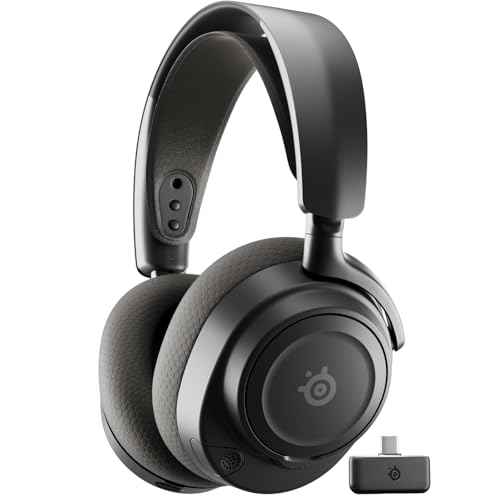
SteelSeries Arctis Nova 7 Gen 2 — Premium without borders
The second generation of the Nova 7 refines the most cosmopolitan design in premium gaming. Its founding idea — that a modern player’s audio life spans a PC, a console, and a phone, often within one sitting — is executed through simultaneous wireless: a 2.4GHz link for the game and Bluetooth for the second device, live at the same time, so a call or a video can join your session without evicting it. Plenty of headsets list both radios on the box. Far fewer let them coexist, and that coexistence is the difference between a specification and a lifestyle.
Gen 2’s headline refinement is control. SteelSeries moved the headset’s brain partly into its phone app, with real-time adjustments that land while you play — EQ, sidetone, balance — rather than after a desktop detour. It sounds like a small thing until a cutscene arrives mixed too quietly and you lift dialogue from your phone without pausing. The 40mm neodymium drivers deliver the house sound: balanced, spacious, unexaggerated, happy across genres in the way a good all-rounder should be. It will not out-inform the BlackShark in a tactical final or out-warm the Cloud Alpha in a film, and it does not need to; its arena is the whole day, and across the whole day it is never the wrong headset.
The retractable ClearCast microphone remains the design’s social masterstroke. Extended, it gives chat and calls a clear, noise-aware capture that handles ordinary rooms well. Retracted, it disappears so completely that the Nova 7 becomes the only premium gaming headset in this guide you can wear on public transport without explanation. Battery endurance past fifty hours with fast-charge recovery suits a product meant to be shared infrastructure, and the suspension headband’s weight distribution keeps it welcome on heads that wear glasses or wear it for work calls between matches.
Its premium compromises are the all-rounder’s eternal ones. No single metric here tops the class — not the microphone, not the battery, not competitive tuning — so specialists will always find a rival that beats it at their specialty. The app-centric control also means the headset’s full personality lives partly on your phone, which purists of self-contained hardware may resent. But judged by the standard it sets itself — one headset, every machine, every hour — the Nova 7 Gen 2 is the most complete answer this tier offers.
- Drivers: neodymium 40mm units with a balanced house tuning
- Wireless: 2.4GHz and Bluetooth running at the same time
- Endurance: beyond fifty hours, plus fast-charge recovery
- Voice: ClearCast boom that retracts fully into the earcup
- Control: real-time adjustments from the phone companion app
Strengths
- Genuine two-device life with no cable swaps or re-pairing
- Retracting mic makes it presentable far beyond the desk
- All-day comfort that glasses wearers consistently praise
Trade-offs
- Beaten at every single specialty by some specialist rival
- Full feature set depends on the companion app
- Microphone is good rather than class-defining
Best for: premium buyers whose gaming, work, and media share one headset across devices.
Not suited for: single-title competitors who want a headset with one ruthless priority.

HyperX Cloud Alpha Wireless — The endurance champion
Every premium headset makes a promise; the Cloud Alpha Wireless makes the easiest one to verify. Its battery is rated up to 300 hours — not a long weekend, not a long week, but a figure so far beyond its rivals that it changes the owner’s relationship with the product. Charging stops being a routine and becomes an occasional event, roughly monthly for most players, which means the headset is simply always ready: no dock discipline, no cable by the couch, no dead-headset evening, ever. In a category where premium money often buys features you must remember to use, this one buys the absence of a chore, and the absence compounds daily.
The endurance is not bought with tinny sound. The Cloud Alpha’s dual-chamber drivers — HyperX’s signature architecture, which separates bass frequencies into their own chamber to reduce interference — deliver the warm, full presentation the Alpha name is known for, with DTS Headphone:X spatial audio adding width for supported content. It is a cinematic sound, generous in the low end and kind to long sessions, better suited to story games, films, and music than to the forensic footstep work the BlackShark specialises in. Competitive players will find positional cues perfectly usable; they will also find the tuning prioritises pleasure over intelligence, and should choose accordingly.
Build follows the family pattern: an aluminium frame, memory foam cushions, and a detachable noise-cancelling microphone that captures a clear, natural voice for chat and calls. The microphone is good rather than broadcast-class — the HS80 Max below keeps that crown — but it detaches for media duty, and the headset’s PC-centred wireless (this is fundamentally a PC headset, with the dongle as its home) keeps the proposition focused. There is no Bluetooth second channel here; the Alpha Wireless is a one-link product, and its link is to your gaming PC.
That focus is its trade-off in full. Console households and multi-device lives are not its audience, its weight — while reasonable — is not the featherweight class, and players who prize a detachable everything, travel-ready design will find it desk-bound. None of that matters to its intended owner, who games at a PC, hates charging things, and wants premium sound with a battery that behaves like a wired headset’s: invisible. For that owner, this is not one option among four. It is the obvious one.
- Battery: up to 300 hours rated — the class outlier
- Drivers: dual-chamber design separating the bass path
- Spatial: DTS Headphone:X for supported games and media
- Voice: detachable boom with noise-cancelling capture
- Frame: aluminium build with memory foam cushioning
Strengths
- Battery life that removes charging from your life almost entirely
- Warm, cinematic dual-chamber sound for games and films
- Sturdy metal-framed build with a detachable microphone
Trade-offs
- A PC-centred product; console and Bluetooth lives need not apply
- Tuning favours pleasure over competitive information
- Desk-bound design with no travel ambitions
Best for: PC players chasing premium sound and a battery they can forget exists.
Not suited for: multi-platform households or players who split time across consoles.

Corsair HS80 Max — The broadcast voice
Ask a room of streamers which headset microphone they would take to a desert island and the HS80 line’s boom is the answer that keeps coming back. The HS80 Max carries that microphone into this tier with Dolby Atmos spatial audio and a personalisation trick none of its rivals here offer: SoundID tuning, which measures your hearing preferences through a short listening test and shapes the headset’s output to your ears rather than to a population average. It is the most voice-and-listener-centred design in the guide — a headset built for people who are heard, and who hear carefully.
The microphone first, since it insists. Its capture has the body and noise rejection of a modest desk microphone: your voice sits forward and full, plosives behave, and the room behind you — keyboard, fan, household — is demoted to a rumour. Flip the boom up and you are muted with mechanical certainty, a gesture streamers perform mid-sentence without breaking eye contact with chat. For anyone whose gaming involves an audience, a team they lead, or meetings they run, this microphone is not a feature on a list. It is the reason the product exists, and it justifies the tier by itself.
As a listening device the Max is cinematic: 50mm drivers with a rich, spacious presentation, and Dolby Atmos lending supported games and films a verticality that flat stereo cannot suggest. The SoundID personalisation is worth the ten minutes it takes — owners consistently describe the before-and-after as the difference between a headset tuned for someone and a headset tuned for them. Comfort comes from memory foam and a floating headband, with a clamp that runs firmer than the Cloud Alpha’s; the fit loosens over the first fortnight, but heads at the larger end should expect an assertive first week.
The boundaries are platform and portability. Its wireless world is PC and PlayStation; Xbox players are not invited, and Bluetooth rides along for phones rather than anchoring a second gaming link. It is also an unapologetically domestic object — substantial, desk-shaped, with no travel story. Within its borders, though, it offers something none of the other linked picks can: a voice so good that the headset replaces a microphone purchase entirely. Price the desk mic, arm, and interface it saves you, and the HS80 Max’s tier maths change character.
- Drivers: 50mm units with Dolby Atmos spatial rendering
- Personalisation: SoundID listening test tailors output to your hearing
- Voice: broadcast-class boom, flip-up to mute
- Wireless: 2.4GHz link for PC and PlayStation, Bluetooth alongside
- Fit: memory foam cushions under a floating headband strap
Strengths
- A microphone that can retire a separate desk-mic setup
- SoundID tuning that adapts the headset to your actual ears
- Atmos gives films and supported games real spatial height
Trade-offs
- Xbox players are outside its wireless world
- Firm initial clamp needs a breaking-in fortnight
- Substantial build that belongs at a desk, not in a bag
Best for: streamers, shot-callers, and meeting-heavy players whose voice is their instrument.
Not suited for: Xbox-first players or anyone needing premium sound on the move.
Audeze Maxwell — Planar-magnetic outlier
The Maxwell is what happens when a company famous for planar-magnetic audiophile headphones decides gaming deserves the real thing. Its 90mm planar drivers are physically different from the dynamic drivers in every other pick here — a thin film driven across its whole surface rather than a cone pushed from its centre — and the difference is audible as speed and resolution: transients snap, dense mixes stay unpicked thread by thread, and the low end extends with a control dynamic drivers imitate rather than match. As a pure listening device, it is the finest object in this guide, and it is not close.
So why does it appear without a link, as a prose-only presence? Because this guide’s brief for the tier weighs the whole product, and the Maxwell’s compromises are the kind that must be chosen knowingly rather than discovered. It is heavy — substantially heavier than the linked four — and while its headband distributes that weight intelligently, necks notice it across a long evening in a way they never notice the BlackShark. Its microphone is detachable and decent rather than a headline, its feature set is comparatively ascetic, and its entire design budget visibly went into the drivers and the acoustic chamber around them.
For a particular reader, none of that is a compromise at all. The listener who games the way others listen to records — single-player epics, scores, sound design as an art form — and who keeps a separate solution for competitive voice chat will find the Maxwell not merely better but categorically different, a hi-fi instrument that happens to game superbly. Audeze’s audience has always accepted weight and focus as the price of that difference. This guide simply insists the price be printed on the label, which is why the Maxwell is honoured here in prose: fully recommended to its reader, honestly withheld from everyone else’s cart.
- Drivers: 90mm planar-magnetic units, audiophile architecture
- Sound character: speed, resolution, and controlled deep bass
- Build: substantial, weighty, engineered around the drivers
- Voice: detachable microphone, competent rather than headline
- Character: a hi-fi instrument that games, not a gaming product first
Strengths
- The finest raw sound quality in this entire comparison
- Planar speed keeps complex scenes perfectly separated
- Build quality that feels machined rather than moulded
Trade-offs
- Weight that long sessions and smaller necks will feel
- Feature set is lean beside the linked flagships
- Microphone is a supporting act, not a co-star
Best for: sound-first listeners who play immersive titles and hear the difference planar drivers make.
Not suited for: players who wear a headset six hours nightly and count grams.
Beyerdynamic MMX 300 — Studio wired benchmark
Beyerdynamic has built studio headphones in Germany for a century, and the MMX 300 is its gaming headset in the most literal sense: a studio headphone’s drivers, build discipline, and voicing, joined to a broadcast-quality condenser microphone on a proper boom. It is wired only, battery-free forever, and proud of both facts. In a guide whose linked picks all carry radios, the MMX 300 stands as the wired philosophy’s premium witness — the argument that at this money, a cable plus a great driver plus a great microphone is still a complete sentence.
The sound is the studio argument made audible: balanced, detailed, and unhyped, with the kind of midrange honesty that makes voices and acoustic instruments sound like themselves. Competitive players get clean positional information without a “gaming” EQ’s exaggerations; music listeners get a headset that does not need to be swapped for headphones when the album starts. The microphone, a proper cardioid condenser, captures a voice with a naturalness that flatters untrained speakers, and the whole product is built to be serviced and kept — Beyerdynamic’s parts culture is the opposite of disposable.
Its prose-only place here follows the same logic as the Maxwell’s: the compromises must be chosen, not stumbled into. There is no wireless path, no Bluetooth, no app, no spatial processing suite — the feature list reads like a product from a more disciplined decade, because it is one. Buyers whose lives need device-hopping will find it stubbornly single-purpose. Buyers whose lives happen at one desk, and who keep products for a decade, will find it the most adult object in the guide.
There is also a temperament question the MMX 300 poses honestly. Premium gaming marketing sells excitement; Beyerdynamic sells correctness. Some players put on a headset like this and feel underwhelmed for an evening, then realise a month later that they have stopped thinking about their audio entirely — the highest state a tool reaches. If that trajectory sounds like satisfaction to you, this prose-only legend may be your pick despite its missing link. If it sounds like a lack of fun, the linked four are waiting with their radios on.
- Drivers: studio-voiced dynamic units from a hi-fi bloodline
- Voice: cardioid condenser boom of broadcast character
- Connection: wired only, by conviction, forever battery-free
- Build: serviceable construction from a parts-friendly maker
- Character: correctness over excitement, decades over seasons
Strengths
- Balanced, honest sound that serves games and music equally
- Condenser microphone with natural, flattering capture
- Built and supported like equipment, not like a gadget
Trade-offs
- No wireless, Bluetooth, or app features of any kind
- Studio restraint can feel plain beside gaming tunings
- Single-desk product in a multi-device era
Best for: desk-bound purists who keep gear for years and value correctness.
Not suited for: anyone whose headset must roam between rooms and devices.
Premium Headsets, Side by Side: The Character Table
| Headset | Connection | Endurance | Defining idea |
|---|---|---|---|
| Razer BlackShark V2 Pro | 2.4GHz wireless | ~70 hours | Competitive information |
| SteelSeries Arctis Nova 7 Gen 2 | 2.4GHz + Bluetooth together | 50+ hours | One headset, every device |
| HyperX Cloud Alpha Wireless | 2.4GHz wireless (PC) | Up to 300 hours | Charging, abolished |
| Corsair HS80 Max | 2.4GHz + Bluetooth | All-week class | The voice is the product |
| Audeze Maxwell | Wireless + wired options | Long, varies by mode | Planar sound above all |
| Beyerdynamic MMX 300 | Wired | Unlimited — no battery | Studio correctness |
Read the last column as the shopping list. Each of these six is the best answer to a different question, and the questions are all legitimate: What wins rounds? What covers my whole digital life? What never needs charging? What makes me sound like a broadcaster? What sounds most like the recording? What will still be correct in ten years? A buyer who cannot yet say which question is theirs is not ready to spend this tier’s money, and the kindest thing a guide can do is say so before the checkout rather than after the return.
The endurance column deserves a second look, because it quietly predicts ownership satisfaction better than any other. The Alpha Wireless’s figure is not a luxury; it is the removal of the most common premium-headset complaint, which is not sound or comfort but the dead battery discovered at the worst moment. Against that, the MMX 300’s “unlimited” is the same virtue achieved by opposite means. Between those poles, the seventy- and fifty-hour designs ask only for a weekly habit — a fair price, but a habit nonetheless, and honest buyers should decide whether they are habit people before choosing which pole to live near.
How Do You Choose Between Information, Immersion, and Voice?
Premium headsets diverge along three axes, and naming your axis is the fastest route through this guide. The information axis belongs to competitive play: the BlackShark’s tuning exists to convert audio into decisions, and players who live in ranked queues will feel its value in their results within a week. The immersion axis belongs to worlds: the Cloud Alpha’s warmth, the HS80 Max’s Atmos height, and the Maxwell’s planar resolution all serve the player who plays to be somewhere else, and who measures a headset by how completely the room disappears. The voice axis belongs to the heard: streamers, leaders, and professionals, for whom the HS80 Max’s microphone and the MMX 300’s condenser are not features but instruments.
Most players live on two axes at once, which is where the Nova 7 Gen 2 makes its quiet case: it is second-best on all three axes and first on the fourth, unglamorous axis of coverage — the ability to be the right headset on every machine you own. There is no shame in choosing the decathlete. There is only shame in choosing by a spec sheet’s loudest number, because at this tier the loudest number is usually the one its maker most needed you to notice.
A practical test: recall your last ten gaming sessions and count how many were competitive, how many were immersive, and how many involved people depending on your voice. The proportions are your answer, and they are rarely the proportions marketing assumes. Buy for the sessions you actually have, and a premium headset stops being an indulgence and becomes what it should be — the correct tool, bought once.
Which Premium-Tier Mistakes Waste the Most Money?
The most expensive mistake at this level is buying a second headset’s features in your first: paying for the Maxwell’s fidelity and the BlackShark’s tuning in one imaginary product that does not exist, then feeling cheated by the real one that arrives. Every pick here is a chosen emphasis; disappointment at this tier is almost always an unchosen one. The second mistake is platform blindness — falling for a wireless flagship whose console support does not include your console, a two-minute check that a surprising number of premium buyers skip in the glow of a discount.
The third mistake is neglecting the return-window audition. Premium prices buy generous return policies; use them as the listening room the category no longer has. Wear your finalist for a genuinely long session, record your voice through it, walk its wireless range, and only then let the window close. The fourth mistake is subtler: assuming the flagship you buy today must serve the player you hope to become — the streamer with an audience, the competitor with a team. Buy for the player you are this season. Headsets at this tier hold their value in use, not in aspiration, and the player you become can make their own excellent choice when they arrive.
How Does Premium Wireless Behave in a Real, Radio-Crowded Home?
Laboratory range figures assume an empty room and a cooperative spectrum; your home offers neither. A modern household radiates Wi-Fi from multiple bands, Bluetooth from a dozen devices, and interference from appliances that were never designed with your ranked match in mind. The mature 2.4GHz links in this guide’s linked picks were engineered for exactly that environment, with frequency agility that lets them step around congestion rather than shout through it. In practical terms, expect any of them to hold a clean connection through two ordinary interior walls and to begin breaking up at the distances where you have left the room’s line of sight entirely — the kitchen run is safe, the garden usually is not.
Where the designs differ is in their failure manners. Better implementations fade with brief crackle that warns you before the link lets go, and reconnect without ceremony when you return. The dual-radio Nova 7 has an extra trick: its Bluetooth channel can keep a call or a podcast alive on your phone while the gaming link does its own work, so a range excursion costs you the game audio, not the conversation. The Alpha Wireless’s PC-centred design is the most conservative — one link, deeply optimised — and in a crowded spectrum that conservatism is a genuine strategy rather than a missing feature.
Dongle placement is the cheapest performance upgrade in this entire category and the one almost nobody performs. A dongle buried in the back of a PC under a metal desk lives in a radio shadow of its owner’s making; the same dongle on a short extension cable, raised to desk level with a clear view of your chair, gains metres of reliable range. Premium money buys good radios, but it cannot buy physics. Give whichever pick you choose a fair RF environment and it will repay you with the invisibility that wireless at this tier promises and, properly placed, actually delivers.
What Should Competitive Players Understand About Tuning Before Spending Here?
Competitive audio rests on a simple principle that marketing often inverts: you do not need more sound, you need the right sounds louder than the wrong ones. Footsteps, weapon handling, ability cues, and positional voice lines occupy specific, learnable frequency regions, and a tuning that privileges those regions — as the BlackShark’s FPS profiles do — converts directly into earlier decisions. The trap is excess: sharpen everything and the mix becomes a fatiguing wall in which nothing is privileged, which is why the profiles shaped with professionals tend to sound surprisingly restrained when you first load them. Restraint is what information looks like before the match starts.
Spatial processing deserves the same scepticism. Dolby Atmos on the HS80 Max and DTS on the Cloud Alpha can genuinely widen a game’s soundstage in supported titles, and for immersion they are pleasures. For ranked play, many experienced players disable such processing, because a clean stereo image they have internalised over a thousand hours is worth more than a wider one they must relearn. Neither choice is wrong; the premium mistake is leaving the decision to a default. Spend your first week with any pick here testing both configurations in your main title, in unranked matches, and then lock the winner in.
Finally, understand that your own hearing is the last component in the chain. The HS80 Max’s SoundID exists because ears differ measurably, and a profile shaped to your hearing can recover detail that no factory tuning, however expert, can aim at a stranger. Competitive players who dismiss personalisation as a lifestyle feature miss its edge: information you cannot quite hear is information you do not have. At this tier, the headsets hand you the tools. The remaining work — a week of honest testing in your own games — is the part no amount of money can outsource.
What Does Two Years of Ownership Do to a Premium Headset?
Year two is where premium construction separates itself from premium presentation. The BlackShark’s light frame, treated like the sporting equipment it is, stays tight and true; treated like luggage, its hinges will tell the story. The Cloud Alpha’s aluminium skeleton shrugs off the desk accidents that accumulate across two years, and its battery — even faded by a realistic margin — still measures its endurance in weeks, which is the quiet genius of starting from three hundred hours: degradation has somewhere enormous to fall from and still land ahead of the field.
Cushions remain the universal consumable, and at this tier they are priced and stocked accordingly. Owners who replace them on schedule describe the ritual as getting a new headset at a tenth of the price, because seal, comfort, and bass response all restore at once. The Nova 7’s fabric and the HS80 Max’s foam both reward that schedule, and both headsets’ modular designs — detachable or retractable microphones, replaceable cables where wired modes exist — mean the parts most likely to fail are the parts most easily renewed. That modularity, rarely photographed for marketing, is a large part of what the tier’s money actually buys.
Software is the third ageing vector, and the honest one to watch. App-supported headsets like the Nova 7 tend to improve modestly across their lives — new presets, small refinements — while the wired MMX 300 simply remains exactly what it was, which its owners count as a feature. Batteries are the fourth vector and the only irreversible one: every wireless pick here will, in year four or five, hold less than it did. Buyers who find that thought intolerable have a standing answer in this guide, and it is wired, German, and patient. Everyone else can accept the fade as the modest rent on years of freedom.
How Should You Audition a Premium Headset During the Return Window?
Treat the return window as the listening room this category no longer provides, and run a deliberate programme rather than drifting through it. Session one belongs to your main title, played at your usual standard: you are listening for whether the tuning’s promises survive contact with the game you actually know, where a footstep’s position is something your instincts can grade. A headset that impresses in an unfamiliar demo and confuses in your own game has failed the only test that matters, however golden its reviews.
Session two belongs to your voice. Record a minute of ordinary speech through the microphone — read a paragraph, call a mock play, narrate a meeting point — and play it back on speakers or ordinary headphones. Then record the same minute with a fan and a keyboard alive in the room. Premium microphones distinguish themselves precisely in that second recording, and since your teammates and audience will live in the second recording’s world, weight it accordingly. If the voice disappoints, adjust the boom’s distance before judging; a centimetre is a mixing decision.
Session three belongs to endurance: one sitting as long as your longest real session, in your chair, with your glasses if you wear them. Note the time when you first become aware of the headset as an object — its weight, its clamp, its warmth. Every pick in this guide should push that moment past the two-hour mark; the one that pushes it past your longest session has passed. Session four is the walk: to the kitchen, to the door, learning where the wireless link thins, so the knowledge arrives during a calm week rather than during a final round. Four sessions, honestly graded, will tell you more than four hundred reviews — because they are graded on your head, your home, and your games.
What Should Console-First Players Take From a PC-Leaning Tier?
Premium gaming headsets are designed PC-first more often than their boxes admit, and console players deserve a translation. PlayStation owners are the best served of the console readers here: the HS80 Max and Nova 7 both treat the PS5 as a first-class wireless citizen, and the BlackShark’s ecosystem includes PlayStation-flavoured configurations worth confirming at purchase. The Tempest-era lesson is that Sony’s consoles handle USB audio properly, so a PC-designed headset usually arrives with its abilities intact.
Xbox owners face the tier’s oldest friction: Microsoft’s wireless licensing means many premium PC headsets simply cannot connect wirelessly to an Xbox, full stop, and no firmware update will change it. Your honest options are the models and variants built for the platform, or any of these headsets used wired through the controller — a configuration that preserves sound quality while surrendering the freedom you paid a premium for, and therefore rarely the right purchase. The Cloud Alpha Wireless, magnificent as it is, is a PC product; an Xbox household should admire it from across the aisle.
Switch and handheld players live in the Bluetooth and 3.5mm world, where the Nova 7’s second radio earns its keep and the wired legends wait patiently. The general rule for console readers is unglamorous and absolute: verify your exact platform against the exact variant before money moves, because at this tier the cost of the wrong box is not inconvenience — it is the entire premium, spent on capabilities your console cannot unlock.
Which Accessories Deserve Money After a Premium Purchase — and Which Do Not?
A premium headset purchase attracts accessory suggestions the way a new car attracts wax, so here is the honest triage. Worth it, almost always: a simple stand or hook, because a headset that lives off the desk surface avoids the knocks, spills, and cable crushes that end premium lives early; and a spare set of the manufacturer’s cushions, bought while they are certainly stocked, because cushion availability a decade from now is a promise nobody can make. Worth it for some: a hard travel case, if — and only if — the headset genuinely travels; the Nova 7 is the only linked pick whose life justifies one for most owners.
Usually not worth it: third-party “upgrade” cables and dongles promising sonic miracles, external DACs bought to fix problems the headset does not have, and decorative skins that complicate the warranty conversation. A premium headset’s electronics were voiced as a system; the aftermarket’s favourite interventions mostly redecorate the signal while lightening the wallet. The honourable exception is the desk-microphone question in reverse — an HS80 Max owner does not need the microphone arm their favourite streamer uses, and recognising the purchases a good product makes unnecessary is part of premium ownership’s quiet dividend.
The deepest accessory truth is unglamorous: the best companion purchase for any headset in this guide is the game, the season pass, or the evening itself — the thing the headset was bought to serve. Accessories should protect the tool or extend its life; the moment they begin competing with the experience for budget, the tail is wagging a very expensive dog.
A Short Word on Buying the Previous Generation Instead
Every premium launch creates the same temptation: last year’s flagship, suddenly discounted, wearing nearly the same name. Sometimes the temptation is wisdom — driver designs change slowly, and a previous BlackShark or Nova generation at a sharp reduction can be the smartest money in the category. Sometimes it is a trap wearing wisdom’s clothes, because the things that improve fastest in this category are precisely the invisible ones: battery chemistry, microphone processing, radio stability in crowded homes, and the app ecosystems that now carry half a headset’s personality.
The deciding question is which parts of the product you are actually buying. If your axis is raw sound, generations blur and the older model at a discount is often the connoisseur’s move. If your axis is voice, endurance, or multi-device coverage, the newest generation’s invisible improvements are the product, and the discount is compensating you for giving up the very thing you came for. Read the trade-off lists in this guide with that lens, and the previous generation sorts itself: a bargain for the sound-led, a false economy for everyone else.
Final Recommendation
For the competitive reader, the BlackShark V2 Pro is the tier’s clearest instrument, and its pro-shaped tuning earns the money every ranked night. For the PC player who wants premium sound without a charging ritual, the Cloud Alpha Wireless stands alone — nothing else at this level makes a battery this forgettable. For the household where one headset must cover PC, console, and phone with equal grace, the Arctis Nova 7 Gen 2 is the complete answer. And for the reader whose voice carries an audience, a team, or a job, the HS80 Max’s microphone justifies the tier in a single sentence of recorded audio. Let the Maxwell and the MMX 300 haunt you a little before you decide: if pure sound or studio correctness is secretly your first axis, they are not detours but destinations. This tier rewards the buyer who knows their question. Ask it honestly, and any of these six will feel less like a purchase than like an arrival.
Frequently Asked Questions
Is the $200 figure exact for these headsets?
No. It names the tier these designs compete in, and their street prices move with promotions, bundles, and platform variants. Shortlist by character using this guide, then check price on Amazon for your finalist’s current position before you commit.
Why are the Maxwell and MMX 300 not linked?
Both are discussed in full as the tier’s sound-first benchmarks, but their compromises — considerable weight in one case, wired-only discipline in the other — are the kind that should be chosen deliberately after reading, not clicked into casually. They are reference points that discipline the whole comparison.
Does a 300-hour battery actually change anything?
Yes, in the way that matters: it removes charging from your routines entirely. Owners of the Cloud Alpha Wireless charge roughly monthly and effectively never face a dead headset. That reliability, compounded over years, is why endurance is treated here as a headline feature rather than a statistic.
Which pick is best for streaming?
The HS80 Max, on the strength of its microphone alone. Its broadcast-class boom captures a voice that needs little or no processing, which is the single largest quality jump a new streamer can buy. The BlackShark’s wideband mic is the runner-up for competitive streaming with heavy callouts.
Can these headsets replace good headphones for music?
The Maxwell plainly can, and the MMX 300 was designed by a company whose headphones do exactly that. For many owners the premium headset quietly becomes the only pair of headphones in the house, because the difference that remains is smaller than the convenience of one device that is always charged, always paired, and always within reach of the chair where life happens. Among the linked picks, the Cloud Alpha’s warmth and the Nova 7’s balance make them satisfying music companions, while the BlackShark’s competitive tuning needs EQ help to flatter a record collection.
Related Guides
Still deciding your tier, or buying for a household that games on everything at once? Step down a level with our headsets around the $120 mark to see what the savings cost, or step sideways into simplicity with the finest headsets built on a 3.5mm plug. True budget hunters will find honest expectations in the best headsets near $40.
Related guide: Best Sennheiser Headsets
Related guide: Best Redragon Headsets
Related guide: Best VoIP Headsets
Related guide: Best Noise-Cancelling Headsets for Transcribing
Related guide: Best Gaming Headsets Razer
Related guide: Best Gaming Headsets For Bass


