What's inside
- Key Takeaways
- Quick Picks
- How Did We Sort the H-Numbers Into Six Picks?
- What Do Connection Modes Actually Buy a Gamer?
- The Six Redragon Picks in Detail
- What Separates the Six Redragon Models on the Desk?
- How Do You Set Up a Redragon Headset for Team Voice?
- What Do Redragon Buyers Most Often Get Wrong?
- Why Does Weight Matter More Than Most Spec Sheets Admit?
- What Is Virtual 7.1 Surround Actually Doing to Your Game?
- How Much Does Latency Matter, and Which Mode Controls It?
- Fabric or Artificial Leather: Which Ear Pad Belongs on Your Head?
- How Should You Treat a Wireless Headset’s Battery?
- Is RGB Lighting a Feature or a Tax?
- How Do You Choose a Redragon Headset for a Younger Player?
- What Should You Verify on the Listing in the Week You Buy?
- Where Does Redragon Sit Among Gaming Headset Brands?
- How Do You Travel With a Gaming Headset Without Wrecking It?
- Can One Headset Serve a Whole Household of Players?
- What Does a Sensible First Week With a New Headset Look Like?
- Do Shooters and Story Games Want Different Headsets?
- How Should You Think About Value Across This Range?
- What Separates a Good Team-Voice Setup From a Loud One?
- Why Do So Many Players End Up Owning Two Headsets?
- Final Recommendation
- Frequently Asked Questions
- Related Guides
As an Amazon Associate I earn from qualifying purchases. This post may contain affiliate links at no extra cost to you.
widgetverdict.com is reader-supported. When you buy through links on our site, we may earn an affiliate commission.
Where to buy: Redragon sells through its Amazon storefront, and each model below links to its own listing — check that page for the colour and connection bundle on offer, because Redragon revises its line-up quickly and the listing is the only reliable statement of what a given model includes this season.
Finding the best redragon headsets means shopping a brand that treats gaming audio as a value sport. Redragon’s catalogue is a thicket of H-numbers — H510, H541, H831, H858, H888, H891 — each a variation on the same themes: big drivers, memory foam, surround processing, detachable or retractable microphones, and connection modes multiplying like controller buttons. The six picks in this guide were chosen to make those variations legible, so you can see exactly what each step in the range buys.
Three patterns organise the six. There are wired and multi-mode models for players who sit at one machine; tri-mode and four-mode wireless models for players who roam between PC, console and phone; and featherweight designs for players whose sessions run long enough that grams become a feature. Every pick carries 7.1 surround sound in its listing except where noted, and every pick is a gaming headset first — none of them pretends to office duty.
A word on the numbers in the names: they are model codes, not rankings. The H891 is not automatically better than the H831, nor the H888 newer in spirit than the H858. Redragon numbers its families the way car makers name trim levels, and the listings’ own words — battery hours, driver sizes, connection modes — are the only honest map. This guide reads those words closely and ignores the digits.
Key Takeaways
- The H510 PRO is the multi-platform RGB anchor: 53mm drivers, 7.1 surround and fabric-covered memory foam, USB powered for PC, PS4 and Switch.
- The H858 takes the same driver size wireless across phone, PC, PS5 and Switch with a detachable noise-canceling microphone.
- The H541 is the simple wired option, with RGB, 3D stereo sound and the widest console list in the set, including Xbox.
- The H888 is the weight story — a 168-gram tri-mode design with a smaller 40mm driver traded for lightness.
- The H831 adds a fourth connection mode, voice monitoring on its detachable mic and a 45-hour-plus battery claim.
- The H891 claims the longest battery here at 65 hours, with a retractable noise-cancelling mic and 50mm drivers.
Quick Picks
| Pick | Badge | Why it earns its place |
|---|---|---|
| Redragon H510 PRO | The RGB all-platform anchor | Three-mode flexibility, 53mm drivers and fabric memory foam for long PC and console sessions. |
| Redragon H858 | Wireless freedom, big drivers | Three wireless modes keep the 53mm drivers and add a detachable microphone. |
| Redragon H541 | The wired console companion | RGB wired simplicity spanning PC, PlayStation, Switch and Xbox. |
| Redragon H888 | The 168-gram featherweight | Tri-mode wireless at a weight long sessions will thank you for. |
| Redragon H831 | Four modes and voice monitoring | The widest connection menu here, plus hearing your own voice through the detachable mic. |
| Redragon H891 | The 65-hour marathoner | The longest battery claim in the set with a retractable microphone that hides when not needed. |
How Did We Sort the H-Numbers Into Six Picks?
We grouped the catalogue by connection first, because connection decides which machines a headset can serve at all. Within each group we kept the model whose listing states the clearest identity — the lightest, the longest-running, the widest platform list — and dropped near-duplicates whose differences lived only in lighting or colour. What survives is a range you can actually navigate: two big-driver anchors, one wired console all-rounder, one featherweight, one connection maximalist and one battery maximalist.
Specification honesty guided the notes throughout. Driver sizes, battery hours and mode counts below come from the listings themselves. Where a listing is silent — exact wireless latency figures, for instance, beyond the H831’s low-latency claim — the analysis says what can and cannot be concluded rather than borrowing numbers from a sibling model or a review of a different revision.
We also treated 7.1 surround claims proportionately. Virtual surround processing is a real and enjoyable feature for games and films, and it appears across this range; it is not a set of eight physical speakers, and its quality depends on the game and the player’s ears. The picks are judged on the whole experience their listings describe, not on the surround badge alone.
Comfort evidence was weighted as heavily as any specification, because gaming headsets fail socially before they fail electronically: the pair that hurts at hour two gets left on the hook while an inferior but comfortable pair gets worn. Memory foam appears across the range, but its coverings and the headsets’ weights differ enough — fabric against leatherette, 168 grams against full-size frames — that comfort is a genuine axis of choice here rather than a shared constant.
Players who also travel for work sometimes keep a second, quieter pair, and Best Bose Headsets shows what strong cancellation costs and delivers.
What Do Connection Modes Actually Buy a Gamer?
Each mode solves a different friction. A 2.4GHz wireless link through a USB dongle is the gaming standard: low latency, console and PC friendly, indifferent to the Bluetooth quirks of various machines. Bluetooth serves phones, tablets and handhelds, and accepts a little more latency in exchange for universality. A wired mode is the fallback that never fails — mid-session battery death, a forgotten dongle, a platform that accepts nothing else — and it doubles as the charging-while-playing path on several models here.
Tri-mode headsets like the H888 and H891 therefore are not showing off; they are covering the three situations a modern player’s week actually contains. The H831’s fourth mode extends the same logic further. Players with one machine and one seat should discount mode counts heavily and spend their attention on fit and drivers — the wired H541 exists for them, and it is not a lesser product for its single cable.
Platform lists deserve the same literal reading. The H541 names Xbox where others do not; the H858 names PS5; the H510 PRO names PS4 and Switch. Console compatibility in gaming headsets is a licencing and connection patchwork, and the listing’s named platforms are the only safe guide. Assume nothing across brands of console, and check the current listing for your exact machine before ordering.
The Six Redragon Picks in Detail

Redragon H510 PRO — The RGB all-platform anchor
The H510 PRO is the range’s reference design: a three-mode RGB gaming headset with 7.1 surround sound, 53mm drivers in memory foam ear pads with a durable fabric cover, and USB power for PC, PS4 and Nintendo Switch. Its identity is balance — nothing here is the extreme of the range, and everything a mainstream player asks for is present.
The fabric cover on the pads is a considered detail. Fabric breathes better than the artificial leather used elsewhere in this line-up, which matters across summer sessions, and it wears differently over years — less prone to the flaking that ends many gaming headsets’ presentable lives. The 53mm drivers are the joint-largest in this guide, promising the physical bass presence that game audio and film soundtracks exploit.
USB power defines its console story: plug into the machine and play, with the RGB lighting fed by the same connection. Players whose battlestations are part of the room’s décor will appreciate the lighting; players in shared bedrooms should check how the lighting behaves at night on the listing, since RGB enthusiasm is not universal at 1 a.m.
- Drivers: 53mm
- Surround: 7.1 surround sound per listing
- Modes: 3-mode (see listing for the exact combination)
- Pads: memory foam with durable fabric cover
- Platforms named: PC, PS4, Nintendo Switch — USB powered
- Lighting: RGB
Strengths
- Fabric-covered foam suits long, warm sessions better than leatherette.
- The largest driver size in the set, shared with two siblings.
- Three modes cover desk and console without a second headset.
Trade-offs
- USB power ties its console use to wired connection.
- RGB styling will not suit every room or every hour.
- Its microphone arrangement is not the detachable type some players prefer — check the listing.
Best for: PC-centred players who also game on PS4 or Switch and like their setup lit.
Not suited for: players wanting a fully wireless console experience, who should take the H858 instead.

Redragon H858 — Wireless freedom, big drivers
The H858 keeps the 53mm drivers and 7.1 surround, then removes the leash: three wireless modes, memory foam ear pads and a detachable noise-canceling microphone, working across phone, PC, PS5 and Switch. It is the pick for the player whose gaming happens in more than one chair — desk in the evening, sofa at the weekend, handheld in bed.
The detachable microphone changes the headset’s social life. Off, it becomes a pair of wireless headphones for music and video on the phone; on, it is a team-voice instrument with noise cancelling aimed at the room behind you. Players who have snapped a fixed boom in a bag will also appreciate a microphone that travels separately.
Its platform list is the most current in this guide, naming PS5 explicitly. Wireless on consoles always deserves a listing check for the exact connection path — dongle or Bluetooth — but the H858’s three modes give it more ways to satisfy a given machine than any single-mode rival here.
Comfort across a sofa session differs from comfort at a desk, and the H858’s memory foam suits the reclined version: the head rests back, the cups take some weight against a cushion, and a headset that clamps for upright posture can press when the head leans. Players whose gaming is mostly sofa-based should favour softer clamp and foam depth — qualities this model advertises — while desk players can tolerate a firmer fit in exchange for stability during quick head movements.
- Drivers: 53mm
- Surround: 7.1 surround sound per listing
- Modes: 3-mode wireless
- Microphone: detachable, noise-canceling
- Pads: memory foam ear pads
- Platforms named: phone, PC, PS5, Nintendo Switch
Strengths
- Big drivers without the cable, across the newest console named here.
- Detachable mic doubles the headset as everyday wireless headphones.
- Memory foam comfort matches its multi-chair brief.
Trade-offs
- A detachable microphone is also a losable microphone.
- Wireless means a battery to manage, unlike the wired picks.
- Xbox is not among its named platforms.
Best for: players splitting time between PC, PS5, Switch and phone.
Not suited for: Xbox-led households, where the H541’s platform list fits better.

Redragon H541 — The wired console companion
The H541 is the traditionalist: a wired gaming headset with a microphone, 53mm drivers, RGB lighting, 3D stereo sound, soft memory earmuffs in an artificial leather design, and a platform list spanning PC, PS4 and PS5, Switch and Xbox. In a range drunk on wireless modes, its argument is that a cable never needs charging, pairing or firmware — and that its console list is the widest here.
Note the sound language: the listing says 3D stereo sound rather than the 7.1 surround claimed by its siblings. Read honestly, that is a different processing promise, and players for whom virtual surround is a headline feature should weigh the siblings. Players who mostly want clear, spacious stereo with big drivers lose little and gain the cable’s certainty.
Artificial leather pads seal more firmly than fabric, which flatters bass and isolation in a noisy room, at the cost of warmth across long sessions. The H541 is therefore the pick for the player in a loud household with a console under the television — maximum compatibility, zero battery anxiety, and RGB to match the setup.
- Drivers: 53mm
- Sound: 3D stereo sound per listing
- Connection: wired, with microphone
- Pads: soft memory earmuffs, artificial leather design
- Platforms named: PC, PS4/5, Switch, Xbox
- Lighting: RGB
Strengths
- The only pick here naming every major console family.
- No battery, no pairing, no wireless failure modes.
- Leatherette seal suits noisy rooms and bass-heavy games.
Trade-offs
- 3D stereo is not the 7.1 processing its siblings advertise.
- Leatherette pads warm up over marathon sessions.
- The cable sets the player’s radius around the machine.
Best for: console players, especially Xbox owners, wanting one wired headset for everything.
Not suited for: players who game from the sofa far from the screen, who need a wireless pick’s radius.
Redragon H888 — The 168-gram featherweight
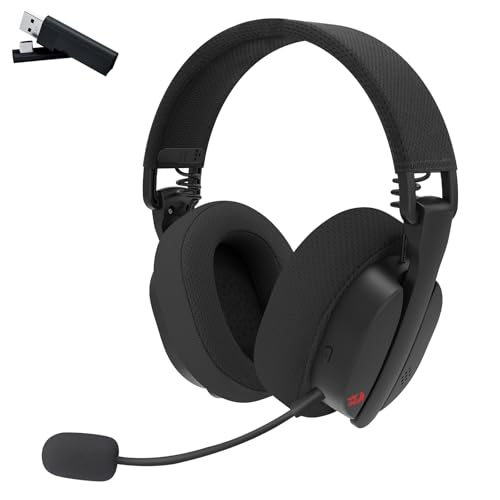
The H888 leads with a number you feel rather than hear: 168 grams. It is a wireless tri-mode gaming headset with 7.1 surround, a detachable microphone and soft memory foam padding, built around a 40mm driver — smaller than its siblings’ — in exchange for that weight. For players whose necks complain before their batteries do, this is the most interesting design in the guide.
The driver trade deserves honesty. A 40mm driver in a well-sealed cup can still deliver full game audio; what it typically concedes is some low-end physicality against a 53mm unit. Players of shooters and strategy titles, where footsteps and cues matter more than cinematic rumble, may never notice. Players of film-like single-player epics might, and should weigh the H858.
Weight compounds across a session the way interest compounds across a loan. A headset that starts light stays unnoticed at hour four, and unnoticed is the highest compliment gaming gear earns. Combined with tri-mode wireless, the H888 is the pick for the player who moves rooms and plays long — the two habits that punish heavy, tethered designs most.
There is a younger-player angle here too: smaller heads and necks feel a heavy headset’s tax sooner, and a 168-gram design with memory foam is kinder across a weekend tournament than a flagship built for adult endurance. Parents comparing this range for a teenager should weigh the H888’s lightness as a health feature, not a compromise, provided the platform list covers the household’s consoles.
Handle it as its design asks, though. Featherweight frames achieve their number with thinner materials, and a headset this light deserves a hook rather than a bag’s bottom. Treated properly, lightness is pure gain; treated roughly, it is the first thing the design spends.
- Weight: 168g lightweight design per listing
- Driver: 40mm
- Surround: 7.1 surround sound per listing
- Modes: tri-mode wireless
- Microphone: detachable
- Padding: soft memory foam
Strengths
- The lightest design here by a clear margin.
- Tri-mode wireless keeps platform options open.
- Detachable mic for headphone-only use between sessions.
Trade-offs
- Smaller driver concedes some bass weight to the 53mm models.
- No battery figure is stated in the listing title — check the listing for endurance details.
- Lightweight builds ask for gentler handling in bags.
Best for: long-session players and anyone whose current headset causes neck fatigue.
Not suited for: bass-first cinematic players, who will prefer the 53mm models’ physical low end.
Redragon H831 — Four modes and voice monitoring
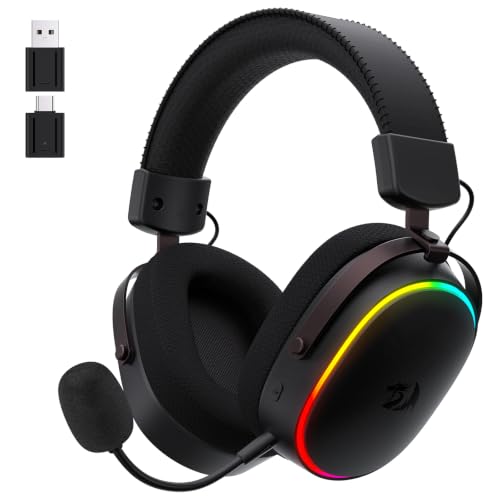
The H831 maximises connection choice: a four-mode wireless gaming headset with 53mm drivers, a battery quoted at over 45 hours, 360-degree spatial sound, low latency and a detachable microphone with voice monitoring, spanning PS4 and PS5, Switch, PC, Mac and phone. If a device in your home makes sound, this headset aspires to marry it.
Voice monitoring is the connoisseur’s feature in the list. Hearing your own voice fed back into the cups — sidetone, in studio language — stops the shouting that sealed headsets provoke and lets team players judge their own volume naturally. Once experienced, its absence on other headsets feels like a missing mirror.
The spatial sound claim and low-latency positioning aim the H831 at competitive play, where directional cues and timing decide rounds. As with all such claims, the listing states the features without publishing measurements; the honest reading is that Redragon tuned this model for that brief, and players should confirm the connection path for their platform delivers the low-latency mode rather than a Bluetooth fallback.
- Drivers: 53mm
- Modes: 4-mode wireless — the widest menu here
- Battery: 45 hours and beyond, per listing (45Hr+)
- Sound: 360-degree spatial sound; low latency positioning
- Microphone: detachable, with voice monitoring
- Platforms named: PS4/5, Switch, PC, Mac, phone
Strengths
- Four modes cover more machines than any sibling.
- Voice monitoring genuinely improves team communication.
- Strong battery claim backs the roaming brief.
Trade-offs
- Mode abundance means more switching logic to learn.
- Spatial and latency claims arrive without published measurements.
- Xbox again absent from the named platforms.
Best for: multi-device competitive players who talk constantly in team voice.
Not suited for: single-machine players, who would pay for modes they never touch — the H541 serves them plainly.

Redragon H891 — The 65-hour marathoner
The H891’s headline is endurance: a wireless tri-mode headset — 2.4GHz, Bluetooth and wired — with a 65-hour battery claim, 50mm drivers, 7.1 surround sound and a noise-cancelling retractable microphone, compatible with PC, PS5, Switch, Mac and mobile. Sixty-five hours is a working week and a half of evening play between charges; the charging cable becomes a monthly acquaintance rather than a nightly ritual.
The retractable microphone is the design’s second idea. Where the H858 and H831 detach their mics — gaining flexibility, risking loss — the H891 slides its microphone away into the cup. It is always there when a call starts, never in a drawer, and the headset keeps a clean headphone silhouette for music on the move. Players choose between the two philosophies by knowing their own tidiness.
Its 50mm drivers sit a step below the 53mm trio and well above the H888’s 40mm, a middle tuning consistent with the whole design: nothing here is the extreme except the battery. For the player whose headset lives across desk, sofa and commute, that balance — plus never thinking about charge — is a coherent flagship argument.
The wired mode deserves a moment of respect in that argument. When the battery finally does run low mid-session — at hour sixty-something, weeks after the last charge — the cable in the box converts a crisis into a shrug, and the same cable serves any machine whose wireless the headset cannot speak to. Tri-mode designs are often sold on their radios; their quiet virtue is that the oldest connection of all remains aboard as the universal translator.
- Drivers: 50mm
- Modes: tri-mode — 2.4GHz, Bluetooth, wired
- Battery: 65 hours per listing
- Surround: 7.1 surround sound per listing
- Microphone: noise-cancelling, retractable
- Platforms named: PC, PS5, Switch, Mac, mobile
Strengths
- The longest battery claim in this guide by a wide margin.
- Retractable mic cannot be lost and hides cleanly.
- Full tri-mode set including a wired fallback.
Trade-offs
- Drivers a step smaller than the 53mm models.
- A retractable mic offers less positional adjustment than a long boom.
- Xbox is not named among compatible platforms.
Best for: players who hate charging and split play across PC, console and mobile.
Not suited for: players wanting a fully detachable microphone for travel headphones duty, who fit the H858 better.
What Separates the Six Redragon Models on the Desk?
| Model | Driver | Connection | Signature |
|---|---|---|---|
| H510 PRO | 53mm | 3-mode, USB powered | Fabric pads, RGB anchor |
| H858 | 53mm | 3-mode wireless | Detachable mic, PS5 named |
| H541 | 53mm | Wired | Widest console list incl. Xbox |
| H888 | 40mm | Tri-mode wireless | 168g featherweight |
| H831 | 53mm | 4-mode wireless | Voice monitoring, 45Hr+ battery |
| H891 | 50mm | Tri-mode (2.4G/BT/wired) | 65H battery, retractable mic |
Three questions sort the table. Does your console appear in the model’s platform list? Do you value weight, battery or driver size most? And where should the microphone live when you are not talking — detached, retracted or fixed? Answer those and the six collapse into one obvious name; skip them and the H-numbers stay a thicket.
For readers taking calls at the same desk between matches, Best Plantronics Headsets covers office headsets whose boom microphones suit all-day talking.
How Do You Set Up a Redragon Headset for Team Voice?
Choose the low-latency connection for play: the 2.4GHz dongle where your model offers one, wired where it does not, and Bluetooth reserved for phones and handhelds. Then set the headset as both output and input in the game or chat app — operating systems love defaulting the microphone to a webcam — and run the app’s mic test while speaking at match volume, not library volume.
Position the boom a couple of centimetres from the corner of your mouth. On the H831, enable voice monitoring and set it until your own voice sounds natural rather than loud; sidetone set too high encourages mumbling, too low encourages shouting. On retractable and detachable models, extend or attach the mic fully before judging its sound — a half-extended boom is the commonest cause of a quiet microphone report.
Finally, agree a push-to-mute habit with your team and configure it before the match. Every model here gives you some mute path; the one you have practised is the one that works when a parent, partner or doorbell enters the room mid-round.
What Do Redragon Buyers Most Often Get Wrong?
Assuming console compatibility across the range leads the list. Three of these six do not name Xbox at all, and wireless console support varies by model and mode. The platform list in each listing is the contract; read it for your machine specifically, especially before buying a wireless model for a console.
Second, chasing driver diameter as a quality score. The 53mm models do not automatically sound better than the 50mm H891 or the 40mm H888; tuning, seal and fit mediate everything, and the H888’s lightness may deliver more actual enjoyment across a long session than three extra millimetres of driver. Buy the whole design, not the biggest number.
Third, ignoring the microphone storage question. Detachable mics get lost in the exact bags they were meant to travel in; retractable mics cannot be upgraded or replaced as easily. Neither is a defect — both are philosophies, and the wrong philosophy for your habits becomes a daily irritation.
Another common misstep is ignoring how you sound to teammates, a weakness the business models in Best Sennheiser Headsets are engineered to avoid.
Why Does Weight Matter More Than Most Spec Sheets Admit?
Gaming sessions are endurance events wearing entertainment’s clothes. A headset’s weight presses on the crown, its clamp presses on the jaw, and both compound across hours in a way a ten-minute shop trial cannot reveal. The H888’s 168-gram design is this guide’s clearest acknowledgement of that physics, and its existence in the range tells you Redragon hears the complaint from real players.
Weight interacts with fit: a light headset with a poor headband still digs one hot spot, while a heavier model with excellent distribution can disappear. Memory foam pads — present across this range — help by spreading the clamp, and fabric covers help by reducing the sweat that makes players readjust constantly. Judge weight and pads together, as a comfort system.
Players with glasses should add one more variable: cup pressure on spectacle arms. Softer foam and lighter clamp forgive frames; firm leatherette seals punish them. If you play in glasses for four-hour stretches, comfort features are not soft marketing — they are the specification that decides whether the headset is worn or abandoned.
What Is Virtual 7.1 Surround Actually Doing to Your Game?
Five of these six headsets advertise 7.1 surround, and the honest explanation makes the feature more useful, not less. The processing takes a game’s multichannel audio and remixes it for two drivers using timing and level cues that imitate how ears locate sounds. Footsteps behind you gain a behind-you quality; a film’s rain fills the room rather than the left-right line. It is an illusion, but a functional one, built from real information in the game’s mix.
Its limits are equally real. Competitive players sometimes prefer plain stereo, where the game’s own audio engine and their own learned cues are not filtered through a second layer of processing. Music, mixed for stereo, usually sounds worse processed. The practical habit is to treat surround as a per-content switch: on for films and single-player worlds, tested both ways for your competitive title, off for music.
Redragon’s implementation arrives through the headset’s USB or wireless processing depending on model and mode, which is why the connection path matters to the feature: a mode that bypasses the headset’s processing may bypass the surround too. Check the listing for how each mode handles it if surround is your headline reason for buying.
How Much Does Latency Matter, and Which Mode Controls It?
Latency is the delay between an event on screen and its sound in your ears. In films it shows as lip-sync drift; in games it shows as gunshots that land late and footsteps that mislead. Wired connections have effectively none worth discussing. A 2.4GHz gaming link is engineered to keep delay low enough that players stop perceiving it. Bluetooth, designed for music and calls, carries the most, in amounts that vary by device and codec.
That hierarchy explains the tri-mode designs in this guide. The H891 and its siblings give you Bluetooth for the phone — where a film’s slight delay is tolerable or corrected by the player app — and 2.4GHz for the console and PC, where it is not. The H831’s explicit low-latency positioning speaks to the same hierarchy. Players should simply internalise the rule: compete on the dongle or the cable, relax on Bluetooth.
One more variable hides in televisions. Console players routing audio through a TV’s own processing add delay before the headset ever sees the signal; connecting the dongle or cable to the console rather than the television keeps the chain short. Setup order matters as much as spec sheets here.
Fabric or Artificial Leather: Which Ear Pad Belongs on Your Head?
This range offers both, and the choice is climatic as much as acoustic. The H510 PRO’s fabric-covered memory foam breathes: air moves, sweat evaporates, and long sessions in warm rooms stay tolerable. The H541’s artificial leather seals: outside noise drops, bass firms up, and the same warmth that fabric releases accumulates against your skin.
Durability tells a longer story. Leatherette surfaces eventually crack and flake, especially in humid climates and with daily use; fabric covers fade and absorb more, but tend to age gracefully rather than suddenly. Players in air-conditioned rooms with noisy households rationally choose leatherette’s seal; players in warm rooms rationally choose fabric’s mercy. Climate, not fashion, should arbitrate.
Either way, pads are wear parts. How a headset feels in month eighteen depends on whether the pads can be cleaned and eventually replaced, and on whether the player treats them as consumables rather than as part of the product’s soul. Wipe them after sessions, let them dry before the headset goes in a drawer, and the material you chose will serve its full term.
How Should You Treat a Wireless Headset’s Battery?
The battery claims in this guide — 45 hours and beyond on the H831, 65 hours on the H891 — describe new cells under manufacturer conditions. Keeping them near those figures across years is a habit problem. Cells dislike being stored empty and dislike being stored full and hot; a headset that lives on a desk hook, used regularly and charged when low rather than after every session, ages slowest.
Long-battery models help their owners here in an unexpected way: fewer cycles per month means fewer cycles per year, so a 65-hour headset charged fortnightly accumulates wear far more slowly than a short-battery model charged nightly for the same play time. Endurance is therefore also a longevity feature, not merely a convenience one.
When a wireless headset will sit unused for weeks — a holiday, a busy season at work — leave it around half charge in a cool drawer, microphone detached or retracted, rather than plugged in continuously. And keep the wired mode in mind as the dignity-preserving fallback: every tri-mode model here can keep playing through a cable while its battery recovers, which is more than can be said for wireless-only designs.
Is RGB Lighting a Feature or a Tax?
Two picks here wear RGB — the H510 PRO and the H541 — and players divide over it honestly. On a desk battlestation, lighting is part of the room’s design and the headset joins the keyboard and case in a single scheme; streamers gain a small on-camera presence from it. In a shared bedroom at midnight, the same lighting is a negotiation with a sleeping partner.
There are practical costs to count. Lighting draws power — on the USB-powered H510 PRO that is the host’s problem, trivially small; the aesthetic cost is the larger one, since a lit headset announces gaming in rooms where a plain one would pass as work equipment. Players who take calls or meetings on the same headset should picture it in that context before choosing the lit model.
Neither answer is wrong, and Redragon’s range respects both: the wireless models here are comparatively sober, the wired anchors carry the light show. Choose by room and by audience, and check the listing for how lighting is controlled or dimmed on the model you pick.
How Do You Choose a Redragon Headset for a Younger Player?
Teen and younger players change the weighting of every feature in this guide. Durability rises to first place: headsets get dropped, sat on, stuffed in school bags and borrowed by siblings. A wired model like the H541 removes the battery and pairing failure modes and survives on simplicity, while its platform breadth covers whatever console the household actually owns — including the Xbox several siblings here cannot serve.
Weight matters more, not less, for younger necks, which makes the H888 a serious candidate for long weekend sessions despite its smaller driver. Volume habits matter most of all: teach the player to set game volume at the lowest level that keeps cues audible, and use the headset’s fit and seal to do the work that volume otherwise would. A well-sealed cup at moderate level beats a loose one turned up, for hearing and for enjoyment alike.
Microphone behaviour deserves a household conversation. Team voice is social, and a detachable or retractable mic gives parents and players a simple physical rule for when voice chat is on. The H831’s voice monitoring also helps younger players hear how loudly they are actually speaking — a self-regulation tool disguised as a feature.
What Should You Verify on the Listing in the Week You Buy?
Redragon revises models within a name more freely than the premium brands do, so the listing in front of you outranks any review — including, in a sense, this guide. Confirm the driver size, the battery figure and the exact mode combination on the current product page, and treat screenshots in older reviews as history. The six models here were read from their current listings; your order should be too.
Confirm the platform row for your exact console generation and the connection that platform uses. Confirm what the box holds — dongle, cables, spare pads — because wireless models are only as flexible as their included receivers. Confirm the microphone type once more: detachable, retractable or fixed decides daily habits, and photographs occasionally show a sibling model.
Finally, confirm the seller is the brand’s storefront or a clearly authorised outlet, and read recent buyer reports for fulfilment on the specific model. In a fast-moving value catalogue, most disappointment arrives as the wrong revision in the box rather than as a bad headset — and that is the one failure entirely within the buyer’s power to prevent.
Where Does Redragon Sit Among Gaming Headset Brands?
Redragon’s proposition is breadth at accessible prices: many models, many connection combinations, specifications that a generation ago belonged to far dearer headsets. The trade a buyer accepts is coherence — a catalogue this wide asks the shopper to do the sorting work that a narrower range does for them, which is precisely the work this guide exists to do.
Against the premium gaming brands, the honest gaps are in software polish, published measurements and the refinement of small things: hinge feel, cable quality, the tactility of a volume wheel. Against budget no-name headsets, Redragon’s gaps run the other way — a real brand with listings that state their specifications, models that persist across seasons, and features like voice monitoring and four-mode wireless that generic rivals rarely attempt.
That middle position suits the majority of players, whose needs are concrete — my console, my room, my session length, my team chat — rather than ceremonial. Read the range as this guide has: six worked answers to six recognisable playing lives, each checkable against its listing in two minutes.
How Do You Travel With a Gaming Headset Without Wrecking It?
Headsets die in bags more often than on desks. The failure points are hinges, boom roots and cable strain reliefs, all stressed when a headset is forced around clothes and chargers. The detachable-microphone models here travel best: remove the mic, let the cups lie as flat as the design allows, and give the headset the top of the bag rather than the bottom. The H891’s retracted mic achieves the same protection without a separate part to track.
Wireless models add a logistics list: dongle, charging cable, and the wired fallback cable if you play on the road. The dongle is the item most often lost and the hardest to replace casually, so it deserves a fixed pocket of its own. Players who travel weekly should consider whether the wired H541’s single cable is, for their life, the more reliable technology — a defensible conclusion this guide will not argue with.
At the destination, hotel and friend’s-house setups punish forgotten configuration. Re-run the input selection on the host machine, because a borrowed PC will cheerfully default to its own microphone while your headset handles output. Thirty seconds of setup beats a match played as a mime.
Can One Headset Serve a Whole Household of Players?
Households try it constantly, and the models here divide by how gracefully they share. Adjustable headbands and memory foam forgive different heads; microphone philosophies divide them. A detachable mic can be claimed by one player and forgotten by another mid-session; a retractable mic stays with the headset and therefore with the household, which is a point for the H891 in shared service.
Hygiene sets the other boundary. Shared pads should be wiped between users, and households with a heavy-use player should simply accept a second, simpler headset — the H541 as the spare — rather than scheduling around one. Two headsets also solve the simultaneous-session problem that no sharing arrangement survives: two players, two screens, one Saturday afternoon.
Where sharing genuinely works is across time rather than across people: one player, several machines, several rooms. That is the tri-mode and four-mode brief exactly, and it is why the H831 and H891 exist. Buy for the sharing pattern you actually have, not the one that sounds thrifty.
What Does a Sensible First Week With a New Headset Look Like?
Day one belongs to fit and configuration: every connection mode paired or plugged once, the chat app’s devices set explicitly, one test recording made and listened to. Day two belongs to surround experiments — the same game scene played with processing on and off, because the difference is content-dependent and your ears are the only laboratory that matters.
By the middle of the week, test the headset in its secondary role: the H858 as phone headphones with the mic detached, the H891 on a wired connection with its battery resting, the H510 PRO on the console rather than the PC. Secondary roles are where multi-mode headsets justify themselves, and discovering a mode’s quirk in a quiet week beats discovering it mid-match.
End the week with the unglamorous checks. Is the charging spot working as a habit, or is the headset already living flat on a sofa? Does the boom land where you set it? Has anyone in the house been shouted at through a sealed cup? Fix the small failures now, while they are habits rather than verdicts, and the headset settles into the years of unnoticed service that mark a good purchase.
Do Shooters and Story Games Want Different Headsets?
Yes, and this range quietly encodes the difference. Competitive shooter players live on information: footstep direction, reload sounds, the callout economy of team voice. They benefit from the H831’s spatial positioning and low-latency modes, from voice monitoring that keeps their own volume honest, and from lighter headsets that stay put during quick movements. Bass weight, for them, is mostly decoration — and can even smear the cues they hunt.
Story-driven players live on immersion: orchestral scores, weather systems, the sub-bass of a collapsing building. They benefit from the larger drivers in the H510 PRO, H858 and H541, from leatherette’s sealed low end or fabric’s long-session comfort, and from surround processing left permanently on. A cable’s radius bothers them less, because their sessions are seated and cinematic.
Most players own both kinds of game, which is why the balanced models — the H891 above all, with its 50mm drivers, full mode set and marathon battery — make such natural defaults. Specialise only when one genre genuinely dominates your library; the hours in your game history, not the genre of the moment, should cast the vote.
How Should You Think About Value Across This Range?
Value in a value brand sounds circular until you price the features instead of the boxes. Wireless costs more than wired because radios, batteries and dongles are real hardware; battery hours cost more than battery silence; a fourth connection mode costs more than three. The range is honest about this arithmetic, so the buyer’s task is to refuse features whose situations never occur in their week.
The most common overbuy is modes: a PC-only player paying for a four-mode flagship uses one mode and funds three. The most common underbuy is comfort: a daily player saving on the wired basic and paying in neck fatigue across a year. Between those errors lies the correct purchase, and it is usually found by ranking your own constraints — console, room, session length, charging temperament — before ranking any specification.
Longevity completes the value picture. A headset whose pads, microphone arrangement and battery habits suit its owner gets used for years; a technically superior headset that irritates gets replaced within one. In this catalogue, the best value is therefore personal in a way spec sheets cannot capture — it is the model whose daily behaviour you will never have to think about.
What Separates a Good Team-Voice Setup From a Loud One?
Team voice quality is a chain, and the headset is only its first link. Microphone placement sets the ceiling; the chat app’s noise suppression and input level decide how much of that ceiling survives; your room sets the floor. Players who sound bad on a good headset almost always have an input level problem — the app amplifying a distant mic into hiss — rather than a hardware problem.
Set the input level so ordinary speech sits comfortably below the app’s clipping point, then speak at that ordinary level consistently. Use push-to-mute or a practised mute gesture for coughs, keyboards and household events rather than relying on suppression to hide them; suppression is a filter, not a courtesy. On the H831, voice monitoring closes the loop by letting you hear your own level as your team does.
The social dividend is underrated. A player whose voice arrives clean and level gets listened to in callouts; a player fighting hiss and echo gets talked over, whatever the quality of their information. In team games, the microphone is a leadership instrument, and the modest setup discipline in this section is the cheapest performance upgrade available anywhere in this guide.
Why Do So Many Players End Up Owning Two Headsets?
Because the briefs genuinely conflict. The headset that wins at a desk — wired, lit, sealed, surround on — is not the headset that wins on a train or in a handheld session on the sofa. Players who accept this early buy one excellent tool per brief and stop apologising; players who resist it buy one compromised flagship after another, each excellent at half their life.
This range makes the two-headset answer unusually attainable: a wired anchor such as the H510 PRO or H541 for the desk, and a light wireless model such as the H888 for everywhere else, together cover more situations than any single pick here. The pairing also provides the spare that saves a match night when a cable fails or a battery dies uncharged.
None of that obliges anyone to buy twice on day one. Start with the brief that owns most of your hours, live with it for a season, and let the second purchase — if it comes — be informed by the specific irritations the first one revealed. That is how gaming setups actually mature: not by grand plan, but by honest friction, answered one device at a time.
Final Recommendation
Start from your machines. Xbox players take the H541 and enjoy its wired certainty; PS5 and Switch players choose among the wireless models by what they value — the H858’s big drivers and detachable mic, the H888’s featherweight frame, the H831’s four modes and voice monitoring, or the H891’s 65-hour battery and retractable mic. PC-only traditionalists should not overlook the H510 PRO, whose fabric pads and three modes make it the range’s anchor. Redragon’s catalogue rewards players who read listings literally and buy the design that matches their rooms, their consoles and their session lengths — do that, and the H-number on the box stops mattering entirely.
Frequently Asked Questions
Which Redragon headset works with Xbox?
Of these six, the H541 names Xbox among its platforms. The wireless models list PC, PlayStation, Switch, Mac and mobile in various combinations, so Xbox players should confirm compatibility on the current listing of any model they are considering.
Is 7.1 surround on these headsets real surround sound?
It is virtual surround processing applied to the audio, not eight separate speakers. It can widen games and films convincingly, and its quality varies by title — treat it as a processing feature, which is how the listings present it.
What is the difference between detachable and retractable microphones?
A detachable mic, as on the H858, H888 and H831, removes completely so the headset doubles as plain headphones. A retractable mic, as on the H891, slides into the earcup — always available, never lost, slightly less adjustable.
Which model has the longest battery life?
The H891 claims 65 hours, ahead of the H831’s 45-hour-plus figure. The H888’s listing title does not state a battery figure, so check its product page for the current specification before comparing.
Are bigger drivers always better?
No. Driver size sets potential, particularly for bass weight, but tuning and fit decide what you hear. The H888’s 40mm design trades some low-end for a 168-gram weight that many players will value more across long sessions.
Can I use these headsets for phone calls and music?
The wireless models pair with phones — the H858, H831 and H891 all name mobile use — and detachable or retractable microphones make them presentable as everyday headphones. The wired H541 and USB-powered H510 PRO are desk and console tools first.
Which pick is best for handheld and Switch play?
The wireless models that name Switch — the H858, H831 and H891 among them — suit handheld play because the console moves with your hands and a cable snags on everything. For docked Switch play at a television, the wired H541 and the USB-powered H510 PRO are equally at home, and their platform lists name the console explicitly.
How long will a headset like these typically last?
With pads treated as consumables and hinges handled as designed, the wired models should serve for years, and the wireless models for as long as their batteries hold useful capacity — which good charging habits extend considerably. The usual end is not electronic failure but accumulated wear: pads, cables and boom joints, in that order.


