What's inside
- Key Takeaways
- Quick Picks
- How We Chose These Picks
- Comparison
- How to Choose Among These Six
- What Makes a Projector Genuinely Portable?
- How Large a Picture Can a Portable Projector Honestly Fill?
- What Should a Travelling Projector Kit Weigh?
- How Do Projectors Behave on Holiday Rental Walls?
- Common Mistakes
- Final Recommendation
- Frequently Asked Questions
- Related Guides
As an Amazon Associate I earn from qualifying purchases. This post may contain affiliate links at no extra cost to you.
widgetverdict.com is reader-supported. When you buy through links on our site, we may earn an affiliate commission.
Portable is a promise about everything except the picture: the best portable outdoor projectors are the ones that leave the house in one hand, set up on an unfamiliar surface without a toolkit, and find their content without a scavenger hunt through adapters. The six picks in this guide approach that promise from strikingly different directions. The soundcore Nebula P1 builds its case on detachable speakers and a gimbal. The Aurzen D1R air runs on USB-C and a power bank. Two unbranded models compete on speaker wattage — 50W and 60W of claimed Dolby Audio — and AI focus. And two familiar minis from the backyard guide, the YGSKK and the smart P62 Pro, return here in their travelling clothes, judged this time on mobility rather than hosting.
Only one title in the six prints a brightness figure: the Nebula P1 states 650 ANSI lumens, and that number — modest on paper, honestly published — becomes the guide’s anchor. It tells you what this class of projector is: a dusk-and-darkness instrument for pictures of moderate size, whose virtues are measured in minutes of setup and grams of luggage rather than in lumens. The other five titles leave brightness unstated or describe it with adjectives — ultra-bright appears in one title without a figure attached — and this guide treats those silences consistently: no output rankings, no daylight promises, and a planning assumption that the evening begins when the light goes.
Resolution follows the now-familiar wording ladder. The Aurzen D1R air states native 1080P. The Nebula P1 states 1080p. The YGSKK states a 1080P video projector without claiming native. The two unbranded wattage models and the P62 Pro lean on 4K Support language, which — as the backyard guide established and this one repeats — describes signals accepted and downscaled, not 4K pictures formed. A traveller choosing among these machines should decide first where the projector will live: a campsite, a holiday rental, a friend’s garden, a van. The reviews are organised around those journeys.
Key Takeaways
- The soundcore Nebula P1 is the only pick stating a brightness figure — 650 ANSI lumens — and the only one with detachable speakers and a built-in gimbal.
- The Aurzen D1R air is USB-C powered and power bank supported, the closest any pick here comes to cable-free travel without a built-in battery.
- Two unbranded models compete on claimed speaker output — 50W and 60W Dolby Audio — with AI auto focus on both.
- The Aurzen states native 1080P; the 4K Support wording on three titles describes accepted signals, not native 4K pictures.
- Google TV, Roku TV and two proprietary smart systems divide the platform field, so content access differs more than optics do.
Quick Picks
| Pick | Badge | Why it earns its place |
|---|---|---|
| soundcore Nebula P1 Portable Projector | Detachable speaker pick | A 1080p Google TV projector whose speakers detach to flank the screen, with a built-in gimbal and the guide’s only stated brightness at 650 ANSI lumens. |
| Generic Portable Outdoor Projector 50W Dolby Audio | 50W app-library pick | An unbranded traveller claiming 50W Dolby Audio, over 15,000 official apps and AI auto focus under its own smart OS. |
| Aurzen Roku TV D1R air | USB-C power bank pick | A native 1080P Roku TV mini that runs from USB-C and a power bank, built for luggage rather than a fixed perch. |
| Generic Portable Outdoor Projector 60W Dolby Audio | 60W ultra-bright claim pick | The loudest audio claim here at 60W Dolby, with AI auto focus and a smart TV OS, its brightness described but never numbered. |
| YGSKK Mini Projector | Electric focus traveller pick | A mini with electric focus and built-in apps whose stated source list covers nearly every device a trip might involve. |
| Smart Outdoor Projector with WiFi and Bluetooth (4K Support) | Named-apps smart pick | An outdoor model with YouTube and Prime Video named among built-in apps, dual speakers and auto focus for host-anywhere evenings. |
How We Chose These Picks
Portability was scored as a system, not a weight. A travelling projector is really four things — the machine, its power route, its content route and its sound route — and a pick earns its place here only if its title gives a credible answer for each leg of the journey. The Nebula P1 answers sound with detachable speakers and content with Google TV. The D1R air answers power with USB-C and a power bank, content with Roku TV. The unbranded pair answer sound with wattage claims and content with app libraries. The two returning minis answer with focus automation and broad device manners. A projector that travels beautifully but arrives mute, powerless or contentless has failed the category’s actual test, however fine its panel.
The honesty discipline from the backyard guide carries over unchanged, and this category needs it more. Speaker wattage in unbranded titles is a claim about amplifier output that says little about loudness or quality in a field at midnight; this guide reports the figures as titled and judges the designs — detachable, dual, built-in — on their placement logic, which is verifiable, rather than on their decibels, which are not. Brightness adjectives are treated as adjectives. The single stated figure, the Nebula’s 650 ANSI lumens, is used as the class anchor it honestly is: plan for darkness, moderate sizes, and evenings that begin at dusk.
Two picks repeat from the backyard guide — the YGSKK and the P62 Pro — and their presence here is deliberate rather than lazy. Both are sold as portable machines, and a buyer comparing guides deserves to see them judged on the travelling brief: how the electric focus behaves on a rental wall, how the named apps serve a host away from home. Their reviews below are written from that angle, and readers coming from the backyard article will find the emphasis — and several conclusions — shifted accordingly.

soundcore Nebula P1 Portable Projector — Detachable speaker pick
The Nebula P1 has the most original design idea in this guide: its speakers detach. Soundcore — Anker’s audio brand — looked at the portable projector’s oldest flaw, sound emerging from a box behind the audience while faces move on a wall ahead, and simply moved the sound. The title states detachable speakers delivering 20W of true 2.0 surround sound with Dolby Audio, which in practice means the two speaker units can sit either side of the screen or the blanket, where stereo belongs, while the projector stays wherever its throw demands. For a category that has solved portability of picture and ignored portability of sound for a decade, that is a genuinely thoughtful answer, and it is this pick’s headline for good reason.
The remaining specification is the guide’s most complete. A built-in gimbal tilts the projector to aim at walls and ceilings without a stack of books — the traveller’s eternal improvisation, engineered away. Auto adjustment handles the alignment. Google TV supplies the content with a finished platform. The picture is stated at 1080p with a maximum screen of 180 inches, and brightness is stated at 650 ANSI lumens — the figure that disciplines all the others. Six hundred fifty ANSI lumens will not fill 180 inches in anything but serious darkness, and the honest pairing is a moderate picture in a dark place: a campsite clearing, a blacked-out rental living room, a garden at full night. Soundcore published the number, and this guide respects a published number by planning around it rather than wishing it larger.
A battery is the thing the title does not state, so the P1 travels with a power plan — mains where available, a power station where not — and its portability is of the carry-and-set-up kind rather than the untethered kind. Within that definition it is the most considered machine here: the only one whose audio design, aiming design and platform all show evidence of someone asking how a projector evening actually unfolds away from home. Travellers who watch in pairs or small groups, value stereo placement, and shoot at moderate sizes in real darkness will find the P1 the pick that thought about them specifically.
- Resolution stated: 1080p
- Brightness stated: 650 ANSI lumens
- Screen stated: Up to 180 inches
- Audio stated: Detachable speakers, 20W true 2.0 surround sound, Dolby Audio
- Mounting stated: Built-in gimbal; auto adjustment
- Platform stated: Google TV
- Battery: Not stated in the listing title — verify with the manufacturer documentation
- Native wording: 1080p stated without the word native in the title
Strengths
- Detachable speakers put stereo sound at the screen, solving portable projection’s oldest flaw.
- The built-in gimbal aims the picture without improvised stacks of books and bags.
- It publishes its 650 ANSI lumen figure, letting travellers plan picture size honestly.
Trade-offs
- At 650 ANSI lumens it needs genuine darkness and moderate picture sizes to shine.
- No battery is stated, so off-grid evenings still need a power station or mains.
- The 180-inch maximum is a geometry figure, not a brightness promise, and should be read that way.
Best for: travelling pairs and small groups who value stereo sound placement and one-hand setup in dark locations. Not suited for: a bright holiday rental at twilight, where 650 stated ANSI lumens cannot fight the evening light.
Look at the Nebula P1 listing on Amazon for its speaker and carry configuration: check price on Amazon.
Generic Portable Outdoor Projector 50W Dolby Audio — 50W app-library pick
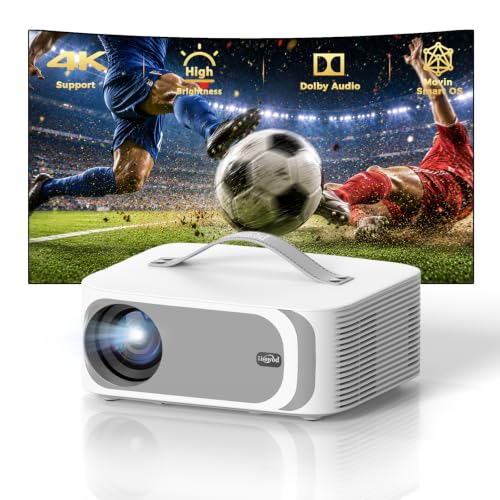
The first unbranded traveller competes on two numbers: 50W of claimed Dolby Audio output, and an app library stated as 15K+ official apps. Both numbers deserve the same reading discipline. Fifty watts describes the audio system’s rated output, not a measured loudness in your garden, and amplifier wattage in this class is best treated as an intention — this machine was built to be heard outdoors — rather than as a specification to rank against the 60W model below it. The app figure is more checkable: a library counted in tens of thousands under the maker’s own Lisowod AI Smart Movin 2.0 OS suggests breadth, though the services a given household actually opens number about six, and their presence should be verified by name before purchase rather than inferred from a five-digit total.
AI auto focus is stated, with HDR10+ named among the picture features — a dynamic HDR format claim that gives this unbranded listing a more specific picture pipeline than its peers, provided the content and the panel cooperate. The 4K Support wording appears again and means what it meant in the backyard guide: 4K signals are welcomed and downscaled; the panel’s own resolution is not stated in the title, and this review will not guess it. WiFi and Bluetooth cover the connections, the latter offering the usual escape route to a trusted portable speaker if the built-in 50W claim proves optimistic in a real field.
As a travelling proposition the shape is coherent: apps inside so no stick is needed, focus automatic so unfamiliar walls are painless, sound built to a wattage that at least aspires to outdoor audibility, and a brand-free listing whose longevity support is an open question a buyer should price in. It is the pick for a household that streams widely, travels often, and prefers its projector self-contained — with the verification homework, on app names and panel resolution, done in the listing’s fine print before the trip rather than discovered during it.
- Audio stated: 50W Dolby Audio
- Platform stated: Lisowod AI Smart Movin 2.0 OS; 15K+ official apps claimed
- Signal stated: 4K Support (panel resolution not stated in the title)
- HDR stated: HDR10+
- Setup stated: AI auto focus
- Connectivity stated: WiFi and Bluetooth
- Brightness: Not stated in the listing title — verify with the manufacturer documentation
- Positioning stated: Portable outdoor projector for outdoor movies and home theater
Strengths
- A five-figure claimed app library under its own OS makes it genuinely self-contained for streaming.
- HDR10+ is a specific picture-format claim few unbranded listings bother to make.
- AI auto focus suits a machine that lands on a new wall every trip.
Trade-offs
- The panel’s native resolution is never stated, so picture detail rests on documentation.
- The 50W audio figure is a rating, not a loudness guarantee in open air.
- An unbranded OS raises update and longevity questions a platform brand would not.
Best for: a streaming-heavy traveller wanting apps, focus automation and ambitious built-in sound in one unbranded box. Not suited for: a buyer who needs a stated native resolution and a named platform’s update track record.
Browse the 50W portable listing on Amazon and verify its app names individually: check price on Amazon.
Aurzen Roku TV D1R air — USB-C power bank pick
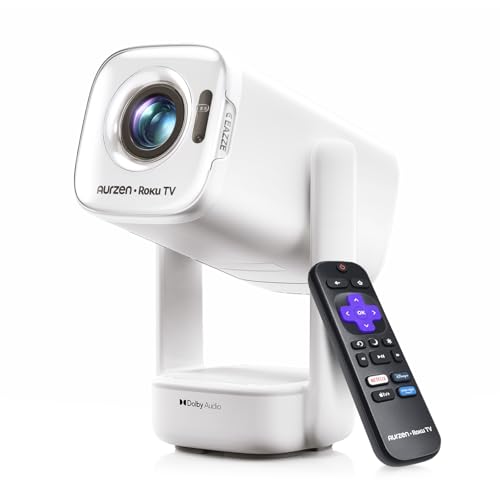
The D1R air solves the portable projector’s power problem with a cable the traveller already owns. Its title states USB-C powered, with power bank support claimed outright — which reframes the whole category. A projector that drinks from a power bank inherits the traveller’s existing kit: the same bank that rescues a phone on a train runs the evening’s film at the destination, and the same USB-C lead serves both. No proprietary brick, no hunt for the right barrel plug in a dark tent. For luggage-based viewing — holiday rentals, dorm rooms, a partner’s flat, the van — that power flexibility is worth more than any single optical figure, and Aurzen is the only maker in this guide whose title claims it.
Everything else in the specification is reassuringly concrete. Native 1080P is stated — the word native, claimed plainly, making this the strongest imaging wording among the six titles. Roku TV is built in with WiFi and Bluetooth, so the content route is the finished Roku platform rather than an unbranded app environment, and Dolby Audio covers the sound processing. The machine is a mini projector in white, pitched at home and outdoor movies, and its relationship to the mains-powered D1R in the backyard guide is best understood as a division of labour: the sibling stays home on its socket, the air goes in the bag with its power bank.
Two honest gaps complete the picture. No brightness figure is printed, so the dusk discipline of this whole category applies — moderate sizes, real darkness. And power bank support, while claimed, comes with an arithmetic the traveller must run: a projector draws far more than a phone, so the bank’s capacity decides whether the film ends before the credits, and the documentation’s power requirement should be matched against the bank you actually own. Neither gap diminishes the concept. Of the six picks, the D1R air is the one whose portability survives contact with an airport, a backpack and a rental wall — the traveller’s pick in the literal sense.
- Resolution stated: Native 1080P
- Power stated: USB-C powered; power bank supported
- Platform stated: Roku TV built-in
- Connectivity stated: WiFi and Bluetooth
- Audio stated: Dolby Audio
- Form stated: Mini projector, white, for home and outdoor movies
- Brightness: Not stated in the listing title — verify with the manufacturer documentation
- Power draw: Not stated in the listing title — match the power bank using the manufacturer documentation
Strengths
- USB-C power with power bank support makes it the most luggage-friendly machine here.
- Native 1080P is claimed outright, the clearest imaging wording in the guide.
- Roku TV gives it a finished, familiar platform with no stick required.
Trade-offs
- A power bank’s capacity may not cover a long film, so runtime arithmetic is the traveller’s homework.
- No brightness figure is stated, keeping it a dusk-and-darkness machine.
- Built-in audio is described only as Dolby Audio, so larger groups will want a Bluetooth speaker.
Best for: travellers screening in rentals, dorms and gardens from a power bank, with Roku as the platform. Not suited for: an off-grid double feature, unless the power bank’s capacity has been matched to the projector’s draw in advance.
Check the D1R air listing on Amazon for its USB-C power requirements: check price on Amazon.

Generic Portable Outdoor Projector 60W Dolby Audio — 60W ultra-bright claim pick
The second unbranded traveller raises its sibling’s bids across the board: 60W of Dolby Audio against 50W, official apps under an ONOAYO Movie branding and a Smart TV OS 3.0, AI auto focus, and the two words this guide has learned to interrogate hardest — ultra-bright, printed in brackets in the title with no lumen figure anywhere to support them. Let the interrogation be fair and brief. Ultra-bright is an adjective; the Nebula P1’s 650 ANSI lumens is a measurement; and in this category a measurement from a rival is worth more than a superlative from a listing, because the traveller planning a picture size can compute with one and only hope with the other. This machine may well be bright for its class. Its title simply declines to prove it, and the review records the declination.
The Projector-4K wording appears in its name as well, and by now the reading is routine: 4K here is the support claim, the signal door, with the panel’s own resolution unstated in the title. What is stated usefully is the source list — PS5, HDMI, USB and laptop — which sketches the machine’s intended evenings: console sessions carried to a friend’s house, laptop films in a rental, a stick or phone feeding it on the road. WiFi and Bluetooth are present, the Bluetooth again serving as the honourable exit if the headline wattage flatters the actual sound. Sixty watts of rated audio output, taken as intent, at least describes a machine designed to be its own speaker for a travelling group, which cannot be said of every mini in this class.
Compared with its 50W sibling, the choice between them is a coin weighted by verification: both leave brightness and panel resolution to documentation, both claim AI focus and app libraries, and the differences that survive scrutiny are the operating systems’ app rosters and whatever the fine print reveals. A traveller choosing between the two unbranded models should spend the decision time in those fine prints — named services, stated resolutions in the specification table, return terms — rather than in the wattage gap, which is the least informative number either title prints. As a self-contained, loud-leaning travelling box, the 60W model makes its case; it simply makes it in adjectives where its branded rivals use figures.
- Audio stated: 60W Dolby Audio
- Platform stated: Smart TV OS 3.0 (ONOAYO Movie); official apps claimed
- Signal stated: Projector-4K (support wording; panel resolution not stated)
- Setup stated: AI auto focus
- Connectivity stated: WiFi and Bluetooth
- Sources stated: PS5, HDMI, USB, laptop
- Brightness: Described as ultra-bright in the title, with no figure given
- Positioning stated: Portable outdoor projector for outdoor movies and home theater
Strengths
- The 60W audio claim is the largest sound rating among the six titles.
- AI auto focus plus a stated source list suits console-and-laptop travelling evenings.
- Its own smart OS with official apps keeps it self-contained without a stick.
Trade-offs
- Ultra-bright is an adjective with no lumen figure behind it in the title.
- The panel’s resolution is unstated beneath the Projector-4K name.
- Wattage ratings cannot be compared as loudness between unbranded listings.
Best for: a travelling group wanting the loudest claimed built-in sound and a self-contained app system. Not suited for: a buyer who plans picture size from published brightness, since this title publishes none.
Read the 60W portable listing on Amazon with its specification table open: check price on Amazon.

YGSKK Mini Projector — Electric focus traveller pick
Judged on the travelling brief rather than the hosting one, the YGSKK’s virtues rearrange themselves. Electric focus — its headline in the backyard guide too — matters even more on the road, because a travelling projector meets a new wall every night: a rental’s textured plaster, a hostel’s painted brick, a friend’s spare-room door. Each surface sits at a different distance from whatever furniture serves as the stand, and a focus that adjusts by motor from the remote turns the nightly ritual into ten seconds from the bed or the blanket. Built-in apps keep the content inside the machine, and the title’s habitat list — bedroom first — suits the traveller’s reality that most portable projection happens in small rooms at close range, where a mini’s picture is at its most convincing.
The source list remains the broadest in this guide: smartphone, TV stick, iPad, PS5, laptop, HDMI and USB all named. On the road that breadth is insurance — whatever device the group actually brought, the projector accepts it — and the PS5 mention in particular marks the machine for the travelling gamer, the console in a carry-on and the hotel wall as the screen. WiFi and Bluetooth complete the wireless picture. Resolution stays as the backyard review recorded it: a 1080P video projector whose title does not claim native, a wording this guide reports without embroidery and sends to the documentation for resolution.
For travel specifically, the unstated items cluster predictably: no brightness figure, no battery, no named audio system. The YGSKK is therefore a mains-powered traveller, happiest where a socket exists within lead distance of a wall — rentals, bedrooms, dorms, a family garden — rather than a wild-camping instrument. Within that territory its combination of motorised focus, app inclusion and universal source manners makes it the lowest-friction machine in this guide to lend, borrow or pack for someone else, which is a real and underrated form of portability: the projector that actually gets taken along.
- Resolution stated: 1080P video projector (native not claimed in the title)
- Setup stated: Electric focus
- Platform stated: Built-in apps
- Connectivity stated: WiFi and Bluetooth
- Sources stated: Smartphone, TV stick, iPad, PS5, laptop, HDMI, USB
- Positioning stated: Portable projector for bedroom and movies
- Brightness and audio system: Not stated in the listing title — verify with the manufacturer documentation
- Power stated: Portable format; no battery claimed in the title
Strengths
- Electric focus from the remote suits a different wall every night.
- The stated source list covers virtually every device a trip involves.
- Built-in apps and a mini body make it the easiest pick to pack for someone else.
Trade-offs
- No battery is claimed, so its travels end where the mains lead does.
- Native resolution is not claimed in the title and rests on documentation.
- Brightness and audio go unstated, keeping groups dependent on dusk and a speaker.
Best for: a traveller moving between bedrooms, rentals and gardens with a console or laptop as the source. Not suited for: off-grid camping far from a socket, where its mains-powered design cannot follow.
See the YGSKK listing on Amazon for its size and remote details: check price on Amazon.

Smart Outdoor Projector with WiFi and Bluetooth (4K Support) — Named-apps smart pick
The P62 Pro returns from the backyard guide with its travelling credentials examined, and they hold up better than its unbranded status might suggest. Auto focus is the first: a projector that sharpens itself on an unfamiliar wall removes the setup step travellers perform most often in the worst light. Built-in apps with YouTube and Prime Video named in the title give the content route a verifiable floor — two services confirmed in print, rather than an app count in the thousands that confirms nothing. Dual speakers with Dolby Audio give it the strongest integrated sound claim among the minis here, and for the travelling pair or small family, integrated sound that works is worth more than a wattage figure that merely promises.
The 4K Support wording gets its by-now-standard reading — signals accepted, panel resolution unstated — and brightness remains unprinted, so the machine travels under the category’s dusk discipline. What distinguishes it on the road is the absence of dependencies: no stick to forget, no laptop to risk, no speaker strictly required, no focus ritual on arrival. A host arriving at a friend’s garden with this box, a lead and a wall has a cinema; the same cannot be said of picks that assume a source device or a sound solution from the host’s own shelves. Portability, in the end, is measured in the things you do not have to remember to pack.
Its ceiling is equally clear. The panel question and the brightness question both await documentation, the brand behind the listing offers no lineage to consult, and a traveller whose evenings demand verified specifications has branded alternatives above it in this guide — the Nebula’s published lumens, the Aurzen’s native claim and power bank route. The P62 Pro’s constituency is the spontaneous host: the machine kept in a cupboard or a car boot against the evening someone says the words movie night, and judged by that constituency’s standards — self-contained, self-focusing, self-voicing — it is a more complete traveller than several better-specified rivals.
- Signal stated: 4K Support (accepted and downscaled; panel resolution not stated)
- Platform stated: Built-in apps; YouTube and Prime Video named
- Audio stated: Dolby Audio with dual speaker
- Setup stated: Auto focus
- Connectivity stated: WiFi and Bluetooth
- Positioning stated: Smart outdoor movie projector
- Brightness: Not stated in the listing title — verify with the manufacturer documentation
- Power stated: No battery claimed in the title; plan on mains
Strengths
- Named apps and dual speakers make it the most dependency-free mini here.
- Auto focus handles the unfamiliar-wall ritual on every arrival.
- Its self-contained design suits spontaneous hosts and car-boot cinemas.
Trade-offs
- Panel resolution and brightness both rest on documentation rather than the title.
- No battery or power bank route is claimed, so mains power bounds its travels.
- An unbranded listing leaves longevity and updates unjudgeable in advance.
Best for: a spontaneous host wanting one self-contained box for gardens, rentals and friends’ walls. Not suited for: a specification-led buyer who wants published brightness and panel figures before travelling.
Check the smart outdoor listing on Amazon for its current app roster: check price on Amazon.
Comparison
| Projector | Picture as titled | Stated brightness | Platform | Portability headline |
|---|---|---|---|---|
| soundcore Nebula P1 | 1080p | 650 ANSI lumens | Google TV | Detachable speakers, built-in gimbal |
| Generic 50W model | 4K Support (signal only) | No figure in title | Lisowod AI Smart Movin 2.0 OS | 50W audio claim, 15K+ apps claimed |
| Aurzen D1R air | Native 1080P | No figure in title | Roku TV | USB-C powered, power bank supported |
| Generic 60W model | Projector-4K (support wording) | Ultra-bright (adjective only) | Smart TV OS 3.0 | 60W audio claim, AI auto focus |
| YGSKK Mini | 1080P video (native unstated) | No figure in title | Built-in apps | Electric focus, broadest source list |
| Smart Outdoor P62 Pro | 4K Support (signal only) | No figure in title | Built-in apps, two named | Dual speakers, auto focus |
The brightness column is again the table’s confession: one figure, one adjective and four silences across six listings for a category sold on outdoor use. Everything else in the table differentiates honestly — platforms are named or described, audio designs are stated, the Aurzen’s power route is unique — so the portable buyer’s decision procedure writes itself: pick the power and platform that match the journey, pick the audio design that matches the group, and then verify brightness and panel resolution for the finalists in their documentation, because the titles have collectively declined to provide them.
How to Choose Among These Six
Begin with the journey, not the machine. A traveller whose screenings happen in rentals, dorms and other people’s homes should start from power and platform: the D1R air’s USB-C and power bank route with Roku TV is the most luggage-native combination here, and the Nebula P1’s Google TV with detachable speakers serves the traveller who carries a power solution anyway and cares about sound placement. A household whose portability means garden-to-garage and friend-to-friend can relax the power question and choose on audio and apps — the unbranded pair’s wattage claims and libraries, the P62 Pro’s named services, the YGSKK’s source manners.
Sound deserves its own choosing pass, because travelling groups divide sharply on it. A couple watching a film on a blanket needs only intelligible dialogue at arm’s length, which every machine here provides. A group of eight spread across a garden needs the sound at the screen and sized to the back row — the Nebula’s detachable speakers solve this by design, while the other five solve it through their stated Bluetooth and a portable speaker the household must remember to charge. The unbranded wattage claims sit between those poles as intentions; a traveller whose evenings are group evenings should test the built-in sound in a real garden before deciding the speaker can stay home, because open air taxes small drivers in ways a living-room audition never reveals.
Then size the picture to the one honest number in the guide. The Nebula’s 650 ANSI lumens describes the class’s centre of gravity: pictures in the 60 to 100 inch range, in genuine darkness, will look confident; the 180-inch maximum in its title is a geometry limit, not a recommendation. Travellers planning larger pictures in imperfect darkness should treat every unstated brightness figure in this guide as a question to answer from documentation and owner reports before committing, and should remember that a smaller, brighter picture impresses an audience more than a vast, washed one on every single evening.
One more filter belongs in the choosing, and it is the household’s streaming allegiance. A Roku household gains a zero-learning-curve machine in the D1R air; a Google TV household gains the same in the Nebula P1; a household that lives inside two named services gains it in the P62 Pro. Choosing against your own platform grain means new sign-ins, new remotes’ logic and a recommendation home screen that does not know you — small frictions that compound across every trip, and that no optical specification in this guide can compensate for. Platform loyalty is usually mocked as a trap; in portable projection it is simply ergonomics.
Finish with the pack list test. Write down everything the chosen projector needs besides itself — power bank or lead, speaker, stick, source device, stand — and count the items. The right portable projector for a given household is usually the one whose list is shortest for that household’s habits, which is why the self-contained P62 Pro and the power-bank Aurzen outrank better-specified machines for many travellers. Portability is a property of the whole bag, never of the projector alone.
What Makes a Projector Genuinely Portable?
Four properties, and weight is only one of them. The machine must be carryable, certainly — every pick here is a mini or portable format by its title. It must set up without expertise on an unfamiliar surface, which is where the gimbal, the auto focus and the electric focus in these titles earn their keep. It must find content without a supporting cast of devices, which is the platforms’ job. And it must be powered by something the journey already contains — a socket, a USB-C bank, a car’s supply — because a projector whose power plan requires its own expedition is luggage, not equipment.
There is a fifth property the titles rarely mention and travellers learn once: tolerance for being knocked, tilted and re-aimed by other people’s hands. A travelling projector is borrowed, adjusted by hosts, carried by children and perched on furniture it was never measured for, so the automation in these listings — auto adjustment on the Nebula, AI focus on the unbranded pair, electric focus on the YGSKK — doubles as insurance against well-meaning interference. A machine that recovers its picture in seconds after every disturbance will be invited on more trips than a marginally sharper machine that needs ten minutes of expert attention each time someone bumps the table.
Measured against those four, the category’s marketing gets quietly reordered. A projector can be light and still fail the test completely if it needs a laptop, a speaker, a stick and a specific cable to show a film. Conversely the Nebula P1, not the smallest machine here, passes more of the test than most: gimbal for the surface, Google TV for the content, detachable speakers for the sound, leaving only power to arrange. The D1R air passes the power leg outright. The wise traveller scores each candidate on all four legs and distrusts any listing — or any guide — that scores it on the scale alone.
How Large a Picture Can a Portable Projector Honestly Fill?
The titles offer two numbers that must not be confused: a maximum screen size, which describes geometry, and a brightness figure, which describes light. The Nebula P1 states both — 180 inches and 650 ANSI lumens — and placing them side by side is the most instructive act in this guide, because 650 lumens spread over 180 inches in anything but a dark cave produces a picture of noble size and apologetic brightness. The same output at 80 inches is four times as concentrated and looks like a different, better projector. Portable projection rewards the host who chooses the smaller, richer picture, and every unstated brightness figure in the other five titles argues for the same humility by default.
Audience expectations complete the picture, in the literal sense that travellers should calibrate them early. Guests primed for a cinema experience will judge a portable picture against a cinema; guests primed for the small miracle of a film appearing on a rental wall will judge it against the wall, and the same projector wins the second comparison every time. Hosts set that frame with a sentence — we are watching this on the garden wall tonight — and the category’s modest stated figures stop being shortcomings and become the terms of a different, more social kind of screening, where the picture’s job is to gather people rather than to disappear into perfection.
Surface and distance complete the calculation. A pale, smooth wall returns more of the light than a dark fence; a projector placed closer throws a smaller, brighter picture than the same machine stretched to its maximum throw. Travellers cannot control the walls they meet, but they can control distance and size, and the discipline of walking the projector toward the wall until the picture firms up — rather than back until it fills the available plaster — is the difference between a travelling cinema people praise and one they politely endure.
What Should a Travelling Projector Kit Weigh?
Less than the traveller’s enthusiasm, which is a real and shrinking budget. The discipline that keeps a travelling cinema travelling is to weigh the system, not the projector: machine, power route, speaker if any, cables, a small stand or the gimbal’s equivalent, and the bag that holds them in one grab. Every pick in this guide is a mini or portable format by title, yet their systems diverge sharply — the D1R air plus a power bank the traveller already owns is close to the theoretical minimum, while a machine that needs a laptop, a stick, a speaker and two proprietary cables assembles a kit that quietly stays home. The projector that gets used is the one whose bag is packed before the invitation arrives, and hosts should build that bag once, deliberately, rather than re-deriving it from cupboards on every trip.
There is also a hierarchy of forgetting to defend against. The items travellers actually forget are never the projector; they are the remote, the one specific cable, the power bank’s own charging lead. A kit list taped inside the bag’s lid sounds like over-organisation until the first evening it saves, in a rental two hours from home, with the film chosen and the light fading. Portability, pursued seriously, becomes a small logistics practice — and the machines in this guide that minimise dependencies, the self-contained P62 Pro and the USB-C Aurzen above all, are best understood as logistics decisions wearing projector costumes.
How Do Projectors Behave on Holiday Rental Walls?
Rental walls are the category’s final exam: textured paint in colours chosen by someone else, pictures hung where the best surface should be, furniture arranged for conversation rather than projection, and a strict moral prohibition on drilling anything. The features these titles advertise read differently against that exam. A gimbal or auto focus earns its keep in the first five minutes. A moderate picture size forgives the wall’s colour and texture where a maximal one indicts them. A platform the traveller already knows — Roku, Google TV — signs into accounts on a strange network without a laptop intermediary. And a power route through USB-C or a standard lead avoids the archaeological hunt for a socket behind a landlord’s sideboard.
Colour deserves a practical note. A cream or pale yellow wall warms every picture projected onto it, and a grey one cools it; at portable sizes and holiday tempos, audiences accept this without noticing, especially with animation and sport. The perfectionist’s travelling accessory is not a screen — though folding screens exist — but the habit of choosing the palest, smoothest wall in the property on arrival and arranging the evening around it. Every projector in this guide will look better for that single free decision than for any setting buried in its menus.
Common Mistakes
Comparing speaker wattage between unbranded listings as if it were loudness. The 50W and 60W claims here are amplifier ratings from different makers; placement and design — detachable, dual, at the screen — predict the evening’s sound better than the number does.
Reading a maximum screen size as a recommendation. The Nebula’s 180 inches is a geometry ceiling; its own stated 650 ANSI lumens argue for far smaller pictures in real darkness.
Assuming portable means battery powered. Only the Aurzen claims a power bank route in this guide, and none claims a built-in battery; the rest travel with a mains plan, which is fine — provided the plan exists before the trip.
Forgetting the pack list. A projector that needs a stick, a speaker, a laptop and a special cable is four devices wearing a trench coat. Count the whole bag when judging portability.
Trusting the adjective ultra-bright. One title here uses it with no figure attached. A published number from any maker outranks a superlative from any listing, every time.
Final Recommendation
If the decision must be made in one sitting, make it by elimination: strike the machines whose power route your journeys cannot feed, strike the platforms your household does not use, and let sound design separate whatever survives. The Nebula P1 is the most thoughtfully portable machine in this guide — detachable speakers, a gimbal, Google TV and the honesty of a published brightness figure — and it earns the general recommendation for travellers who screen in darkness at moderate sizes. The Aurzen D1R air is the pick for genuine luggage travel, where its USB-C power bank route and native 1080P Roku package have no rival here. The unbranded pair serve streamers who want apps and loud claimed audio in one box, the YGSKK serves the multi-room household, and the P62 Pro serves the spontaneous host. Choose by the journey’s power and the group’s sound, verify the two numbers the titles withhold, and the travelling cinema will survive contact with real walls.
Test the whole kit once at home, in the garden, at the size and darkness of a real trip, before the first journey depends on it. That single rehearsal surfaces the missing cable, the unsigned-in account, the power bank that falls short of a feature film, while every one of those discoveries is still free. A portable projector’s real specification is the evening it makes possible in a place that is not your living room. Buy the machine whose absences you can live with — every pick here has them printed or implied — pack its bag once with a checklist taped inside the lid, and the trips will take care of themselves, one borrowed wall at a time, all summer long.
Frequently Asked Questions
What stand should a travelling projector use?
Whatever the destination provides, supplemented by design: the Nebula P1’s built-in gimbal removes the stand question for most walls and ceilings, while the flat-based minis here sit happily on a shelf, a crate or a camera tripod if their base allows. Travellers should favour height adjustability over elegance — the stand’s whole job is to place the lens at the picture’s centre height — and should test the arrangement at home, since a wobbling perch announces itself in the first scene change and never improves across an evening.
Can any of these run without mains power?
Only via the Aurzen D1R air’s stated route: USB-C power with power bank support, with the bank’s capacity matched to the projector’s draw in the documentation. None of the six claims a built-in battery — for that, see the battery guide linked below — and the other five assume a socket or a power station.
Is 650 ANSI lumens enough for outdoor use?
For moderate picture sizes in genuine darkness, yes — that is the use the Nebula P1’s figure describes. It is not a twilight or daylight specification, and stretching it toward the stated 180-inch maximum dilutes it past usefulness. The class as a whole, including the five titles that print no figure, should be planned as dusk equipment.
What does detachable speakers actually change?
Placement. The Nebula P1’s speakers can sit either side of the picture instead of inside the projector behind the audience, which restores stereo imaging and puts dialogue where the faces are. Outdoors, where no walls return sound to the listeners, that placement is worth more than raw wattage claims.
Can a portable projector replace a television on a long trip?
For the trip’s own evenings, largely yes: the platform picks here carry the same services a television would, and a dark room plus a pale wall delivers the essential experience at a fraction of a television’s luggage. What does not travel is daylight performance and screen size ambition — a month-long rental in a bright apartment will expose both — so long-stay travellers should weight the native 1080P claim and the most credible brightness evidence most heavily, and accept the category for what it is everywhere else.
Are the unbranded models’ app libraries trustworthy?
Treat the counts as breadth claims and verify the specific services your household uses by name before buying. A library of 15,000 apps is irrelevant if your six are absent, and a modest library with your six present — or two services named in the title, as the P62 Pro does — is the more useful specification.
Do portable projectors work for business travel presentations?
Several of these machines moonlight credibly: a native 1080P picture from the D1R air or a laptop-fed session through the YGSKK’s stated HDMI will fill a small meeting room wall after dark or with blinds drawn. The constraints are the category’s own — brightness figures unstated or modest, sound designed for films rather than conference calls — so a traveller whose presentations are the primary mission should verify brightness in the documentation and treat the cinema features as a bonus, while a traveller whose films are primary can present with confidence as the side benefit.
How do I protect a portable projector in transit?
With the lens treated as the fragile instrument it is: cap or cover it, pack the machine in the middle of soft luggage rather than at a case’s edge, keep the remote and cables in the same bag so the kit cannot be separated by a hurried unpack, and let a cold projector warm to room temperature before switching it on in a humid destination, so condensation forms on the case rather than inside the optics. None of the titles here claims ruggedisation, so the bag and the habit are the protection.
Which pick suits a travelling gamer?
The YGSKK and the 60W unbranded model both name the PS5 among their sources, and the YGSKK’s electric focus suits hotel walls particularly well. Neither title states an input lag figure, so competitive players should verify responsiveness in the documentation; casual and social gaming travels happily on either.
Related Guides
For evenings with no socket at all, our guide to portable projectors with built-in batteries covers the fully untethered class. Readers photographing their trips can browse our roundup of action cameras beyond the GoPro catalogue. And for the low-light end of travel shooting, our guide to action cameras that perform after dark completes the kit.


