What's inside
- Where to Buy These Cameras
- Key Takeaways
- Quick Picks
- How We Chose These Picks
- Comparison
- How to Choose a Non-GoPro Action Camera
- Why do creators leave the default brand at all?
- What does sensor size actually change in action footage?
- How much does the bundle matter beside the camera?
- Common Mistakes
- Final Recommendation
- Frequently Asked Questions
- Related Guides
As an Amazon Associate I earn from qualifying purchases. This post may contain affiliate links at no extra cost to you.
widgetverdict.com is reader-supported. When you buy through links on our site, we may earn an affiliate commission.
Shoppers looking for the best non gopro action cameras usually arrive with one of two motives. Some want a different shape of tool — a flip screen for talking to the lens, a square sensor for vertical edits, a second battery in the box — and some simply want to spend their money outside one brand’s ecosystem of mounts, apps and subscriptions. Both motives are legitimate, and this guide serves them with six cameras from DJI, Insta360 and AKASO whose listing titles state, between them, 8K video, sensors up to 1/1.1 inches, variable aperture, dual OLED touchscreens, Leica-branded glass and underwater ratings down to 131 feet. GoPro appears in these pages only as a measuring stick in prose, because it is the reference most readers carry in their heads; it is not a pick, it carries no link here, and no verdict below depends on it.
The six picks divide by ambition. Three DJI Osmo Action models form a ladder inside one family: the Action 4 with its 1/1.3-inch sensor, 4K at 120 frames per second and a stated 160 minutes of runtime; the Action 5 Pro adding subject tracking, dual OLED touchscreens and 47GB of built-in storage; and the Action 6 in a Capture More Combo built around a 1/1.1-inch square sensor, a variable aperture running from f/2.0 to f/4.0, two batteries and a 1.5-metre extension rod. Insta360’s Ace Pro 2 arrives as a dual-battery bundle with an 8K specification, a Leica SUMMARIT lens, 50-megapixel photos and a flip touchscreen. AKASO closes the guide at the accessible end: the Brave 7 LE with two 1350mAh batteries, a remote and external microphone support, and the EK7000, a long-running 4K30 design with EIS and a 131-foot waterproof rating in blue.
Every claim in the reviews traces back to a listing title, and every silence in a title is reported as a silence. Where a title says nothing about a depth rating, a screen or a stabilisation system, the specification box says so in plain words instead of borrowing the figure from a sibling model. That discipline matters in this category more than most, because action camera families share names across generations and a reader can easily buy the specification of a camera one rung up the ladder while paying for the rung below.
How to read the six reviews that follow: Each one argues for its camera in its own terms first, because a pick that cannot state its case alone does not belong in a shortlist, and only then sets the camera against its neighbours. Specification boxes separate what the listing title states from what it leaves open, strengths and trade-offs are written for that model alone, and the verdict lines name a concrete buyer and a concrete mismatch rather than gesturing at audiences in general. Readers in a hurry can live in the Quick Picks table and the comparison; readers spending flagship money should read their chosen camera’s full review, including the trade-offs, before ordering.
Where to Buy These Cameras
Each linked pick below carries its Amazon product link in the Quick Picks table and again inside its own review, where the current listing can be checked before ordering. The two AKASO models and the three DJI combos are sold in several bundle shapes, so the listing page — not this guide — is where the exact contents of a given box should be confirmed on the day of purchase. GoPro models mentioned as reference points are deliberately not linked; readers who want that comparison can open any retailer in a second tab and set the two specification sheets side by side.
Key Takeaways
- DJI fields three of the six picks: the Osmo Action 4, the Action 5 Pro and the Action 6 Capture More Combo, spanning 4K/120fps to 8K.
- The Osmo Action 6 states the largest sensor here, a 1/1.1-inch square design, with a variable aperture of f/2.0 to f/4.0.
- Insta360’s Ace Pro 2 bundle pairs an 8K specification and a Leica SUMMARIT lens with a 2.5-inch flip touchscreen and two batteries.
- The Action 5 Pro states 47GB of internal storage and dual OLED touchscreens — the only pick here listing built-in capacity in its title.
- AKASO’s Brave 7 LE and EK7000 both state 131-foot underwater capability and external microphone support at the accessible end of the guide.
- GoPro is used only as a prose reference point throughout; none of the six picks is a GoPro, and none of the links leads to one.
Quick Picks
| Pick | Badge | Why it earns its place |
|---|---|---|
| DJI Osmo Action 4 Standard Combo | Low-light colour all-rounder | A 1/1.3-inch sensor, 4K/120fps, 10-bit D-Log M colour and a stated 160 minutes of runtime in the Standard Combo. |
| DJI Osmo Action 5 Pro | Tracking and dual-screen pick | Subject tracking, dual OLED touchscreens, stated stabilisation and 47GB of internal storage over the same 1/1.3-inch, 4K/120fps base. |
| DJI Osmo Action 6 Capture More Combo | Square-sensor flagship combo | An 8K specification on a 1/1.1-inch square sensor, variable f/2.0–f/4.0 aperture, two batteries and a 1.5m extension rod in one box. |
| Insta360 Ace Pro 2 Dual Battery Bundle | Flip-screen 8K bundle | 8K video, a Leica SUMMARIT lens, 50MP photos, dual AI chips and a 2.5-inch flip touchscreen, bundled with two batteries. |
| AKASO Brave 7 LE Action Camera | Two-battery underwater value | 4K30 and 20MP with EIS 2.0, a touchscreen, remote control, 131-foot underwater rating and two 1350mAh batteries in the box. |
| AKASO EK7000 Action Camera | Established entry design | A long-running 4K30, 20MP design with EIS, remote control, 4x zoom, external microphone support and a 131FT waterproof rating, in blue. |
How We Chose These Picks
Selection began with a boundary: the camera had to be a credible standalone alternative, the sort of model a rider, diver or vlogger would cross-shop against the market’s default choice rather than a novelty bought alongside it. That boundary admitted the current DJI ladder, Insta360’s flagship conventional action camera and AKASO’s two most established designs, and it excluded accessory kits, rebadged generics with no stated sensor, and 360 models, which answer a different question and appear in their own guides on this site.
Within the boundary, titles were read for the properties that decide action footage: sensor size, because it governs low-light headroom and depth of field; maximum frame rate at 4K, because slow motion is the genre’s signature move; stabilisation, named in some titles and silent in others; screens, because framing a chest-mounted shot is guesswork without one; and endurance, expressed in stated minutes, battery counts and internal storage. A pick earned its place by stating a distinctive combination of those properties, not by repeating a sibling’s list with one number changed.
Bundle composition was treated as part of the product. A second battery, an extension rod or a remote control changes what a camera can do on its first weekend, and several titles here are explicit about those contents, so the reviews weigh them as specifications rather than as marketing garnish. Where a title leaves bundle contents vague, the review says so and sends the reader to the listing for the inventory.

DJI Osmo Action 4 Standard Combo — Low-light colour all-rounder
The Action 4’s title reads like a colourist’s shopping list, and that is its identity inside the DJI ladder. A 1/1.3-inch sensor is large by action camera standards, and DJI pairs it in the title with an explicit low-light claim, 4K recording at 120 frames per second, and 10-bit D-Log M colour performance. Ten-bit D-Log M is the phrase an editor notices first: a flat, wide-gamut profile that holds more gradation in skies, water and skin than an 8-bit standard profile, at the cost of footage that looks washed out until it is graded. For a creator who already colour-corrects, that trade is the entire point of the camera. For a rider who uploads from the trailhead, it is a setting to leave off, and the camera’s standard colour will serve better.
The stated 160 minutes of runtime is the second pillar. Action cameras live or die by whether they survive the whole outing, and a figure north of two and a half hours moves the battery from a planning problem to a background detail for most rides, dives and hikes. The title calls the camera waterproof without attaching a depth figure, and this review follows that wording exactly: splash, rain and shallow immersion are the promise as written, while a specific depth rating belongs to the manufacturer documentation and should be confirmed there before any dive is planned around this camera.
Set against its own siblings, the Action 4 is the value-shaped rung. The Action 5 Pro below adds tracking, a second OLED screen and internal storage; the Action 6 adds a bigger square sensor and an adjustable aperture. What the Action 4 keeps is the core imaging proposition — the same 1/1.3-inch sensor class, the same 4K/120fps ceiling — in the Standard Combo, the plainest box of the three. Buyers whose work is daylight adventure with occasional dusk footage, edited by someone who enjoys a grading pass, will find this rung covers their brief without paying for tracking features their shooting style never invokes.
A word about who should skip the siblings and settle here. Riders who mount a camera in October and review footage in bulk at Christmas do not need tracking, because nobody is performing to a stationary frame; they need dynamic range for low sun, battery for the whole ride and colour that survives a batch grade. That is the Action 4’s exact shape. Its Standard Combo also keeps the first purchase focused: camera, core protection and the essentials, with mounts bought deliberately for the sports actually practised rather than collected from a bundle’s leftovers. In a category addicted to flagship creep, there is a quiet confidence in a mid-ladder camera whose title leads with sensor, colour and runtime — the three things its footage will actually be judged by, months later, on a screen far from the trail.
- Sensor stated: 1/1.3-inch
- Video stated: 4K at 120fps
- Colour stated: 10-bit and D-Log M colour performance
- Low-light claim stated: Stunning low-light imaging
- Runtime stated: Long-lasting 160 minutes
- Waterproofing: Waterproof stated; depth figure — Not stated in the listing title — verify with the manufacturer documentation
- Waterproof depth figure / stabilisation system name: Not stated in the listing title — verify with the manufacturer documentation
Strengths
- 10-bit D-Log M gives editors genuine grading headroom in sky and water tones.
- A stated 160-minute runtime covers most outings without a mid-day battery swap.
- 4K at 120fps delivers proper slow motion, not an interpolated imitation.
Trade-offs
- D-Log M footage needs grading before it looks its best, which casual uploaders may never do.
- The title states no depth figure for its waterproofing claim.
- No internal storage is stated, so recording depends on cards the buyer supplies.
Best for: creators who grade their footage and shoot into dusk on rides, dives and travel days. Not suited for: divers planning around a specific depth rating, since the title states none and the documentation must supply it.
Confirm the Standard Combo contents on the Action 4’s listing: check price on Amazon.

DJI Osmo Action 5 Pro — Tracking and dual-screen pick
Where the Action 4 courts the editor, the Action 5 Pro courts the solo operator. Its title keeps the shared foundation — 1/1.3-inch sensor, 4K at 120 frames per second — and adds the three features a one-person crew actually feels: subject tracking, dual OLED touchscreens and 47GB of storage built into the camera. Subject tracking changes the geometry of self-filming. A camera on a tripod at a skate spot, a workbench or a trail gate can hold its rider in frame as they move through the scene, which converts a static wide shot into something closer to a camera operator’s pan, and removes the familiar heartbreak of a perfect trick performed two feet outside the frame edge.
Dual OLED touchscreens answer the framing problem from the other side. An action camera spends half its life facing its owner — vlogging, checking a helmet mount’s angle, reviewing a line — and a front screen that can be operated by touch, rather than merely watched, shortens every one of those interactions. OLED panels also stay readable in the contrasty light of snowfields and water surfaces where lesser screens wash out, although the title does not quantify brightness and this review will not invent a figure for it.
The 47GB of stated internal storage deserves a clear-eyed paragraph. It is not a replacement for cards on a week-long expedition, but it is a genuine rescue on the day the card wallet stays in the other bag, and it simplifies the camera’s life as a second unit that can be handed to a friend without a media ritual. The Essential Combo naming signals a leaner box than DJI’s adventure bundles, so the listing’s contents list is worth reading before assuming which mounts and spares are inside. Judged as a whole, the 5 Pro is the rung for people who film themselves, alone, and want the camera to share the workload.
Consider the 5 Pro as a second camera as well as a first. Production-minded creators often pair a main unit with a locked-off wide camera at the scene’s edge, and subject tracking makes that locked-off unit dramatically more useful: placed at a ramp’s landing or a workshop’s door, it follows the performer through its field instead of recording an empty frame with occasional visits. The internal storage supports that role too, since a B-camera that records to its own memory cannot be defeated by a card left in the A-camera’s reader at home. None of this appears in the title as a use case, and it is offered here as reasoning about the stated features rather than as a specification — but it is the sort of reasoning that separates a camera that merely records a day from one that covers it.
- Sensor stated: 1/1.3-inch
- Video stated: 4K at 120fps
- Tracking stated: Subject tracking
- Stabilisation: Stabilization stated in the title (system name not specified)
- Screens stated: Dual OLED touchscreens
- Internal storage stated: 47GB
- Runtime figure: Not stated in the listing title — verify with the manufacturer documentation
Strengths
- Subject tracking keeps a moving solo performer inside the frame without an operator.
- Touch operation on both screens speeds up vlogging and mount checks.
- Built-in 47GB storage rescues the day a memory card is forgotten.
Trade-offs
- The title states no runtime figure, so endurance comparisons rest on documentation.
- Internal storage is finite and no substitute for cards on long trips.
- The Essential Combo is a lean bundle; contents need confirming on the listing.
Best for: solo vloggers and self-filming athletes who need tracking, a front touchscreen and card-free backup storage. Not suited for: expedition shooters who need a stated multi-hour runtime figure in the title before committing.
Look over the Essential Combo’s contents on the Action 5 Pro listing: check price on Amazon.

DJI Osmo Action 6 Capture More Combo — Square-sensor flagship combo
The Action 6 is the most conceptually interesting camera in this guide, because two of its stated features attack problems the rest of the category works around. The first is the 1/1.1-inch square sensor. A square capture area reframes the vertical-versus-horizontal argument that haunts every creator who publishes to both widescreen and phone-shaped feeds: shoot once in a tall, wide field, then crop the delivery shape in the edit without the savage quality loss of punching into a corner of a 16:9 frame. Paired with the title’s 8K headline, that square becomes a reframing budget — pixels held in reserve above and below the widescreen cut.
The second is the variable aperture, stated as f/2.0 to f/4.0. Action cameras have historically been fixed-aperture devices, and an adjustable iris gives this one a control stills photographers take for granted: open toward f/2.0 when light falls and depth of field can thin, stop toward f/4.0 when the scene is bright and everything from the handlebars to the horizon should hold focus. It also softens the need for neutral-density filters in some bright conditions, though the title makes no filter claim and none is implied here.
The Capture More Combo name is earned by its contents as stated: extended battery life delivered through two batteries, and a 1.5-metre extension rod that turns the camera into its own chase view, third-person rig and high-angle pole. Rods change action footage more than resolution does, because they change where the camera can be. The title states waterproofing without a depth figure, the same honesty rule as its siblings, and it states no screen details, so vloggers who live on a front display should verify the configuration in the documentation. As a flagship statement — biggest sensor here, only adjustable aperture here, richest stated bundle here — the Action 6 is complete.
The extension rod deserves a paragraph of its own, because 1.5 metres of reach rewrites a solo shoot. Held ahead, it produces the chase view that makes cycling and skiing footage feel inhabited; held above, it becomes a pocket crane for market stalls, trailheads and crowded viewpoints; trailed behind a boat or a board, it keeps the camera in the action’s weather while the operator stays dry-handed. Rods are the accessory riders most often buy third and wish they had bought first, which is why its presence in this combo is a functional headline rather than a garnish. Combined with two batteries, the box describes a full production day: morning on the rod, afternoon on the mount, evening reviewing footage that was framed for two different feeds from the same square capture.
- Sensor stated: 1/1.1-inch square sensor
- Video stated: 8K
- Aperture stated: Variable, f/2.0 to f/4.0
- Batteries stated: 2 batteries, extended battery life
- Included accessory stated: 1.5m extension rod
- Waterproofing: Waterproof stated; depth figure — Not stated in the listing title — verify with the manufacturer documentation
- Waterproof depth figure / screen details: Not stated in the listing title — verify with the manufacturer documentation
Strengths
- The square sensor lets one recording serve widescreen and vertical edits with less cropping loss.
- A variable aperture adds genuine exposure and depth-of-field control rare in this category.
- Two batteries and an extension rod arrive in the box, ready for a full first day.
Trade-offs
- Square-sensor workflows ask the editor to reframe deliberately rather than accept a default frame.
- No screen configuration is stated in the title for front-facing work.
- The flagship combo is the fullest box here, and surplus for riders who only need a helmet camera.
Best for: creators publishing to both horizontal and vertical feeds who want reframing headroom and aperture control. Not suited for: vloggers who require a confirmed front-screen setup from the title alone.
See what the Capture More Combo includes on the Action 6 listing: check price on Amazon.
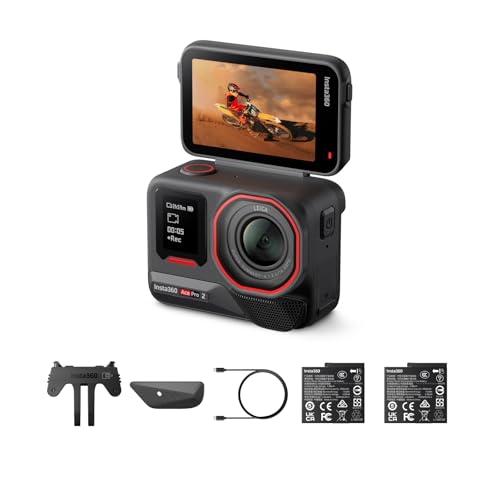
Insta360 Ace Pro 2 Dual Battery Bundle — Flip-screen 8K bundle
The Ace Pro 2 makes its argument through a single piece of hardware none of the DJI picks states: a 2.5-inch flip touchscreen. A flip screen folds the front-facing problem into the camera’s own body — vloggers frame themselves on the same large panel they use for review, at an angle they can tilt, rather than on a small fixed front display. For creators whose footage is mostly their own face and voice, that hinge is worth more than a resolution step, and Insta360 has built the rest of the title around supporting it: an 8K specification on a 1/1.3-inch sensor, a Leica SUMMARIT lens, and 50-megapixel still photographs for the days the camera doubles as the travel stills camera.
The dual AI chip claim and the AI editing line point at the second half of Insta360’s proposition, which is software labour. Action footage is mostly waiting — hours of ordinary riding around seconds of incident — and tools that surface highlights, stabilise intelligently and assemble a first cut address the genre’s real bottleneck, which is the evening edit rather than the morning capture. The title also states low light capability and Active HDR, pairing the large sensor with processing aimed at the two hardest common scenes: dusk and backlit midday. No figures are attached to either claim, so they stand here as stated directions, to be weighed against sample footage rather than treated as measurements.
The Dual Battery Bundle framing matters because Insta360 sells this camera in several shapes; the bundle in this guide is the two-battery one, and the review credits it accordingly. What the title does not state is equally notable: no waterproof depth figure appears, no runtime in minutes is given, and no internal storage is listed. A diver or an endurance rider should take those three questions to the documentation. A talking-to-camera creator, though, will find the stated list — flip screen, Leica glass, 8K, AI assistance, spare battery — aimed precisely at their working day.
The 50-megapixel stills figure changes the Ace Pro 2’s travel role in a way pure video specifications do not. Many creators carry an action camera as their only camera on trips where a larger body would stay in the hotel, and a stills count of that size supports real cropping, printing and thumbnail work rather than apologetic frame grabs. Pair that with the flip screen and the camera becomes the trip’s portrait tool as well — self-timer group shots framed properly, market details composed on a tilting panel, low angles taken without lying in the street. The title’s low-light claim matters here too, since travel stills are so often dusk stills. Judged as a hybrid rather than as a video camera with a photo mode, the bundle’s logic tightens considerably.
- Sensor stated: 1/1.3-inch
- Video stated: 8K, AI-powered
- Lens stated: Leica SUMMARIT lens
- Photos stated: 50MP
- Screen stated: 2.5-inch flip touchscreen
- Processing stated: Dual AI chip, AI editing, Active HDR
- Waterproof depth / runtime minutes: Not stated in the listing title — verify with the manufacturer documentation
Strengths
- The flip touchscreen is the strongest self-framing tool in this guide.
- Leica-branded optics and 50MP stills broaden the camera beyond video duty.
- AI editing features attack the highlight-hunting labour that dominates action footage.
Trade-offs
- No depth rating is stated for buyers whose sport is underwater.
- No runtime figure in minutes appears in the title.
- The flip hinge is a moving part that rough mounting styles should treat with care.
Best for: vloggers and travel creators who film themselves talking and want a tilting screen with 8K headroom. Not suited for: divers, since the title states no depth figure to plan a dive around.
Check the Dual Battery Bundle’s inventory on the Ace Pro 2 listing: check price on Amazon.

AKASO Brave 7 LE Action Camera — Two-battery underwater value
The Brave 7 LE’s title is the longest in this guide and the most democratic: nearly everything a first-time action camera buyer asks for is answered in it. 4K recording at 30 frames per second and 20-megapixel stills set the imaging level. EIS 2.0 names its electronic stabilisation generation. A touchscreen handles menus. A remote control is included for the handlebar and helmet shots where the camera is out of reach. Two 1350mAh batteries are in the box, external microphone support is stated for vloggers who outgrow built-in audio, and the underwater figure is the boldest number here: 131 feet, a depth that covers recreational diving rather than merely surviving a pool drop.
That depth figure deserves its prominence. The three DJI titles and the Insta360 title in this guide say waterproof and stop; AKASO prints a number, and a number can be planned around. Snorkellers, freedivers and scuba divers working within recreational limits can read 131 feet against their dive profiles directly. The honest counterweight is that the title does not separate the camera’s native sealing from any housing arrangement, so the listing and documentation should be read for how that depth is achieved and what it requires — a check that applies to every underwater claim in the category, stated or not.
The compromises live where the price class predicts. 4K30 is half the frame rate of the DJI picks’ 4K120, so slow motion at full resolution is off the menu, and the sensor size goes unstated in the title, leaving low-light expectations to be set by sample footage rather than by a specification. What the Brave 7 LE offers instead is completeness: the remote, the spare battery, the microphone path and the depth figure are the contents of a working kit, and for a buyer whose budget must cover the whole kit at once, that completeness is the specification that matters.
The remote control is the feature land-based buyers underestimate and boat-based buyers understand instantly. A camera sealed for a dive, strapped to a mast, mounted on a paddle or fixed to a bike’s fork cannot be conveniently touched, and a wrist or handlebar remote converts those placements from set-and-pray into directed shooting. It also disciplines battery use: record the descent and the reef, not the boat ride out, because starting and stopping no longer requires breaking position. Within the Brave 7 LE’s stated kit — remote, two batteries, microphone support, touchscreen for the dockside review — the remote is the piece that most expands where the camera can work, and it costs the buyer nothing extra to discover, because it is already in the box.
- Video stated: 4K at 30fps
- Photos stated: 20MP
- Stabilisation stated: EIS 2.0
- Underwater stated: 131 feet
- Batteries stated: 2 x 1350mAh
- Extras stated: Touch screen, remote control, zoom, WiFi, external microphone support
- Sensor size: Not stated in the listing title — verify with the manufacturer documentation
Strengths
- A stated 131-foot underwater rating can be planned against real dive profiles.
- Remote control and a second battery are included rather than sold as the second purchase.
- External microphone support gives vlog audio an upgrade path.
Trade-offs
- 4K recording tops out at 30fps, so full-resolution slow motion is unavailable.
- Sensor size is unstated, leaving low-light performance to sample footage.
- How the depth rating is achieved needs confirming in the documentation.
Best for: divers, snorkellers and first-time buyers who want a complete two-battery kit with a remote. Not suited for: slow-motion specialists who need 120 frames per second at 4K.
Review the Brave 7 LE kit contents on its Amazon listing: check price on Amazon.

AKASO EK7000 Action Camera — Established entry design
The EK7000 is the elder of this guide, a design that has introduced a generation of riders and paddlers to action cameras, and its title still covers the fundamentals without embarrassment: 4K at 30 frames per second described as Ultra HD, 20-megapixel stills, EIS stabilisation, WiFi, a remote control, 4x zoom, external microphone support and a 131FT waterproof rating, finished in blue. Read as a checklist for a first camera, very little is missing. A teenager’s first mountain bike season, a kayak that may capsize, a ski trip where the camera is likelier to be lost than outgrown — these are the assignments the EK7000 was built for, and its longevity in the catalogue is itself evidence about how it survives them.
Its role in a 2026 guide needs stating plainly, because the newer picks above outgun it on paper. The DJI models state larger sensors and quadruple its 4K frame rate; the Ace Pro 2 doubles its resolution and adds a flip screen; its own sibling, the Brave 7 LE, adds a touchscreen and names a newer stabilisation generation. The EK7000’s counter-argument is risk arithmetic. Cameras mounted to surfboards, sleds and borrowed bikes live dangerously, and there is a rational fleet strategy in owning one camera whose loss is an annoyance rather than a financial event, especially for family and club use where the camera changes hands weekly.
The title’s silences should be respected as firmly as its claims. No battery count or capacity is stated, so the box contents need checking on the listing; no sensor size is given; the generation of its EIS is unnamed where the Brave specifies 2.0. None of that prevents the EK7000 from doing its job. It prevents this review from promising more than the job requires — competent 4K30 footage, stabilised, waterproof to a stated depth, controllable from a wrist remote, at the accessible end of the guide.
There is a teaching role the EK7000 fills better than any flagship in this guide. A child’s first camera, a scout group’s shared unit, a school club’s loaner — these need controls that explain themselves, footage good enough to reward the effort, and a replacement cost that does not turn every hand-off into a ceremony. The EK7000’s long production run also means its quirks are documented across years of owner experience, a support library no new model can match on launch day. Buying it in that spirit is not settling; it is matching the tool to an assignment where durability of the programme matters more than dynamic range. The blue finish, trivial as it sounds, helps here too — a camera that is easy to spot in grass, sand and kit bags is a camera that comes home.
- Video stated: 4K at 30fps, Ultra HD
- Photos stated: 20MP
- Stabilisation stated: EIS
- Waterproof stated: 131FT
- Extras stated: WiFi, remote control, 4X zoom, external microphone support
- Colour stated: Blue
- Battery details / sensor size: Not stated in the listing title — verify with the manufacturer documentation
Strengths
- A proven, simple design that new users can learn in an afternoon.
- The stated 131FT rating covers swimming, snorkelling and water sports.
- Remote control and microphone support are present at the entry end of the guide.
Trade-offs
- 4K30 and an unnamed EIS generation trail the newer picks in this guide.
- Battery contents are not stated in the title and need a listing check.
- No touchscreen is stated, so control runs through buttons and the app path.
Best for: families, clubs and beginners who need a waterproof camera they can afford to risk. Not suited for: creators who need high-frame-rate 4K or a touchscreen workflow.
Confirm what ships with the EK7000 on its listing: check price on Amazon.
Comparison
| Product | Top video stated | Sensor stated | Signature extra |
|---|---|---|---|
| DJI Osmo Action 4 | 4K/120fps | 1/1.3-inch | 10-bit D-Log M, 160-minute runtime |
| DJI Osmo Action 5 Pro | 4K/120fps | 1/1.3-inch | Subject tracking, dual OLED screens, 47GB storage |
| DJI Osmo Action 6 Combo | 8K | 1/1.1-inch square | Variable aperture f/2.0–f/4.0, rod and 2 batteries |
| Insta360 Ace Pro 2 Bundle | 8K | 1/1.3-inch | Flip touchscreen, Leica lens, 50MP photos |
| AKASO Brave 7 LE | 4K/30fps | Not stated in the listing title | 131-foot rating, remote, 2 batteries |
| AKASO EK7000 | 4K/30fps | Not stated in the listing title | 131FT rating, remote, 4X zoom |
The table exposes the guide’s real fault line, which is not brand but frame rate at 4K. The DJI pair records 4K at 120 frames per second, the 8K models hold their highest rate in reserve at a resolution most screens cannot yet show, and the AKASO pair settles at 4K30. A buyer who films action to slow it down should shop in the upper rows; a buyer who films journeys to remember them will be served honestly by any row, and should spend the difference on mounts, batteries and the trips themselves.
How to Choose a Non-GoPro Action Camera
Start with the shot you cannot currently get. If your footage fails because the subject leaves the frame, tracking and screen arrangements are your criteria, and the Action 5 Pro and Ace Pro 2 lead. If it fails at dusk, sensor size and stated low-light design are the criteria, favouring the 1/1.3-inch models and the Action 6’s larger square sensor. If it fails in the edit because vertical crops look ragged, the square sensor answers a problem no amount of bitrate solves. Naming the failure first prevents the commonest error in this category, which is buying the longest specification list rather than the shortest route to the missing shot.
Then audit the unglamorous logistics. How many batteries does the box hold, and how long is a stated runtime where one exists? Is storage built in, or does every outing begin with a card check? Does the camera take an external microphone, because wind noise ruins more adventure footage than any sensor limitation? The titles in this guide answer these questions unevenly — some in detail, some not at all — and the pattern of answers is a fair map of each maker’s priorities. A camera that will live on a dive boat needs its depth figure in writing; a camera that will live on a desk tripod needs its screen.
Finally, price the ecosystem, not the camera. Mounts, spare batteries, a microphone, a case and a replacement lens cover accumulate into a second purchase that can rival the first, and bundle-shaped picks like the Capture More Combo and the Dual Battery Bundle exist precisely to fold that second purchase into the first. A cheaper body with an empty box can cost more by the second month than a fuller box bought once.
One more filter deserves applying before any of the above: your editing reality. Footage from these cameras arrives in different shapes — flat 10-bit files that expect a grade, AI-assisted libraries that expect an app, square captures that expect a reframe, plain 4K30 that expects nothing but a timeline. The camera whose files fit the hours you actually have for editing will produce more finished videos than a technically superior camera whose files wait unopened. Be honest about whether your evenings belong to colour panels, phone apps or neither, and let that honesty rank the shortlist before the specifications do. The best alternative to the default brand is ultimately the one whose footage you finish.
Why do creators leave the default brand at all?
The reasons are usually practical rather than tribal. A creator whose audience lives on vertical video gains real quality from a square sensor. A vlogger gains hours from a flip screen. A dive club gains simplicity from a printed depth figure and a remote in the box. Ecosystem fatigue plays its part too — apps, subscriptions and accessory systems differ between brands, and switching is often a decision about the software evening rather than the hardware morning. None of these reasons requires the default brand to be bad; they require only that a different tool fit a particular hand better, which is the ordinary logic of every mature equipment category.
There is also a portfolio reason. Many working creators run two cameras from different families so that a firmware quirk, a mount failure or a lost unit cannot silence a whole shoot day, and so that colour character can differ deliberately between the main and cutaway angles. A non-default second camera is therefore not always a replacement; sometimes it is insurance with a lens.
Battery behaviour in cold and heat belongs in this conversation too, because action cameras work where phones refuse. Cold drains cells and can stiffen touchscreens; heat builds inside sealed waterproof bodies recording at high frame rates. The titles here state runtime only for the Action 4, so endurance planning for the others should start from the documentation and from the oldest fieldcraft in the genre: carry the spare, rotate it warm from an inside pocket, and treat any single-battery plan on a once-a-year trip as a gamble the footage did not deserve.
What does sensor size actually change in action footage?
Sensor size governs how much light the camera gathers per frame, and light is the currency everything else is bought with. A larger sensor can hold a faster shutter in dim conditions, which freezes motion instead of smearing it, and can keep sensitivity lower, which keeps noise out of shadowed rock, forest and water. The 1/1.3-inch sensors stated by the DJI Action 4 and 5 Pro and the Ace Pro 2, and the 1/1.1-inch square sensor in the Action 6, sit at the generous end of what this category offers, which is why their titles pair them with low-light language.
Size is not destiny, though. Processing decides how gathered light becomes a watchable image, which is why the Ace Pro 2’s dual AI chip and Active HDR claims and DJI’s D-Log M colour pipeline belong in the same conversation as the glass and silicon. The titles that state no sensor size — both AKASO models — are not condemned by the omission; they simply ask to be judged on footage rather than on a figure, a reasonable request at their end of the guide.
Audio is the third leg of the sensor question and the one specification sheets handle worst. Wind, water and gloves conspire against built-in microphones, and post-synchronised voice notes are nobody’s workflow. A stated external microphone path — present in both AKASO titles — or a maker’s wireless microphone ecosystem, confirmed in the documentation for the DJI and Insta360 models, can matter more to a vlog’s watchability than the difference between 4K and 8K. Judge the sound chain with the same seriousness as the image chain, ideally before the first trip rather than after the first silent sunset.
Dynamic range is where sensor size meets processing in the visible image. A rider exiting a tunnel into noon sun, or a skier crossing from shade to a white slope, asks the camera to hold detail at both ends of the brightness scale in the same frame. Active HDR on the Ace Pro 2, D-Log M on the Action 4 and the larger square sensor on the Action 6 are three different answers to that single moment — computational, editorial and optical respectively. None can be ranked from a title alone, which is why this guide describes the mechanism each maker claims rather than declaring a winner, and why buyers who shoot in contrasty mountains or on water should weight this paragraph heavily: their sport lives in exactly the light that separates these designs.
How much does the bundle matter beside the camera?
On the first weekend, the bundle is the camera. A second battery decides whether the afternoon session happens. An extension rod creates the third-person shot that makes solo footage watchable. A remote turns a helmet camera from a hope into a tool. This is why the reviews above read bundle contents as specifications: the Capture More Combo’s rod and twin batteries, the Ace Pro 2’s dual-battery framing, the Brave 7 LE’s remote and spare cells are functional differences, not packaging trivia.
The discipline is to inventory the box on the listing before ordering, because combo names are not standardised across brands or even within them. Essential, Standard, Capture More and Dual Battery each promise a different inventory, and the only authoritative list is the one on the product page on the day of purchase. Buyers who plan around an accessory should confirm that accessory by name, in the box contents, before the order rather than after the unboxing.
Stabilisation deserves its own scepticism. Every pick here that addresses it does so in different words — a numbered EIS generation, a bare EIS, the word stabilization alone — and none of those phrases is a measurement. What a buyer can reason about is the combination of stabilisation with frame rate and light: electronic systems crop the frame and lean on shutter speed, so the large-sensor, high-frame-rate models hold structural advantages at dusk that no software label can repeal. Read the claims as directions, then let sample footage from your own sport cast the deciding vote.
Common Mistakes
Treating waterproof as a depth. Three titles in this guide say waterproof without a figure, and two print 131 feet. Those are different promises. Rain, spray and a dropped camera in a stream are covered by the word alone; a planned dive is covered only by a number, confirmed in the documentation for the housing arrangement it assumes.
Buying 8K for a 1080p audience. Resolution headroom helps reframing and future-proofing, and the square-sensor Action 6 uses it intelligently. But if every deliverable is a phone feed, the editing load and storage cost of 8K arrive immediately while the benefit may never be seen. Match the ceiling to the delivery, or to a stated reframing plan.
Ignoring the microphone question until the first windy ride. Built-in microphones fight wind and waterproofing membranes at once. Both AKASO titles state external microphone support, which is an upgrade path worth valuing before the first ruined voiceover, not after.
Comparing combo names instead of contents. Standard, Essential and Capture More are marketing nouns, not units. Two boxes with similar names can differ by a battery, a rod or a mount set, and the difference is the purchase. Read the inventory list, not the adjective.
Forgetting that stabilisation is stated unevenly. One title names EIS 2.0, one says EIS, one says stabilization without a system name, and some say nothing. Silence is not proof of absence, but it is a reason to check the documentation before assuming a gimbal-smooth result on a mountain bike.
Final Recommendation
For most readers leaving the default brand, the DJI Osmo Action 5 Pro is the balanced landing: tracking and dual touchscreens for solo work, internal storage for forgotten-card days, and the proven 4K/120fps imaging core. Editors who grade should step sideways to the Action 4 and its 10-bit D-Log M; creators feeding both horizontal and vertical channels should step up to the Action 6 and its square sensor; talking-to-camera vloggers should weigh the Ace Pro 2’s flip screen above every specification in this guide. Underwater and first-camera buyers are served honestly by the Brave 7 LE’s complete kit, with the EK7000 as the risk-it-anywhere spare. If this guide has a closing thought, it is that the best alternative is the one whose stated strengths point at your actual footage — so name the shot you are missing, and let that name, not a logo, choose the camera.
Whichever rung you choose, spend the first week learning the camera at home — mounts tightened, menus memorised, one test clip graded or reframed — because the trip itself is the worst classroom an action camera ever gets.
Frequently Asked Questions
Are non-GoPro action cameras compatible with standard mounts?
Mounting systems across the major brands have largely converged on compatible interfaces and adapters, but the titles in this guide do not enumerate mount standards, so a buyer with an existing chest, helmet or vehicle rig should confirm the interface and any included adapters in the manufacturer documentation for the specific model.
Which of these cameras is best for diving?
On stated evidence, the two AKASO models lead because their titles print a figure — 131 feet — that can be set against a dive plan. The DJI and Insta360 titles say waterproof without a depth, so a diver considering them should obtain the rated depth and housing requirements from the documentation before relying on either underwater.
Does 8K matter on an action camera?
It matters most as reframing room and future headroom rather than as a delivery format. The Action 6 pairs 8K with a square sensor so crops in two orientations stay detailed, and the Ace Pro 2 pairs it with AI editing tools. Buyers delivering only to phone feeds may never spend the benefit, which the mistakes section above treats honestly.
What is D-Log M, and should a beginner use it?
D-Log M is DJI’s flat, wide-gamut colour profile, stated in the Action 4’s title alongside 10-bit colour. It records footage that looks muted straight from the camera and rewards colour grading with smoother skies and water. Beginners uploading unedited clips should use the camera’s standard colour and adopt the flat profile when they begin grading.
Why does the Ace Pro 2 have a flip screen when others do not?
The flip touchscreen serves self-filming: the operator sees and touches the main screen while facing the lens. Fixed dual-screen designs, like the Action 5 Pro’s dual OLED arrangement, solve the same problem with a smaller front panel. Which suits a creator depends on how much of their footage is their own face.
Can these cameras replace a vlogging camera entirely?
For many creators, yes — the Ace Pro 2 and Action 5 Pro are both described in their titles as vlogging cameras, with screens, tracking and microphone paths aimed at that work. What they cannot replace is a larger camera’s shallow depth of field and lens choice, which is a creative difference rather than a quality verdict.
Related Guides
Dusk and night riding narrow the field considerably, a problem taken up in our guide to best low light action cameras Cameras that children can drop, dunk and learn on are gathered separately in our roundup of best kids action cameras When the shot should capture every direction at once, our comparison of best consumer 360 cameras


