What's inside
- Where to Buy These Cameras
- Key Takeaways
- Quick Picks
- How We Chose These Picks
- Comparison
- How to Choose a Consumer 360 Camera
- Why does reframing matter more than resolution in 360 video?
- What does the invisible selfie stick effect actually do?
- Is 360 video worth its file sizes and editing time?
- How do you keep two protruding lenses alive for a season?
- Common Mistakes
- Final Recommendation
- Frequently Asked Questions
- Related Guides
As an Amazon Associate I earn from qualifying purchases. This post may contain affiliate links at no extra cost to you.
widgetverdict.com is reader-supported. When you buy through links on our site, we may earn an affiliate commission.
The best consumer 360 cameras share one magic trick and differ in everything else. The trick is capture without aiming: two lenses record the whole sphere around the camera, and the framing decision — the pan, the crop, the subject — is postponed to the edit, where it can be made slowly, twice, or not at all. The differences are in resolution, sensor size, battery, toughness and software, and the six cameras in this guide span the category’s full modern range: Insta360’s X3 and X5, DJI’s Osmo 360, AKASO’s 360 combo, an ambitious Xtra model with a stated 105GB of internal storage, and Samsung’s Gear 360, the pioneer whose presence here is historical and is labelled as such wherever it appears.
A boundary needs drawing before the reviews, because the number 360 now decorates a different species as well. This guide is about spherical action cameras that travel, dive and ride. It is not about 360-degree meeting cameras and panoramic webcams, which are conference-room furniture with lenses; those answer a hybrid-work question, are excluded from the shortlist, and get no further space here beyond this sentence of dismissal. Everything below is built to be mounted on a stick, a helmet, a bike or a wrist and taken somewhere worth surrounding.
The headline figures, stated strictly as their titles state them, sketch the field. The X5 and the Osmo 360 and the Xtra all claim 8K spherical video, the Osmo on a stated 1-inch imaging system and the Xtra on a stated 1-inch sensor equivalent with 100MP photos. The X3 and the AKASO work at 5.7K, the AKASO on dual 1/2-inch 48MP sensors with 72MP stills and two batteries in its combo. Battery claims run from the X5’s stated three hours down to silence. The Gear 360’s title, written in another era, promises only a real 360-degree high-resolution VR camera — and that spareness is itself the history lesson its review will teach.
One discipline governs every review: 360 specifications are the easiest in photography to inflate and the hardest to compare, because a spherical resolution is spread over the whole sphere while the viewer watches a fraction of it. This guide therefore reports figures as stated, compares mechanisms — sensor size, lens replaceability, storage, battery — and refuses to convert headline numbers into promised sharpness. The camera that wins a reader should win on the workflow they will actually live with.
Where to Buy These Cameras
Amazon links for the linked picks appear in the Quick Picks table and within their reviews, where the listing confirms the combo contents — sticks, batteries, lens guards — that 360 cameras depend on more than most. Because one pick here is a legacy model, its listing deserves extra care: check what is actually being sold, in what condition, before treating it as available in the ordinary sense.
Key Takeaways
- Three picks state 8K spherical video: the Insta360 X5, the DJI Osmo 360 and the Xtra 360 camera.
- The Osmo 360 states a 1-inch 360 imaging system and includes a 1.2m invisible selfie stick kit in its Essential Combo.
- The X5 states a three-hour battery, replaceable lenses and a built-in wind guard — the durability pick.
- The AKASO 360 combo includes two rechargeable batteries and states 72MP spherical photos from dual 48MP sensors.
- The Samsung Gear 360 is included as a historical pick: a category pioneer whose sparse title belongs to an earlier era.
- The Xtra 360 states 105GB of built-in storage, the largest internal capacity in this guide.
Quick Picks
| Pick | Badge | Why it earns its place |
|---|---|---|
| Insta360 X3 360 Camera | Proven all-round sphere | 5.7K spherical video with Active HDR, a 4K single-lens mode, FlowState stabilisation, a 2.29-inch touchscreen and AI editing. |
| Insta360 X5 | Tough 8K flagship | 8K spherical video with a low-light lead, replaceable lenses, a stated three-hour battery, a built-in wind guard and triple AI chips. |
| DJI Osmo 360 Essential Combo | One-inch sensor entrant | A stated 1-inch 360 imaging system with native 8K spherical video, a 4K/120fps 170-degree boost mode and a 1.2m invisible stick in the box. |
| AKASO 360 Action Camera Standard Combo | Two-battery value combo | 5.7K spherical video with 360-SuperSmooth, dual 48MP sensors, 72MP photos, horizon lock, AI tracking and two batteries included. |
| Samsung Gear 360 Camera | Historical pioneer pick | The mid-2010s pioneer that carried consumer 360 to its first mass audience, included and labelled as a historical pick. |
| Xtra 360 Camera with Invisible Selfie Stick | Storage-rich newcomer | 8K panoramic video, a stated 1-inch sensor equivalent, 100MP photos, 105GB of built-in storage, bullet time and an invisible stick, for travel and vlogging. |
How We Chose These Picks
Selection began by defining the consumer end of the category honestly. Professional spherical rigs, multi-camera arrays and the meeting-room species were excluded; what remained had to be a single pocketable unit that one person can shoot and edit alone, with the reframing workflow that makes 360 worth its file sizes. Within that boundary, the current flagships admitted themselves, and the value combo earned its place by stating a complete kit — two batteries, tracking, horizon lock — rather than a bare camera at a bare price.
Two judgement calls in the shortlist deserve defending in the open. The first is the Gear 360. It is not a contemporary recommendation and its review does not pretend otherwise; it is included because the category’s history is genuinely useful to a buyer — it explains where the invisible-stick, reframe-later grammar came from, and it serves collectors and tinkerers who still shoot with the pioneers. A guide that silently omitted it would be tidier and less truthful. The second call is the Xtra, a newer name whose title states flagship-class figures — 8K, a 1-inch sensor equivalent, 100MP photos, 105GB of storage. It is reviewed on its stated claims with the same rigour as the famous brands, neither promoted nor patronised.
Bundle variants were untangled carefully, because this category sells the same camera in standard, essential and creator-shaped boxes whose contents differ by the accessories 360 shooting actually needs. Where a title names a combo, the review credits that combo’s stated contents and no other; a bundle of the same model under a different name is not a separate pick and is not double-counted anywhere in this guide.
Software was weighed as heavily as hardware, because 360 footage is unwatchable until an app or editor reframes it. Titles that state AI editing, AI tracking or stabilisation systems were credited for acknowledging that the edit is half the product. Titles that state nothing about software leave the buyer to investigate the ecosystem, and the reviews say so where it applies.

Insta360 X3 360 Camera — Proven all-round sphere
The X3 is the camera that taught the consumer market the reframe-later habit, and its title still describes the complete grammar of the genre: 5.7K spherical video with Active HDR, a 4K single-lens mode for the days a conventional wide shot is wanted, FlowState stabilisation, a 2.29-inch touchscreen, AI editing, waterproofing, and a stated parish of uses — motorcycle, wintersports and vlogging — that maps precisely onto where 360 cameras actually earn their storage. As a specification it has been overtaken at the top by 8K models, including two in this guide. As a working system, it remains the reference against which the category’s value is judged.
The single-lens mode deserves more respect than it gets in 360 reviews, because it doubles the camera’s working life. A 360 camera on a trip is also the owner’s only camera much of the time, and the ability to shoot a plain 4K wide clip — an interview, a detail, a sign — without reframing anything makes the X3 a travel camera that happens to shoot spheres, rather than a sphere machine that tolerates travel. Owners consistently report that the mode they bought is not the mode they use most, and dual-mode cameras forgive that miscalculation in a way pure 360 designs cannot.
Active HDR addresses the spherical camera’s characteristic scene: half the frame in shadow, half in glare, because a camera that sees everything cannot turn away from the sun. HDR processing across the sphere keeps the bright slope and the shaded rider in the same watchable frame, and FlowState’s stabilisation — Insta360’s named system — holds the horizon through the vibration of bars and boards. The title states waterproofing without a depth figure, the recurring honesty note of this guide, and states no battery duration, so endurance planning belongs to the documentation.
Against its own successor, the X5, the X3 concedes resolution, low-light emphasis, lens replaceability and stated battery life. What it retains is maturity: an ecosystem of mounts, cases and editing habits built around it over years, and a position in the range that usually makes it the considered buy rather than the flagship buy. None of that appears in a title, and all of it is the sort of context a guide exists to supply — clearly separated, as here, from the stated facts.
For the buyer entering 360 for the first time, the X3 remains the syllabus: every concept in the category — reframing, invisible sticks, horizon lock, single-lens fallback — is present in its stated list, in a camera the market has thoroughly debugged. Buyers who know they will shoot at night or crop aggressively should climb to the 8K picks; buyers learning the grammar should start where the grammar was written.
Motorcyclists, whom the title names first among its uses, understand the X3’s appeal instinctively. A rider cannot aim a camera and ride at once, and should not try; a spherical camera on a bar or helmet mount records the overtake, the view and the rider’s own reactions in one indifferent sphere, and the evening edit chooses among them at leisure. That indifference to aim is the deepest safety feature in this guide, and it is why so many helmet cameras have quietly become spherical ones.
- Spherical video stated: 5.7K 360 with Active HDR
- Single-lens mode stated: 4K single-lens camera
- Stabilisation stated: FlowState stabilization
- Screen stated: 2.29-inch touchscreen
- Editing stated: AI editing
- Uses stated: Motorcycle, wintersports, vlogging
- Battery duration / waterproof depth: Not stated in the listing title — verify with the manufacturer documentation
Strengths
- The dual-mode design covers spherical and conventional shooting in one body.
- Active HDR suits the half-glare, half-shadow scenes 360 always captures.
- A mature accessory and editing ecosystem surrounds it.
Trade-offs
- 5.7K spherical video is a step below the 8K picks for aggressive cropping.
- Lenses are not stated as replaceable, so a scratch is a serious event.
- No battery duration is stated in the title.
Best for: first-time 360 buyers and travellers who want the proven all-round system. Not suited for: night shooters and heavy croppers, who need the 8K, low-light-stated picks below.
Review the X3’s current listing and its bundle options: check price on Amazon.

Insta360 X5 — Tough 8K flagship
The X5’s title reads like a list of the category’s historical weaknesses, answered one by one. Fragile protruding lenses? Rugged and replaceable, stated outright — the single most consequential line in this guide for anyone who has priced a scratched 360 lens, because a spherical camera’s exposed glass is its actuarial destiny and a replaceable lens converts a write-off into a spare part. Short battery? Three hours, stated. Wind-ruined audio? A built-in wind guard. Dim scenes? The title leads its imaging claim with low light, backed by a triple AI chip design and an 8K specification.
The 8K figure earns its place differently in 360 than in conventional cameras. A spherical frame is a warehouse from which the editor cuts windows; the higher the warehouse resolution, the sharper each window. 8K capture is therefore not vanity in this category but cropping budget, and it is why the flagship tier converged on the number. Combined with the stated stabilisation and the invisible selfie stick effect — the genre’s signature illusion, in which the stick vanishes from the stitched frame and the camera appears to float — the X5 describes the current ceiling of the consumer form.
Low light deserves the guide’s usual discipline. The claim is stated prominently, and the triple AI chip design gives it a mechanism — processing power devoted to exactly the multi-frame work night footage needs. No sensor size is stated in the title, a notable silence beside the Osmo 360’s stated 1-inch system, so the two flagships ask to be compared as claim-plus-processing against dimension-plus-resolution. Sample footage in the buyer’s own darkness remains the arbiter, as it was throughout our low-light guide.
Waterproofing is claimed in the product name without a depth figure, and no single-lens mode is mentioned, both silences recorded here rather than filled. What is stated is already a complete flagship argument: the toughest lens story, the longest stated battery and the joint-highest resolution in the guide, from the brand that defined the consumer category.
The X5 is therefore the recommendation for the committed spherical shooter — the rider, skier or creator whose camera will be knocked, frozen, rained on and edited hard, and who needs the footage and the hardware both to survive the season. Its premium over the X3 buys exactly the things experience teaches owners to want: lenses that can be replaced, hours that can be trusted and resolution that survives the crop.
Skiers should note the partnership between the stated battery and the stated lens policy, because winter attacks both at once. Cold shortens every recording day and multiplies every fumble, and a three-hour claim with lenses that can be swapped after a gate strike describes a camera designed by people who have plainly broken the previous generation in the cold. Design empathy of that kind cannot be measured from a title, but it can be recognised in one, and the X5’s title is full of it.
- Spherical video stated: 8K 360 degrees
- Low-light claim stated: Leading low light
- Lens stated: Rugged and replaceable lens
- Battery stated: 3-hour battery
- Audio stated: Built-in wind guard
- Processing stated: Triple AI chip design; stabilization
- Sensor size / waterproof depth: Not stated in the listing title — verify with the manufacturer documentation
Strengths
- Replaceable lenses turn the commonest fatal accident in the category into a repair.
- A stated three-hour battery leads this guide.
- 8K capture funds sharp reframed crops and vertical cuts.
Trade-offs
- No sensor size is stated beside its low-light claim.
- No single-lens mode is mentioned in the title.
- Flagship completeness is wasted on occasional, daylight-only shooting.
Best for: committed riders, skiers and creators whose 360 camera takes knocks all season. Not suited for: casual holiday shooters, whose needs the X3 or AKASO cover without the flagship step.
See the X5’s listing for its kits and lens accessories: check price on Amazon.

DJI Osmo 360 Essential Combo — One-inch sensor entrant
DJI’s arrival in consumer 360 was the category’s most anticipated entrance, and the Osmo 360’s title leads with the specification DJI people recite first: 1-inch 360-degree imaging. Sensor size is the currency this guide trusts most, because it predicts low-light behaviour and dynamic range before a frame is shot, and a 1-inch system is the largest imaging claim among the spherical picks here — the Xtra’s stated equivalent being the nearest rival. Native 8K spherical video is stated with the word native doing quiet work, distinguishing capture resolution from upscaled arithmetic.
The second mode is the title’s surprise: 4K at 120 frames per second in a 170-degree boost video. A boosted single-lens mode at high frame rate gives the Osmo a second personality — a conventional action camera with slow motion — which answers the X3’s dual-mode argument from the DJI side and means the Osmo’s owner is not carrying a sphere-only device on trips where most shots are ordinary. For creators whose feeds mix reframed 360 spectacle with straightforward slow-motion clips, that pairing collapses two purchases into one bag.
The Essential Combo includes the accessory the genre cannot shoot without: a 1.2m invisible selfie stick kit, stated in the title and therefore creditable to this box. A 1.2-metre stick is the working length for the floating-camera effect — long enough to place the camera in the scene’s weather, short enough to carry — and its inclusion spares the buyer the classic 360 disappointment of a camera that cannot perform its signature trick until a second order arrives.
The silences are recorded plainly: no battery duration, no waterproof claim or depth, no lens-replaceability statement and no stabilisation system name appear in the title. DJI’s documentation will answer those questions, and buyers cross-shopping the X5 should put replaceability and battery at the top of that reading, because the X5 states both and the Osmo, in its title, does not. The comparison that the titles do support — sensor dimension and dual-mode range against toughness and endurance — is a genuinely interesting one, and this guide leaves it honestly open.
For the buyer whose priority is image quality per frame — the largest stated sensor, native 8K, and a boost mode for conventional work — the Osmo 360 Essential Combo is the connoisseur’s route into the category, with the stick already in the box and the ecosystem of its maker behind it.
There is a strategic point about DJI’s ecosystem that the title cannot state and a guide should. Owners already invested in DJI drones, gimbals and microphones will find the Osmo’s colour language, app habits and accessory logic familiar in a way that shortens the learning season considerably. Ecosystems are not a specification, and this review has kept them out of the scoring; but for the substantial population already inside this particular one, familiarity is a real feature, and pretending otherwise would be its own kind of inaccuracy.
- Imaging stated: 1-inch 360-degree imaging
- Spherical video stated: Native 8K 360-degree video
- Boost mode stated: 4K/120fps and 170-degree boost video
- Included stated: 1.2m invisible selfie stick kit (Essential Combo)
- Battery / waterproofing / lens replacement: Not stated in the listing title — verify with the manufacturer documentation
Strengths
- The largest stated imaging system in this guide, at 1 inch.
- A 4K/120fps boost mode gives it a conventional slow-motion personality.
- The invisible stick is included, so the signature shot works on day one.
Trade-offs
- No battery duration is stated for planning long shoots.
- Lens replaceability is not mentioned beside the explicit claim of the X5.
- No waterproof figure appears in the title.
Best for: image-quality-first creators who want the big-sensor sphere plus a slow-motion boost mode. Not suited for: buyers who need stated battery hours and replaceable lenses confirmed in the title.
Check the Essential Combo’s contents on the Osmo 360 listing: check price on Amazon.
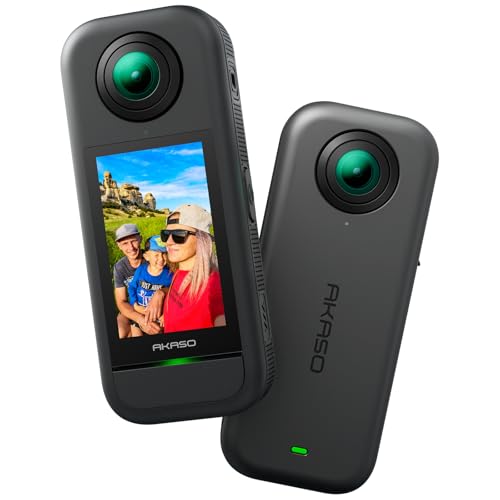
AKASO 360 Action Camera Standard Combo — Two-battery value combo
AKASO’s 360 makes the value argument in the category’s own language, and its title is admirably specific: 5.7K spherical video, a named stabilisation in 360-SuperSmooth, dual 1/2-inch sensors of 48MP each, 72MP spherical photographs, the invisible selfie stick effect, 360-degree horizon lock, AI tracking and two rechargeable batteries in the Standard Combo. Read as a checklist against the flagship reviews above, the absences are resolution and sensor size; the presences are everything a first spherical season actually consumes — power, stability, tracking and stills.
Horizon lock deserves explanation for readers new to the genre, because it is the feature that makes 360 footage feel professional rather than seasick. A spherical camera records every tilt the bike, board or body performs; horizon lock holds the world’s level inside the reframed frame while the camera’s own world rolls, so the viewer watches the rider lean without the landscape leaning too. Stated plainly in this title, it is a more useful promise for action use than a resolution step the delivery platform will compress away.
AI tracking addresses the editor’s labour. Reframing spherical footage means directing a virtual camera through every clip, and a tracking system that holds a chosen subject while the operator sets the frame’s other decisions removes the genre’s most repetitive hour. The 72MP stills figure, reported as stated, suits the traveller who pulls spherical photographs — tiny-planet novelties aside, a high-resolution sphere is a location archive from which ordinary photographs can be cropped for years.
The two batteries are the combo’s quiet headline. Spherical shooting is power-hungry — two sensors, constant stitching, high resolutions — and a second battery in the box is the difference between a full day’s experimenting and a rationed hour of it, which matters most for exactly the learners this camera courts. No waterproof claim, screen description or battery duration in hours appears in the title, and those checks belong to the listing and documentation before a wet or long shoot is planned around it.
As the guide’s value spherical pick, the AKASO asks the flagship buyer a fair question: how much of the X5’s or Osmo’s premium buys footage you will see, and how much buys specifications your audience’s screens will discard? For daylight action, social delivery and a first year of learning the grammar, its stated list is complete where completeness counts.
- Spherical video stated: 5.7K 360 video
- Stabilisation stated: 360-SuperSmooth; 360-degree horizon lock
- Sensors stated: 1/2-inch, 48MP (dual)
- Photos stated: 72MP 360 photo
- Tracking stated: AI tracking; invisible selfie stick effect
- Batteries stated: 2 rechargeable batteries (Standard Combo)
- Waterproofing / battery hours: Not stated in the listing title — verify with the manufacturer documentation
Strengths
- Two batteries in the box suit power-hungry spherical shooting days.
- Horizon lock and AI tracking target the real pains of the genre directly.
- 72MP spherical stills give travellers an archivable location record.
Trade-offs
- 5.7K and 1/2-inch sensors sit a tier below the 8K, 1-inch flagships.
- No waterproof claim appears in the title.
- Battery endurance is stated as a count, not as hours.
Best for: first-year spherical shooters and value buyers who need a complete two-battery kit. Not suited for: night and heavy-crop shooters who need 8K and the largest sensors.
Look at the Standard Combo’s full contents on the AKASO 360 listing: check price on Amazon.
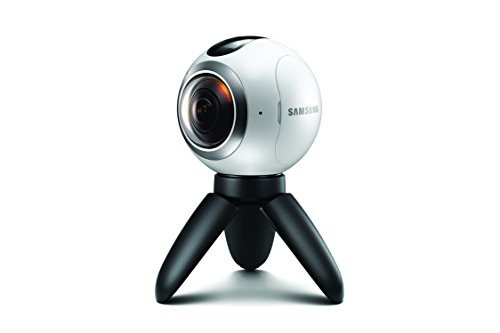
Samsung Gear 360 Camera — Historical pioneer pick
This review is a museum label, and it is written as one deliberately. The Samsung Gear 360 arrived when consumer spherical video was a rumour, and for a generation of early adopters it was the category: a golf-ball camera from a giant maker, sold beside phones, that put 360 capture into ordinary hands years before reframing apps made it graceful. Its title — a real 360-degree high-resolution VR camera, US version with warranty — preserves the era’s vocabulary exactly. Cameras were VR cameras then; the audience was expected to watch through headsets; and high resolution needed no number because the number, by the standards of the day, was the headline.
Judged as a contemporary purchase, the honest assessment is short. Its unstated-by-modern-measure specifications, its phone-era ecosystem assumptions and its vintage software support place it outside any recommendation this guide makes to a buyer who simply wants to film their riding, skiing or travelling in 360 today. The X3 several reviews above is the camera that buyer should order. Nothing in this paragraph is a criticism of the Gear 360; it is a statement about what a decade does to a category it helped create.
Judged as an object of interest, its case is genuine. Collectors of camera history value the pioneers that defined a form, and the Gear 360’s spherical, two-eyed design is the consumer category’s founding shape. Tinkerers and educators use legacy units to teach stitching, spherical projection and the archaeology of formats at a cost that risks nothing. Some owners still shoot with theirs and prize the period character of the footage. For those readers, the listing exists, and this guide links it with its nature stated in the open rather than burying the caveat.
There is also a lesson for every other buyer in this guide, and it is the reason the Gear earns its place beyond nostalgia. The gap between its title’s confident vagueness and the modern titles’ dense specificity — replaceable lenses, stated hours, named stabilisation, sensor dimensions — is the measure of how much consumer 360 matured, and of how quickly today’s flagship language becomes tomorrow’s museum label. Buy the current cameras for their stated mechanisms, enjoy them fully, and expect to smile at their titles in ten years.
To be unambiguous, as a historical pick must be: this is the only review in the guide whose recommendation is conditional on wanting the past itself. Everyone else should read it as context, enjoy the perspective, and buy from the five contemporary picks that surround it.
- Claim stated: Real 360-degree high-resolution VR camera
- Version stated: US Version with Warranty
- Resolution / sensor / battery / stabilisation: Not stated in the listing title — verify with the manufacturer documentation
- Era note: Legacy model from the category’s first consumer generation; specifications and support should be verified against the listing and documentation with its age in mind
Strengths
- A founding design of consumer 360, of genuine interest to collectors and educators.
- Its simplicity introduces spherical concepts without modern menu depth.
- Period footage has a character contemporary cameras cannot imitate.
Trade-offs
- Its ecosystem and software assumptions belong to an earlier phone era.
- No modern specification — resolution, battery, stabilisation — is stated in its title.
- It is not a contemporary recommendation for ordinary 360 filming.
Best for: collectors, educators and tinkerers who want the pioneer itself, with its era understood. Not suited for: any buyer who simply wants a current 360 camera for travel or sport.
Examine the Gear 360 listing closely, including condition and what is included: check price on Amazon.

Xtra 360 Camera with Invisible Selfie Stick — Storage-rich newcomer
The Xtra arrives with the boldest paper specification in this guide and the least established name, and its review holds both facts at once. The stated list: 8K panoramic video, a 1-inch sensor equivalent, 100MP photos, 105GB of built-in storage, waterproofing, bullet time, an invisible selfie stick in the package, and a stated parish of travel and vlogging. Item by item, that list meets or exceeds the flagship reviews above — which is precisely why this guide’s discipline matters. Claims are reported as claims; the word equivalent in the sensor line is preserved rather than silently upgraded to the Osmo’s plain 1-inch statement; and the buyer is advised, in the verdict as in the text, to weigh an ambitious newcomer’s promises against the ecosystems of the proven brands.
The storage figure is the most concrete differentiator. 105GB built in is more than double the internal capacity stated anywhere else in our camera guides this season, and for spherical video — the hungriest format a consumer camera records — internal capacity of that size changes the shooting day: no card anxiety, no mid-trip offload ritual, and a camera that can be lent, mounted and forgotten about until the evening. Travellers shooting spheres daily will feel that number more than they feel a resolution step.
Bullet time names the genre’s party trick — the camera swung overhead on its stick, the world wheeling around a centred subject — and its presence in the title signals that the Xtra’s makers understand the culture they are selling into, as does the included invisible stick. Waterproofing is claimed without a depth figure, and no battery duration, stabilisation system name or lens-replacement statement appears, so the same documentation checks advised for the flagships apply here with interest.
The balanced verdict is this. On stated specifications, the Xtra is a flagship-class spherical camera with a storage advantage nobody else in the guide matches. On everything a title cannot state — stitching quality, app polish, mount ecosystem, the maker’s support horizon — it carries newcomer risk that the Insta360 and DJI names have already retired. A confident early adopter who values the storage and the stills figure may rationally choose it; a buyer whose season cannot absorb an ecosystem surprise should choose from the proven pair and watch this name with interest.
Either way, its presence improves the guide. A category with a credible challenger stating 100MP stills and 105GB of storage is a category whose incumbents must keep answering, and the next editions of every pick above will be better for the pressure this one’s title applies.
- Video stated: 8K panoramic video
- Sensor stated: 1-inch sensor equivalent
- Photos stated: 100MP
- Storage stated: 105GB built-in
- Effects stated: Bullet time; invisible selfie stick included
- Uses stated: Waterproof action camera for travel and vlogging
- Battery / depth figure / stabilisation name: Not stated in the listing title — verify with the manufacturer documentation
Strengths
- 105GB of built-in storage is unmatched in this guide.
- 100MP stated stills lead the guide for spherical photography.
- The invisible stick is included for the signature floating shots.
Trade-offs
- The sensor is stated as an equivalent, a qualifier buyers should note.
- No battery duration or stabilisation system is named in the title.
- A newer name carries ecosystem and support questions the big brands have answered.
Best for: confident early adopters and heavy travellers who will use the storage and stills capacity. Not suited for: buyers whose season depends on a proven app, mounts and support ecosystem.
Read the Xtra 360 listing carefully, including its full contents: check price on Amazon.
Comparison
| Product | Spherical video stated | Imaging stated | Defining trait |
|---|---|---|---|
| Insta360 X3 | 5.7K with Active HDR | Not stated in the listing title | 4K single-lens mode, AI editing |
| Insta360 X5 | 8K | Not stated in the listing title | Replaceable lens, 3-hour battery |
| DJI Osmo 360 Combo | Native 8K | 1-inch 360 imaging | 4K/120fps boost mode, stick included |
| AKASO 360 Combo | 5.7K | Dual 1/2-inch 48MP sensors | Horizon lock, AI tracking, 2 batteries |
| Samsung Gear 360 | High resolution (era claim) | Not stated in the listing title | Historical pioneer pick |
| Xtra 360 | 8K panoramic | 1-inch sensor equivalent | 100MP photos, 105GB storage |
Two rows of this table cannot be compared with the other four, and the table is honest about why. The Gear 360’s row describes an era, not a rival. The Xtra’s row describes claims at flagship level from a name still proving them. The remaining four divide cleanly: the X5 for toughness and hours, the Osmo for sensor and dual-mode range, the X3 for proven all-round value, and the AKASO for the complete learning kit — a division of labour a buyer can act on without a single invented figure.
How to Choose a Consumer 360 Camera
Decide first whether you are buying a camera or a workflow. Spherical footage is raw material, not footage; it becomes watchable inside an app or editor that reframes, tracks and stabilises it. Every pick here should therefore be auditioned twice — once for its stated hardware, and once for the editing path its maker provides, which the titles gesture at with phrases like AI editing and AI tracking. A creator who edits on a phone in the evening and one who edits on a desktop at the weekend are buying different products even when the camera is identical.
Next, price the lens risk honestly. A 360 camera’s two protruding lenses are the most exposed glass in consumer photography, and they meet handlebars, rocks, pool edges and ski lifts as a matter of routine. The X5’s stated replaceable lens is the only title here that answers that risk directly; every other pick asks the buyer to mitigate it with guards, cases and care, whose availability belongs on the pre-purchase checklist. One scratched lens can cost more than the price gap between a value pick and a flagship, which rearranges the value argument considerably.
Then match resolution to your cropping habits. If your spherical footage is published mostly whole — tiny planets, immersive uploads, gentle reframes — 5.7K serves honestly and the AKASO and X3 spend your money on batteries and maturity instead. If you cut aggressively — vertical extractions, punched-in action moments, several different frames from one ride — the 8K picks earn their premium on every clip, because cropping budget is the one specification that cannot be added later.
Finally, inventory the stick. The invisible selfie stick is not an accessory in this category; it is the instrument’s tripod, crane and drone impersonator in one, and a combo that includes one at a stated length — the Osmo’s 1.2m kit, the Xtra’s bundled stick — starts its owner shooting the signature shots immediately. Buyers of the other picks should add a stick to the same order and spare themselves the flat, handheld first week that convinces too many new owners that 360 was a gimmick.
One last consideration belongs to households rather than individuals: who else will use this camera? Spherical footage is the most shareable kind a family produces — grandparents can look around a grandchild’s ride, friends can stand inside a summit panorama — and a camera whose app the whole household can drive will be used by the whole household. The flagships’ editing ecosystems differ in friendliness as much as in power, and a demo of the reframing app, tried before purchase on a phone you already own, is the cheapest research in this entire guide.
Why does reframing matter more than resolution in 360 video?
Because the viewer never sees the sphere. Every watched second of consumer 360 is a flat window cut from the sphere by someone — the shooter in an app, a tracking algorithm, or the viewer’s own dragging finger in an immersive player. The craft of the category is the cutting: choosing the subject, easing the pan, holding the horizon. A camera system that makes that craft fast and forgiving — through tracking, templates and honest stabilisation — produces better finished videos than a sharper sphere edited reluctantly, which is why this guide weighs stated editing features beside stated sensors.
Reframing also redeems the shoot itself. A conventional camera operator who misses the moment has missed it; a spherical camera pointed anywhere has captured every direction, and the moment can be found in the edit that evening. Parents film birthdays this way, riders film descents this way, and journalists film scenes this way — capture first, direct later. The cost is file size and editing time, and buyers should budget both as honestly as they budget the camera.
There is a creative dividend too. One ride down one trail can yield a forward chase cut, a face cut, a vertical cut and a tiny-planet novelty from a single recording, because the sphere remembers what the operator never looked at. Creators feeding several channels from one outing are, in effect, buying that multiplicity, and it is the strongest argument the category makes against its own file sizes.
What does the invisible selfie stick effect actually do?
It exploits the seam. A spherical camera stitches its two lenses’ views into one image, and a slim stick held along the camera’s axis falls inside the narrow blind zone where the two views meet and are blended. The stick is not removed by software magic after the fact so much as never properly captured in the first place, and the result — a camera apparently floating ahead of a skier, above a runner, behind a cyclist — remains the genre’s most imitated shot. Stick length sets the shot’s drama: the stated 1.2 metres of the DJI kit is a versatile middle, long enough for a third-person view, short enough for a crowd.
The effect has working limits worth knowing before the first outing. Wide grips, mounts at an angle, gloves and the camera’s own shadow can intrude into the seam and betray the trick, and very long sticks flex, which the stabilisation must then forgive. None of this diminishes the effect; it merely rewards the ten minutes of practice at home that the mistakes section of every one of our camera guides keeps recommending in different words.
Buyers should also note what the effect replaces. The floating third-person view once required a second person, a drone or a chase vehicle. A stick in a combo box delivers an approximation of all three for the price of a sandwich, which is why combos that include one are credited so warmly in these reviews and why a first 360 purchase without one is an incomplete purchase, whatever the camera’s resolution.
Is 360 video worth its file sizes and editing time?
For the right subjects, decisively yes — and the subjects share a trait: the action surrounds the camera or refuses to be predicted. A group ride, a summit panorama with weather arriving, a child’s party, a boat under sail, a descent where the crash, the view and the friend are in three different directions. In those scenes a conventional camera is a bet placed in advance, and 360 is the refusal to bet. The file sizes are the stake; the sphere is the winnings.
For predictable subjects, the honest answer flips. A talking-head update, a product demonstration, a single athlete on a known line — these are framed better by a conventional camera in a fraction of the storage, with no reframing session between the shoot and the upload. Several picks in this guide hedge exactly this bet with single-lens and boost modes, and the hedge is wise: the best 360 camera for most households is one that also knows how to be ordinary.
The editing time, finally, is shrinking for a stated reason. AI tracking and template editing, both claimed in titles in this guide, automate the first pass of reframing, leaving the creator to adjust rather than to direct from nothing. Buyers whose objection to 360 has been the evening edit should re-examine that objection against the current generation — while keeping, as this guide does, a clear eye on which claims are mechanisms and which are adjectives.
How do you keep two protruding lenses alive for a season?
Start with the physics of the problem. A spherical camera’s lenses bulge precisely so they can see past the body, which means they are the first surface to meet a handlebar end, a lift gate, a pool wall or the inside of a kit bag. Every handling habit in 360 ownership follows from that geometry: the camera travels in a case or with guards fitted, it is set down lens-up or lens-sideways never lens-down, and it is wiped with a proper cloth because a gritty thumb across a fisheye writes a permanent signature into every subsequent frame.
Lens guards are the working compromise, and buyers should decide their position on them before the first outing rather than after the first scratch. Guards cost a little stitch quality at the seam in some conditions and save the lens in all of them; many owners shoot guarded for action and unguarded for calm, deliberate scenes. The one pick in this guide that steps outside the dilemma is the X5, whose lenses are stated as replaceable — a design answer that reframes the whole question from prevention to maintenance, and the strongest single argument in its review.
Finally, build the check into the ritual of the day. A ten-second lens inspection while the camera mounts — front clean, rear clean, guards seated — catches the smear, the droplet and the hair before they star in an hour of footage. Spherical cameras are uniquely unforgiving here because there is no safe edge of the frame to crop a blemish into; the sphere remembers everything, including the fingerprint. The owners whose footage stays clean for years are not luckier than other owners. They are ten seconds more disciplined, twice a day.
Common Mistakes
Buying a meeting camera for action work. Panoramic conference devices wear the same 360 label as the cameras in this guide and share nothing else with them — not the mounting, not the sealing, not the software. Check that a candidate is a spherical action camera before its price tempts you; the categories are separated in this guide’s introduction for a reason.
Treating the Gear 360 as a current alternative. It is a historical pick, labelled as such in its review, its table row and this list. Its ecosystem belongs to another era. Collectors should buy it knowingly; everyone else should buy a contemporary pick and enjoy the Gear as context.
Ignoring the lens until it scratches. Protruding spherical lenses meet the world first. Lens guards, a case habit and — on the one pick that states it — replaceable lenses are not accessories to consider later; they are part of the purchase, and their absence from a first order is the commonest false economy in the category.
Judging sharpness from the spherical headline. An 8K sphere spread over 360 degrees delivers a fraction of that resolution to any single view. Judge a 360 camera by reframed sample footage at your delivery size, not by dividing your hopes by its headline.
Leaving the stick for a second order. The floating shots that sell the category need the invisible stick, and two combos here include one for exactly that reason. A first week of flat handheld spheres has ended more 360 experiments than any specification ever written.
Final Recommendation
For most readers, the Insta360 X5 is the complete contemporary answer: 8K for the crop, replaceable lenses for the knocks, three stated hours for the day, and low-light emphasis for the evening. Image purists should weigh the DJI Osmo 360’s stated 1-inch imaging and its boost mode with equal seriousness — it is the connoisseur’s alternative, not a runner-up. First-time spherical shooters are served by the X3’s proven grammar or the AKASO’s complete two-battery kit, the Xtra tempts the storage-hungry early adopter with figures stated boldly and weighed carefully in its review, and the Gear 360 closes the guide as what it is: the honoured ancestor, recommended to collectors and to no one else. Choose by the season your camera must survive and the edit you will actually do, and the sphere will repay you — that, and not a headline number, is the verdict this guide stands behind.
Whichever sphere you choose, give it one honest week of practice at home — a street, a garden, a dog — before the trip it was bought for; the grammar of reframing is learned in days, but only in days actually spent.
Frequently Asked Questions
What is the difference between a 360 camera and a regular action camera?
A regular action camera records the direction it is pointed, in one wide frame. A 360 camera records every direction at once from two lenses, and the frame is chosen afterward in an app or editor — a process called reframing. Several picks here, including the X3 and the Osmo 360, also offer single-lens modes that behave like a regular action camera when that is all a shot needs.
Why is the Samsung Gear 360 in a current guide?
As a labelled historical pick. It pioneered consumer 360, it remains of interest to collectors, educators and tinkerers, and its sparse title teaches modern buyers how far specifications have come. It is not recommended as a contemporary alternative to the other five picks, and its review says so in plain terms.
Do I need an invisible selfie stick for a 360 camera?
For the category’s signature floating third-person shots, yes — the stick hides in the stitch seam between the two lenses. Two combos in this guide include one (the DJI at a stated 1.2m, and the Xtra), and buyers of the other picks should add a stick to the same order rather than discovering its absence on the first outing.
Is 8K necessary in a 360 camera?
It is cropping budget rather than display resolution. Because any viewed frame is a window cut from the sphere, 8K capture keeps reframed and vertical cuts sharper. Buyers publishing gentle whole-sphere edits can live happily at 5.7K, as the X3 and AKASO picks demonstrate; aggressive croppers should pay for 8K.
Which 360 camera is best for low light?
On stated evidence the contest is between the X5, whose title leads with low light and triple AI processing, and the Osmo 360, which states the largest imaging system at 1 inch. The titles support both mechanisms and crown neither; sample footage in your own conditions — dusk riding, night streets — should settle it, as our low light action camera guide also advises.
Can a 360 camera replace my normal camera on a trip?
Largely, if it has a single-lens or boost mode, as the X3 and Osmo 360 do — those modes cover the ordinary clips a trip demands while the sphere covers the spectacles. A pure 360 workflow asks more editing of every clip, which is why the dual-personality picks are recommended to travellers so warmly here.
Related Guides
The same spherical grammar at gentler prices is surveyed in our guide to best inexpensive 360 cameras For cameras that point at the sky rather than around it, our comparison of best astronomy cameras And for reviewing all that reframed footage at a desk, our roundup of best curved monitors


