What's inside
- Where to Buy These Cameras
- Key Takeaways
- Quick Picks
- How We Chose These Picks
- Comparison
- How to Choose a Kids Action Camera
- At what age does a child actually use an action camera?
- Is a waterproof case or a sealed body better for a child?
- What should parents check before the first pool day?
- How do families keep a child’s camera alive for a second summer?
- Common Mistakes
- Final Recommendation
- Frequently Asked Questions
- Related Guides
As an Amazon Associate I earn from qualifying purchases. This post may contain affiliate links at no extra cost to you.
widgetverdict.com is reader-supported. When you buy through links on our site, we may earn an affiliate commission.
The best kids action cameras are not small versions of adult cameras, and judging them by adult standards produces the wrong shortlist. A child’s camera will be dropped on pool concrete, buried in sand, mounted crooked on a bicycle, forgotten in a wet swimsuit pocket and operated by hands that consider menus a form of punishment. The six cameras in this guide were chosen for that reality. Their titles emphasise waterproofing — an IP68 rating, waterproof cases, a 30-metre figure — along with the details that decide whether a first camera survives its first summer: cards included in the box, mounts for bikes, age ranges printed plainly from 3-12 up to 5-16, and designs in yellow and gift-ready colours that a child can find in a beach bag and a parent can find in the grass.
Four of the six are purpose-built children’s cameras. Two PROGRACE models bookend the young end: a waterproof IP68 camera with a 32G card for girls aged 3-12, and an underwater model with a bike mount and 1080P video for the same 3-12 span. MOMILLA’s camera reaches older, claiming 4K video, 50MP stills, autofocus and 16X zoom for ages 5-16 behind a waterproof case. Agoigo’s yellow waterproof camera keeps the formula simple for ages 3-12 with a 32GB card included. The final two picks are the step-up path: the Vemont 1080P action camera, a general sports camera with a full mounting kit and a 30m waterproof figure, and the AKASO EK7000, the established 4K30 design that older children graduate to when the toy-shaped camera starts to feel like one.
Every specification below comes from a listing title, and the gaps are labelled as gaps. Children’s cameras are marketed with particular exuberance, so this guide holds a firm line: resolutions and megapixels are reported as stated, age ranges are reported as the makers state them, and anything a title does not mention — battery life, screen size, stabilisation — is marked as unstated rather than guessed. A parent should be able to trust the silences in this guide as much as its claims.
One more framing before the reviews. For a young child, the camera’s real product is not footage quality; it is the afternoon — the dive filmed, the bike ride narrated, the holiday seen through their eyes at knee height. Specifications matter in service of that afternoon: waterproofing so the pool is allowed, a card in the box so the camera works on Christmas morning, a mount so the bike ride is filmable at all. The reviews judge each pick against the day it will actually live.
Prices are deliberately absent from this guide, as they are from all our camera guides; the listings carry the current figures, and a child’s camera should be chosen on fit and survivability first in any case.
Where to Buy These Cameras
Each linked pick carries its Amazon link in the Quick Picks table and inside its review, where the listing confirms the exact contents — card, case, mounts — before a gift deadline makes returns awkward. Children’s models are frequently sold in colour and bundle variants, so the listing page is the place to confirm that the version in the basket is the version described here.
Key Takeaways
- Four picks are purpose-built for children, with stated age ranges of 3-12 (PROGRACE, Agoigo) and 5-16 (MOMILLA).
- Three picks include a memory card in the title — both PROGRACE models and the Agoigo — so they can record on the first morning.
- Waterproofing is stated four ways: IP68, a waterproof case, a 30M figure on the MOMILLA’s underwater sibling class, and 30m/98ft on the Vemont.
- The MOMILLA states the highest figures for older kids: 4K video, 50MP photos, autofocus and 16X zoom.
- The Vemont and the AKASO EK7000 form the step-up path for children who outgrow toy-shaped cameras.
- No title in this guide states a battery life in hours, so endurance expectations should be set by the documentation.
Quick Picks
| Pick | Badge | Why it earns its place |
|---|---|---|
| PROGRACE Kids Waterproof Camera | Youngest swimmers first camera | An IP68 waterproof body, 1080P video and a 32G card in the box, aimed at ages 3-12 for pool, beach, bike and skateboarding. |
| MOMILLA Kids Camera with Waterproof Case | Older-kids specification step-up | 4K video, 50MP photos, autofocus and 16X zoom for ages 5-16, protected by a waterproof case for swimming and travel. |
| Agoigo Kids Waterproof Action Camera | Yellow pool-and-playground pick | A waterproof action camera in yellow for ages 3-12 with a 32GB card included, aimed at pool, backyard, picnic and playground filming. |
| Underwater Camera for Kids 3-12 (PROGRACE) | Bike-mount adventure pick | 1080P waterproof video, a 32GB card and a stated bike mount, for diving, swimming, riding and skateboarding at ages 3-12. |
| Vemont Action Camera 1080P | Step-up with full mount kit | A general 1080P, 12MP sports camera with a stated 30m/98ft underwater figure and a mounting accessories kit — the bridge out of toy-shaped cameras. |
| AKASO EK7000 Action Camera | Graduation camera for teens | The established 4K30 design with EIS, a remote control, 4X zoom, microphone support and a 131FT waterproof rating, in blue. |
How We Chose These Picks
Selection started from the accidents, not the images. Every candidate was read first for its water story, because the pool and the beach are where children’s cameras earn their keep, and a camera that cannot be dunked will spend the holiday in a parent’s pocket being guarded instead of used. Titles that stated a rating, a case or a depth figure were credited; the mechanism matters less to a seven-year-old than the permission it grants, but it matters to the parent replacing a drowned camera, so the reviews distinguish an IP68 body from a camera in a waterproof case wherever the title allows.
The second filter was first-morning completeness. A child’s camera given as a gift competes with every other present that day, and the ones that record immediately — card included, charged, mounted — are the ones still in use by February. Three titles state an included 32G or 32GB card, and that line in a specification box is worth more to a gift-buyer than a megapixel figure. Mounts were read the same way: a stated bike mount turns a camera into a riding companion rather than a handheld novelty.
Age honesty was the third filter. The stated ranges — 3-12, 5-16 — were treated as the makers’ own guidance about button size, menu patience and physical robustness, and the shortlist was built to cover the span rather than cluster at one birthday. The two general sports cameras at the end were admitted deliberately, labelled as step-ups, because the commonest children’s-camera disappointment is not a bad camera but a child who has outgrown the category while the camera has not.
Resolution claims were handled with the guide’s standing restraint. A 4K claim on a children’s camera and a 50MP stills figure are reported exactly as their titles state them, neither inflated into a quality promise nor dismissed; parents comparing on image quality should look at sample footage, while parents comparing on survivability — the axis this category is actually bought on — will find the relevant facts in the waterproofing, card and mount lines.

PROGRACE Kids Waterproof Camera — Youngest swimmers first camera
The IP68 rating is the sentence that matters in this title, and what those four characters buy a family deserves a slow look. An IP68 body is sealed as a body — no separate case to fit correctly, no latch for small fingers to half-close, no moment at the pool gate where a parent must decide whether the housing was assembled right. The camera can simply go in the water with the child, which for ages 3-12 is the difference between a camera that films the holiday and a camera that watches it from a towel. PROGRACE pairs that sealing with 1080P video, a resolution honestly matched to the screens children’s footage is watched on.
The 32G card in the box is the second kindness. A first camera that cannot record until a parent orders a card teaches a child that cameras are mostly waiting; this one records on the first afternoon. The title’s stated playground — pool, beach, bike, skateboarding — describes a camera expected to live outdoors and be mounted or carried through all of it, and the travel camcorder framing suggests a size small hands can wrap around, although dimensions are not stated and grip should be judged from the listing photographs against the child’s hands.
The title names girls 3-12 as its audience and birthday gifting as its occasion, which parents of boys should read as marketing rather than mechanism: nothing in the stated specification is gendered, and the same camera in a different colour serves any child in the age range. What the title does not state is equally worth listing — no depth figure accompanies the IP68 rating, no battery life is given, and no screen size appears — so a family planning snorkelling beyond paddling depth should confirm the immersion limits in the documentation.
As the guide’s opening pick, this PROGRACE sets the category’s baseline virtues in the right order: sealed first, complete in the box second, adequate resolution third. For a child between three and about nine whose filming world is the pool, the beach and the pavement, that order is not a compromise. It is the correct engineering brief, executed plainly.
Grandparents should note this pick in particular, because it solves the long-distance gift problem elegantly. A camera that needs accessories sourced, a case assembled or a card formatted by the receiving household often waits weeks for an adult with time; this one needs a charge and a child. The giver can also be reasonably sure the gift will be used in the giver’s presence on a video call within the week — pool footage being the universal currency of grandchildren — which is not a specification, but is, for the person paying, very close to the point of the purchase.
- Waterproof stated: IP68 rating
- Video stated: 1080P
- Age range stated: 3-12 years
- Storage stated: 32G card included
- Uses stated: Pool, beach, bike, skateboarding; travel camcorder
- Depth figure / battery life / screen size: Not stated in the listing title — verify with the manufacturer documentation
Strengths
- IP68 sealing needs no case assembly by small or hurried hands.
- A card in the box means the camera records on the day it is given.
- 1080P is honestly matched to family screens and keeps files manageable.
Trade-offs
- No depth figure is stated alongside the IP68 rating.
- Battery life is unstated, so holiday endurance rests on the documentation.
- Older children near twelve may find its positioning young.
Best for: children roughly three to nine whose filming is pool, beach and pavement, and gift-buyers who need it working immediately. Not suited for: families planning snorkelling at depth, since no immersion depth is stated in the title.
Confirm the card and colour options on the PROGRACE listing: check price on Amazon.

MOMILLA Kids Camera with Waterproof Case — Older-kids specification step-up
MOMILLA aims at the child the first camera no longer fits. The stated age range runs 5-16 — the widest in this guide — and the specification reads like a deliberate promotion: 4K vlogging video instead of 1080P, 50MP still photographs, autofocus, and a 16X zoom. Each of those figures is reported here exactly as the title states it, and parents should hold them the way this guide does — as the maker’s claims, to be weighed alongside sample images — but the intent behind the list is unmistakable. This is a camera for a child who has started to care what the footage looks like, who films friends, narrates travel and may already be cutting clips together.
Autofocus deserves its headline place. The fixed-focus simplicity of younger children’s cameras is a virtue at age five and a frustration at eleven, when the subject is a face across a pool or a skateboarder approaching at speed. A stated autofocus system, whatever its speed, acknowledges that older children film subjects that move through depth. The 16X zoom tells the same story: it is a tool for filming wildlife, performances and sports from where a child is allowed to stand, rather than from where the action is.
Water protection arrives by a different route than the PROGRACE above: a waterproof case, with the title naming swimming among its uses and describing the camera as an underwater toddler camera for travel — wording that spans its wide age claim a little awkwardly. A case-based system asks for one adult habit, which is checking the seal is clean and latched before the swim; in exchange, cases often allow the camera itself to be a more capable, less sealed device the rest of the year. No depth figure is stated for the case, and no card is mentioned in the title, so both belong on the pre-purchase checklist.
For the right child, this is the guide’s most ambitious package: the only pick courting the vlogging, zooming, photographing older kid rather than the dunking younger one. Families choosing it should be choosing that ambition deliberately — a five-year-old will not use the zoom, and a fifteen-year-old will forgive the case ritual for the specification it protects.
A word on the vlogging word in this title, because parents will be asked about it. A child who wants to talk to a camera is asking for something healthy: narration, presentation, the beginnings of storytelling with an audience in mind. The MOMILLA’s stated kit — autofocus for the moving presenter, zoom for the world beyond them, 4K for the edit — treats that wish as a craft rather than a phase. Families who buy it are buying a small production apprenticeship, and should expect to be interviewed, reviewed and occasionally filmed making dinner, which is the tax this category levies on every household that encourages it.
- Video stated: 4K, vlogging camera
- Photos stated: 50MP
- Focus stated: Autofocus
- Zoom stated: 16X
- Age range stated: 5-16 years, boys and girls
- Water protection stated: Waterproof case; swimming and underwater use
- Included card / case depth figure: Not stated in the listing title — verify with the manufacturer documentation
Strengths
- The widest stated age range, growing with the child from five to sixteen.
- Autofocus and 16X zoom serve real subjects at real distances.
- 4K and 50MP claims court the older child who cares about image quality.
Trade-offs
- Waterproofing depends on a case seal being fitted and checked correctly.
- No memory card is stated as included, so the first morning may need one bought.
- Its specification is surplus for a young child who only dunks and presses record.
Best for: children from about eight upward who vlog, photograph and film friends at a distance. Not suited for: very young children, for whom the case ritual and zoom are obstacles rather than features.
Check what ships with the MOMILLA camera on its listing: check price on Amazon.

Agoigo Kids Waterproof Action Camera — Yellow pool-and-playground pick
Agoigo’s title leads with the two facts a gift-buyer scans for: waterproof, and yellow. The colour is not decoration in this category. A yellow camera can be spotted in grass, in sand, in the blue confusion of a pool bag and at the bottom of a paddling pool, and a camera that can be found is a camera that comes home. Paired with a stated 32GB card in the box, the package repeats the first-morning virtue this guide keeps rewarding: unwrap, charge, film the garden before lunch.
The stated territory is telling — backyard, picnic and playground alongside the pool. This is a camera pitched at the geography of ordinary childhood rather than at holidays alone, and that pitch is realistic about where most children’s footage is actually shot. The title calls it an underwater digital video camcorder while stating no resolution figure and no depth rating, and this review preserves both silences exactly: video quality and immersion limits are questions for the listing details and documentation, not for inference from the word underwater.
The age range, 3-12, matches the PROGRACE pair, and the comparison between them is the useful one for parents. The PROGRACE IP68 model states its sealing standard and its 1080P resolution; the Agoigo states its colour and its card and leaves the rest open. A parent who values a stated waterproof standard should lean one way; a parent buying for a child who loses things in plain sight may find the yellow body the more practical specification. Neither instinct is wrong, and the titles give each parent the fact their instinct needs.
Toddler wording appears in the title’s gift line, and the usual caution applies: the maker’s range begins at three, and children at the very bottom of it will use the camera as a supervised toy with a record button, which is a perfectly good first chapter. What they will grow into — playground expeditions, pool filming, picnic documentaries — is all inside the stated territory, and the camera asks nothing of the family except to be charged and to be found, which its colour handles.
School holidays are this camera’s true season, and they explain its design better than any specification. Holiday cameras are lent to cousins, left in holiday-home kitchens, carried by three children in rotation and retrieved from under car seats. A bright colour, a card already inside and no case ritual to teach each new borrower are exactly the virtues that rotation demands. The Agoigo will not win a specification argument against the MOMILLA, and it is not trying to; it is trying to still be present, charged and findable in week five of the summer, which is the argument that matters in August.
- Waterproof stated: Waterproof action camera; underwater camcorder
- Age range stated: 3-12 years, boys and girls
- Storage stated: 32GB card included
- Colour stated: Yellow
- Uses stated: Pool, backyard, picnic, playground
- Video resolution / depth figure: Not stated in the listing title — verify with the manufacturer documentation
Strengths
- A yellow body is findable in grass, sand and pool bags.
- The included 32GB card makes it a complete gift out of the box.
- Its stated territory matches everyday childhood, not just holidays.
Trade-offs
- No video resolution is stated in the title for quality comparisons.
- No depth or sealing standard accompanies the waterproof claim.
- Parents wanting stated figures must work through the listing and documentation.
Best for: gift-buyers for children three to ten who need a findable, complete, water-ready first camera. Not suited for: parents who want a stated waterproof standard and resolution before buying.
Look over the Agoigo camera’s listing for its full details: check price on Amazon.

Underwater Camera for Kids 3-12 (PROGRACE) — Bike-mount adventure pick
This second PROGRACE entry earns its separate place with one stated accessory: a mount for a bike. Mounting changes what a child’s camera is. Handheld filming documents where the child stood; mounted filming documents what the child did — the descent, the trail, the wobble and recovery — and for the riding, skateboarding and scootering years that is the footage families actually keep. The title builds its whole stated world around that motion: diving, swimming, riding, skateboarding, with 1080P waterproof video and a 32GB card included to capture it.
Against its sibling at the top of this guide, the trade is legible. That model states an IP68 rating; this one states the mount and keeps its waterproofing at the level of a claim, with diving named among its uses but no depth figure attached. A family whose child lives on a bike should weight the mount; a family whose child lives in the pool should weight the rating. PROGRACE, perhaps deliberately, has given the two families two different cameras wearing one brand, and this guide preserves the distinction rather than blending the specifications into a fictional combined model.
The 1080P figure matches its sibling and suits the purpose: mounted footage is watched for the ride, not for pixel-peeping, and 1080P files are kind to the family computer and the grandparents’ tablet alike. The gift framing — birthday and Christmas — and the boys-camera wording in the title are marketing wrappers around a specification that, like its sibling’s, serves any child in the 3-12 range whose world has wheels.
One practical note belongs in this review rather than the mistakes section, because it decides this pick’s success: a bike mount is only as good as its fitting, and an adult should fit it, check its tightness after the first rides, and teach the rider that the camera’s view is set before moving off, never adjusted at speed. Bought with that ten-minute ritual in mind, this is the most adventurous stated package for a young rider in the guide.
Consider the footage this mount actually produces, because it differs in kind from everything else a child shoots. A bike-mounted camera films effort and landscape together: the hill arriving, the wobble on the loose surface, the speed that felt enormous and looks, on replay, both slower and braver than memory. Children rewatch mounted footage the way athletes rewatch game tape, narrating their own decisions, and a camera that gives a nine-year-old that relationship with their own riding has done something no resolution figure can describe. That is the purchase being made here, with a waterproof 1080P camera as its vehicle.
- Video stated: 1080P waterproof video
- Age range stated: 3-12 years
- Storage stated: 32GB card included
- Mount stated: Mount for bike
- Uses stated: Diving, swimming, riding, skateboarding; pool toy positioning
- Depth figure / sealing standard: Not stated in the listing title — verify with the manufacturer documentation
Strengths
- A stated bike mount turns the camera into a ride recorder, not just a handheld.
- 1080P and an included card keep the package complete and simple.
- Its stated sports span water and wheels in one camera.
Trade-offs
- Diving is named without a depth figure to plan it by.
- No sealing standard is stated, unlike its IP68 sibling.
- The mount needs an adult fitting and periodic tightness checks.
Best for: young riders and skateboarders aged roughly six to twelve who will actually use a bike mount. Not suited for: pool-first families who need a stated sealing standard for constant immersion.
Verify the mount and card on this PROGRACE listing: check price on Amazon.
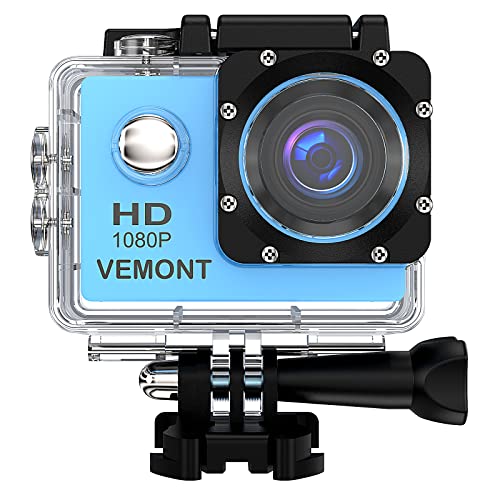
Vemont Action Camera 1080P — Step-up with full mount kit
The Vemont is not a children’s camera, and its presence in this guide is a deliberate, labelled step-up. Its title describes a 1080P, 12MP sports camera, waterproof to a stated 30m or 98ft, supplied with a mounting accessories kit. For a child of ten or eleven who has begun to call the younger picks toys — a judgement about shape and status as much as specification — a real sports camera in the adult pattern answers the actual complaint. It looks like the cameras on the helmets at the bike park, it mounts like them, and its mounting kit opens the full grammar of placements: bars, boards, helmets and chest straps, subject to whatever the kit’s contents list confirms.
The stated depth figure is the strongest water number among the step-up picks and exceeds what most children’s cameras claim: 30 metres covers every pool, lake and snorkelling reef a family holiday contains, with the usual instruction that how the figure is achieved — housing or body — should be confirmed in the documentation before the camera is trusted at depth. The 12MP stills figure is modest beside the MOMILLA’s stated 50MP and is reported without embroidery; this camera’s case rests on its mounts and its depth, not on headline arithmetic.
What the title withholds defines the supervision this pick needs. No age range is stated, because it is not a children’s product; no card is mentioned; no stabilisation is claimed. A parent buying it for a child is buying an adult-pattern tool and should expect to be the one who charges it, fits the mounts and curates the footage, at least at first. For the right older child that apprenticeship is the point — the Vemont is the camera a parent and child can operate together, halfway to the real thing.
Set against the EK7000 below, the Vemont trades resolution for depth and kit: 1080P against 4K30, a stated mounting kit against a remote control. A child filming rides to watch on the family television will feel the 1080P ceiling less than a child filming to upload; a child snorkelling will feel the depth figure more. The step-up decision is genuinely a choice, and the titles state enough to make it honestly.
The Vemont also serves a quieter family purpose: it is the camera a parent can borrow back. Its adult pattern means the same unit that films a child’s snorkelling on Saturday can film a parent’s trail run on Sunday, on the same mounts, with no relearning. Households that share one action camera across generations — more common than the marketing of either category admits — should weight that interoperability heavily, and should read the stated mounting kit as the shared language that makes it possible.
- Video stated: 1080P
- Photos stated: 12MP
- Waterproof stated: 30m / 98ft underwater
- Kit stated: Mounting accessories kit
- Product class stated: Sports camera (general, not child-specific)
- Age range / included card / stabilisation: Not stated in the listing title — verify with the manufacturer documentation
Strengths
- A stated 30m depth figure covers family snorkelling with room to spare.
- The mounting kit teaches real action-camera placement across sports.
- An adult-pattern body satisfies the older child who rejects toy styling.
Trade-offs
- 1080P is the resolution ceiling in a guide where two picks state 4K.
- No child-specific design, age guidance or included card is stated.
- It asks for more adult involvement in charging, mounting and file care.
Best for: older children around ten to twelve who want a real sports camera and will share it with a parent. Not suited for: young children, who need the sealed simplicity and stated age design of the purpose-built picks.
Inspect the Vemont kit contents on its Amazon listing: check price on Amazon.

AKASO EK7000 Action Camera — Graduation camera for teens
Every children’s category needs an exit door, and in this guide the EK7000 is it. A teenager who has filmed two summers on a yellow camera is ready for the real grammar of the hobby — 4K at 30 frames per second, EIS stabilisation, a wrist remote for shots the camera takes alone, 4X zoom, external microphone support for the first narrated edits, WiFi for moving footage to a phone, and a waterproof rating stated at 131FT that covers the family’s diving as confidently as its paddling. The blue finish even softens the transition; it is a serious camera that has not forgotten colour exists.
The recommendation is aimed at a specific household moment: the child is twelve to fifteen, the footage is starting to be edited rather than merely watched, and the next purchase should last years rather than a season. The EK7000’s long production history serves that moment well — its operation is documented across a generation of owners, its accessories are a known ecosystem, and its simplicity means the teenager, not the parent, becomes the household expert within a weekend. External microphone support matters more at this age than at any other in the guide, because narration is where young editors find their voice, literally.
The title’s limits are the familiar ones and are stated here without softening. No battery contents are enumerated, no touchscreen is claimed, and the stabilisation is EIS without a generation number. A teenager comparing against flagship cameras will find the gaps; a teenager comparing against the camera they are graduating from will find a doubling of resolution, a remote, a microphone path and a depth figure, which is the comparison that actually governs this purchase.
Parents should also hear the risk argument in the EK7000’s favour at this age. Teenage cameras get mounted to borrowed bikes, taken to lakes and lent to friends. A proven, replaceable design absorbs that social life with less financial anxiety than a flagship, and a camera that is allowed to go everywhere will film more of a teenager’s world than a precious one kept at home — which is, in the end, the whole point of graduating.
One risk of graduating a teenager deserves naming, because the EK7000 mitigates it better than flagships do. Teenagers film each other, and group footage raises the stakes of every drop, dunk and loss in front of an audience whose opinion matters enormously. A camera whose replacement is an errand rather than a catastrophe keeps the filming social and brave; a precious camera makes its owner the group’s cautious outlier. The EK7000’s proven, affordable design is therefore not merely cheaper for this age — it is socially better suited to how teenagers actually use cameras together.
- Video stated: 4K at 30fps, Ultra HD
- Photos stated: 20MP
- Stabilisation stated: EIS
- Waterproof stated: 131FT
- Extras stated: WiFi, remote control, 4X zoom, external microphone support
- Colour stated: Blue
- Battery contents / touchscreen: Not stated in the listing title — verify with the manufacturer documentation
Strengths
- 4K30 and EIS give a graduating teenager real footage to edit.
- A remote and microphone support teach solo and narrated filming.
- The stated 131FT rating covers family diving without a housing worry in the title.
Trade-offs
- No touchscreen is stated, so control is buttons, remote and app.
- Battery contents are not enumerated in the title.
- Its design is a generation old beside the flagship cameras in sibling guides.
Best for: teenagers graduating from a childhood camera who edit, narrate and lend their gear. Not suited for: young children, for whom its adult controls and unstated age design are the wrong tool.
Confirm the EK7000 box contents on its listing before ordering: check price on Amazon.
Comparison
| Product | Stated age span | Video stated | Water story stated |
|---|---|---|---|
| PROGRACE Kids Waterproof | 3-12 | 1080P | IP68 body |
| MOMILLA Kids Camera | 5-16 | 4K | Waterproof case |
| Agoigo Kids Waterproof | 3-12 | Not stated in the listing title | Waterproof claim |
| PROGRACE Underwater (bike mount) | 3-12 | 1080P | Waterproof claim; diving named |
| Vemont Action Camera | General sports camera | 1080P | 30m / 98ft stated |
| AKASO EK7000 | General sports camera | 4K/30fps | 131FT stated |
The water column is the one to study, because it contains four different kinds of promise: a sealing standard, a case, a depth in metres and a depth in feet, plus two claims with no figure attached. None of them is automatically best. The IP68 body is the most foolproof for the youngest children, the case protects the most capable camera, and the printed depths serve the families who snorkel. What the table forbids is treating the word waterproof as one thing — in this category it is at least four, and the right one depends on the child’s age and the family’s water.
How to Choose a Kids Action Camera
Choose by the child’s next summer, not their last one. A camera bought for a five-year-old should survive being wrong — dropped, dunked, abandoned in sand — because a five-year-old’s filming is experimental by nature. A camera bought for an eleven-year-old should survive being outgrown slowly, which argues for the wider age ranges and the step-up picks. The stated age spans in this guide are the makers’ own maps of that territory, and a buyer whose child sits at a boundary — nine, ten, eleven — should shop across it deliberately rather than defaulting to the younger shelf.
Make waterproofing the first specification and resolution the last. This inverts adult buying, and it is correct for children because the binding constraint on a child’s footage is permission: the camera that may enter the pool films the pool. A 1080P camera in the water beats a 4K camera on the towel in every currency except pixels, and children spend their footage socially — shown to grandparents, replayed at bedtime — where the dive itself is the content and its resolution is a footnote.
Audit the box as a gift-giver, not as a hobbyist. Is a card included, and of what size? Is there a mount for the vehicle the child actually rides? Does the water protection need assembly, and if so, which adult owns that ritual on holiday? The titles in this guide answer these questions unevenly, and the pattern of answers predicts the first month’s happiness more reliably than any resolution figure. A camera that needs three accessories ordered separately is not one present but four.
Finally, decide who the footage is for. If it is for the family archive, prioritise simplicity and let the child shoot everything. If it is for a young creator’s channel, prioritise the MOMILLA’s stated tools or the step-up pair, and accept the supervision they invite. Both are honourable purposes; confusing them — buying a creator’s camera for the archive, or a dunking toy for a channel — is where this category’s disappointments are manufactured.
A last, unfashionable criterion: repairability of the plan, not the product. Children lose chargers, misplace mounts and fill cards with footage nobody may delete. A camera ecosystem whose cards are standard, whose mounts are common and whose operation a second adult in the family can learn in minutes will survive those small disasters gracefully. The picks above were read with that household resilience in mind, because the best children’s camera is the one still working — found, charged and mounted — on the ordinary Saturday when nothing was planned and everything happened.
At what age does a child actually use an action camera?
Younger than most parents expect, if using is defined honestly. A three-year-old uses a camera the way they use a magnifying glass: as a way of looking, with an adult nearby and the record button as the whole interface. The footage is wobbling, partial and occasionally wonderful, and its value is the looking rather than the file. Cameras for this age — the sealed, simple end of this guide — succeed by surviving the looking, which is why their titles talk about water and gifts rather than about image pipelines.
From about six, filming becomes intentional: rides are narrated, jumps are repeated for the camera, friends direct each other. Mounts and cards start to matter because the child now has projects. From about ten, the social layer arrives — footage is edited, shared and compared — and the specification conversation in the MOMILLA and step-up reviews becomes the right one. Parents who match the camera to the stage, rather than to the birthday number alone, rarely buy twice in a season.
The practical test is the child’s current obsessions. A swimmer needs the water story; a rider needs the mount; a performer needs the screen and microphone path. Age ranges in titles are averages drawn over thousands of children, and your child is a specific one, which the stated uses in each title — pool, bike, skateboarding, playground — describe better than the numbers do.
Is a waterproof case or a sealed body better for a child?
For the youngest children, the sealed body wins on a single ground: there is nothing to assemble wrong. An IP68 camera, as the first PROGRACE states, removes the adult ritual of checking gaskets and latches at the exact moment — pool gate, beach arrival, boat boarding — when adults are busiest and children are most impatient. Every case that was ever flooded was flooded through a seal somebody meant to check.
The case has its own honest advantages, visible in the MOMILLA’s design. A cased camera can be a better camera the other ninety percent of the year — larger screen, more controls, the zoom and autofocus its title states — and the case is only worn for swimming. Families with an older, careful child and a mostly dry filming life may rationally prefer the capable camera plus its armour to a permanently sealed simpler one.
Whichever route a family chooses, the maintenance is part of the purchase: rinse salt and chlorine off after swims, let seals dry before storage, and inspect the case or body for sand and hair before the next immersion. Teaching a child that ritual is not a chore imposed on the fun; for many children it becomes part of the expedition, the checklist before the dive, and it is how a camera survives to a second summer.
What should parents check before the first pool day?
Four things, in order. First, the water mechanism itself: if the pick uses a case, fit it empty, close it as the documentation directs and submerge it with tissue inside before the camera ever goes in — the oldest trick in underwater photography and still the cheapest insurance a parent can buy. If the pick is a sealed body, confirm its stated limits against the planned water, remembering that two titles here claim waterproofing without any depth figure at all.
Second, the card and the charge. Format the included card in the camera, record a test clip in the kitchen, and play it back, because a card fault discovered at home is an errand and the same fault discovered on holiday is a story told with regret for years. Third, the mount: fit it to the actual bike or board, tighten it, and shake the vehicle the way the vehicle will shake itself. Fourth, the rules — agreed with the child before the excitement: the camera is never adjusted while moving, it comes out of the water for adult checks at agreed intervals, and it is rinsed and dried by whoever used it last, a small sovereignty that children, in this guide’s experience of families, take surprisingly seriously.
How do families keep a child’s camera alive for a second summer?
The killers are mundane: a camera stored wet, a case closed on sand, a battery left flat from September to June, a mount screw lost in a drawer. The countermeasures are equally mundane and mostly free. Rinse and dry after water use, store the camera dry with its case open or its body uncovered, charge it once midway through the off-season, and keep mounts and screws in one labelled bag that lives with the camera rather than with the household’s general hardware drift.
Children can own most of this ritual, and the ownership is the deeper retention strategy. A child who rinses their own camera, checks its card and packs its mount bag is a child who will still be filming next summer, because the camera has become equipment in their world rather than a toy in the house’s. The purpose-built picks in this guide, with their simple mechanisms, are designed for exactly that handover of care.
Finally, review the footage together at the season’s end and keep the best of it somewhere safer than the card. Cameras die; afternoons, once copied, do not have to. The family archive that results — knee-high, wobbling, narrated at full volume — is the real product every pick in this guide is selling, and it is worth the ten minutes of copying that protect it.
Common Mistakes
Buying the resolution instead of the water rating. A 4K camera kept dry by anxiety produces less childhood than a 1080P camera allowed in the pool. In this category the waterproof mechanism is the image-quality feature, because it decides which moments exist as footage at all.
Forgetting the card. Two of the six titles here state no included card. A camera unwrapped to great excitement that cannot record until a delivery arrives teaches a lesson nobody intended. Check the box contents, and if a card is not among them, buy it in the same order.
Assuming waterproof means any depth, any duration. Claims in these titles range from a sealing standard to a bare word. Diving, in particular, is named by one title with no depth attached. Depths and durations live in the documentation, and a family that snorkels should read them before the reef, not after the fogging.
Handing a step-up camera to a six-year-old. The Vemont and EK7000 are fine cameras whose controls, menus and care requirements assume an older operator. A young child given one gets frustration; an older child given a toy-shaped camera gets embarrassment. The category’s middle is where birthdays should be matched carefully.
Letting the mount be an afterthought. For riders, the mount is the camera’s reason to exist. A stated bike mount decided one review in this guide, and a missing mount for the child’s actual vehicle turns an action camera into a spectator. Inventory the mounts against the child’s real sports before ordering.
Final Recommendation
For most families, the choice resolves by age. Under nine and water-mad: the IP68 PROGRACE, sealed, carded and ready. A rider in the same span: its bike-mount sibling. Approaching the teens with creative intent: the MOMILLA, whose stated zoom, autofocus and 4K serve the child who films on purpose. Ready to graduate: the Vemont for its mounts and depth, or the EK7000 for its 4K and remote, chosen by whether the young filmmaker’s world is wetter or faster. And for the gift that must simply work, brightly, on the day: the yellow Agoigo. If a closing principle is wanted, it is this — a child’s camera should be bought the way a child’s shoes are bought, for the ground they will actually cover this season, with a little room to grow and no expectation of lasting forever, because the growing is the point.
Buy it a week before the holiday rather than the night before, charge it at home, and let the first film be the garden — the camera that has already survived one ordinary afternoon will be trusted, correctly, with the extraordinary ones.
Frequently Asked Questions
What age is right for a first action camera?
The makers in this guide start at three, and the sealed, simple picks suit that end when an adult is nearby. Intentional filming — mounts, projects, narration — usually arrives between six and nine, and the editing, sharing stage from about ten. Match the pick to the stage your child is entering, not the one they are leaving.
Are kids action cameras really waterproof?
Four different mechanisms stand behind the word in these titles: an IP68 sealed body, a waterproof case, and two stated depth figures of 30m and 131FT, alongside two claims with no figure. Each is real within its limits, and the limits — depth, duration, seal care — are stated in each product’s documentation, which should be read before diving use.
Is 1080P enough for a child’s camera?
For family screens and the social life of children’s footage, yes, comfortably — and the two 1080P PROGRACE picks spend their budgets on sealing and completeness instead. The 4K claims in this guide belong to the older-child MOMILLA and the step-up EK7000, where editing and uploading make resolution worth its cost.
Do these cameras need a memory card bought separately?
Three titles state a card in the box — both PROGRACE models at 32G or 32GB and the Agoigo at 32GB. The MOMILLA, Vemont and EK7000 titles do not mention one, so buyers of those picks should confirm the box contents and add a card to the order if none is included.
Can a kids camera be mounted on a bike?
One pick states a bike mount outright — the PROGRACE underwater model — and the Vemont states a mounting accessories kit whose contents should be checked for the bar mount a bicycle needs. An adult should fit any mount and check it after the first rides, and the rider should never adjust it while moving.
When should a child move up to a regular action camera?
When the complaints change. Dissatisfaction with toy styling, a wish to edit and narrate, or sports that need real mounts are the three reliable signals, usually between ten and thirteen. The Vemont and EK7000 reviews in this guide are written for exactly that conversation.
Related Guides
Older children fascinated by filming everything at once will enjoy the cameras in our guide to best consumer 360 cameras For a first spherical camera that a family can afford to experiment with, our shortlist of best inexpensive 360 cameras And for the child whose camera interests turn skyward at night, our comparison of best astronomy cameras


