Our Top Picks


What's inside
- What a business luggage set actually contains
- The cabin case: the piece that earns its keep
- Wheels: spinner freedom against two-wheel durability
- Shells and fabrics: what the outside is made of
- Handles, trolleys, and the hardware you touch daily
- Locks and everyday security
- Laptop storage and the working interior
- Garment care: arriving with clothes ready to wear
- Cabin sizing: principles rather than promises
- Weight, capacity, and the checked piece
- Durability in the places cases actually fail
- Warranty and repair: reading the small print before it matters
- Matching the set to the travel pattern
- A working routine: the set across one real trip
- Care that keeps a set in service
- The companion piece: small bag, daily consequences
- Colour, identification, and travelling as one system
- Value across the category, without a price tag in sight
- Check prices on Amazon
- Pulling the decision together
As an Amazon Associate I earn from qualifying purchases. This post may contain affiliate links at no extra cost to you.
Business travel punishes luggage in ways a holiday trip rarely does. The same set may be rolled across a wet station platform at dawn, lifted into an overhead bin by one handle, checked on a tight connection, dragged over hotel carpet, and opened on a bed thirty minutes before a meeting where the shirt inside has to look pressed. A luggage set built for that rhythm is not simply a matching group of cases in one colour. It is a small system: a cabin case sized for overhead storage, a larger checked case for longer trips, and often a smaller personal or accessory piece that keeps documents, chargers, and a change of clothes within reach when the main case is out of sight. Choosing the set as a system, rather than as three separate purchases that happen to share a finish, is the single decision that shapes everything else in this guide.
Our research for this category drew on manufacturer specifications, published dimension and weight figures, airline baggage guidance stated at the level of general principle, and owner reports describing months of weekly travel. That mix matters, because a specification sheet can tell you a shell is polycarbonate while only long-term owners can tell you whether the trolley handle developed a rattle by the fortieth flight. Where figures appear below, they are the kind of published, category-level numbers a buyer can verify on a product page or a measuring tape at home, not promises about any single model. Business travellers also differ from one another more than marketing admits: a consultant flying twice a week with hand baggage only needs something quite different from a sales director checking a case for a five-day roadshow, and a good set serves its owner by matching the pattern of trips actually taken.
This guide works through the anatomy of a business set piece by piece. It covers how the pieces nest and complement one another, the real differences between spinner and two-wheeled designs, what shell materials survive baggage systems and what merely survives photography, and the smaller details — handles, locks, zips, laptop storage, garment sections — that decide whether a case feels like equipment or like an obstacle. It closes with sizing principles for cabin bags, warranty terms worth reading before purchase, and a checklist that turns the whole category into a short series of measurable questions.
What a business luggage set actually contains
The classic business configuration is a three-piece set: a cabin case, a medium or large checked case, and a small companion piece such as an under-seat bag, a boarding tote, or a slim garment carrier. Some sets add a fourth element, usually a duffel or a beauty case, but the working core is the pairing of one case that stays with you and one case that can be surrendered to the hold. The cabin piece carries the meeting-critical load — laptop, documents, one full change of clothes, medication, and anything that would end the trip if it went missing. The checked piece carries volume: extra suits, shoes, gym kit, and the margin for weather changes. The companion piece bridges the two, holding what is needed during the flight itself and sliding under the seat where it stays reachable.
Nesting is the quiet virtue of a matched set. When the cases are stored at home, the smaller pieces fit inside the largest, so a three-piece set occupies the floor space of one case in a cupboard or under a bed. Travellers in small flats feel this benefit weekly, not yearly. Nesting only works when the manufacturer designed the shells as a family, with wheel housings and handles placed so the inner case sits flat; sets assembled from unrelated lines often claim nesting and deliver a wobble. If storage space matters, published figures for the largest case are the footprint of the whole set, which makes a bulky checked case a commitment that follows you home.
Matching sets also share hardware logic. The same zip pulls, the same lock style, the same handle grip shape, and the same wheel design repeat across pieces, so packing habits and muscle memory transfer from the cabin case to the checked case without thought. That consistency sounds cosmetic until a traveller is repacking in a dark hotel room at five in the morning; identical layouts mean the charger pocket is where the hand expects it to be. The trade-off is that a weakness in the shared design — a fragile wheel housing, say — is present in every piece at once, which is why the durability sections below deserve more attention than the colour chart.
Two-piece and four-piece alternatives
Not every traveller needs three pieces. A two-piece set pairing a cabin case with one checked case suits travellers whose trips fall into two clear lengths, while four-piece sets add either a second checked size or a dedicated garment bag for people who carry suits more often than knitwear. The risk in larger sets is paying for a piece that travels twice a year and mostly nests. A useful discipline is to list the last ten trips taken, note which bag each trip truly needed, and buy the set that covers the eight common trips rather than the two exceptional ones; the exceptional trip can borrow capacity from a soft duffel that packs flat the rest of the year.
The cabin case: the piece that earns its keep
Within any set, the cabin case does the most work per litre. It is lifted most often, rolled furthest, opened most frequently, and judged hardest when a trip goes wrong, because it holds the items the trip depends on. Published capacities for cabin cases in this category commonly fall in a band that suits two to four days of business packing when combined with the personal item, and the internal layout matters more than the raw litre count. A cabin case split into two equal halves by a zip divider packs differently from one with a single deep compartment and compression straps; the first suits folded shirts and a suit, the second suits rolled knitwear and packing cubes.
Front access defines many business cabin cases. A separate front pocket or a front-opening lid that reaches the laptop sleeve without exposing the whole interior lets a traveller work at the gate, pass security screening with less unpacking theatre, and reach a document folder while the case stands upright between their knees. On soft-sided cabin cases this is usually a deep external pocket; on hard-sided designs it may be a hinged front panel, which adds weight and a second set of hinges to the durability ledger. Travellers who work from airport lounges tend to value this feature highly, while those who board, stow, and sleep can happily live without it.
Because the cabin case is also the fallback when a checked bag is delayed, its packing plan should always assume one autonomous day. Owner reports repeat this lesson with feeling: the meeting outfit, the charger, and the wash bag belong in the cabin case on every trip, not only on trips that feel risky. A set whose cabin piece is too small to hold that autonomous day is a set with a structural flaw, whatever its other virtues, so capacity and layout of the smallest rolling piece deserve scrutiny out of proportion to its size.
Wheels: spinner freedom against two-wheel durability
Four-wheeled spinner cases roll upright beside the traveller, turning in place and gliding sideways down an aircraft aisle, which is why they dominate smooth environments: terminals, hotel lobbies, office corridors, and city pavements in good repair. The effort saving is real on long terminal walks, because the case’s weight rests on its wheels rather than hanging partly from the traveller’s arm. Spinner wheels are usually smaller, mounted at the corners, and more exposed; each wheel is a small assembly of tyre, hub, and swivel, and the corner mounting that gives the case its agility also gives kerbs and cobbles four targets instead of two.
Two-wheeled cases, pulled at an angle behind the traveller, use larger wheels set into the rear of the shell, often partly recessed. Larger wheels roll over broken pavement, tram tracks, gravel hotel drives, and the expansion joints of older stations with less drama, and the recessed mounting protects them from the sideways knocks that baggage handling delivers. The cost is manoeuvrability in tight spaces and a share of the load carried by the pulling arm across a long day. Travellers whose routes include historic city centres, rural stations, or long walks from station to office often prefer the two-wheel layout and accept the aisle shuffle it requires.
- Spinner wheels suit smooth floors, frequent direction changes, and travellers who keep the case beside them rather than behind them.
- Two larger wheels suit rough surfaces, heavier loads, and routes where the case is pulled for distance outdoors.
- Wheel diameter, published on some specification sheets, predicts rough-ground behaviour better than wheel count alone.
- Replaceable wheels, offered on some ranges, turn the most common mechanical failure into a spare-part swap instead of a new case.
- Wheel housings should sit tight to the shell with no visible flex when the loaded case is rocked side to side in a shop.
Within a set, wheel style is normally shared across pieces, so the choice is made once and lived with three times. A hybrid pattern exists in some families where the cabin piece is a spinner and the large checked piece uses bigger wheels, on the logic that the checked case travels furthest on the worst ground while the cabin case lives on terminal floors. Where a set offers that mix, it deserves a serious look from travellers whose checked bag regularly crosses a city on foot. Whatever the layout, wheels should spin freely and silently when the case is new; a gritty or clicking wheel on a shop floor will not improve with mileage.
Shells and fabrics: what the outside is made of
Hard-sided business cases are moulded most often from polycarbonate, from ABS, or from blends of the two, with polypropylene and aluminium appearing at other points in the category. Polycarbonate is the resilient option: it flexes under impact, absorbs the energy of a drop or a crush load, and springs back, so dents are rarer and cracks rarer still, though the surface shows scuffs and scratches readily and a glossy polycarbonate case can look travelled within a season. ABS is stiffer and usually lighter on the wallet; it resists scratching a little better in some finishes but is more brittle in cold conditions and more likely to crack at a corner after a hard fall. Blended shells try to split the difference, and their behaviour depends on the proportion and quality of the mix, which published specifications do not always state plainly.
Polypropylene shells, common in some European ranges, are notably light and tolerate flexing well, with a matte texture that hides abrasion; aluminium cases sit at the far end of the category, rigid, heavy, and closed with latches rather than zips, chosen by travellers who prize structure and a professional appearance over weight. None of these materials is waterproof in the way a sealed box is waterproof: water enters through zips, seams, and handle apertures long before it troubles the shell itself, which is why a hard case still benefits from a rain cover or an internal dry bag for documents on a wet platform.
Soft-sided business cases are usually built from nylon fabrics, and the word ballistic in this category refers to a heavy, densely woven nylon originally developed for protective applications; in luggage it signals a thick, abrasion-resistant cloth that shrugs off scuffs, hides wear, and tolerates being dragged across a car boot or a kerb. Polyester fabrics appear on lighter soft cases and generally give up some abrasion life in exchange for lower weight and cost. A fabric case also gives a little when forced into a full overhead bin or a small car boot, and its external pockets — almost impossible to add gracefully to a moulded shell — are exactly what many business travellers use most.
Hard or soft for the working traveller
The hard-versus-soft decision turns on what the case must protect and where it must fit. Hard shells protect contents from crushing and from rain driven sideways across a tarmac, and they present a smooth, wipe-clean surface that suits client-facing travel. Soft cases protect the traveller’s routine: they squeeze, they offer outside access, and they forgive overpacking by a centimetre or two. Fragile contents argue for hard; awkward spaces and frequent access argue for soft. Many experienced travellers run a mixed system — a hard checked case for protection in the hold and a soft cabin case for access in the cabin — and sets exist in both unified styles, so the mixed approach usually means buying pieces from one family in different finishes or accepting mismatched colours for matched function.
Finish matters beyond taste. Textured and matte shells show scratches less than gloss, dark colours show dust and baggage-belt rubber marks less than pale ones, and a distinctive but sober colour is easier to spot on a carousel without announcing itself across a hotel lobby. Corner guards, whether moulded into the shell or riveted on, protect the points that strike the ground when a case tips, and reinforced wheel housings matter more to lifespan than shell thickness measured at the centre of a panel, where impacts rarely land.
Handles, trolleys, and the hardware you touch daily
The trolley handle is used hundreds of times per trip and its quality is felt in the wrist. Good handles extend in stages, lock positively at each stage, and offer at least one height that lets the case roll beside a walking traveller without clipping heels. Side-to-side play at full extension — the wobble every traveller knows — comes from loose tolerances between the telescoping tubes; a small amount is normal, but a handle that twists noticeably under a turning load will annoy daily and wear faster. Handle tubes are usually aluminium or steel, mounted inside or outside the packing space; external mounts keep the interior floor flat for shirts, while internal mounts protect the mechanism and leave two ridges inside that packing must work around.
Carry handles deserve equal suspicion. The top handle lifts the case into bins and onto scales, the side handle carries it up stairs and off carousels, and both should be padded or shaped for a loaded grip, firmly anchored, and — on better designs — sprung to lie flat so they neither catch in baggage machinery nor rattle in the bin. Stitching or riveting at handle anchors is a known failure point in owner reports across the whole category, so anchor reinforcement is worth a close look in photographs and in person where possible.
Zips are the third hardware system, and for most soft and many hard cases they are the closure, the security, and the weather seal in one. Coil zips run smoothly and tolerate misalignment; chain zips with larger teeth feel sturdier and resist bursting under an overpacked load. Double zips that meet at the lock allow the case to be opened from either end and secured at one point. Pullers should be metal, large enough for a gloved hand, and replaceable or repairable, because a broken puller on a sound zip is a nuisance while a failed zip coil is a case out of service. Expansion zips, which release an extra gusset of fabric for the return journey, add useful volume for purchases and papers, at the cost of a cabin case that may no longer fit the bin once expanded — a trap worth remembering at the gate.
Locks and everyday security
Most business sets use a combination lock built into the shell or the zip pulls, commonly described as TSA-compatible, meaning it can be opened by airport security staff with a master key used in the United States and recognised in a number of other countries, rather than being cut off. The lock’s real job is modest: it keeps zips from wandering open in transit, deters casual opportunistic access in a hotel corridor or office, and signals that a case has been opened if the combination is disturbed. It is not a safe, and no luggage lock in this category resists a determined thief with time and tools; valuables and data belong in the cabin piece, under the traveller’s own eye.
Integrated locks keep the profile clean and cannot be lost, while separate padlocks through zip pulls allow a traveller to replace a failed lock in minutes and to lock interior compartments or a laptop bag to a fixed point in a hotel room with a cable. Some cases add a cable lock that loops from the case to a rail or desk leg, useful in trains and shared offices. Digital and fingerprint locks appear at the top of the category; they remove the forgotten-combination problem and add a battery-dependence problem in its place, so travellers who choose them should confirm the mechanical override arrangement before the first trip, not during it.
Laptop storage and the working interior
A business set earns its name in the laptop compartment. In cabin pieces this may be a padded sleeve inside the main space, a separate front section sized for a laptop and tablet, or a removable sleeve that doubles as a meeting-room carrier. Padding should surround the machine on all sides, with the base of the sleeve lifted slightly above the floor of the case so a dropped case does not drive the laptop’s edge into the ground. Published sleeve dimensions, where given, should be compared against the traveller’s actual machine including its power supply, because a sleeve that fits the laptop but not its charger solves only half the problem — and travellers moving between laptop sizes, or carrying a machine alongside a tablet and a paper notebook, will feel a tight sleeve daily. Anyone who regularly pairs their case with a separate machine for the office should compare layouts against guides such as best travel business laptops to keep the whole kit coherent.
Cable and accessory organisation separates thoughtful interiors from empty boxes. Elastic loops, mesh pockets, and a removable pouch for chargers and adapters keep small items from migrating to the bottom of the case, and a dedicated pocket for a power bank respects the rule, standard across airlines, that spare lithium batteries travel in the cabin rather than the hold. Travellers who charge devices from the case itself — some cabin bags include a routed cable and an external port fed by the traveller’s own power bank — should check how the arrangement behaves at security screening, where the power bank must usually be shown or removed. The chargers themselves are a category of their own, compared in best travel chargers for phones, and a set whose pockets swallow the chargers a traveller already owns is worth more than one that demands a new kit.
Garment care: arriving with clothes ready to wear
Wrinkles are the tax that travel levies on business clothing, and luggage design can reduce the tax even if nothing abolishes it. The mechanism of a crease is pressure held over time on a folded fibre, so the countermeasures are to reduce fold sharpness, reduce pressure on the folds, and reduce the time garments spend compressed. A dedicated garment section — a panel or folder that keeps a suit or dress shirts flat across the full width of the case, sometimes with a hanger clamp at one end — attacks the first cause by making folds wide and few. Compression straps attack the second when used with judgement: snug enough to stop movement, not so tight that they emboss a strap line across a jacket.
Some cabin and checked pieces include a fold-out garment bag section that accepts clothes on their hangers, folds once along a padded bar, and lies over the main packing space. The padded bar matters: a fold bent around a bar of real diameter creases far less than a fold pressed flat between hard layers. Travellers who carry a suit on most trips should treat this feature as a headline criterion rather than a bonus, and should note that garment sections consume volume, so a case that carries a suit beautifully may carry little else — which is acceptable when the checked piece of the set carries the rest.
Packing method meets case design
Case design and packing method multiply one another. Shirts folded around a packing folder, knitwear rolled, and a suit turned partly inside out with shoulders nested — the standard techniques described in every serious packing guide — all work better in a case whose interior is flat, whose straps cross at useful points, and whose divider can be placed over the garment layer as a pressure shield. Mesh dividers add a small benefit of their own: they let a traveller see and reach a layer without unpacking the whole case at security or in a hotel corridor. Wet-and-dry separation matters on the return leg, where a waterproof-lined pocket or a supplied laundry bag keeps worn items and any damp gym kit away from the clean clothes still to be worn, and a set that includes such a pocket in both the cabin and checked pieces shows a designer who has actually travelled.
Shoes are the other crease and dirt problem. A pair of business shoes carries street grit and holds its shape badly under load, so a separate shoe compartment or supplied shoe bags keep soles off fabric and let shoes be packed heel-to-toe along a case edge where their rigidity does no harm. Checked pieces in better sets include a lined pocket sized for shoes; where they do not, the traveller’s own bags fill the gap, and the set should not be judged harshly for an omission a small accessory solves.
Cabin sizing: principles rather than promises
Airlines set their own cabin baggage limits, they change them, and they differ between carriers, routes, and fare classes, so no guide can honestly print one number and call it the rule. What a buyer can rely on is a set of principles. First, the limit that matters is the smallest one on the traveller’s regular routes, including regional partner airlines, whose bins and sizers can be stricter than a flagship carrier’s. Second, published case dimensions should include wheels and handles, because sizers measure the whole object; a shell quoted without its wheels can be taller than the figure that persuaded the buyer. Third, weight limits bind as often as size limits on some carriers, and a heavy empty case spends the allowance before a single shirt is packed, which is why the empty weight printed in manufacturer specifications deserves as much attention as the litre count.
Expandable cabin cases carry a specific risk already noted: expanded, they may exceed the very limit they met in the shop. Soft cases carry the opposite property — they compress slightly into a sizer or a full bin — which is one reason frequent flyers on varied carriers often choose fabric cabin pieces. A prudent routine is to measure the case at home, wheels to handle, and compare that measurement with the published allowances of the airlines actually flown, keeping a small margin for measurement differences and for a case packed to bulging. Travellers who also carry a backpack as the personal item should confirm the pairing works as a system; the backpack guides at best backpacks for travel anti theft laptop university cover the under-seat half of that system, and a case and backpack that share a trolley sleeve arrangement travel as one unit from kerb to gate.
Weight, capacity, and the checked piece
The checked case in a business set is a study in trade-offs. Larger cases swallow a week of clothing and a pair of shoes without strategy, but a fully loaded large case can exceed checked weight allowances, and a half-empty large case lets contents shift and crease. Medium checked cases suit the common three-to-five-day trip and stay manageable on stairs and in car boots. Published empty weights across the category vary widely for the same external size, because shell material, frame, wheels, and garment hardware all add up; a lighter empty case converts directly into more allowance for contents on weight-limited routes.
| Decision point | Leans one way | Leans the other |
|---|---|---|
| Wheel layout | Four spinners for smooth terminals | Two large wheels for rough streets |
| Exterior | Hard shell for crush and rain protection | Fabric for pockets and slight compression |
| Cabin access | Front laptop panel for gate working | Simple shell for lower weight |
| Checked size | Large for week-long trips | Medium for weight limits and handling |
| Closure | Zip for weight and expansion options | Latched frame for rigidity and zip-free security |
Interior volume figures deserve a sceptical eye, because there is no single enforced method for measuring a case’s litres and brands measure differently — some by filling, some by geometry, some generously. External dimensions and empty weight are harder to flatter, so comparisons between sets are safest when built on those two published figures plus the layout description. A traveller comparing two sets side by side will learn more from packing the same reference load — a suit, two shirts, shoes, wash bag, and a laptop kit — into each than from any litre claim, and shops that allow a pack trial are giving the most honest specification in the category.
Durability in the places cases actually fail
Across owner reports for the whole category, failures cluster in predictable places: wheels and their housings, trolley handles, zip pulls and coils, handle anchors, and corners. Shells themselves rarely fail first on quality cases, which is why durability research should spend its attention on the moving parts. Wheel housings should be screwed or riveted rather than merely glued, with the wheel axle supported on both sides where the design allows. Trolley mechanisms should be anchored to a frame or shell structure, not to a fabric panel. Corners benefit from reinforcement because drops land there, and the base of a soft case benefits from a rigid skid plate where it meets the ground at every kerb.
Checked pieces live harder lives than cabin pieces, travelling conveyors, carts, and holds, so the durability bar for the largest piece of a set should be the highest of the three even though it is the piece the traveller handles least. Abrasion strips on the back of a soft checked case, recessed wheels, and a lock that sits flush all reduce the snag points that baggage systems exploit. Travellers whose work involves wet climates or outdoor sites may also pair the set with weatherproof carry for the laptop itself, a niche covered by best waterproof laptop backpacks travel, so a soaked platform does not become a soaked computer while the cases wait for a taxi.
Warranty and repair: reading the small print before it matters
Luggage warranties in this category range from a couple of years to lifetime cover, and the word lifetime conceals wide variation. The questions that separate a strong warranty from a decorative one are specific. Does cover include wheels, handles, and zips — the parts that actually fail — or only defects in the shell and frame? Does it cover damage caused by airlines, which some premium ranges include and most standard ranges exclude? Who pays shipping to the repair centre, and how long does a repair typically take, a figure the brand’s support pages sometimes publish? Is the remedy repair, replacement, or a voucher, and if replacement, is it with the same model, the nearest equivalent, or a credit?
Repair networks matter as much as terms. A brand with authorised repairers in the traveller’s home city turns a broken wheel into a week’s errand; a brand that requires international shipping turns it into a season without the case. Spare parts policy is part of the same picture: ranges that sell replacement wheels, handles, and zip pulls directly respect the traveller’s time, and standardised wheel fittings make a road repair plausible. Registration requirements deserve a diary note, since some warranties only run from a registered purchase, and keeping the receipt with travel documents is a small habit that pays out years later.
Warranty length also signals how a manufacturer expects its hardware to age. A set sold with a short warranty is not automatically poor — it may simply be priced for replacement rather than repair — but for a traveller who flies weekly, the arithmetic of one durable set against repeated replacements usually favours durability, in cost, in waste, and in the simple reliability of equipment whose behaviour is known. The environmental side of that arithmetic is real as well: a repairable case kept for a decade displaces several disposable ones, and business travel, of all travel, rewards the boring dependability of gear that never becomes the story of the trip.
What a claim actually involves, and why it shapes the purchase
It is worth picturing the warranty process before buying, because the friction of a claim decides whether cover is real. Typically the owner photographs the damage, submits the receipt and registration, and either ships the case or carries it to a repairer; the brand then repairs the original piece or replaces it. Each step hides a question a buyer can ask in advance. Must the case be returned in its original packaging, which few travellers keep? Is a loaner or expedited route offered to people who travel for work, or does the standard timeline assume the case is a holiday item that can rest for a month? Are wear items such as wheels treated as consumables with a stated service interval, and if so, are the spares priced and stocked like parts for a working tool? Brands that answer these questions plainly on their support pages are telling the buyer something true about the organisation behind the set, and that organisational quality — a staffed repair bench, a stocked parts shelf, a support line that knows a trolley from a handle — is as much a part of a business set as its shell. A traveller whose work depends on the equipment should weigh it accordingly, the same way a tradesperson weighs the service network behind a vehicle rather than the brochure photograph.
Matching the set to the travel pattern
The right set is the one that fits a traveller’s repeated week. For the two-night flyer who never checks a bag, the set’s value sits almost entirely in the cabin piece and the companion bag, and the checked piece is insurance for the rare long trip; such a traveller should weight cabin layout, front access, and low empty weight above all else. For the consultant on four- and five-day engagements, the checked piece carries the wardrobe and the cabin piece carries the office, so garment care and checked durability lead. For the traveller who drives more than flies, cabin limits loosen, wheels meet car parks and wet pavements more than terminal marble, and two-wheel layouts with fabric exteriors come back into contention.
Climate and wardrobe refine the choice further. Travellers who carry suits daily need the garment section and should accept its volume cost; travellers in knitwear and separates can roll everything and should spend the volume on capacity instead. Those who travel with samples, printed materials, or equipment should look hard at shell rigidity and at whether the checked piece’s interior can be configured with dividers rather than straps alone. And travellers who regularly bring purchases home should value expansion in the checked piece, where extra volume carries no gate risk, over expansion in the cabin piece, where it does.
- List the last ten trips and the bag each one truly required before choosing a set size.
- Measure the cabin piece at home, wheels and handle included, against the strictest regular carrier’s published allowance.
- Weigh the empty cabin case; on weight-limited routes it is part of the packing budget.
- Check whether wheels, handles, and zips are named in the warranty, and whether spares are sold.
- Pack a reference load — suit, shirts, shoes, wash bag, laptop kit — into any set under serious consideration.
- Confirm the laptop sleeve fits the machine and its charger, not the machine alone.
A working routine: the set across one real trip
Specifications become clear when a set is followed through a single ordinary trip. Packing begins the night before, checked piece open on the floor and cabin piece beside it, because the division of labour between them is decided at packing, not at the airport. The suit travels in the checked piece’s garment section if the trip is long, or in the cabin piece if the trip is short and nothing can be risked; shirts fold around a folder, knitwear rolls into the corners, and shoes go in their bags along the wheel-side wall where their weight sits low. The cabin piece takes the autonomous day — meeting outfit, wash bag in its leak-resistant pocket, chargers coiled into their pouch — and the companion piece takes the flight: laptop, documents, headphones, medication, and the folded itinerary that still earns its paper copy on the day the phone battery fades.
At the airport the system’s design choices surface one by one. The companion piece rides on the cabin case’s handle through the terminal, freeing a hand for coffee and a phone. At security, the front laptop section opens without disturbing the packed clothes, and the wash bag comes out of its own pocket rather than from under a layer of shirts. At the gate, the cabin case either rolls down the aisle and lifts into the bin — where its empty weight and handle design are suddenly the whole specification sheet — or it is gate-checked, in which case everything essential is already in the bag under the seat. On arrival the checked piece is inspected at the belt, wheels spun, corners glanced at, before the desk is out of reach; the set then reassembles into one rolling column for the walk to the taxi rank, companion on top, cabin in the middle, checked piece pulled behind or beside.
In the hotel, the set’s interior logic repeats in miniature. The checked piece becomes the wardrobe, opened flat, garment section lifted out and hung before anything else is touched, because twenty minutes hanging in a steamed bathroom undoes more creases than any packing method prevents. The cabin piece stays packed as the departure kit and the laundry boundary, worn clothes returning to its lined pocket rather than mixing with what remains clean. At checkout the division restores itself without a decision: clean to the checked piece, worn to the cabin piece, work to the companion piece, and the traveller who has run the routine ten times does it while thinking about the meeting, which is the entire point. A set that supports a routine this uneventful has done its job; luggage should be the least interesting part of any business trip, and the best sets achieve that invisibility by the accumulation of small, correct decisions described throughout this guide.
Care that keeps a set in service
A business set maintained lightly and regularly outlasts a neglected premium set. Wheels collect grit and hair around their axles, and a monthly wipe and spin check keeps rolling resistance low and reveals a damaged wheel while it is still a spare part rather than a trip problem. Zips run better for an occasional pass with a dry cloth along the coil and a check that pulls sit flat. Fabric shells respond to a damp cloth and mild soap; hard shells clean with the same, and scuffs on polycarbonate can be softened with a melamine sponge used gently, accepting that a working case will carry its history on its surface.
Storage is the other half of care. Cases stored nested, unzipped slightly, and out of direct sun keep their fabrics, linings, and plastic shells from ageing in the dark, and a note inside the smallest piece listing the warranty registration and purchase date turns a future claim into a formality. Locks should be exercised occasionally so a combination is not forgotten in the month it is needed, and a photograph of each piece, kept with travel documents, speeds any airline damage report. None of this is elaborate; it is the same five-minute attention that keeps shoes heeled and shirts pressed, applied to the equipment that carries them.
The companion piece: small bag, daily consequences
The smallest member of a set is easy to treat as a free extra, yet on travel days it is the piece in the traveller’s hands most often. Under-seat bags and boarding totes carry the flight itself: headphones, a book or tablet, medication, a pen that works, the documents for arrival, and the snacks that stand between a delayed traveller and a poor decision at a kiosk. The design questions are different from those asked of the rolling pieces. Access while seated matters more than capacity, so a bag that opens wide at the top and holds its shape on the floor of the footwell beats a cavernous sack that must be excavated. A trolley sleeve on the back — the strap that slides over the cabin case’s extended handle — turns two pieces into one rolling unit through the terminal, and its absence is felt on every long walk.
Weight distribution is the companion piece’s other quiet job. Moving the laptop, its charger, and the document folder out of the cabin case and into the personal item lowers the load that must be lifted into the overhead bin, which matters at the end of a long day and matters more across a career of travel. It also creates resilience: if the cabin case is gate-checked on a full flight, the traveller who kept work and one change of clothes in the companion piece loses a bag and keeps the trip. Sets that include a companion piece designed with that scenario in mind — padded laptop section, a flat pocket for documents, room for a folded shirt — show a system thinker behind the product line, and travellers building a set from separate pieces should assemble the same logic deliberately.
Colour, identification, and travelling as one system
A matched set announces itself, and that has practical sides beyond appearance. On a carousel, three pieces in one finish are spotted as a group, and a traveller can confirm at a glance that the whole set has arrived. In a hotel room or a client’s office, matched luggage reads as deliberate and professional in a way that a borrowed assortment does not. Against that, a full set in a common colour — black above all — joins the majority of bags on every belt, so identification details matter: a coloured zip pull, a distinctive but removable tag, or a strap in a personal colour, applied to every piece the same way, so recognition habits built on the cabin case work on the checked case too.
Identification also has a paperwork side. A card inside each piece with name, phone number, and an email address gives a finder a route back that does not depend on the airline’s tag surviving, and a photograph of the set, taken once and kept on the phone, supports any lost-bag description far better than memory under stress. Some travellers add a tracker in the checked piece, placed in an interior pocket; where that is done, the traveller should follow the airline’s current rules for such devices and remember that a tracker reports location, not condition, so the damage-report routine still starts with inspecting the case at the belt, wheels and corners first, while the airline’s desk is still in sight.
Value across the category, without a price tag in sight
Because this guide prints no product prices, value has to be judged structurally, and the structure is legible. Money in a luggage set goes to four places: shell or fabric quality, moving hardware, interior workmanship, and warranty support. Of those, the moving hardware — wheels, trolley, zips, locks — is where a modest set most often parts company with a strong one, and it is also where a buyer in a shop can judge quality directly, by rolling, lifting, opening, and closing rather than by reading. Interior workmanship shows in binding, lining attachment, and whether pockets are shaped for objects or merely sewn rectangles; shell quality shows in flex, finish, and the reinforcement at corners and housings.
The honest way to compare two sets at different levels is to ask what the difference buys in years. A set whose wheels and handles are replaceable, whose warranty names those parts, and whose materials tolerate abrasion converts its cost into a long service life with small maintenance. A set bought mainly on appearance converts its cost into a shorter life and a replacement decision that arrives mid-career, usually mid-trip. Neither choice is irrational — a traveller who flies twice a year for conferences may never wear out a modest set — but the weekly traveller should buy for the failure points, because those are what the calendar will eventually find.
One more habit belongs in the routine: a twice-yearly hardware review, done at home in daylight, in which each piece is rolled across a hard floor and listened to, each zip is run its full length under light tension, each lock is opened and reset, and the trolley handles are extended and loaded with a downward press. Five minutes per piece catches the hairline crack, the loosening wheel screw, and the zip that has begun to separate at one tooth, while every one of those faults is still a home repair or a calm warranty claim rather than an airport emergency with a departure board counting down.
Check prices on Amazon
Live listings for the shortlist in this guide are pulled from Amazon below, so prices and availability are always current at the moment you look.


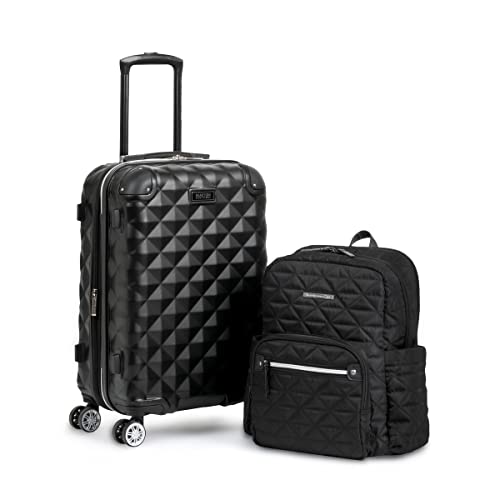
Wrangler Smart Spinner Hardside Luggage, 2 Piece Set, Black

Pulling the decision together
A business luggage set is bought rarely and used relentlessly, so the decision rewards patience at the specification stage. Start with the travel pattern, because it fixes which pieces matter; settle wheels and exterior next, because they are shared across the set and lived with daily; then work through the interior — laptop storage, garment care, pockets with a purpose — before weighing warranty terms, which protect the whole purchase at once. Sets that look identical in photographs separate quickly under that sequence of questions, and the set that survives it will feel less like a purchase and more like a colleague: present at every departure, unremarkable at every arrival.
Some links in this guide are affiliate links, which means this site may receive a commission if a reader follows one and later buys something, at no added cost to the reader; that arrangement never shapes which materials, wheel layouts, or warranty terms are described as stronger or weaker here. Every judgement above rests on manufacturer specifications, published figures, and the accumulated owner reports described at the outset. Choose the set that fits the trips already on the calendar, and it will still be rolling quietly beside its owner on the morning the calendar fills again.