Our Top Picks


What's inside
- What Type B means on a flieger dial
- The 1940s observation watch specification in plain terms
- Type A and Type B side by side
- Modern homages from legitimate watchmakers
- Case sizes: from 55 millimetres to the modern wrist
- Movements: automatic, hand wound, and the hacking seconds question
- Lume: reading a Type B dial in the dark
- Crystals, cases, and water resistance for daily life
- Straps: leather first, with honest alternatives
- How to choose a Type B flieger that fits your life
- Wearing a Type B watch today
- Care, winding habits, and keeping the dial honest
- Common mistakes when buying a first Type B
- Type B in a collection, and as an only watch
- Reading Type B at speed: a practical method
- Hands, markers, and the details collectors argue about
- Comparing modern size options for different wrists
- Automatic versus hand wound in daily rotation
- Date windows, small seconds, and other variations
- What ownership feels like after the first year
- Questions to ask before ordering
- How the Type B story is documented
- Check prices on Amazon
- Gift buying and first mechanical watch considerations
As an Amazon Associate I earn from qualifying purchases. This post may contain affiliate links at no extra cost to you.
What Type B means on a flieger dial
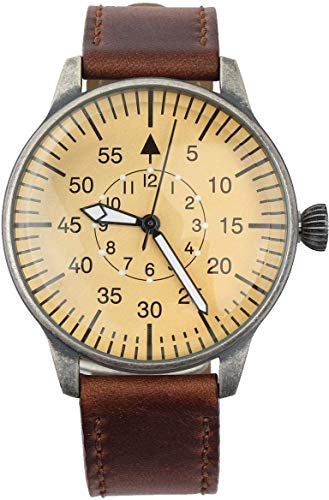
A Type B flieger is a pilot style watch whose dial follows the Baumuster B layout created for German observation watches of the Second World War period. The defining feature is easy to state and takes a little practice to use: minutes dominate the outer track, printed in large Arabic numerals at five minute intervals, while hours move to a smaller inner ring numbered one to twelve. A prominent triangle marker with dots beside it sits at twelve, long sword or baton hands sweep a high contrast black dial, and the whole arrangement was designed to be read at a glance by a navigator who cared about elapsed minutes at least as much as the hour of the day.
That layout is the opposite instinct from the better known Type A dial, which places large hour numerals around the outside in the conventional way and a smaller minute track inside or at the edge. Neither layout is a decoration applied at random. They are two standardised answers, Baumuster A and Baumuster B, to a military specification for Beobachtungsuhren, usually shortened to B-Uhren, meaning observation watches. Modern watches that use the Type B layout are therefore quoting a specific historical instrument, and understanding that instrument is the key to deciding whether the dial will delight or frustrate its wearer in daily use.
Our research draws on published historical accounts of the B-Uhr specification, manufacturer specifications for current production pilot watches, and owner reports from collectors who wear modern Type B models daily. No original wartime watch needs to be handled to understand the category, and this guide deliberately discusses modern, legitimately produced watches from established watchmakers as a class. It does not present imitation or counterfeit goods as buying options in any form, because the modern homage market from real watch brands is broad, honest about its references, and built to standards the wartime originals never attempted for civilian wrists.
The 1940s observation watch specification in plain terms
In 1940 the German air ministry formalised requirements for a precision observation watch to be issued to navigators and observers, not simply to pilots flying the aircraft. Navigation by dead reckoning depended on accurate timing over measured courses, which is why the specification demanded a large, legible dial, a chronometer grade movement, hacking seconds so the watch could be synchronised to a reference signal, and a case large enough to be worn over a flight jacket and operated with gloves. The resulting watches measured about 55 millimetres across, a pocket watch scale adapted to the wrist with a long leather strap that could close over clothing.
Five German manufacturers produced watches to this specification during the war years, and Swiss supply also played a documented role in the wider story of these instruments. The watches were issued equipment, marked as service property, and expected to be returned, which is why surviving originals are museum and collector pieces rather than a practical shopping category today. Their movements were adapted pocket watch calibres with centre seconds, and features such as a large crown that could be wound while wearing gloves became visual signatures that modern flieger watches still quote, sometimes at sizes far beyond what a modern wrist requires or wants.
Why minutes came first for the navigator
The Type B dial, introduced as the specification evolved, reorganised the dial around the task of timing. A navigator plotting position from speed, heading, and elapsed time lives in minutes and seconds. Putting five, ten, fifteen, and onward to sixty in large figures around the outside made elapsed minute reading immediate, while the hour, which changes slowly and is usually known approximately, could be read from the smaller inner ring when needed. The long minute hand points directly at the figure that matters, and the shorter hour hand indicates its ring with a shape distinct enough to avoid confusion once the reader has spent a day learning the system.
Modern wearers should be honest about the learning curve. For the first days, a Type B dial is slower to read than a conventional dial, because the eye instinctively treats the large outer numerals as hours. Owners consistently report that the layout becomes natural within a week or two of daily wear, after which the dial feels logical and distinctive rather than difficult. People who check the time in split seconds dozens of times a day, in meetings or while presenting, may still prefer Type A. People who enjoy instruments with a purpose built logic usually adapt quickly and then miss the layout when they return to ordinary dials.
Type A and Type B side by side
A Type A dial shows hours one to twelve in large numerals around the perimeter, a minute track, triangular twelve marker, and typically a cleaner, more open face. It reads instantly to anyone who has ever worn an analogue watch. A Type B dial shows minutes five to sixty in large numerals around the perimeter, hours one to twelve on an inner ring, and a busier, more technical face that rewards attention. Both share the black dial, white printing, strong luminous material, and large hands of the observation watch family. Choosing between them is choosing which information the dial shouts and which it whispers, and there is no correct answer outside the wearer habits and taste.
Size for size, a Type B dial contains more printed information, so legibility depends heavily on proportions. In a 38 millimetre case the inner hour ring can become cramped if the printing is heavy, while in a 40 or 42 millimetre case the rings separate cleanly. This is why many modern makers reserve Type B for their larger pilot models or take particular care with typeface weight and spacing on smaller versions. Published photographs can mislead here because dial macro images enlarge everything; specifications for case diameter, together with owner reports about reading the inner ring in poor light, give a more realistic picture than studio images alone.
Readers new to pilot watches may find it useful to compare the wider watch categories covered in best analog smartwatches and best hybrid smartwatches, not because those watches share the B-Uhr layout, but because the contrast underlines what a purely mechanical flieger is: a time only instrument with no notifications, no sensors, and no battery management, whose entire design effort goes into telling the time legibly for decades.
Modern homages from legitimate watchmakers
Contemporary Type B watches come from a healthy range of established makers, from accessible German and Japanese brands with long pilot watch catalogues to Swiss houses whose predecessors supplied wartime or postwar aviation watches, and to small independent brands that specialise in historically faithful reissues. These are original products sold under their own names, with their own warranties, movements, and design choices, openly referencing a layout that is now a historical standard rather than a living trademark. That openness is the ethical and practical line that matters: a homage states its inspiration, a legitimate brand stands behind its watch, and the buyer receives service, parts, and recourse that no imitation can offer.
Within that legitimate market, fidelity varies by intent. The most faithful modern pieces reproduce the outer minute numerals, inner hour ring, triangle marker, blued or blackened hands, and unsigned or minimally branded dial of the originals, sometimes even omitting a logo because the wartime specification did. More interpretive pieces add a date window, a brand name, a coloured accent, or a smaller seconds subdial. Purists tend to resist date windows on Type B dials because cutting a hole in the minute track disrupts the very information the layout prioritises, while pragmatic daily wearers accept a discreet date at three or six as a fair trade. Neither camp is wrong, but the dial should be judged by whether its additions respect the minute first logic.
What to look for in dial execution
- Outer minute numerals at every five minutes, large, evenly spaced, and fully printed rather than abbreviated.
- Inner hour ring numbered one to twelve, separated clearly from the minute track at a quick glance.
- Triangle marker at twelve flanked by two dots, aligned precisely with the sixty minute numeral.
- Hands long enough to reach their respective tracks, with the minute hand clearly dominant.
- Matte black dial finish that avoids reflections, with white printing that stays sharp at the edges.
- Minimal dial text, so the historical layout is not crowded by slogans or oversized branding.
- Luminous material applied generously to numerals, markers, and hands, with even brightness across elements.
Printing quality separates satisfying Type B dials from merely correct ones. Because the design depends entirely on typography and spacing, slightly misaligned numerals, fuzzy edges, or an inner ring printed a fraction too close to the centre become visible every day. Reputable makers publish close, straight on dial images, and owner photographs in ordinary light are even more revealing. A dial that looks crisp in a phone photograph taken on a train is executing the design properly. A dial that only looks good in a rendered product image should be treated with caution, whatever the specification sheet promises about heritage or inspiration.
Case sizes: from 55 millimetres to the modern wrist
The original 55 millimetre case was a tool dimension, chosen for legibility and gloved use over a jacket, and it wears like a small wall clock on almost every human wrist. Modern Type B watches translate the design into 38 to 42 millimetre cases, with occasional 43 or 44 millimetre models for buyers who want closer historical presence. Lug to lug length matters as much as diameter, because long straight lugs on pilot watches can make a nominally modest case wear large. A 40 millimetre case with a 48 millimetre lug to lug span and a flat profile will suit many wrists, while the same diameter with downturned lugs and a thinner case may wear noticeably smaller.
At 38 to 39 millimetres, a Type B watch becomes a versatile daily piece that fits under a cuff and suits smaller wrists, provided the dial printing remains legible as discussed above. At 40 to 41 millimetres, most makers hit the sweet spot of presence and wearability that the majority of owners settle on. At 42 millimetres and above, the dial breathes, the inner ring opens up, and the watch reads as an overt instrument, which suits larger wrists and casual clothing. Thickness interacts with all of this; a hand wound movement can keep a case near ten or eleven millimetres thick, while an automatic with a display back and higher water resistance may reach thirteen, changing how the watch slides under sleeves and how top heavy it feels on a leather strap.
Try on advice translates poorly through specifications alone, so buyers ordering unseen should measure a watch they already wear, compare lug to lug figures rather than diameter alone, and check return policies before committing. A paper circle cut to the case diameter and placed on the wrist gives a crude but useful impression of footprint, though not of thickness or lug shape. Owner reports organised by wrist size, which many brand communities collect, are among the most practical research sources in this category, because pilot watches wear so differently from dress watches of the same nominal diameter that generic size advice routinely misleads first time flieger buyers.
Movements: automatic, hand wound, and the hacking seconds question
Most modern Type B watches use automatic mechanical movements, wound by a rotor as the wrist moves and also usually by the crown. Automatics suit daily wear because they stay running with regular use, offer power reserves commonly around 38 to 80 hours depending on the calibre class, and keep the case sealed against daily dust and moisture by reducing crown use. Buyers will encounter Swiss and Japanese movements across the legitimate market, in house calibres at higher tiers, and workhorse third party calibres in accessible models whose service costs and parts availability are well understood by independent watchmakers around the world.
Hand wound movements are the historically faithful choice, because the original observation watches were manually wound pocket watch movements. A modern hand wound flieger asks its owner for a daily or near daily winding ritual, rewards that attention with a thinner case and a direct mechanical connection many enthusiasts prize, and often displays its movement through a case back without a rotor blocking the view. The risk is simply forgetting to wind and finding the watch stopped, which matters if it is the only watch worn for time critical work. For a watch bought partly for its ritual and history, that trade is usually welcome rather than resented.
Hacking, accuracy, and service intervals
Hacking seconds, the ability to stop the seconds hand when setting the time, was part of the original specification because synchronised timing mattered operationally. Most quality modern movements in this category hack, and buyers who care about historical fidelity or about setting to a reference clock should confirm the feature in manufacturer specifications rather than assuming it. Non hacking movements exist at lower tiers and are not defective, but they belong to a different value proposition and should be priced and judged accordingly, with the setting technique of advancing the minute hand slightly to compensate explained in many owner guides.
Published accuracy figures for mechanical watches are ranges, not promises of a single daily rate, and a watch regulated to run a few seconds fast per day is generally preferred to one running slow, because a fast watch can be corrected by a brief hack while a slow watch requires full resetting. Position, temperature, and state of wind all influence rate, which is why chronometer certification, where offered, describes performance across tested conditions rather than a guarantee for one wrist. Service intervals for modern mechanical calibres typically fall in the four to seven year region depending on maker guidance and use, and the cost and local availability of that service should be part of the purchase decision for a watch intended to be kept for decades.
Lume: reading a Type B dial in the dark
Luminous material made the observation watch usable in unlit cockpits and remains central to the type. Modern watches use phosphorescent pigments, most commonly grades of strontium aluminate sold under well known trade families, charged by light and glowing green or blue green through the night. On a Type B dial the lume plot layout is a test of design discipline: the outer minute numerals or their markers, the inner hour markers, the triangle, and both main hands should glow with balanced intensity, so the minute first logic survives in darkness. A dial where only the hands glow brightly has kept the appearance of a flieger and lost much of its function.
Buyers should distinguish lume quantity from lume quality. Thickly applied material stores more light and glows longer, which is why premium pilot watches advertise layered application. Photographs of lume taken immediately after charging exaggerate performance; the useful question is whether the dial remains readable after several hours in darkness, which owner reports from overnight wear answer more honestly than any studio lume shot. Colour choice also matters to some wearers, because aged style cream lume suits the historical look in daylight but generally glows less intensely than fresh white material, a genuine trade between daytime character and night performance.
Crystals, cases, and water resistance for daily life
Sapphire crystal is now the expected standard in serious modern flieger watches, valued because it resists the scratches that quickly cloud a watch worn daily with shirt cuffs, desks, and seatbelts. Some historically minded models use domed sapphire that mimics the profile of wartime acrylic while keeping modern hardness, and anti reflective coating on the underside improves the matte dial legibility that the whole design depends on. Acrylic crystals still appear on the most faithful reissues, offering warm distortion and easy polishing at the cost of frequent marks. Mineral glass sits between the two and is acceptable at lower tiers if the price reflects it.
Case finishing on pilot watches is traditionally restrained: brushed steel, bead blasted matte surfaces, or occasionally titanium for reduced weight. Polished dress finishes fight the instrument character and show wear quickly. Water resistance in the category ranges from splash resistant ratings on the most historical pieces to genuinely swim capable figures on modern daily wear models, and buyers should match the rating to their real life rather than to aviation romance. A watch that will be worn in rain, washed around, and kept on during travel needs seals and a screw down crown more than it needs another line of dial text, and gaskets require periodic checking during service to keep any rating meaningful.
The large crown remains both a signature and a practical feature. Original crowns were oversized for gloved hands, and modern versions range from faithful diamond or onion shapes to simple large cylinders that are easy to grip with cold or wet fingers. A crown that digs into the back of the hand is a known ergonomic risk of oversized designs, especially on the left wrist, which is why some makers reduce the diameter slightly or shape the crown to soften contact. Published case dimensions rarely capture this, so owner comments about crown comfort deserve weight alongside the more easily compared numbers for diameter and thickness.
Straps: leather first, with honest alternatives
Leather is the historically correct strap for a flieger, originally long enough to close over a flight jacket and often fitted with rivets near the lugs in the style now instantly associated with pilot watches. Modern leather straps for Type B watches are conventional lengths, usually in brown or black with contrasting stitching, in calf, horsehide style finishes, or suede and nubuck for a softer look. A thick, minimally tapered strap balances a 40 to 42 millimetre instrument case visually and physically, preventing the watch from rotating on the wrist. Stitching quality, edge finishing, and lining material decide whether a strap still looks good after a summer of daily wear or cracks and darkens unevenly within months.
Riveted straps are a matter of taste and proportion. On larger cases they complete the historical reference, while on a 38 millimetre watch the same hardware can overwhelm the lugs. Many owners keep the supplied leather for cooler months and rotate to a canvas, nylon, or rubber strap in heat and humidity, accepting a less period correct look for comfort and water tolerance. Steel bracelets appear on some modern pilot lines and change the watch entirely, adding weight and a contemporary tool character; they suit buyers who want one watch for every setting more than they suit historical purists. Lug width, commonly 20 or 22 millimetres in this class, decides how large the aftermarket strap world is, and it is worth confirming before purchase.
Readers comparing strap driven style changes across watch types will recognise similar trade offs in best high end smartwatches, where case and strap materials also decide whether a large watch reads as an instrument or as jewellery, even though the technology inside could hardly be more different from a mechanical flieger.
How to choose a Type B flieger that fits your life
- Case diameter between 38 and 42 millimetres, checked together with lug to lug length against your wrist size.
- Dial execution with a clear outer minute track, a legible inner hour ring, and minimal extra text or cut outs.
- Movement type, automatic for convenience or hand wound for thinness and historical fidelity, with hacking seconds confirmed if synchronising matters to you.
- Power reserve and published accuracy range from the manufacturer, read as ranges rather than guarantees.
- Luminous material coverage across numerals, markers, and hands, judged by overnight readability reports rather than charged lume photographs.
- Sapphire crystal with anti reflective treatment, or acrylic only where historical fidelity is the deliberate priority.
- Water resistance matched to real daily exposure, with crown design checked for comfort on your wearing wrist.
- Leather strap quality, lug width, and the availability of summer alternatives in the same width.
Budget in this category buys different things at different tiers, and this guide deliberately avoids attaching fixed figures to individual models because line ups and street prices change. At accessible tiers the money buys a sound third party movement, a well printed dial, and sapphire if the maker prioritises it. In the middle, it buys better regulation, finer dial and hand finishing, stronger lume application, and movements with longer reserves. At higher tiers it buys in house calibres, chronometer testing, historical brand continuity, and case finishing that rewards close inspection. At every tier the Type B layout itself costs nothing extra; what changes is the care with which it is executed, which is why dial photographs and movement specifications reveal more than heritage storytelling.
A useful decision exercise is to live with the layout on paper first. Draw or print the dial at true size, tape it to the wrist, and practise reading it at arm length in ordinary and dim light. People who smile at the small ritual of translating the inner ring tend to become long term Type B owners. People who find it irritating in a two minute exercise will find it more irritating in a hurried station glance, and should choose a Type A dial without any sense of having settled for less, because the Type A is an equally authentic historical standard with a longer production history of its own.
Wearing a Type B watch today
In contemporary dress a Type B flieger occupies a distinctive middle ground. It is too purposeful to be a dress watch and too restrained to be a novelty, which makes it work with casual tailoring, knitwear, field jackets, and most office clothing short of formal suits. The black dial and leather strap keep it quiet from a distance, while close up the unusual numeral arrangement starts conversations that ordinary pilot watches do not. Owners often describe it as the watch in a collection that non enthusiasts notice and ask about, precisely because the dial logic is visible once explained and puzzling until that moment, a combination that gives the design a social life beyond its specification sheet.
For travel, a time only flieger has quiet virtues: no battery to manage, no charger to pack, no screen to wake, and a dial that reads in any light after a glance. It will not track a second time zone unless the wearer uses the minute track creatively or chooses one of the rarer dual time interpretations, and it will not count steps or display messages. Comparing it with the multifunction approach in best outdoor smartwatches clarifies the choice rather than settling it. Some travellers want data, others want an instrument that does one job with total reliability through a long day of trains, terminals, and changing light, and the Type B belongs firmly and proudly to the second philosophy.
Care, winding habits, and keeping the dial honest
Mechanical care for a flieger is ordinary watch care applied consistently. Keep the watch away from strong magnetic fields where possible, because magnetised hairsprings are a common and easily corrected cause of sudden fast running. Rinse salt water and sweat from the case where the water resistance allows it, dry the leather strap separately rather than soaking it, and store the watch dial up in a dry place. Hand wound models prefer a regular winding time, fully winding at the same point each morning, while automatics worn in rotation may need a brief manual wind after rest before being set and worn for the day.
Leather straps are consumables with a typical life measured in months to a few years depending on climate and rotation, and replacing a strap is the cheapest way to refresh the whole watch. Keep the original buckle if it is signed or well finished, check spring bars at every strap change, and use the correct tool size for the lug holes to avoid chewed lugs that future owners, and present owners looking closely, will notice. A watch bought for its historical design deserves the small discipline of correct tools, because nearly all cosmetic damage to pilot watches happens not in dramatic accidents but during strap changes on kitchen tables with improvised screwdrivers.
Common mistakes when buying a first Type B
The first mistake is buying diameter by nostalgia, choosing the largest case because the originals were huge, and then never wearing the result because it catches on every cuff and doorway. The second is ignoring the inner ring in photographs, discovering only on delivery that the hour numerals are too small or too faint for quick reading. The third is paying for a movement story while accepting poor dial printing, when the dial is the part seen a hundred times a day. The fourth is treating water resistance as a styling detail and wearing a splash resistant historical piece into pools and showers until moisture fogs the crystal and a service becomes urgent rather than routine.
A fifth mistake deserves separate emphasis because it harms buyers directly: pursuing a bargain into imitation goods sold under another maker name or with copied branding. Such pieces offer no warranty that means anything, no assured water resistance, no safe materials control, and no service path, and they misrepresent the legitimate homage market that this guide describes. Established brands at every tier sell openly branded Type B watches with real specifications and real after sales support, including accessible models, so there is no tier at which a buyer needs to accept a counterfeit to own this dial. Research the seller as carefully as the watch, buy through authorised or reputable channels, and keep the paperwork that future servicing and resale will ask for.
Type B in a collection, and as an only watch
As a collection piece, a Type B flieger earns its place by being the dial that teaches its owner something. It sits naturally beside a Type A, a chronograph, or a dive watch without duplicating any of them, and it anchors the aviation corner of a collection with the most intellectually interesting layout of the family. Collectors who enjoy specifications will find endless detail to compare: the exact shape of the triangle, the font of the inner ring, the handset proportions, and the degree to which each maker balances fidelity against wearability. That depth explains why a layout designed for a single wartime task still supports a whole modern subculture of comparison and debate.
As an only watch, the Type B asks more commitment. Its owner accepts the reading habit, the leather strap rotation in summer, and the absence of complications beyond, on some models, a date. In return it offers a watch that never looks generic, works across most wardrobes, and carries a story that can be explained in one sentence and explored for an hour. Buyers who need instant time reading under pressure, extensive water use, or digital functions should choose differently and happily. Buyers who want their single watch to have a point of view will find few designs at any level that state one as clearly as minutes on the outside and hours tucked inside, waiting to be learned.
Reading Type B at speed: a practical method
New owners benefit from a deliberate reading method during the first week. Glance first at the long minute hand and read its numeral on the outer track, then find the short hour hand against the inner ring, then confirm with the triangle at twelve as an orientation anchor. Reversing the usual habit takes conscious effort for a few days, after which the sequence becomes automatic. Practising away from pressure, on a train or at a desk, builds the habit faster than testing it in moments that matter. Several owners report setting a Type B watch ten minutes fast during the learning period is a poor idea, because the translation step and the correction step multiply confusion; set it correctly and let the brain do one new thing at a time.
The layout also changes how elapsed time is judged, which many wearers come to value more than the novelty. Because minutes are the large scale, a Type B dial makes a twenty minute wait, a forty minute journey, or a meeting overrunning by fifteen minutes visually obvious in a way a conventional dial does not. Cooks, commuters, teachers, and anyone whose day is divided into timed blocks often find this genuinely useful rather than merely historical. The watch quietly trains attention toward duration, which was exactly its navigational purpose, translated from plotting a course over the sea to catching a connection across a city without staring at a phone screen.
Hands, markers, and the details collectors argue about
Handset design carries much of the character. Traditional flieger hands are broad sword or cathedral influenced shapes with generous luminous fill, sized so the minute hand reaches the outer track and the hour hand reaches its inner ring without ambiguity. Blued steel hands, produced by heat colouring, appear on historically minded models and read as nearly black in most light while flashing blue at certain angles, a subtle luxury that photographs struggle to capture. Painted black or white hands are more legible in flat light and cheaper to produce well. The seconds hand, often a simple counterweighted needle, matters more on a Type B than on many watches because timing seconds against the dominant minute track is part of the original concept and part of daily enjoyment for owners who time anything from espresso extraction to presentation sections.
Small dial details separate thoughtful editions from generic ones. The triangle at twelve should sit exactly on its minute mark, the two flanking dots should be symmetrical, and the sixty numeral is usually omitted in favour of that triangle, a convention new buyers sometimes mistake for a missing number. The inner ring may carry a full set of hour numerals or, on some interpretations, markers with selected numerals, and the choice affects both authenticity and clarity. A brand name, where present, usually sits in the upper half where the originals carried nothing, and restrained typography there is a reliable sign that the maker understood the assignment: the layout is the brand statement, and anything else is commentary.
Comparing modern size options for different wrists
Wrist size guidance in this category needs numbers handled carefully. As a starting frame rather than a rule, wrists under about sixteen centimetres in circumference usually settle happiest at 38 or 39 millimetres with short lugs, wrists in the broad middle range wear 40 or 41 millimetres as the original designers might have scaled the concept themselves, and wrists above about eighteen and a half centimetres can carry 42 to 44 millimetres without the watch looking like a costume. Bone structure, wrist shape, and personal style move these boundaries considerably, which is why the lug to lug measurement and case thickness, both published by serious makers, should always be read together with diameter before any conclusion is drawn.
Thickness and strap choice can rescue or ruin a borderline size. A 42 millimetre watch at eleven millimetres thick on a soft, well broken in leather strap often wears friendlier than a 40 millimetre watch at fourteen millimetres thick on a stiff new strap that holds the case away from the wrist. Trying a candidate on its actual strap type matters, and where that is impossible, owner photographs on similar wrists, taken straight down at natural arm length rather than in flattering close up, are the next best evidence. Retailers of legitimate brands understand this uncertainty and reputable return policies exist precisely because pilot watch sizing is the least predictable part of an otherwise specification driven purchase.
Automatic versus hand wound in daily rotation
Ownership rhythm decides the movement question more honestly than ideology. A watch worn every day suits an automatic perfectly, staying wound and ready, with the crown touched mainly for date changes and seasonal time shifts. A watch worn in rotation among several may suit hand winding better, because the morning ritual of winding and setting becomes part of picking it up, and no watch winder is needed to keep it ready. Collectors often own both types and describe the hand wound flieger as the weekend watch and the automatic as the weekday default, a division that reflects affection rather than hierarchy, since both approaches have powered serious aviation instruments at different moments in history.
Power reserve figures deserve a practical reading. A reserve around forty hours covers a day off the wrist; a reserve near eighty hours covers a long weekend; reserves beyond that serve collectors rotating many watches. What matters more for a Type B bought to be worn constantly is that the movement holds its rate across the reserve rather than only when fully wound, a quality makers describe as isochronism and reviewers assess over several days of wear. Published figures start the comparison, but consistent timekeeping in owner reports across weeks of ordinary use is the evidence that a particular calibre and its regulation deserve the trust a single watch owner must place in them.
Date windows, small seconds, and other variations
Variations on the Type B theme reveal maker priorities. A date window at six can preserve dial symmetry while interrupting the thirty minute numeral area least offensively; a date at three replaces or crowds the fifteen numeral that the minute first layout values highly, which is why purists resist it there. Small seconds subdials quote other historical pilot instruments and add mechanical charm, but on a Type B they compete with the inner hour ring for space and can tip a smaller case from technical to cluttered. No date, centre seconds, and a clean two ring dial remains the reference configuration against which every variation should justify itself, and many buyers who start by wanting a date discover after a month of ownership that they check dates on every other device they own and time on this one.
Coloured dial interpretations, bronze cases, and left handed crown editions extend the family further from its source. Bronze develops a personal patina that suits the historical narrative while demanding an owner who enjoys change rather than permanence. Left handed or destro editions move the crown to the left side, originally a practical idea for wearing over sleeves and now a comfort option for right wrist wearers. These editions are legitimate design evolution from real brands, judged by the same standards as the core models: dial discipline, movement quality, honest specifications, and finishing that matches the tier. Novelty that sacrifices the minute track clarity has missed the point of the type, whatever material the case is made from.
What ownership feels like after the first year
Long term owner reports follow a recognisable arc. The first month is about the reading habit and the compliments. The first summer tests the leather strap and teaches rotation to breathable alternatives. The first scratch on the case ends the precious phase and begins the companion phase, in which the watch is simply worn, wound, and trusted. By the first year the dial layout has usually become the owner reference standard, and conventional dials can feel oddly vague about minutes for a few glances after a swap. That inversion is the surest sign the design has done its work: a wartime navigator solution has quietly reorganised how a modern wearer perceives the structure of an hour.
Resale and keeping value behave sensibly in the legitimate market. Documented watches from established makers, with boxes, papers, and service history, find second owners readily because the Type B niche is knowledgeable and patient. Limited or historically faithful editions hold interest longest, while heavily personalised or modified pieces narrow their audience. None of this should drive a purchase, because a watch bought to be worn for decades amortises its cost in daily use regardless of market mood, but buying from a real brand through a reputable channel preserves options that imitation goods destroy completely, including the simple option of having the watch serviced by its maker when it eventually needs attention.
Questions to ask before ordering
A short list of questions resolves most remaining uncertainty. Does the maker publish full dimensions including lug to lug and thickness, and clear straight on photographs of the actual dial? Is the movement identified by calibre with its reserve, accuracy range, and hacking behaviour stated? Is the crystal material named, and the water resistance explained with crown details? Are strap dimensions, lug width, and replacement strap options listed? Is the warranty international, who performs service, and what does a standard service cost according to owner experience? A seller who answers all of these plainly is selling a real watch. A seller who answers with heritage adjectives and countdown timers is selling a mood, and the difference matters at every tier of this market.
Finally, consider what the watch will actually accompany. A Type B flieger pairs with the clothing, work, and routines described earlier in this guide, and it asks its owner to enjoy mechanical timekeeping as a daily practice rather than a background utility. If that description sounds like a pleasure rather than a chore, the layout that began as a navigation instrument in the nineteen forties has found exactly the wrist its modern makers intended, and the remaining decision is only which legitimate interpretation, in which size, with which movement, expresses that pleasure most faithfully for the person who will read minutes first for years to come.
How the Type B story is documented
Enthusiasts who want to verify the history in this guide will find the observation watch story unusually well documented for a piece of military equipment. Surviving issued watches appear in museum collections with their markings recorded, the specification features described here, from the 55 millimetre case to the hacking movement and the two dial patterns, are consistent across published references, and the five wartime manufacturers are a matter of record rather than brand mythology. Modern makers who reproduce the layout usually publish their own accounts of the reference watches, and comparing those accounts is itself instructive, because the makers who get the small historical details right, such as the omitted sixty numeral and the flanking dots, tend to be the same makers whose dial printing and movement choices withstand scrutiny in the present day.
That documentary trail also protects buyers. A design whose history is public knowledge cannot be monopolised by storytelling, so any brand claims can be checked against the shared record, and a watch can be judged on execution rather than on the romance of its brochure. Collectors forums maintain photographed archives of both originals and modern editions, organised by maker and year, which makes it possible to see how a particular model dial actually looked in production rather than in launch imagery. Spending an evening in those archives before spending money on metal is the closest equivalent this category has to handling the watch in a shop, and it frequently changes shortlists by revealing printing habits, handset proportions, and case finishing that specification tables never mention at all.
Check prices on Amazon
Live listings for the shortlist in this guide are pulled from Amazon below, so prices and availability are always current at the moment you look.

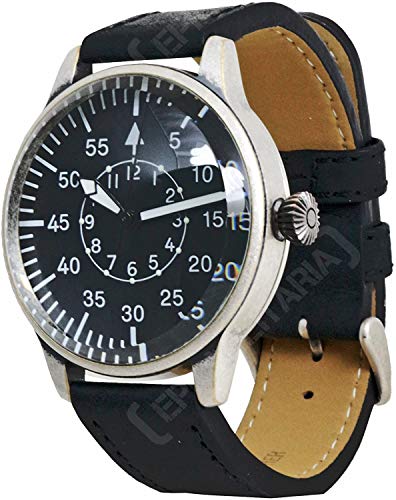
Mil-Tec Vintage Aviator Watch Black Dial Quartz Mens Flieger Pilot World War 2 Wristwatch

Toujours PRET Mechanical Military flieger Watch Blasted Stainless Steel 39mm

chotovelli Men’s Flieger Pilot Watch – Beige B-uhr Dial, Domed Crystal, Black Leather Strap (Tipo.3)


Citizen Men’s Eco-Drive 3-Hand Date Avion Watch with Leather Strap (Style: AW1361:10H)

Gift buying and first mechanical watch considerations
A Type B flieger is a memorable gift precisely because it is not the default choice, but gift buyers should apply one extra filter: the recipient reading habits. Someone who already enjoys aviation history, mechanical instruments, maps, or analog tools will usually relish learning the dial, while someone who wants a watch purely as jewellery may find the inner ring an obstacle between them and an accessory. Where the gift is a first mechanical watch, an automatic movement removes the winding learning curve and leaves only the dial to learn, a kinder introduction than asking a new owner to master both rituals at once, and a presentation that includes a short explanation of the navigator story turns initial puzzlement into the intended moment of recognition.
Presentation details help more than extra accessories. A note explaining that the large numbers are minutes, that the triangle marks twelve, and that the layout comes from nineteen forties observation watches gives the recipient the key before the first confused glance. Choosing a strap colour that matches the shoes and belts the recipient actually wears, rather than the most historical brown in the catalogue, increases the chance the watch leaves its box daily. Legitimate brands supply warranty cards and documentation that should be kept together and passed over with the watch, because a gift of a mechanical instrument is also a gift of its service future, and that future depends on paperwork surviving the excitement of the day it is given.
For buyers choosing their own first mechanical watch, the same logic applies without the guesswork about another person taste. The Type B rewards commitment and repays it with distinctiveness, but it should be chosen with eyes open about service costs, strap replacement, and the absence of the convenience features modern wearers may rely on without noticing. Trying the layout, reading owner reports across a full year of wear rather than unboxing impressions, and buying the best dial execution available within a sensible personal budget will matter far more after twelve months than any launch discount or limited label attached to the purchase in its first exciting week of ownership and discovery.
One last practical habit separates satisfied long term owners from frustrated ones: wear the watch continuously for the first fortnight rather than rotating it away whenever the dial feels unfamiliar. Learning any instrument layout depends on uninterrupted repetition, and two weeks of daily glances, at breakfast, on platforms, in meetings, and in dim evening light, embeds the minute first sequence more thoroughly than months of occasional weekend wear. Owners who give the design that fair trial almost always reach the point where the inner hour ring stops being a puzzle and becomes simply where the hour lives, and from that point the watch stops being an experiment and starts being, unmistakably, their watch.
How this guide supports itself is worth stating plainly in closing: a number of the outbound links readers may follow from this page are affiliate links, and a purchase made after following one may return a small commission that funds further research guides of this kind without adding anything to the price paid. That support does not buy placement, soften criticism of weak dial printing or poor lume, or change the historical facts set out above, all of which can be verified against published sources on the observation watch specification and current manufacturer documentation. We would rather a reader choose a Type A dial after honest comparison than a Type B bought under any misunderstanding this page could have prevented.
Choose a Type B flieger for the quiet pleasure of reading minutes first on a dial that once helped navigators find their way home, and every ordinary glance at your wrist will carry a small, deliberate echo of that instrument panel logic.