Key takeaways
- Heavy-duty tow vehicle batteries compared on cranking amps, reserve capacity, group size, vibration resistance, and dual-battery setup options.
What's inside
- Why towing duty changes what a battery must do
- Cold cranking amps, explained without the marketing fog
- Reserve capacity and the loads you forget to count
- Group sizes for common tow vehicles
- AGM, flooded, and lithium starting batteries compared
- Vibration resistance and rough-road survival
- Dual-battery setups, isolators, and auxiliary power
- Alternator load with trailer brakes, lights, and charging
- Heat, cold, and the calendar working against you
- Choosing and using a charger or maintainer
- Terminal corrosion, cables, and everyday care
- How to compare specific batteries for your rig
- Replacement intervals and end-of-life signs
- Installation notes that protect the new battery
- Matching the battery to five common towing profiles
- Grounds, connectors, and the hidden half of the circuit
- Jump-starting a tow rig without creating a second problem
- Parasitic draws and the trailer that drains its tow vehicle
- Check prices on Amazon
- Final guidance before you order
As an Amazon Associate I earn from qualifying purchases. This post may contain affiliate links at no extra cost to you.
Towing asks more of a starting battery than commuting ever will, because the same unit that spins a cold diesel at dawn may also feed trailer lights, brake controllers, and a winch before lunch. As an Amazon Associate, this site earns from qualifying purchases. Everything below rests on manufacturer documentation, published specifications, and standards references rather than hands-on claims, so you can check each figure against the product pages and the documentation for your own truck before you buy.
Why towing duty changes what a battery must do
A tow vehicle lives a harder electrical life than the family car parked beside it. Long grades hold engine speed high for minutes at a time, which keeps the alternator hot. Campground arrivals happen after dark, so lights, fans, and trailer circuits draw current while the engine idles or sits off. A boat ramp adds a winch or a tongue jack to the load list. Each of those moments pulls on stored energy, and the battery is the buffer that absorbs every spike the alternator cannot cover instantly.
Starting duty alone is demanding. A large gasoline V8 may need 200 to 300 amperes for a few seconds on a warm day, while a diesel with glow plugs and a high-compression starter can draw far more, and it draws that current after the glow plug cycle has already taken its share. Cold thickens engine oil, slows chemical reaction inside the cells, and raises the current needed to turn the crankshaft, all at the same moment. That triple penalty is why a battery that feels fine in October can strand a loaded rig in January.
Reserve duty matters just as much once the trailer is attached. Electric trailer brakes pulse current through the controller on every stop. Breakaway systems carry their own small battery, yet the tow vehicle still supplies lighting, charging for the trailer battery, and often a 12-volt feed for a refrigerator running on DC while underway. Add an inverter for tools, a compressor for air bags, or a powered jack, and the parked draw grows from trivial to serious within one trip.
Vibration is the quiet third burden. Wash-board gravel, expansion joints, and rough launch ramps shake the battery tray thousands of times per hour. Inside a flooded cell, that shaking can shed active material from the plates, and shed material collects at the bottom until it shorts a cell or simply reduces capacity. A battery built for towing therefore needs plate support, a strong case, and a hold-down that actually holds, not merely a heavy label on the top cover.
Cold cranking amps, explained without the marketing fog
Cold cranking amps, usually shortened to CCA, describe the current a fully charged 12-volt battery can deliver for 30 seconds at 0 degrees Fahrenheit while holding at least 7.2 volts. The test comes from industry practice documented by standards bodies and battery councils, and it gives buyers a common yardstick. A rating of 850 CCA means the battery met that cold test at that current, under controlled conditions, when new and fully charged.
Marine cranking amps and hot cranking amps use warmer test temperatures, so the numbers look larger for the same battery. Comparing a CCA figure from one listing with a warmer-test figure from another listing misleads more than it helps. Our research compared CCA to CCA only, and we suggest you do the same. When a product page lists several figures, find the cold figure first and treat the warmer numbers as secondary context.
How much CCA does a tow vehicle need? Start with the vehicle maker specification, printed in the owner manual and often on a label under the hood. That figure reflects the starter, the engine, and the factory cable sizes. Meeting the factory figure is the floor, not the goal. A modest margin above it helps as the battery ages, because capacity fades every year and a battery at 80 percent health on a cold morning behaves like a smaller unit.
More is not endlessly better, though. A very high CCA battery in the same group size often uses thinner plates packed closer together, which can trade some deep-draw tolerance for peak current. Tow vehicles need both peak current and reserve, so the right pick balances the two rather than hunting the largest number on the shelf. Diesel trucks with two factory batteries split the load, and each unit should match its partner in rating, age, and chemistry.
Temperature derating deserves a number, not a shrug. Lead-acid capacity falls as temperature drops; a battery may offer roughly 60 to 65 percent of its warm capacity near 0 degrees Fahrenheit, while the engine demands more current at the same time. That squeeze explains why makers fit larger batteries to trucks sold in cold regions, and why a marginal battery reveals itself on the first hard frost rather than during summer towing.
Reserve capacity and the loads you forget to count
Reserve capacity, shortened to RC, states how many minutes a fully charged battery can deliver 25 amperes at about 80 degrees Fahrenheit before voltage falls to 10.5 volts. A rating of 120 minutes means two hours at that steady draw under test conditions. Real loads vary, but RC remains the best single published clue for how a battery handles sustained demand with the engine off.
Count a typical evening at a site. Interior lights and a vent fan might draw 6 to 10 amperes together. A trailer refrigerator on DC can draw 10 amperes or more by itself, which is why most guidance says to run it on propane or shore power when parked. Phone chargers and a laptop add a few amperes. A powered tongue jack draws heavily but briefly. Two hours of modest loads can consume 20 to 40 ampere-hours, a large share of what a single starting battery should give up.
Depth of discharge is the limit that protects battery life. A starting battery is built for shallow, brief draws followed by prompt recharge. Repeatedly taking it below about half charge shortens its life sharply, and taking it near empty can end it in a season. Dual setups and dedicated auxiliary batteries exist precisely to keep the starting unit shallow while house loads run deeper on a battery built for that pattern.
Ampere-hour figures appear on some listings and can help when comparing auxiliary batteries, yet they are measured at a stated discharge rate, often over 20 hours. A battery rated 100 ampere-hours at the 20-hour rate will deliver less at high current. For starting batteries, RC and CCA remain the more useful pair. For an auxiliary unit feeding trailer accessories overnight, ampere-hours at a realistic rate deserve closer attention.
Worked example: a weekend load budget
Take a half-ton truck with a single Group 48 battery rated at 120 minutes RC. That reserve converts, roughly, to a usable shallow-draw budget far smaller than the headline minutes suggest, because you should stop well before 10.5 volts. If evening loads total 12 amperes for three hours, the draw is 36 ampere-hours. A starting battery of this size holds perhaps 65 to 75 ampere-hours in total, so the evening used about half the stored energy. Starting the next morning after a cold night then becomes a gamble rather than a plan.
The same budget in a dual-battery truck looks different. The auxiliary battery absorbs the 36 ampere-hours, the starting battery stays near full, and the morning start is routine. That contrast, more than any single specification, explains why serious tow rigs separate starting duty from accessory duty whenever space and budget allow.
Group sizes for common tow vehicles
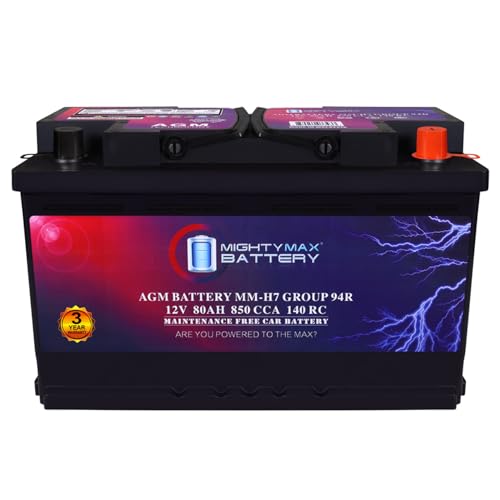
Group size is a physical standard: length, width, height, terminal placement, and hold-down shape. It says nothing directly about capacity, though larger cases usually hold more plate material. Common tow vehicle fitments include Group 24 and 24F, Group 27, Group 34 and 78, Group 35, Group 48 (also called H6), Group 49 (H8), Group 65, and Group 94R (H7). The F and R suffixes signal reversed terminal positions, which matter because cables are cut to reach one layout only.
Full-size gasoline trucks from the major American makers often use Group 48, 65, 78, or 94R depending on year and engine. Heavy-duty diesels commonly pair two Group 48, 65, or 27 units, one on each side of the engine bay. Large SUVs built on truck frames tend to follow the truck fitments, while unibody SUVs that tow smaller trailers may use Group 35, 24F, or 47. These are patterns, not guarantees; the owner manual and the label on the fitted battery settle the question for a specific vehicle.
Terminal orientation errors cause real harm. A reversed battery can place the positive post under a metal hold-down or force cables to stretch across the case, chafing insulation over time. Before ordering, photograph the fitted battery from above, note which side the positive post sits on, and compare that layout with the diagram on the product page. That one-minute check prevents the most common fitment mistake our research found in owner forums and retailer question sections.
Height matters in tight bays. Some trucks accept a taller group with a different hold-down, and some do not clear the hood. A taller battery also raises the center of mass slightly and can interfere with intake plumbing on certain diesels. Measure the tray, the hold-down style, and the clearance, then match all three. Never defeat a hold-down to make a near-fit battery stay; vibration will punish that shortcut first.
Upgrading within the same tray is sometimes possible. A Group 27 may replace a Group 24 where the tray and cables allow, gaining reserve capacity. A Group 49 may replace a Group 48 in certain German and American SUVs with a longer tray. Each such swap needs verification of terminal layout, venting, and the battery management system settings, because many modern trucks register a new battery so the charging algorithm matches its age and type.
AGM, flooded, and lithium starting batteries compared
Flooded lead-acid batteries, the conventional design, hold liquid electrolyte that can move freely around the plates. They cost the least per unit of cranking power, tolerate simple charging, and have served tow vehicles for decades. Their weaknesses fit towing poorly in some respects: they vent small amounts of gas, need periodic water checks in serviceable designs, spill if tipped, and suffer more from vibration unless built with reinforced plates.
Absorbed glass mat batteries, called AGM, hold the electrolyte in fiberglass separators pressed between the plates. The design resists vibration well, spills nothing in normal use, self-discharges slowly, and accepts charge faster than a comparable flooded unit. AGM also delivers strong cold cranking performance in a sealed case that can mount in more positions. The trade-offs are higher purchase cost and sensitivity to overcharging and heat; a failing voltage regulator that a flooded battery tolerates for a while can shorten AGM life quickly.
Gel batteries, a third lead-acid variant, appear in some auxiliary roles but rarely as the best starting choice for a tow truck, because peak cranking delivery and charge acceptance under an automotive alternator suit AGM better. Gel units prefer lower, carefully controlled charging voltage. For a starting role, our research found AGM and quality flooded units dominate maker recommendations, and gel belongs mainly in specific low-draw auxiliary niches.
Lithium iron phosphate starting batteries form the fourth category. They weigh far less, often a third of a lead-acid equivalent, hold voltage firmly under load, and can deliver strong cranking bursts. Built-in battery management electronics protect the cells and may include a reserve jump feature. The cautions are serious, though: charging below freezing can damage lithium cells unless the unit has internal heating or charge blocking, alternator compatibility varies, and a sudden management-system cutoff behaves very differently from the gradual fade of lead-acid. Cost per unit remains high, and fitment support for heavy tow duty is narrower.
For most tow vehicles, the practical contest is AGM versus a premium flooded battery. If the truck sees rough roads, long storage between trips, or a dual setup with an auxiliary load, AGM earns its premium. If the truck tows on paved highways, runs weekly, and the owner checks water and terminals twice a year, a quality flooded unit remains a rational, economical choice. Lithium suits weight-critical builds and experienced owners who verify alternator and temperature compatibility in writing from the battery maker.
Charging profiles differ by chemistry
Each chemistry wants a different charging voltage window. Flooded units commonly charge around 14.4 to 14.8 volts in bulk and float near 13.5 volts. AGM units often specify a slightly lower ceiling and warn against equalization charges meant for flooded cells. Lithium units rely on their internal management and need an alternator or charger that will not present damaging voltage spikes. Smart chargers with selectable chemistry modes exist for this reason, and the maintenance section below returns to charger choice in detail.
Mixing chemistries in one bank is a mistake. A flooded starting battery and an AGM auxiliary battery tied together without proper isolation will charge at one voltage that suits neither perfectly. Dual setups should use matched chemistry or a DC-to-DC charger that gives the auxiliary battery its own profile while drawing from the starting side in a controlled way.
Vibration resistance and rough-road survival
Manufacturers address vibration with plate straps, anchored plate groups, reinforced cases, and separators that keep plates from flexing. Some publish vibration test results against industry standards; others describe construction features without a number. When a listing mentions a vibration rating or a test standard, note it. When it says nothing, the absence tells you the battery was aimed at ordinary car duty rather than trucks that leave pavement.
The hold-down does half the work. A battery that can move 2 millimeters in its tray will hammer its plates on every washboard mile, no matter how strong the case. Inspect the tray for cracked corners, replace missing wedges, and torque the clamp firmly without crushing the case. Rubber mats under the battery help on some trays but must not block vent paths or trap water against the case bottom.
Heat shields matter on trucks where the battery sits near a turbocharger or exhaust manifold. A missing factory shield, often discarded during a hurried replacement, raises case temperature on every tow. High under-hood temperature accelerates grid corrosion, the main life limiter for lead-acid batteries in hot climates. Refit the shield, keep the insulating sleeve if the truck came with one, and treat those parts as battery components rather than trim.
Cable condition completes the mechanical picture. A heavy cable with green corrosion creeping under its insulation adds resistance that no battery rating can overcome. Voltage drop testing across each cable during cranking, a procedure any shop can perform, reveals hidden resistance. Replacing a tired cable often restores starting performance that the owner blamed on the battery, and it protects the new battery from chronic undercharge caused by the same resistance on the charging path.
Dual-battery setups, isolators, and auxiliary power
Factory diesel duals exist to start the engine, with both batteries working as one bank for cranking. Accessory duals serve a different purpose: one battery starts the truck, the other runs accessories, and an isolating device keeps a drained auxiliary battery from pulling the starting battery down with it. Confusing those two architectures leads to wiring errors, so decide which job you are building before buying parts.
The simplest isolator is a voltage-sensitive relay. It connects the two batteries when charging voltage is present and separates them when the engine stops. It suits matched lead-acid chemistries and modest accessory loads, and it needs no driver input. Its limits are fixed connect thresholds and a shared charging profile, which is why lithium auxiliary batteries and mixed chemistries usually need something smarter.
A DC-to-DC charger sits between the alternator side and the auxiliary battery, taking variable input and delivering the exact profile the auxiliary chemistry requires. Better units include solar input, ignition sensing for smart alternators, and current limiting that protects a small alternator from a deeply discharged auxiliary bank. For a tow rig that powers a winch, a compressor, camp lights, and a trailer charge line, a DC-to-DC unit is the controlled, modern answer.
Diode isolators, the older approach, split charging current through diodes that drop roughly half a volt or more. That drop undercharges batteries unless the alternator sense wire compensates, and many modern charging systems cannot compensate cleanly. Heat is the other cost: a diode isolator handling 100 amperes turns that voltage drop into significant warmth under the hood. Our research treats diode units as legacy hardware, serviceable on older trucks but rarely the best new purchase.
Cable sizing for dual runs deserves arithmetic. A winch can draw 300 to 450 amperes at full pull, and voltage drop grows with cable length and falls with conductor cross-section. Runs from a rear-mounted auxiliary battery to a front winch need very heavy cable, solid lugs, and a fuse or breaker near the battery sized to protect the cable. Undersized cable does not merely slow the winch; it heats, sags voltage, and can stall the motor mid-pull on a ramp, exactly when the load matters most.
Fusing belongs at the source end of every long positive run. A chafed unfused cable against a frame rail is a fire path with hundreds of amperes behind it. Fit the fuse within a short distance of the battery post, protect the cable in split loom where it passes metal edges, and use grommets at bulkheads. These details never appear in headline specifications, yet they decide whether a dual setup is an asset or a liability after five rough seasons.
Winches, jacks, and other heavy accessory loads
A winch pull is a battery event as much as a mechanical one. Rated line pull assumes a voltage at the motor that a tired battery cannot sustain. Keep the engine running during pulls so the alternator shares the load, pause between pulls to let the motor and battery recover, and watch for dimming lights as an early sign of voltage collapse. A dual setup with a healthy auxiliary battery transforms winch behavior on a steep ramp because the voltage stays firm deeper into the pull.
Powered tongue jacks and landing gear draw 20 to 30 amperes for short bursts and often run from the trailer battery, which the tow vehicle charges through the seven-pin connector. That charge line is thin and fused modestly, typically supporting a maintenance-level current rather than rapid charging. Expect it to hold a trailer battery over a driving day, not to refill a depleted one. Owners who arrive with a flat trailer battery and a power jack learn this limit at the worst moment, usually in the dark.
Air compressors for suspension bags and tire inflation add a mid-range draw, commonly 20 to 45 amperes for onboard units. Run them with the engine on, and wire them through a relay with a proper fuse rather than a cigarette-lighter plug that was never meant for sustained compressor duty. Stable voltage also protects the compressor motor itself, which draws more current and runs hotter as voltage sags.
Alternator load with trailer brakes, lights, and charging
The alternator carries the whole moving electrical system once the engine runs, and the battery covers only the gaps. Towing adds steady loads: trailer lighting, the brake controller output, the trailer battery charge line, electric fans working harder on grades, and often a transmission cooler fan. A truck with a 130-ampere alternator that idles at a campground gate may deliver only a fraction of that rating at idle speed, which is why long idling with every load on can still discharge the battery.
Smart alternators complicate planning. Many modern trucks vary output voltage to save fuel, sometimes dropping to levels that barely charge an auxiliary battery through a simple relay. That behavior is normal, not a fault, and it is the strongest argument for a DC-to-DC charger with ignition sensing on a late-model tow vehicle. The owner manual and maker technical bulletins describe the charging strategy for each model; check before blaming new batteries for low resting voltage.
Electric brake controllers draw in pulses proportional to braking force. A tandem-axle trailer with four brake magnets can pull roughly 12 to 16 amperes under firm braking. The wiring path, especially the ground return through the connector, must be clean and tight. A corroded seven-pin ground raises resistance, weakens brakes, and heats the connector, a chain of consequences that starts with neglected maintenance rather than a failed battery.
Upgrading the alternator helps only when the rest of the path matches. Heavy output needs the factory heavy-duty cable or an added charge lead, clean grounds between engine, frame, and body, and a battery that can accept the charge. Bolting a high-output alternator onto corroded grounds yields disappointing results. Measure voltage at the battery with the engine running and loads on; a healthy system holds roughly 13.8 to 14.6 volts for lead-acid chemistries, varying with temperature and smart-charge strategy.
Idling to charge is slow and expensive in fuel. A battery at half charge may need hours of driving to refill fully because charge acceptance tapers as the battery fills. The last 20 percent arrives slowly by design of the chemistry. Owners who rely on short drives between long parked stretches should plan on periodic charger sessions at home, which leads directly to the maintenance guidance below.
Heat, cold, and the calendar working against you
Heat ages lead-acid batteries faster than cold does, even though cold causes the dramatic no-start mornings. As a rule drawn from maker documentation, battery life roughly halves for every sustained rise of about 15 degrees Fahrenheit above a moderate baseline in under-hood temperature. Trucks in desert regions that tow grades in summer combine the hottest environment with the heaviest electrical load, and two to three years can be a full service life there.
Cold reduces available capacity and cranking power while the engine needs more of both. Oil viscosity is the mechanical half of the problem; a block heater or the factory cold-weather package reduces starter load more cheaply than any battery upgrade. Garaging, even in an unheated space, trims the worst overnight lows. A battery blanket helps in extreme regions when paired with a maintainer, because a warm, fully charged battery is the combination that starts diesels reliably at minus 20.
Storage between trips quietly drains batteries. Parasitic draws from modules, keyless systems, and accessories take a small current around the clock; figures of 20 to 50 milliamperes are common on modern trucks. At 40 milliamperes, the draw removes about one ampere-hour per day. A truck parked for a month between tows can lose a third of its charge, and a lead-acid battery stored partly discharged sulfates, permanently losing capacity. This is the single most preventable cause of early failure our research encountered.
Sulfation is chemistry, not mystery. Discharge converts plate material to lead sulfate; prompt recharge converts it back. Left sitting, the sulfate crystals harden and resist conversion, shrinking active surface. Maintainers counter this by holding a full charge with a chemistry-appropriate float. Solar maintainers suit trucks parked outdoors away from outlets, and choosing one with the right output for a large truck battery matters more than panel novelty.
Choosing and using a charger or maintainer
A charger for a tow vehicle battery must match chemistry, size, and the smart charging behavior of the truck. Look for selectable AGM and flooded modes, temperature compensation on better units, and enough output to recover a large battery in reasonable time. A tiny maintainer preserves a full battery; it will not rescue a deeply discharged Group 49 overnight. For recovery, a 10-ampere class unit is a practical floor for full-size truck batteries, and owners comparing options in that class will find a useful roundup under best 10 amp auto battery chargers.
AGM batteries deserve a charger with a true AGM profile rather than a generic automatic mode that may push voltage too high during absorption. The profile protects the sealed construction, which cannot replace lost water. Owners committed to AGM across both starting and auxiliary positions should study dedicated guidance such as best agm battery chargers before pairing a charger with a dual bank, because charging two AGM units through an isolator behaves differently from charging one on a bench.
Automatic operation matters for owners who connect a charger and walk away for a week. A good automatic unit moves through bulk, absorption, and float without supervision, restarts after a power cut, and refuses to energize reversed leads. Those behaviors, reviewed in depth at best automatic battery chargers, matter most for trucks stored at a second property or a storage lot where nobody watches the indicator lights.
Where no outlet exists, a solar maintainer keeps the starting battery ahead of parasitic draw. Panel output must exceed the daily parasitic loss with margin for cloudy stretches, and the controller must suit the battery chemistry. A modest panel that works for a compact car may fall behind on a diesel truck with two batteries and heavier standby draw. Options sized for vehicle storage are compared at best 12 volt solar chargers, and the sizing logic there applies directly to tow rigs parked outdoors between trips.
Connect chargers correctly. Clamp to clean posts or the maker-approved remote terminals, keep sparks away from the battery top, and follow the vehicle manual where it specifies a ground point away from the battery for jump and charge connections. Many modern trucks route charge current through a sensor on the negative cable; connecting around that sensor confuses the battery management system and can leave the new battery chronically undercharged even though a charger showed green.
Terminal corrosion, cables, and everyday care
Corrosion at the terminals is a chemical reaction between acid vapor, air, and the metals of post and clamp. White or blue-green crust raises resistance, and resistance at the post shows up as slow cranking, clicking, or electronics that reset during starting. Cleaning means removing the clamps, in the correct order, scrubbing post and clamp to bright metal with a terminal tool, refitting tightly, and protecting the joint. Surface wiping without removal leaves the hidden resistance in place.
Disconnect order protects you and the truck. Remove the negative clamp first and refit it last, so a wrench touching body metal while on the positive post cannot short the battery. Expect the truck to lose radio presets and idle learn after disconnection, and some models need a steering or window relearn described in the manual. A memory saver can preserve settings, but it must be used exactly as its maker directs.
Protective sprays and felt rings slow the return of corrosion but do not substitute for a tight, clean joint. Over-tightening distorts soft lead posts and cracks clamps; under-tightening leaves micro-movement that frets the joint and invites more corrosion. The clamp should not rotate by hand once fitted. That simple test, done twice a year, catches most developing problems before they become a no-start at a ramp.
Check electrolyte level on serviceable flooded batteries with the engine off and the battery cool, topping only with distilled water to the maker mark, never with acid. Sealed and AGM units need no water and must not be opened. Any battery with a cracked case, a swollen side, or a post that lifts should be replaced rather than nursed, because those are structural failures, not maintenance items.
Load testing gives an honest verdict. A carbon-pile or electronic tester applies a defined load or measures conductance and compares the result with the rating on the label. Many parts stores perform this check without charge. Test when the battery is charged, because a discharged healthy battery fails unfairly, and test each unit of a diesel pair separately after isolating it, because a strong partner can mask a weak one during a combined check.
How to compare specific batteries for your rig
Start with fitment, then rank by the pair of numbers that govern towing life: CCA for the cold start and RC for everything after. A battery that wins on CCA by a wide margin but gives up 30 minutes of reserve may serve a commuter better than a tower. For a truck that camps, winches, or runs accessories, reserve deserves equal billing, and for diesels the pair must be evaluated as a matched set of two.
Warranty structure tells you how the maker expects the battery to age. Look for the free-replacement period rather than the total pro-rata horizon, because the long tail of a pro-rata schedule often contributes little value. Keep the receipt and record the install date; warranty claims turn on documentation. Commercial-use exclusions matter for owners who tow for work, since some warranties shorten when the truck earns its living.
Date codes reveal shelf age. A battery that sat in a warehouse for a year has already spent part of its life self-discharging, and a reputable seller rotates stock and recharges displays. Decode the sticker or stamp using the maker guide, and prefer a unit built within the last few months. Fit the freshest battery available in a diesel pair, and never pair a fresh unit with a two-year-old partner; the older battery drags the newer one down and the pair fails at the pace of the weaker half.
Weight is a rough proxy for plate material in lead-acid designs of the same group. Two batteries with equal ratings but a notable weight gap invite a closer look at construction and warranty. This heuristic fails across chemistries — lithium is light by nature — but within flooded or within AGM lines it remains a useful sanity check against inflated label claims.
Brand support networks matter on the road. A battery bought for a long towing route should be replaceable under warranty in the towns along that route. National retailer and parts-store brands hold an advantage here that a slightly stronger specification from an obscure label cannot match when you are stranded two states from home on a Sunday.
Reading a specification sheet critically
Check whether CCA was measured at 0 degrees Fahrenheit and whether RC used the standard 25-ampere draw; maker sheets state the method when they follow it. Note the stated weight, the case dimensions, and the terminal type. Confirm the venting arrangement suits your battery box, especially on SUVs where the battery sits inside the cabin or under a seat and must vent outside through a tube. A missing vent connection in a cabin installation is a safety defect, not a detail.
Treat cycle-life claims on starting batteries with caution. A starting battery may publish a modest cycle count at shallow depth, which is honest, while an auxiliary deep-cycle unit publishes far higher counts at deeper discharge. Comparing those numbers across categories confuses two different jobs. Match the battery category to the job first, then compare numbers inside that category.
Replacement intervals and end-of-life signs
Service life varies with climate and use more than with the calendar alone. In mild regions with regular driving, a quality flooded battery often lasts four to five years, AGM somewhat longer, while desert heat or chronic storage discharge can cut either figure in half. Tow vehicles that sit between trips should be judged by condition testing rather than age alone, yet any battery past five years on a truck that tows far from home is living on borrowed confidence.
Early warnings arrive before the failure. Cranking slows on the first cold morning. The starter clicks once before engaging. Voltage at rest, measured after the surface charge fades, sits near 12.4 volts instead of 12.6 to 12.7 for a full lead-acid battery. Headlights brighten noticeably as engine speed rises from idle. Each sign alone is a prompt to test; together they are a verdict.
Plan replacement on your schedule, not the battery schedule. Replacing a marginal battery at home in October costs the same part price as replacing it at a resort-town store in January, minus the tow, the spoiled trip, and the limited shelf choice. For diesel pairs, replace both units together even when only one fails testing, because the survivor has lived the same life and will follow soon, taking the new unit health down with it in the meantime.
Recycling is built into this product category. Old batteries carry a core charge that returns when you hand the old unit back, and the lead inside is reclaimed at very high rates through the retail network. Never discard a vehicle battery in household waste, and transport the old unit upright, secured against tipping, with terminals protected from contact with tools or cargo.
Installation notes that protect the new battery
Clean the tray, repair the hold-down, and confirm the new battery sits flat before connecting anything. Route cables without tension or sharp bends, keep them clear of steering and exhaust parts, and refit heat shields and insulation. Connect positive first and negative last during installation, the reverse of removal. Then set the clock, perform any relearn the manual lists, and register the battery with the vehicle system where the maker requires it.
After installation, verify charging voltage at the posts with the engine running and the lights on. A reading far below the expected band points to alternator, cable, or smart-charge behavior that needs attention before it undercharges the new unit. Recheck clamp tightness after the first week, because new clamps and posts settle. That five-minute revisit prevents the classic comeback where a fresh battery gets blamed for a loose connection.
Break-in needs nothing exotic. A full initial charge on a smart charger before the first trip removes shelf discharge and starts the battery life at a true 100 percent. Avoid a deep accessory discharge in the first days. From there, ordinary towing duty with prompt recharge after parked loads keeps the battery in the shallow-cycle pattern it was built for.
Matching the battery to five common towing profiles
The weekend boat owner with a gasoline half-ton needs reliable CCA, moderate reserve, and a maintainer habit, because the truck may sit all week. An AGM in the factory group is a strong fit, with attention to ramp winch loads and a clean seven-pin ground.
The diesel fifth-wheel owner needs a matched pair, high reserve, and charging verification, because the truck carries the largest starting load and often powers the most accessories. Heat management and paired replacement dominate the decision, and a DC-to-DC auxiliary system earns consideration when camp loads run nightly.
The travel-trailer family that camps without hookups needs accessory energy more than extra cranking margin. A starting battery kept shallow, plus an auxiliary battery sized by an honest load budget, beats any single oversized starting unit. Solar support at the storage lot closes the loop.
The work-truck owner who tows equipment daily needs durability and warranty access above all. Vibration resistance, cable condition, and a free-replacement period honored locally decide the purchase, and replacement should be planned by test results each autumn rather than by failure in the field.
The cold-region owner who tows snowmobile or ice-fishing trailers needs cold performance first: the highest sensible CCA in the correct group, a battery that can accept charge in the cold, engine heating support, and storage charging all winter. In that profile, a lithium starting battery without low-temperature charge protection is the wrong tool, however light it feels on the scale.
Grounds, connectors, and the hidden half of the circuit
Every ampere that leaves the positive post must return through the ground path, yet grounds receive a fraction of the attention given to ratings and brands. On a tow vehicle the return path runs through the negative cable, the engine block, the frame, the body, and the trailer connector ground, and each joint in that chain can corrode quietly for years. A battery cannot overcome a return path built from rust, paint, and loose star washers, no matter how strong its cold figure looks on paper.
Inspect ground straps with your hands, not just your eyes. A strap that looks intact may have only a few strands left inside frayed braiding, and it will pass a visual check while failing under cranking load. Flex each strap gently, look for green powder at the crimps, and confirm that frame connections bite into clean metal rather than sitting on undercoating. Where a strap bolts to the frame, wire-brush the contact patch, refit with a serrated washer, and coat the outside of the finished joint to slow the next round of corrosion.
The seven-pin trailer connector is a ground path and a charge path in one weather-exposed plug. Its ground pin carries the return current for every trailer light, the brake magnets, and the charge line at once. When that pin corrodes, symptoms scatter in confusing directions: brakes feel weak, lights glow dim or cross-feed, and the trailer battery never quite charges. Owners often replace the tow vehicle battery for faults that live entirely in this connector, so clean and test it before condemning anything under the hood.
Voltage drop testing settles arguments that opinions cannot. With the engine cranking or a heavy load switched on, a meter across a cable or ground strap should show only a small fraction of a volt; common workshop guidance treats roughly 0.2 volts on a single cable run and 0.5 volts across the whole starting circuit as upper working limits. A run that drops a full volt is converting battery energy into heat at a joint, and the fix is mechanical — clean, tighten, or replace — rather than a bigger battery.
Ground quality also shapes charging. The alternator regulates by the voltage it senses, and a poor engine-to-body ground can make different modules see different voltages, producing odd warning lights and restless idle behavior that vanish once the straps are renewed. Before any long towing trip, a ten-minute ground inspection repays itself more reliably than almost any accessory purchase, because it protects the battery, the brakes, and the electronics in a single pass.
Jump-starting a tow rig without creating a second problem
A dead battery with a trailer attached adds hazards to an ordinary jump-start. The rig may sit on a grade, the trailer brakes may need power to hold or release, and traffic may pass close behind the trailer. Set the parking brake, chock a trailer wheel, and place warning triangles before opening the hood. Safety steps come first because a rushed connection on a slope invites the exact mistake everyone later regrets.
Use the connection points the vehicle maker specifies. Many trucks provide a remote positive post and a designated ground point away from the battery, partly to keep sparks clear of battery vent gas and partly to route current through the battery sensor. Connect positive first, then the ground at the specified point, start the donor vehicle, wait a few minutes so the flat battery gains surface charge, and only then attempt the start. A diesel with two flat batteries may need a heavy-duty donor and patience; a compact jump pack rated for small gasoline engines is the wrong tool for that job.
Portable jump packs deserve the same critical reading as batteries. Peak ampere figures on pack labels are not measured like CCA, and honest makers also state which engine sizes and diesel ratings the pack supports. For tow duty, choose a pack the maker explicitly rates for your engine type, keep it charged on a calendar reminder rather than a guess, and remember that a lithium pack stored in a hot cab all summer ages quickly. A pack that reads full after a year untouched is reporting its gauge, not proving its capacity; a periodic check on a healthy vehicle confirms it still delivers.
After any successful jump, the work is not finished. A battery flat enough to need a jump has suffered a deep discharge, and a short drive will not restore it. Put it on a proper charger at home, then test it once charged, and find the cause — a light left on, a failing alternator diode, a parasitic draw, or simple age. Skipping the diagnosis converts one bad morning into a repeating pattern, usually at greater distance from home.
Parasitic draws and the trailer that drains its tow vehicle
Some parked drains come from the trailer, not the truck. A trailer left plugged in can feed its interior lights, its refrigerator control board, and a tired breakaway battery from the tow vehicle through the charge line. Breakaway batteries that have failed internally may draw current continuously as the system tries to charge a shorted cell. Unplugging the trailer during storage is the simplest protection, and testing the breakaway battery each season is a safety task in its own right, since that small battery must hold the brakes if the trailer separates.
Finding a parasitic draw on the truck itself follows a patient method. With everything off and the modules asleep — which can take half an hour on a modern vehicle — a meter in series with the negative cable shows the resting draw. Pulling fuses one at a time while watching the meter identifies the circuit, and maker service information then narrows the component. Randomly replacing the battery before this check wastes money when the true fault is a glovebox lamp switch or a module that never sleeps.
Aftermarket accessories are frequent offenders. A dash camera in parking mode, an alarm, a telematics dongle, or a poorly wired inverter can each draw more than the entire factory standby budget. Owners who add such devices to a tow vehicle should measure the new resting draw and adjust the maintenance plan accordingly, either with a larger maintainer, a solar panel with real margin, or a battery monitor that warns before the draw becomes a no-start.
Battery monitors, from simple voltmeters to shunt-based units that count ampere-hours in and out, suit owners who camp often. State-of-charge knowledge turns arguments into decisions: you can see whether the evening loads fit the auxiliary battery, whether the drive refilled it, and whether the starting battery is quietly trending downward week by week. For a rig that tows far from services, that visibility is worth more than a small gain in any single specification.
Check prices on Amazon
Live listings for the shortlist in this guide are pulled from Amazon below, so prices and availability are always current at the moment you look.
Final guidance before you order
Confirm the group, the terminal layout, and the maker minimum CCA from the manual. Choose chemistry for your roads, storage pattern, and charging system rather than for novelty. Rank the shortlist by reserve capacity once the cold figure clears the factory floor with margin, then check the build date and the warranty network along your routes. Fit a maintainer habit to your parking reality, clean the cables you already own, and test the old battery before blaming it, because the honest fault sometimes lives in a green cable or a tired alternator.
Done in that order, the purchase stops being a guess at a parts counter and becomes a matched component in a towing system that includes the alternator, the trailer connector, and the way the truck spends its parked weeks. The reward is unglamorous and total: a rig that starts on the cold morning, at the far ramp, with the trailer lights burning bright behind it — and a battery that is still doing exactly that three winters later, long after the cheaper unit on the next shelf would have quit on a dark grade with the hazard lights ticking.