What's inside
- Key Takeaways
- Quick Picks
- How We Chose These Picks
- Why Is V30 the Line That Matters?
- Capture Cards or Endurance Cards — Which Does Your Camera Need?
- Which SD Cards Earned a Detailed Look for Action Cameras?
- Do GoPro, DJI and Insta360 Ask for Anything Different?
- How Much Capacity Does an Action Camera Day Actually Need?
- How Do the Six Action Camera Cards Compare?
- How Do You Care for Cards That Live in Action Cameras?
- What About Cold, Heat, Water and Vibration?
- What Do the Camera Makers’ Own Recommended Lists Tell Us?
- What Mistakes Do Action Camera Owners Keep Making?
- Final Recommendation
- Frequently Asked Questions
- Related Guides
As an Amazon Associate I earn from qualifying purchases. This post may contain affiliate links at no extra cost to you.
widgetverdict.com is reader-supported. When you buy through links on our site, we may earn an affiliate commission.
Where to buy: all six cards below carry verified Amazon links — four capture-grade cards for the headline work, plus two endurance specialists for the cameras that record all day.
An action camera is the rudest host a memory card will ever meet. It writes at full bitrate without pause, bakes in the sun on a helmet, freezes on a ski lift, vibrates on a handlebar and gets asked to do it again tomorrow — and the footage it produces is, by definition, the moment you cannot reshoot. The best action camera sd cards are therefore not the fastest cards on the shelf but the ones whose sustained-write certification and build match that abuse: V30 as the non-negotiable floor for 4K, genuine class markings from makers who stand behind them, and — for the cameras that record endurance events, long rides and all-day loops — NAND built to be overwritten for years.
GoPro, DJI and Insta360 all publish card guidance for their cameras, and it converges on the same point: use a card rated V30 or above from a reputable maker, and treat unrated bargains as the false economy they prove to be at altitude, at speed, underwater. This guide’s six picks are all verified, title-matched cards from our pool — four capture cards spanning 128GB to 512GB for the headline cameras, and two endurance cards for the long-recording fringe where write cycles, not write speed, decide how long a card lives. Every figure quoted belongs to the exact card it is attached to.
Key Takeaways
- V30 is the floor for action cameras: it certifies the sustained write speed 4K recording consumes, without dips that corrupt clips.
- All six picks are verified and linked, spanning capture cards from 128GB to 512GB and two endurance specialists.
- Peak read speed sells cards; sustained write behaviour saves footage — rank on the second, enjoy the first at offload time.
- High-bitrate modes on flagship action cameras eat capacity fast; 256GB and 512GB have become the working sizes for long days.
- Endurance cards trade headline speed for overwrite lifespan — the right trade for loop recording, time-lapse and all-day mounted cameras.
- Format cards in the camera, carry a spare, and never trust a once-in-a-lifetime session to an untested card.
Quick Picks
| Card | Badge | What it is for |
|---|---|---|
| SanDisk 128GB Extreme microSDXC | Best all-round action camera card | The Extreme at the classic working size, with V30 and A2 and strong verified write figures for 4K all day. |
| Kingston Canvas Go Plus 128GB microSDXC | Best fast alternative at 128GB | Kingston’s action-aimed line posts the highest quoted read figure at this size with full V30 and A2 classes. |
| SanDisk 512GB Extreme Pro microSDXC | Best for long days and high bitrates | Flagship capacity and classes plus bundled recovery software, for shooters who cannot swap mid-session. |
| Samsung PRO Plus 512GB microSDXC | Best Samsung for action cameras | Samsung’s top line names GoPro and DJI in its own positioning, with V30 and A2 at half a terabyte. |
| SanDisk 256GB High Endurance microSDXC | Best endurance card with V30 | Endurance NAND that still carries a V30 rating — built for up to tens of thousands of recording hours. |
| Samsung PRO Endurance 128GB microSDXC | Best pure endurance pick | Samsung’s endurance line for loop recording and long mounted sessions where lifespan outranks bitrate. |
How We Chose These Picks
Entry required two things: verification and a class marking fit for the work. Every card was confirmed against our pool by full manufacturer title before it could be considered, and every capture pick carries V30 — the sustained-write certification the camera makers themselves specify — because a card guide for action cameras that admits uncertified cards has failed before it starts. The two endurance picks were admitted under a separate, stated logic: they exist for recording patterns where overwrite lifespan is the binding constraint, and their sections say plainly what they are and are not for.
Ranking weighed sustained behaviour and ecosystem over spec-sheet theatre. Capacity spread mattered — 128GB for the day-tripper, 512GB for the expedition — because action-camera owners split into exactly those camps. We credited bundled recovery software, adapter inclusion and each maker’s record of honouring warranty claims on camera-used media. And we kept brand breadth honest: SanDisk’s Extreme family dominates this niche in the real world, but Kingston’s action line and Samsung’s top tier have earned their slots on certification and figures, not on variety.
We also weighted a factor that never appears in benchmarks: what the card’s maker publishes about the card’s intended life. Listings that speak in recording hours, temperature ranges and warranty years are telling you the design brief; listings that speak only in peak megabytes are telling you a different one. Action cameras audit the design brief, not the advertisement, and the six below were chosen by readers who have learned to hear the difference.
Why Is V30 the Line That Matters?
Video Speed Class exists because recording is a sustained-write problem. When a GoPro or DJI camera records 4K, it does not write in polite bursts with rests between; it pours data continuously at its recording bitrate for as long as the session lasts, and the card must absorb every second of that pour at speed, including when the card is nearly full and its controller is busy with housekeeping. V30 certifies a minimum sustained write of 30MB/s under standardised testing — a floor, maintained, rather than a peak, touched. Cards without the certification may benchmark faster and still dip below the floor mid-recording, which is when dropped frames and terminated clips happen: always at the best moment, never at the dull one.
Sustained behaviour also explains a paradox owners notice: a card can copy files to a computer at dazzling speed and still fail a camera. Reading and writing are different sports, and the camera only enters its card in one of them. The spec sheet leads with the sport the camera does not play, because that number is bigger; the V30 mark certifies the one it does. Learning to read a card’s paperwork in that order — floor first, ceiling second — is the whole literacy this category requires.
The camera makers’ own guidance reflects this. GoPro’s card recommendations, DJI’s lists and Insta360’s requirements all centre on V30-class media from reputable brands, and warranty conversations about recording failures begin with the card. Treat V30 the way pilots treat fuel minimums — not as an aspiration but as the line below which the activity is not being done properly. Everything else about a card — read speed for offloads, A2 for the phone it visits next, capacity for the day’s length — is optimisation on top of that foundation.
What about the highest modes? Flagship action cameras now offer very high bitrates and high-frame-rate modes that push sustained demand upward, and manufacturers’ recommended lists for those modes lean on the strongest V30 cards — which in practice means the flagship lines in this guide rather than any V30 card ever made. The certification is the entry ticket; the flagship headroom above it is what the extreme modes spend. Buy accordingly: V30 always, flagship V30 when your camera’s best mode is the one you actually use.
There is an analogy from the camera’s other consumable: nobody buys a battery rated for “up to” an afternoon and plans a wedding on it. Ratings that matter are floors — guaranteed minimums under stated conditions — and V30 is the storage world’s floor rating for this work. Everything above the floor is comfort; everything below it is hope. Professional practice, in storage as in power, is to plan on floors and enjoy the comfort as a bonus rather than a budget.
Capture Cards or Endurance Cards — Which Does Your Camera Need?
The distinction is about what kills the card. A capture card dies, eventually, of nothing in particular — it is retired, lost or outgrown — because action-camera shooting writes intensely but intermittently. An endurance card is built for the opposite life: continuous overwriting, hour after hour, in dashcams, security cameras and mounted action cameras recording entire events in loop or time-lapse. That duty consumes NAND write cycles as its main cost, so endurance lines use flash and firmware tuned for total hours written, and their listings talk in recording hours — tens of thousands of them — rather than in speed ceilings.
The trade is real: endurance cards historically carry modest speed classes, because their design budget went to lifespan. One pick below breaks that pattern by pairing endurance construction with a V30 rating, which makes it the crossover choice for long-form action recording at full quality. The other is a purer endurance card whose classes suit HD and moderate bitrates — honest tools for ride-long loop recording, event time-lapse and the camera that lives on a boat or a bike for a season, where a capture card’s NAND would be spent long before its speed mattered.
Most action-camera owners need capture cards, and four of the six picks serve them. The endurance pair earns its place because the question “which card for my camera that records all day?” is asked constantly and answered badly by guides that only rank speed. Match the card to the failure mode you actually face: dips in sustained write, or death by a thousand overwrites.
The two families also age differently, which matters to owners who keep cameras for years. A capture card’s decline, when it comes, announces itself in speed — slower buffer clearing, a hesitation the owner learns to read. An endurance card’s whole design purpose is to postpone that announcement beyond the camera’s own working life. Neither is immortal; both are honest about their intended arc, and the buyer’s job is simply to pick the arc that matches the calendar of their shooting.
Budget follows the same split, honestly stated: endurance cards charge for lifespan, capture cards for speed, and paying either premium for the other’s virtue is the category’s most respectable waste of money — respectable, because the card bought is genuinely good; a waste, because its goodness will never be called upon. The questions at the top of this guide exist to prevent exactly that polite, expensive mismatch.
The same honesty applies in reverse to this guide’s own ordering: the endurance pair sits at the bottom of the six not because it is lesser but because its audience is narrower, and a reader whose camera records everything should read the list upside down. Rankings serve the median reader; the guide’s text exists to tell every other reader where their own ranking starts. Knowing which reader you are is the last specification in the category, and no card can supply it for you.
That is also the answer to give the friend who asks which single card to buy for a camera they have not yet chosen: the class travels, the capacity waits. A V30 card from this guide’s capture four will serve whichever badge wins their camera decision, at whichever size their trips demand — because in this category the honest universals are class, authenticity and care, and everything else is itinerary.
Keep that hierarchy in mind at the shelf and the category becomes simple in the way good tools are simple: a certified card, genuinely bought, correctly sized, carefully kept. The cameras will supply the drama all by themselves — it is rather their point — and the card’s job is to be the one part of the expedition that never becomes a story.
Which SD Cards Earned a Detailed Look for Action Cameras?

SanDisk 128GB Extreme microSDXC — Best all-round action camera card
The Extreme is the card the action-camera world runs on, and at 128GB it is the working size for a full day of mixed shooting. Its verified listing quotes up to 190MB/s read and up to 90MB/s write with U3, V30 and A2 — write headroom at triple the certified floor, which is what high-bitrate modes and rapid burst photography in the camera’s stills mode actually draw on. SanDisk names action cameras and drones in the card’s own positioning, and the Extreme family’s presence on every camera maker’s recommended list is the market’s longest-running peer review.
One hundred and twenty-eight gigabytes is the size discipline built in: enough for hours of 4K across a day’s sessions, small enough that offloading nightly stays natural, and priced so that carrying a matched spare — the professional habit this guide keeps recommending — costs less than the mount the camera sits on. If a single card must be named for a GoPro, a DJI or an Insta360 leaving the house tomorrow, this is the name, and the burden of proof sits on every alternative to explain why it should displace it.
Its supporting habits are worth copying whatever card you buy: this is the size professionals standardise on, which means it is the size that rental desks stock, that teammates carry as spares, and that every card reader on every production desk accepts without a thought. Standardisation is a hidden specification — the card that matches the fleet is the card that can be borrowed, swapped and replaced in the field at midnight. The Extreme at 128GB is not merely a good card; it is the ecosystem’s common language, and fluency has operational value.
- Capacity: 128GB microSDXC, UHS-I, adapter included
- Verified listing figures: up to 190MB/s read, up to 90MB/s write
- Classes: U3, V30, A2, Class 10
- Positioning: action cameras, drones, smartphones
- Distinction: the category’s default recommendation
Strengths
- Write headroom far above the V30 floor for high-bitrate modes.
- On every major camera maker’s recommended-media lists.
- Working capacity that encourages nightly offload discipline.
Trade-offs
- Long expedition days at top bitrates will outgrow 128GB.
- Peak reads assume a capable reader at the computer end.
- Its popularity makes it a prime counterfeit target.
Best for: the great majority of action-camera owners shooting full days of 4K. Not suited for: multi-day trips without offload access, where its bigger siblings win.

Kingston Canvas Go Plus 128GB microSDXC — Best fast alternative at 128GB
Kingston built the Canvas Go Plus line for exactly this guide’s subject — its name is a travel itinerary — and the 128GB card’s verified listing quotes up to 200MB/s, the highest read figure at this size here, with Class 10, U3, V30 and A2 in full. That combination makes it the SanDisk default’s most credible challenger: same certifications, same working capacity, a headline figure that edges the favourite, and a maker with its own decades-deep flash pedigree.
Where the Go Plus earns particular attention is the offload end of the day. Action footage is bulky, evenings on trips are short, and a card that empties at the top of the class’s pace — behind a reader that can match it — returns minutes to every single day of a trip. In the camera, its V30 floor does the same guaranteed work as every certified card here. Choose it when it is priced against the Extreme on the day, or when Kingston is simply the brand your kit already trusts; the cameras will not know the difference, and your evenings might.
Kingston’s line also deserves credit for aiming honestly: the Go Plus name promises travel and action rather than studio or surveillance, and the card’s certification set matches the promise without inflation. In a category where every card claims every virtue, a maker that scopes its line to the actual job — and then posts the class’s fastest quoted read figure inside that scope — has earned the comparison shoppers will inevitably make. Make it: on many days, this is the card the default has to beat.
- Capacity: 128GB microSDXC, UHS-I
- Verified listing figure: up to 200MB/s
- Classes: U3, V30, A2, Class 10
- Positioning: action cameras and drones in Kingston’s Go Plus line
- Distinction: highest quoted read figure at 128GB
Strengths
- Full capture certifications matching the class leader.
- Top-of-class quoted read pace for fast nightly offloads.
- A purpose-built action line from a major maker.
Trade-offs
- Write ceilings are class-assured rather than headline-quoted.
- Smaller installed base than the Extreme family.
- Peak read figure needs a fast reader to materialise.
Best for: trip shooters who offload nightly and value every minute of it. Not suited for: buyers who want the single most documented card in the niche.

SanDisk 512GB Extreme Pro microSDXC — Best for long days and high bitrates
Some shooting days do not permit a card swap: the expedition, the event, the dive boat, the race. The Extreme Pro at 512GB is built for those days — flagship classes (U3, V30, A2), transfers quoted up to 200MB/s in its verified listing, and half a terabyte of runway that absorbs high-bitrate 4K from dawn to dark without the mental arithmetic of remaining space. Its listing also bundles RescuePRO Deluxe recovery software, which on a card holding an irreplaceable day is less a bonus than a philosophy.
The capacity cuts both ways and the guide should say so: a 512GB card concentrates a whole day — or a whole trip, in careless hands — into one failure point. The professional pattern is capacity plus discipline: offload and back up nightly even when the card says you do not need to, and let the big card’s gift be freedom from swapping rather than freedom from backing up. Bought with that habit, this is the card that ends storage as a topic of thought on serious shoots, which is the highest service a card can perform.
The expedition case has one more layer: power and connectivity. Offloading half a terabyte in a tent, a boat or a mountain hut is a logistics problem of batteries and ports, and a card that holds the whole trip removes the problem rather than solving it — which is why expedition shooters forgive this card its price and its risk concentration alike, then mitigate the risk with a second body of footage discipline: in-camera dual recording where offered, and a hard drive that swallows a copy whenever civilisation briefly appears.
- Size: 512GB microSDXC on the UHS-I bus, adapter in the box
- Listing figure (verified): up to 200MB/s transfer
- Classes: U3, V30, A2, Class 10
- Bundle: RescuePRO Deluxe recovery software in listing
- Positioning: long sessions, high bitrates, no-swap days
Strengths
- Flagship classes at expedition capacity.
- Recovery software bundled for the irreplaceable-day scenario.
- Ends mid-session card management entirely.
Trade-offs
- Concentrates a huge amount of footage in one card.
- Flagship pricing at flagship capacity.
- Full-capacity offloads take real time even with fast readers.
Best for: expedition, event and professional shooters whose days forbid swapping. Not suited for: casual day-trippers, who are better served by a 128GB pair.
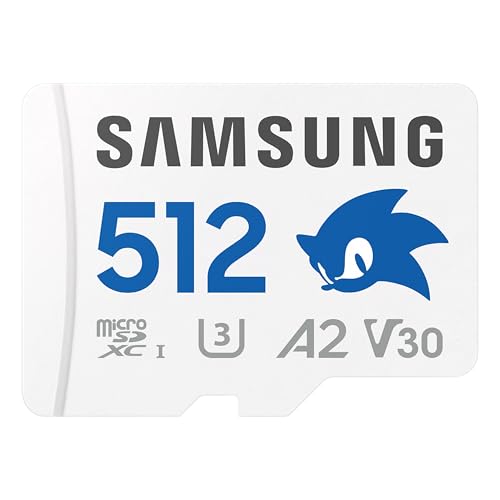
Samsung PRO Plus 512GB microSDXC — Best Samsung for action cameras
Samsung does not leave its action-camera case to inference: its verified listing for the PRO Plus at 512GB names GoPro and DJI hardware directly, alongside up to 180MB/s read and the U3, V30 and A2 certification set. That is a flagship speaking plainly — half a terabyte, capture-certified, from the maker whose NAND and controller are designed in the same house. For the shooter whose kit already leans Samsung, or whose drone and camera both appear in the card’s own positioning, the argument closes quickly.
In the field, the PRO Plus’s reputation is for steadiness: sustained behaviour that stays near its class promises as the card fills, which is precisely the trait 4K sessions audit. Against the SanDisk flagship at the same capacity it trades the recovery-software bundle and a sliver of quoted transfer pace for Samsung’s ecosystem and its own field record. Either flagship serves; the choice is the day’s price and the badge your other cards wear, and a guide that pretends otherwise is manufacturing differences the footage will never reveal.
Samsung’s card carries one more quiet advantage for the multi-device shooter: the same PRO Plus line spans the consoles and tablets in the same kit, so a household can standardise on one card family across the action camera, the drone and the handheld, learning one behaviour profile deeply. Fleets fail on surprises, and a single well-understood card across three devices is three fewer surprises waiting at altitude. That argument never appears in a specification table, and working shooters make it every season.
- Size and format: 512GB microSDXC, UHS-I, ships with adapter
- Maker’s verified figure: up to 180MB/s read
- Classes: V30 and A2 over a U3, Class 10 base
- Positioning: GoPro, DJI, consoles and tablets per its listing
- Maker: Samsung’s own NAND and controller
Strengths
- Maker explicitly positions it for GoPro and DJI duty.
- Full flagship certification set at 512GB.
- Sustained-behaviour reputation as the card fills.
Trade-offs
- No bundled recovery software in its listing.
- Quoted transfer pace a step below the SanDisk flagship.
- Themed editions circulate; confirm the exact listing.
Best for: Samsung-leaning shooters wanting flagship capacity and certification. Not suited for: buyers who value the recovery-software bundle above ecosystem.

SanDisk 256GB High Endurance microSDXC — Best endurance card with V30
This is the crossover pick, and for a certain kind of action shooting it is the smartest card in the guide. SanDisk’s High Endurance line is built for overwrite-heavy lives — its verified listing speaks of recording up to 40,000 hours of video and names dashcams and home monitoring — yet this card still carries V30, U3 and 4K UHD positioning, which almost no endurance card offers. Mounted cameras recording entire endurance events, long-distance rides documented start to finish, time-lapse rigs writing for days: these workloads burn write cycles like a dashcam while demanding capture-class sustained speed, and this is the card engineered for their intersection.
The capacity is well judged for the role — 256GB holds very long sessions at action bitrates — and the endurance construction means the card’s second year of weekly long recordings looks like its first, where a capture card’s NAND would be quietly spending itself. If your action camera’s life is measured in hours recorded rather than clips captured, buy the card whose maker measured its life the same way. For ordinary highlight-reel shooting, the capture picks above remain the right tools; this one is for the marathoners.
Event organisers have quietly become this card’s constituency: the finish-line camera that records ten hours of runners, the stage-side unit that captures a festival day entire, the training-ground camera a coach reviews in the evening. None of those jobs makes a highlight reel’s demands on peak speed, and all of them make a librarian’s demands on stamina and trust. A card rated in tens of thousands of hours, still holding a V30 certificate, is the rare specialist that asks for no apology in either direction.
- Capacity: 256GB microSDXC, UHS-I, adapter included
- Verified listing note: rated for up to 40,000 hours of recording
- Classes: U3, V30, Class 10
- Positioning: dashcam-grade endurance with 4K capture class
- Distinction: endurance NAND plus V30 in one card
Strengths
- Endurance lifespan without surrendering V30 certification.
- Built for the all-day, every-day recording pattern.
- Capacity suits very long sessions at full bitrate.
Trade-offs
- Read pace is working-grade, not flagship-grade.
- Endurance premium is wasted on occasional highlight shooting.
- Hours rating assumes its intended recording patterns.
Best for: endurance events, long mounted recordings and time-lapse rigs. Not suited for: weekend highlight shooters, who should buy capture cards.

Samsung PRO Endurance 128GB microSDXC — Best pure endurance pick
Samsung’s PRO Endurance is the specialist’s specialist: a card whose verified listing addresses dashcams, body cameras and security cameras, built around one promise — to keep recording, through overwrite after overwrite, for years. Brought into an action-camera guide, its honest role is the long-session fringe: the camera mounted for a full day of loop recording on a boat or a bike, the event time-lapse that writes modest bitrates for a weekend, the second camera whose job is coverage rather than hero footage. In those roles lifespan is the specification, and this card’s endurance engineering outlasts capture cards several times over.
The honesty paragraph matters here: its listed classes — Class 10, U1, V10 — are not 4K action specifications, and asking this card to absorb a flagship camera’s top bitrates is the mismatch this guide exists to prevent. Buy it for the duties its maker built it for and it is arguably the most durable card in this entire roundup; buy it as a cheap substitute for a V30 capture card and it will fail a job it never applied for. Specialists reward correct use — this is the guide’s clearest example.
Its presence in an action-camera guide also performs a public service: it gives the coverage-camera buyer a destination that is not a capture card’s leftovers. Too many all-day recordings are entrusted to whatever card was spare, and the failure arrives on the one day the coverage mattered — the incident, the finish, the moment the camera existed for. A dedicated endurance card, bought on purpose for the mounted camera and left there, converts that gamble into a maintenance schedule. That conversion is worth more than any speed figure in this guide.
- Capacity: 128GB microSDXC, adapter included
- Verified listing positioning: dash cam, body cam, security camera
- Classes: Class 10, U1, V10
- Positioning: maximum overwrite lifespan
- Distinction: Samsung’s dedicated endurance line
Strengths
- Endurance engineering that outlasts capture cards under looping.
- From Samsung’s top tier of flash manufacturing.
- Ideal for coverage cameras and long moderate-bitrate sessions.
Trade-offs
- Speed classes do not cover flagship 4K bitrates.
- Its talents are invisible in ordinary highlight shooting.
- 128GB is modest for top-bitrate hero-camera duty.
Best for: loop recording, coverage cameras and long moderate-bitrate mounted sessions. Not suited for: primary 4K action capture, where the V30 picks are mandatory.
Do GoPro, DJI and Insta360 Ask for Anything Different?
Remarkably little, which is itself the headline. The three ecosystems converge on microSD, on V30 as the working floor, and on the same short list of trusted makers — because the physics of sustained writing does not care whose logo is on the camera. A card that serves a GoPro at its highest modes serves a DJI or an Insta360 with the same indifference, and owners who run mixed fleets — a common pattern, since each maker leads in some niche — can standardise on one card family across all three without compromise.
The differences that do exist live at the edges. Each maker’s flagship modes push bitrates differently, so a card comfortably inside one camera’s ceiling may sit nearer another’s; the makers’ published lists, model by model, are the authority for those edges. The 360-degree cameras add a wrinkle of their own: they write two sensors’ streams simultaneously, which makes sustained behaviour doubly non-negotiable and turns the V30 floor from advice into architecture. And every ecosystem shares the same formatting liturgy — in the camera, before the session, without exception.
For the buyer, the convergence is a gift: it collapses three shopping problems into one, lets a spare serve every device in the bag, and means the six cards in this guide are a fleet answer rather than a per-camera negotiation. Buy the class, size by the trip, and let the cameras argue about everything else.
Standardisation pays one more dividend at replacement time: when a card in a standardised fleet retires, its replacement is a known purchase from a known listing, not a fresh research project conducted in a hurry. Fleets built on one family age gracefully because every decision about them was made once, calmly, and simply repeated. In expedition terms, that is the difference between logistics and improvisation — and cameras, like expeditions, punish improvisation precisely where the footage matters most.
How Much Capacity Does an Action Camera Day Actually Need?
Capacity planning for action cameras is bitrate planning wearing a disguise. At the moderate 4K settings most owners actually use, a 128GB card holds a generous day — several hours of footage across sessions, with room for the stills and time-lapses that share the card. Push the camera into its highest-bitrate modes, high frame rates or 5K-class recording, and the same card’s day shrinks dramatically, which is why the camera’s own remaining-time estimate, read with your settings chosen, is the only honest calculator in this conversation.
The working patterns sort themselves into three camps. Day shooters who offload nightly live happily at 128GB and gain the discipline dividend — the nightly copy is also the nightly backup. Weekend and expedition shooters, away from reliable power and ports, are the 512GB flagships’ natural constituency. And the all-day recorders — events, journeys, mounted coverage — plan in hours rather than highlights, which is the endurance pair’s arithmetic: enough capacity for the session, enough lifespan for the season.
Whatever the camp, leave the card its breathing room: a card run to the final megabyte mid-session is a card whose controller had no space to work in, and the last clip of the day is rarely the one to gamble. Treat ninety percent as full, and the capacity you planned is the capacity you will experience.
A note on the camera’s own arithmetic: the remaining-time estimate it displays assumes your current mode, and switching to a higher bitrate mid-day rewrites the estimate without ceremony. Expedition shooters learn to check the figure after changing modes, not before — the card did not shrink, but the day’s appetite grew, and the time to discover that is at the mode change, not at the summit.
How Do the Six Action Camera Cards Compare?
| Card | Capacity | Class highlights | Natural home |
|---|---|---|---|
| SanDisk Extreme | 128GB | V30, A2, up to 90MB/s write | The default day of 4K shooting |
| Kingston Canvas Go Plus | 128GB | V30, A2, up to 200MB/s read | Nightly offload speed on trips |
| SanDisk Extreme Pro | 512GB | V30, A2, recovery software | No-swap expedition days |
| Samsung PRO Plus | 512GB | V30, A2 | Samsung-leaning flagship kits |
| SanDisk High Endurance | 256GB | V30 plus endurance rating | All-day recording at full quality |
| Samsung PRO Endurance | 128GB | Endurance-first, V10 | Loop and coverage recording |
Four capture cards, two endurance cards, and one honest dividing line: bitrate versus lifespan. If your camera records highlights, any of the V30 four serves, separated by capacity and offload pace. If your camera records everything, the endurance pair is the guide’s real content — and choosing between them is choosing whether full 4K class must survive the marathon (SanDisk) or whether lifespan alone rules (Samsung).
One more reading of the table: the two 128GB capture cards and the two 512GB flagships are not rivals but seasons — the same shooter may own both, choosing by the trip. Guides are forced to rank; owners are free to portfolio. The wisest sentence in this entire comparison may be that the correct answer to “which one?” is sometimes “one of each size, bought once, used for years.”
How Do You Care for Cards That Live in Action Cameras?
Format in the camera, every time a card changes role or returns from the computer. Action cameras lay out their file systems precisely, and in-camera formatting is the simplest protection against directory quirks and mid-session errors. Before any important session, record a test clip at your highest mode and play it back in the camera; a card that hesitates in the driveway will not improve on the mountain. Keep contacts clean and dry, store spares in their cases rather than loose in a bag’s grit, and retire any card that produces a recording error — not after the third error, after the first unexplained one.
Retirement has a graceful form at this tier: the demoted card’s second life. A capture card retired from hero duty still serves in a coverage camera, a trail camera or a media player, where its remaining life is spent at a pensioner’s pace — provided its error was age rather than damage, and provided nothing irreplaceable rides on it again. Label the demotion on the card itself. The sin is not reusing an old card; it is reusing one anonymously, at full stakes, by accident.
Build the offload ritual into the day: copy everything off nightly, verify the copies open, keep two copies of anything irreplaceable before the card is formatted for tomorrow, and rotate two matched cards so no single card carries a whole trip. Heat deserves respect too — a camera baking on a dashboard between sessions is ageing its card as surely as it is ageing its battery, so shade the kit when it is parked. None of this is glamorous, and all of it is the difference between shooters who lose footage and shooters who tell stories about other shooters losing footage.
Card rotation completes the care picture: two matched cards, alternated by day, halve each card’s write load and guarantee that a formatted, tested spare is always in the case rather than in a drawer at home. Mark them plainly — a paint-pen numeral is enough — and let the rotation be the rhythm that triggers the offload. Systems beat intentions in the field, and a two-card rotation is the smallest system that covers failure, fullness and forgetfulness in one habit.
The rotation also solves the oldest labelling problem in the field: which card is empty. A two-card system with a case that holds one slot marked for fresh media and one for full turns the question into a glance. Shooters lose more footage to organisational confusion — the formatted card that was not, in fact, copied — than to any electronic failure, and the humble labelled case is the highest-return accessory in this entire guide.
What About Cold, Heat, Water and Vibration?
Action cameras work where other electronics retire, and their cards share the posting. The makers of the lines in this guide publish the familiar litany of resistances for these cards — water, temperature extremes, shock, X-rays — and the claims are broadly trustworthy as far as they go: the card itself is a sealed sliver of silicon with no moving parts, tougher than the camera around it in most accidents. The honest caveat is that survival and performance are different promises. A card can survive a freezing night on a summit and still write reluctantly until it warms, because cold thickens every electronic process in the chain.
Fieldcraft closes the gap between the claims and the conditions. Keep the working card in the camera, where the device’s own warmth shelters it, and the spares in an inside pocket rather than an outer bag in winter. In heat, shade the kit between sessions and never leave cards on a dashboard — a parked car’s interior is the harshest consumer-electronics environment on earth, and it ages cards and batteries alike. After water sessions, dry the card’s contacts before it meets a reader; the card may be waterproof, but the reader is not, and corrosion is a team sport.
Vibration deserves its own sentence, because it is the action camera’s native weather: a card’s contacts are a pressure fit, and a loose slot on a vibrating mount can produce the intermittent error that ruins a session without damaging anything. Seat cards firmly, prefer cameras whose slot doors latch positively, and treat a vibration-correlated error as a fit problem to solve mechanically before condemning the card. The environment is the exam; these habits are how a good card passes it.
What Do the Camera Makers’ Own Recommended Lists Tell Us?
Every major action-camera maker publishes a list of recommended or tested cards, and the lists are worth reading as literature: they are short, they are brand-conservative, and they are unanimous about class. The same flagship families recur — the Extreme name appears so often it reads as a refrain — because the makers test what their support departments can stand behind, and a card that generates recording-failure tickets does not stay listed. Inclusion on those lists is the closest thing this industry has to a peer-reviewed result.
The lists also teach by omission. No maker recommends an unrated card, a no-name card, or a card whose only credential is a peak read figure — and the absence is the lesson for buyers tempted by marketplace superlatives. When the company that built your camera, and fields its warranty claims, will not put its name beside a class of card, the discount on that class of card is not a bargain; it is the market pricing a risk the maker has already measured.
Use the lists as a floor, not a ceiling: this guide’s six all sit comfortably within the makers’ philosophy, and the endurance pair extends it to a duty the headline lists under-serve. But if a card you are considering appears on no maker’s list and carries no V30 mark, the conversation is over before it starts — whatever its price, and whatever its packaging promises.
There is a corollary for the second-hand and bundled markets: cards included free with a camera purchase inherit none of the maker’s list’s authority, whatever the bundle’s artwork implies. Judge the included card by its own markings, keep it as the spare if it falls short of V30, and let the camera’s first real session ride on a card that earned its place rather than one that arrived by adjacency.
What Mistakes Do Action Camera Owners Keep Making?
The expensive classic is the uncertified bargain card: fine in the shop’s demo, corrupt at the summit, because sustained writes are where unrated cards go to die. The second is capacity complacency — assuming last year’s 64GB habits survive this year’s high-bitrate modes, and watching the card fill during the session that mattered. The third is the opposite error, buying one enormous card and treating it as a trip archive, one drop or failure away from losing everything at once.
The quieter mistakes are procedural: formatting on the computer and fighting the camera’s complaints, ignoring the first recording error a card reports, leaving footage un-backed-up on a card that returns to the camera the next morning, and running an endurance workload on a capture card — or a capture workload on an endurance card — because the guide that sold them never explained the difference. Match class to camera, endurance to duty cycle, and back up like the footage matters, because it was the whole point of the day.
The final mistake is a purchase-order error: buying the card on the trip, from the shop at the trailhead, at the moment of maximum urgency and minimum choice. That shop’s shelf holds what it holds, priced as urgency is priced, and the buyer’s careful research evaporates at the till. Every card in this guide should be bought the calm way — online or in a real store, tested at home, already in the case when the trip begins. Preparation is the cheapest accessory in action photography, and it is sold nowhere at the trailhead.
Final Recommendation
For most action cameras the answer is the SanDisk Extreme at 128GB — certified, proven and sized for a day — with the Kingston Go Plus as its equal-footing alternative when price or offload pace argues for it. Step up to the 512GB flagships, SanDisk’s Pro or Samsung’s PRO Plus, when your days forbid swapping, and step sideways to the endurance pair when your camera records everything rather than highlights. The mountain, the wave and the race will not wait for a second take — buy the card that treats your one take with the seriousness it deserves.
Buy the card before the trip, test it the week it arrives, and let its first full session be a rehearsal rather than the performance — a card that has already held a day of your footage and returned it intact has earned the mountain. That small ceremony, repeated across the six honest options in this guide, is the entire difference between storage as a gamble and storage as a foundation.
Frequently Asked Questions
What happens if I use a card without V30 in a 4K action camera?
The camera may refuse high modes, record with dropped frames, or stop clips mid-session when the card’s sustained write dips under the recording bitrate. Some footage survives; the important seconds are statistically the ones that do not. V30 exists to remove that gamble.
How much 4K footage fits on 128GB?
It depends entirely on the camera’s bitrate for the mode you choose — high-bitrate modes can consume several gigabytes every few minutes, while standard modes stretch the same card across hours. Check your camera’s recording-time estimate with the card inserted; it is the only figure that knows your settings.
Are endurance cards good for action cameras?
For the right action work, yes: loop recording, all-day mounted sessions and time-lapse reward lifespan over peak speed. For primary 4K capture, only the endurance card that also carries V30 — the SanDisk High Endurance here — qualifies; pure endurance cards with V10 classes are coverage tools, not hero cameras’ media.
Should I format the card in the camera or the computer?
In the camera. Action cameras format to their own expectations, and in-camera formatting prevents the directory and file-system quirks that computer formatting can introduce. Offload and back up first — formatting erases the card completely.
Why did my camera stop recording mid-session?
The usual suspects are a card whose sustained write cannot hold the mode’s bitrate, a nearly full card whose housekeeping slows it further, or heat. Test a certified V30 card at the same settings; if the problem vanishes, the original card has told you what it is.
How many cards should I carry?
Two matched cards is the working minimum for anything you cannot reshoot: one in the camera, one ready, with nightly offloads keeping both in rotation. Capacity per card follows your day length and bitrate; the spare is not optional equipment, it is the plan.
Can I use the same card in my drone and my action camera?
Yes — the capture picks here serve both, and the makers position them for both. Format the card in whichever device will use it next, offload before swapping, and remember that a card carrying one device’s footage should never be formatted by the other in a moment of haste.
Why does my camera warn about a slow card at high settings?
Because at those settings the recording bitrate approaches or exceeds what the card can sustain, and the camera is protecting your footage by refusing to gamble. Believe the warning: it is the V30 conversation happening inside the device, and the remedy is a certified card from this guide’s capture four.
How long do action camera cards last?
In capture duty, years — the write volumes of even keen shooters are modest against a quality card’s endurance, and most cards are retired with a camera rather than worn out by one. Overwrite-heavy mounted recording is the exception, which is what the endurance picks exist for. Any card, in any duty, retires at its first unexplained error.
Is it safe to delete clips in the camera to make room?
It works, but it is poor practice on a working card: deleting fragments the card’s free space and invites the housekeeping slowdowns that matter at high bitrates. Offload and format instead — the session you save will be your own, usually the one right after the deletion spree.
Should I buy cards in multi-packs?
Matched pairs from reputable sellers are the professional pattern and often the economical one. Apply the same authenticity discipline as to any purchase, test each card on arrival, and treat a multi-pack price that undercuts every single-card listing as the warning it is.
Related Guides
Complete the kit with best 512GB micro SD cards for drones and cameras, best high endurance cards for dashcams and best 1TB micro SD cards for maximum capacity.


