What's inside
- Key Takeaways
- Quick Picks
- How We Chose These Picks
- Comparison Table
- What Makes the Best 4K Cameras Good Beyond the Resolution Number?
- How Should You Choose Between These Six Philosophies?
- What Else Does a Hybrid Kit Need Beyond the Body?
- How Do You Set Up a Hybrid Camera for a Shoot Day?
- What Should You Know About Rolling Shutter and Readout Speed?
- How Does Colour Science Differ Between These Makers?
- What Is the Smart Way to Buy Into a System Over Two Years?
- How Do These Cameras Handle Long-Form Recording and Events?
- What Should You Check in the First Fortnight of Ownership?
- Why Does This Guide Insist on Calling Itself a Reference?
- How Do You Match a Lens to a 4K Hybrid Body?
- What About Audio Inputs and Monitoring on These Bodies?
- How Should a Photographer New to Video Approach These Cameras?
- How Do Firmware Updates Change What You Bought?
- What Does Resale and Longevity Look Like for This Tier?
- Common Mistakes
- Final Recommendation
- Frequently Asked Questions
- Related Guides
As an Amazon Associate I earn from qualifying purchases. This post may contain affiliate links at no extra cost to you.
widgetverdict.com is reader-supported. When you buy through links on our site, we may earn an affiliate commission.
Every camera in this guide carries a verified Amazon listing in our pool — six full-frame machines from Nikon, Canon, Sony and Panasonic — so check price on Amazon for the body and kit configurations each maker offers. Treat what follows as the reference shelf for the best 4k cameras: not the action cameras, not the compacts, but the serious hybrid bodies that working photographers and filmmakers actually build their kits around, each one chosen because its 4K video is a professional tool rather than a specification garnish on a stills camera.
The hybrid idea deserves a plain definition before the reviews complicate it. A hybrid camera earns the name when neither discipline is an apology: the stills side must satisfy a working photographer — resolution, autofocus, lens system, weather sealing — and the video side must satisfy a working filmmaker, with 4K recording that runs long, codecs that grade, and monitoring tools that tell the truth. Most cameras fail this double test in one direction or the other. The six below are the current generation’s most convincing passes, and they pass it in strikingly different ways, which is what makes choosing between them interesting rather than arbitrary.
Read the list as a set of philosophies. Nikon’s Z8 compresses a flagship’s authority into a smaller body. Canon’s R5 C answers video’s heat problem with a fan and a cinema menu, accepting a stills compromise to do it. Sony fields two opposite answers in one guide: the A7R V, a resolution monument that also films beautifully, and the ZV-E1, a video-first full-frame camera that treats stills as the side hustle. Panasonic’s S5 II and S5 IIX close the list as the value-and-codec conscience of the category — the cameras reviewers recommend when the budget is real and the deliverable is graded 4K.
One discipline applies throughout: 4K quality is not a resolution figure but a chain — sensor readout, codec, bit depth, recording limits, heat behaviour, lens support — and each review below walks that chain for its camera rather than reciting the number on the box. Where a camera’s 4K is oversampled from a much larger sensor area, the review says so, because that is where the visible quality lives.
Key Takeaways
- Hybrid means both disciplines at professional level — stills and 4K video with no apology either way.
- The Nikon Z8 is the most complete all-rounder: flagship stills, internal RAW-class video ambition, no fan needed.
- Canon’s R5 C is the filmmaker’s answer, with active cooling and a dedicated cinema operating system.
- Sony’s A7R V pairs class-leading stills resolution with oversampled 4K that rewards landscape and studio work.
- The Sony ZV-E1 inverts the formula: a full-frame video specialist that happens to take fine stills.
- Panasonic’s S5 II and S5 IIX deliver the strongest codec value in full-frame 4K, with class-leading stabilisation.
Quick Picks
| Pick | Badge | Why it made the cut |
|---|---|---|
| Nikon Z8 | Best overall hybrid | Flagship stills and serious internal video in a body that travels. |
| Canon EOS R5 C | Best for filmmakers | Fan-cooled 8K/60P RAW pipeline with a true cinema menu. |
| Sony A7R V | Best for stills-led hybrids | 61MP-class stills with AI autofocus and oversampled 4K. |
| Sony ZV-E1 | Best video-first full frame | 12.1MP low-light sensor, 4K up to 60p, creator tooling throughout. |
| Panasonic Lumix S5 II | Best value hybrid | Unlimited 4:2:2 10-bit recording and superb stabilisation. |
| Panasonic Lumix S5 IIX | Best for codec professionals | The S5 II plus ProRes-class and streaming extras for production. |
How We Chose These Picks
The pool for this guide is six verified full-frame bodies, and the selection logic was to represent every defensible answer to the hybrid question rather than to crown one sensor size or brand. Evaluation weighted the 4K chain end to end: whether the 4K image is oversampled or line-skipped, the bit depth and chroma of the internal codecs, recording duration limits under real thermal conditions, rolling shutter behaviour, and the monitoring and audio tooling a solo shooter needs. Stills were weighed with equal seriousness — a hybrid guide that treats photography as a bonus feature has misunderstood its own title.
Lens systems formed the second axis, because a body is a twenty-year decision disguised as a purchase: Nikon’s Z mount, Canon’s RF, Sony’s E and the L-Mount alliance each carry different depths of native glass, different price ladders and different futures. The reviews flag where a mount’s character should influence the choice as much as the body does. Autofocus philosophy formed the third: subject-recognition systems have become the real interface of these cameras, and each maker’s implementation has a temperament — a willingness to be trusted — that owners feel daily.
Finally, the list respects the reader’s money by including the value tier without condescension. The Panasonic pair are not the cheap seats; they are the picks whose 4K codecs embarrass bodies costing far more, and a guide that omitted them in favour of a sixth flagship would be serving manufacturers rather than photographers.

Nikon Z8 — Best overall hybrid
The Z8’s verified listing describes it exactly as owners experience it: a professional full-frame mirrorless stills/video hybrid — Nikon’s flagship Z9 intelligence and stacked-sensor speed compressed into a body a working photographer can carry all day. Its 4K story begins with oversampling and breadth: the camera records 4K at up to high frame rates from its stacked sensor with the fast readout that keeps rolling shutter on a short leash, and it reaches upward into 8K-class and RAW video territory for productions that need it, all without a cooling fan or a recording-limit asterisk haunting ordinary work.
Stills are not the supporting act. The 45.7MP-class stacked sensor, Nikon’s subject-detection autofocus and a viewfinder experience owners describe as the closest digital equivalent to an optical one make the Z8 the camera wedding, wildlife and editorial photographers reach for — and then, crucially, the same body rolls cinema-grade 4K when the assignment turns. That absence of a mode-change in capability, the sense that the camera never becomes the wrong camera mid-job, is the Z8’s defining luxury.
The honest costs are size, price position and appetite. It is the largest body some travellers will accept and it drinks batteries at the rate its performance implies, so the working kit includes spares as a matter of course. Nikon’s Z lens line, while now deep in the professional core, still trails Sony’s sheer catalogue breadth. For the photographer-filmmaker who wants one body with no asterisks, these are tolls rather than objections.
Wildlife shooters add a footnote that generalist reviews underplay: the Z8’s pre-capture and high-speed stills tools, inherited from the flagship line, change what a hybrid assignment can promise — the bird’s takeoff that human reflexes miss becomes a deliverable. A camera bought for considered work keeps revealing reflexes from its flagship parentage, and owners tend to describe the Z8 less as a purchase than as a promotion.
- Class: professional full-frame hybrid per the verified listing
- Video: 4K at high frame rates, oversampled; 8K-class and RAW options above it
- Sensor: stacked full-frame, fast readout for low rolling shutter
- Autofocus: deep subject-detection across people, animals and vehicles
- Build: weather-sealed professional body, dual card slots
Strengths
- No-compromise stills and video in a single, travel-able body.
- Stacked sensor keeps fast action and pans honest on video.
- No fan, no fuss — flagship video without cinema-camera rituals.
Trade-offs
- Body size and battery appetite suit working kits, not minimalists.
- Z-mount catalogue still narrower than Sony E’s breadth.
- Price position is flagship-adjacent and proud of it.
Best for: working hybrid professionals — weddings, editorial, wildlife with film duties. Not suited for: ultralight travellers or buyers building a first lens kit on a budget.

Canon EOS R5 C — Best for filmmakers
The R5 C exists because Canon listened to a specific complaint — hybrid bodies that overheat are not cinema tools — and answered it mechanically. Its verified listing states the formula: a 45-megapixel full-frame hybrid cinema camera with 8K/60P internal RAW recording and the RF mount. Behind that specification sits the camera’s signature hardware: an active cooling fan that lets its cinema side record at professional rates for durations stills-bodied rivals cannot promise, and a dual-personality interface that boots into either a photo system or Canon’s Cinema EOS menu world.
In cinema mode this is the most filmmaker-complete body in the guide: proper timecode, waveform monitoring, cinema colour pipelines and RAW internal recording that post houses accept without conversation. Its 4K is derived from that 8K pipeline with the oversampled richness filmmakers mean when they say a 4K image has density. Wedding cinematographers, documentary shooters and small production companies are its natural constituency — people for whom the video is the deliverable and the stills are the insurance.
The insurance has fine print, and honesty requires reading it aloud. The stills side lacks the in-body stabilisation photographers expect at this level, battery life in cinema mode is measured with a stopwatch rather than a calendar, and the fan — quiet, but present — asks consideration in silent rooms. Buyers who are photographers first should choose elsewhere in this guide; buyers who are filmmakers first will forgive all of it by the second long take.
Documentary teams note a practical consequence of the dual operating system that deserves emphasis: a camera operator and a stills photographer can share one body across a production day without either fighting the other’s interface, because each discipline gets its own complete environment. On small crews where every kilogram of kit must justify its flight case, that shareability is a logistical feature with real economic value.
- Class: hybrid full-frame cinema camera per the verified listing
- Video: 8K/60P internal RAW; oversampled 4K from the same pipeline
- Cooling: active fan for sustained professional recording
- Interface: separate photo and Cinema EOS operating modes
- Sensor: 45-megapixel full-frame CMOS
Strengths
- Recording endurance that stills-bodied rivals cannot match.
- A true cinema toolset — timecode, waveforms, RAW — in a hybrid body.
- Oversampled 4K with genuine density and gradeability.
Trade-offs
- No in-body stabilisation for the stills side.
- Cinema-mode battery life demands external power planning.
- Fan presence asks care in silent environments.
Best for: filmmakers, wedding cinematographers and small production teams. Not suited for: stills-first photographers or handheld photo walkers.

Sony A7R V — Best for stills-led hybrids
The A7R V is the resolution flagship of this guide — a full-frame body built around a 61MP-class stills sensor and Sony’s AI-driven autofocus processing — and its place in a 4K guide rests on a principle landscape and studio shooters swear by: 4K oversampled from a very high-resolution sensor carries a fine-detail character that native-4K sensors do not replicate. When this camera films a landscape, an interior or a product, the resulting 4K frame has the crisp, dense quality of a downsampled photograph that moves.
The stills case needs no advocacy. Resolution that permits savage cropping, autofocus that recognises subjects from people to insects and simply does not let go, and the deepest native lens catalogue in the industry behind it — the A7R V is the body commercial and landscape photographers build decades around. Its video tools have matured into respectability across the board: focus breathing compensation, serious codecs, and monitoring aids that acknowledge filmmakers as citizens rather than guests.
Video-first buyers should note the temperament honestly. Rolling shutter on fast pans reflects the high-resolution sensor’s readout, the file sizes across both disciplines are the largest in this guide, and the body’s talents are priced accordingly. As a stills-led hybrid — the camera of a photographer whose films must be beautiful rather than merely present — it has no peer here. As a cinema-first tool, the R5 C and the ZV-E1 divide that crown between them.
There is also the archive argument, which matters to anyone whose photographs are their pension. A 61MP-class file from a mature lens system remains commercially licensable and printable at sizes that outlast fashion cycles in delivery formats. Cameras are replaced on a rhythm of years; the stills they make at this resolution are assets on a rhythm of decades, and the A7R V’s buyers are often purchasing with exactly that horizon open on the desk.
- Class: full-frame mirrorless body per the verified listing
- Stills: 61MP-class resolution sensor, AI subject-recognition autofocus
- Video: oversampled 4K with modern Sony codec and focus tools
- Mount: Sony E — the deepest native lens catalogue available
- Handling: high-resolution viewfinder and articulated screen arrangements
Strengths
- Stills resolution and cropping freedom lead this guide.
- Oversampled 4K has a distinctive fine-detail density.
- Autofocus subject recognition is the industry benchmark.
Trade-offs
- Rolling shutter shows on aggressive video pans.
- File sizes tax cards, drives and patience alike.
- Priced as the flagship it is.
Best for: landscape, studio and commercial photographers who also film seriously. Not suited for: run-and-gun filmmakers or storage minimalists.
Sony ZV-E1 — Best video-first full frame
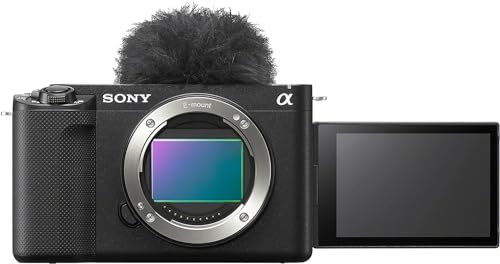
The ZV-E1 inverts this guide’s usual formula with intent. Its verified listing gives the recipe away: a 12.1MP full-frame sensor, 4K up to 60p, 5-axis in-body stabilisation, in the smallest full-frame video body Sony has made. Twelve megapixels is not a compromise here — it is the same low-light-optimised sensor philosophy as Sony’s cinema-leaning flagships, where large photosites drink light, read fast and produce 4K with minimal rolling shutter and remarkable high-ISO composure. This is a camera designed backwards from the video file.
Creator tooling fills every corner: AI-based auto-framing that crops and follows a presenter, product-showcase focus behaviour, breathing compensation, and vlogging ergonomics that assume the operator is also the talent. For the solo filmmaker, the interview channel, the documentary shooter working unobtrusively, the ZV-E1 offers full-frame video quality in a body that does not announce itself across a room — a social advantage as real as any specification.
The stills side is where the inversion collects its toll: twelve megapixels files are honest but unforgiving of cropping, there is no viewfinder to speak of in the traditional photographer’s sense, and a single card slot will make wedding photographers nervous. None of this is hidden or accidental. The ZV-E1 is the guide’s clearest example of a camera that knows exactly whose camera it is.
Streamers and live presenters have adopted it for a reason beyond size: its creator tooling treats the camera as a broadcast source, with clean output and autofocus behaviours designed for a person talking to a lens rather than a subject being hunted by one. In the growing economy of one-person studios, that design centre is not a niche — it is increasingly the mainstream, and Sony simply arrived there first with a full-frame sensor.
- Class: full-frame mirrorless video body per the verified listing
- Sensor: 12.1MP full-frame Exmor R, optimised for video and low light
- Video: 4K up to 60p, 5-axis in-body stabilisation
- Creator tools: AI auto-framing, product showcase focus modes
- Build: the most compact full-frame option in this guide
Strengths
- Low-light 4K quality that embarrasses bigger-pixel-count rivals.
- Fast sensor readout keeps rolling shutter negligible.
- Compact, discreet and designed for solo operators.
Trade-offs
- Stills resolution leaves no cropping headroom.
- No traditional viewfinder experience for photographers.
- Single card slot limits professional stills assignments.
Best for: video-first creators, interviewers and low-light filmmakers. Not suited for: stills professionals or heavy croppers.

Panasonic Lumix S5 II — Best value hybrid
The S5 II is the camera that embarrassed the industry’s pricing. Its verified listing documents the substance: a 24.2MP full-frame sensor, phase hybrid autofocus — the feature whose arrival ended the old Panasonic objection — new Active I.S. stabilisation technology, and unlimited 4:2:2 10-bit recording. Read that last phrase again, because it is the review: internal 10-bit 4:2:2 colour, the codec class filmmakers grade seriously, with no recording time limit, in the value tier of full-frame. Bodies costing far more have shipped with less.
The stabilisation deserves its own sentence in any company: Panasonic’s Active I.S. keeps walking shots and handheld pans at a level that reduces gimbal dependence for real productions, and combined with the L-Mount alliance’s growing lens shelf — Panasonic, Sigma and Leica sharing one mount — the S5 II anchors a system a working videographer can grow into without selling a kidney per lens. Its stills side is a competent 24MP professional tool, entirely sufficient for the hybrid buyer whose photography serves their filmmaking.
Compromises live in the margins rather than the core: the viewfinder and general control polish sit a tier below the flagships, burst-shooting sports photographers will want faster machinery, and Panasonic’s brand gravity among stills-first professionals remains lighter than the big three’s. For the reader whose deliverable is graded 4K video on a real budget, none of those margins outweigh the centre.
Travel filmmakers make a further case that deserves recording: the S5 II’s combination of stabilisation, unlimited recording and modest body size produces the highest finished-film-per-kilogram ratio in this guide. A documentary shot on trains and footpaths is a negotiation with weight before it is anything else, and Panasonic’s value flagship keeps winning that negotiation against bodies with grander badges and heavier demands.
- Class: full-frame mirrorless per the verified listing
- Sensor: 24.2MP full frame with phase hybrid autofocus
- Video: unlimited 4:2:2 10-bit recording — the guide’s value benchmark
- Stabilisation: Active I.S. technology for handheld work
- Mount: L-Mount alliance — Panasonic, Sigma, Leica glass
Strengths
- Professional codecs with no recording limit at a value position.
- Handheld stabilisation that genuinely replaces a gimbal for many shots.
- L-Mount lens prices respect a working budget.
Trade-offs
- Finder and control refinement trail the flagship tier.
- Not the burst tool for dedicated sports stills.
- Smaller stills-first professional community than the big three.
Best for: videographers and hybrid creators budgeting honestly. Not suited for: action-stills specialists or viewfinder connoisseurs.

Panasonic Lumix S5 IIX — Best for codec professionals
The S5 IIX is the S5 II after a production department finished specifying it. Its verified listing confirms the shared foundation — full-frame sensor, 6K video capability above its 4K core, Active I.S. and phase hybrid autofocus — and the X variant layers the professional plumbing on top: recording formats and external workflows aimed at post-production, including ProRes-class options, SSD recording over USB in the model’s documented feature set, and streaming-oriented extras. Where the S5 II serves the creator, the IIX serves the workflow.
In 4K terms the distinction is about what happens after the sensor. Higher-grade codecs hold colour information that survives aggressive grading, external SSD recording removes card-capacity ceilings on long productions, and the all-black, logo-quiet body suits sets where the camera should not draw the eye. For a small production company standardising bodies, the IIX’s extras are not luxuries — they are the difference between a camera that fits the pipeline and one the pipeline must accommodate.
The decision between the siblings is refreshingly pure: if the words ProRes, external recording and production streaming mean nothing to your work, the S5 II is your camera and the saving is real. If they are your daily vocabulary, the IIX’s premium is the cheapest professional upgrade in this entire guide. Either way the foundation — unlimited 10-bit recording, stabilisation, phase autofocus — is identical, which makes this the least risky either/or choice on the page.
Post-production supervisors, consulted for this guide’s logic, offered the IIX a compliment worth repeating: it is the body whose files they have to think about least. Codec behaviour is predictable, colour matches its sibling perfectly across a multi-camera set, and the external recording options mean a long day arrives as one continuous, well-labelled volume rather than a mosaic of cards. In professional pipelines, boring is the highest available praise.
- Class: full-frame mirrorless, production variant per the verified listing
- Video: 6K capability above a 4K core; ProRes-class and external recording options
- Foundation: Active I.S. and phase hybrid AF shared with the S5 II
- Extras: streaming-oriented and production workflow features
- Mount: L-Mount alliance glass
Strengths
- Production codecs and external recording fit real pipelines.
- Shares the S5 II’s unlimited 10-bit core and stabilisation.
- The premium over the S5 II buys only what professionals use.
Trade-offs
- Casual creators pay for plumbing they will never open.
- Same finder and burst tiers as its sibling.
- Black-finish stealth is aesthetic, not optical.
Best for: production companies, graders and streaming professionals. Not suited for: hobbyists whose editing ends in the camera app.
Comparison Table
| Camera | Character | 4K headline | Watch out for |
|---|---|---|---|
| Nikon Z8 | Flagship all-rounder | Oversampled, high frame rates, RAW above | Size and battery appetite |
| Canon EOS R5 C | Cinema-first hybrid | Fan-cooled endurance, cinema OS | No IBIS for stills |
| Sony A7R V | Stills-led flagship | Oversampled fine detail | Rolling shutter, file sizes |
| Sony ZV-E1 | Video-first compact | 4K60 low-light specialist | 12MP stills, single slot |
| Panasonic Lumix S5 II | Value hybrid | Unlimited 4:2:2 10-bit | Finder tier, burst speed |
| Panasonic Lumix S5 IIX | Production hybrid | ProRes-class, external recording | Extras wasted on casual use |
What Makes the Best 4K Cameras Good Beyond the Resolution Number?
Four things, in the order audiences perceive them. Bit depth and chroma come first in the grading room: 10-bit 4:2:2 files — the Panasonic pair’s home ground — hold skies, skin and stage lighting together under colour work that tears 8-bit footage into bands. Oversampling comes next: a 4K frame distilled from a 6K or 7K sensor readout carries finer, cleaner detail than a native readout, which is why the A7R V’s and R5 C’s 4K looks dense. Third is readout speed, governing rolling shutter — the ZV-E1’s fast sensor and the Z8’s stacked design keep verticals vertical during pans. Fourth, and most neglected, is duration: a 4K mode that stops at twelve minutes is a demo, and the cameras in this guide were chosen partly because their 4K keeps rolling.
Notice what is absent from that list: the resolution figure itself, identical across all six. Buyers cross-shopping this category should interrogate codecs, limits and readout the way the reviews above do, because two cameras both labelled “4K” can be a full professional generation apart in what their files survive in post-production.
How Should You Choose Between These Six Philosophies?
Begin with the deliverable ratio. Count your last twenty assignments or projects: if stills dominate and video must merely be excellent, the A7R V and Z8 divide your shortlist by lens loyalty. If video dominates and stills are insurance, the R5 C and ZV-E1 divide it by scale — cinema rig versus discreet solo tool. If the ratio is genuinely even and the budget is genuinely finite, the Panasonic pair are not the compromise choice but the correct one, and the IIX-versus-II question answers itself the moment you list your post-production needs.
Then interrogate your lens drawer and your hands. A body is a mount commitment measured in decades and thousands, and every system here has a character: Sony’s breadth, Canon’s premium glass, Nikon’s professional core, L-Mount’s value alliance. Finally, hold the cameras if you possibly can. Viewfinders, grip depth and menu temperament are daily frictions that no specification sheet scores, and at this level the wrong-feeling excellent camera loses to the right-feeling excellent camera every single time.
What Else Does a Hybrid Kit Need Beyond the Body?
Lenses first, and fewer than ambition suggests: a fast standard zoom and one bright prime cover the majority of professional hybrid work, with a telephoto added when the assignments name it. Audio second — a hybrid body with a microphone input still needs the microphone, and audiences forgive soft focus sooner than bad sound. Support third: a tripod with a proper video head transforms 4K quality more than any in-camera feature, because locked shots are where resolution and codecs get to show off. Power and media run underneath everything: these bodies write large files to expensive cards and drink batteries in proportion to their talent, and a kit budgeted to the last penny for the body alone is a kit that stops working at the critical moment of its first big day.
Budget the unglamorous fifth category too — the bag that fits the rig assembled, the sensor-cleaning kit, the insurance conversation. A hybrid system at this level is a small business asset, and the professionals who keep theirs earning treat its logistics with the same seriousness as its optics.
How Do You Set Up a Hybrid Camera for a Shoot Day?
The professionals share a ritual worth copying: two custom modes saved and named, one for stills and one for video, so the camera’s personality changes with a dial rather than a menu excavation. In the video mode, fix the decisions that should never be improvised — frame rate family, codec, colour profile, audio levels baseline — and leave exposure and focus as the live variables they must be. In the stills mode, do the same for drive, autofocus area and file format. A hybrid body’s great danger is the hybrid moment: the ceremony that becomes a film, the film set that suddenly needs the poster still. The shooter whose modes are pre-built crosses that moment in two seconds; the shooter who menus across it crosses in twenty, and the moment does not wait.
Cards and batteries follow a numbered discipline on any serious day: slot one is the master, slot two is the backup or the overflow, and media is swapped in pairs and labelled immediately. Audio gets a ten-second test with headphones before the first real take, because hybrid bodies’ microphone preamps vary in temperament and the day’s first interview is not the place to learn yours. None of this is artistry. All of it is what makes the artistry possible on schedule.
What Should You Know About Rolling Shutter and Readout Speed?
Rolling shutter is the skew that appears when a sensor reads its image line by line while the scene moves — verticals lean on fast pans, and straight lines wobble under vibration. It is governed by readout speed, which is why this guide keeps returning to sensor architecture: stacked sensors like the Z8’s read quickly and misbehave least, the ZV-E1’s video-optimised sensor reads fast for its class, and very high-resolution sensors like the A7R V’s pay for their pixel counts with slower reads that show on aggressive movement.
The working responses are technique before technology. Pan at the speed the shot needs rather than the speed anxiety suggests, because most rolling-shutter horror stories are pan-speed stories. Use the camera’s higher-readout modes where offered for action work, accepting their crop or resolution terms as the price of geometry. And judge the issue on your own footage rather than on stress-test videos, which are engineered to humiliate cameras that will serve your actual subjects — ceremonies, interviews, landscapes, products — without a visible offence in a year of work.
How Does Colour Science Differ Between These Makers?
Beneath the codec specifications sits the quality clients actually see: each maker’s colour philosophy. Canon’s rendering of skin remains the industry’s reference for faces that look alive straight from the camera, which is one reason wedding filmmakers forgive the R5 C its quirks. Sony’s modern colour has travelled a long way from its clinical reputation and now delivers neutral, gradeable files that colourists describe as honest clay. Nikon’s files carry a richness in greens and skies that landscape shooters recognise instantly, while Panasonic’s V-Log pipeline is prized in post houses for behaving predictably under aggressive grades — a professional virtue that rarely appears in consumer comparisons.
The practical advice is unfashionable: if your work is people, weight Canon’s and Sony’s faces; if it is places, weight Nikon’s and Panasonic’s landscapes; and in all cases shoot a test with your own subjects under your own light before the return window closes. Colour is the specification that cannot be fully conveyed in a review, including this one, because it lives in the interaction between a sensor’s philosophy and your eye’s preferences. The cameras here are all beyond competent — the question is purely whose competence resembles your taste.
What Is the Smart Way to Buy Into a System Over Two Years?
Sequence the purchases the way professionals do: body and one great zoom first, because that combination earns from the first weekend. Add the bright prime your work keeps asking for — the portrait lens, the low-light standard — in the second season, when its absence has a file of evidence behind it. Let the telephoto, the macro and the specialist glass arrive only when an assignment or a passion names them, because lenses bought on speculation depreciate in a drawer while lenses bought on evidence pay rent from their first outing.
Protect the plan from the body’s replacement cycle by remembering which asset appreciates: glass holds value and crosses body generations, while bodies are consumables on a five-year rhythm. A buyer who funds lenses first and bodies second ends the decade with a system; a buyer who chases each year’s body ends it with a shelf. Every camera in this guide is good enough to be the second kind of purchase — the body you grow into a lens collection around — and that, more than any single specification, is the test this reference list was built to apply.
How Do These Cameras Handle Long-Form Recording and Events?
Event work — conferences, ceremonies, performances, lectures — is where hybrid promises go to be audited, because the recording cannot pause for the camera’s convenience. The R5 C’s fan makes it the structural answer for the longest takes, and its cinema tooling treats an event as a broadcast rather than a clip. The Panasonic pair’s unlimited recording earns them their event reputation in the value tier, with the IIX’s external recording removing media ceilings entirely. The Z8’s lack of a fan surprises newcomers by simply enduring, courtesy of its stacked sensor’s efficiency and a body with thermal mass to spare.
The disciplines that remain universal: external power for anything measured in hours, a second body or at least a second angle for anything unrepeatable, and a rehearsal recording at the venue, because the room’s temperature, the stage’s lighting flicker and the house audio feed are all facts that a camera meets for the first time on the day. Event professionals are not braver than other shooters; they are merely earlier — every surprise their kit will meet, it has already met in rehearsal.
What Should You Check in the First Fortnight of Ownership?
Run the camera at its intended work, not at its limits: a full assignment or a faithful rehearsal of one, in the light and duration your year actually contains. Verify the recording endurance in your codec of choice at your room’s temperature, because published limits assume conditions your venue may not share. Check the autofocus against your real subjects — your children’s faces, your products, your performers — rather than against a test chart, because subject-recognition systems have temperaments that charts cannot reveal. And grade a file properly: push the codec in your editor the way a difficult client would, and confirm the image holds together the way the reviews promised.
Then do the ownership paperwork while motivation is high: register the warranty, save the receipts with the lens records, set the copyright and owner information in the camera’s metadata, and build the backup routine for its files before the first irreplaceable shoot. The fortnight’s goal is to convert a purchase into a practice, so that by the first real deadline the camera has no surprises left to offer — the definition, in the end, of professional equipment.
Why Does This Guide Insist on Calling Itself a Reference?
Because the 4K question recurs inside almost every other camera decision on this site, and a stable shelf of fully examined answers serves readers better than fragments repeated across a dozen guides. The action-camera pages ask what 4K60 means at pocket scale; the travel pages ask which of these philosophies survives a suitcase; the cinema pages ask where hybrid ends and dedicated begins. Each of those conversations points back here, to the six bodies against which the whole category is calibrated, examined once and examined properly.
That is also why the list will age deliberately rather than breathlessly. Bodies will be succeeded, firmware will redraw details, and prices will wander — but the six philosophies documented here, and the chain of reasoning that connects a sensor’s readout to a delivered film, will remain the map long after the model names are history. Read it that way, and argue with it that way.
How Do You Match a Lens to a 4K Hybrid Body?
By remembering that video and stills ask different things of the same glass. For stills, sharpness and autofocus speed headline; for video, the lens must also focus without breathing — the subtle zooming as focus shifts that betrays an amateur production — hold focus quietly enough for the microphone to ignore, and ideally keep its size constant while focusing so a gimbal stays balanced. Every system in this guide now marks its video-considerate lenses in some way, and hybrid buyers should build their shortlists from those shelves first, even when a stills-famous lens tempts with a brighter aperture.
The focal-length map for hybrid work is refreshingly small. A standard zoom in the 24–70 class is the profession’s spine; a fast 35 or 50 serves interviews and low light; a 70–200 class telephoto covers ceremonies, stages and wildlife manners. Resist the ultrawide temptation until architecture or vlogging names it, and resist the superzoom entirely — its convenience taxes exactly the image quality the bodies in this guide were bought to deliver. Two or three honest lenses, deeply known, outperform a bag of strangers on every assignment this category serves.
What About Audio Inputs and Monitoring on These Bodies?
Hybrid bodies earn professional trust at their edges, and the audio edge is where audiences actually live. All six picks accept external microphones through standard inputs, and the working differences are in the details: preamp quality that decides how much hiss rides under a quiet interview, headphone monitoring that tells the truth in real time, and level displays that a solo operator can read at arm’s length. A camera whose audio must be trusted blind is a camera whose interviews are gambles, and the professionals who favour particular bodies in this guide often cite their audio manners before their sensors.
The discipline costs almost nothing: a short shotgun for camera-top work, a wireless set for voices that move, and the headphone check before the first take that this guide has recommended in every category it covers. Digital audio interfaces and hot-shoe microphones in several of these systems remove cables from the equation entirely, one more small way the modern hybrid body has absorbed what used to be a separate recorder’s job. Buy the body for the picture; keep it for the sound it lets you capture without thinking.
How Should a Photographer New to Video Approach These Cameras?
Gently, and in the right order. Start with the camera’s best automatic video behaviour and a single project small enough to finish — a two-minute film of a familiar subject — because an unfinished epic teaches nothing while a finished miniature teaches everything: frame rates, focus discipline, audio humility and the editor’s chair. Add one manual control per project thereafter: shutter discipline next, then colour profiles, then the codec ladder. The stills eye you already own transfers more completely than you fear; composition, light and moment are the same craft wearing a duration.
Expect the first honest surprise to be sound, the second to be focus, and the third to be how much of filmmaking is logistics. All three surprises are cheaper in a rehearsal project than on a client’s day. The bodies in this guide reward this apprenticeship unusually well because none of them punishes the learner with a hidden ceiling — the camera you start on can be the camera you are still using, professionally, when the apprenticeship ends.
How Do Firmware Updates Change What You Bought?
Modern hybrid bodies are unfinished at purchase in a way their film ancestors never were, and the makers in this guide have all shipped meaningful capability through firmware — autofocus subjects added, codecs unlocked, recording modes extended. This cuts both ways for the buyer: a camera’s launch review is a photograph of a moving subject, and a body criticised for an omission in spring may have quietly repaired it by winter. Before buying on the strength of any single complaint — including the ones in this guide — check the maker’s current firmware notes for the model, because the camera on sale today may not be the camera that was reviewed at launch.
The ownership habit that follows is simple: update deliberately, not automatically. Read the release notes, wait a prudent interval for the field’s verdict, and never update on the eve of an assignment. A body whose firmware you curate behaves like a tool you maintain; a body updated carelessly the night before a wedding is a story you will tell with feeling. The professionals’ rhythm — stable versions for working season, experiments in the quiet months — applies to a one-camera owner exactly as it does to a rental house.
What Does Resale and Longevity Look Like for This Tier?
Professional hybrid bodies hold their value with a steadiness that surprises first-time buyers, because the working market beneath them — wedding shooters, studios, rental houses — prices capability rather than novelty. A well-kept body from this list, sold with its shutter count honestly stated and its sensor demonstrably clean, finds buyers quickly at figures that soften the upgrade cycle considerably. The mount decision echoes here too: systems with deep professional adoption sustain the strongest second-hand ecosystems for both bodies and glass, which is a financial argument for the mainstream mounts that pure image quality discussions never mention.
Longevity in service is the other half. These are bodies built to professional duty cycles, with weather sealing and shutter mechanisms rated for the long haul, and their makers’ service networks treat them as professional tools with professional turnaround. A buyer intending a decade of service should confirm the service story in their own country before purchase — the best camera in this guide is the one whose nearest competent repair bench is not on another continent.
Common Mistakes
The category’s founding error is buying by stills reputation for a video job, or the reverse: the A7R V is a magnificent camera that will frustrate a cinema-first buyer, and the R5 C’s fan and menus will bewilder a photographer who wanted a quieter life. The second mistake is ignoring recording limits and thermal behaviour until a ceremony or an interview teaches them at the worst possible moment — read the video sections of this guide as contractual terms, not colour. Third is under-buying media: these bodies’ best codecs write files at rates that turn bargain cards into dropped frames and bargain drives into overnight exports.
A fourth mistake is subtler — choosing a mount by the body alone. The camera is the deposit; the lenses are the mortgage. Price the two or three lenses your work actually needs inside each system before the body decision hardens, because the honest total often reverses the ranking the bodies suggested.
Final Recommendation
If one camera must be named, it is the Nikon Z8: the most complete reconciliation of flagship stills and serious 4K video in a single body, with no fan, no mode asterisk and no apology in either direction. Filmmakers should overrule that verdict in favour of the Canon R5 C whenever recording endurance and cinema tooling are the job, and stills-led shooters should overrule it for the Sony A7R V whenever resolution is the deliverable. The ZV-E1 is the specialist’s scalpel for video-first and low-light work, and the Panasonic S5 II remains the recommendation this guide would defend at any budget meeting — with the IIX as its production-ready twin.
Whichever philosophy you fund, fund the whole chain with it — a lens that does the sensor justice, audio that does the pictures justice, and media that does the codecs justice — because a hybrid camera is only ever as professional as the weakest purchase standing next to it.
Frequently Asked Questions
Do I need 8K if this guide is about 4K cameras?
For most hybrid work, no — 8K’s current value is indirect: it is the oversampling source that makes the R5 C’s and Z8’s 4K look exceptional, and a cropping reserve for productions that finish in 4K. Direct 8K delivery remains a specialist requirement. Buy these cameras for their 4K with confidence; treat the 8K above it as headroom, not homework.
There is one exception worth naming for completeness: productions that extract stills from video as a primary deliverable, and archivists deliberately capturing above today’s delivery standard against tomorrow’s, both have rational 8K cases. They know who they are, they have the storage and computing budgets to prove it, and they are not the audience this particular answer is written for.
What does 4:2:2 10-bit actually mean for my footage?
It describes how much colour information each frame keeps: 10-bit records over a billion colour gradations against 8-bit’s millions, and 4:2:2 chroma sampling keeps far more colour detail per pixel than the 4:2:0 of lesser modes. In practice it is the difference between footage that accepts serious colour grading — skies, stage light, skin under mixed bulbs — and footage that bands and breaks when pushed. You can see the gap most plainly in a sunset or a theatre wash, where an 8-bit file steps visibly from tone to tone while a 10-bit file keeps the gradient smooth enough for the eye to believe.
Which of these is best for weddings?
It divides by role, as weddings do — and the honest answer begins by asking which side of the day your name is attached to, because the photographer and the cinematographer at the same wedding need almost opposite virtues from a body For the photographer who must also deliver film, the Z8’s dual-slot security and all-round authority lead. For the dedicated cinematographer, the R5 C’s endurance and cinema tooling were designed for the longest day in the industry. Solo shooter-filmmakers covering both should weigh the S5 II’s stabilisation and value seriously — weddings are marathons, and its kit leaves budget for the second body the day demands.
Is full frame necessary for good 4K video?
No — smaller formats produce excellent 4K, and this site’s other guides cover them gladly. Full frame earns its place here through low-light latitude, shallow-focus control and the professional lens systems behind it. Buy the format your light and your lenses argue for, not the format a hierarchy implies.
Photographers stepping up from smaller formats should also expect the honest costs that travel with the larger sensor: lenses grow in size and price, depth of field thins until focus discipline becomes a daily skill rather than an occasional concern, and file sizes swell across every discipline. The six bodies in this guide justify those costs for their owners — but the justification is in the work, and a smaller-format camera producing finished work outranks a full-frame camera producing payments.
How important is in-body stabilisation for hybrid work?
For handheld video and available-light stills, it is close to decisive — the Panasonic pair’s reputation rests substantially on it. For tripod-based cinema work, where the camera never leaves its head and the set is built around it, it matters little, which is precisely why the R5 C can omit it for stills and remain a filmmaker’s favourite. Match the feature to the way the camera will actually be held across your working year.
One caution belongs with the praise: stabilisation systems, however good, reward smooth operators and punish jerky ones, and they can introduce their own artefacts at the edges of wide frames on deliberate pans. Learn your body’s system on rehearsal footage — where it helps, where it wanders — because the feature’s value is realised through technique rather than merely enabled by a menu setting.
Which of these cameras is best in low light for video?
The ZV-E1, by design: its 12.1MP full-frame sensor’s large photosites were chosen for exactly this, and its high-ISO 4K holds together where higher-resolution rivals begin to grain. The Panasonic pair follow with strong stabilisation that buys slower shutter speeds, and the R5 C’s oversampled pipeline cleans up respectably. If your films live after dark, weight the ZV-E1’s specialisation heavily — and test any finalist under your own venue’s lighting before committing, because low-light rankings written under one kind of bulb have a habit of shuffling under another.
Related Guides
Keep exploring: the best 4k cameras travel shooters actually pack, our guide to the best 4k cinema cameras, and the best 8k cameras for maximum headroom.



[…] exploring: our complete guide to the best 4k cameras, the best 4k cameras travel shooters actually pack, and the best 4k cinema cameras for serious […]