Our Top Picks




What's inside
- How a 12-hour bezel tracks a second time zone
- 12-hour bezels compared with 24-hour bezels and GMT hands
- The products in this roundup
- Who a 12-hour bezel suits best
- How to set and use a 12-hour bezel, step by step
- What to check before buying
- Care, accuracy, and living with a mechanical dual-time watch
- Common mistakes and how to avoid them
- Frequently asked questions
- Check prices on Amazon
- Choosing among the listings here
As an Amazon Associate I earn from qualifying purchases. This post may contain affiliate links at no extra cost to you.
A watch with a 12-hour bezel solves a familiar travel problem in a surprisingly simple way. Instead of adding a fourth hand, a separate subdial, or a digital display, it uses the rotating ring around the dial to show a second hour. You keep your main hands set to one place, turn the bezel to line up with another place, and then read the second time directly from the bezel markings. Because the bezel is marked from one to twelve, just like a normal clock face, most people can learn the system in a few minutes and use it without doing mental arithmetic every time they glance at their wrist.
This guide explains how that system works, how it differs from a 24-hour bezel, and who benefits most from it. It also walks through the products named in the listings for this roundup, describing only what those listings themselves state, and then covers the broader buying questions that apply to any dual-time watch: bezel action, legibility, case materials, water resistance language, and the daily habits that make a second time zone display actually useful rather than decorative.
Disclosure: This article was written from published documentation, manufacturer and retailer listings, and general references about watch design. The writer did not personally use the products described here, and no hands-on impressions are claimed. As an Amazon Associate we earn from qualifying purchases.
How a 12-hour bezel tracks a second time zone
The core idea is offset. Every time zone differs from another by a whole number of hours in most of the world, with a smaller number of regions using half-hour or quarter-hour offsets. A rotating bezel marked in hours lets you shift the reference point for reading the hour hand. If you rotate the bezel so that its zero or twelve marker sits ahead of or behind the normal twelve o’clock position by the difference between two places, the hour hand points to two readings at once: the ordinary dial gives you one time, and the bezel gives you the other.
In practice, the routine is quick. Suppose you live in one city and regularly call family, colleagues, or clients in a city six hours ahead. You set the watch normally for home time, then rotate the bezel six positions forward. From then on, when the hour hand points to a number on the bezel scale, that bezel number is the hour in the second city. The minute hand does not change, because minutes are the same in both places when the offset is a whole number of hours. That shared minute reading is one reason the system feels so natural once you have used it for a day.
The simplicity is also the limitation. A 12-hour bezel cannot by itself tell you whether the second time is morning or evening. If the difference and the time of day matter for a phone call, you still need to know, from context, whether the other city is in daylight or darkness. For many travelers that is easy to remember, because they know roughly whether their destination is ahead into the evening or behind into the morning. For people tracking several zones or working across the international date line, the ambiguity can matter more, and that is where other watch types earn their place.
12-hour bezels compared with 24-hour bezels and GMT hands
A 24-hour bezel works with an additional hand that completes one full rotation per day. That hand points to a 24-hour scale, so morning and evening are distinct positions on the dial. The advantage is clarity about day and night in the second zone. The trade-off is reading speed and familiarity. Many people find a 24-hour scale less intuitive at a glance, because the numbers do not match the twelve-hour clock they have read since childhood, and the extra hand adds visual information that needs to be learned.
A 12-hour bezel, by contrast, adds no hand at all. It reuses the hour hand you already read. That keeps the dial cleaner and the learning curve shorter, and it often keeps the watch visually closer to a familiar dive or field style. Readers who are also comparing connected options may find it helpful to browse best analog smartwatches alongside traditional dual-time designs, because analog styling now appears in both mechanical and connected watches, and the choice often comes down to whether you want time zones handled by a bezel, by software, or by an extra hand.
There is also a middle path in watch design. Some watches combine a GMT hand with a 12-hour bezel, some use a fixed 24-hour scale printed on a chapter ring, and some rely on a world-time ring listing city names. None of these approaches is automatically better. The right question is how often you check the second zone, how quickly you need to read it, and whether morning versus evening ambiguity would ever cause a real mistake in your routine.
Reading speed and everyday legibility
Legibility decides whether a feature gets used. A bezel with large, high-contrast numerals, clear markers for each hour, and a distinct marker at the twelve position can be read in a fraction of a second. A bezel with small numerals, low contrast, or decorative styling may look refined in a product photo and still be slow to read on a moving train or in dim light. When you compare listings, look closely at the bezel photographs rather than only at the dial, because the bezel is the part you will actually consult for the second zone.
Direction of rotation matters too. A bidirectional bezel turns both ways, which makes small corrections easy and is common on travel-oriented designs. A unidirectional bezel turns only one way, a tradition from dive watches where the restriction served a safety purpose for timing elapsed periods underwater. For second time zone use, bidirectional movement is generally more convenient, because overshooting the target by one hour can be corrected with a small turn back instead of a full rotation forward. Listings do not always state rotation direction clearly, so treat it as a detail to confirm on the specific product page before ordering.
The products in this roundup
The listings below fall into three groups. Two listings use the Minskolei Shield name and describe an automatic mechanical watch with a dual time zone bezel and a two-crown or double-crown design. Two listings share the same Longines Spirit Zulu Time name and size. One listing, under the Tophill name, covers a range of styles that includes GMT among them. Finally, one Casio digital watch takes a completely different approach to world time, and it is included here deliberately as a contrast rather than as another bezel watch.
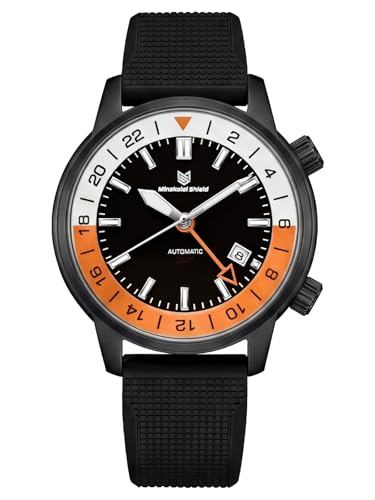
Minskolei Shield GMT Men Watch Automatic Mechanical Dual Time Zone Watches
The first listing is titled Minskolei Shield GMT Men Watch Automatic Mechanical Dual Time Zone Watches, and its description adds a Two Crown Design, a Built-in Dual Time Zone Bezel, and a Stainless Steel case and bracelet description in the wording of the listing itself. Those three points define what can responsibly be said about it here: it is presented as an automatic mechanical men’s watch, it is presented as a dual time zone design, and the dual time function is described as built in and operated through a design with two crowns.
A two-crown layout usually separates functions so that one crown handles the main time setting and another control relates to the internal or external timing or zone function, although the exact assignment varies by model and should be confirmed from the instructions supplied with the specific watch. What matters for a buyer is the practical consequence: if you like adjusting the second zone without disturbing the main time, a dedicated second control can be appealing. If you prefer the fewest possible controls and the simplest possible case side, a single-crown design with a purely external bezel may suit you better. Neither preference is wrong; they are different ideas about how a watch should be handled day to day.
Because the listing describes the bezel as built in, pay particular attention to the photographs showing whether the hour scale sits inside the crystal or on an outer ring, since that affects both appearance and how the scale is read at an angle. Internal scales tend to give a smoother outer profile, while external bezels offer a grip surface you can turn directly. Again, the listing title alone does not settle every mechanical detail, and a careful buyer will match the photos and the seller’s description against the exact variant selected on the product page.
LONGINES Spirit Zulu Time 39MM Automatic Watch
The second listing is titled LONGINES Spirit Zulu Time 39MM Automatic Watch. Two facts are stated plainly in that title: the model family name is Spirit Zulu Time, and the stated size is 39MM. The word Zulu in aviation and military usage refers to coordinated universal time, often called Zulu time, which is why the name signals a travel and multi-zone purpose before any further description is read. The listing presents the watch as an automatic watch, meaning it belongs to the self-winding mechanical category as described on the page, rather than to quartz or digital categories.
A stated 39MM size will suit readers who prefer a moderate case that sits comfortably under a shirt cuff and does not dominate a smaller wrist. Case size is always a personal fit question, however, and numbers alone do not capture lug shape, thickness, or bracelet drape. If you are choosing between sizes or between this model and a larger travel watch, the most useful comparison is against a watch you already own and know well: compare the stated case width with your current watch, consider how much presence you want, and remember that legibility of a second-zone display depends on dial layout as much as on raw diameter.
LONGINES Spirit Zulu Time 39MM Automatic Watch, second listing
The third listing carries the same title as the second: LONGINES Spirit Zulu Time 39MM Automatic Watch. It is treated here as a second listing of the same named model rather than as a different watch, because the titles supplied for this roundup are identical. Duplicate or near-duplicate listings can appear for many ordinary retail reasons, including different sellers, different strap or bracelet configurations offered through separate pages, or marketplace catalog structure, and the title alone does not establish which of those reasons applies in this case.
The practical advice is simple. If you are interested in this model, open the specific listing you intend to order from, confirm the configuration shown there, and make sure the photographs, the stated size, and the delivery and returns terms on that page match your expectations. Do not assume that two listings with the same title offer identical bundles, packaging, or seller services. Treating the two entries as the same product name presented twice is the honest reading of the information provided, and it avoids inventing a distinction that the titles do not support.
Minskolei Shield GMT Watch Automatic Mechanical Wristwatch with two-tone bezel
The fourth listing is titled Minskolei Shield GMT Watch Automatic Mechanical Wristwatch, and its description adds GMT Watch Two-Tone Bezel, Double Crown Design, and Sapphire Glass. Compared with the first Minskolei listing, the distinguishing points stated here are the two-tone bezel and the mention of sapphire glass. A two-tone bezel uses two colors or finishes on the ring, which on travel watches is often used to separate portions of a scale visually. On this listing, the safe statement is the one the title makes: the bezel is described as two-tone, and buyers should look at the listing photographs to see how the two tones divide the scale and how readable the numerals remain against each tone.
Sapphire glass, named in the listing, is a crystal material widely used in watches and generally discussed in the industry in terms of scratch resistance compared with ordinary mineral glass. That general point is about the material class, not a measured claim about this individual unit. As with the first Minskolei entry, the double crown design is part of the stated description, so the same buying note applies: check the instructions and the product photographs to understand which control does what, and consider whether a second crown fits your preference for how a dual-time watch should be adjusted.
Having two Shield listings in one roundup is useful because it shows how much variation can sit under one model name. One emphasizes a built-in dual time zone bezel and stainless steel construction in its wording; the other emphasizes a two-tone bezel and sapphire glass. A buyer choosing between them should compare the exact product pages side by side, variant by variant, rather than assuming the watches differ only in appearance or that they are identical apart from color.
TOPHILL Men Watches Automatic Mechanical Watches, dive, GMT, chronograph and dress styles
The fifth listing is titled TOPHILL Men Watches Automatic Mechanical Watches – Dive, GMT, Chronograph & Dress Styles, with further wording naming 316L Stainless Steel, Sapphire Crystal, a Ceramic Bezel, a water resistance description written as 5ATM-300M Waterproof, and Super Luminous treatment. This is a broad listing that spans several styles, so the most important buying step is to select the exact style variant on the product page and confirm that the variant you receive is the GMT style if a GMT function is what you want, rather than a dive, chronograph, or dress variant from the same listing family.
The materials named in the listing are worth unpacking in general terms. The grade designation 316L refers to a stainless steel alloy commonly used for watch cases and bracelets. Sapphire crystal is the same material class mentioned in the previous listing. A ceramic bezel insert is a material choice often discussed for its color stability and surface hardness as a class. Super luminous wording in the listing refers to luminous material intended to make markers readable in low light. Each of these is a statement from the listing title about what the product family claims to include; the specific variant, finish, and configuration still need to be checked on the page for the exact option selected.
Water resistance language deserves special care on any watch listing, and this one is a good example of why. The title pairs two different expressions of water resistance in a single phrase. Rather than treating any number as a promise for swimming or diving, read the seller’s full guidance on the product page, follow the watchmaker’s general rule that water resistance is not a permanent property, and keep crowns fully closed before any contact with water. Readers whose travel involves regular swimming may also want to compare dedicated outdoor and connected models in roundups such as best adventure smartwatches, where water handling is a central design brief rather than one line in a broad listing.
Casio AE-1200WH-1AV Digital World Time Watch, the digital alternative
The sixth listing is deliberately different. The Casio AE-1200WH-1AV Digital World Time Watch for Men is a digital watch, not a bezel watch, and it should be understood as an alternative approach to the same travel problem. Its listing title states a 10-Year Battery, 100M Water Resistant construction, an LED Light, Multi Time capability, a Stopwatch, a Countdown Timer, and a Black Resin Band. Where a 12-hour bezel watch shows a second zone by rotating a ring, a digital world time watch shows additional times through its electronic display and mode buttons, as described by the multi time wording in its title.
The contrast is instructive. A digital world time model can typically present several city times, alarms, and timing functions in one lightweight resin case, and the stated long battery life in the title speaks to a low-maintenance ownership pattern. A mechanical bezel watch offers a traditional dial, no reliance on a battery for its main timekeeping in the case of an automatic movement, and a second-zone reading that is visible without pressing a button. Neither approach is a substitute for the other. Travelers who want a traditional watch face and a simple offset ring will lean toward the bezel. Travelers who want multiple stored times and timing tools in a light case will lean toward the digital option. Presenting the Casio here as the digital alternative, clearly distinct from the bezel watches above, keeps that choice honest.
Who a 12-hour bezel suits best
The natural owner of a 12-hour bezel watch tracks one other place, repeatedly. That includes frequent flyers who shuttle between two hubs, remote workers with a team in one other region, people with family in one other country, and sailors, drivers, and field workers who check a home base time while away. For these patterns, the bezel is set once, glanced at often, and reset only when the destination changes. The feature earns its keep through repetition, not novelty.
It suits fewer people whose work spans many zones at once. If your day involves coordinating across four continents, a single offset ring will not hold all of that information, and a world time display, a phone, or planning software will do more of the work. Similarly, if precise morning and evening distinction in the second zone is critical for legal, medical, or transport deadlines, the 12-hour ambiguity is a real drawback to weigh, not a detail to dismiss. Honest fit matters more than feature enthusiasm, and a watch that matches your actual pattern will be worn and used, while a clever complication that mismatches your routine will be ignored within a month.
Style is a legitimate part of the fit as well. Many 12-hour bezel watches borrow the visual language of dive and field watches: a bold ring, strong numerals, and a sporty case. If that look matches your wardrobe, the watch will be reached for daily. If you mostly wear formal clothing, you may prefer a slimmer dual-time design or a dress watch for work and a bezel watch for travel days. Readers weighing a connected watch for travel notifications and activity features alongside a traditional piece may find best active smartwatches a useful parallel read, since many travelers now carry both a mechanical watch for time and a connected watch for alerts, choosing per trip which one leads.
How to set and use a 12-hour bezel, step by step
Start by setting the main time correctly for the zone you will treat as primary. Many travelers keep the main hands on home time throughout a trip and use the bezel for local time at the destination, because home time is the reference they would otherwise lose. Others set the main hands to local time on arrival and use the bezel for home. Either convention works, provided you pick one and stay consistent for the whole trip; switching conventions mid-trip is how mistakes happen.
Next, work out the hour difference between the two places. Count forward if the second place is ahead of the primary place, and backward if it is behind. Rotate the bezel by that number of hour positions in the correct direction, so the bezel scale is shifted by the offset. Then read the second time by looking at which bezel numeral the hour hand points toward, while reading minutes from the minute hand as usual. Check your setting once against a phone or an airport clock at the moment you set it, not to distrust the watch, but to confirm you rotated in the right direction, since direction errors are the most common beginner mistake and are easiest to catch immediately.
Worked examples in plain language
Imagine your primary time is eight in the morning and the second city is five hours ahead. After rotating the bezel forward by five positions, the hour hand will point to the bezel numeral corresponding to one in the afternoon for that second city, while the dial itself still shows eight. Later, when your primary time reaches noon, the bezel reading will show five in the evening for the second city. The pattern becomes automatic: the gap between the two readings never changes until you move the bezel or cross into a place with a different offset.
Now imagine the second city is three hours behind. Rotate the bezel backward by three positions. When the main dial shows ten in the morning, the bezel reading shows seven in the morning for the second city. If you need to phone that city at a civilized hour, the bezel tells you at a glance whether your morning is still their early morning. Over a week of travel, these small glances replace repeated phone checks and mental subtraction, which is exactly the modest, practical benefit the design promises.
Half-hour offsets and daylight saving changes
Two complications deserve plain warnings. First, some regions use offsets that are not whole hours. A 12-hour bezel marked only in whole hours cannot display a half-hour difference exactly, because the bezel can only shift by full hour steps while the minute hand stays shared. If your key second city uses such an offset, you will need to remember the extra half hour separately, or choose a different type of watch or a digital display for that route.
Second, daylight saving changes shift offsets on specific dates, and the two places you track may change on different weekends or not at all. When a clock change approaches, recheck the difference between your two zones and reset the bezel if the gap has grown or shrunk by an hour. Building this check into your travel routine, alongside passport and charger checks, prevents the one class of error that a mechanical bezel cannot correct by itself, because the ring knows nothing about calendars.
What to check before buying
Begin with the bezel itself. Look for clear hour numerals, a decisive click or smooth but firm movement as described for the model, and alignment: the bezel marker should line up cleanly with the dial markers when set to zero offset. Misalignment is a common annoyance on lower-cost watches and is visible in close product photographs if you look for it. Decide in advance whether you prefer an external rotating ring you grip directly or a built-in scale adjusted by a second crown, as described in the Minskolei listings, because that choice shapes daily handling more than most other details.
Next, consider the movement category stated in the listing. The mechanical listings here describe automatic watches, which wind through wrist motion and a manual winding option on many designs, and which need regular wear or winding to keep running. That ownership pattern suits people who enjoy mechanical objects and wear the watch frequently. People who want to pick up a watch after a month in a drawer and find it still showing the right time often prefer quartz or digital designs, such as the Casio digital alternative in this roundup, whose listing states a long battery life. There is no hierarchy here, only a match between habits and technology.
Case size, materials, and crystal
The Longines listings state a 39MM size, which gives at least one concrete anchor in this roundup for discussing fit. A moderate diameter tends to work across a wide range of wrists and clothing, while larger cases make bezel numerals bigger and reading faster at the cost of presence and weight. Materials named across the listings include stainless steel, 316L stainless steel on the Tophill listing, sapphire glass or sapphire crystal on two listings, and a ceramic bezel and resin band at opposite ends of the material spectrum. Each material class carries general trade-offs known across the industry: steel is durable and heavier, resin is light and casual, ceramic inserts keep their color well, and sapphire is prized as a crystal class for scratch resistance. Apply those general points cautiously and confirm the exact material of the exact variant on its product page.
Bracelet and strap comfort deserve as much attention as the case. A steel bracelet that does not adjust finely can make an otherwise well-sized watch feel loose or tight through the day as your wrist changes with temperature. Look at clasp type, micro-adjustment, and lug width in the listing details if they are provided, and remember that straps can often be changed later while case fit cannot. A watch bought for travel will spend long days on the wrist in airports and aircraft seats, so comfort over twelve hours matters more than first impressions over twelve seconds.
Water resistance, luminosity, and travel practicality
Treat water resistance as a set of instructions, not a single number. The Tophill listing includes water resistance wording and the Casio listing states 100M water resistance in its title, but the safe general practice is the same for every watch: follow the maker’s guidance for that model, keep crowns and pushers closed, avoid operating controls underwater unless the maker explicitly allows it, and have seals checked periodically if the watch sees regular water use. A travel watch that survives rain, hand washing, and an occasional swim under the maker’s stated conditions is more useful than a watch whose owner is afraid to wear it near a sink.
Luminosity, mentioned as Super Luminous wording on the Tophill listing, matters for red-eye flights, dim cabins, and early starts. In general terms, larger luminous areas on hands and hour markers are easier to read in the dark than small decorative applications. For the second zone specifically, consider whether the bezel numerals themselves are luminous or only the dial markers are; on many designs the bezel scale is not luminous, so the second time may not be readable in complete darkness even when the main time is. That is a small detail that frequent night travelers will notice and daytime travelers will never miss.
Finally, think about value in terms of use rather than prestige. A dual-time watch that you understand, set correctly, and wear on every trip is worth more to you than a more elaborate world timer that stays at home. Readers comparing connected alternatives on a tighter budget may also want to scan best affordable smartwatches before deciding, because the real competition for a travel watch today is often the connected watch already on your other wrist or the phone already in your pocket, and an honest comparison across categories leads to a better purchase than a comparison within one category alone.
Care, accuracy, and living with a mechanical dual-time watch
Automatic mechanical watches, the category named in most listings here, keep time through a balance and spring system regulated to a tolerance that differs from quartz accuracy. In general industry terms, a mechanical watch may gain or lose a number of seconds per day depending on its movement, position, and state of wind, while a quartz or digital watch typically varies far less. For travel purposes, a few seconds rarely matter; for catching trains, minutes matter and seconds do not. Reset the time against a reliable source at the start of a trip, and the watch will serve the journey well.
Daily care is straightforward: keep the watch clean, store it away from strong magnetic fields where practical, and follow the maker or seller guidance on service intervals and on operating a second crown, returning any crown fully to its closed position after adjustment.
Common mistakes and how to avoid them
The most common mistake is rotating the bezel in the wrong direction, which produces a second time that is wrong by twice the intended offset in feel, because the gap appears on the wrong side. The fix is the immediate check described earlier: set the bezel, then compare once with a known source. The second mistake is forgetting a daylight saving change, which leaves the bezel one hour out for weeks. The third is assuming a 12-hour bezel shows whether the second zone is in morning or evening, and scheduling a call into someone’s night. A moment of context, remembering whether the other city is ahead into its evening or behind in its morning, prevents that error entirely.
A fourth mistake is buying by photograph alone. Bezel numeral size, crown size, bracelet finishing, and case thickness are all hard to judge from a single hero image. Read the full listing, study photographs that show the watch from the side and on a wrist if provided, and use the stated size, such as the 39MM stated on the Longines listings, as an anchor against a watch you already own. A fifth mistake is choosing a broad multi-style listing, such as the Tophill listing that spans dive, GMT, chronograph, and dress styles, without confirming that the selected variant is the style you actually intended to order.
Frequently asked questions
Can a 12-hour bezel replace a GMT hand?
For tracking one additional zone in whole hours, yes, in the sense that it shows the second hour without any extra hand. It does not replace the day and night clarity of a 24-hour GMT display, and it does not store multiple cities the way a digital world time watch can. Think of it as the simplest sufficient tool for a two-place life, rather than as a universal replacement for every other system.
Does the bezel affect the main time?
No. Rotating a 12-hour bezel changes only the scale you read the hour hand against. The hands themselves keep showing the primary time on the dial exactly as before. That separation is what makes the system safe to experiment with: you can reset the bezel as often as you like without disturbing the underlying timekeeping, which is one reason the design is friendly for first-time travel watch owners.
What about the second crown on some models?
The Minskolei listings describe a two crown or double crown design. In general terms, an extra crown on a dual-time watch is used to operate an additional function, often connected with the zone or scale adjustment, without moving the main crown. The exact operation differs by model, so the instructions packed with the specific watch are the authority. Treat the second crown as a handling preference to evaluate, not as a quality ranking.
Check prices on Amazon
Live listings for the shortlist in this guide are pulled from Amazon below, so prices and availability are always current at the moment you look.

Choosing among the listings here
If your priority is a traditional luxury name in a moderate stated size, the Longines Spirit Zulu Time 39MM Automatic Watch listings present that option, with the caution that two listings share the title and the exact page you order from should be checked carefully. If you like the idea of a built-in dual time zone bezel operated through a two-crown design in stainless steel, the first Minskolei Shield listing describes exactly that combination. If a two-tone bezel and sapphire glass are the details that catch your eye, the second Minskolei Shield listing is the one whose title names them.
If you want a broad style family with named materials including 316L stainless steel, sapphire crystal, and a ceramic bezel, and you are willing to confirm the GMT variant carefully within a listing that also covers dive, chronograph, and dress styles, the Tophill listing fits that description. And if your honest priority is maximum world time utility, long stated battery life, timing functions, and a light resin case, the Casio AE-1200WH-1AV makes the digital case persuasively, as a different tool for the same underlying need.
Whichever direction you choose, let your travel pattern decide. Count the places you truly track, decide whether morning and evening clarity matters for those places, pick the reading system you will understand at a tired glance in an airport, and only then compare cases, crystals, and bracelets. A second time zone is a small promise a watch makes every day, and the best bezel is the one whose promise you can read without thinking, in the city you are in, for the city you miss or the team you support, at exactly the moment you need it. For the traveler who lives between two clocks, a simple ring of twelve numbers, turned with intent at the start of a journey, remains one of the most elegant answers watchmaking has ever offered.