What's inside
- Key Takeaways
- Quick Picks
- How We Chose These Picks
- Comparison Table
- Does Dual-Frequency GPS Actually Change Race Data?
- How Should Triathletes Weigh Coaching Against Hardware?
- What Does Race Week Demand From a Watch?
- How Long a Battery Does Your Longest Day Need?
- What Separates a Training Watch From a Racing Watch?
- How Do the Three Platforms Treat Your Training History?
- Which Watch Survives the Swim Start Best?
- How Should You Spend the Rest of the Budget?
- What Should You Test in the First Two Weeks?
- Can One Watch Serve Training and Everyday Life?
- How Do You Keep a Race Watch Accurate Over a Season?
- What Changes When the Race Is on Trails Instead of Roads?
- Common Mistakes
- Final Recommendation
- Frequently Asked Questions
- A Short Word on Second Watches and Spares
- Trust, but Verify Your Own Files
- Related Guides
As an Amazon Associate I earn from qualifying purchases. This post may contain affiliate links at no extra cost to you.
widgetverdict.com is reader-supported. When you buy through links on our site, we may earn an affiliate commission.
Race morning exposes every shortcut a watchmaker took, which is why the best multisport smartwatches are judged by what survives a triathlon rather than what glows in a product photograph. A multisport watch must record a swim, a ride and a run as one continuous effort, hold satellite contact through city streets and forest switchbacks, and still have charge left for the journey home. The six watches below come from the three brands that dominate start lines: Garmin, with three generations of Forerunner plus its previous mid-range workhorse; Suunto, with a compact AMOLED racer carrying serious navigation; and Polar, with a training-science veteran that measures running power from the wrist. Price bands differ, sizes differ, and the depth of coaching differs most of all — so the right choice depends on whether you are building toward an Ironman, a first Olympic-distance finish, or a faster local 10K.
Terminology needs tidying before the picks, because multisport gets used loosely in listings. Strictly, it means a watch that strings disciplines together in a single recorded activity with transitions, the way a triathlon actually unfolds. Several watches here are running-first instruments that also serve triathletes, and their listings say so in nearly those words. Others speak the language of sports modes counted by the dozen. Both approaches can serve a triathlete well, but they are not identical promises, and the reviews below keep the distinction visible so a buyer training for a specific event can match the tool to the start line they actually face.
Key Takeaways
- Garmin’s Forerunner 970 is the flagship here: 47mm, DLC titanium, AMOLED, a built-in flashlight and enhanced navigation.
- The Forerunner 570 shrinks the modern formula to a 42mm aluminium case with training and recovery features intact.
- Forerunner 965 remains a potent touchscreen multisport watch, with a battery claim of up to 13 days in its listing.
- Suunto’s Race 3S packs dual-frequency GPS, offline maps and a race planner into the smallest case of the group.
- Polar’s Vantage V is the training-science pick, measuring running power and blood oxygen saturation.
- The Forerunner 745 is the elder statesman: detailed training stats and on-device workouts without flagship pricing pressure.
Quick Picks
| Pick | Badge | Why it earns a place |
|---|---|---|
| Garmin Forerunner 970 | Flagship racer | DLC titanium over a 47mm AMOLED case, with flashlight and enhanced navigation for long-course athletes. |
| Garmin Forerunner 570 | Compact modern Garmin | The current Forerunner recipe in a 42mm aluminium case sized for smaller wrists. |
| Garmin Forerunner 965 | Touchscreen endurance | Advanced multisport tracking, on-device workouts and a claimed thirteen days of battery. |
| Suunto Race 3S | Navigation specialist | Dual-frequency GPS, offline maps, 64GB storage and climb guidance in a featherweight titanium build. |
| Polar Vantage V | Training science | Running power from the wrist, blood oxygen saturation and a triathlon training focus. |
| Garmin Forerunner 745 | Proven value | Detailed training statistics and on-device workouts from an earlier, battle-tested generation. |
How We Chose These Picks
Multisport shortlisting began with a blunt filter: could this watch plausibly record a full triathlon without excuses? That demanded credible satellite positioning, a training platform that understands more than running, and a listing that speaks about sport as its primary purpose rather than as one tile among lifestyle features. Fashion watches with a triathlon mode buried in a menu did not make the cut, and neither did listings that hid behind vague fitness language. What remained was a field of genuine instruments spanning several generations, which is useful: triathletes range from first-timers renting wetsuits to age-groupers with a decade of data, and one price point cannot serve both honestly.
Generation gaps were treated as information, not disqualifications. The Forerunner 745 and Polar Vantage V come from earlier design cycles than the AMOLED newcomers, and their listings show it — no touchscreen fanfare on the Polar, no display boasting on the 745. Yet training statistics, workout guidance and multisport recording were already mature arts when those watches launched, and a lower street price can redirect budget toward race entries, shoes and a wetsuit. Conversely, the newest Garmins and the Suunto justify themselves with navigation depth, display quality and recovery tooling that earlier hardware never attempted.
Claims discipline mattered throughout. Battery figures appear below only where a listing prints them: thirteen days for the 965, thirty-eight hours of dual-frequency GPS for the Suunto. Screen brightness appears only for the Suunto, whose title states 2000 nits. Where a title stays silent — and several do — the reviews describe role and handling instead of inventing numbers, and the spec lists say so plainly.

Garmin Forerunner 970 — Flagship racer
The Forerunner 970 sits at the top of Garmin’s running line in this roundup, and its listing assembles the flagship vocabulary accordingly: a 47mm case, carbon gray DLC titanium, an AMOLED display, enhanced navigation and a built-in flashlight. That flashlight is less gimmick than it sounds — fumbling for a headtorch during a pre-dawn transition setup or a night-time portaloo expedition is a universal triathlete experience, and a wrist light that lives on the watch removes one small friction from race weekends. Titanium with a DLC coating speaks to durability and weight simultaneously, since long-course athletes wear the watch through training blocks measured in months, not just on the day itself.
Enhanced navigation is the other headline, aimed at athletes whose training strays onto unfamiliar trails, holiday routes and recon rides of distant courses. Combined with Garmin’s training and recovery ecosystem — the platform context this watch inhabits — the 970 presents itself as the single instrument for an entire season: plan, execute, recover, repeat. The AMOLED display brings the readability and map clarity that older transflective Garmins traded away for stamina, and 47mm gives those maps room to breathe during a ride when glances last half a second.
Flagship ownership carries flagship caveats. A 47mm case is a lot of watch on a slender wrist, especially under a wetsuit cuff that must strip quickly in transition. The listing does not print a battery figure, so endurance claims should be checked against Garmin’s own specification for your exact usage pattern before assuming it matches the 965’s stated thirteen days. And the price of admission at this tier buys capability many athletes will never open — if your calendar holds one sprint triathlon a year, the 570 or 745 will record it just as faithfully.
- Case: 47mm, Carbon Gray DLC Titanium, Black/Whitestone
- Display: AMOLED
- Extras named in listing: built-in flashlight, enhanced navigation
- Role per listing: premium GPS running and triathlon smartwatch
- Battery figure: not stated in listing title
- Touchscreen: not stated in listing title
Strengths
- Titanium construction with DLC coating suits a full season of daily training wear.
- Enhanced navigation supports course recon and unfamiliar training territory confidently.
- The built-in flashlight earns its place on race mornings and night runs alike.
Trade-offs
- The 47mm footprint can fight wetsuit cuffs and overwhelm smaller wrists.
- No battery figure appears in the listing, so endurance needs independent confirmation.
- Flagship capability is wasted on a calendar containing a single short race.
Best for: long-course triathletes and marathoners wanting Garmin’s current flagship navigation, materials and display.
Not suited for: petite wrists, one-race-a-year calendars, or buyers who want endurance figures printed before purchase.

Garmin Forerunner 570 — Compact modern Garmin
Garmin describes the Forerunner 570 in its own listing as smaller-sized, and that single adjective unlocks the modern Forerunner experience for a large group of athletes the flagships exclude. The 42mm aluminium case in Whitestone and Cloud Blue houses an AMOLED display and the training and recovery features that define the current generation, without demanding a forearm built for a 47mm instrument. Aluminium keeps weight and cost below the titanium tier while shrugging off the knocks of daily training perfectly well.
Training and recovery features deserve unpacking, because the pairing describes how modern endurance coaching actually works. Training features structure the work — sessions, targets, readiness to absorb load — while recovery features police the gaps between sessions, where adaptation actually happens and where enthusiastic amateurs most often sabotage themselves. A watch that only shouts about workouts sells half the discipline. The 570’s listing puts both halves in the title, which positions it for runners and triathletes following a plan rather than merely collecting miles.
Smaller cases always raise the same two questions: screen room and battery room. Maps and data fields compress at 42mm, so riders who glance down at speed should weigh how many fields they truly read mid-effort. The listing prints no battery figure, so assumptions are unwise; check Garmin’s specification against your longest training day. What the 570 unquestionably delivers is proportionality — a watch that looks like it belongs on the wrist wearing it, in the current generation’s full training language.
- Case: 42mm, Aluminum, Whitestone/Cloud Blue
- Display: AMOLED
- Features named in listing: training and recovery features
- Role per listing: advanced GPS running and triathlon smartwatch, smaller-sized
- Battery figure: not stated in listing title
- Flashlight: not stated in listing title
Strengths
- The 42mm case finally fits the wrists that flagships leave behind.
- Training and recovery tooling arrives together, matching how plans actually function.
- Aluminium keeps the watch light through long runs and full race days.
Trade-offs
- Data fields and maps compress on the smaller AMOLED canvas.
- No endurance figure is printed in the listing for pre-purchase checking.
- Aluminium lacks the scratch shrug of the 970’s coated titanium.
Best for: smaller-wristed runners and triathletes wanting the current Garmin training system at a wearable size.
Not suited for: map-heavy ultra navigation at a glance, or buyers who rank case presence over proportion.

Garmin Forerunner 965 — Touchscreen endurance
The Forerunner 965 was Garmin’s AMOLED statement when it launched, and its listing still reads confidently: advanced GPS multisport touchscreen smartwatch, heart rate monitoring, training stats, on-device workouts and up to thirteen days of battery life, sold here with a Signature Series charging bundle. That battery claim is the headline act. Thirteen days swallows a full Ironman build week, a race weekend and the recovery shuffle afterwards without a charger entering the kit bag, and it reframes the AMOLED era’s central anxiety — that bright screens must mean nightly charging — as largely solved for this class.
Touchscreen control on a multisport watch is a genuine interface fork. Maps pan and zoom naturally under a finger, menus surrender faster in daily life, and then a rainy ride or a swim start reminds you why buttons earned their cult. Garmin’s implementation lets both coexist, and experienced owners develop a hybrid habit: touch on dry land, buttons when wet or gloved. On-device workouts matter for the plan-followers, delivering structured sessions to the wrist without phone mediation, while training stats give the analytical athlete the numbers to argue with their coach.
One generation separates these Garmins. The 965 predates the 970’s flashlight and enhanced navigation billing, so buyers choosing between them are choosing which generation’s extras matter. This listing’s bundle softens the older model’s pitch with its charging accessory included. For athletes who prize proven endurance and a touchscreen at a step below flagship money, the 965 remains the thinking person’s Garmin in this line-up.
- Display: touchscreen (case size not stated in listing title)
- Battery claim in listing: up to 13 days
- Training: training stats and on-device workouts
- Sensing named in listing: heart rate monitor
- Bundle named in listing: Signature Series charging bundle
- Role per listing: advanced GPS multisport smartwatch
Strengths
- Thirteen claimed days cover heavy training weeks without charger anxiety.
- Touchscreen map handling suits course study and daily navigation beautifully.
- On-device workouts deliver structured sessions straight to the start line.
Trade-offs
- It lacks the flashlight and enhanced navigation billing of the newer 970.
- Touch input still frustrates in heavy rain despite button backup.
- Case dimensions go unstated in the listing for buyers comparing sizes.
Best for: data-driven triathletes wanting touchscreen maps, structured workouts and a printed thirteen-day endurance claim.
Not suited for: buyers who want the newest flagship extras, or athletes who distrust touchscreens entirely.

Suunto Race 3S — Navigation specialist
Suunto’s Race 3S carries the densest specification in this roundup, and nearly all of it serves navigation and endurance. Start with the positioning: thirty-eight hours of dual-frequency GPS, the tier that holds a clean line between skyscrapers and along cliff-shadowed trails where lesser receivers smear the track. Add offline maps stored on a generous 64GB, a race planner and climb guidance, and the watch becomes a course-management tool for athletes who race in mountains, abroad, or anywhere the route deserves study rather than hope. The 1.32-inch AMOLED is rated at 2000 nits in the listing, brightness that keeps maps legible under alpine sun.
Then notice the packaging: this is the S model, titanium and featherweight in the maker’s phrasing, with 125 sports modes and an AI coach using ZoneSense to interpret effort. Suunto’s training language differs from Garmin’s — ZoneSense aims to read what your body is actually doing rather than what the plan assumed — and some athletes find that honesty liberating after years of being scolded by readiness scores. Climb guidance speaks directly to trail and mountain racers, breaking ascents into manageable information while the legs are making their own arguments.
Platform gravity is the counterweight. Garmin owns the larger ecosystem of integrations, group challenges and third-party habits; switching to Suunto means rebuilding routines inside a different app culture. The 38-hour GPS figure, while strong for dual-frequency accuracy, trails the multi-day claims of less precise modes elsewhere, so expedition athletes should study the battery ladder across GPS settings. For the mountain racer who values a true track and a readable map above ecosystem size, though, the Race 3S argues its case forcefully.
- Display: 1.32-inch AMOLED, 2000 nits per listing
- Positioning: dual-frequency GPS, 38 hours per listing
- Storage: 64GB, with offline maps
- Tools named in listing: race planner, climb guidance, AI Coach, ZoneSense
- Sports modes: 125
- Build per listing: titanium, featherweight design
Strengths
- Dual-frequency positioning protects track accuracy in cities and gorges alike.
- Offline maps plus climb guidance serve mountain racing better than any rival here.
- The bright AMOLED stays readable under hard summer sunlight.
Trade-offs
- Suunto’s ecosystem is smaller than Garmin’s web of integrations and habits.
- Thirty-eight GPS hours is a ceiling expedition athletes must plan around.
- The dense feature set rewards study; casual users will leave much unused.
Best for: trail and mountain racers, plus city athletes wanting dual-frequency accuracy and serious offline mapping.
Not suited for: Garmin-ecosystem loyalists, or buyers wanting the simplest possible first sports watch.

Polar Vantage V — Training science
Polar built its reputation in physiology laboratories before sports watches were fashion items, and the Vantage V carries that heritage openly: a premium GPS multisport watch for multisport and triathlon training, with heart rate monitoring, running power measured from the wrist, waterproof construction and blood oxygen saturation among its listed abilities. Running power is the differentiator with real training consequences. Pace lies on hills and into headwinds; power tells the truth about effort in both, letting a runner hold a climb at target strain instead of surging on pride and paying for it at the next aid station.
Blood oxygen saturation adds a recovery and altitude signal that the other listings here do not name, useful for athletes who train high or who watch sleep quality closely during heavy blocks. Polar’s surrounding platform has always spoken the language of training load, recovery balance and orthostatic discipline — less lifestyle garnish, more laboratory report. For the self-coached athlete who reads their own data carefully, that seriousness is the product. The watch is also honestly of its generation: the listing makes no AMOLED or touchscreen claims, and its interface belongs to the button-driven era.
That era’s virtues include focus and, typically, gentler pricing as newer flagships crowd the shelves — money that can fund a power-compatible training plan, race entries or the wetsuit the Vantage V will time you out of. Its limits are equally clear: no offline maps are promised, no flashlight, no music-storage boasts. What is promised is measurement integrity from a company that supplied heart rate straps to Olympians long before wrists got smart, and for a certain kind of triathlete that promise outranks every screen specification.
- Role per listing: premium GPS multisport watch for triathlon training
- Running: power measured at the wrist
- Sensing named in listing: heart rate monitor, blood oxygen saturation
- Construction per listing: waterproof
- Display type: not stated in listing title
- Battery figure: not stated in listing title
Strengths
- Wrist-based running power transforms pacing on hills and into wind.
- Blood oxygen saturation supports altitude camps and recovery watching.
- Polar’s training-load heritage suits analytical, self-coached athletes.
Trade-offs
- No mapping or navigation features are promised in the listing.
- The interface belongs to an earlier, button-led generation.
- Endurance figures are absent from the listing for pre-purchase checks.
Best for: self-coached triathletes and runners who pace by power and read recovery data seriously.
Not suited for: map-led trail navigation, touchscreen expectations, or casual step-count duty.
Garmin Forerunner 745 — Proven value
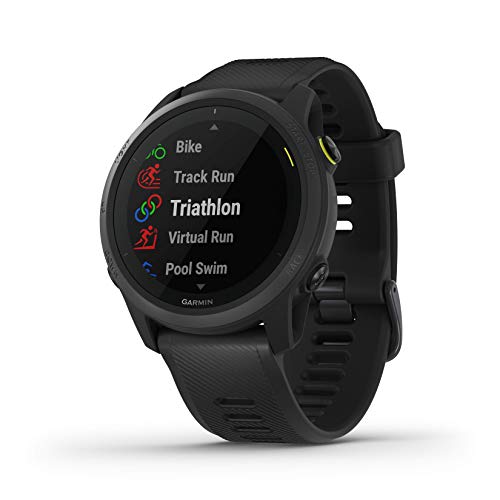
The Forerunner 745 represents the moment Garmin’s mid-range matured: a GPS running watch with detailed training stats and on-device workouts, essential smartwatch functions, and a black case that has timed more personal bests than any flagship on this page. Its listing is refreshingly modest — no display superlatives, no titanium — because the watch’s reputation was built across seasons of start lines rather than launch events. For a first-time triathlete, that maturity translates into a training platform whose advice, metrics and quirks are documented by an enormous community of owners.
Detailed training stats and on-device workouts are the substance. Structured sessions arrive on the wrist, the watch judges execution, and the surrounding Garmin platform assembles the story of a training block. Essential smartwatch functions cover the daily layer — notifications and the basics — without pretending to rival a phone. In multisport company the 745 historically earned its keep as the triathlete’s Garmin below the top tier, recording the three disciplines and the transitions between them as one race.
Buyers should enter with eyes open about generation. Newer Forerunners bring AMOLED clarity, flashlights and navigation billing this watch never claimed, and the listing prints no battery figure to compare against the 965’s thirteen days. Battery ageing on any older model also deserves a thought — a well-kept 745 still trains happily, but endurance should be verified against your longest day. Judged as a value instrument with a complete training brain, the 745 remains easy to recommend to athletes whose budget prefers race entries over watch cases.
- Colour: Black (case size not stated in listing title)
- Training: detailed training stats, on-device workouts
- Daily layer per listing: essential smartwatch functions
- Role per listing: GPS running watch
- Battery figure: not stated in listing title
- Display type: not stated in listing title
Strengths
- A complete, mature training platform with an enormous owner community.
- On-device workouts bring structured coaching without flagship pricing.
- The unpretentious design wears comfortably through training and workdays.
Trade-offs
- Newer displays, navigation extras and flashlights live in other models here.
- No printed endurance figure appears in the listing for comparison.
- Ageing batteries on older stock deserve a realistic expectation check.
Best for: first-time triathletes and value-led runners wanting Garmin’s training brain without flagship cost.
Not suited for: buyers wanting AMOLED maps, the newest sensors, or printed multi-week battery claims.
Comparison Table
| Watch | Size / build | Display | Battery claim | Signature tool |
|---|---|---|---|---|
| Garmin Forerunner 970 | 47mm DLC titanium | AMOLED | Not stated in listing title | Enhanced navigation, flashlight |
| Garmin Forerunner 570 | 42mm aluminium | AMOLED | Not stated in listing title | Training and recovery features |
| Garmin Forerunner 965 | Size not stated in listing title | Touchscreen | Up to 13 days | On-device workouts, training stats |
| Suunto Race 3S | Titanium, featherweight per listing | 1.32-inch AMOLED, 2000 nits | 38 hours dual-frequency GPS | Offline maps, climb guidance |
| Polar Vantage V | Size not stated in listing title | Not stated in listing title | Not stated in listing title | Wrist running power |
| Garmin Forerunner 745 | Black; size not stated in listing title | Not stated in listing title | Not stated in listing title | Detailed training stats |
Does Dual-Frequency GPS Actually Change Race Data?
Dual-frequency reception, named outright only in the Suunto listing here, attacks a specific enemy: signal reflection. In a city centre or a steep valley, satellite signals bounce off glass and rock before arriving, and a single-band receiver can be fooled into placing you twenty metres inside a building you ran past. The resulting track zigzags, distance inflates or shrinks, and instant pace becomes a random number generator precisely where marathon crowds and cameras concentrate. A dual-frequency receiver cross-checks two signal bands to reject the reflections, holding a track that follows the road you actually ran.
Whether that matters depends on your terrain and your temperament. Open suburban loops and track sessions flatter any receiver, and the Garmins and Polar here will record them faithfully. Downtown marathons, trail races in gorges and ultras along cliff paths are where the Suunto’s positioning earns its keep — and where a corrupted file hurts most, because those are the races you analyse for years. Athletes who pace by the wrist rather than by feel should weight accuracy heavily; athletes who race by effort and check the file later can weight other virtues — battery, maps, coaching — ahead of it.
How Should Triathletes Weigh Coaching Against Hardware?
Every watch here records; they differ in how opinionated they are about what the recordings mean. Garmin’s current pair speak fluently about training and recovery, turning sleep, load and readiness into daily guidance that a busy age-grouper can follow without a spreadsheet. Polar’s platform has always leaned toward load management and recovery balance, the laboratory view. Suunto’s ZoneSense attempts to read effort from the body’s signals during the session itself, adjusting the meaning of a workout to the day you actually had rather than the day the plan imagined.
Coached athletes should choose differently from self-coached ones. If a human coach writes your plan, the watch is a recording instrument and a data pipe — prioritise accuracy, battery and comfort, which pushes the 965, the Race 3S or even the 745 forward. If the watch is your coach, its guidance philosophy becomes the product, and you should sample each platform’s tone before committing years of data to it. An athlete who hates being told to rest will disable Garmin’s nudges within a month; an athlete who craves structure will find Polar’s reports motivating rather than stern. The best coaching system is the one still switched on in week twenty.
What Does Race Week Demand From a Watch?
Race week compresses every requirement into a few unforgiving days. The watch must arrive charged or charge quickly in a hotel room shared with three other devices. It must find satellites in an unfamiliar city, ideally after syncing fresh assistance data over breakfast. It must be comfortable enough to sleep in for the final nights, because taper-week sleep and resting heart rate are the last form indicators you get. And it must be operable by muscle memory at 6 a.m. in the dark with wetsuit gel on your fingers — which is where the 970’s flashlight stops being a novelty and button certainty beats touchscreen elegance.
Rehearse with the watch you race in. Do at least two full brick sessions and one open-water swim in the exact configuration you will use, including the multisport sequence and the transition button presses, because fumbling a lap press mid-race corrupts the file and frays the mind simultaneously. Check that the strap sits correctly under and over a wetsuit cuff. Confirm the low-battery behaviour in training rather than discovering it at kilometre thirty. None of the six watches here will fail a prepared athlete; several have failed unprepared ones who met their settings menus for the first time on the start line.
How Long a Battery Does Your Longest Day Need?
Work backwards from your longest realistic day, then add margin for cold, age and faffing. A sprint or Olympic triathlon asks a few hours of any watch here. A full Ironman asks ten to seventeen hours of continuous recording with navigation and alerts alive, which is a serious demand that should be checked against the manufacturer’s full specification for the exact model and mode — only two listings here print figures at all, the 965’s thirteen days of general use and the Suunto’s thirty-eight hours of dual-frequency GPS, and those numbers describe different modes that cannot be compared naively.
Ultrarunners should be stricter still. A hundred-mile day with maps open will humble specifications written for marathoners, and mid-race charging strategies — a small power bank at an aid station, a watch that charges without ending the recording — become part of race craft. For the majority training six to ten hours a week toward road races and standard triathlons, though, any pick here clears the bar comfortably, and the deciding factors revert to fit, accuracy and coaching taste. Buy endurance for the calendar you have entered, not the one you fantasise about during January sales.
What Separates a Training Watch From a Racing Watch?
Training rewards information density: laps, intervals, load graphs, recovery verdicts, the whole laboratory worn daily. Racing rewards the opposite — a screen showing two or three numbers large enough to read through sweat and tunnel vision, buttons that answer gloved or gel-slicked fingers, and a battery that will not feature in your race-day anxieties. The interesting tension in this line-up is that all six watches attempt both lives, and their compromises differ. AMOLED flagships display training data gorgeously and demand interface discipline at speed. The older button-led designs feel sparse at the desk and serene at kilometre thirty-five.
Data-field discipline is a skill the athlete supplies. Configure a race screen with elapsed time, current discipline metric and one effort gauge, then resist decorating it. Every additional field shrinks the others and adds a decision your exhausted brain must process. Training screens can carry the richness — that is where analysis belongs, at conversational pace with a clear head. Athletes who set up both profiles in the first fortnight consistently report calmer races than athletes who race on factory defaults, regardless of which watch they bought.
Alerts follow the same philosophy. A low-heart-rate warning during a recovery spin is coaching; a buzzing wrist every kilometre of a marathon is noise that some racers love and others mute forever. Decide your notification policy per activity type during training, including whether the finish-line photo moment finds your watch still recording or helpfully paused. These are small settings with outsized emotional consequences at hour nine of a long day.
How Do the Three Platforms Treat Your Training History?
Garmin Connect, Suunto’s app and Polar Flow are not interchangeable filing cabinets; each interprets your effort through its own philosophy, and your history becomes fluent in that philosophy over time. Garmin’s scale is its argument — integrations with training plans, equipment tracking, challenges and an ocean of fellow users whose segments and courses enrich the experience. Suunto leans toward the outdoor diary, where routes, ascents and expeditions organise the story. Polar Flow reads like a physiology report, foregrounding load, recovery and sleep with a clinician’s calm.
Switching costs are therefore real even when the hardware tempts. Personal records, course libraries and years of load baselines do not emigrate gracefully, and a mid-career platform change means a season of the new system underestimating or misreading you while it learns. That is not an argument never to switch — the Race 3S’s navigation or the Vantage V’s power metric may be worth a rebuild — it is an argument to switch deliberately, in a quiet month, exporting what can be exported and accepting a bedding-in period.
Data export policies deserve a check before any purchase in this class. Athletes increasingly feed their files to third-party analysis tools, coaches’ platforms and race predictors, and a watch that records beautifully but shares grudgingly becomes a bottleneck. All three brands here have long histories with the training ecosystem, which is one quiet reason no-name multisport watches were excluded from this roundup entirely: a start line is the wrong place to discover that your files go nowhere.
Which Watch Survives the Swim Start Best?
Open-water starts are controlled violence: bodies collide, arms swing, and a watch can be struck, grabbed or pressed against a buoy line. Case toughness and strap security matter more in that scrum than any feature list. Titanium and coated flagship cases shrug off the knocks; a secure strap with a keeper stops a torn wetsuit sleeve from becoming a lost watch. The Polar listing states waterproof construction directly, while the other titles omit ratings — so swim buyers must verify the exact specification with the manufacturer rather than trusting category vibes, and must check that buttons are rated for pressing in the water if mid-swim operation matters to them.
Sighting technique also changes what you need. Triathletes who sight every six strokes and navigate by buoys ask little of the watch mid-swim beyond recording; those racing unfamiliar adventure swims may glance at a course line, which favours readable displays and, on the Suunto, genuine mapping. Wrist heart rate in cold water is unreliable across the entire industry, a sensor-physics limitation rather than a brand failure, so swim data should be read for duration, distance and stroke rather than pulse precision.
Post-swim care is unglamorous and decisive. Rinse the watch with fresh water after sea or pool sessions, dry the charging contacts, and inspect the strap for the grit that abrades both skin and case during the ride. A multisport watch lives a harder life than any other wearable category — salt, chlorine, sunscreen, road spray and transition-zone concrete in a single morning — and the models here are built for owners who accept that maintenance rhythm as part of the sport.
How Should You Spend the Rest of the Budget?
A watch is one line item in a multisport budget that also contains entry fees, travel, shoes that wear out quarterly, wetsuit hire or purchase, bike maintenance and the small mountain of gels a long season consumes. Framing the purchase inside that budget changes the answer for many athletes. The difference between the flagship tier and the 745 tier can equal a race entry plus a pair of racing shoes — equipment that will unquestionably make you faster — while the watch difference buys navigation polish and materials you may enjoy without gaining a single second. Enjoyment is a legitimate purchase reason; it simply should be chosen knowingly.
Conversely, some upgrades pay sporting rent. Dual-frequency accuracy for a city marathoner whose pacing strategy lives or dies by the wrist, offline maps for a trail racer tired of wrong turns, a flashlight for an athlete whose training happens at 5 a.m. on unlit roads — these features remove friction or risk from every week of the season. The honest test is frequency: a feature used forty times a year is an investment, a feature used twice is a souvenir. Run each headline claim in these listings through that test against your own calendar before letting it move you up a tier.
Second-hand and previous-generation routes deserve mention for the budget-minded, with the usual cautions about battery health and warranty. The presence of the 965 and 745 in this roundup is itself the mainstream version of that strategy: buy the mature model new, with support, at the price the flagship’s arrival created. Multisport is expensive enough without paying launch-day premiums for capabilities your training has not yet grown into.
What Should You Test in the First Two Weeks?
Returns windows reward the organised. In the first fortnight, run one session in every discipline you race, including a genuine multisport brick with transitions, and inspect the files afterwards rather than admiring them on the watch face. Check satellite behaviour on your hardest local segment — the tower block canyon, the tree tunnel — and compare distance against a known route. Sleep in the watch for a full week so recovery features form a baseline, and wear it through two ordinary workdays to judge whether its size and strap survive your real life, not just your training life.
Test the failure modes too. Start a workout with a low battery and learn the warnings. Pause, resume and lap with wet hands. Sync after several offline days and confirm nothing vanished. Pair the watch with your headphones, your bike sensors and your training platform of choice while returns remain painless. Athletes who run this checklist keep their watches for years; athletes who skip it discover incompatibilities in race week, when the only remaining option is endurance of the wrong kind.
Can One Watch Serve Training and Everyday Life?
Multisport watches used to announce themselves across a room; the AMOLED generation changed that, and the 970, 570 and 965 all pass in offices and restaurants without commentary. Daily wear matters more than aesthetics, though, because recovery metrics depend on the watch being present for sleep, stress and the long sedentary stretches between sessions. A watch abandoned on the dresser outside training hours is a stopwatch with ambitions; a watch worn continuously becomes the health record the coaching features were designed around. Comfort, strap choice and case size therefore feed data quality directly, which loops the decision back to fit: the 42mm 570 worn constantly will out-coach a 47mm flagship worn only for workouts.
Everyday duties stay modest across this field and the listings reflect it — the 745’s phrase, essential smartwatch functions, honestly describes the whole category’s daily layer. Notifications arrive, timers and alarms behave, and the phone remains the communications hub. Buyers wanting a wrist that replaces phone tasks should shop the lifestyle flagships in other roundups; buyers wanting a training instrument that behaves politely at dinner will find this group exactly calibrated. The multisport watch’s party trick is not conversation — it is knowing, on any given morning, whether today should be hard.
How Do You Keep a Race Watch Accurate Over a Season?
Accuracy is a maintenance habit, not a factory setting. Sync the watch regularly so satellite assistance data stays fresh and the first fix of a cold morning comes quickly. Wear it snugly for sessions where heart rate drives decisions, looser for sleep, and clean the optical sensor window when sunscreen and sweat have filmed it over. Update firmware between training blocks rather than the night before a race, because updates occasionally rearrange menus your fingers know by heart, and race week is no time to relearn a start sequence.
Course files deserve the same housekeeping. Download the official route when organisers publish one, ride or run a recon segment if geography allows, and delete the three test activities cluttering the history so the files that matter stay findable. For destination races, let the watch acclimatise: sync on arrival, take a short shakeout run the day before, and confirm the time zone and satellite behaviour in the new city while the stakes are a gentle twenty minutes rather than a championship start.
Finally, protect the record of the race itself. Stop the activity after the finish-line photographs, not before them, if you want the medal moment inside the file — and save rather than discard when the watch asks its tired question at the end of a long day. More than one athlete owns a perfect training block and a missing Ironman file because a depleted brain pressed the wrong option in the finishing chute. The watches here all record superbly; the human interface at hour twelve remains the weakest component, so build the habit of pressing save before celebrating.
What Changes When the Race Is on Trails Instead of Roads?
Trail racing rewrites the priority list. Gradient replaces pace as the effort language that matters, descents punish loose straps and heavy cases across hours of jarring, and navigation stops being a convenience the first time a junction appears in fog with three unmarked paths leaving it. That is the terrain the Race 3S was assembled for — climb guidance, offline maps, a bright screen for glancing at a route line — and the terrain where the 970’s enhanced navigation earns its billing for Garmin loyalists. Road-focused athletes can safely rank those features low; trail athletes should rank nearly everything else below them.
Battery planning changes with the scenery too, because trail days run longer than road days at the same distance and map screens wake constantly at junctions. The two printed endurance figures in this roundup belong to different modes, so trail buyers should study each manufacturer’s mode-by-mode table and then test the chosen setting on their longest training day before trusting it at a remote start line. A watch that dies at kilometre eighty has not recorded a race; it has recorded most of one, which is worse than a simpler watch that lasted.
Common Mistakes
Assuming every watch labelled multisport strings disciplines together identically. Listings use the word loosely; some mean a true single-activity triathlon mode with transitions, others mean a long menu of separate sports. Read the manufacturer’s description for the exact model and confirm the sequence recording your race requires before the entry fee and the watch both become sunk costs.
Comparing battery numbers across different modes. Thirteen days of smartwatch use and thirty-eight hours of dual-frequency GPS describe unrelated workloads. Shoppers who rank watches by whichever number is largest are comparing a marathon time with a 10K time and declaring a winner.
Letting a flagship’s feature list bully a modest calendar. Enhanced navigation, titanium and flashlights are wonderful servants of a heavy season and expensive ornaments on a light one. The 745 and Vantage V record a sprint triathlon with the same fidelity as the 970; the difference appears across months of volume, not across one Sunday.
Ignoring wrist size until the wetsuit test. A 47mm case that feels fine in the shop can jam a cuff in transition and bruise a wrist bone over a marathon. Smaller athletes have a genuine high-end answer in the 42mm 570 and the compact Race 3S — use them rather than enduring an oversized flagship.
Switching platforms on a whim mid-season. Years of load history, personal records and course files live inside one ecosystem, and abandoning them in June for a shinier watch in July resets the coaching brain you rely on. Change platforms in the off-season, with time to rebuild baselines before the work matters.
Final Recommendation
Choose the Forerunner 970 if your season is heavy, your courses are unfamiliar and your wrist carries 47mm happily — it is the most complete instrument here. Choose the 570 when the same Garmin training language needs to fit a smaller arm, and the 965 when touchscreen maps plus a printed thirteen-day claim outweigh the newest extras. Take the Suunto Race 3S for mountains, cities and any race where the track itself must be beyond argument, and the Polar Vantage V if power-based pacing and recovery science drive your training decisions. Let the Forerunner 745 serve the sensible majority entering multisport on a budget that also contains entry fees. Every watch on this page has timed finish lines its owners remember; pick the one whose strengths match the races already on your calendar. Then commit to it for the whole block: learn its menus until they vanish from conscious thought, let its recovery picture accumulate across enough weeks to mean something, and save the upgrade itch for the off-season, when a new instrument can be learned at leisure instead of being carried, half-understood, into the hardest mornings of the year.
Frequently Asked Questions
Can these watches record a full triathlon as one activity?
That is the defining job of the category, and the listings for the Garmin trio and the Polar speak directly to triathlon training, while the Suunto’s 125 sports modes and race planner address the same world from a trail-leaning angle. Exact transition handling differs by model and firmware, so confirm the multisport sequence on the manufacturer’s page for the precise watch you intend to race in, then rehearse it in training.
Which of these watches has the longest stated battery?
Only two listings print figures, and they measure different things: the Forerunner 965 claims up to thirteen days of watch use, while the Suunto Race 3S claims thirty-eight hours of dual-frequency GPS recording. The other four listings stay silent on endurance, so any ranking beyond those two statements would require each maker’s full specification sheet — worth reading before a purchase aimed at very long events.
Is running power from the wrist genuinely useful?
Polar’s Vantage V lists it, and the training logic is sound: power responds instantly on gradients and into wind where pace misleads, giving hill sessions and tempo runs an honest effort target. It is a relative metric — compare your own numbers across weeks rather than against a training partner’s different device — and athletes who learn its patterns gain a pacing tool that works on terrain where GPS pace falls apart.
Do I need offline maps for road triathlons?
Closed, marshalled road courses rarely demand mapping; you follow the road, the cones and the athlete ahead. Offline maps, a stated strength of the Suunto here, earn their storage on trail races, training camps in new cities and self-supported long rides where a wrong turn costs an hour. Match the feature to your geography honestly — many road athletes will use maps twice a year and coaching tools twice a day.
Should a beginner buy the flagship first to grow into it?
Growth is a fair argument for the 570 or 965, whose coaching depth unfolds as fitness builds. The full flagship makes sense when a long-course entry is already paid and the season is real. Beginners whose plans are still forming usually progress faster with money split between a capable watch like the 745 and the unglamorous essentials — shoes, a wetsuit that fits, a coach’s eye for one session — than with titanium worn over an empty calendar.
How do these watches handle open-water swimming?
The Polar listing states waterproof construction outright; the other titles do not print water ratings, so this guide will not assign depths the makers did not claim here. Triathletes should confirm the swim specification for the exact model on the manufacturer’s site, rinse any watch after salt or chlorinated water, and practise the transition button sequence with wet hands before race day arrives.
A Short Word on Second Watches and Spares
Serious seasons sometimes justify a spare: the older watch kept charged for the training partner, the backup that travels to championship races in the kit bag against the nightmare of a cracked screen in the hotel. The generational spread in this roundup makes that strategy unusually practical, since a retired 745 or a discounted 965 can serve as the household’s second instrument while the flagship races. Even without a spare, keep the charging cable, a saved copy of your key settings and your platform login details somewhere a frazzled race-week brain can find them. Preparation is a feature no manufacturer can ship, and it decides more race mornings than any specification in these listings.
Trust, but Verify Your Own Files
One habit separates satisfied owners from frustrated ones across every brand here: auditing your own data occasionally instead of worshipping it daily. Run a measured course monthly and compare. Note when a track misbehaves and what the conditions were — towers, tunnels, a dying battery — so patterns emerge that a settings change can fix. The watches in this roundup are instruments, and instruments reward owners who calibrate them against reality now and then. Do that, and whichever badge ends up on your wrist will tell you the truth often enough to train bravely by it. Keep the same sceptical kindness for the recovery scores as well: let them inform the morning’s decision, never dictate it, because legs, mood and life stress still outrank any algorithm when the alarm goes off before dawn. A season of that balanced trust — instrument checked, body consulted, plan adjusted — is what these six watches exist to support, and it is available at every price point represented on this page, from the veteran instruments to the titanium flagship alike, provided the owner meets the hardware halfway with honest setup, steady habits and thoroughly realistic expectations throughout the season.
Related Guides
Race-day instruments assume rough handling, a theme continued among outdoor GPS watches. Athletes who prefer a traditional circular case while keeping serious tracking should browse round smartwatches, and Samsung loyalists can compare the same training ambitions inside Samsung Galaxy watches.


