What's inside
- Key Takeaways
- Quick Picks
- How We Chose These Picks
- Comparison
- Which Bose Rung Matches Your Room?
- What Does A.I. Dialogue Mode Actually Solve?
- How Do You Connect a Bose Bar to the Television?
- Should You Buy the Newest Generation or the Proven One?
- How Does Bose Sound Differ From the Rest of the Category?
- What Should You Check Before a Bose Bar Arrives?
- Can One Bar Serve a Whole Household’s Habits?
- Common Mistakes
- Final Recommendation
- Frequently Asked Questions
- Related Guides
As an Amazon Associate I earn from qualifying purchases. This post may contain affiliate links at no extra cost to you.
widgetverdict.com is reader-supported. When you buy through links on our site, we may earn an affiliate commission.
A guide to the best bose soundbars has an unusual luxury: one maker, one design philosophy, and a range that climbs in clear steps from a compact television speaker to a flagship surround bar. Bose has never chased the longest feature list in the category. Its bars argue a different case — that most households want television sound that is clearer, fuller and simpler than the set’s own speakers, delivered by a cabinet that disappears under the screen and a remote that anyone in the house can operate without a manual. Judged on that philosophy, the range is remarkably coherent. Judged carelessly, its similar-looking black bars blur into one another, and buyers end up paying for the wrong rung of the ladder.
The ladder matters because the steps are real. At the bottom sits the Solo 5, a previous-generation budget bar kept honest company by its universal remote. Above it, the TV Speaker modernised the formula with HDMI-ARC and Bluetooth, and its second generation adds Dolby Atmos and a deeper bass claim to the same compact idea. The Smart Dolby Atmos Soundbar brings Bose’s A.I. Dialogue Mode and a full streaming suite into the middle of the range, while the Smart Ultra stands at the top as the flagship all-in-one surround system with HDMI eARC. A sixth model, the Lifestyle Ultra, arrives as the wireless home flagship wearing a different family name. Six bars, one philosophy, five distinct answers to how much bar a room needs.
Two cautions belong at the front of a Bose guide, because the range invites two specific confusions. The Smart Ultra and the Smart Dolby Atmos Soundbar are different models with different listings and different strengths — the Ultra is the flagship surround system with eARC and both Alexa and Google voice control, while the Smart Atmos bar is the streaming-rich all-in-one whose listing names AirPlay, Spotify Connect and Chromecast. Their features are not interchangeable and are not merged anywhere in this guide. Likewise, the two TV Speaker generations share a name and a shape but not a specification: only the second generation claims Atmos and deep bass in its title.
Bose ownership has a texture worth naming before the reviews. These are bars for households that value setup simplicity, restrained design and dialogue that stays intelligible at family volumes. None of the six ships with a separate subwoofer in its listing, and none chases detachable surrounds or driver-count headlines. The range bets that clarity, balance and ease beat spectacle for the way most people actually watch — and the reviews below test that bet room by room rather than assuming it.
Price spread deserves a sentence of orientation, because the ladder’s bottom and top are far apart. The Solo 5 competes with ordinary budget bars; the Smart Ultra and Lifestyle Ultra compete with other brands’ flagships. Between those poles, each rung adds a named capability — a connection, a format, a dialogue system, a streaming suite — rather than a vague promise of better sound, which makes the range unusually legible: a buyer can point at the exact feature that separates two prices and decide whether their evenings will use it. Keep that legibility in mind while reading; it is the range’s greatest courtesy to its customers.
Key Takeaways
- The Bose range climbs in clear steps: Solo 5, two TV Speaker generations, the Smart Dolby Atmos Soundbar, the Smart Ultra and the Lifestyle Ultra.
- The Smart Ultra and the Smart Dolby Atmos Soundbar are separate models — the Ultra is the flagship with HDMI eARC; the Smart Atmos bar is the streaming-rich mid-tier with AirPlay, Spotify Connect and Chromecast in its listing.
- Only the second-generation TV Speaker claims Dolby Atmos and deep bass; the first generation is an HDMI-ARC and Bluetooth compact.
- A.I. Dialogue Mode appears in the listings of both smart bars, marking dialogue clarity as the range’s signature priority.
- The Solo 5 is a previous-generation budget pick whose universal remote remains its most practical asset.
- Every pick is an all-in-one bar with no separate subwoofer in its listing, so placement stays simple throughout the range.
Quick Picks
| Pick | Badge | Why it makes the cut |
|---|---|---|
| Bose TV Speaker | Simple compact upgrade | HDMI-ARC and Bluetooth in a compact all-in-one with an included remote — the straightforward step up from TV speakers. |
| Bose TV Speaker (2nd Gen) | Second-generation compact | The same compact idea renewed with Dolby Atmos, clear dialogue and deep bass in its listing. |
| Bose Smart Dolby Atmos Soundbar | Smart mid-tier Atmos | A.I. Dialogue Mode, Alexa built in and a full streaming suite of Bluetooth, AirPlay, Spotify Connect and Chromecast. |
| Bose Smart Ultra Soundbar | Flagship Smart Ultra | Bose’s all-in-one surround flagship with Dolby Atmos, A.I. Dialogue Mode, HDMI eARC and Alexa plus Google voice control. |
| Bose Solo 5 | Previous-generation value | The older budget bar with a universal remote, for basic rooms that need clarity without smart features. |
| Bose Lifestyle Ultra Soundbar | Wireless Lifestyle flagship | A wireless home soundbar with Dolby Atmos and surround sound under Bose’s Lifestyle name. |
How We Chose These Picks
Single-brand guides live or die by their honesty about generations, so the selection began with the range’s own structure rather than with a hunt for novelty. Every current rung of Bose’s ladder is represented: the compact TV Speaker in both generations, the two distinct smart Atmos bars, the flagship Lifestyle model, and the older Solo 5 holding the budget end. Leaving any rung out would have hidden a real decision, because Bose buyers overwhelmingly choose between Bose models once the brand has won them — the meaningful contest is inside the range.
Listings were read literally and separately. When the Smart Dolby Atmos Soundbar’s title names Bluetooth, AirPlay, Spotify Connect and Chromecast, those services belong to that bar’s review and to no other. When the Smart Ultra’s title names HDMI eARC and Google voice control alongside Alexa, those belong to the Ultra. Bose’s naming similarity makes this discipline essential, and the comparison table preserves each model’s own claims so a buyer can verify the split at a glance.
Dialogue received the weight Bose itself gives it. The A.I. Dialogue Mode named in both smart bars’ listings, and the clear-dialogue claim in the second-generation TV Speaker’s, were treated as first-class features, because the audience for this brand reports buried speech — not weak surround — as the failure that sent them shopping. A Bose guide that ranked by spectacle would misread its own subject.
Finally, the range’s all-in-one character shaped expectations throughout. No pick’s listing includes a separate subwoofer, surround speakers or a multi-box system, so bass and envelopment are judged within single-cabinet physics. That constraint is also the range’s charm: every one of these bars installs as one unit, one connection and one remote, and the reviews credit that simplicity as a genuine feature rather than an absence.
A note on the two flagships completes the method. The Smart Ultra and the Lifestyle Ultra are reviewed as alternatives, not as a sequence — the guide does not crown one and demote the other, because their listings make different promises to different rooms. Where a listing is brief, the review says so and declines to fill the silence with a sibling’s specifications; that restraint is deliberate, and readers comparing the two flagships should carry it to the product pages with them.

Bose TV Speaker — Simple compact upgrade
The original TV Speaker is Bose’s argument in its purest form: a compact, all-in-one bar whose listing promises Bluetooth and HDMI-ARC connectivity, an included remote, and nothing it cannot deliver. HDMI-ARC is the detail that elevates it above the basic bars of its era, because the television’s own remote then governs volume and the bar wakes and sleeps with the set — the two behaviours that decide whether a soundbar gets used daily or becomes furniture with a standby light. For the enormous population of viewers whose only complaint is that television speech sounds thin and distant, this is the complete answer in one small cabinet.
Bluetooth covers the bar’s second life as the room’s speaker. A phone pairs in seconds and the kitchen, bedroom or den gains a music system that was really bought for the news. Bose’s tuning in this class favours clarity over drama, which suits the spoken-word diet of the rooms it serves: news, drama, documentary and sport commentary all sit forward, and music plays with a tidiness that larger, bass-eager rivals sometimes trade away.
Its limits are the ones its own listing admits by silence. No Atmos is claimed — that arrives with the second generation below — and no smart features, voice control or streaming services are named, because the bar has none to name. Bass is the compact cabinet’s own: fuller than any television’s, lighter than any system with a separate subwoofer. Buyers should therefore read this pick as the clarity upgrade, honestly bounded. Where the room is small, the television is modest and the household values a remote that simply works, those bounds are not a compromise at all.
Second televisions are its natural habitat. The set in the guest room, the kitchen-diner or the parents’ house needs exactly this: one cable, one small bar, speech you can follow from across the room. It is also the Bose most likely to be bought for someone else, and its simplicity is what makes it giftable — the recipient will have it working before the wrapping paper is cleared.
Longevity deserves a closing note. A bar without apps, accounts or voice platforms has almost nothing in it that can age badly, and this model’s continued place in the range reflects that durability of purpose. Streaming standards will churn around it for a decade while it goes on doing the one job it was bought for, which is a kind of future-proofing the smarter bars cannot promise.
Renters form a quiet constituency for this model. It asks for no wall mounting, no network configuration and no account creation, so it can move from flat to flat in a carrier bag and be working in the new room before the kettle is unpacked. A product that survives a decade of addresses without ever becoming a setup project earns a kind of loyalty that specification sheets cannot measure, and the TV Speaker’s continued presence in Bose’s range suggests the company knows it.
- Type: compact all-in-one soundbar for TV
- Connections: HDMI-ARC, Bluetooth per listing
- Remote: included remote control
- Format claims: no Atmos claimed in listing
- Cabinet: compact, single unit
- Colour: Black
Strengths
- HDMI-ARC gives one-remote, wake-with-the-TV behaviour in a compact bar.
- Bluetooth doubles it as the room’s everyday music speaker.
- Nothing in its design depends on apps or accounts, so it cannot age badly.
Trade-offs
- No Dolby Atmos, voice control or streaming services are offered.
- Bass is limited to what a compact single cabinet can produce.
- The second generation below adds Atmos for rooms that use the format.
Best for: small rooms, second televisions and households upgrading purely for clarity.
Not suited for: Atmos film nights and smart-home households wanting voice control built in.
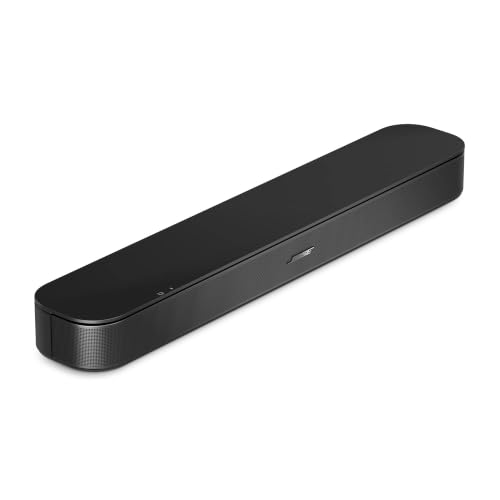
Bose TV Speaker (2nd Gen) — Second-generation compact
Sequels in audio usually add a badge and little else. The second-generation TV Speaker adds the two things its predecessor’s owners most plausibly wanted: its listing claims Dolby Atmos and deep bass, alongside the clear-dialogue focus and the same compact, HDMI-ARC and Bluetooth formula that made the first generation a fixture of small rooms. The result is a compact bar that no longer asks its buyer to choose between Bose’s simplicity and the format the rest of the category is built around. Atmos in a cabinet this size is rendered within one enclosure’s means, but its presence changes the bar’s film-night ceiling considerably.
Clear dialogue leads the listing for a reason. The TV Speaker line has always been bought by viewers who struggle to follow speech, and the second generation keeps that audience at the centre while widening the bar’s ambitions around it. Deep bass, as claimed, addresses the other half of the television-speaker complaint — the weightlessness — and in a compact room the combination of forward speech and a fuller low end covers the overwhelming majority of what viewers actually ask a bar to fix.
Set against its predecessor, the choice is refreshingly binary. The first generation costs less and does the clarity job; the second adds Atmos decoding and bass ambition for rooms that also watch films. Set against the smart bars above it in the range, the second-generation TV Speaker holds its ground on simplicity: no voice assistant is built in, no streaming suite is named in its listing, and the included remote remains the whole control story. Households that distrust app-mediated audio will find that restraint deliberate and welcome.
Bedrooms make an especially strong case for this model. Late viewing rewards dialogue clarity at low volume and bass that registers without travelling through walls, and a compact cabinet suits the dressers and narrow stands bedroom televisions sit on. Add the one-cable HDMI-ARC installation and the bar disappears into the room’s routine within an evening.
The honest boundary is scale. Atmos from a compact single cabinet is an enhancement of film sound, not a simulation of a multi-speaker theatre, and large lounges should climb to the Smart Ultra. But for the rooms the TV Speaker line was invented for, the second generation is the most complete version of the idea Bose has listed — the same small bar, now fluent in the format of the moment.
Parents of young children will recognise a further virtue: the bar forgives the viewing conditions of family life. Cartoons at dawn, a film attempted in fragments across an evening, the news caught in ten-minute pieces — a compact bar that wakes instantly with the television and keeps speech clear at whatever volume the hour allows fits that rhythm better than a system that needs warming up, modes selected and surrounds deployed. Convenience at 6 a.m. is a specification too, even if no listing prints it.
- Type: compact soundbar, second generation
- Connections: Bluetooth and HDMI-ARC per listing
- Format: Dolby Atmos per listing
- Dialogue: clear dialogue positioning per listing
- Bass: deep bass claim per listing
- Remote: included remote control for easy setup
Strengths
- Brings Dolby Atmos into the compact TV Speaker formula.
- Clear-dialogue focus keeps the line’s original audience at its centre.
- Keeps the one-cable, one-remote simplicity of the first generation.
Trade-offs
- Atmos is rendered within a single compact cabinet’s limits.
- No built-in voice assistant or named streaming services.
- Large lounges will want the Smart Ultra’s scale instead.
Best for: bedrooms and modest lounges wanting Atmos without leaving the compact class.
Not suited for: main rooms chasing flagship surround scale from their bar.

Bose Smart Dolby Atmos Soundbar — Smart mid-tier Atmos
The middle of the Bose range is occupied by a bar whose listing reads like a streaming inventory: an all-in-one Dolby Atmos soundbar with A.I. Dialogue Mode, voice control with Amazon Alexa built in, and support for Bluetooth, AirPlay, Spotify Connect and Chromecast. That combination defines its identity precisely. This is the Bose for the household whose listening life runs through phones and services — music cast from an iPhone at breakfast, a Spotify playlist handed to the bar in the evening, the television’s film sound given Atmos breadth at night — all from one cabinet under the screen.
A.I. Dialogue Mode is the feature that ties it to the brand’s core promise. Bose’s dialogue processing aims to keep speech intelligible as scenes shift from whispers to explosions, adjusting the balance so the remote’s volume button stops being the evening’s most-used control. In a mid-tier bar this matters more, not less, than at flagship level: the rooms it serves are family rooms, where viewing is social, volumes are moderate and nobody wants to ride the remote through every scene change.
Distinguish it carefully from the Smart Ultra below, because Bose’s naming invites the blend. The Smart Ultra is the flagship surround system: HDMI eARC in its listing, Alexa and Google voice control, the top of the range. This Smart Dolby Atmos Soundbar is the streaming-led all-in-one: its listing leads with services and dialogue rather than with surround flagship claims, and it names no eARC. Buyers choosing between them are choosing between a music-and-streaming centre and a film-first flagship, and the listings support reading them exactly that way.
Voice control through the built-in Alexa suits kitchens and open family spaces where hands are busy and the television is half companion, half appliance. Combined with the casting suite, the bar becomes the room’s general-purpose audio endpoint — the thing every device in the house can play through — which is a role compact bars cannot fill and one that justifies its mid-range position without any appeal to spectacle.
Its ceiling is the all-in-one format itself. One cabinet, however clever its processing, will not place sound behind the sofa, and bass remains cabinet-bound. Within those bounds, though, this is arguably the most complete everyday Bose: Atmos for films, dialogue intelligence for television, and the fullest streaming welcome in the range for everything else the household listens to.
Multi-phone households should dwell on the casting list a moment longer, because it is the practical difference between this bar and its flagship sibling. AirPlay serves the iPhone owners, Chromecast serves the Android owners, Spotify Connect lets either hand the bar a playlist and then use the phone for something else entirely. A shared house runs on such diplomacy, and a bar that speaks every phone’s native casting language avoids the small daily frictions that quietly decide which speaker a household actually uses.
- Type: all-in-one soundbar for TV
- Format: Dolby Atmos per listing
- Dialogue: A.I. Dialogue Mode per listing
- Voice: voice control with Amazon Alexa built in
- Streaming: Bluetooth, AirPlay, Spotify Connect, Chromecast per listing
- Position in range: smart mid-tier, below the Smart Ultra
Strengths
- The fullest streaming suite in the Bose range, named service by service.
- A.I. Dialogue Mode targets the volume-riding problem directly.
- Atmos and Alexa arrive in one tidy all-in-one cabinet.
Trade-offs
- Its listing names no HDMI eARC, unlike the Smart Ultra flagship.
- Single-cabinet bass and surround remain within one enclosure’s physics.
- Streaming features overlap what a smart TV already offers some households.
Best for: streaming-centred family rooms where the bar doubles as the house music endpoint.
Not suited for: film-first main rooms, which the Smart Ultra was built to serve.

Bose Smart Ultra Soundbar — Flagship Smart Ultra
At the top of the smart range stands the Smart Ultra, and its listing states its rank without ambiguity: an all-in-one surround sound system for TV with Dolby Atmos, A.I. Dialogue Mode, Alexa and Google voice control, and HDMI eARC. Each element earns its place in that sentence. eARC is the flagship connection, carrying the television’s best audio signal and keeping one remote in charge. Two voice ecosystems are named rather than one, so the bar joins Google households as readily as Alexa ones. And the surround-system language — absent from the mid-tier bar’s listing — announces that this model, not its sibling, is Bose’s film-first flagship.
The all-in-one qualifier deserves emphasis rather than apology. The Ultra pursues surround immersion from a single cabinet, using Bose’s processing to widen and lift the soundstage while dialogue stays anchored by the same A.I. Dialogue Mode the mid-tier bar carries. For main rooms that refuse extra boxes — no subwoofer cabinet, no rear speakers, no cable runs — this is the most ambitious expression of the one-bar philosophy in the range, and the natural rival to other brands’ flagship single bars.
Dialogue at flagship level is a subtler art than dialogue in a compact bar. Big scenes bury speech under score and effects at exactly the moments plots turn, and the Ultra’s dialogue processing exists for those moments: the whispered confession inside the action sequence, the exposition delivered over weather. Households that watch prestige drama and blockbuster films in the same week will feel the feature working across both, which is the flagship’s real daily dividend — not its loudest scene, but its clearest quiet one.
Against the Smart Dolby Atmos Soundbar, the division of labour is clean. The mid-tier bar’s listing is the streaming inventory — AirPlay, Spotify Connect, Chromecast — while the Ultra’s is the cinema specification: eARC, surround-system positioning, dual voice ecosystems. A household should choose by its evenings. Music-and-casting households take the mid-tier bar and lose nothing they use; film households take the Ultra and gain the range’s fullest presentation of the thing they watch most.
Price discipline applies at the top of any range, so check price on Amazon and measure the Ultra against the room it must fill. In a main lounge with the house’s largest television, its flagship premium buys the complete Bose statement in one cabinet. In a bedroom or second room, the same money overshoots the room’s needs, and the second-generation TV Speaker will satisfy at a fraction of the commitment. Flagships reward correct sizing more than any other tier.
There is a final, unfashionable point in the Ultra’s favour: it asks nothing of the room’s future. No stands to buy when surrounds are added, no subwoofer placement to renegotiate, no second phase of the project waiting on next year’s budget. Households that finish installations and then simply live with them for a decade are this bar’s natural owners, and the flagship premium looks different — smaller, honestly — when divided by ten years of evenings rather than by one purchase day.
- Type: all-in-one surround sound system for TV
- Format: Dolby Atmos per listing
- Dialogue: A.I. Dialogue Mode per listing
- Voice: Alexa and Google voice control per listing
- Connection: HDMI eARC per listing
- Position in range: smart flagship, above the Smart Dolby Atmos Soundbar
Strengths
- The range’s flagship surround presentation from a single cabinet.
- HDMI eARC plus both Alexa and Google voice control.
- A.I. Dialogue Mode keeps flagship spectacle from burying speech.
Trade-offs
- Its listing leads with cinema, not with the mid-tier bar’s streaming suite.
- Single-cabinet design still bounds bass depth and rear envelopment.
- Flagship pricing overshoots small rooms and second televisions.
Best for: main lounges wanting Bose’s fullest one-cabinet film and television sound.
Not suited for: secondary rooms, where its scale and price exceed the brief.

Bose Solo 5 — Previous-generation value
Every range has an elder, and the Solo 5 wears the role openly: a previous-generation TV soundbar system whose listing centres on its universal remote control. That remote is not a footnote. It was designed to command the television and the bar together, taming the two-remote shuffle that defined early soundbar ownership, and for households whose viewing involves older televisions, cable boxes and a drawer of competing remotes, it remains a genuinely practical piece of engineering. The Solo 5’s proposition is clarity and control at the budget end of a premium brand.
Set expectations by its generation. Its listing claims no Atmos, no HDMI-ARC, no Bluetooth streaming suite and no voice anything — the technologies that structure the rest of this guide arrived after it. What it offers is Bose’s core competence in its simplest historical form: a compact bar that makes television speech fuller and clearer than the set’s speakers, installed without ceremony and operated by one universal remote. For a spare room, a workshop television, a caravan or a relative’s ageing set, that competence is the entire requirement.
The budget framing needs care, because an old premium product and a new budget product are different purchases wearing similar prices. New budget bars from lesser brands may list more features; the Solo 5 counters with Bose’s tuning, build and that remote, plus a design that has survived years of service in real rooms. Buyers should check price on Amazon against the first-generation TV Speaker, its natural in-range rival: where the gap is small, the newer bar’s HDMI-ARC and Bluetooth argue strongly; where the Solo 5 is discounted deeply, its simplicity closes the case.
There is also a honesty dividend in buying the elder. Its limits are fully mapped — no firmware surprises, no platform dependencies, no features waiting to be discontinued. It will do tomorrow exactly what it does today, in a category where smarter products occasionally unlearn tricks when services change their terms. Some households find that permanence worth more than a feature list, and they are not wrong.
Buy it, then, as what it is: the budget door into Bose sound for rooms where clarity and one-remote control are the whole brief, and where the absence of Atmos and streaming is not a gap but a simplification. Judged as a previous-generation value pick rather than as a cut-price flagship, the Solo 5 still earns its place in the range it helped build.
Workshops, garages and garden rooms deserve a mention in the Solo 5’s defence, because those spaces chew through electronics and punish delicacy. A bar with no streaming platform to configure, no voice assistant listening and no app demanding updates can live above a workbench or beside a treadmill for years, playing the radio, the match and the occasional film with undiminished clarity. Not every room wants the future; some rooms want a speaker that simply refuses to become obsolete, and the elder Bose is unusually qualified for that duty.
- Type: TV soundbar sound system, previous generation
- Remote: universal remote control per listing
- Format claims: no Atmos claimed in listing
- Connectivity: per listing, remote-led simplicity
- Position in range: budget elder of the Bose line
- Colour: Black
Strengths
- Universal remote still solves the multi-remote problem elegantly.
- Bose clarity and build at the range’s budget end.
- No apps, accounts or platforms to age or be discontinued.
Trade-offs
- No Atmos, HDMI-ARC or streaming features by modern standards.
- Its value depends on the day’s gap to the newer TV Speaker.
- Compact single-cabinet bass, from an older generation of the formula.
Best for: spare rooms, older televisions and budget buyers who prize one-remote simplicity.
Not suited for: buyers expecting current connectivity or Atmos from their bar.

Bose Lifestyle Ultra Soundbar — Wireless Lifestyle flagship
The Lifestyle name carries history at Bose — it has long marked the company’s premium home-entertainment line — and the Lifestyle Ultra brings that badge to a wireless home soundbar whose listing promises Dolby Atmos and surround sound. The wireless designation is its distinguishing stroke within this guide: where the Smart Ultra’s identity is built on eARC and flagship processing, the Lifestyle Ultra presents itself as the cable-light flagship, a bar intended to anchor a living room’s sound without the installation ceremony that premium audio usually demands.
Positioning it honestly requires care, because its listing is terser than the Smart Ultra’s. Atmos and surround sound are claimed; dialogue modes, voice ecosystems and connection specifics are not named in the title, and this review will not lend it the Smart Ultra’s features by association. What can be said on the listing’s own terms is still substantial: a flagship-tier Bose bar, wireless in its home role, carrying the format of the moment and the surround ambition of the range’s top end, under the name Bose reserves for its lifestyle-led premium products.
The buyer it suits is therefore defined by priorities rather than by specification hunger. Households furnishing a room where cables are unwelcome — a clean media wall, a rented lounge, a space where the television floats and every wire shows — will value the wireless proposition first and ask specification questions second. Households comparing spec sheets line by line will find the Smart Ultra’s listing more forthcoming, and should let that transparency guide them if the two bars sit near each other in price; check price on Amazon, because the relationship between these two flagships is exactly the kind of thing that shifts with the season.
Design context matters for the Lifestyle badge. Bose’s Lifestyle products have always sold integration — equipment that behaves as furniture-grade furnishing rather than as studio gear — and a wireless Atmos bar under that name is aimed at rooms where the technology is expected to vanish into the décor until the film starts. In such rooms, the bar’s restraint is not a missing feature list; it is the product.
Taken together with the Smart Ultra, the Lifestyle Ultra gives Bose two flagships with different temperaments: one specified like a cinema component, one presented like a piece of the room. That duplication is only confusing if the listings are blurred; kept separate, as this guide keeps them, it is a genuine choice between two kinds of premium.
Media-wall installations sharpen its case further. A television floated on a panelled wall with a soundbar beneath it is now a standard living-room project, and every cable in that composition is a small defeat. A wireless flagship bar reduces the defeat count at the exact price tier where buyers are paying for the room to look effortless. Whether the Lifestyle Ultra’s wireless design also simplifies a particular household’s connections should be confirmed on its product page, but the intent printed in its listing is unmistakable, and it is aimed at a real and growing kind of room.
- Type: wireless home soundbar
- Format: Dolby Atmos per listing
- Sound: surround sound per listing
- Line: Bose Lifestyle premium family
- Position in range: wireless flagship alternative to the Smart Ultra
- Colour: Black
Strengths
- Wireless flagship proposition for rooms where cables are unwelcome.
- Dolby Atmos and surround sound under Bose’s premium Lifestyle name.
- Design-led integration for media walls and minimalist lounges.
Trade-offs
- Its listing names fewer specifics than the Smart Ultra’s does.
- Dialogue and voice features are not stated in its title.
- Two Bose flagships require careful comparison before choosing.
Best for: design-led living rooms wanting a wireless Bose flagship with Atmos.
Not suited for: specification-led buyers, who will prefer the Smart Ultra’s detailed listing.
Comparison
| Pick | Atmos per listing | Connection named | Dialogue feature | Voice / streaming named |
|---|---|---|---|---|
| Bose TV Speaker | Not claimed | HDMI-ARC, Bluetooth | Not stated in listing title | None named |
| Bose TV Speaker (2nd Gen) | Yes | HDMI-ARC, Bluetooth | Clear dialogue | None named |
| Bose Smart Dolby Atmos Soundbar | Yes | Not stated in listing title | A.I. Dialogue Mode | Alexa; AirPlay, Spotify Connect, Chromecast |
| Bose Smart Ultra | Yes | HDMI eARC | A.I. Dialogue Mode | Alexa and Google voice control |
| Bose Solo 5 | Not claimed | Not stated in listing title | Not stated in listing title | Universal remote instead |
| Bose Lifestyle Ultra | Yes | Wireless home design | Not stated in listing title | None named |
Which Bose Rung Matches Your Room?
Work down from the room, not up from the budget. A main lounge with the household’s largest television and a film habit belongs at the top of the ladder — the Smart Ultra for specification-led buyers, the Lifestyle Ultra where wireless, design-led integration leads the brief. A family room that listens as much as it watches belongs to the Smart Dolby Atmos Soundbar, whose streaming suite will work daily. Small rooms, bedrooms and second televisions belong to the TV Speaker pair, split by whether Atmos matters to the room’s viewing. The Solo 5 serves the rooms the rest of the range has outgrown: older sets, spare spaces, and any television whose household measures a bar by clarity and one good remote.
Television size sharpens the split. Compact bars under very large screens sound as mismatched as they look, while flagship bars under small screens waste their width. Bose’s ladder conveniently tracks screen size from the compact pair upward, so matching bar to screen is mostly a matter of honesty about the room’s dimensions rather than expertise about audio.
What Does A.I. Dialogue Mode Actually Solve?
Modern mixes are mastered for cinemas, where dialogue can sit low in a wide dynamic range because the room is quiet and the system is powerful. Living rooms are neither, so speech drowns precisely when scenes get busy. Dialogue processing counters by identifying and lifting the speech band within the mix, keeping voices at a consistent intelligibility while effects swell around them. The practical test is domestic: a drama watched at family volume, with the kitchen running and a conversation in the next room, remains followable without subtitles or volume-riding.
Bose names the feature in both smart bars’ listings, and the second-generation TV Speaker carries a clear-dialogue claim of its own, which tells you where the brand believes its buyers’ pain lives. Shoppers whose households include older viewers, hearing-sensitive listeners or open-plan rooms should treat dialogue technology as a headline feature, not a garnish — it will be used in every programme, while surround spectacle earns its keep on film nights.
How Do You Connect a Bose Bar to the Television?
Where a bar offers HDMI-ARC or eARC — the TV Speaker pair and the Smart Ultra respectively — that single cable is the right installation: it carries the television’s sound, lets the TV remote control volume, and wakes the bar with the set. eARC on the flagship carries the fullest signal for Atmos material, while ARC serves the compact pair’s needs completely. Set the television’s audio output to the ARC/eARC path and disable the set’s own speakers so the two never compete.
The elder Solo 5 belongs to an earlier connection era and should be installed by its own manual’s route, with its universal remote programmed last so it can command the whole setup. Whichever bar you choose, sit it at the front edge of the stand, clear of anything that would block its drivers, and run a familiar dialogue scene at your normal volume before declaring the job done — placement and a two-minute listening check fix more complaints than any setting buried in a menu.
Should You Buy the Newest Generation or the Proven One?
The TV Speaker pair poses the question in its cleanest form. The second generation adds Atmos and a deep-bass claim; the first generation answers with a lower commitment and an entirely proven simplicity. Film-watching small rooms should take the newer bar, because Atmos is the format the catalogue increasingly assumes. Speech-led rooms — news, drama, sport — gain little from the format and may rationally keep the change, because their programmes will sound near-identical through either cabinet.
The Solo 5 extends the same logic one generation further. Proven designs carry no surprises and no dependencies, and their discounts can be steep; their cost is paid in missing connections rather than in sound quality for basic television. The discipline is to name what the room will actually use in the next five years, then refuse to pay for rungs above it — Bose’s ladder is honest enough that each rung can be defended on exactly those terms.
How Does Bose Sound Differ From the Rest of the Category?
Stand in a showroom and the category’s default tuning announces itself: bass lifted for impact, treble sharpened for sparkle, a presentation designed to win a ninety-second comparison. Bose has historically tuned against that grain, favouring a balanced, speech-forward presentation that sounds less thrilling in the demo and less tiring across a three-hour film. The listings in this guide reflect the philosophy — dialogue modes and clarity claims where rivals print wattage and driver counts. Neither tuning is objectively correct; they serve different evenings. Households that watch long, talk over the television and keep volumes neighbourly tend to settle into the Bose presentation and stay. Households that measure a bar by its biggest explosion should test the wider category guides before committing, because Bose will not chase them there.
The all-in-one discipline is the other half of the difference. Rival ranges increasingly treat the bar as the first instalment of a system — subwoofer later, surrounds eventually — while Bose’s six listings present finished products, each complete in its box. That completeness simplifies buying and caps the spending spiral, at the cost of an upgrade ceiling: a Bose bar that no longer satisfies cannot grow, only be replaced. Buyers who enjoy staged upgrades should weigh that ceiling honestly, because it is the one structural limit no amount of tuning can soften.
What Should You Check Before a Bose Bar Arrives?
Three measurements prevent nearly every disappointment in this range. First, the stand: compact Bose bars fit almost anywhere, but the flagship Smart Ultra needs a surface or wall worthy of its width, and every bar needs its height checked against the television’s lower bezel and remote sensor. Second, the connection: confirm the television offers HDMI-ARC for the compact pair, or eARC to feed the flagship its fullest signal, and plan the cable before the bar is on the furniture. Third, the household’s phones: a streaming-led household should verify its services against the Smart Dolby Atmos Soundbar’s named list — AirPlay, Spotify Connect, Chromecast, Bluetooth — rather than assuming a service is present because the brand is premium.
One expectation check completes the preparation. These are all-in-one bars, so set the household’s bass expectations at single-cabinet level before the first film, not after it. Viewers arriving from television speakers will be delighted; viewers arriving from a separate subwoofer system should audition with their most demanding scene early, while the decision can still be revisited calmly.
Can One Bar Serve a Whole Household’s Habits?
A family room’s bar works several jobs in a single day: morning news at low volume, children’s programmes after school, a parent’s podcast while cooking, sport in the evening, a film after the house quiets. The Bose range’s virtues — instant wake with the television, speech that survives background noise, remotes and voice controls that need no teaching — are aimed squarely at that rotation. Notice how rarely the listings discuss peak performance and how often they discuss control, dialogue and connection: the brand is selling the rotation, not the demo.
The rotation also explains why the mid-tier Smart Dolby Atmos Soundbar may be the range’s sweet spot for more households than the flagship. Its streaming suite serves the podcast and playlist hours, its dialogue mode serves the news and drama hours, and its Atmos serves the film hour — every job in the day gets a named feature. The Smart Ultra serves the film hour more grandly and the other hours no better, which is why the correct Bose for a busy family room is so often the middle rung rather than the top one.
Common Mistakes
Merging the two smart bars is the Bose-specific error, and it happens in both directions: buyers credit the Smart Dolby Atmos Soundbar with the Ultra’s eARC flagship status, or assume the Ultra carries its sibling’s full streaming inventory because its price is higher. The listings draw the line clearly — streaming suite on one, eARC and dual voice control on the other — and choosing well means choosing which of those inventories your household will actually open.
Assuming the two TV Speakers are one product in two boxes wastes money in the other direction. Only the second generation claims Atmos and deep bass. A buyer who purchases the first generation expecting the format, or who pays for the second generation for a speech-only room, has misread a ladder that is printed plainly enough — the generation is part of the product’s name, not a detail.
Oversizing the bar to the room is the generic error with a Bose accent. The flagship’s width and scale are wasted under a small bedroom television, and its price could have bought the correct compact bar plus years of streaming subscriptions. Finally, judging any of these all-in-one bars against multi-box systems on bass alone mistakes the product category: Bose’s range trades physical low-end spectacle for clarity, integration and calm, and it should be bought — or rejected — on those stated terms.
Final Recommendation
Start from the room’s evenings. The main lounge takes a flagship: the Smart Ultra where specifications lead, with its eARC connection, surround-system ambition and both voice ecosystems, or the Lifestyle Ultra where a wireless, design-led flagship suits the room better. The listening household takes the Smart Dolby Atmos Soundbar, the range’s streaming centre with dialogue intelligence. The small room takes a TV Speaker — the second generation if films and Atmos are part of its life, the first if clarity and Bluetooth are the whole brief. The budget room and the older television take the Solo 5 and its universal remote without a whisper of apology.
Bose’s range rewards buyers who know what their rooms actually do after dark. It offers no subwoofers to place, no surrounds to charge and no specification theatre — just a ladder of one-cabinet answers, each rung honest about what it adds. Climb exactly as high as your evenings reach, and the bar you bring home will do the most Bose-like thing imaginable: disappear under the television and make every word easy to hear, for years, without ever asking to be thought about again.
One last practical counsel: because the rungs are so clearly separated by named features, the day’s pricing between adjacent models matters more here than in most ranges. When a promotion pulls the second-generation TV Speaker close to the first, or the Smart Ultra close to its streaming sibling, the higher rung’s named extras become nearly free, and the ladder should be climbed without hesitation. Check the gaps on the day you buy, then commit — a Bose bar correctly rung is a decade-long decision, and it deserves the five minutes that getting the rung right requires.
Frequently Asked Questions
What is the difference between the Smart Ultra and the Smart Dolby Atmos Soundbar?
They are distinct models. The Smart Ultra is the flagship all-in-one surround system: HDMI eARC, A.I. Dialogue Mode, and Alexa plus Google voice control in its listing. The Smart Dolby Atmos Soundbar is the streaming-led mid-tier bar: A.I. Dialogue Mode, Alexa built in, and Bluetooth, AirPlay, Spotify Connect and Chromecast in its listing. Their features are not interchangeable.
Is the second-generation TV Speaker worth it over the first?
For film-watching rooms, yes: its listing adds Dolby Atmos and deep bass to the compact formula, with clear dialogue retained. For speech-led rooms — news, drama, sport — the first generation’s HDMI-ARC clarity covers the brief and usually costs less.
Do any of these Bose bars include a subwoofer?
None of the six listings includes a separate subwoofer; the whole range is all-in-one by design. Bass comes from each cabinet itself, with the second-generation TV Speaker claiming deep bass in its title. Buyers who need subwoofer pressure should compare multi-box systems in the wider soundbar guides.
Which Bose bar is best for older viewers?
Dialogue-led models: the second-generation TV Speaker for its clear-dialogue focus and simplicity, or either smart bar for A.I. Dialogue Mode. The Solo 5 also serves well where an older television and a single universal remote simplify life.
Can I stream music to these bars?
The TV Speaker pair offers Bluetooth. The Smart Dolby Atmos Soundbar goes furthest, naming Bluetooth, AirPlay, Spotify Connect and Chromecast. The Smart Ultra and Lifestyle Ultra listings emphasise television sound and voice rather than a streaming inventory, so check their product pages if a specific service matters to you.
Is the Solo 5 too old to buy?
Not for its brief. It lacks Atmos, HDMI-ARC and streaming, but as a budget clarity bar with a universal remote for older setups it remains coherent — provided its price sits clearly below the first-generation TV Speaker’s. Compare the two on the day before deciding.
Which Bose bar should a Samsung or LG television owner choose?
Any of them — Bose bars are brand-neutral, connecting by HDMI-ARC or eARC where offered and asking nothing at all of the television’s own smart platform or its maker’s ecosystem allegiances. Choose by room and rung: a flagship for the main lounge, a TV Speaker for the smaller set, and let the television’s available ARC or eARC connection confirm the installation route.
Do Bose bars work for music in a kitchen or dining room?
The Bluetooth-equipped TV Speaker pair and the streaming-rich Smart Dolby Atmos Soundbar are the natural music picks, the latter adding AirPlay, Spotify Connect and Chromecast for phone-led households. In rooms where the television is the only screen, a bar that doubles as the room’s speaker earns its place twice over, and its dialogue clarity turns out to flatter radio voices and podcasts just as it flatters television drama.
Related Guides
JBL takes almost the opposite design path, and the best JBL soundbars guide follows its Bar range from a compact 2.0 model up to detachable-surround systems. Sony’s ladder is organised around its BRAVIA Theater Bars, covered in the best Sony soundbars roundup. And if the connection itself is your puzzle, the best HDMI ARC soundbars guide explains one-cable television sound across brands.



[…] loyalties run deep in this category, so the best Bose soundbars guide walks that single maker’s range from its compact TV speaker to the Smart Ultra. […]